







What’s in here6 sections
You picture the sheet becoming another sheet. That is the quiet promise the word recycled makes, and it is not one of the three things that actually happen to a set of sheets after you drop them off. A cotton percale and a wrinkle-free poly-cotton go into the same bin on the same morning, and they come out in different places, because what a sheet is made of decided years ago how far up the chain it can travel. This is where they go, who takes them, and what decides which of the three doors yours walks through.
Quick Answer
Yes, old sheets genuinely recycle, but not through your curbside bin. Textiles need a separate drop-off stream, and the bar for admission is dry and free of odor, not clean and intact. “Recycled” then means one of three different endpoints, and which one your sheet reaches was decided by its fiber.
No, It Doesn’t Go in the Curbside Bin
The instinct almost everybody has is to fold the old sheets neatly and set them in the blue bin next to the flattened cardboard, and that instinct is the one thing that guarantees they will not be recycled. The reason has nothing to do with the sheet. Curbside single-stream collection is built for bottles, cans, paper and rigid plastic, and fabric behaves in that machinery the way a long scarf behaves in a bike chain: it wraps around the rotating discs of the sorting screens and stops them. That is why municipal pages are emphatic about it rather than politely discouraging, and why textiles need their own collection stream rather than a slot in the existing one.
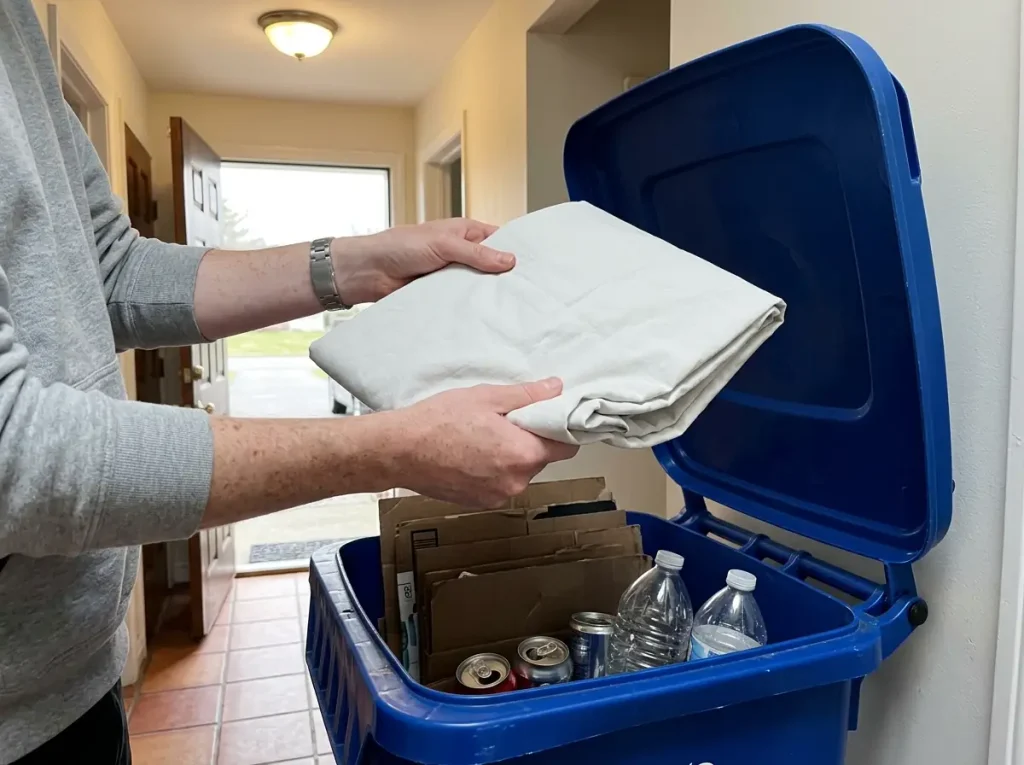
Textile recycling bins, municipal drop-off locations and retail take-back programs all exist as a parallel system, for exactly this reason.
The second thing worth settling before any of it makes sense is the admission bar, because most people set it far too high and talk themselves out of the trip. The bar is dry, and free of odor and of oil, grease or solvent stains. That is the whole list.
Dry and odor-free is the entire test. Worn sheets qualify, torn sheets qualify, and stained sheets qualify. Thinned to the point of transparency does not disqualify anything either. A fitted sheet whose elastic gave up two years ago and now sits in the closet like a deflated balloon still qualifies.
What does disqualify a sheet is contamination rather than condition. Damaged textiles are accepted. Wet or moldy fabric is rejected, and so is anything stained with grease, oil or something biological. Large rugs and carpeting are out too, in every program worth naming.
So the mental test is not is this still nice enough. It is is this dry and does it smell like nothing.
Do not wash the sheets one last time before you drop them off. It feels like the respectful thing to do, and it is the most common way a well-meaning drop-off goes wrong: a sheet that is still faintly damp, sealed in a bag, grows mildew before it reaches the sorting floor, and mildew is the one condition that gets it rejected. Dry and unwashed beats washed and damp every time.
And one fork before you drive anywhere. If the set is still in shape that somebody could sleep on it tonight, recycling is the wrong question entirely, because it is still good enough for somebody to sleep on, and that is a different route with different rules about who accepts what.
The Three Places That Will Actually Take a Sheet
Once curbside is off the table, the problem stops being philosophical and turns into a driving question with three answers. Only one of them is the steel box on the corner that most people picture, and none of them are hard to find once you know what category you are searching for.
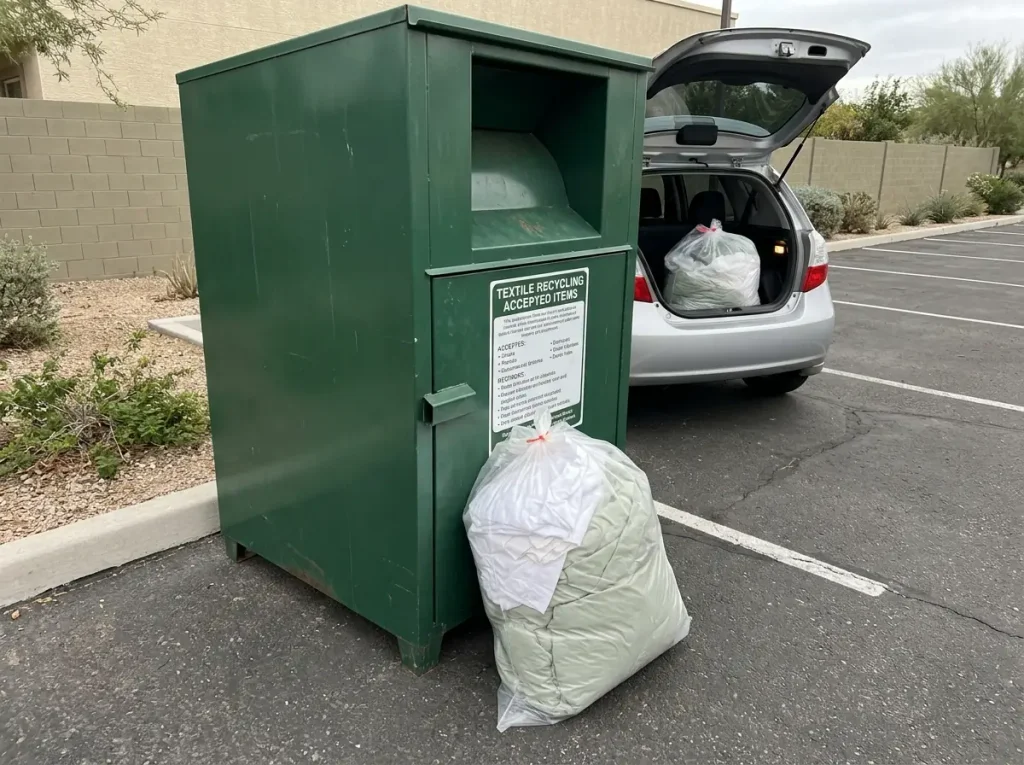
The first is a national bin network. The American Textile Recycling Service, or ATRS, is the useful worked example because it says out loud what most programs leave vague: it takes sheets, towels, pillows, pillowcases, comforters, blankets and curtains, in any condition, as long as they are dry and not mildewed. Household textiles, not just clothing.
Its bins are placed regionally rather than everywhere (Arizona, Arkansas, Colorado, Central Florida, Louisiana, Michigan, Oklahoma, Central Tennessee and Texas), so the network is real but the coverage is not universal. A near me search for a textile recycling bin beats assuming, and it is what finds a drop-off location fastest.
The second is municipal textile drop-off: a county waste authority’s collection point, or a seasonal collection event that runs one Saturday in spring. It is worth saying that this is not the same thing as a charity donation bin, which wants wearable clothing and sends the rest away. These are slower to find, usually buried two clicks into a government site, and they are the most likely of the three to accept genuinely unusable fabric without flinching. The third is retail take-back, the collection box inside a store that you have walked past a hundred times, usually run as a brand’s own program.
All of this sits on a commercial industry rather than on goodwill, which is the part that answers the “is any of this even real” doubt. The trade group that represents the textile recycling industry — the Secondary Materials and Recycled Textiles association, SMART — has existed since 1932.
Its member companies turn worn textiles into industrial rags and into fiber for cars and home furnishings, and bale the wearable material for secondhand resale in overseas markets. That is a supply chain with margins and customers, not a feel-good gesture, which is precisely why the bins keep getting emptied.
The bin that takes household textiles and the bin that takes only wearable clothing look identical from the street: same steel box, same slot, same faded logo. The difference is the sticker on the front listing what goes in. Read it before you load the car, or you will be driving home with a comforter that this particular box does not want.
One more thing none of them take: mattresses, furniture, appliances or electronics. A mattress is its own disposal problem with its own rules, and no textile bin is the answer to it.
Where the Sheet Actually Ends Up
This is the part every roundup skips, and it is the part you came for. The bin is not the end of the journey. It is the sorting step. What arrives at a grading facility gets opened, judged by hand, and routed, and the routing goes to three genuinely different places.
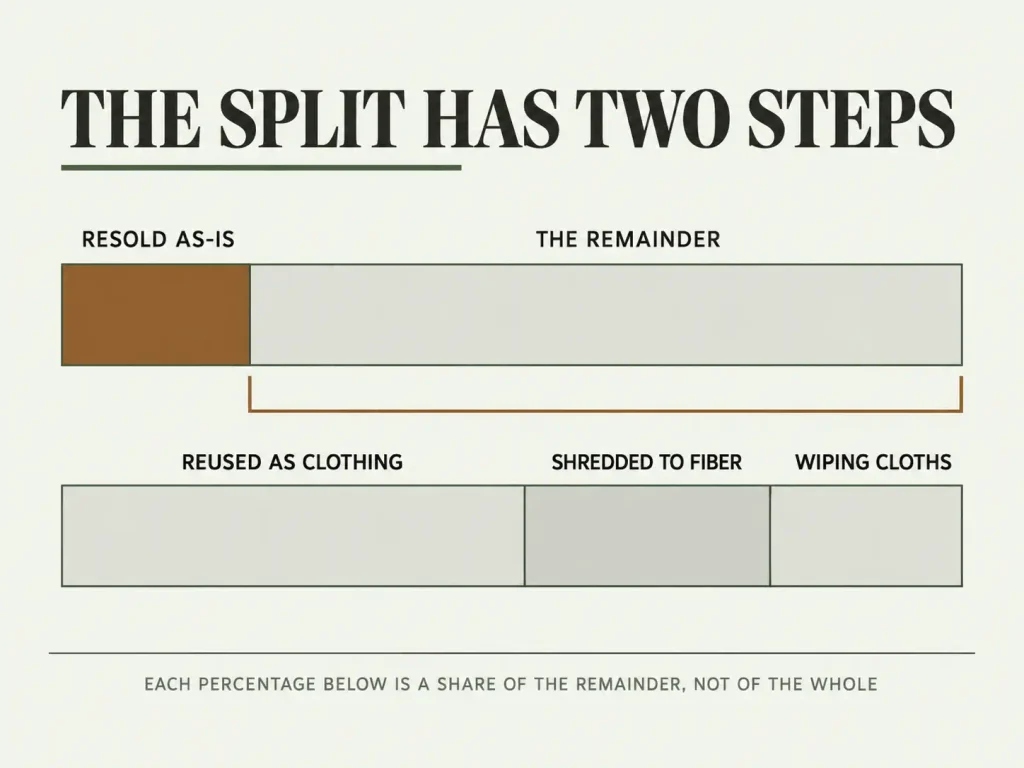
Here is the split, and the precision matters because it gets garbled everywhere. About 20% is resold as-is in thrift stores. That is the first cut, taken before anything else happens.
Then, of the remaining 80%: 45% is reused as clothing or household textile, baled and sold into overseas secondhand markets; 20% is shredded into fiber for home insulation, carpet padding and automotive material; 30% is cut into industrial wiping cloths. Those are the state breakdown of where a donated sheet actually ends up, and the two-step structure is the part people flatten by accident. It is not 45% of everything. It is 45% of what did not sell on a shelf first.
Read that list again and notice what is missing from it. Almost none of it becomes new sheets. The mental image the word recycled plants, cotton going back around into cotton, is the rarest outcome on the whole board, and saying so plainly is more useful than softening it. The likeliest thing that happens to your set is that somebody in another country buys it whole, or that it ends up as a rag on a workshop floor wiping down a lathe.
That skepticism is not paranoia, incidentally. It shows up almost word for word in the r/ZeroWaste threads on old bedding, where somebody with a stack of fitted sheets orphaned by a move to a bigger mattress writes that they doubt anyone would want them and are wary of an organization that “claims to recycle the fabric.”
The honest answer to that doubt is the breakdown above, not reassurance. Something does happen to the sheet. It is just rarely the thing you imagined.
Now the part that decides which of those doors your sheet is even eligible for, which is the fiber. A single-fiber sheet, 100% cotton or linen, that is uncoated and uniform can realistically reach any of those destinations, mechanical re-spinning included. The fibers in it are all the same thing, they all behave the same way under tension, and a machine can pull them apart and spin them back into a usable yarn.
A poly-cotton blend cannot do that, and the reason is mechanical rather than bureaucratic. Mechanical fiber recycling needs fibers of similar strength in the same batch. Polyester is stronger than cotton, so in a mixed feedstock the two do not stretch together and the thread snaps during spinning. That is the whole barrier.
Chemical processes that separate mixed fiber exist, but at lab and pilot scale, not at the bin on the corner. So a blend is still perfectly welcome at a drop-off point, because dry is dry and a textile is a textile, but its practical ceiling is the wiping cloth or the shredded insulation fiber. It will not come back as yarn.
The wrinkle-free finish is a subtler version of the same story. A resin finish is a coating sitting on the surface of the fiber, not a change to the fiber underneath. The cotton in an “easy-care” percale is still cotton.
But a heavily finished sheet reads differently to a grader sorting bales by hand, and it sorts accordingly. It is the same fiber-and-finish distinction that decides which pile a set belongs in before any of this, showing up one step further down the chain and doing the same work.
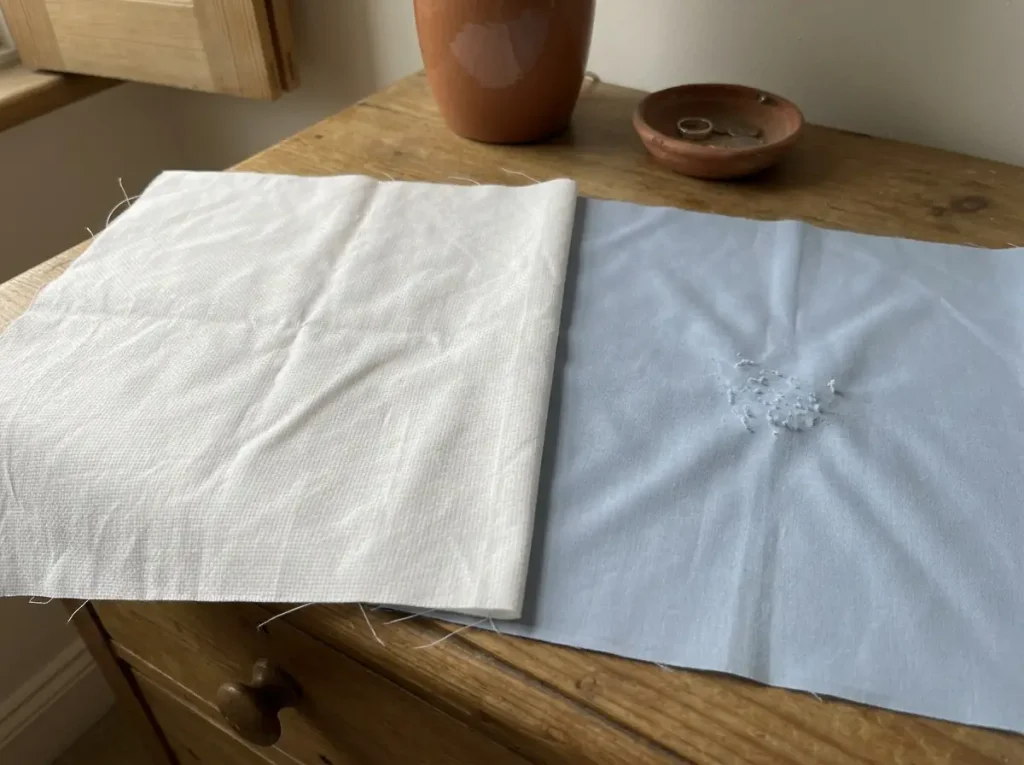
The two sheets that make this concrete are probably in the same closet right now: a plain white cotton percale, and an easy-care poly-cotton that feels almost the same when folded. They go into the same bag on the same morning, into the same bin, and their ceilings were set years earlier at the mill. One can come back as fiber. The other’s best case is a rag.
Bag It Dry, and Know What You Are Buying
The staging is almost insultingly simple, which is worth saying out loud because most people assume there is a preparation ritual they are about to get wrong. There is not.
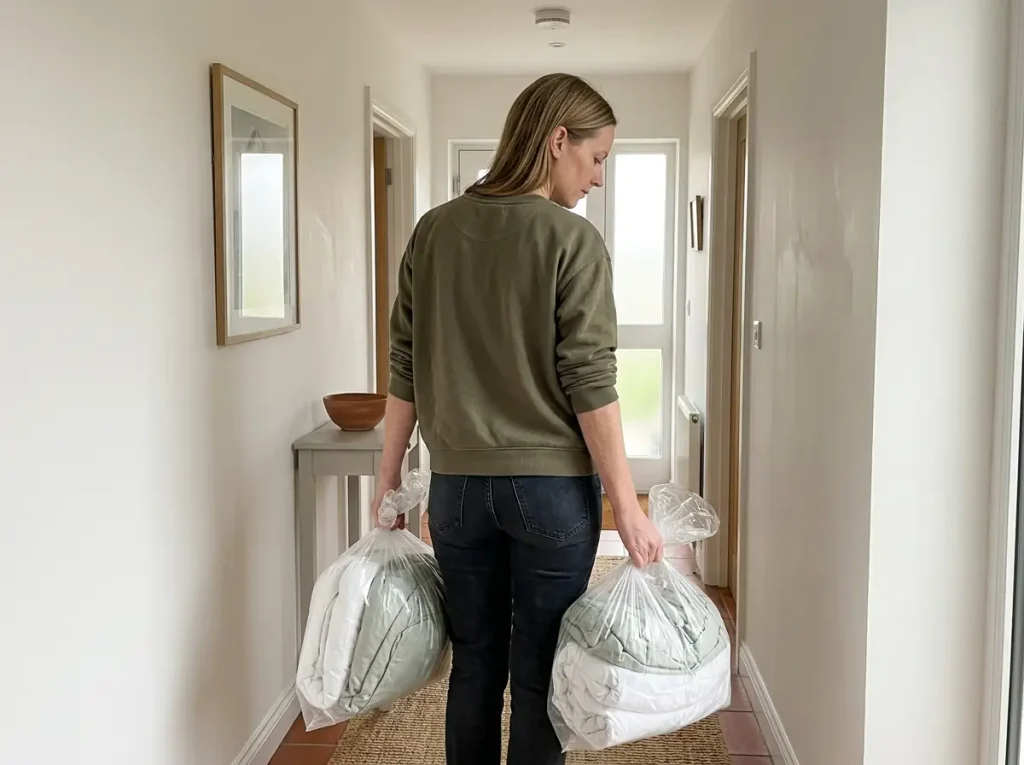
Put the sheets in a bag. Any bag, including one already in the house, including the one the last delivery came in. That is the entire instruction the source guidance gives, and nothing sold in a store improves on it.
What you do not have to do is a longer list than what you do: you do not cut the sheet into squares, strip the labels, separate cotton from blend, repair the tear, remove the elastic, or wash it first. Facilities grade what arrives. That is their job, they are better at it than you are, and pre-sorting by fiber at home changes nothing about where the sheet lands. Most of the “prepare your textiles” advice floating around the search results is written for clothing donation — pair the socks, check the pockets — and it does not transfer to bedding.
The one failure that actually matters happens in the last ten feet. Rain between the car and the bin, or a bag set down in a puddle, turns an accepted sheet into a rejected one. Damp fabric grows mildew inside a sealed bag, and one wet bundle can spoil the baled textiles it is pressed in with. Bale contamination is expensive enough that facilities would rather reject a bag than risk it.
So when you bag textiles for drop-off, keep them dry from the closet to the slot.
The sheets that never make it to a bin are the ones put aside to deal with later, at the bottom of a closet, where they stay for two years and come out smelling of the closet. Unlike the tear and the pilling, that smell genuinely does disqualify them. A bag by the front door beats a tidy pile on a shelf.
And before the bin, the instinct most people already have is the right one: cut the good parts into rags. The community reaches for that first in every thread about old bedding, long before anyone mentions recycling, and they are correct to. A worn percale makes better cleaning cloth than anything sold as cleaning cloth, and it keeps the fabric in your own house doing work. The bin is for what is left over after that.
Now the honest part. Recycling moves the landfill date; it does not cancel it. Insulation and carpet padding are durable destinations measured in years, which is genuinely good. A wiping cloth’s working life is measured in uses.
And the scale is worth knowing before anyone feels too pleased. In the EPA’s textile waste data, the EPA’s own textile recycling numbers put the recycling rate for sheets and pillowcases at about 15%, against 11.3 million tons of textiles landfilled and another 3.2 million tons burned in the same year. Roughly one sheet in six or seven that leaves a house gets recycled at all.
Dropping yours off puts it in the good sixth, and that is a real thing to do. It is also cleanup rather than a fix. The decision that mattered was made when the set was bought.
The Short Version
Curbside will not take a sheet, and putting one in there does active harm to the sorting equipment. A separate textile stream will take it, and the bar is far lower than people assume: dry and free of odor, not clean and intact. Torn, thinned and faded all still qualify; wet and mildewed do not.
The bin is a sorting step rather than an ending. About a fifth of what goes in is resold as-is; most of the rest becomes secondhand goods sold abroad, shredded fiber for insulation and padding, or industrial wiping cloths. Almost none of it becomes new sheets, and knowing that up front is better than being quietly disappointed later.
What a sheet is made of set its ceiling long before it reached the bin. Single-fiber cotton or linen can come back as fiber. A blend’s realistic best case is a rag, because polyester and cotton snap apart on the spinning frame rather than holding together.
Which makes the next set the place where this actually gets decided. A single-fiber cotton or linen sheet that survives a hundred washes and then recycles cleanly costs less, in every sense that matters here, than two blends that pill by wash twenty and can only ever become rags. Check the composition label on the next one you buy — that is the recycling decision, made three years early.
So: tonight, bag the textiles for drop-off and leave them by the door, dry and unwashed. This week, look up one drop-off point near you. That is the whole task, and it is the entire practical answer to how you recycle old sheets.
Frequently Asked Questions
01Can you put old sheets in the recycling bin?
No. Curbside recycling is built for containers, paper and rigid plastic, and loose fabric wraps around the sorting equipment at the facility. Sheets need a separate textile drop-off stream instead: a collection bin, a municipal drop-off point or a retail take-back box.
02Do sheets have to be clean to be recycled?
They have to be dry and free of odor, which is not the same as clean or intact. Torn, thinned, faded and stained with ordinary life all still qualify. Wet, mildewed or stained with oil, grease or solvent does not.
03What happens to sheets after you drop them off at a textile bin?
About a fifth is resold as-is in thrift stores, and most of the rest becomes secondhand goods sold overseas, shredded fiber for insulation and carpet padding, or industrial wiping cloths. Very little of it comes back as new fabric.
04Can polyester or poly-cotton sheets be recycled?
Yes, they are accepted at drop-off points, but a blend cannot be mechanically re-spun into new yarn, because polyester and cotton have different strengths and the thread snaps during spinning. Its realistic destinations are wiping cloths or shredded fiber rather than resale.
05Should you cut up old sheets before recycling them?
No. The sorting facility does the grading, so a whole sheet in a dry bag is what they want. Cutting rags for use at home is worth doing first with the parts still good enough, and the bin takes whatever is left.





Tried it on your own bed?
No comments yet. Tell us what you changed, and what the sheet did after a few washes.