







What’s in here9 sections
- What a Pill Actually Is
- Fiber Length Decides Whether It Can Pill At All
- Weave Decides How Fast
- The Bamboo Answer Nobody Gives Straight
- Read the Wash Count, Not the Calendar
- What Actually Helps, in Order (and What Doesn’t)
- When Pilling Means Replace, and When It Doesn’t
- Conclusion
- Frequently Asked Questions
You strip the bed on a Sunday, run a bare heel across the foot of the fitted sheet, and it comes back rough. Three washes in. Little bobbles have grown across the bottom third of the sheet, and the first instinct is to blame the detergent, the machine, or whatever the last person in the house poured into the drawer. It is none of those.
Fiber length decides whether a sheet can pill at all, the weave decides how fast it happens, and a finish applied at the mill decides whether the first few washes tell you the truth about either one. This article covers what a pill physically is, the two variables that rank above everything else, the bamboo answer the internet keeps arguing with itself about, how to read the wash count as a diagnostic, what actually helps, and the one rule for when pilling means the set is finished.
Quick Answer
Sheets pill when short or weakened fibers break under friction and tangle into balls on the surface. It is a fiber and weave problem, not a wash-routine one. Once it starts it does not reverse, so the real choice is management or replacement, and prevention happens at the purchase.
What a Pill Actually Is
Before any of this is fixable, it is worth knowing that a pill is not dirt arriving on the sheet. It is the sheet’s own fiber coming loose and staying put. Every yarn in a woven sheet is a bundle of individual fibers twisted together, and not all of them are gripped equally.
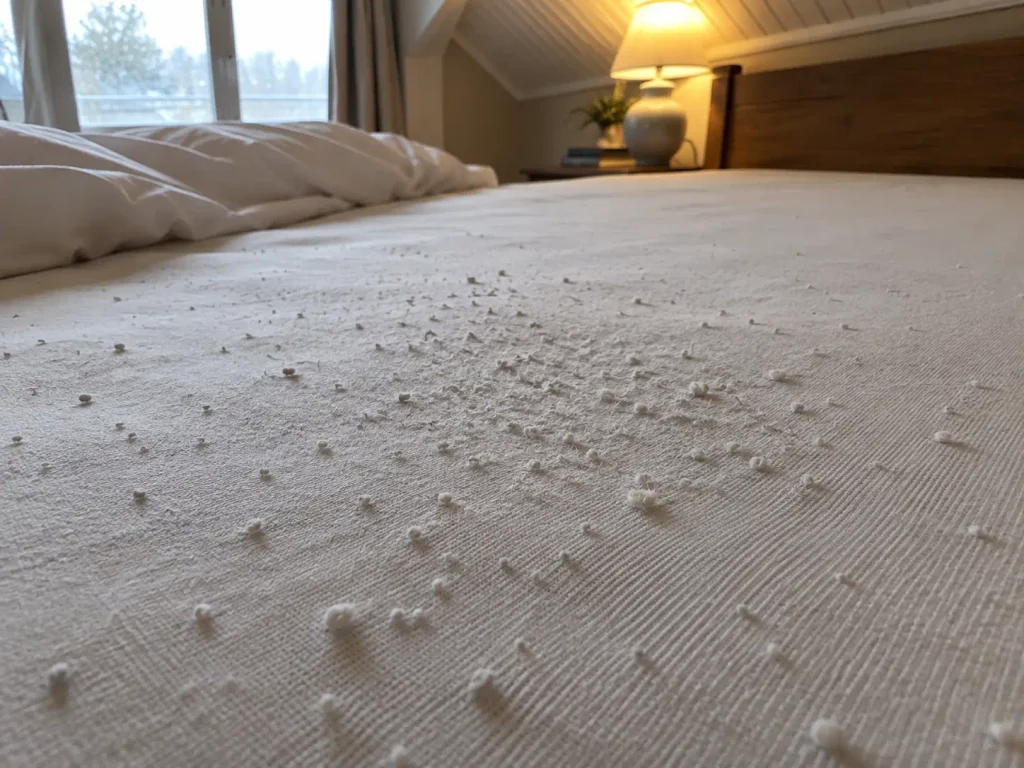
Under friction, the loosest ends work their way up out of the twist and stand proud of the surface. Several of them tangle around each other, and fiber breakage along the way leaves more short ends behind to join them. The ball they form stays anchored to the fabric because the other end of those same fibers is still held inside the weave. Call them pills, bobbles, fuzz balls or lint balls; they are the same thing, and the name changes with who is complaining.
That last part is the whole reason pilling frustrates people. Nothing has been added to the fabric. The pill is made of the sheet, which is why pulling one off with your fingers takes a little bit of sheet with it, and why a fresh crop appears in the same patch a couple of weeks later. This is also a measured phenomenon rather than an opinion: mills grade it against the same AATCC and ASTM tests textile labs use to grade pilling, with specimens tumbled in a chamber and the result scored on a photographic scale from 1 to 5.
The friction sources are not exotic. Tossing and turning in the night drags fabric across fabric. Heels and elbows press and rotate against one spot for hours. Stubble and coarse leg hair act like a very fine comb.
The dryer drum does in forty minutes what a week of sleeping does. And sweat matters here, though not the way people assume: moisture weakens cellulose fibers while they are being rubbed, so the damp spots and the friction spots are the same spots.
Which brings up the detail nobody mentions until they see it. On a shared bed, pilling is never symmetrical. There is an r/Bedding thread where the bobbles showed up only on the fiancé’s side, after roughly a month of use, and that is the normal pattern rather than the odd one.
One sleeper is heavier, or moves more, or has coarser skin on their heels. The bed is one bed; the friction is not evenly shared. Most people only find out when they strip the mattress and see one half stippled and the other half looking almost new.
Before you decide anything about a pilled set, lay the fitted sheet flat and look at where the bobbles are. A band across the middle means the torso turning. A patch at the foot means heels. An even haze across the whole sheet means the dryer, not the bed. The location tells you which habit to change.
Fiber Length Decides Whether It Can Pill At All
If one number explained pilling it would not be the one printed on the package. It would be the length of the fiber that was spun into the yarn in the first place. Cotton does not arrive as thread; it arrives as a mass of individual hairs of varying length, and how long those hairs are is the single largest input into how the finished sheet behaves. The trade calls it staple length, and unlike almost everything else in bedding marketing, staple length is measured to the inch under ASTM D5103: short-staple runs up to 1 inch, medium-staple sits between 1 1/32 and 1 3/32 inches, and long-staple is anything over 1 1/8 inches.
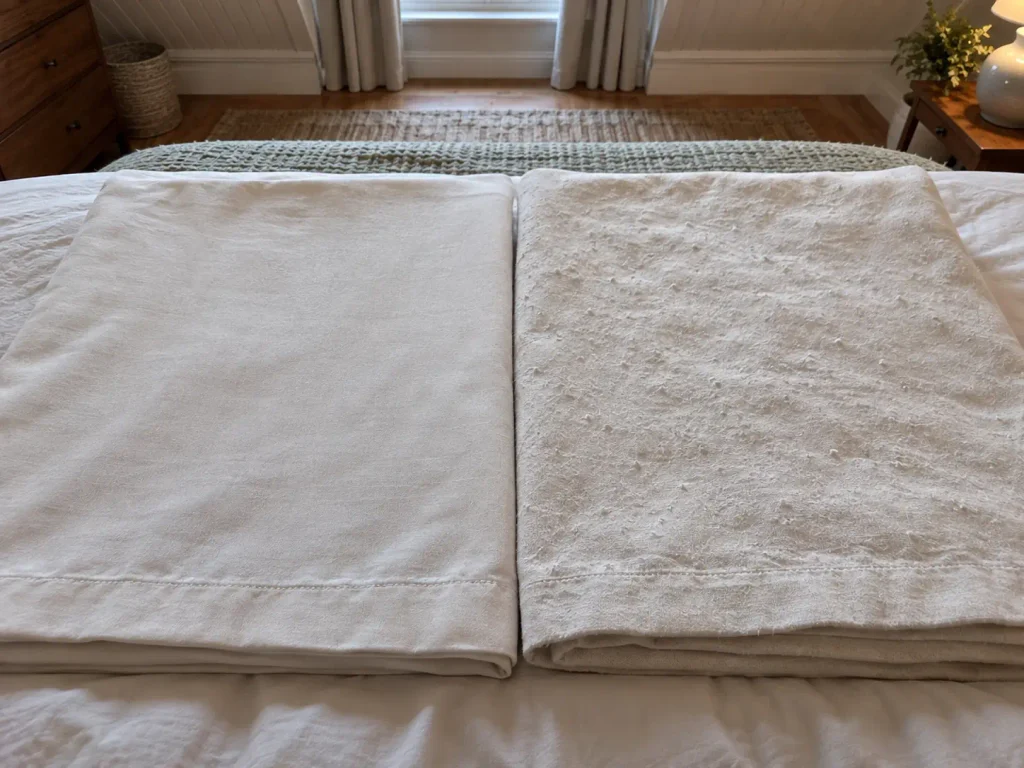
The mechanism follows directly from those bands. A yarn spun from short fibers needs many more of them to reach a given length, and every fiber has two ends. More fibers per inch of yarn means more loose ends available to migrate out and tangle.
A long-staple yarn simply has less raw material sticking out to begin with. It is not that long-staple cotton resists pilling through some quality of character; it is that there is less of it to pill. Above long-staple sits extra-long-staple cotton, which is where Pima, Supima and the rare Sea Island cotton live, and combed cotton is a separate step that pulls the shortest fibers out before spinning regardless of the grade. Both do the same job from different directions: fewer ends in the yarn.
Which leads to the honest headline of this section: short-staple cotton can pill no matter how carefully it is washed. Cold water helps at the margin. A gentle cycle helps at the margin. Neither of them lengthens a fiber that was 7/8 of an inch when it went through the spinning frame.
Wash routine moves the date; it does not change the outcome. And a cotton-polyester blend does not solve it either, for a reason worth holding onto until the last section: it changes what the pills are made of rather than whether they appear.
This is exactly where the labels stop being useful. “Egyptian” describes where a plant grew, not how long its fiber is, and plenty of Egyptian-labeled cotton is ordinary upland stock by the time it reaches a sheet. GOTS certified tells you how the cotton was grown and processed, which is worth knowing for other reasons, but it is an organic standard and not a staple measurement either.
If you want the full autopsy on what an Egyptian cotton label is actually worth, it is one click sideways. The short version: a long-staple upland cotton grown anywhere will outlast a short-staple Egyptian one, and the package will tell you nothing about which you bought.
There is a tell, though, and it shows up before the first pill does. A long-staple sheet gets smoother over its first several washes as the surface settles and the shortest stray ends shed off for good. A short-staple sheet gets fuzzier over exactly the same washes and the same routine.
Same machine, same detergent, opposite direction. If a set is heading the wrong way by wash five, the fiber already told you what it is. This is also why the community keeps flagging sets that should have been safe on paper, like the r/Bedding thread warning people off a particular 300-count percale from a name-brand retailer. A tight weave on a poor fiber still pills, which is precisely what the ordering predicts.
Weave Decides How Fast
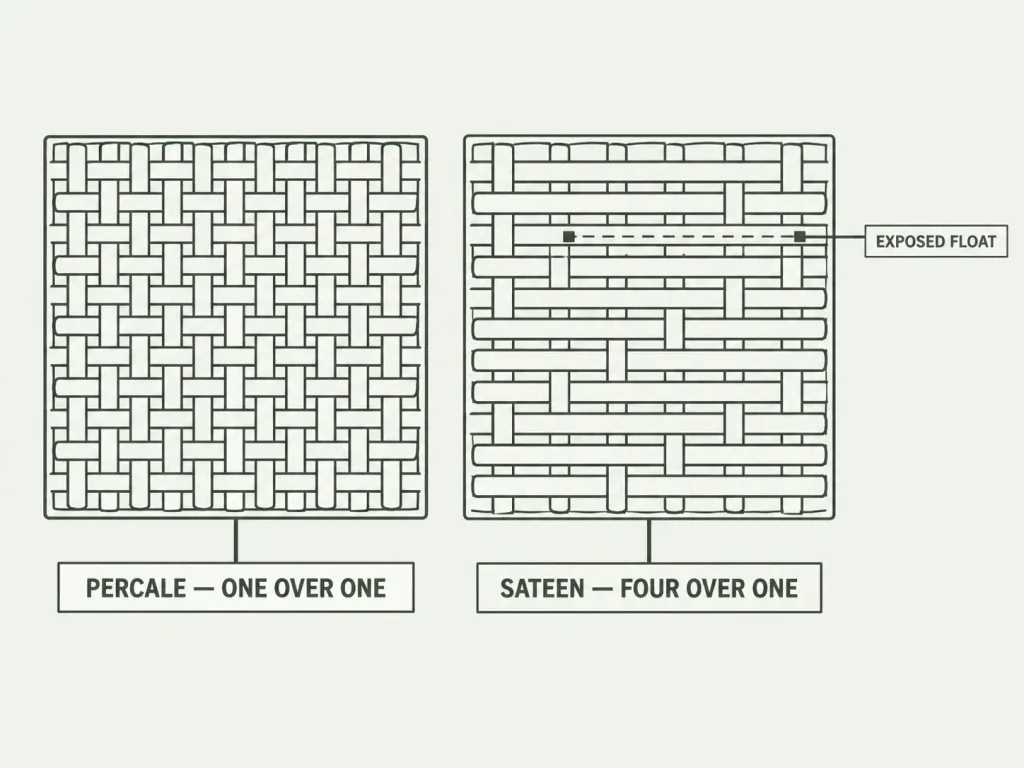
Fiber length sets whether pills are coming. The weave sets how long you get before they arrive. A plain weave, which is what percale is, alternates one thread over and one under across the entire fabric, so every thread is pinned on both faces at very short intervals. A fiber end trying to work its way out has almost nowhere to go, because the next crossing point is a fraction of a millimeter away.
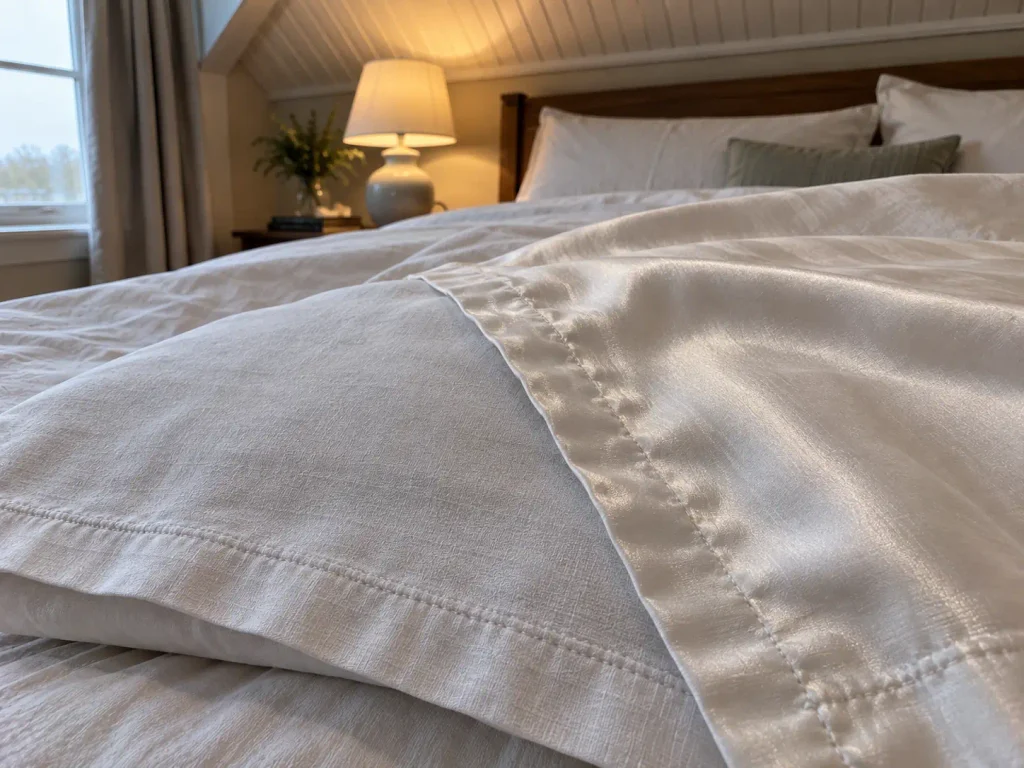
A sateen does the opposite on purpose. It floats several warp threads over one weft thread to put more unbroken thread on the surface, which is what makes it smooth and gives it that slight sheen. That exposed float is also the longest unanchored stretch of yarn in the fabric, and abrasion catches long floats first.
The trade-off is built into the structure: you are buying surface smoothness with anchoring. If you want the durability comparison in full, the Materials side already settled that percale outlasts sateen, and the weave is the reason.
Weave tightness works the same way, as a speed dial rather than an on/off switch. A dense, tightly beaten fabric holds its fiber ends better than a slack one, and that buys real time. It does not buy immunity. Put a tight construction on short-staple cotton and you get a sheet that pills at wash twenty instead of wash eight, which is a genuine improvement and not a solution.
Thread count is not the variable here, and it gets one line: a high thread count is often the same threads counted twice, so a 600 that is really a doubled 300 tells you nothing about either fiber length or float length. Linen is measured by GSM instead, which is weight per square meter rather than threads per inch, and the heavier linens hold their surface for years — the Materials side has the detail on how long linen sheets last, by GSM.
Flannel and jersey sit in their own category, because their surfaces are deliberately raised or looped. Flannel is napped on purpose to trap air, and a napped surface is a field of loose fiber ends by design. The community shorthand for this is that flannel will “pill no matter what,” and for once the shorthand is basically right. The fuzz is the product.
One thing a sateen does that a percale does not: it tells on itself early. The first pills on a sateen show up in a band across the middle of the fitted sheet, where the torso turns, and because the weave is shiny they catch the light from an angle long before your hand can feel them. Stand at the foot of a stripped bed and look along the surface rather than down at it.
The Bamboo Answer Nobody Gives Straight
This is the one place where the whole internet argues with itself, and the argument dissolves the moment you separate the plant from the yarn. The claim, printed on more or less every bamboo sheet set sold: bamboo is a long natural fiber, and long fibers resist pilling.
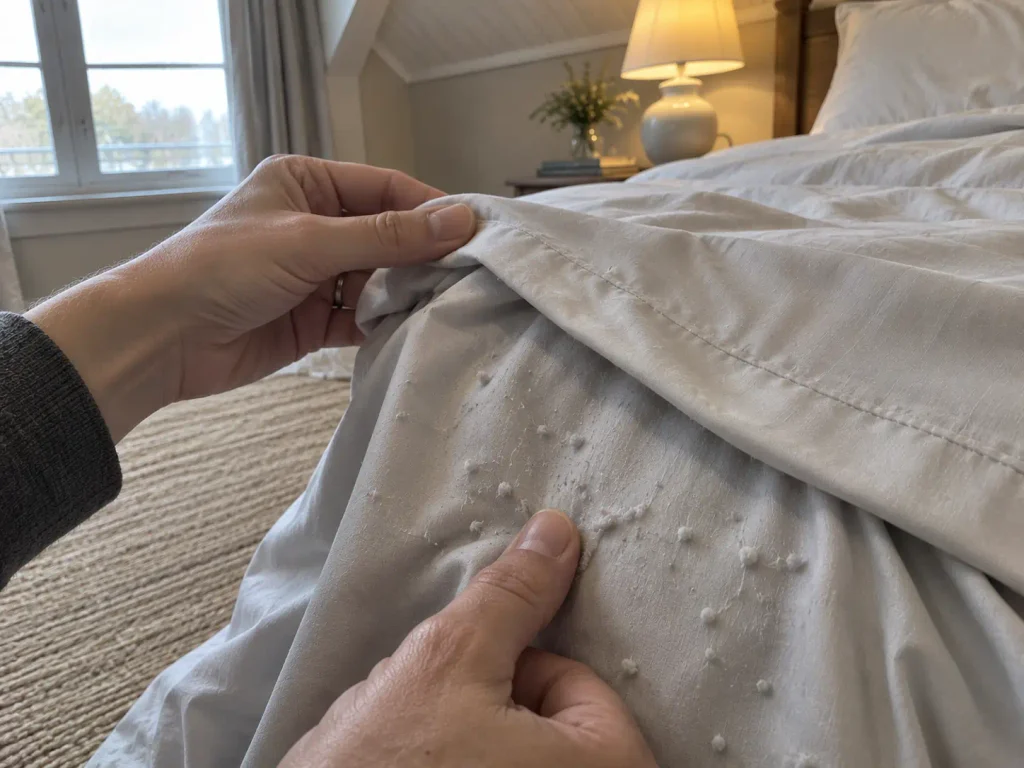
The counter-claim, posted with equal confidence by people who own the sheets: bamboo pills, sometimes faster than the cotton it replaced. Both of these are being stated honestly. They are also both about different objects.
Here is the resolution. Almost nothing sold as “bamboo bedding” contains bamboo fiber in the way linen contains flax fiber. It is bamboo viscose, sometimes labeled rayon: the plant is pulped, dissolved in an alkaline and carbon-disulfide bath until it is a syrup, and then extruded back out through spinnerets and regenerated into a fiber.
The length of the fiber in the standing plant does not survive being liquefied. Whatever the finished yarn is, it is not the original bamboo hair.
That matters mechanically, not just semantically. Regenerated cellulose does not rebuild the crystalline structure that a natural long-staple fiber has, and that structure is a large part of what makes a natural fiber resist abrasion and wet damage. A regenerated fiber is measurably more vulnerable to friction and to washing than a true long natural fiber of the same length. So the label’s long-fiber story is describing the field, and the pilling behavior was decided in the chemical bath afterward.
Which means, practically, that the pilling was settled at the mill and not on the shelf. No wash routine reverses a decision made before the yarn existed. The usual advice is to buy bamboo for softness and treat any pilling as a care failure.
After reading enough of the community warnings about specific bamboo-labeled brands, the more useful position is the reverse: assume the fiber is regenerated cellulose, then judge the set on construction and weave the way you would judge anything else. The lifespan work on how long bamboo sheets actually last, judged by weave does that by-weave sorting properly.
One tell worth knowing, because it is the rare case where the pill itself identifies the fiber. Bamboo viscose pills softly. The bobbles are pale, slightly furry, and squash flat under a thumb. A polyester pill is hard, gritty, and springs back.
If you roll one between finger and thumb and it gives, you are holding regenerated cellulose regardless of what the tag says.
Read the Wash Count, Not the Calendar
The useful question is not whether your sheets pill but when they started, because the answer points at three completely different culprits. Months are the wrong unit. A guest room set washed six times a year and a primary bed washed weekly are not the same age at twelve months, and every competitor timeline that says “a few months” is averaging across those two beds as though they were one.
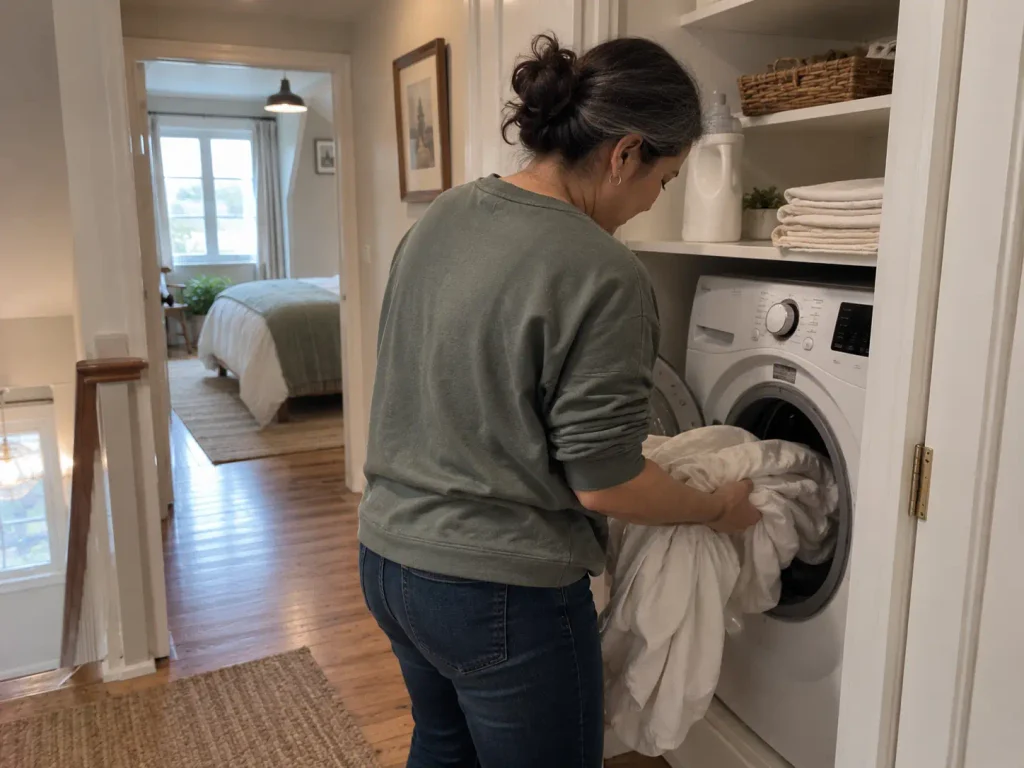
Pills by wash three are not ordinary wear. Something is wrong, and it is usually one of two things: a genuinely defective batch, or a fabric whose hand was being performed by a finish. Starches and resin finishes are applied at the mill to make fabric feel crisp, smooth and substantial in the package, and they wash out.
When the finish leaves, the actual surface is exposed for the first time, and if that surface is short-staple it starts shedding immediately. This is the mechanism behind the community’s “bad batch” complaints about sets that looked right on paper.
Pills creeping in gradually between wash fifteen and wash forty are ordinary wear on an ordinary fiber. Nothing was done wrong, no one is owed a refund, and the sheet is behaving exactly as a medium-staple cotton behaves. A sheet with nothing on it by wash forty was long-staple from the start, and it will probably keep going for years.
State those bands for what they are: a diagnostic framework built from the staple-length and abrasion mechanisms above, not a published standard. Nobody has run that study on real beds, which is itself the gap.
Synthetics run on their own clock entirely, and it is a shorter one. Microfiber pills on its own schedule measured in months rather than wash counts, because sub-denier polyester is brushed on the surface to fake a soft hand and brushing is fiber ends by definition. The three bands above are a cotton diagnostic. Do not apply them to a polyester sheet and conclude you got a defect.
The community’s nearest data point lands right where the framework predicts. One r/Bedding poster described pilling appearing after “about a month of cumulative use” on one side of a shared bed, which at a roughly weekly wash puts onset around wash four or five. That is one report, not an average. It also sits squarely in the defect-or-finish bucket rather than the normal-wear one.
The wash that exposes a finish is usually the first hot one, not the first wash. A set can come through three cold cycles looking perfect and out of a single hot one with a completely different hand. If you want to know what you actually bought, run one warm wash early and judge the fabric after it, not out of the package.
What Actually Helps, in Order (and What Doesn’t)
Everything in this section is free until the last two paragraphs, and the free things are the ones that work best. Start with the cycle. Pilling in the laundry is driven by mechanical abrasion in the drum, not by detergent chemistry, which is why the standardized lab test for pilling is literally a tumbling chamber.
A gentle cycle and a lower spin speed reduce how hard the fabric rubs against itself, and they cost nothing but a dial turn. Wash temperature matters less than most people assume, though it is not nothing: a cold wash is gentler on the fiber than a hot water wash, and heat is what strips a finish and exposes the surface underneath. If you have been running everything hot out of habit, that is the one setting worth changing tonight.
Then the load. Four habits, all free, all more effective than anything you can buy:
- Do not pack the drum. Overloading the washer means fabric that cannot move gets ground against itself instead of floating.
- Wash bedding on its own, away from towels, zippers and hook-and-loop fasteners. A single zipper pull is a scouring tool.
- Skip fabric softener, and skip anything carrying optical brighteners or bleach. Softener coats fibers rather than protecting them, and the coating goes away while the abrasion stays; the brighteners are cosmetic and the bleach weakens the fiber it is whitening.
- Wash a set inside out when the pilling is on the sleeping face. The friction still happens, but it happens to the side nobody sees.
The dryer deserves its own line, because it is where a surprising share of the abrasion actually happens. Tumble dry low rather than high, take the set out slightly damp, and the fabric spends far less time being beaten against itself in hot air. Line drying skips that stage altogether and is the gentlest option there is, with the trade that percale comes off the line stiff until it has been slept on for a night.
And the single most effective thing in this entire article costs nothing at all: rotate bedding sets. Alternating two sets halves the wash count and the sleep hours each one sees, which roughly doubles the calendar life of both. It is unglamorous and it beats every purchase on this page.
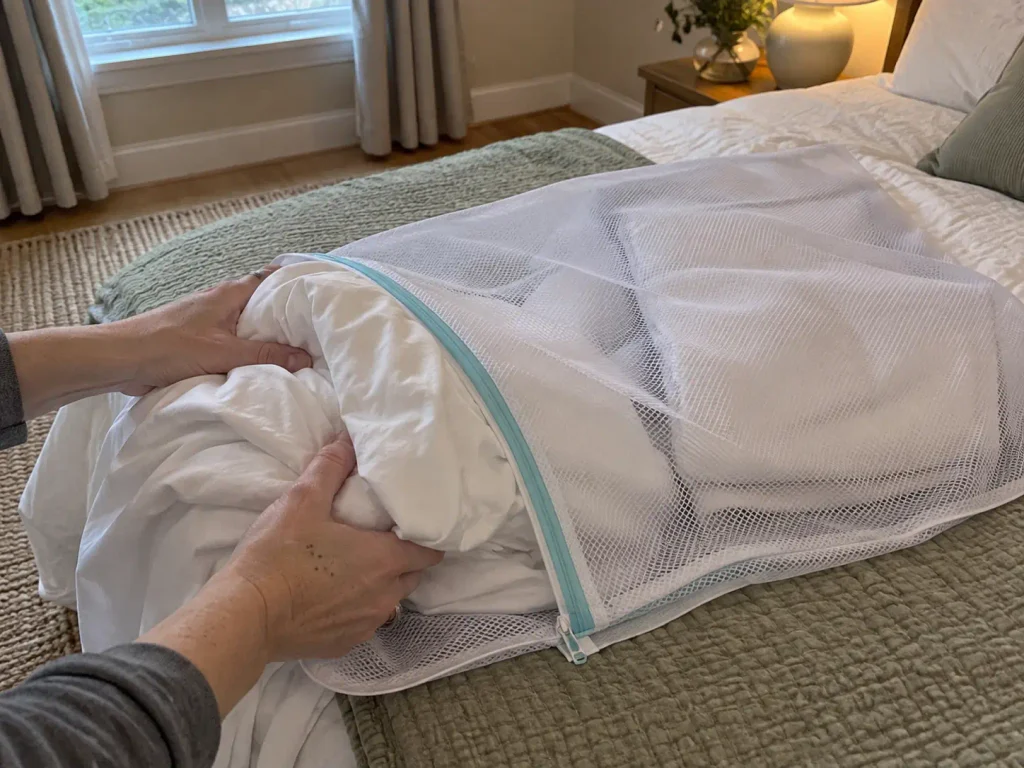
Once the free moves are in place, the cheap intervention that matches the mechanism directly is a mesh bag, because it reduces the friction rather than treating the result. The OTraki Large Mesh Washing Bag is 43 by 35 inches, which is the rare one actually sized for a full sheet set rather than for delicates, and it is rated to 140-176°F so a warm wash will not deform it. Its flaw is the size: a complete set goes in a little tight, and it is not a bag meant for washing one item at a time.
Now the honest limit, and it comes before the tool rather than after it. Removal is management, not repair. Shaving a sheet does not stop new pills, because the short fibers that made the old ones are still in the yarn.
The other tools people reach for sort themselves quickly on that basis: a sweater comb works but is slow across something the size of a bed, a lint roller lifts loose fluff and leaves anchored pills exactly where they are, and a pumice stone or the razor method both cut into the weave as readily as into the bobbles.
With that understood, a Pionix Extra Power Fabric Shaver is a 35W unit spinning at 12,000 RPM, and the reason it works where a razor gouges is that it uses rotating blades built to cut pills off without cutting the weave underneath. Its flaw: it is corded electric rather than battery-powered, so it lives in the laundry room and is not the one you travel with.
The deeper how-to of shaving a set safely belongs elsewhere; what matters here is the expectation. A shaved sheet feels better for about two washes. Then the next crop comes up out of the same weakened patch, in the same places, every time.
Shave a pilled sheet on a hard flat surface, never on the bed. On a mattress the fabric dips under the head of the shaver and the blades reach the weave instead of the bobbles. A dining table and ten minutes gets you a clean surface; the same ten minutes on the mattress gets you thin spots.
Skip the special detergents. A fiber that is too short is not a chemistry problem, and nothing poured into a drawer makes a 7/8-inch fiber longer.
When Pilling Means Replace, and When It Doesn’t
Pilling on its own is a cosmetic complaint, and treating it as the end of the set throws out sheets with years left in them. A bobbly sheet is rougher than it was. It is not weaker than it was, not in any way that matters, because the fiber forming the pill was the loose surplus rather than the structural yarn. Plenty of perfectly sound sheets get binned for looking tired.
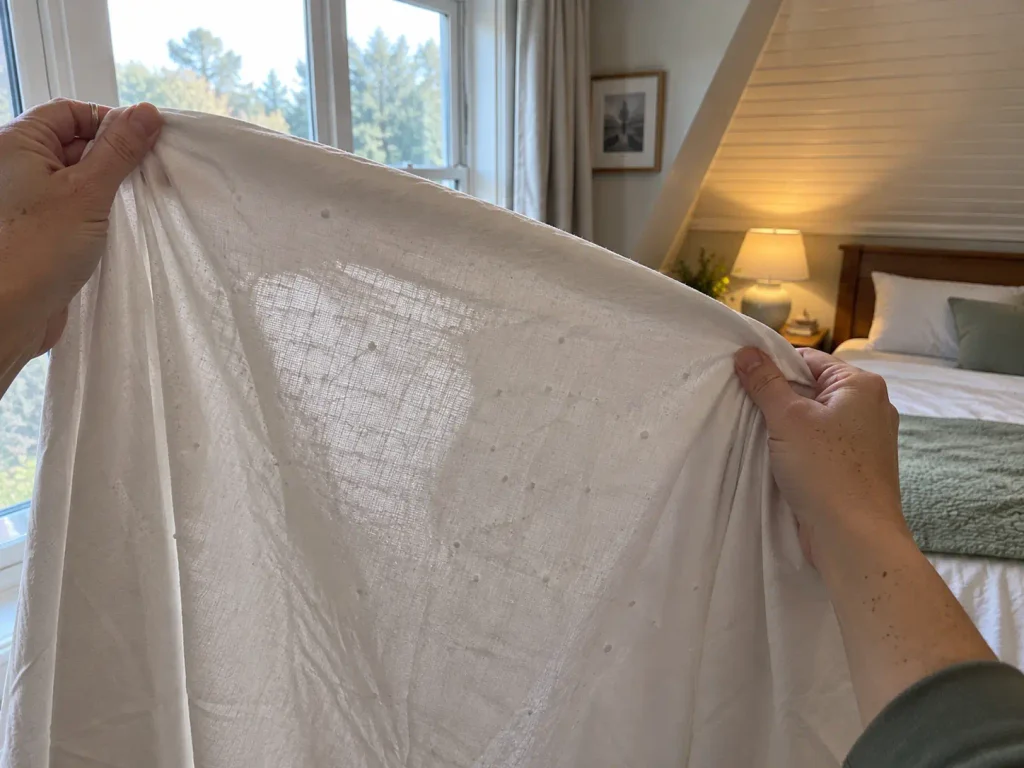
The distinction worth carrying is between cosmetic wear and structural wear, and almost every argument about sheet lifespan is really an argument about which of the two somebody is looking at. So here is the rule this pillar exists to give you. Pilling alone almost never means replace.
Pilling plus thinning at the same spot does, because that combination is the fabric telling you the yarn itself is going rather than just the surface fuzzing. Two signs, same location. One sign is a complaint; two signs are a verdict, and the wider set of structural signs that do mean a set is finished follows the same logic.
Checking for the second sign takes no tools. Hold the pilled area up to a window and hold an unworn edge of the same sheet beside it, a hem or the tuck-under that never sees a sleeper. A thin patch reads visibly brighter, because there is simply less cotton between you and the light. If the two look the same, the set is cosmetically worn and structurally fine.
Blends complicate the reading, and this is where a lot of people misjudge their own sheets. Polyester has far higher tensile strength than cotton, so a pill containing polyester fiber does not snap off and shed the way a pure-cotton pill eventually does. It sits there and accumulates. That is why a poly-cotton set can look markedly worse at a year than a cotton one while the fabric underneath is still entirely sound.
A set like the MALOUF Double Brushed Microfiber Sheet Set is the clearest illustration of the point, because even at a premium tier it is 100 percent double-brushed microfiber, which is sub-denier polyester with a raised surface. Its flaw is the one being described: pilling in polyester does not fall away on its own, it stays put as hard little balls that no wash cycle finishes removing.
Looking worse and being worn out are two different verdicts, and the window test separates them.
Worth saying plainly: pilling is the sheets’ own clock and says nothing about anything else on the bed. The sheets, the comforter and the pillows run on four separate clocks, and a pilled fitted sheet is not a reason to look at a comforter that is doing fine.
Where the sheet goes next depends on which verdict it got. A pilled but structurally sound set is exactly what donation exists for, and shelters take sheets that a thrift shop will not. A set with thin patches or holes has no second home, and the right destination is where a genuinely worn-out sheet should go rather than a bin.
One last location note, because it saves people from replacing sets they should keep. The foot of a fitted sheet fails first on both counts at once: it is where heels work against the fabric all night, and it is where the elastic pulls the fabric taut and thin over the mattress corner. If the foot passes the window test, the rest of the sheet almost certainly does too, and the set has another season in it whatever the surface looks like.
When the verdict really is replace, the buying rule this whole article earns is short. Long-staple cotton, plain weave, single-ply. The Feather & Stitch 100% Cotton Percale Sheet Set is the standing example of that specification: 100 percent cotton percale at 300 single-ply threads, with a 16-inch pocket, which is a plain weave with no exposed float for abrasion to catch. Its flaw is that a genuine single-ply 300 is not the cheapest thing on the shelf, and the saving that matters is in the weave rather than in chasing a bigger thread-count number.
Conclusion
Fiber length decides whether your sheets can pill at all. The weave decides how fast it happens. The wash routine only moves the date, which is why a gentler cycle helps and a special detergent does not.
Count the washes instead of the months. Pills at wash three and pills at wash thirty are two different problems with two different answers: the first is a defect or a finish that washed out, the second is ordinary wear on an ordinary fiber.
And bobbles alone are cosmetic. Bobbles plus a thin patch in the same place is the set telling you it is done.
At around the twentieth wash, hold the foot of the fitted sheet up to a window next to an edge that never gets slept on. If the two look the same thickness, the set has another year in it whatever the surface looks like. If the foot glows brighter, you have your answer, and what to do with the set once it really is finished is the next stop.
Before buying anything, put a second set into rotation this week and run the next wash on gentle. That alone halves the friction the fabric sees, and it costs nothing.
Frequently Asked Questions
01Why do my sheets pill but my partner’s side doesn’t?
Pilling follows friction, and friction is never shared evenly on a bed. The heavier or more restless sleeper’s side abrades faster, so it fuzzes first. This is normal wear, not a manufacturing defect, and rotating the sheet end to end evens it out.
02Does washing sheets in cold water stop pilling?
Cold water helps a little but does not stop it, because the driver is mechanical tumbling rather than water temperature. A gentle cycle and a lower spin speed do more than the temperature dial. Not overloading the drum does more than either.
03Can pilled sheets be fixed permanently?
No. A fabric shaver removes the pills but not the cause, because the short fibers that formed them are still in the yarn. Expect a clean surface for a wash or two, then a new crop in the same spots. It is management, not repair.
04Do expensive sheets pill less?
Only if the price bought staple length. A high thread count or a premium label does not prevent pilling on its own; a long-staple fiber in a plain weave does. Plenty of costly sateen pills before a cheaper percale ever starts.
05Should I throw away sheets that have pilled?
Not on pilling alone. Check the same spot for thinning by holding it to a window against an unworn edge. Pilled but sound sheets are donation material; only genuinely thin or holed ones should go to textile recycling.





Tried it on your own bed?
No comments yet. Tell us what you changed, and what the sheet did after a few washes.