







What’s in here6 sections
Someone on r/BuyItForLife posted about an LL Bean fitted sheet that finally ripped, and the post opens on pure irritation: they were, in their own words, super ticked off about it. Then they looked up the order date. Nine years. That number sits a long way from the one-to-two-year interval most replacement advice repeats, and the gap exists because the calendar was never measuring the right thing.
A fitted sheet has elastane in its corner casing and the rest of the set has none, and elastane begins relaxing permanently somewhere above 104°F while a home dryer runs 135 to 170°F on a normal cycle. So here is what actually fails on a fitted sheet, how to test it tonight with the sheet already off the bed, how to tell a worn-out sheet from one that was never the right size, and where the finished one goes.
Quick Answer
A fitted sheet is finished when the corner elastic stops gripping overnight, not at a fixed age. The two tells specific to this piece are elastic that won’t snap back and pilling concentrated where the sleeper lies. The real clock is dryer cycles, not calendar years.
The Fitted Sheet Is the Only Piece Under Tension
The flat sheet, the top sheet by its other name, is laid on the bed. The pillowcases are slid on. The fitted sheet is pulled over four corners, its corner pockets stretched down around each one, and stays pulled, every hour of every night, for as long as you own it. That difference is why it reaches the end of its life first, and why it gets there at a part of the sheet nobody thinks to inspect.
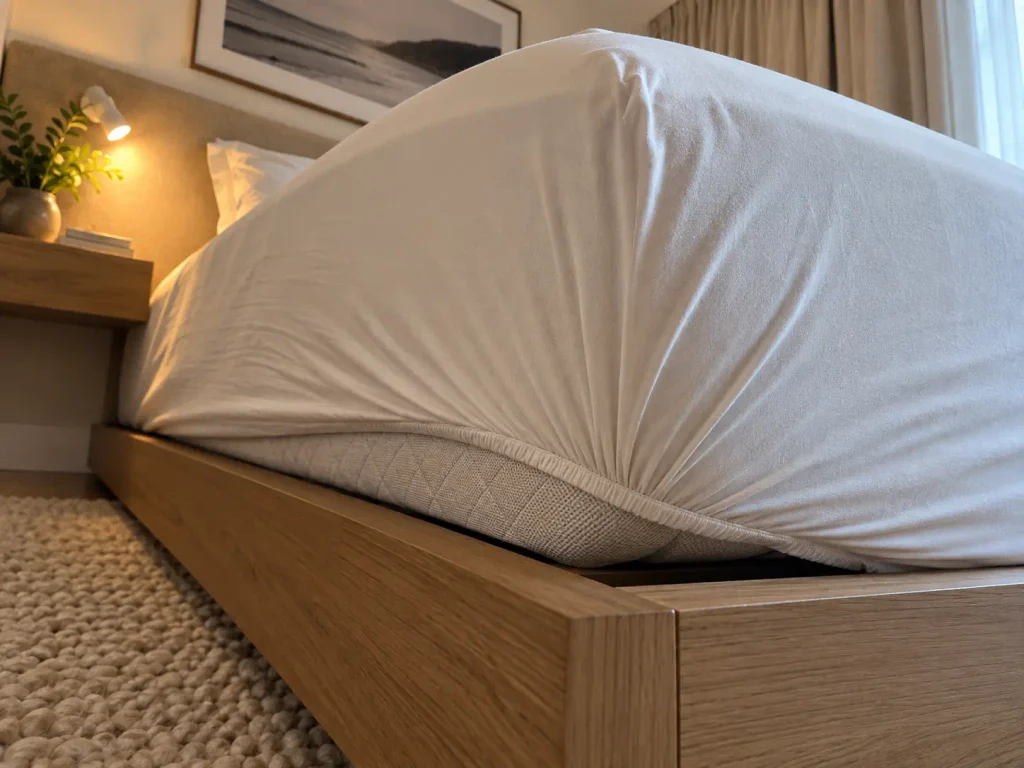
This is the thing that confuses people on laundry day. You strip the bed on a Saturday, the flat sheet looks perfectly fine, the cases look fine, and the fitted one is somehow the problem. You’re comparing four pieces that never had the same job.
Stretch is work, and only one of them has been doing it. The fitted sheet runs on a clock of its own, and the other three don’t get to vote on it.
Three Things Are Eating the Elastic at Once
The elastane in that casing isn’t failing from one cause. It’s failing from three, simultaneously. Heat is the first: the temperature that starts breaking elastane down for good sits around 104°F, and a home dryer runs 135 to 170°F on cycle.
Read that again, because it matters more than it looks: even the low setting is above the threshold. There is no dryer setting that is kind to elastane. There is only less unkind.
Chemistry is the second. Fabric softener coats the fiber and works into it, and chlorine does worse. The third is plain mechanical stress, the stretch-and-release of being peeled off a corner and hauled back on, several hundred times a year.
None of these three waits its turn. They compound, which is exactly why the elastic gives out while the cotton it’s sewn into still has years left in it.
And the damage is permanent. This is the part people resist, because we’re trained to believe a gentler wash undoes things. It doesn’t.
Once elastane has relaxed thermally, no cold cycle resets it. A casing that won’t snap back isn’t having a bad day and it isn’t going to improve next Tuesday.
What a Dead Casing Actually Looks Like
Here’s the detail that gives it away, and it’s the one nobody prints: the elastic doesn’t break. It lengthens. Pull a dead casing out flat against a new sheet of the same size and the dead one is visibly longer, sometimes by inches. Look at the thread inside and it has gone flat and faintly glossy where it used to be round and matte.
That’s a fiber that relaxed, not a fiber that snapped, and it’s why the sheet looks completely intact right up until the morning it isn’t.
Which is also why the signs every other checklist leads with — fading, yellowing along the folds, a color that has washed out a shade — tell you almost nothing about a fitted sheet. Those are fabric signals on a piece that fails at its elastic, and the only clock that tracks it is the wash count, specifically how many of those washes ended in a hot dryer.
The community has arrived at the same conclusion from the other direction, without the vocabulary. The most upvoted fitted-sheet thread on r/BuyItForLife is titled “ISO Fitted sheet my husband can’t destroy” — 236 votes, 301 comments, and it frames durability around a specific stress-tester instead of a time window. That’s the right frame. The question was never how old the sheet is.
Hang the fitted sheet to dry and machine-dry the flat sheet and cases with everything else. It takes ten seconds at the machine and it removes the single largest heat exposure from the only piece that has elastane in it. Run three sets in rotation instead of two and you cut each sheet’s dryer count by a third on the same calendar.
What the Underside Is Rubbing Against
One more variable, and it’s under the sheet where nobody looks. The fitted sheet’s back face spends every night in contact with whatever the mattress surface is, and a bare mattress top is more textured and holds more moisture against that face than a smooth barrier does. A Nestl Premium Cotton Terry Mattress Protector puts a cotton terry face between the two, with a TPU backing rather than vinyl, and it changes what the sheet is actually abrading against night after night, though the TPU still sounds faintly plastic for the first few nights until it settles.
It won’t save the elastic; nothing does that except heat and time. What it changes is the friction and moisture load on the fabric, and what the backing is made of changes what it traps.
Two Tests You Can Run Tonight
Knowing the elastic goes first is only useful if you can tell a tired sheet from a finished one without buying a replacement to compare it against. Both of these checks take under a minute, they cost nothing, and the right moment for both is the moment the sheet is already in a heap on the floor on laundry day. Do them before the sheet goes in the machine, not after.
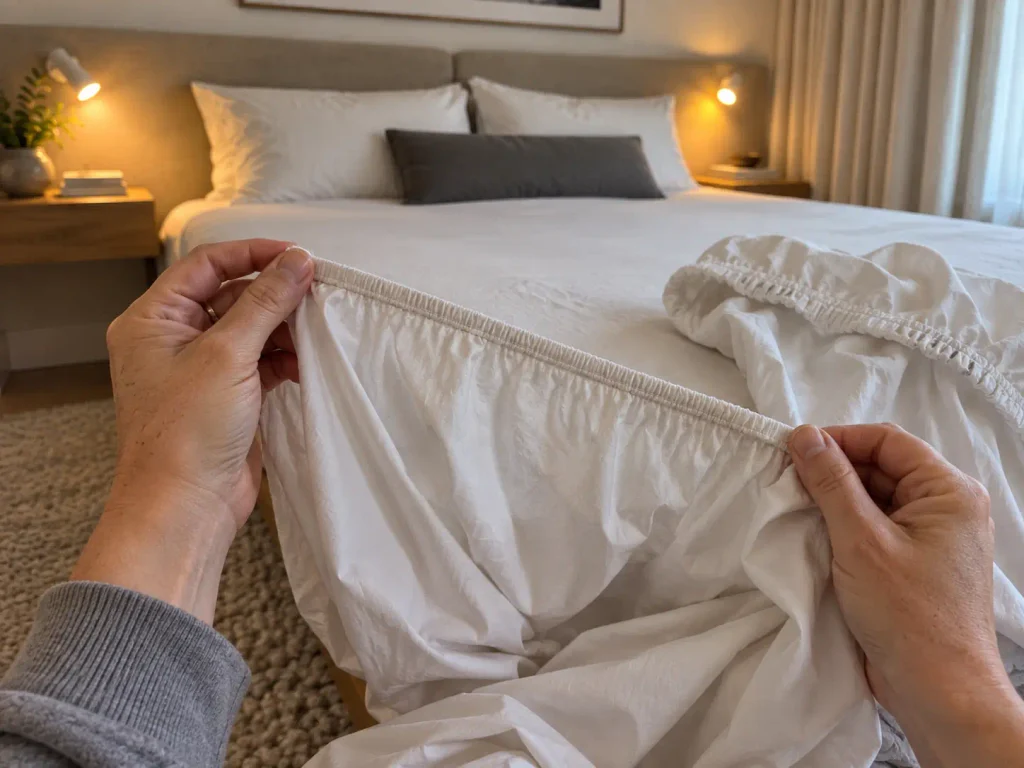
Test One: The Snap-Back
Take one corner casing between your fingers, stretch it a few inches, let go, and watch. Healthy elastane returns fast and returns fully. A casing that drifts back slowly, stops short of where it started, or sits visibly longer than the corner opposite it is done.
The corner-to-corner comparison is the whole trick, and it beats any absolute measurement you could look up. Both corners came off the same loom on the same day and went through every wash together, so the only variable between them is how much work each one did. If one is longer than the other, that difference is wear, and it’s wear you can see with no reference sheet in the house.
Which corner to check first: almost always the one at the foot, on the side of the bed you get out of. That’s the corner being peeled and re-stretched every single morning while the other three sit still. It’s the corner that fails first, and if it still snaps back cleanly, the sheet is fine and you can stop testing.
Also look at the casing itself, not just its behavior. Twisted inside its channel, flattened where it should be round, or pulling the fabric into permanent puckers that won’t shake out are all the same verdict.
Test Two: Where the Pilling Sits
Pilling is short fibers breaking loose from the yarn and knotting together under friction, and friction concentrates where a sleeper’s weight actually sits. That’s the center of the mattress. It is not the edges, which barely get touched from one year to the next. This is the same mechanism the same pilling tests textile labs run to grade fabric durability reproduce in a machine, a surface rubbed repeatedly under load, just distributed unevenly on a real bed by where a real sleeper lies.
So the location is the diagnosis. Pills in the middle with clean, untouched edges is a wear pattern, and it means the sheet did its job for however long it did it. Pills everywhere, including the border that nothing ever touches, usually means the fiber itself was short and weak from the start.
Which brings up the variable that actually predicts this. High-synthetic sets (polyester, microfiber, cotton-poly blends) pill measurably faster than long-staple 100% cotton or linen, because longer fibers have more contact points along the yarn and resist working loose. Fiber length decides the pilling timeline, and the tag almost never prints it.
What the tag does print is thread count, and thread count is not a durability spec: Consumer Reports’ lab testing, built on Cotton Incorporated’s own durability data on long-staple cotton, found no correlation between thread count from 200 to 800 and either quality or longevity. A good long-staple cotton sheet is expected to run three to five years and soften as it goes rather than degrade. The number on the tag won’t tell you which test your sheet passes.
Do the pilling read with the sheet on the bed and the light coming across it from a window, not overhead. Raking light throws a shadow off every pill and the contact zone shows up as a visible patch with a border. Flat overhead light hides all of it, which is why a sheet can look fine on the floor and look finished on the mattress.
When the Two Tests Disagree
Most of the time they agree and the verdict is easy. The interesting case is the split: the elastic is clearly going, the fabric read clean, no pills in the contact zone, no thinning. The sheet has one failed component and three good ones.
The free fixes come first. Rotate which corner takes the morning peel — get out on the other side for a while, or turn the sheet ninety degrees when you put it back on, so the load moves to a corner that has been resting. And line-dry that sheet from here on, because every dryer cycle is compounding the exact failure you just diagnosed.
If it still lifts after both of those, GORILLA GRIP corner clips are the community’s own workaround before replacement: elasticized straps with metal clips that stretch to 25 inches and cover Twin through California King, clipped under the mattress to pull the corners down from below. The flaw is worth stating plainly, because it decides whether they’ll work for you: if the original elastic has lost all its memory, the clip is pulling on fabric that no longer helps. It stops the sheet lifting. It does not put tension back in the seam.
Worn Out, or Never the Right Size
Both tests above quietly assume the sheet once fit the mattress it’s on. A surprising number of “the corners keep popping” complaints are a sheet that never had a chance. Same symptom every morning, completely different cause, and only one of the two is a replacement.

The scenario is common enough to be a pattern. Somebody buys a mattress topper in March and by April is convinced their two-month-old sheets have failed. They haven’t. The bed got two inches taller and the sheet didn’t.
The Snap-Back Settles It
This is the second thing the corner test is good for. If the casing returns fast and full and the sheet still pops off overnight, the elastic is innocent and the geometry is wrong. Nothing about that sheet needs replacing. It needs to go on a different bed, or that bed needs a different sheet.
There’s a tell in the failure pattern too, and it shows up before you touch a tape measure. A sheet in the wrong size fails at all four corners on the same night, usually the first night. A sheet with dead elastic fails at one corner for weeks first, then a second, then the rest. One is a geometry problem that was always there; the other is wear arriving unevenly, corner by corner, in the order those corners were worked.
Two structural facts feed into this. Mattresses got taller and fitted sheets largely didn’t — a modern mattress plus a topper routinely runs past the pocket depth older sheets were cut for. And corner-only elastic loses grip against that depth long before the fiber is tired, which is a construction difference rather than a quality tier: it changes how the sheet fails, not just how well it grips on night one.
Whatever you conclude here applies to this piece alone, by the way. The verdict on a fitted sheet doesn’t transfer to the flat sheet or the cases, because the rest of the set runs on four separate clocks.
Before you conclude anything, put the sheet on the bed rotated ninety degrees so the long side runs across the mattress instead of along it. If it now grips on all four corners, the sheet is the wrong shape for the bed rather than worn out. If it pops in the new orientation too, the geometry is genuinely too deep and no amount of rearranging fixes it.
If the test says geometry, this article has done its job and the next question isn’t a replacement question at all — it’s measuring the mattress with the topper on, working out what depth to buy, and choosing between corner-only and all-around elastic. That answer lives with the mattress-plus-topper-plus-two-inches formula, which is where it belongs.
What to Do With the One That’s Finished
A dead fitted sheet has two very different afterlives depending on which test it failed. The donation bin is the wrong answer for most of them, which is not at all the same thing as saying the trash is the right one. The sheet is on the floor, it’s diagnosed, and there are more honest options than either.

If Only the Elastic Failed, Replace the Piece
The fabric passed the pilling read, the seams are intact, and one component is dead. Buying a full set to fix one corner is buying three things you didn’t need, and the flat sheet you already own is probably the piece that will outlive everything else in the closet. Standalone fitted sheets exist for exactly this situation.
A Queen fitted sheet with all-around elastic and four-way stretch is sold on its own rather than as a set, OEKO-TEX certified, and built with elastic running the full perimeter instead of gathered only at the corners, which is the construction difference the section above named, applied to the failure you just diagnosed. Sold on its own, though, matching a flat sheet and cases to it later is guesswork, so if you care about the set looking like a set, factor that in now rather than in a year.
If the Fabric Failed Too, Replace the Set
Pilling across the whole contact zone, fabric you can hold up and see light through, seams letting go at the corner: that’s the fabric, and at that point the flat sheet and the cases are the same age with the same story. A Linen Home 100% cotton percale set prints its specification on the listing instead of hiding it behind a label word (100% cotton, percale weave, 200 thread count, 15-inch pocket, OEKO-TEX certified), and 100% cotton in a percale weave is the construction that resists pilling longest at the affordable end. Its flaw is the first month: 200-count percale reads more crisp than soft out of the package, and it needs several washes before it settles into anything you’d call soft.
Where the Old One Actually Goes
This surprises people who assume charity shops take anything: a fitted sheet with blown elastic is usually not donation material, even with perfect fabric. Thrift charities are selling it to someone, and nobody buys a sheet that won’t stay on. A shelter is a different question entirely, because a shelter isn’t reselling anything. The distinction between who turns it away and who takes it is real and it’s worth knowing before you drive anywhere, so read who takes the sheets a thrift shop turns away before you box it up.
And the fabric is still fabric. A cotton percale sheet with a dead casing is several square yards of usable cloth that has already been washed a hundred times, which makes it better cleaning material than anything you’d buy for the purpose.
Cut past the casing and you’ve got rags, dust covers, or drop cloth. It is the cheapest repurpose there is, and the only one that uses the part of the sheet that never wore out. What doesn’t get cut up has a real recycling route with a real destination, and where the fabric actually ends up is a genuine answer, not a shrug.
Worth keeping the nine-year sheet from the top of this article in view while you decide. That post is the counterexample to every two-year interval on this SERP, with one caveat: it’s a fabric-life data point, not an elastic-life one. The sheet ripped. Its elastic may have been long gone.
That’s the whole argument of this article in a single Reddit post: the set retires unevenly, which is why the flat sheet from a set three years gone is usually still folded in the closet, outliving the fitted sheet it came in with. For the rest of what’s on that bed, the keep, donate, recycle or toss decision is the same framework applied piece by piece.
The Short Version
Stop counting years. Pull a corner, let go, watch what the elastic does. That is the replacement decision, and it takes five seconds.
Read where the pilling sits before you condemn the fabric. Center-of-mattress pills are wear and they’re honest. Edge-to-edge pills, including the border nothing touches, are the fiber telling you it was short-staple from the beginning.
And if the elastic passed the test but the sheet still lifts off overnight, you have a size problem, not a wear problem. Nothing needs replacing. Something needs measuring.
The wash-twenty check: after twenty washes, the corner you peel every morning will be measurably longer than the one diagonally opposite. Hold the two against each other once a season and you’ll see the sheet failing months before it embarrasses you at three in the morning.
Next laundry day, before the sheet goes in the machine, stretch one corner and let it go. Five seconds. Then you’ll know whether you’re shopping or not.
Frequently Asked Questions
01How often should fitted sheets be replaced?
Replace a fitted sheet when the corner elastic stops snapping back, which usually lands somewhere between two and five years depending on dryer heat rather than on a fixed interval. The variable is wash-and-dry count, not the calendar. A line-dried sheet outlasts a machine-dried one by years on the same number of birthdays.
02Why does the fitted sheet wear out before the rest of the set?
It is the only piece held under continuous tension, and its elastane casing degrades from dryer heat, fabric softener and nightly stretch all at once. The flat sheet and the pillowcases have no elastane in them and spend zero hours a day stretched, so they fail slowly from abrasion instead.
03Can you fix a fitted sheet that won’t stay on?
If the elastic still snaps back fast and full, yes: the problem is pocket depth, not wear, and the sheet is fine on a shallower bed. If it does not snap back, corner clips will hold it down but they cannot restore tension to a casing that has already relaxed.
04Is it worth replacing just the fitted sheet?
Yes, when the fabric passes the pilling check and only the elastic failed. Standalone fitted sheets are sold for exactly that, and buying a whole set means replacing three pieces that are still working. The trade-off is matching a flat sheet and cases to it later.




Tried it on your own bed?
No comments yet. Tell us what you changed, and what the sheet did after a few washes.