







What’s in here8 sections
- First, Find Out If the Sheet Is Actually Done
- If It Passed the Test, Keep It (Nobody Says This)
- The Repurpose Door — and What It Really Costs You
- The Donate Door — Who Takes Worn Sheets, and Who Doesn’t
- The Recycle Door, and Why Most Sheets Never Reach It
- The Fiber Decided This Long Before You Did
- What to Do Tonight
- Frequently Asked Questions
There is a moment where you are standing over an armful of sheets you have pulled out of the closet, and the question in your head is where does this go. That is the second question. The first one is whether the sheet is actually finished.
A sheet that looks tired and a sheet that is worn out are two completely different physical states: one is dye and finish and a flattened nap, the other is the yarn itself giving up. Almost everything written about old bedding skips past that and starts handing out craft projects. Here is the free test first, then the four doors, then the thing that decided which door this sheet was always going to take, years before you owned it.
Quick Answer
Structural wear retires a sheet, not cosmetic wear. Work down this order and stop at the first one that fits.
- Hold the middle panel to a window: even light through means worn.
- Keep it as a spare if only the color and hand are tired.
- Cut it into rags if the damage sits in one zone.
- Donate it clean and intact; torn goes to an animal shelter.
- Textile-recycle anything dry and odorless, torn or stained.
- Bin it only for mold, a musty smell, or bugs.
First, Find Out If the Sheet Is Actually Done
Before anything gets cut up or bagged, there is a two-minute check that costs nothing and settles which of the four doors is even open. Most sheets fail it in the direction people do not expect.
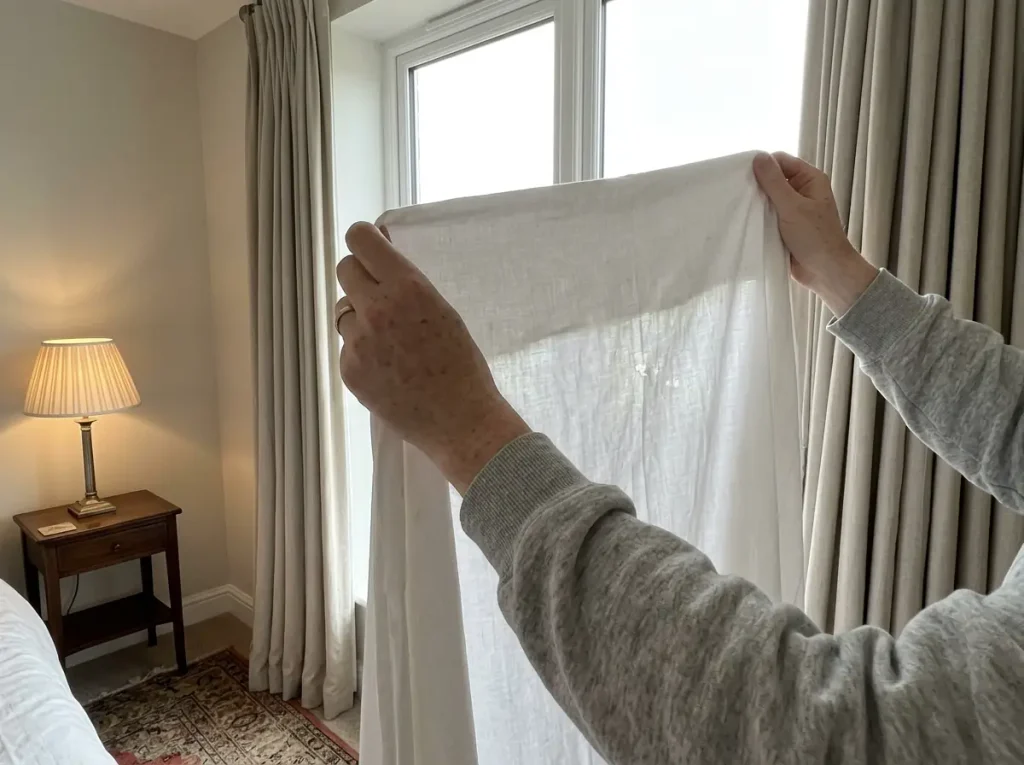
Cosmetic wear is dye, finish and pilling. The white has gone the color of weak tea, the pattern has gone flat, the crispness it had out of the package is long gone. None of that is the fabric failing.
The crispness was mostly starch and a resin finish, and those wash out on schedule whether the sheet is good or not. Fading is what a dye does under repeated hot water and detergent. The yarn underneath can be completely sound, and in a long-staple cotton it usually is.
Structural wear is the yarn giving up, and it looks like something else entirely: thinning you can see through, a sheer patch, a tear that starts on its own without you pulling anything, seams parting where the hem is stitched. That is the difference between a sheet that is old and a sheet that is over. If you want the full taxonomy of the signals a sheet sends on its way out, what actually kills a sheet covers sheet lifespan in depth and settles when to replace sheets at all; this article picks up the moment after that verdict.
The test is a window. Hold the middle panel of the flat sheet up against a bright one and look at the light coming through. A uniform screen of light across the whole panel means thinning fabric everywhere and a sheet that is genuinely done. A bright patch in one area with sound fabric around it means you have a worn area, not a worn sheet, and that distinction is worth actual money in rags.
Do the window test on a dry sheet, not one straight out of the wash. Damp cotton swells and closes up the weave, and a thin sheet held up wet will read as sound. Wait until it has been folded a day.
And sheets do not wear evenly, which is the part almost nobody accounts for. They wear on the side that gets slept on, and the worn zone on a flat sheet is not centered on the bed either. It sits where the hips and the heels go, roughly a third of the way up from the foot, and in a shared bed it is always sharper on one side than the other.
That is why the standing community answer to a damaged sheet is to cut around it rather than write off the whole piece. Half a worn sheet is very often still full-strength fabric.
On a fitted sheet there is a second clock running, and it runs faster. The corner elastic dies long before the woven fabric does. It gets stretched, then it gets cooked in the dryer, and eventually it is a limp cord in a casing.
Dead elastic corners are not a dead sheet. The body of it is still perfectly good cotton, the elastic is the disposable part, and treating the two as one object is how sound fabric ends up in a bin.
If It Passed the Test, Keep It (Nobody Says This)
The greenest and cheapest answer to what do I do with these old sheets is very often the one the internet skips entirely, because it does not make for a list.
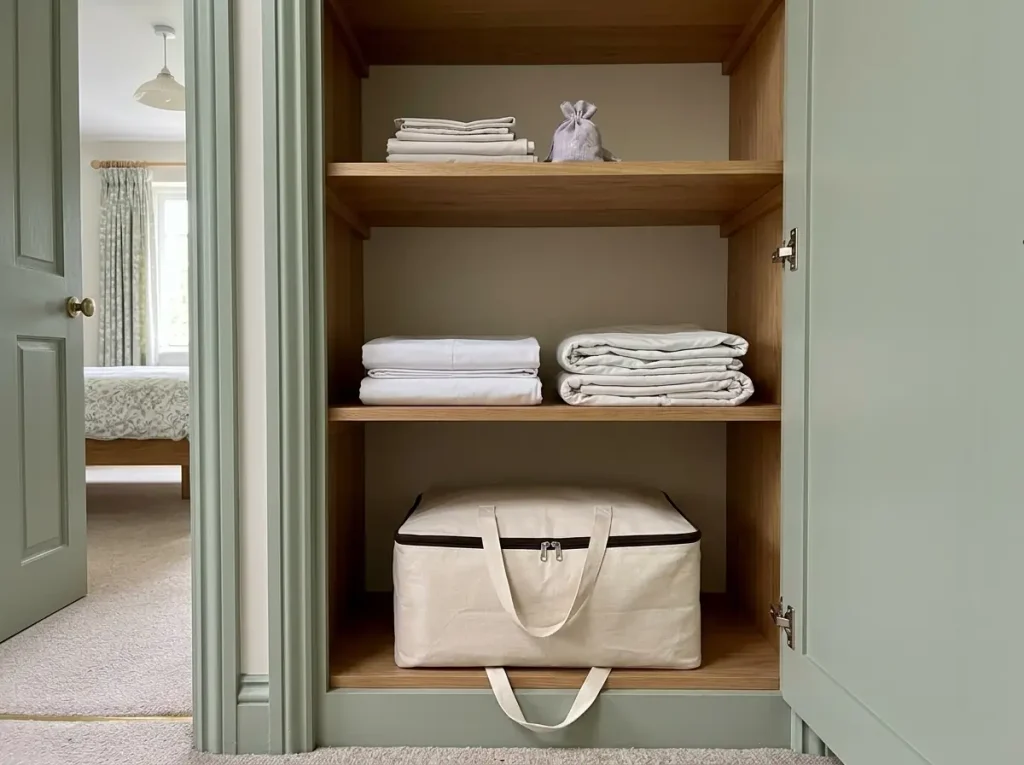
A sheet that fails only on looks is a spare set, a guest set, a summer set. It has years left in a role where nobody is judging its color. The set that is too faded for the bed you look at every day is exactly the right set for the week the good one is in the wash, or for the nephew sleeping on the sofa bed, or for the mattress you drag out at Christmas. Nobody has ever inspected a guest sheet for whiteness.
There is a community argument that goes further than that, and it is worth hearing. In the r/ZeroWaste thread on old fitted sheets, one commenter pushes back hard on the cut-it-into-rags reflex, arguing that older sheets are frequently better woven than what gets sold new today and will hold up for decades more if you let them. Vintage fabric, the thread calls it.
The point stands on its own physics. A dense weave in single-ply cotton from fifteen years ago is a different object from a thin two-ply sheet counted twice to reach a number on the package, and cutting the first one up out of habit is a real loss. This is also where gently used and worn stop being the same word: one describes a set that looks secondhand, the other a set that has structurally gone.
So the practical version: keep two sets in rotation and demote the third to the closet. The demoted set earns its keep on the week the good one is in the wash, which is more often than anyone plans for. This also makes more sense once you notice that the four pieces run on separate clocks: a set almost never dies all at once, so a “spare” is usually two good pieces and two tired ones, which is fine for the job.
A demoted set announces itself by the pillowcases, not the sheets. The cases yellow at the head end from hair product and skin oil months before the flat sheet shows anything at all. If the cases have gone and the rest looks new, you have a spare set with two pieces missing, not a dead set.
Here is the honest counter, though: a spare set stored badly is a spare set you will never use. It has to be dry, folded, and somewhere you will actually look. The bottom of a box in the garage is not storage, it is a slow route to the same landfill with an extra year of guilt attached.
A labeled bin bag on the shelf does the job for nothing. So does the oldest trick in the linen closet, which is folding the whole set inside one of its own pillowcases so it stays together and announces what it is.
If you want the tidy version, a set of cotton storage bags in 10oz canvas with a three-zipper opening holds a king set flat and lets air through, which matters for cotton going into a closet for six months. Its limit, stated plainly: it is a zippered bag, not a rigid box, so it will not keep moths or damp out, and it will not fix a set that already smells of the closet.
The Repurpose Door — and What It Really Costs You
Cutting a sheet up is the answer everybody reaches for first, and it is a good one, as long as you know it is a beginning and not an ending.
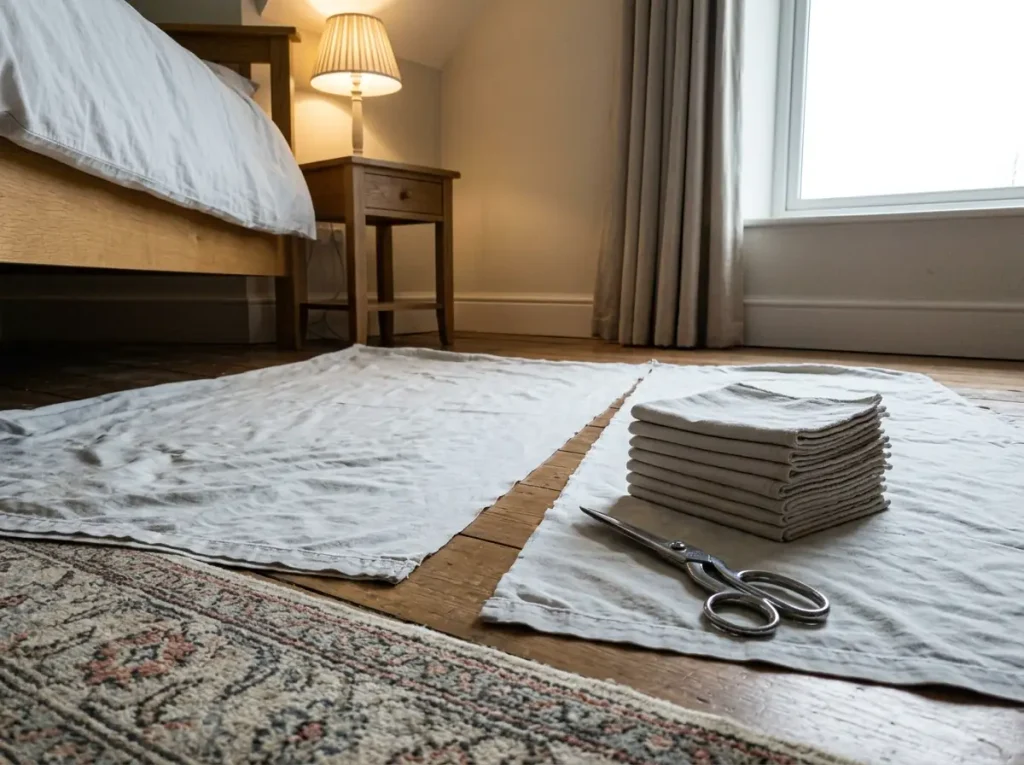
A plain cotton sheet is genuinely excellent at a short list of second jobs. Cleaning rags, because cotton absorbs instead of pushing water around like a synthetic cloth does. Drop cloths for painting. Frost covers thrown over tomatoes in October, where the weave breathes and a plastic sheet would cook them.
A washable layer over a pet bed is another. And the one from the community that costs nothing and repeats: a clean cloth from an old sheet as produce storage wrap in the fridge, swapped every few days, reported to keep vegetables usable roughly twice as long. That is the useful end of upcycling, as opposed to the Pinterest end.
Now the number nobody gives you. One r/ZeroWaste commenter tracked a fitted sheet cut down into reusable at-home waxing strips and reported that second life ran about a year and a half, possibly two-plus years, before it was actually finished.
That is the honest shape of repurposing: the rag has its own clock, it starts at zero, and it runs out too. Repurposing is not an exit from the waste stream. It is a detour of about eighteen months to two years.
Cut rags along the grain, never on the diagonal. A cut that follows the weave gives an edge that sheds once in the first wash and then stops. A diagonal cut sheds threads for the entire life of the rag, and you will find them on everything you wipe.
Then there is the volume, which is the thing craft lists never warn you about. A braided rag rug reported in that same thread came in at 57 inches across and weighed 9.5 pounds. Nine and a half pounds of old sheets.
That is not a Saturday afternoon and it is not one set. It is most of a closet, converted, and it is worth knowing before you cut the first strip.
Which leads to the honest limit. A household needs a finite number of rags, and it is a smaller number than you think.
Cutting up four sets because it feels virtuous produces a rag bin you will never work through, and that cloth goes into the same landfill three years later having done nothing except take up a shelf. Cut what your house will actually use in a year, and route the rest through one of the other doors while it still has value to somebody else.
And the last point sets up everything below: what the sheet is made of decides how well this goes. A plain-weave cotton cuts clean, tears in a straight line and works as a cloth without shedding into whatever it touches. A resin-finished or polyester-blend sheet frays into synthetic lint every single time it goes through the wash, which means the rag is quietly shedding microplastic for its entire working life.
The Donate Door — Who Takes Worn Sheets, and Who Doesn’t
This is the door most people hesitate in front of, and the hesitation is nearly always the same one: a quiet suspicion that a sheet this old is not really a donation, it is somebody else’s problem. In the Declutter 365 group, the woman who started the thread said it outright before anyone could contradict her, that she did not think the Salvation Army would accept them. She was second-guessing herself for no reason.
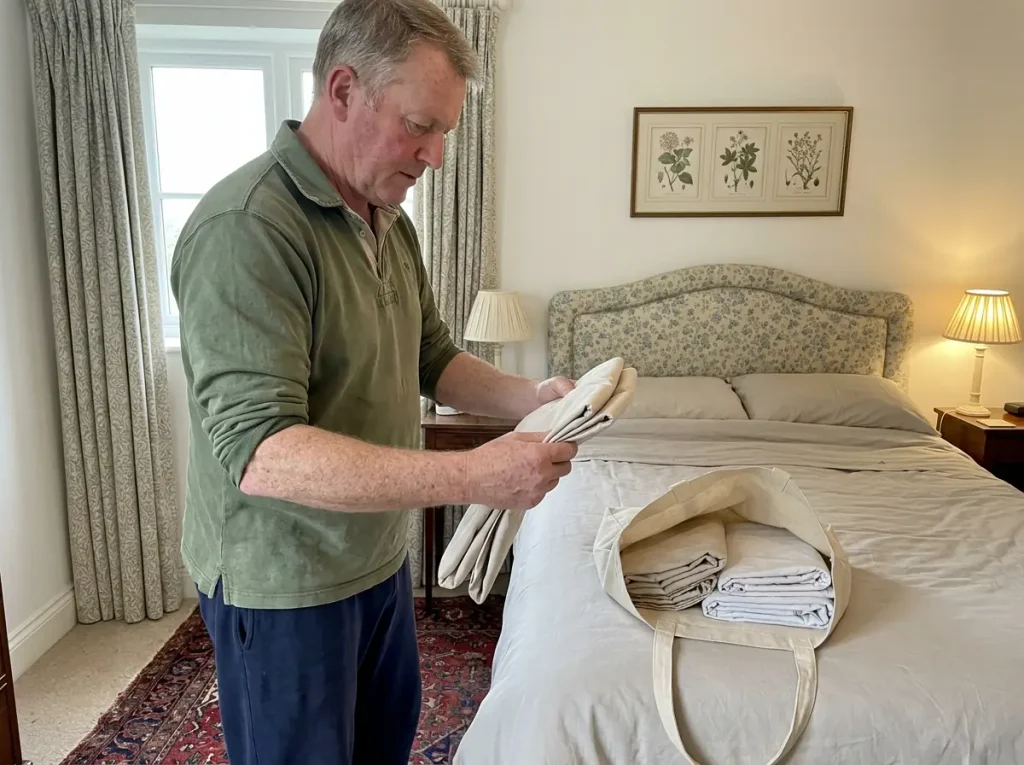
The rule, stated plainly, because it does not seem to exist anywhere in one line: clean and structurally intact clears a human charity, even if it is faded, thin-feeling or twenty years out of fashion. Only a torn or threadbare sheet needs a different door.
Two named Goodwill affiliates publish the same shape of list in writing. Linens accepted; mattresses, box springs and pillow tops refused. Read those lists side by side and the logic is obvious: what a thrift store turns away is the stuff that cannot be laundered through, not “old” as a category. The same logic runs the whole secondary-textile trade, and it is worth seeing what the textile recycling industry actually asks for: damage is not disqualifying anywhere in that chain.
Below that tier there is a second one, where worn genuinely stops mattering at all. Animal shelters take sheets and blankets used or new, so long as they are clean and not falling apart. Kennel lining, drying wet animals after a bath, cleanup.
The community phrase for it is down to rags, and it is accurate: shelters go through them fast and the bar sits close to the floor. It is also, in the r/ZeroWaste thread, the single most repeated answer by a wide margin. A homeless shelter is worth one phone call for the same reason, though the bar there climbs back to clean and intact, because a person is sleeping under it.
Wash it, fold it, and label the bag with what is inside. A bag marked “queen flat sheets, clean” gets sorted in under a minute and goes on the floor the same day. An unlabeled bag of unidentified fabric goes into the triage pile, and the triage pile is where donations go to be quietly written off.
There is one hard stop in this article, and it is here. Visible mold, a musty smell that survives a wash, or any sign of bed bugs takes a sheet out of both the donate door and the repurpose door. Not one or the other. Both.
Contamination like that sits deeper in the fiber than a hot cycle reaches, and passing it to a charity or to a shelter full of animals is worse than doing nothing. Bag it, seal it, and put it in the general waste. That call does not get argued with.
One small thing that changes how you pack the bag: shelters ask for sheets by the armful and never by the set. The flat sheet and the fitted sheet get used for completely different jobs there, so a set with one ruined half is still a whole donation. Do not throw away a good flat sheet because its fitted partner tore.
The Recycle Door, and Why Most Sheets Never Reach It
Textile recycling is real, it accepts far more than people assume, and it is also the door that almost nobody actually walks through. Those three facts sit together and are worth understanding as a set.
Start with the bar, because it runs backwards from what people expect. It is lower than donation, not higher. Stained, torn and overly worn textiles are all accepted for recycling, and the only real conditions are that the material is dry and has no odor.
A sheet too far gone to hand to a charity is precisely what this stream exists to process. And it does get processed rather than buried: roughly 45% is resold as secondhand goods, about 30% is cut down into industrial wiping and polishing cloths, around 20% is shredded into fiber for insulation, carpet padding and pet bedding, and only about 5% is genuinely unusable.
Now the reality check, and it is bleak. Look at the EPA’s own textile-waste numbers: textile recycling runs at roughly 15%, against 11.3 million tons of textile waste landfilled in the same year. Sheets and pillowcases specifically came in at 15.8%.
So five out of six old sheets in America go into the ground. “Just recycle it” is not a default outcome anybody is opting out of. It is the exception you have to go looking for.
The reason for the gap is mostly one misunderstanding. Almost no municipal program takes textiles in the household bin. Put a sheet in the curbside recycling and it gets pulled at the sort line and sent to landfill behind your back, and it may foul the bale on its way through.
The real routes are a municipal textile bank, a drop-off box, or a retailer textile take-back program. Finding out which of those your town runs is the genuine work of this door, and it takes one search. That is the whole barrier, and it is why the number is 15%.
The recycler wants the sheet dry more than clean. A damp sheet bagged for a week will mildew and take the material bagged around it with it, which is why the standard is “dry and no odor” rather than “washed”. Line-dry it an extra hour before it goes in the bag.
And it matters for one bag of sheets, not just in aggregate. Textiles are estimated at around 5% of all landfill space, which is a strange number until you picture a sheet: large, light, full of air, and slow to compact. It takes up far more room than it weighs.
Once your question widens past flat linens, though, the rules change again. A comforter is a different problem, because a filled item gets sorted by what is inside it, not by the shell.
The Fiber Decided This Long Before You Did
Every door above was open or closed for this particular sheet on the day it was woven. That is the part of the decision worth carrying into the next set you buy, and it is the part nobody prints on the package.
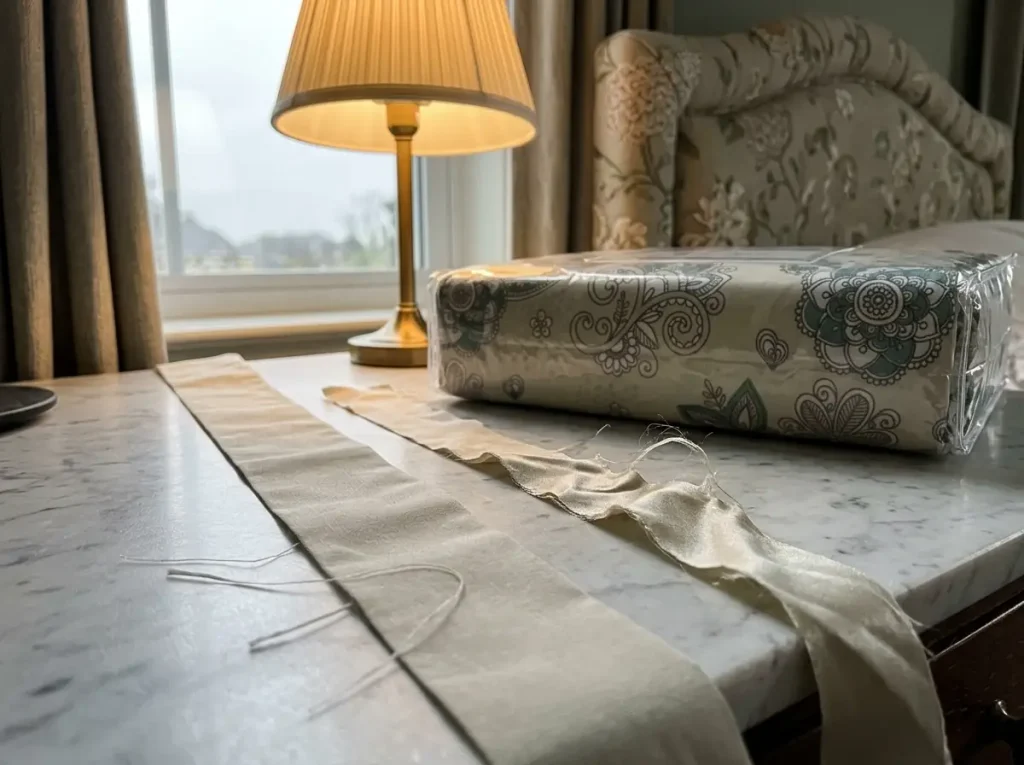
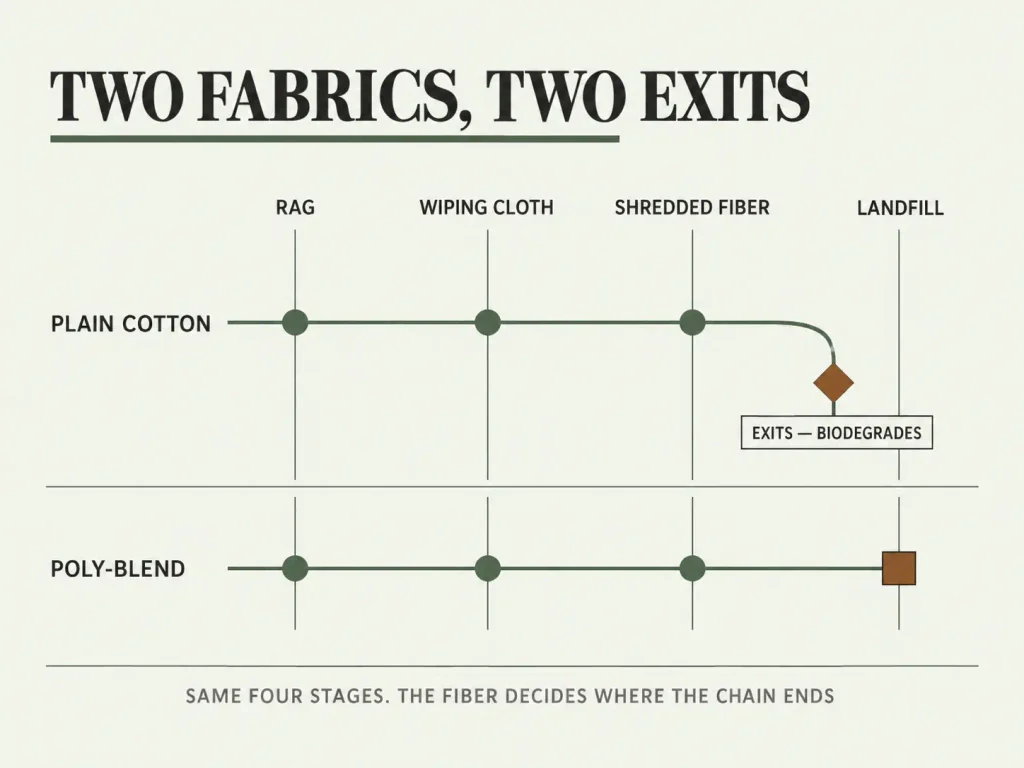
The mechanism is measurable and somebody measured it. In a Cornell-run study for Cotton Incorporated, scoured cotton fabric lost between 55% and 77% of its weight in 90 days at a commercial composting facility. Polyester in the same test degraded very slowly, and most of the fibers came out intact. That is Cotton Incorporated’s own biodegradability testing, run by an industry group with every commercial reason to have found something flattering, and which published the numbers anyway.
Follow that down to the rag stage and it explains the whole chain. A plain cotton or linen sheet tears clean, works as a cloth without shedding into your kitchen, and keeps quietly breaking down after you are finished with it. A synthetic or resin-finished sheet sheds microfiber the entire time it is a rag, and is still essentially intact fabric long after you have forgotten it existed. The same divergence shows up in the wash long before the end, which is the argument in how the two fibers actually age: one of them pills and one of them thins, and they are not the same failure.
The finish matters as well as the fiber, though less than you would think. Softeners, resins and heavy dyes shift the speed of the breakdown, but every cotton sample tested still biodegraded. Which is the same lesson as everywhere else on this subject: the finish is the part that washes out, and the fiber is the part that does not.
So the buying consequence, said once and without a pitch attached. A plain-weave, single-ply cotton set has a graceful exit built into it: bed, spare, rag, compost, each stage a real stage rather than a delay.
Something like the Feather & Stitch percale set is the plain version of that, at 100% cotton, 300 threads counted honestly at single ply rather than doubled, with 16-inch pockets. Its flaw is not hidden either. A single-ply percale will never have the smooth cool hand of a sateen, and it comes out of the dryer creased and stays creased unless you iron it.
That is the trade. The exit is a reason to prefer that construction, but it is not the only reason and it should not be the deciding one on its own.
None of which requires you to buy anything today. The sheet in your hands was sorted into its exit route by a mill years ago and there is nothing to do about that now. It applies to the next set, whenever the next set happens.
What to Do Tonight
Hold the middle panel to the window before you decide anything at all. Most of the sheets people retire are tired rather than finished, and the honest answer for those is a folded bag in the closet, not a craft project.
If it is genuinely worn, the routing is short. Clean and intact goes to a human charity even when it is faded. Torn and threadbare goes to an animal shelter, which wants it.
Mold, a musty smell or bugs goes in the bin, and that one is not negotiable. Everything else that is dry and odorless is recyclable, even the pieces nothing will take as a donation.
And cut up only what your house will actually work through, because the rag has its own clock of roughly eighteen months to two years, and a cupboard of cloth you never use is just a landfill with a delay on it.
After a season of washes, look at the panel where the hips go rather than at the color. Fading is the sheet aging. Light coming through is the sheet finishing.
Pull the oldest set out tonight and hold it up. If the light comes through evenly, you have a rag. If it does not, you have a spare set and nothing to do.
Frequently Asked Questions
01Should you throw away old sheets?
Only if they are moldy, musty or bug-infested. Anything dry and odorless can be textile-recycled even when it is far too torn to donate, and torn sheets are still actively wanted by animal shelters. The bin is the last door, not the first.
02Where is the best place to donate sheets?
A human charity if the sheet is clean and intact, even faded. Goodwill affiliates list linens among accepted goods. An animal shelter if it is torn or threadbare; they use sheets for kennel lining and cleanup and go through them fast.
03How many years should you keep bed sheets?
No number answers it, because a set washed weekly ages nothing like a guest set used four times a year. Judge it by holding the middle panel to the light, not by the calendar. The wash count is the clock, not the date of purchase.
04Can you put old sheets in the recycling bin?
Almost never in a curbside bin. Textile recycling runs through drop-off boxes, retailer take-back programs and scheduled collections instead, and the material only has to be dry and odor-free, not undamaged. A sheet in the curbside bin gets pulled and landfilled.
05Will charities take sheets that are worn but not torn?
Yes. The bar is clean and structurally sound, not new-looking. Faded, softened and unfashionable are all fine. A hole, a tear or a smell are what move a sheet to the animal-shelter route or the recycling stream instead.





Tried it on your own bed?
No comments yet. Tell us what you changed, and what the sheet did after a few washes.