







What’s in here7 sections
The bag in the trunk had a whole stripped bed in it: two flat sheets, a fitted sheet, four pillowcases, two bed pillows and a comforter. The volunteer at the intake door took about eleven seconds, handed back the pillows and the comforter, and kept the rest. Nothing in that bag was dirtier or older than anything else in it, which is the part that makes the trip home feel like a judgment.
It isn’t one. A woven sheet and a stuffed pillow fail in completely different ways, and every donation door in the country is sorting by what an item can still safely be — not by what it cost or how presentable it looks folded.
A thrift store is asking whether somebody will buy this off a rack. An animal shelter is asking whether a dog can lie on it. Those two questions produce opposite answers on the same sheet, and once you can hear the difference, the sorting takes five minutes at home instead of two trips across town. Here is which door takes what, what each one specifically refuses at intake, and the thirty-second test that tells you which pile a sheet belongs in.
Quick Answer
Match the sheet’s condition to the door before you drive anywhere. Landfill is never the first move.
- Clean and intact: a thrift charity or homeless shelter. Refuses bed pillows and mattress toppers.
- Torn, stained or faded: an animal shelter. Refuses stuffed comforters and quilts.
- Past reuse but dry: textile recycling. Refuses anything wet, oily or paint-soaked.
- Perfectly good, just not yours: Buy Nothing, Freecycle, Marketplace. Refuses nothing, moves fastest.
- Damp, mildewed or smelling of mold: no door takes it. That one piece is household trash.
The Door That Turns Sheets Away, and the One That Doesn’t
That bag came back half full because two organizations were being handed the same question and they were never answering the same question at all. This article assumes you have already decided the set is finished; if you have not, whether a set is finished at all is the call to make before you bag anything, because half of what gets donated is retired early and half of what gets binned should have been donated.
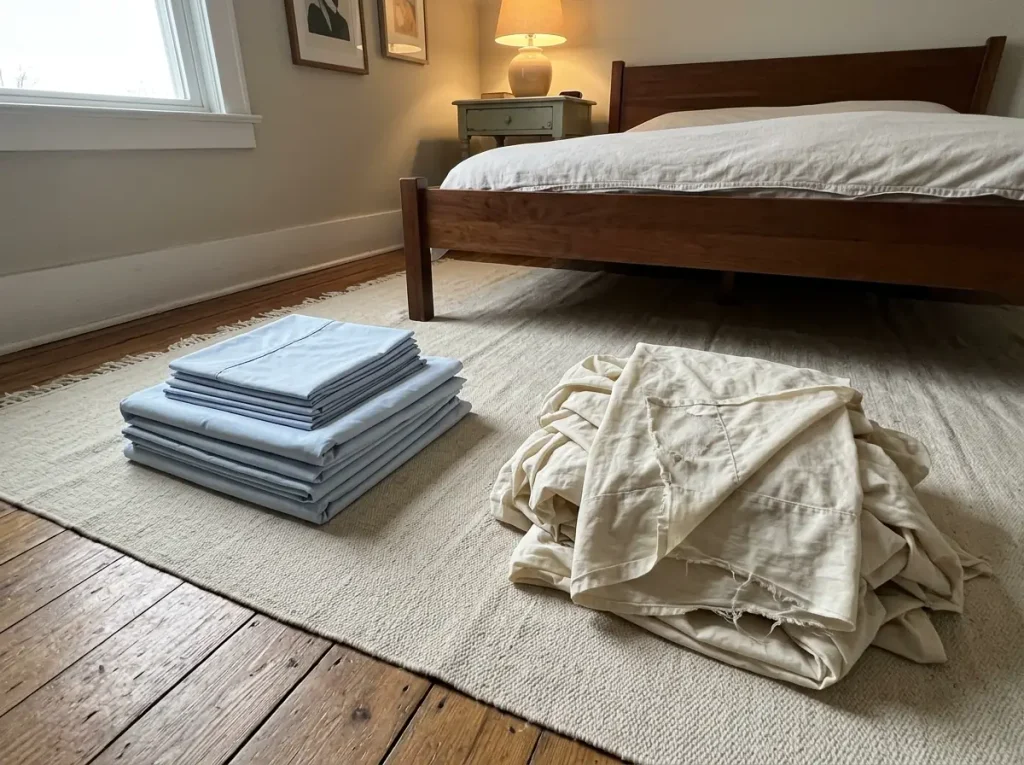
Almost everybody has driven to a drop-off with a mixed bag and read the “no” as a verdict on the sheets. It usually means the opposite. The sheets were fine. Something else in the bag wasn’t, and the sorting table has no way to tell you which.
What a thrift store is actually deciding
A resale charity has one question: will this price on a rack. That is why its refusals are by category rather than by condition. Goodwill of Greater Washington publishes the list of what it cannot accept, and it is specific: mattresses, box springs, bed rails, sleeper sofas, air mattresses, mattress toppers and bed pillows are all refused outright. Sheets, comforters and bedspreads are welcome when they are clean.
Read that list again and the logic falls out of it. Used bed pillows are turned away for hygiene even when they look immaculate, because the test is not does this look presentable but was this worn against skin overnight for years. A pillow absorbs sweat, skin oil and everything that lives in the resulting environment, and no amount of folding hides that from a policy written at head office. Decorative throw pillows are exempt from the same ban, which is the tell: the rule is about the sleeping surface, not about stuffing.
A sheet passes that test easily. It gets washed weekly at temperature, it is one layer thick, and it dries all the way through. That is why the sheets stayed in the bin and the pillows came home.
Do not put a rag in a donation bag, even a clean one. Goodwill’s list bans rags outright, clean or dirty, and one obvious cut-up sheet in the top of the bag makes the volunteer sort the whole thing by hand instead of by the armful. The bag that gets opened and inspected is the bag that gets partly refused.
What a shelter is actually deciding
An animal shelter is not reselling anything, so the question changes to: is this dry, safe and washable. Stains pass. Holes pass. Fading passes.
Foothills Animal Shelter takes sheets in nearly any condition, because the sheet is going on a kennel floor under a dog, gets washed at a temperature no household uses, and gets replaced when it finally shreds. The one thing that will get a bag turned away at either door is bed bugs, which is why anything from a bed that had them goes in a sealed bag to the trash and nowhere else.
That flips the whole hierarchy people carry around in their heads. The torn sheet you were embarrassed to donate is the one a shelter actively wants, and the pristine matched set you were most proud of is the one that belongs at the resale door instead.
There is one category shelters refuse that thrift stores accept, and it catches people out: stuffed bedding. Comforters, quilts, anything filled with down, cotton or polyester batting.
An animal that chews through the cover ingests the filling, and a choking hazard is not something a kennel can supervise, so the biggest warmest thing in your closet is the wrong donation there. Flat blankets and sheets are the safe ones. Local Humane Society branches publish the same distinction on their own wish lists.
The politeness of the standard advice, just call your local shelter!, leaves people genuinely unsure whether any of this is real. An r/declutter thread asked the blunt version: has anyone here actually succeeded donating old sheets and towels to a shelter. Someone who runs one answered directly.
Yes, and the list runs wider than bedding: sheets, blankets, towels, old litter boxes, gently used toys, cleaning supplies. Which matters if you have more than sheets to unload and want one stop instead of three.
The phrase worth stealing from that world is by the armful. Shelters take bedding loose, unmatched and unfolded. Nobody there is looking for a pressed matched set, and the twenty minutes you spend folding a kennel liner is twenty minutes spent for nobody.
The two things neither door will take
There is exactly one hard stop that both sides enforce and it is not negotiable anywhere: anything damp, mildewed or smelling of mold. Goodwill’s exclusion list names wet and mildewed items separately from every category ban, and textile recyclers apply the same rule. The reason is downstream rather than squeamish. Textiles get collected into a shared load, and one musty sheet can spoil the bale around it.
The second is contamination that is not water: gasoline, oil, paint, solvent. A drop cloth that did its job is trash, not a donation, and that includes the sheet you finished the hallway with last spring.
A thrift store’s back room has a sorting table and a floor limit, and anything that will not price becomes a disposal cost that comes out of their budget. That is why the “no” arrives fast and feels personal. It isn’t personal. It is arithmetic on a pallet.
Sort by Condition Before You Sort by Charity
Once you can hear that the two doors are asking different questions, the useful move is to stop thinking of the heap as “old sheets” and start thinking of it as three piles. The sort takes five minutes and it is the entire difference between one wasted trip and one correct one. Do it on the bed you just stripped, not in a parking lot with the engine running.
Pile one is clean and structurally intact. No thinning, elastic still gripping, no permanent staining. This goes to a human charity or a homeless shelter, and it is the pile most people undersell. They look at a faded sheet, decide it is embarrassing, and route perfectly sound cotton to the rag drawer.
Pile two is cosmetically finished and structurally fine. Faded, permanently wrinkled, out of style, mismatched with its partner. An r/SanJose poster described exactly this and put it better than any guide has: sheets that were not ripped, barely used, just crushed. A lot of what gets called old bedding was retired for looks. Crushed is not worn. That sheet belongs in pile one and somebody will sleep on it happily for another five years.
Pile three is structurally done. Thinning where the hips and shoulders lie, a dead elastic corner, holes, staining that survived hot water. This goes to an animal shelter or a textile recycler, and it is both bigger than people expect and far less useless than they assume — the American Textile Recycling Service accepts textiles in any condition as long as they are dry, grades them, and routes them to reuse or back into the material stream.
Mismatched is not a disqualification for pile three, and this is buried in exactly one competing guide. A lone flat sheet whose fitted partner died two years ago is a perfectly good donation. Nobody at the receiving end is looking for its sibling.
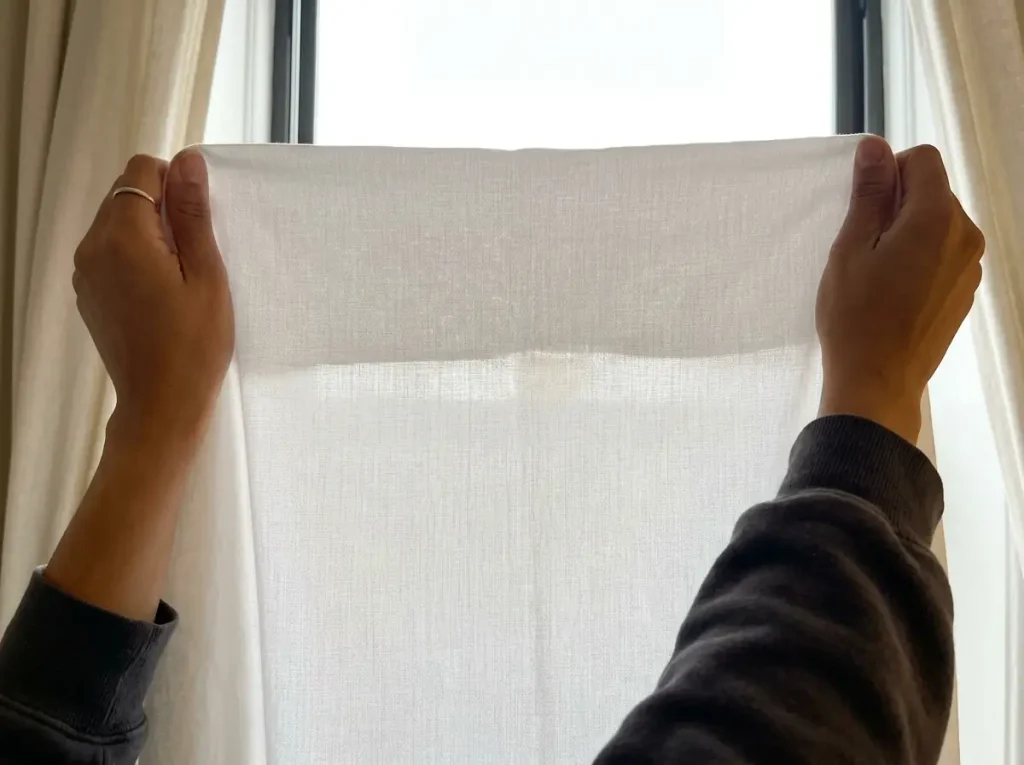
The fastest structural test is not looking at the sheet, it is holding it up to a window. A weave that has thinned over the hip and shoulder shows as a brighter panel long before it shows as a hole, and that brighter panel is exactly where the sheet will tear in a stranger’s washing machine. Bright panel means pile three, even when the sheet looks whole flat on the bed.
That window test is worth doing on a dry sheet rather than one fresh out of the wash. Damp cotton swells and closes the weave, and a thin sheet held up wet reads as sound. Give it a day folded first.
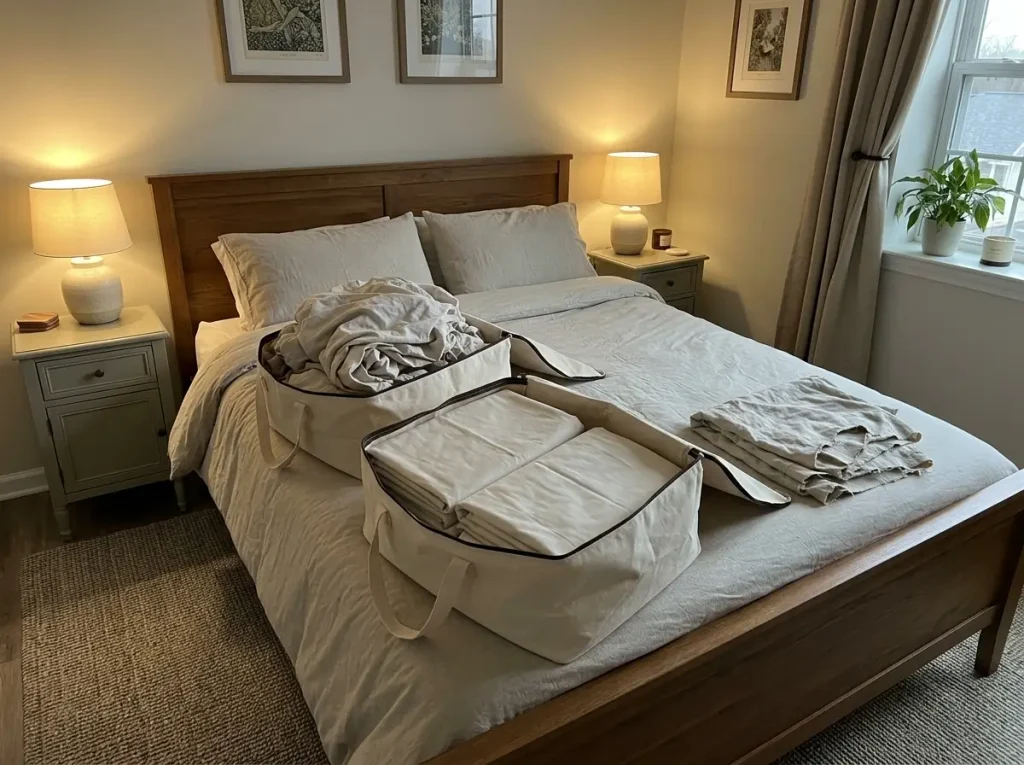
Once the three piles exist, the job is keeping them three piles between the bedroom and the door, which is where the whole system quietly falls apart. A knotted plastic garbage bag does two things wrong at once: it mixes the piles the moment somebody lifts it by the wrong corner, and it seals in whatever moisture the load already has.
A set of 2 Pack Cotton Storage Bags for Duvets, Blankets is 10oz cotton canvas with a three-zipper closure and a king/queen footprint, which is enough to hold a full stripped bed’s worth per bag and breathe while it sits in a trunk in the sun. The flaw is worth saying plainly: it is not airtight, so one damp item inside contaminates everything around it exactly as it would in any other bag. It carries and separates a sorted pile. It does not rescue a piece that already failed the dry test.
The Doors Nobody Lists
Those two destinations cover most of a stripped bed, and they are also the reason people conclude there is nowhere left to take the rest. The list of places that want household textiles is considerably longer than the two names everybody repeats.
Where people actually sleep on them
Homeless shelters and transitional housing are a separate channel from thrift stores entirely, because there is no resale step. The sheet arrives and goes on a bed. Demand is not theoretical either: US homelessness rose roughly 18% in the most recent federal count, which is why shelter bedding need gets described as persistent rather than seasonal.
The size detail nobody publishes: twin and twin XL are what run short, because cots and bunks take twin. A queen set is welcome and a twin set is genuinely useful, and if you have both, lead with the twin.
Red Cross and similar disaster-relief partnerships run scheduled home pickups through GreenDrop, a licensed partner that does the collecting and sorting on the charity’s behalf. This is the answer for anybody who has the sheets and not the car, and it also explains a small mystery: calling the charity about whether they take X sometimes gets a different answer than the drop box does, because they are not the same operation.
Where they stop being bedding
An r/Anticonsumption thread crowdsourced destinations well past the obvious two, and the list is more interesting than it sounds: pet and wildlife rescues, bird refuges, community theaters that want flat sheets for set dressing and drop cloths, and community gardens that use them as shade cover over seedlings. The moment somebody discovers a local theater wanted their old flat sheets, “donate” stops meaning “one national charity or nothing.”
Textile recycling drop-offs at retail chains and municipal programs take pile three when no shelter nearby wants it, and this is the route that closes the biggest gap in the whole system.
The EPA’s own figures for textile waste put the 2018 recycling rate for sheets and pillowcases at 15.8%, against 11.3 million tons of textile waste landfilled that year. Roughly five of every six old sheets go into the ground instead of back into the material stream. That is not a moral failing on anybody’s part. It is what happens when the default is a trash bag and the alternative takes a phone call.
And for the single piece nobody will take at all, the San Jose municipal recycling guidance has the zero-trip answer: a sheet genuinely past donating is still the best drop cloth you will ever own for painting. Free, immediate, and it delays the landfill by another year or two.
Giving them away without a charity at all
Buy Nothing groups, Freecycle, Craigslist’s free section and Facebook Marketplace are the fastest route for a set that is perfectly good and simply not yours anymore. No intake hours, no category policy, no drive. Post a photo, say the size, and somebody who needs a queen set this week collects it from a porch.
I would reach for this one first for anything in pile one, honestly, and it took a while to come round to that. The instinct is that a real charity is the more serious act. But the sheet reaches a person who needs it tonight rather than a sorting table, a rack, and a price sticker, and the pile-one set is exactly the kind of thing that moves within an hour.
Shelters and rescues almost never put a bedding wish list on the front page of the site. It lives on a page called “wish list” or “ways to give”, it is often months out of date, and the answer changes with whatever arrived that week. Phone, do not browse. Ninety seconds on the phone beats twenty minutes on a website that was last edited in 2023.
The Fitted Sheet Is a Different Problem
One piece of the set fails on its own schedule, and it is the piece that condition sort above handles worst, because nothing about a dead elastic corner is visible while the sheet is folded.
Elastic ages on a clock that has nothing to do with the woven fabric around it. Every trip through a hot dryer cooks it a little, every corner-stretch over a mattress loads it, and time alone degrades it whether the sheet is used or sitting in a closet.
The result is a fitted sheet whose cotton face is in better shape than the flat sheet lying next to it while the corners are completely finished. The flat sheet looks donation-ready and is. The fitted sheet looks donation-ready and is not — and only one of those two will embarrass the person who receives it.
The failure stays invisible until the sheet is on a mattress, which is exactly when it announces itself: the corner pops off the first night in its new home. People report this constantly and always with the same shape of surprise, that the flat sheet still looked fine while the fitted sheet had been quietly unusable for months.
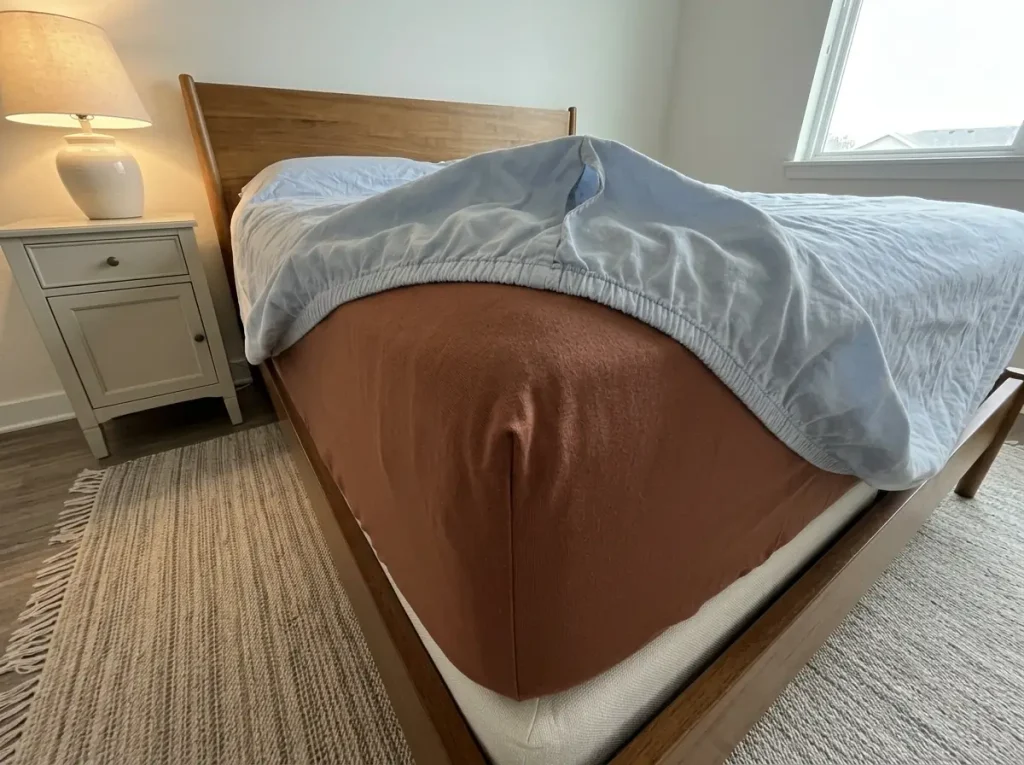
The test takes ten seconds and it has to be done on a bed, not in your hands. Pull one corner over the mattress, then walk round and tug the diagonally opposite corner.
If the first corner lifts off, the elastic has lost its recovery. That is the whole test. A corner that lifts under a tug will lift under a sleeper.
A fitted sheet that fails it is still a good pile-three donation, and this is the part worth holding onto. A shelter lining a kennel does not care whether it grips a mattress. Dead elastic ends a sheet’s life as bedding; it does not end the fabric.
The reason it died first is a construction decision made before you bought it. Most budget sets run elastic only at the four corners, which means four points absorb every bit of tension the whole sheet ever sees. Something like the Queen Size Fitted Sheet, Strong All-Around Elastic & 4-Way Stretch runs elastic around the entire perimeter and pairs it with a 4-way stretch knit rated to 16-inch mattresses, so the load spreads across the whole hem instead of loading four points — which is the spec that decides whether the next fitted sheet outlives its flat partner or dies three years early. Its flaw: all-around elastic costs more than corner-only, and on a thinner-than-average mattress it can feel over-tight at the short corners until it settles after the first wash.
That is one number to check on a package. Full perimeter or corners only. It is almost never on the front of the box.
Make the Trip Count
Sorting solves what goes where. The last thing standing between three tidy piles and an actual drop-off is a handful of small logistics that decide whether the bag gets accepted at the door or handed back across the counter.
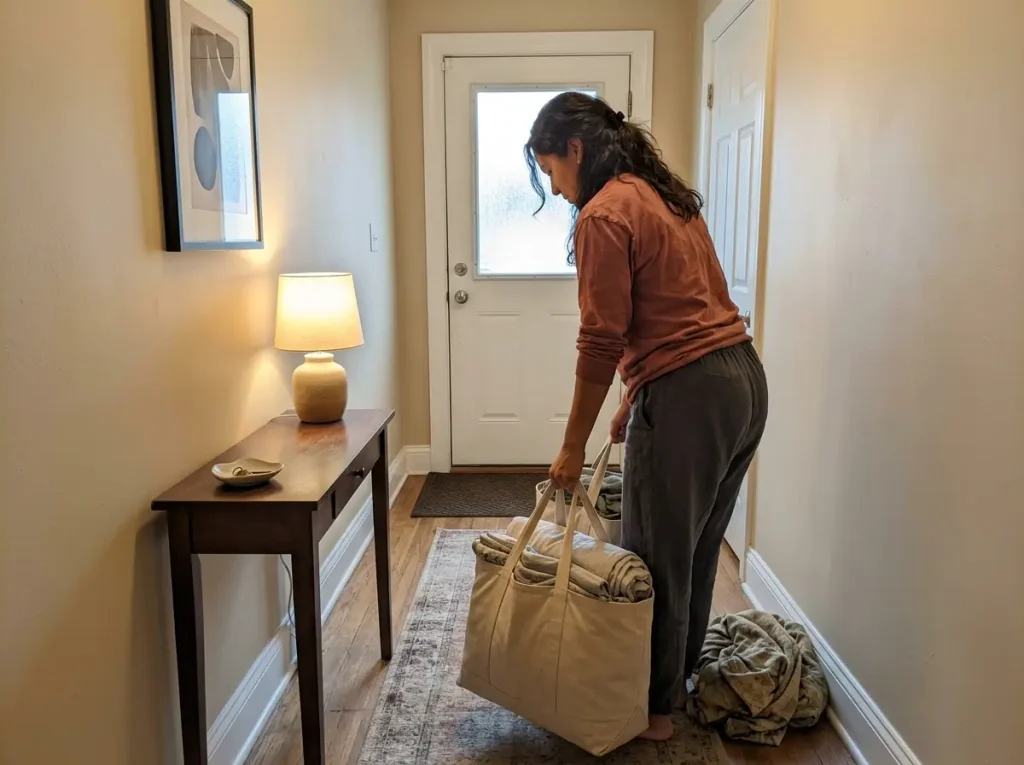
The call that saves the second trip
Call before you drive. Shelter needs turn over weekly, and a rescue that was buried in blankets in November may be asking for them in January. The same call settles whether the nearest Salvation Army takes bedding at that particular location, because the answer varies by store rather than by policy.
Ninety seconds on the phone is what turns three stops into one, and it is the step nobody makes because it feels like an imposition. It isn’t. Intake staff would far rather answer the question than sort the refusal.
Ask two things: do you want bedding this week, and what do you not take. The second question is the one that saves the trip.
Packing so the piles stay piles
Take the piles separately and label them. The intake volunteer sorts faster, and a pile-three item does not travel in the same bag as pile one and drag down the reception of everything around it. That is the practical reason for the labeling, not tidiness.
Everything travels dry, and this one rule overrides every convenience. A slightly damp pillowcase in a sealed bag on a warm afternoon becomes a mildewed bag by the time it arrives, and then the whole bag is a refusal rather than one piece.
Do not fold pile three into a matched, pressed presentation. Shelters take bedding by the armful. Time spent folding a kennel liner is time spent for nobody.
At intake, expect a fast visual check, a category question, and occasionally a no. A no on one item is not a verdict on the bag. And the last detail worth knowing is that the donation door and the retail door are usually not the same door, and the donation door closes earlier. Often a full hour before the shop does, because the sorting has to finish before staff go home.
Conclusion
Sort by condition before you sort by charity. The pile decides the door, and doing it the other way round is what produces a trunk that comes home still full.
The sheet a thrift store refuses is usually the sheet an animal shelter wants, because one is deciding whether it will sell and the other whether a dog can lie on it. The only thing both refuse is anything damp or mildewed, and that piece really is household trash.
And check the fitted sheet’s elastic separately from everything else in the set. A dead corner finishes it as bedding and leaves it perfectly good as a donation.
The wash-twenty check: hold a sheet up to a window every season or so. The day the panel over the hip and shoulder reads brighter than the rest, the weave has thinned there and the sheet has moved from pile one to pile three. That moment comes long before it tears, and catching it there is the difference between a donation and a refusal.
Strip the bed tonight and build the three piles on the mattress before anything goes into a bag. Then make one phone call. That is the whole job.
Frequently Asked Questions
01Can I donate used bed sheets to Goodwill?
Yes. Sheets, comforters and bedspreads are accepted when they are clean and dry. Bed pillows, mattresses and mattress toppers are refused outright, and so is anything wet, mildewed or used as a rag. The refusal is by category, not by how worn the item is.
02Should you donate or throw away old sheets?
Donate or recycle first. The EPA measured a 15.8% recycling rate for sheets and pillowcases, so throwing away is the default outcome rather than the correct one. A sheet too worn for a charity is still wanted by an animal shelter or a textile recycling program.
03Where is the best place to donate sheets?
It depends on condition. Clean and intact goes to a human charity or a homeless shelter, where twin sizes are shortest. Worn, stained or torn goes to an animal shelter or a textile recycler. Call first either way, because needs change week to week.
04Do animal shelters take stained or torn sheets?
Yes. Most take sheets in nearly any condition, including stains, holes and fading, as long as they are dry and free of mold. What they refuse is stuffed comforters and quilts, because an animal that chews the cover can swallow the filling.
05What can I do with old sheets nobody will take?
Drop cloths for painting, shade cover in a garden, rags, or padding for moving furniture. Past that, a textile recycling drop-off accepts fabric that is beyond reuse as long as it is dry. Landfill is the last resort, not the first.




Tried it on your own bed?
No comments yet. Tell us what you changed, and what the sheet did after a few washes.