







What’s in here8 sections
Somebody opened a thread in r/Bedding with the exact confusion most people have: “I either see 1-2 years, or 20+ years, very few in the middle. Do they either die young or live forever?” Both numbers are true, and that is the problem: they are not measuring the same thing. A guest-room set washed once a month and a nightly set washed every Sunday can be four years apart on the calendar and identical in the only unit that matters, which is how many times they have been through hot water and a dryer. So here is how long bed sheets last in real terms: the honest range by quality tier, why the wash count beats the calendar every time, and how to tell a set that is tired from a set that is finished.
Quick Answer
Budget and blend sheets in nightly use last 1 to 2 years. Well-cared-for cotton percale or sateen runs 3 to 5 or more. But wash count and wear signs decide it, not the date on the receipt: judge at twenty-plus washes by pilling, thinning, dead elastic and yellowing that will not come out.
The Real Range, Tier by Tier
The honest answer is a range wide enough to be useless until you know which end you are on, so start by placing the set you already own. A budget blend and a well-made percale are not on the same scale at all, and treating them as one number is why the internet gives you “one to twenty years” and calls it advice.
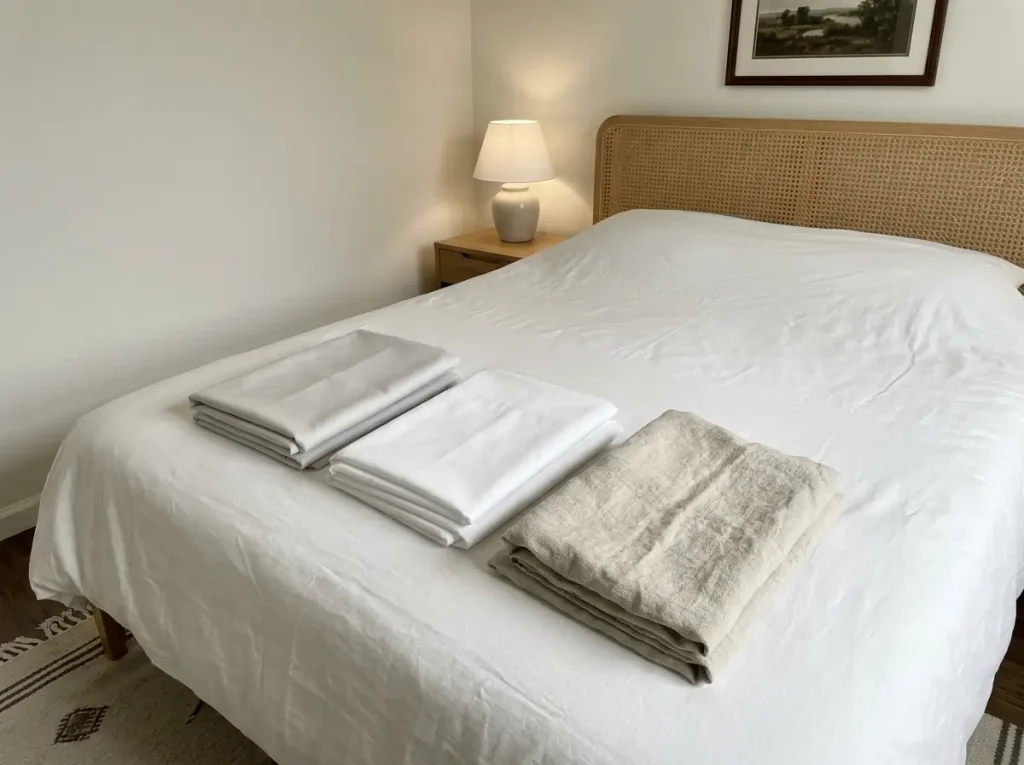
A budget or cotton-poly blend in nightly use, washed weekly, gives you one to two years. The weave starts feeling off well before the second birthday. Around eighteen months you notice the hand has gone slightly limp and the crispness never comes back after a wash. Good 100% cotton with a tighter weave and longer staple holds up two to four years, and a careful percale reaches five or more. That gap reframes the whole purchase: one real percale set can outlast three budget sets, which means the cheap-set-every-year cycle a lot of people accept as normal is a choice, not a law of nature.
Linen is not on this scale at all: linen runs on a completely different clock, banded by GSM, where eight to fifteen years is ordinary rather than remarkable. Inside the cotton tier, percale outlasts sateen, and the float length is why. Those are two sentences and two links on purpose. The mechanism belongs to those articles; the threshold belongs to this one.
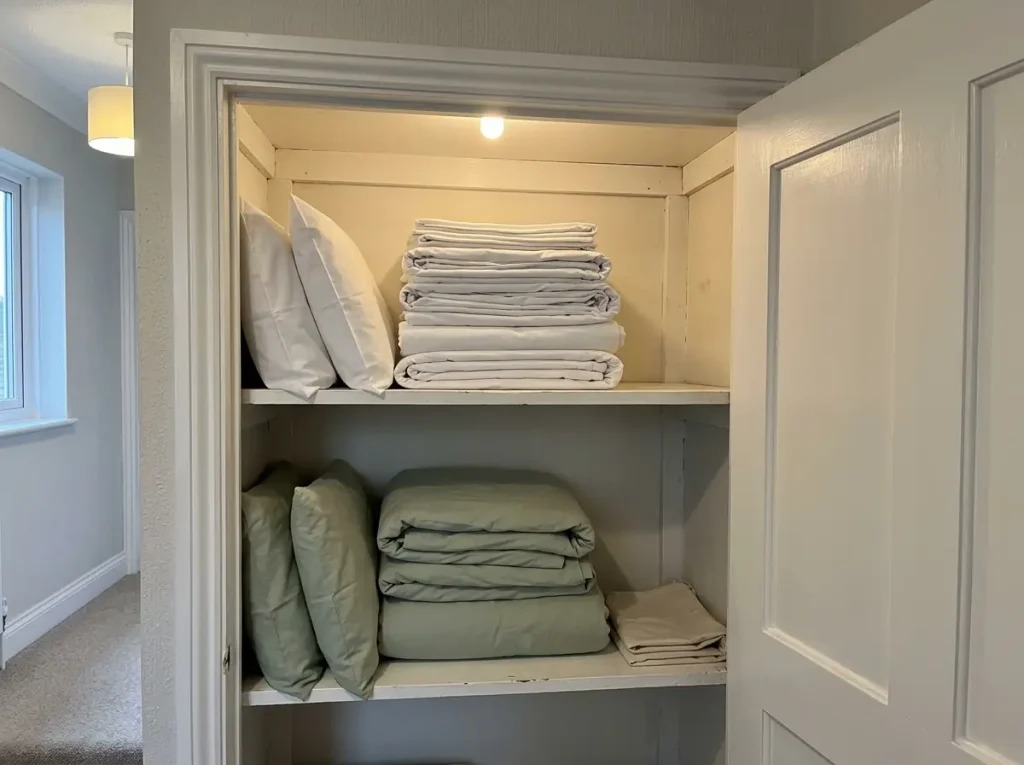
Here is the part nobody prints on the box: the tier does not announce itself. What tells you is how the set behaved at the first wash. A blend that came out of the machine slightly slick, already lying flat and smooth without any help, is telling you there is polyester in there doing the smoothing. A cotton that came back wrinkled and needed shaking out and a hand-smooth over the mattress is telling you it is cotton. One of those is on the two-year curve and one is on the five-year curve, and you knew which on day two.
Write the month on the care label of every new set with a laundry marker. It takes four seconds and it settles every future argument about whether these are the ones from two summers ago or the ones from last spring. Sheets have no birth certificate and memory is generous to bedding you like.
That same r/Bedding thread holds sets “going on 10 years” sitting right next to sets that gave out inside two, and the people reporting both are describing the same fiber. The split is not fate. It is the tier plus everything in the next section. If you are buying at the far end of the range on purpose, the Feather & Stitch 100% Cotton Percale Sheet Set is what that end looks like: 100% cotton, percale weave, 300 thread count in a 16-inch pocket, and buyers who have run it through repeated cool washes report no pilling at all, which is the percale float length doing the work. Quality percale costs more up front than a blend set does, and the gain is not on the receipt: it is in the two budget sets you do not buy afterward.
Count Washes, Not Years
Every number in the section above is a calendar number, and the calendar is the wrong instrument. It measures how long you have owned the sheets, not how much has happened to them.
Cotton bedding shows its first visible wear signs somewhere between 50 and 75 wash cycles. High-grade percale takes hundreds. Lower-quality sheets pill or thin after a handful. That is the real scale, and once you have it, the year ranges stop being mysterious and start being arithmetic.
One set washed weekly logs 52 cycles a year. Split the same weekly washing across two sets in rotation and each absorbs around 26. Rotation does not just give you a spare for laundry day. It literally halves the countdown. The same set crosses the 50-to-75 band in year one on its own and somewhere in year two with a partner.
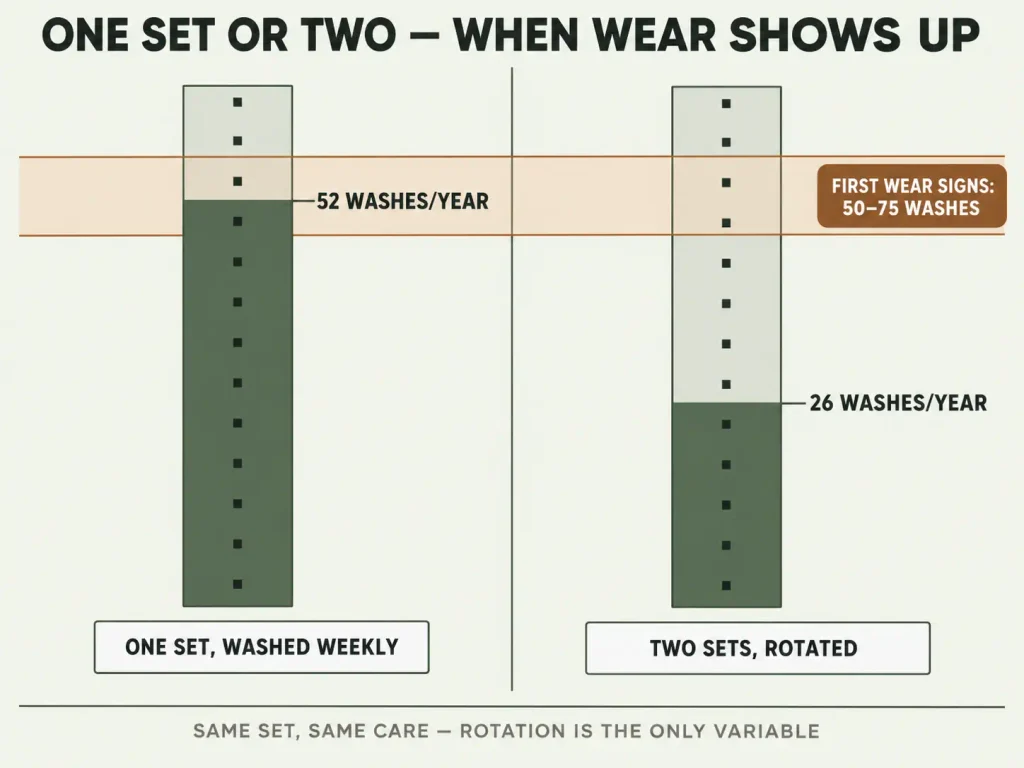
Run the same math on a household and it explains everything. A guest-room set washed monthly may not reach fifty washes in four years. A child’s bed washed weekly, sometimes twice, gets there inside one. Two identical sets bought the same week, put in two different rooms, are four years apart in wear and zero days apart in age. If you want the set-count side of this worked out properly, how many sets you actually need, season by season does that math; here the point is only that the number of sets changes the clock.
And then the settings, which are the biggest single lever nobody thinks about. A sheet washed weekly in hot water and dried on high reaches the end of its life about 40% faster than the identical sheet washed cool and dried low or line-dried. Forty percent. That is more damage than the sleeping does. Heat is what breaks cotton down and what cooks the elastic, and it is a dial you already own.
There is a wrinkle in the wash-count model, and it is worth naming because it is where the guest room fools people. A guest set can feel finished after eight years despite having been washed forty times, while the main-bed set feels fine at two. The guest set was washed forty times and stored for the other seven and a half years, and storage does its own quiet damage, particularly to elastic, which ages sitting in a dark closet doing nothing. No cycle counter records that.
Tired or Finished — the Four Signs
There is a real line between a set that looks worn and a set that is actually done, and most people replace on the wrong side of it. Either they toss sheets that had two good years left, or they keep sleeping on something that failed months ago and blame the mattress.
Four signs are structural, which means the cloth itself has changed and no treatment brings it back:
- Thinning you can see light through, patchy translucence, not the even glow every woven fabric has
- Pilling that survives repeated washes, pills that come back after you shave them off
- Elastic that no longer holds a corner, covered on its own below, because it is a separate clock
- Discoloration that survives a full wash cycle, including an oxygen-bleach soak
Two or more of the four means replace. One alone is usually still fixable, and that rule is the whole reason to separate these from the cosmetic list.
Cosmetic and fixable is the shorter list and the more common situation: dulled color, minor surface pilling that a cheap fabric shaver handles in ten minutes, a crease that will not press out, and yellowing that lifts with an oxygen-bleach soak. The r/Bedding regulars treat persistent yellowing in the sleeping zone with an hour in OxiClean White Revive, or a few drops of Mrs. Stewart’s bluing agent in the wash, before they write a set off. Both are cheaper than a set and both work on discoloration that a normal cycle leaves behind.
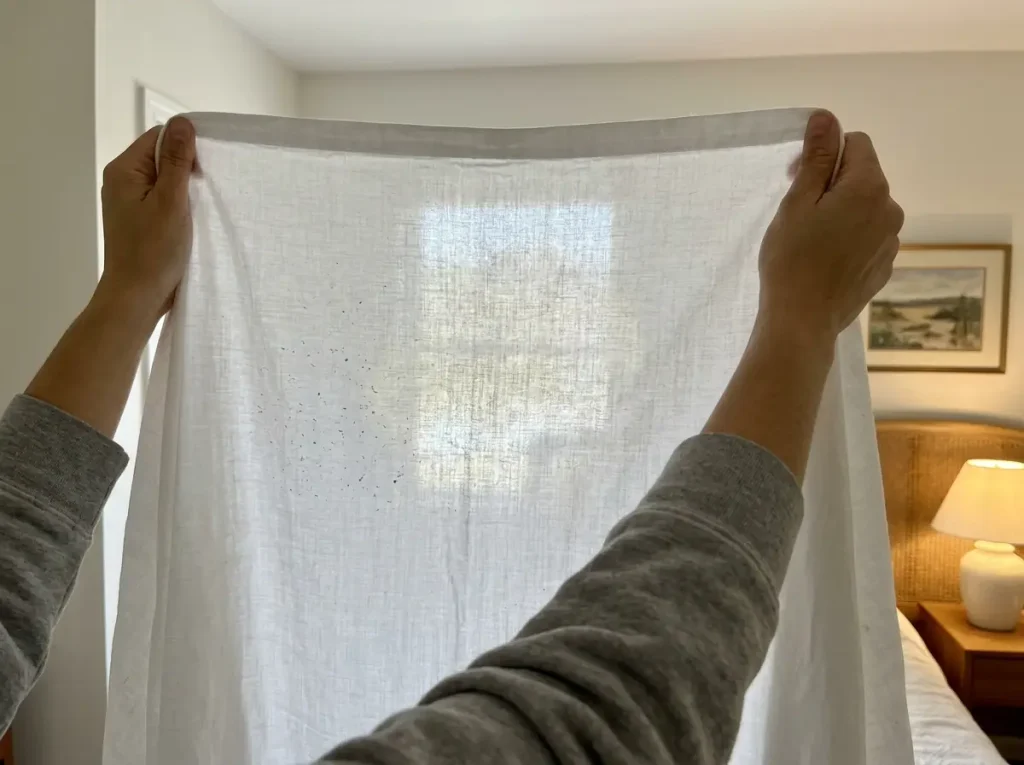
The test itself takes thirty seconds and you can do it tonight. Hold the middle of the flat sheet up to daylight. Even translucence across the whole panel is just what woven cotton looks like backlit. Patchy translucence, brighter in some places than others, is structural, and it means the yarns have thinned unevenly where something has been rubbing them.
Do the window test on the fitted sheet too, but stretch it flat over the mattress first and look down at it in the morning light instead of holding it up. A fitted sheet has been under tension its whole life, and the thin spots only open up and show when it is pulled to the shape it actually lives in. Held slack in your hands it looks fine right up until the week it tears.
Now the detail that saves you from checking the wrong place. The thin patch shows up in the middle third of the flat sheet and slightly off-center, where a hip or a shoulder has been parked for a few thousand hours. The hems and the sides show nothing at all, and they will keep showing nothing long after the middle has given up. Checking the corner tells you exactly nothing about the sheet.
There is one exception to that, and it is worth thirty seconds of your time while you have the sheet in your hands. Run a thumb along the hem stitching and the side seams. Fraying at a hem, or stitching that has started to pull open along a seam, is structural, but it is structural in a way the window test will never catch, because the panel either side of it can still be perfectly sound. It is also the one failure on this list worth repairing rather than replacing: a seam that has let go on an otherwise good sheet is twenty minutes on a sewing machine, where a thin middle third is not fixable by anybody.
Splitting failure into structural and cosmetic is not my idea originally. It is the generalization of something the fiber side already worked out, that microfiber runs two clocks at once, structural and comfortable, and a set can be years from a hole while being months past pleasant. That turns out to be true of every fabric, not just microfiber. And when a listing says “resists pilling,” there is a real lab behind that phrase if anyone cared to point at it: the repeated-laundering pilling tests the industry actually runs exist, they are standardized, and almost no consumer listing cites one.
The Elastic Goes First
In a lot of sets nothing about the cloth has failed at all. The fitted sheet just stopped staying on the mattress, and that is a different failure with a different fix and a much cheaper answer than the one most people reach for.
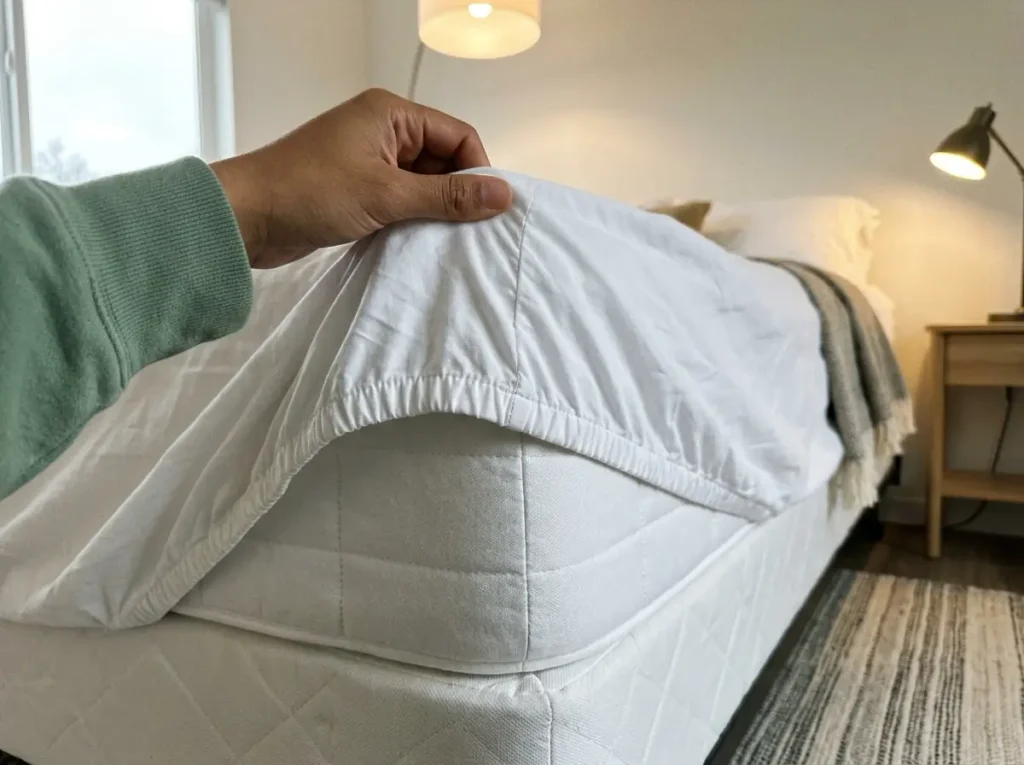
Elastic degrades from heat, age and repeated stretching, on a schedule of its own that has nothing to do with the weave. It is a construction issue that often coincides with general fabric fatigue without being the same clock: the band and the cloth are two materials aging in the same machine at different rates. Hot washing and high-heat drying do the damage twice over: the same cycle that wears the cotton is actively cooking the rubber, and rubber loses first.
The free fix comes before the purchase, and for most people it is the whole answer. Wash the fitted sheet cooler than habit. The elastic is the part of the set that cares most about temperature, so if you only change one setting, change it for that piece. Then clip the corners. GORILLA GRIP fitted bed sheet holders are elastic straps that stretch across the underside and pull the corners down; they cost pocket change, they stretch up to 25 inches, and they work on a set whose cloth is otherwise fine. That’s it. No purchase of a sheet required.
When the elastic really is gone and the flat sheet and cases are still good, replacing the one failed piece beats replacing four. A Queen Size Fitted Sheet with strong all-around elastic and 4-way stretch has the band running the full perimeter rather than gathered only at the corners, which is what stops the migration in the first place; it fits mattresses up to 16 inches and carries OEKO-TEX certification. Its flaw is honest and worth saying: it is still a new fitted sheet. If the flat sheet and pillowcases are also showing two of the four structural signs, this fixes the corner and nothing else.
Worth knowing before you diagnose anything: fitted sheets fail before flat sheets from the identical set. More mechanical stress, more friction, more weight on them all night. Somebody in that r/Bedding thread has 1960s top sheets still going while the bottom sheets of the same vintage gave out decades ago. Same purchase, same closet, two completely different lifespans.
And here is how you tell the elastic from the mattress, which is the mistake underneath half of these. A mattress that has grown deeper, because you added a topper or the foam has expanded, pops all four corners evenly, because two inches are missing everywhere at once. A dead elastic band pops the same one corner every time, usually the one on the side that gets slept on. Four corners is a measurement problem. One corner is a materials problem.
Before you decide the fitted sheet is finished, measure the mattress with the topper on and add two inches. “Fits up to 16 inches” on a package means the elastic will reach 16. It does not mean it will stay there. Half the corner pops blamed on dead elastic are two inches of mattress the sheet was never sized for.
Two People, One Bed, Uneven Wear
Everything so far has treated the set as one object aging at one rate, which is convenient and slightly wrong. A shared bed wears in patches, and the patches are personal.
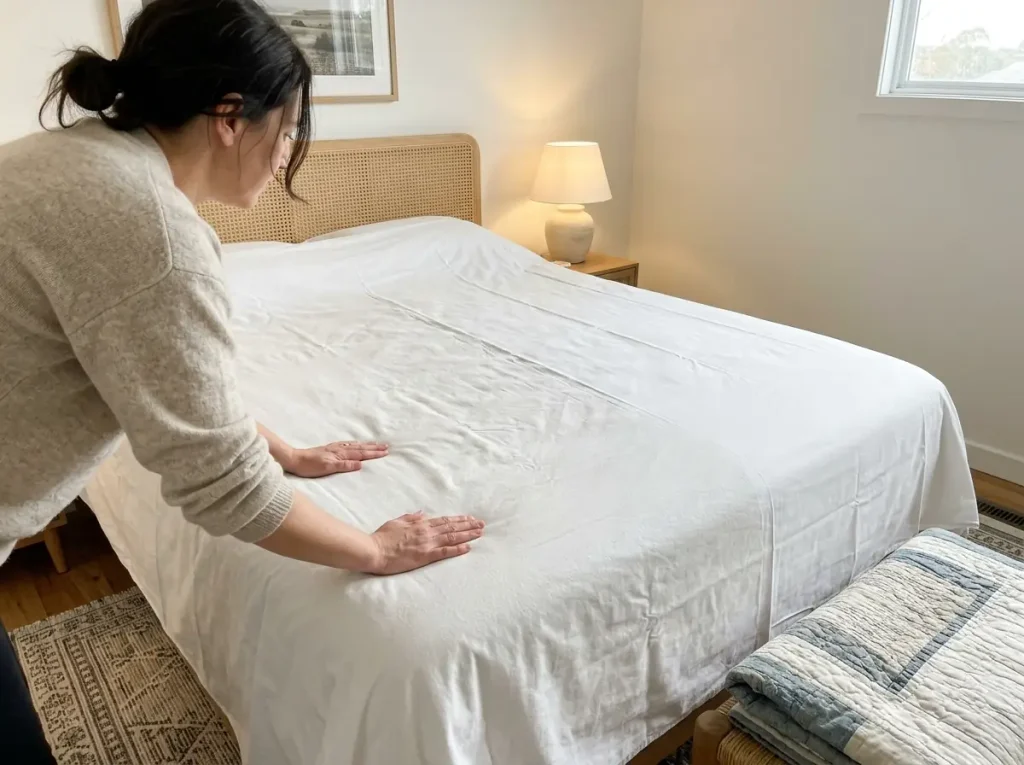
The logic is plain enough that it does not need a study, and there isn’t one: nobody has tested the two-sleepers case. But friction does not distribute itself out of fairness. The side that gets slept on catches it; a spare side, or a half that only gets used when someone visits, barely ages at all. The same sheet can be genuinely two different ages across its own width, and both halves were bought on the same day by the same person.
The r/Bedding evidence for asymmetry inside one purchase is real and worth naming precisely for what it is: those 1960s top sheets outliving their fitted counterparts show that pieces of one set run separate clocks. Extending that to the left and right sides of a shared mattress is reasoning, not research. It happens to be reasoning that holds up every time somebody actually looks.
The hot sleeper’s side compounds it further. More moisture goes into that half of the sheet every night, which means more of the wash stress lands there too, and a year of that adds up to a difference you can feel with your hand. Which is exactly how you find it, not by eye: run a flat palm across the sheet from one side to the other. The slept-on third catches slightly against your skin where the fibers have opened up. The far side still slides. Nothing about that shows in a photograph, and it is usually visible to the fingers a full season before it is visible to the eye.
The fix costs nothing and takes ten seconds on laundry day. Turn the flat sheet end-for-end and rotate the fitted sheet 180 degrees every time you put the set back on. The wear spreads across the whole panel instead of concentrating in one hip-shaped zone. You are not making the sheet stronger; you are refusing to let one third of it do all the work.
What Actually Extends the Number
Almost every lever that buys a set another year is something you do in the laundry room, and it is free. The things you can buy help, but they help less than the settings you already control.

Free, and the biggest by a distance: wash cool, dry low or line dry. Hot wash plus high-heat dry costs around 40% of the sheet’s life, which is the single most useful number in this whole article. Free, and second: rotate two sets rather than running one into the ground. That halves the cycles each set absorbs. Between those two changes you have roughly doubled how long a set lasts without spending anything, which is worth sitting with before reading the rest of this section.
Load size and detergent are the quieter levers. A load with room to move abrades less than a stuffed drum. Sheets rubbing against each other under pressure for forty minutes is a form of wear, and it is why an overloaded machine ages a set faster than a half-empty one. A mild, dye-free detergent is the other half; Seventh Generation Concentrated Laundry Detergent, Free & Clear has no fragrance, no dyes and no optical brighteners, which are the additives that sit in the fiber rather than leaving with the rinse. Being concentrated, it invites overdosing out of habit if you are used to the regular stuff, and more detergent does not clean better, it just leaves more residue in the weave. If sweat is the reason you are washing this often, the order to wash things in when sweat is the problem covers the sequence properly.
On the temperature question there is one number that pulls the other way, and it is a laundry mechanic, not a health promise. A wash only removes dust mites at 130°F or above, the threshold the AAFA gives for washing bedding. Below that the wash cleans the fabric, which is a different job. So there is a genuine trade-off: hot washing costs sheet life and cool washing does not clear mites, and where you land on it depends on your household rather than on a rule. And the boundary, said once and left there: a rash or a reaction that persists, spreads, or comes with fever or swelling is a question for a doctor rather than a laundry question, regardless of how new or old the sheets are. No wash setting and no new set is the answer to that one.
Now the layers, which come after the free changes because they cost money and do less. A mattress protector takes the friction, the oils and the moisture the sheet would otherwise absorb, and the Nestl Premium Cotton Terry Mattress Protector has a cotton terry face over a TPU backing, so the absorbing side is cotton rather than plastic. Its flaw: the terry face reads noticeably thicker under a fitted sheet, and anyone sensitive to texture notices it for the first few nights. A pillow protector does the same job one layer up, and a FAUNNA 600TC cotton pillow protector 4-pack is 100% cotton with a silent zipper, though a four-pack is genuinely more than a two-pillow bed needs, and the per-unit advantage evaporates if half of them sit unopened in a closet.
The protector is also the piece nobody replaces on schedule, and it fails silently. The waterproof backing stiffens with age and starts to crackle faintly when you press down on the mattress. From the moment you can hear that, it has stopped absorbing anything and started trapping heat instead: the one component in the bed whose failure makes the bed hotter rather than looser.
Put the off-season set away completely dry and completely cool, not warm out of the dryer. A folded stack that goes into a bag with any residual dryer warmth traps its own moisture as it cools, and that is where the faint stored-linen smell and the yellowing at the fold lines come from. Leave the stack out overnight before it goes in the bag.
Storage closes the list. The set that is out of rotation should go in a breathable cotton bag, never a sealed plastic bin: trapped moisture is what yellows a stored set, and a sealed container guarantees the moisture stays. Cotton storage bags in 10oz canvas with a three-zipper opening hold a king or queen set and let the air through. What cotton canvas will not do is protect against moths or against damp in an unventilated basement, so it still needs a dry place to sit.
Conclusion
Stop counting years and start counting washes. Cotton starts showing between 50 and 75 cycles, one set washed weekly logs 52 a year, and putting two sets in rotation halves how fast you get there, which is the cheapest year of extra life available to anyone.
Two of the four structural signs means replace; one means fix. Hold the sheet to a window before you decide, and when a corner pops, check the elastic before you condemn the cloth. Most of what gets thrown out for “looking old” was cosmetic, and most of what gets kept too long failed in the middle third where nobody looks.
At around twenty washes, hold the middle third of the flat sheet against daylight. That is where the answer shows up first, and it is the reading that tells you which curve your set is actually on: the one that dies young or the one that lasts.
Hold your flat sheet up to a window tonight. If the light comes through evenly, you have got another year in it. Put the set into rotation with a second one, drop the wash temperature, and buy nothing.
Frequently Asked Questions
01How often should you replace bed sheets?
Every 1 to 2 years for budget blends in nightly use, and 3 to 5 or more for good cotton that gets washed carefully. The count of washes decides it, not the date of purchase. A monthly-washed guest set outlives a weekly-washed main set by years.
02How many washes do bed sheets last?
Cotton shows its first visible wear signs between 50 and 75 wash cycles; high-grade percale runs into the hundreds. Weekly washing on a single set logs 52 cycles a year, so one set alone reaches that band inside the first year.
03How do you know when sheets are worn out?
Four signs are structural: thinning you can see light through, pilling that survives repeated washes, elastic that no longer holds a corner, and discoloration that survives a wash. Two or more means replace. Hold the middle of the flat sheet to daylight and look for patchy translucence.
04Should you replace the whole set when the fitted sheet fails?
No. The elastic runs its own clock and usually gives out before the cloth does, so try corner clips and a cooler wash first, then a single replacement fitted sheet with all-around elastic. Fitted sheets take more friction and weight than flat sheets from the same purchase.
05Does washing sheets more often wear them out faster?
Yes by cycle count, but temperature does far more damage than frequency. A hot wash with a high-heat dry ages a sheet around 40% faster than the same sheet washed cool and dried low, so the settings matter more than the schedule.





Tried it on your own bed?
No comments yet. Tell us what you changed, and what the sheet did after a few washes.