







What’s in here6 sections
It is laundry day, the sheet is out of the dryer, and you are holding it up to the kitchen lamp because something about the middle of it looked wrong on the bed. You can see the outline of your own hand through a patch of it. You already know that is bad news; what you do not know is whether it is fixable.
Here is the part almost nobody says out loud. Pilling is loose fiber tangled on top of a weave that is still completely whole, which is exactly why a shaver takes it off and the sheet survives. A thin spot is the opposite event: the weave has gaps because the yarns that built it have snapped.
Pilling vs thinning is cosmetic wear against structural failure, and the two have nothing in common but the word “worn.” This article covers what the hold up to light test actually tells you, why the location of the damage flips the verdict, what wore it through in the first place, and what one hole says about everything else in the set.
Quick Answer
A thin spot you can see light through, or an actual hole, means the yarns have broken. That sheet is structurally finished, and no wash, softener or repair reverses it. Pilling is cosmetic and shaves off. Hem and seam tears can be mended once; a thin patch in the sleeping zone cannot.
What a Thin Spot Actually Is
Pilling and thinning get filed together under “worn out sheets,” and they are not the same event at all. One sits on the fabric. The other is the fabric failing. The difference is testable in about four seconds, and once you have run the test you stop guessing.
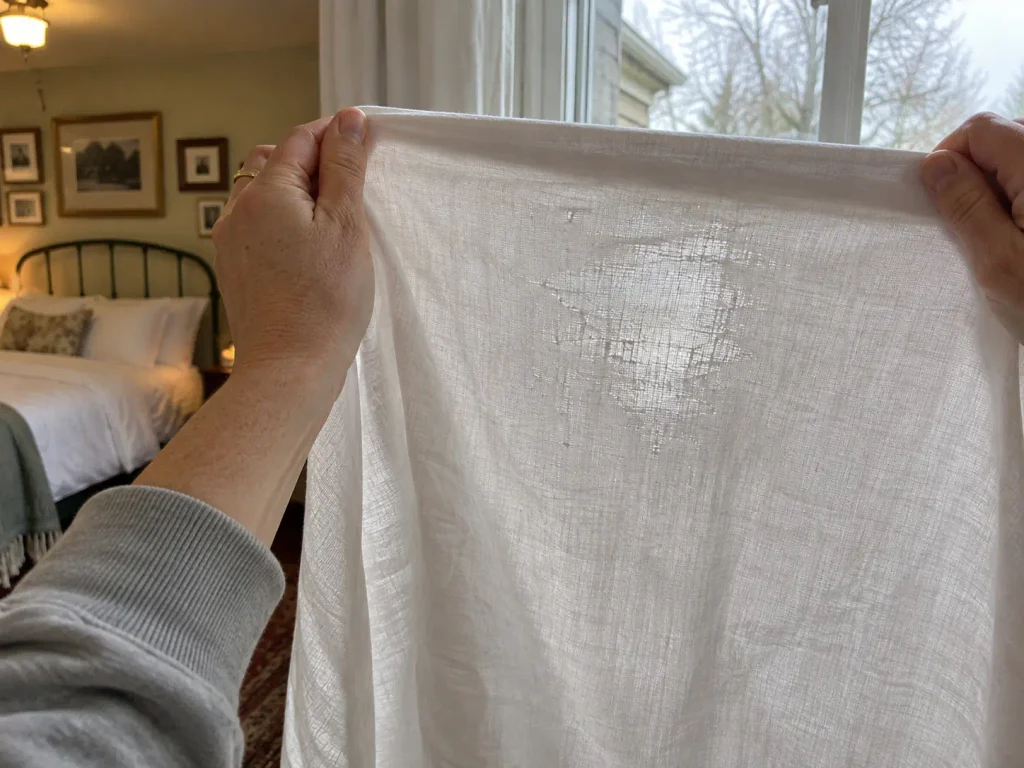
Pilling is fiber that has worked loose from the yarn, rolled into knots, and parked itself on the surface of a weave that was never damaged. That is why a fabric shaver takes the pills off without touching the weave and the sheet goes back on the bed intact. The structure underneath was never part of the problem. Annoying, cosmetic, reversible.
A thin spot is a different physical event with a different ending. The yarns themselves have abraded and snapped, and fiber abrasion at that scale is not reversible by anything you can do at home.
Zoom in far enough and what friction does to a cotton fiber at the molecular level is chain scission: the cellulose main chain fails at the glycosidic bond, crystallinity drops, and the fiber surface shows dislocations, defects and cracks. That is the whole reason washing, softening and vinegar do nothing here. There is no chain left to restore. You are not treating a stain or a finish; you are looking at missing material and a weave failure underneath it.
The light test, and it takes four seconds
Hold the sheet up to a window or a lit lamp and look at how the light comes through. An even, consistent glow across the whole panel is fabric that is simply thin by construction, which some percales are and always were.
A brighter patch, with a visible change in the weave density inside it, means yarns are missing from that spot and you are looking at see-through fabric where solid cloth used to be. Threadbare is the old word for it and it is the right one. That is not a judgment call about how the sheet feels. It is a structural verdict you can see, and it is the point of no return for that panel.
The textile industry draws that exact line and puts a number on it. Abrasion tests (Taber, Martindale, Wyzenbeek) rub a fabric sample against an abradant and count cycles until a defined endpoint is reached. According to Canvas Etc’s explainer on the endpoint abrasion tests are actually measuring, “Endpoints include yarn breakage, hole formation, or a specified change in appearance.” A hole is a measured failure event with a cycle count attached to it, not a vague sign of age.
And the community arrives at the same test without anyone teaching it. “Hold it up to the light” is the phrase that surfaces across mending and laundry threads independently, from people who have never read a testing standard in their lives. When the amateurs and the lab converge on the same four-second check, the check is good.
A thin spot does not feel thin first. It feels smooth. The nap, the tiny fuzz that gives cotton its hand, is the first thing friction takes, so the failing patch reads as softer than the fabric around it long before it reads as thinner. If one area of your fitted sheet has gone noticeably silkier than the rest, that is not the sheet finally breaking in. Take it to the window.
One more thing worth saying and then moving past: none of this explains why the fiber came loose to begin with. That is a question about staple length and weave, and it is the reason why sheets pill in the first place sits one level up from here. This article picks up at the point where the answer stops being “shave it.”
Where the Hole Is Decides Whether It Is Worth Mending
A tear at the hem and a thin patch in the middle of the bed are the same damage to the same cloth, and they get opposite answers. One sits where nothing rubs it. The other sits under a sleeping adult for eight hours a night, every night, for years.
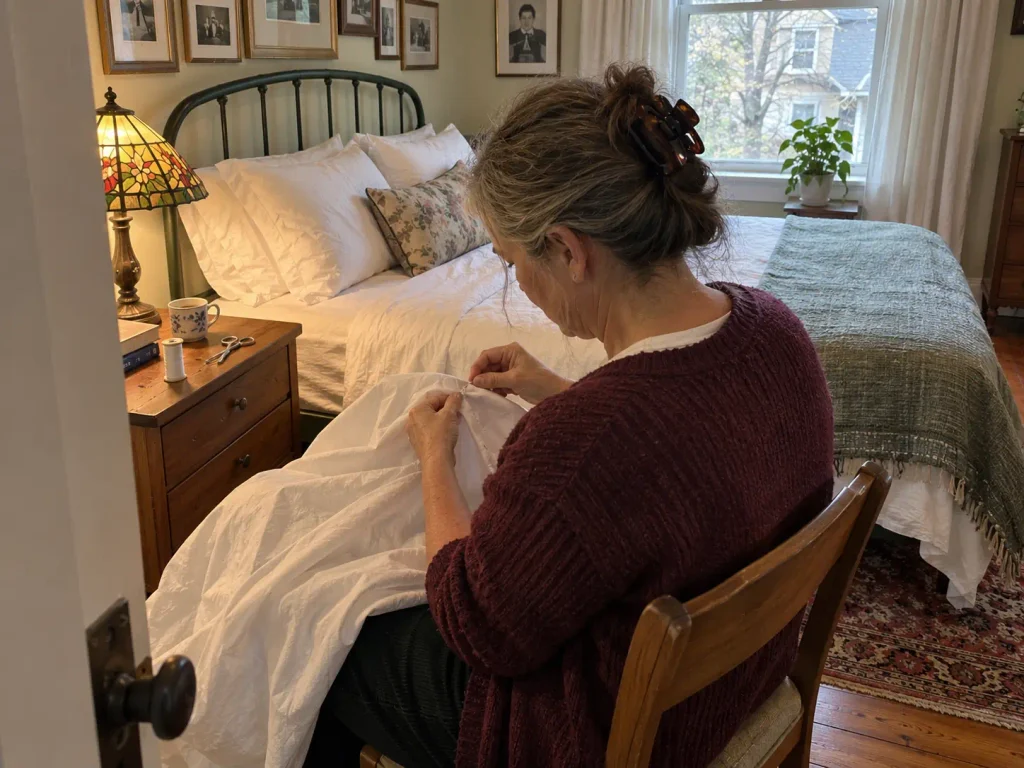
Hem, seam and corner damage: mend it, once. A hem tear or a seam fray lives outside the high-friction zone, and that changes everything about the verdict. A seam that has pulled or a hem that has torn is a construction failure, not a fabric failure, which means the cloth on either side of the damage is still sound and still has tensile strength to spare.
Stitches have something to bite into. A patch holds, a re-stitch holds, and the sheet goes back into rotation without drama. Worth distinguishing from a fitted sheet whose corners have gone slack: dead fitted sheet elastic is elastic casing failure, it runs on its own clock entirely, and the fabric is often still perfectly fine.
Sleeping-zone thinning: replace it. The middle third of the bed, hips and shoulders and the foot where feet push, is where the abrasion happened, so the cloth there has already lost most of its strength. Sleeping zone wear is not damage in one spot; it is the cloth spending its whole working life there.
Sewing a patch onto fabric that is failing gives the stitches nothing to hold. The thread is now stronger than the cloth around it, so the repair tears out along its own seam line, usually opening a hole wider than the one you set out to fix. That is not bad sewing. That is a strength mismatch, and no technique gets around it, which settles replace vs repair for the center of the sheet.
Check the layer underneath before you declare anything
If the sheet wore through in the sleeping zone, the same friction passed straight down through it. The mattress protector underneath took a version of the same rubbing for the same number of nights, so pull the sheet off and look at it before deciding the rest of the bed is fine. If it needs replacing too, a cotton-terry face is the one to look for, because a plain polyester protector is a raincoat that traps every bit of moisture the sheet passes down to it. The Nestl Premium Cotton Terry Mattress Protector has a cotton terry face over a TPU waterproof backing, and its flaw is right there in the construction: that backing makes a plastic-sounding rustle when somebody moves a lot, and it is nowhere near as breathable as the cotton face suggests, because the membrane is still a membrane.
What the menders themselves say
The honest answer on this comes from people who sew, not from people who sell sheets. On an r/sewhelp thread asking whether a hole in a fitted sheet could be saved, the reply that landed was: “Anything can be fixed, however in my opinion a thin fitted sheet is not worth the time and effort.” That is somebody with a needle in hand telling you not to bother, which carries more weight than any retailer’s replace-every-two-years line.
The one traditional repair that genuinely works has a name: sides to middle. You cut a worn flat sheet down the center through the thin patch, unpick the outer hems, and sew the two good outer edges together, so the worn middle becomes the new outer edges and the untouched edge fabric becomes the new center.
It is a real technique with real history behind it, discussed on r/Visiblemending. It also only works on flat sheets, and it puts a seam straight down the middle of the bed, which you will feel. Decide now whether you can live with that.
And one cause that is not wear at all. If holes appear suddenly, scattered, in a pattern, on sheets that are not old, look at the washer before you blame the fabric. A front loader’s drum holes can be sharp on the reverse side, and at high spin speeds fabric gets pushed through them. It comes up repeatedly on r/laundry, and the damage looks different from wear: drum holes are sharp-edged and arrive all at once, while wear holes are soft-edged and always announce themselves with thinning first.
The foot of the bed fails earlier than people expect and gets blamed on the wrong thing. It is not the mattress edge and it is not a manufacturing flaw. It is heels, which never leave the sheet and drag across the same few inches every time somebody rolls over. A set that is sound everywhere and worn at the foot is a set that was slept in normally, not one that was mistreated.
What Actually Wore It Through
Two sheets bought the same week, washed the same number of times, and one is see-through while the other is fine. The difference was decided before either of them reached the bed, by the length of the fiber and the way it was woven.
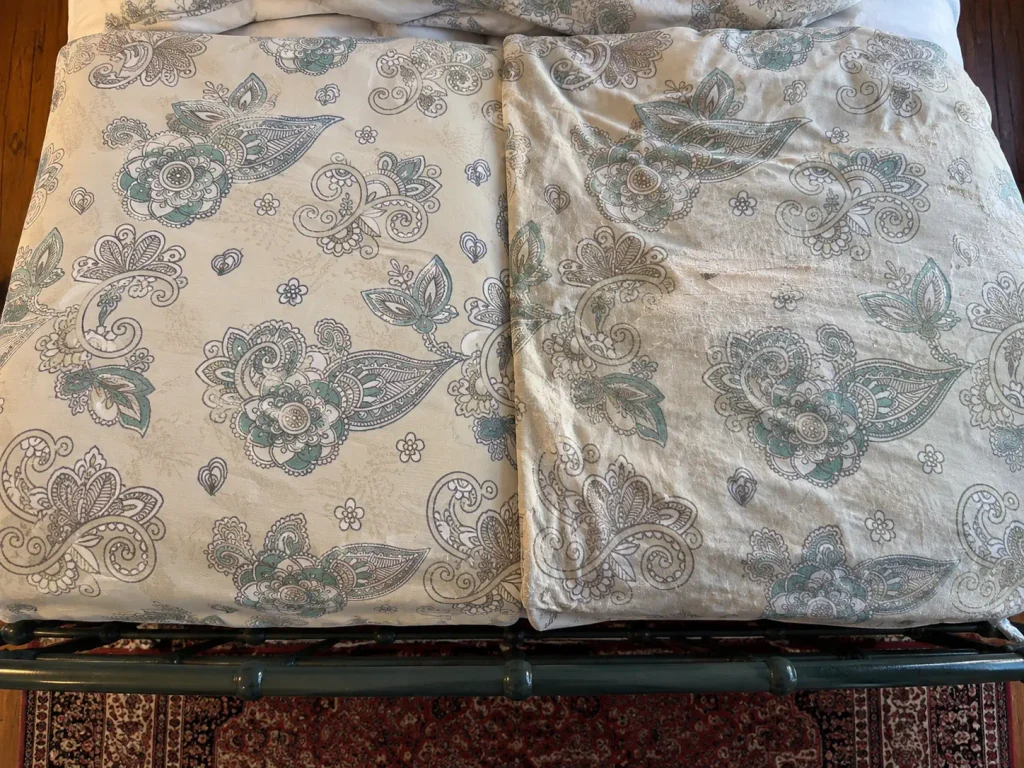
Fiber length comes first, and it decides more than anything printed on the package. Short-staple cotton means a yarn built from many short fibers with many loose ends; long-staple means fewer, longer fibers spun tighter with less to work free. Fibers with high elongation, elastic recovery and work of rupture resist abrasion best, because they flex thousands more times before anything snaps. That is staple length, which is the part the thread count never tells you, and it is the same variable that decides pilling, just seen one stage further along the road.
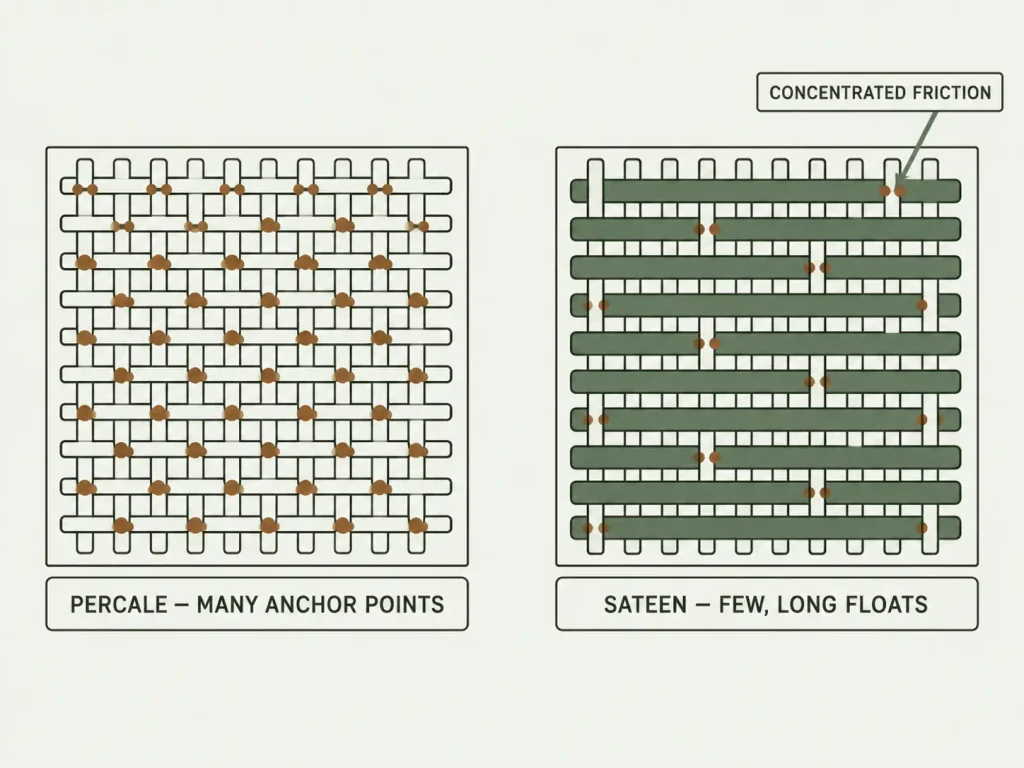
Weave comes second, and weave density decides how the rubbing gets shared out. Percale’s plain weave anchors every yarn over one and under one at both faces, so friction gets spread across an enormous number of anchor points and no single yarn carries much of it.
A sateen is a floating weave: three or four threads over one, which means each float is a long unanchored segment doing all the rubbing by itself. Same friction on the bed, far fewer points carrying it. If you want the full version of that argument, percale outlasts sateen, and the weave is the reason covers it properly; here it is enough to know it is the structure, not the price, that set your timeline.
Then there is wash heat, working quietly the whole time. Hot water accelerates cellulose breakdown, and laundry-science testing has measured double-digit cellulose loss from a single hot cycle. The damage compounds, invisibly, for as long as you keep doing it. Nothing shows until it shows.
There is no magic wash number, and here is why
The question everybody wants answered is how many washes a sheet gets before it thins. There is no universal number, and anybody printing one made it up. The industry abrasion tests count cycles to hole formation, but they count for a specific fabric at a specific load against a specific abradant. Change the fiber and the number moves by a multiple.
What you can count is your own arithmetic. Washing one set every week is roughly 52 cycles a year on that set; running two sets in rotation halves that wash count to 26. That is the single cheapest and most effective thing anyone can do about this, and it costs nothing if the second set is already in the closet, which for most people it is.
The other free fix people report is washing sheets on their own, away from towels, zips and hooks, because mixed loads get blamed over and over for accelerated wear at the contact points. Wash temperature matters on the same axis: warm instead of hot, and line drying instead of tumble dry high heat, both buy time at the far end of the timeline.
Hot-wash damage never shows on the sheet you are washing. It shows up two years later as a set that thinned “suddenly,” and the sudden part is an illusion. The yarn had been losing strength the entire time and simply crossed the line where the weave could no longer hold its shape. Warm instead of hot costs you nothing and buys the tail end of the timeline.
One Hole Means the Set Is Further Along Than It Looks
The temptation after finding one hole is to treat it as an accident. A snag, a bad wash, one unlucky spot. It almost never is, and the rest of the set will tell you so if you check it before you spend anything.
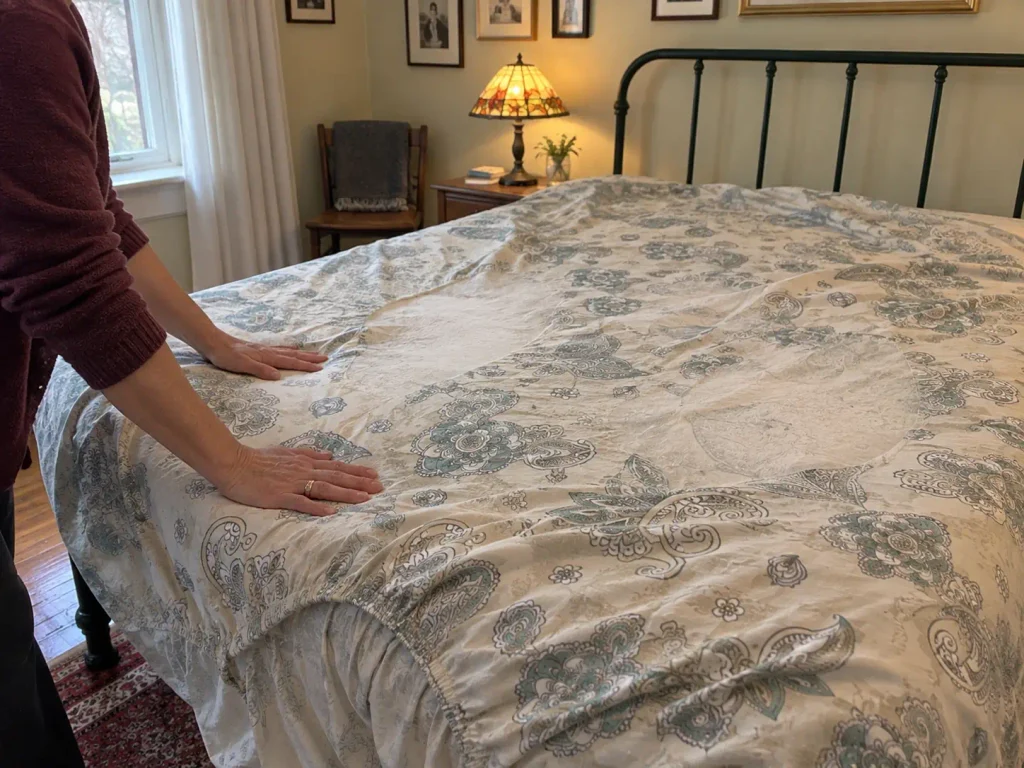
The friction was never local. Whatever rubbed that spot rubbed every other high-friction zone of the same sheet at the same rate, for the same number of nights, under the same sleeper. One hole is the first place to cross the threshold, not the only place standing near it. Most of the signs to replace sheets that get listed elsewhere are really this one sign, found in one place first.
The four-minute check before you buy anything
Take both sheets to a window. Hold the flat sheet and the fitted sheet to the light at hips, shoulders, the foot, and across both fitted-sheet corners. If two or more zones glow brighter than the fabric around them, the set is finished, whatever the calendar says and whatever how long a set should be lasting in the first place would predict. If only the one spot glows, and it sits at a hem, mend it and carry on.
The pieces of a set also do not fail together, which nobody tells you. A flat sheet floating under a duvet takes a fraction of the abrasion the fitted sheet takes underneath a sleeper. Finding the fitted sheet gone does not condemn the flat sheet; it usually has a year or more left in it, and there is no rule anywhere that says a set has to be replaced whole.
The fitted sheet almost always goes first and gets blamed for being lower quality than its own flat sheet. It is usually identical cloth. It simply spent every night pinned between a sleeper and a mattress, absorbing every one of the body movements per night that the flat sheet never felt.
Buying the next one so this takes longer
Long-staple cotton in a percale weave is the combination that resists this specific failure, because it is long fibers spread across many anchor points, which is the two variables working in the same direction for once. The Feather & Stitch 100% Cotton Percale Sheet Set is the accessible version of that: 100 percent cotton, plain weave, 300 thread count in a single ply, 16-inch pocket. Its flaw is the first-contact impression. A single-ply 300 feels closer to a budget hotel sheet than to anything plush, and the first wash does not change that.
Going further up the fiber ladder means Supima, an extra-long-staple cotton whose fibers flex more times before they break. The Tuft & Needle Supima Cotton Percale Sheet Set is 100 percent Supima in a percale weave with an OEKO-TEX certification and a 16-inch pocket, and its flaw is availability: stock on it runs thin, so it is the kind of listing that empties between publication and click.
The ELINEN 100% Supima Cotton Sheets sit in the same fiber class and stay in stock, which is why they belong in the same breath. Their flaw is the number on the box: 600 thread count reached the way high counts usually are, by counting plies, so the set lands heavier and warmer than a hotel percale. The Supima is the reason to buy them. The 600 is not.
If you want a label that actually names what it is holding, the California Design Den Certified 100% Egyptian Cotton Percale Sheet Set carries both a Good Housekeeping seal and OEKO-TEX Standard 100, which is more verifiable paperwork than most “premium cotton” sets can produce between them. Its flaw is the same one every honest percale has: out of the package it is stiff, and it stays stiff for several washes, which is exactly how many people end up returning a sheet that was going to be the best one they owned.
And linen goes further still, for a different reason. Flax fiber is longer than any cotton staple and the yarn is thicker, so the abrasion gets distributed differently and the longevity stretches into years rather than seasons.
The DAPU 100% French Linen Sheets declare 170 GSM on the listing, which is a spec most brands will not print. The flaw is not a secret and never will be: it will never look ironed, not once, not ever, and it costs the most of anything here. Before you commit to any of them, what to read on the label before buying the next set is worth twenty minutes.
One last thing people say afterward, almost without exception. They buy one good set, and then wish they had bought two, because the rotation is what would have doubled the life of the first one.
Conclusion
Hold it to the light. An even glow is thin cloth that was always thin; a brighter patch with a changed weave is broken yarn, and broken yarn does not come back no matter what you wash it in.
Mend the hem, replace the middle. A tear outside the friction zone is worth a needle and an evening. A thin spot under the sleeper gives stitches nothing to hold, and the repair opens wider than the hole.
Check the other zones before you spend. One hole is the first to cross the line, not the only one standing near it, and the difference between replacing a set and replacing one piece of it is real money over the cost per year of keeping a bed made.
After a season on whatever comes next, call it wash twenty, hold the fitted sheet to the window at the hips and the foot before you notice anything by feel. Thinning reads as smooth long before it reads as thin, and catching it at the smooth stage is what buys you the time to rotate a second set in while the first one still has life. By wash forty you will know whether the fiber you paid for was the durability you were promised.
Take both sheets to a window tonight, before you order anything. Four minutes will tell you whether you are replacing a set or one piece of it, and those are very different purchases.
Frequently Asked Questions
01Why are there holes in my bedsheets?
Usually friction breaking yarns where you sleep, after enough nights in the same high-contact zones. Two alternates worth ruling out: a front loader’s drum holes can push fabric through at high spin, and stored sheets can take pest damage.
02Do bed bugs cause holes in sheets?
No. Bed bugs feed on people, not on fabric, so they leave rust-colored spots and dark specks, never holes. Carpet beetle larvae and clothing moths do damage fabric: beetles graze scattered uneven holes, moths cluster theirs near folds and seams.
03What to do with sheets that have holes in them?
They stop being bedding and become something else. Cut them into rags, drop them at a textile recycler, or give them to an animal shelter, which will take what a charity shop turns away. Worn cotton makes better cleaning cloth than anything you can buy.
04How to fix sheets with holes?
Only at a hem or a seam, and only once: patch it or re-stitch it. In the sleeping zone the cloth is too weak to hold stitches and the repair tears wider than the original hole. Sides to middle works on flat sheets and leaves a center seam.
05How often should you throw away bed sheets?
There is no calendar answer, because it runs on wash cycles and fiber, not years. Quality cotton tends to run two to four years at weekly washing, and a two-set rotation roughly doubles that. The light test beats any date on a chart.





Tried it on your own bed?
No comments yet. Tell us what you changed, and what the sheet did after a few washes.