







What’s in here6 sections
In a r/Bedding thread, one person counts four sheet sets in eighteen months, every one of them fuzzing up the same way, the last one “pulled after 2 washes and 3 weeks of use.” If you are looking at a set that has gone bobbly faster than anything you have owned, the internet will hand you two flatly opposite answers: microfiber resists pilling, and microfiber is the worst offender on the shelf. Both are describing something real, and the word that reconciles them is printed on the bag you threw away: double-brushed. Brushing is a finishing step done after the cloth is woven, which means the softness you felt in the package and the fuzz you are looking at now were the same manufacturing decision.
So here is what the fiber actually is, why the finish pills before any wear does, what your washing adds to that, and the only question that matters tonight, which is whether this set is done.
Quick Answer
Microfiber pills because it is sub-1-denier filament polyester that gets mechanically brushed to raise a soft nap, and that brushing loosens fiber ends before any wear happens. Cotton pills the opposite way, from wear breaking short fibers. Some fuzz within a year is normal; heavy pilling within weeks is a badly finished set.
What Microfiber Actually Is, Before Anyone Sleeps On It
The intro promised that the softness and the fuzz are the same decision. This is where that stops being a claim. Before the washing, the dryer or your skin get anywhere near it, the sheet already carries one property that decides most of what follows, and almost no label prints it.
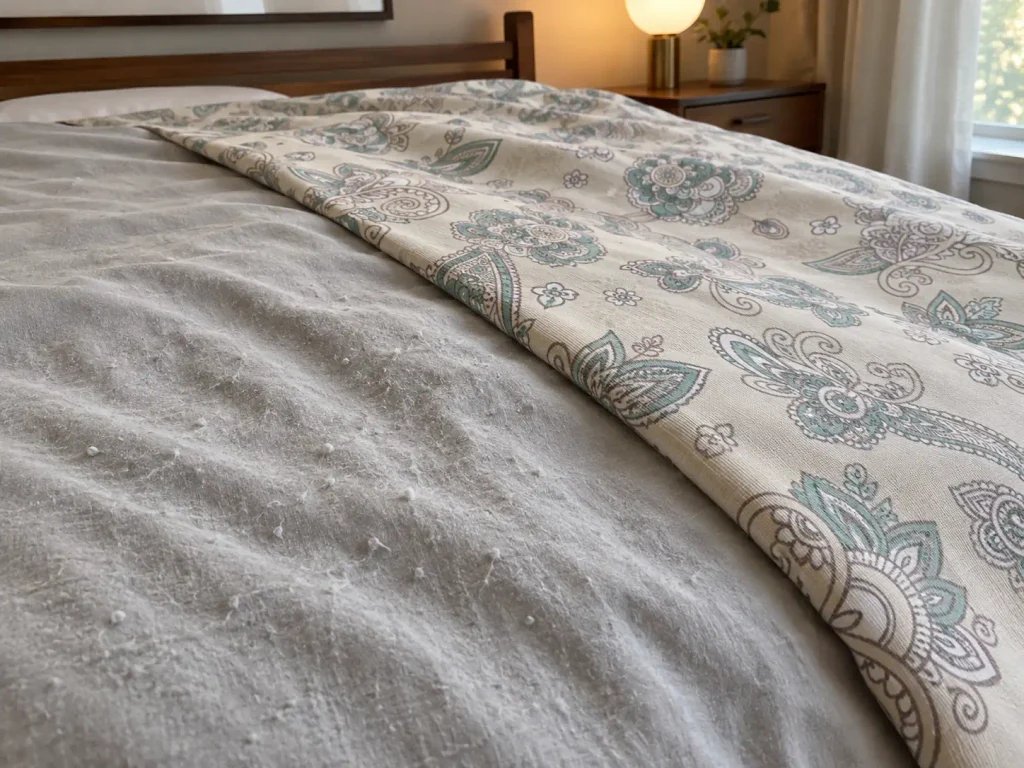
You have held both sets. A cotton percale feels cool and faintly papery. The microfiber feels like the inside of a sweatshirt. That is not one fabric being nicer than another; it is a different object, and the sweatshirt feeling was added on purpose after the cloth came off the loom.
Microfiber is polyester, sometimes a polyester and nylon blend, drawn to under one denier per filament, which the trade calls sub-denier, usually under 10 micrometers across. An order of magnitude thinner than a hair. That thinness is the whole point of the fiber and also its weakness, and it is the part of what microfiber actually is that decides how it ages.
Filament, Not Staple: the Sentence Everything Else Hangs On
Cotton arrives as short fibers. They have to be twisted together into a yarn, and no matter how well that is done, ends stick out along the length of the thread. Staple length is a measured, classified property: a fiber long enough to have an official length is the difference between a cotton that stays smooth and one that does not, which is why staple length decides what cotton does more than the number on the front of the package.
Microfiber has no staple length, because microfiber is not staple. It is filament: molten polyester pushed through a spinneret and drawn out as one continuous thread that runs the whole length of the yarn. There are no ends. None.
A filament yarn, left alone, is one of the smoothest surfaces you can weave, and a tightly woven one smoother still.
Which sets up the fact this entire article rests on. If filament microfiber has no fiber ends, and pills are made of tangled fiber ends, then the ends on your sheet had to be manufactured. And they were.
Brushing Is a Step, Not an Adjective
After weaving, the cloth goes through napping: rollers covered in fine wire that drag across the surface and rake fiber ends up off the base fabric. That raised nap is the suede-like hand you paid for. It is also, physically, a field of loose ends standing up from an otherwise smooth cloth, and it is there before the set is ever slept on.
Double-brushed means the same pass was run again on the reverse side. It is a manufacturing step, not a marketing word, and it means two rounds of raised ends from day one. That is not a scandal; it is the trade. Softer hand, more loose surface fiber.
You can feel the nap direction on a brand-new set, out of the bag, before a single wash. Run an open palm up the sheet, then down it. One way is smooth, the other catches slightly and drags. That drag is the raised ends standing up, and it is the exact material that is about to tangle into pills.
The community gets the mechanism right and the premise wrong. Worth naming, because it is the most repeated explanation out there. On that same r/Bedding thread, u/jatineze writes: “Pilling happens when loose fibers rub against each other and knot up. Short fibers tend to have more loose fibers. Microfiber is the worst of all.” The first sentence is correct.
The second does not apply here.
Microfiber does not have short fibers. It has a haircut.
Hold it against a cotton set of the same price class and the contrast gets concrete. A Feather & Stitch 100% Cotton Percale Sheet Set is 300 thread count, single-ply, long-staple-leaning cotton in a plain one-over-one weave with a 16-inch pocket, and it will feel crisp rather than soft on night one because nothing was raised off its surface. It also pills eventually, because fibers break under rubbing and work their way loose, which is the short-staple cotton problem.
So this is not the cotton that never fuzzes. It is the cotton that fuzzes later, and for the opposite reason.
Why the Finish Pills Before the Wear Does
So the ends were manufactured, not worn in. That reverses the story you have been told for years. Pills are supposed to mean a sheet is wearing out, and on a brushed microfiber set the first ones mean almost nothing of the sort.
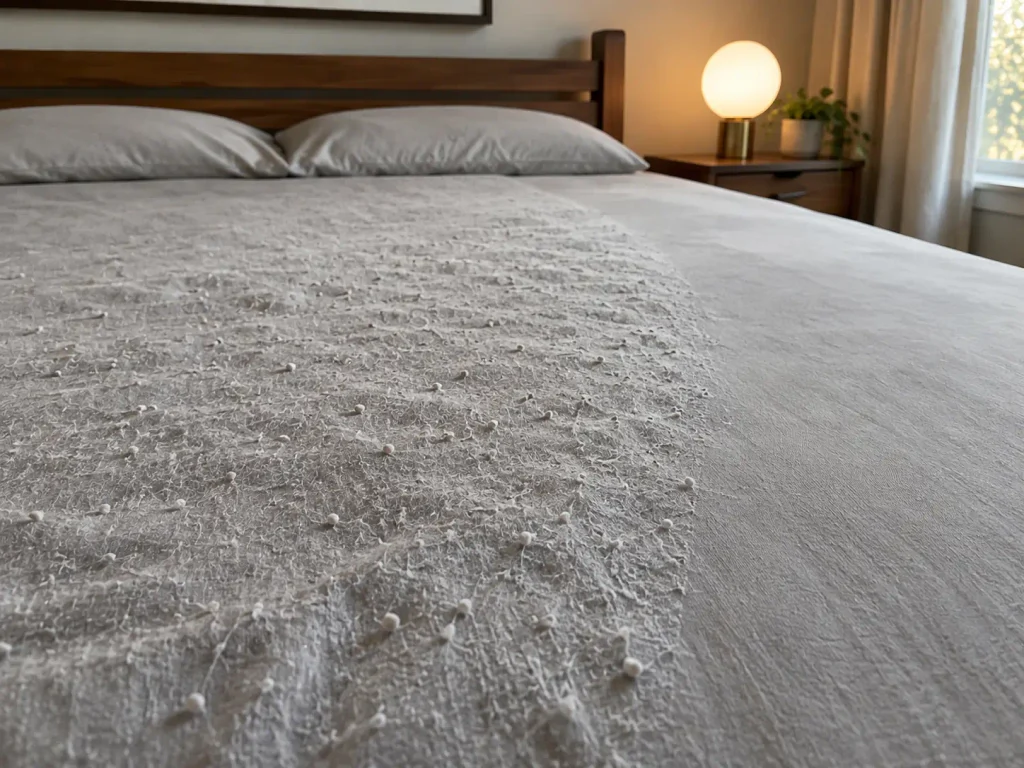
Think about a new sweatshirt. It sheds fuzz for about three washes, then stops, and nobody ever called the sweatshirt defective. A brushed sheet does the same thing. Nobody told you that, so the first fuzz reads as a fault.
Two Clocks, Not One
There are two separate processes running on your sheet, and every page in the search results collapses them into one. The first is the finishing shed: the raised ends from the napping step rolling into small balls under any friction at all. It is front-loaded, heaviest in the first handful of washes, and it slows down because there is a finite supply of raised ends.
The second is structural pilling: the filaments themselves abrading, breaking and tangling under real, repeated friction. That one does not slow down, because it is fed by use.
This is also why the search results contradict themselves. One page says microfiber resists pilling, another says it is among the worst. They are each describing one clock and calling it the whole picture. The general rule still holds underneath, that fiber length decides it first, then the weave, and microfiber is the exception that proves how much the finish can override the fiber.
The Two Numbers That Predict It
Denier sets the speed. A thinner filament bends further under less force, so it tangles more readily, and an under-denier set will pill faster than a better one at identical use. It is the same fiber at a different denier that separates a decent microfiber set from a bad one, not the word on the label, which is the same on both.
GSM is the number you can actually find. Grams per square meter, and 90 to 120 is the honest range for brushed microfiber. Below 90 the cloth is thin enough that it pills and tears sooner. Above 120 it starts trapping heat. When a microfiber package leads with a thread count instead, and “1,800 thread count” microfiber exists, that is its own signal, because thread count on microfiber is a number counted twice and GSM is the one that predicts anything. Honest sellers print GSM.
And this is measured, not felt. According to ASTM International, in the industry’s own pilling scorecard, “The observed resistance to pilling is reported on an arbitrary scale ranging from 5 (no pilling) to 1 (very severe pilling).” A machine tumbles the fabric for a set time and a person grades what comes out. The fuzz on your bed is a scored, repeatable defect with a number attached.
Where the pills form tells you which clock is running. Finishing fuzz comes up evenly everywhere, including the places nobody touches: the outer third of a king, the part tucked under the mattress. Friction pilling arrives in a patch shaped like a sleeper: heels, knees, one hip. Check the untouched margins first; they are the control group.
The community found the friction map on its own, in two places that never spoke to each other. On r/homemaking, the original poster locates the damage precisely: pilling “mostly where my apparently very stubbly legs lay.” On a Quora thread about the foot of the bed, the answer is the same shape: feet shift, kick and rub the same area every night. Pills in one patch are a map of how you sleep, not a verdict on the sheet.
What Your Washing Adds, and What It Only Gets Blamed For
The fiber and the finish set the ceiling. The laundry decides where inside that range your set actually lands. This is also where most advice goes wrong, because the two things that genuinely accelerate microfiber pilling are not the two things people are usually told to change.

You have probably already tried something. A gentler cycle. A cup of vinegar. A different detergent. Most of it aimed at the wrong target.
The Free Fix Is What Else Is In the Drum
Wash the sheets alone. Not with towels, ever. Terry loops are the single most abrasive thing in a normal household wash, and a brushed surface covered in raised ends is the most vulnerable thing you could put next to them. r/homemaking’s u/wisper1969 puts it flatly: “if you wash your linens with any towels they will pill.”
Costs nothing, changes the outcome more than any product will.
Then the dryer, which does two separate things and gets credited with one. High heat means more aggressive tumbling and more friction against the drum, and that is ordinary pilling, faster. But at the top end polyester is still plastic: it can ripple and partially fuse, and what you get then is a heat pill: stiffer, glassier, catching on your skin instead of brushing past it.
That one is not surface damage. It is damage in the filament, and no wash undoes it. Pull the set out faintly damp and let it finish on the bed.
Run one diagnostic wash: the set alone, warm not hot, no towels, out of the dryer while still faintly damp. Then give it a week. If almost no new fuzz arrives, the finishing shed is over and the set is fine. If fuzz keeps coming at the same rate on a clean, low-friction wash, the friction is coming from the bed, and the set is telling you its remaining life is short.
This is the variable the labs measure too, not folklore. AATCC’s Test Method 124 grades fabric appearance specifically after repeated home laundering, which is to say a recognized pilling-resistance test, not a guess about what your machine does over a season.
The Settings That Are Worth Changing, and the Ones That Are Not
Everything else on the dial matters less than the load itself, but it is not nothing, and it is all free. A cold wash or a gentle cycle reduces the agitation that rolls raised ends into balls, and on a synthetic it costs you no cleaning power worth having. A low heat dry is the single most useful setting change, for the reason above; air dry is better still if you have the space, because it removes the tumbling entirely. Wash inside out where the set allows it: turning it puts the brushed face away from the drum wall on the way round.
Two habits do more than the settings. Do not pack the drum: overloading the washer is what turns a wash into a friction event, because fabric with nowhere to move grinds against itself for the whole cycle. And if you can, rotate sheet sets rather than running one set every week — the same set washed half as often ages at half the rate, which sounds obvious and is the thing almost nobody does.
None of this stops a brushed nap from shedding. It only keeps you from adding to it.
What Does Not Work, in One Clause
Fabric softener and vinegar both aim at residue and hand-feel. The raised ends are a mechanical condition standing off the surface of the cloth, and coating them does not lay them back down. Vinegar works on the wrong thing, and that argument belongs to the sibling article rather than here.
Worth knowing where people land when they give up on the fiber altogether, though, because the community is remarkably consistent about it. Worth noting too that a knit microfiber snags and pills faster than a woven one, which is why the jersey-feeling sets go first. r/Bedding converges on “Pima, Supima, Egyptian, or ‘long staple’ cotton,” and on r/homemaking u/Bumbleonia names something specific that worked: a 100% Supima percale at 200 thread count.
Not a coincidence. That is a long-staple fiber in an unfinished weave, which is the exact opposite of what you are holding. If that is where you are heading, read the label before the next set, because the label words are where that decision is won or lost.
Normal Fuzz, or a Finished Set
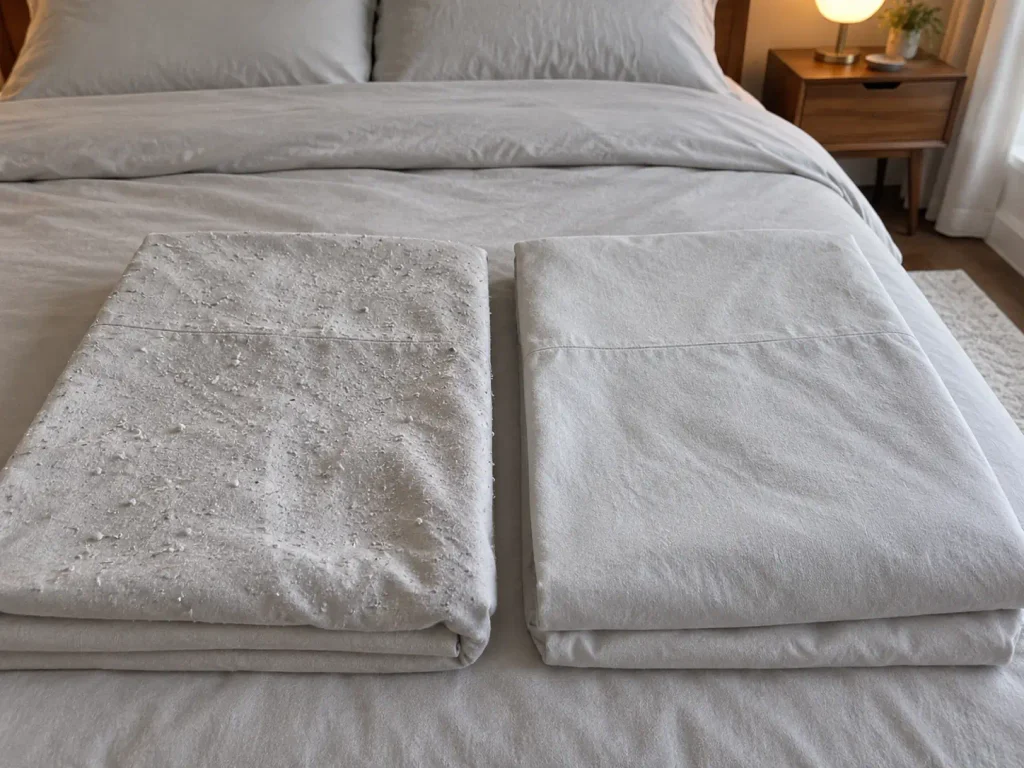
Everything so far explains why the pills are there. None of it answers the question you actually came with, which is whether to keep washing this set or stop. That verdict rests on three things you can check tonight, and not one of them is how much fuzz there is.
The Three Checks, in Order
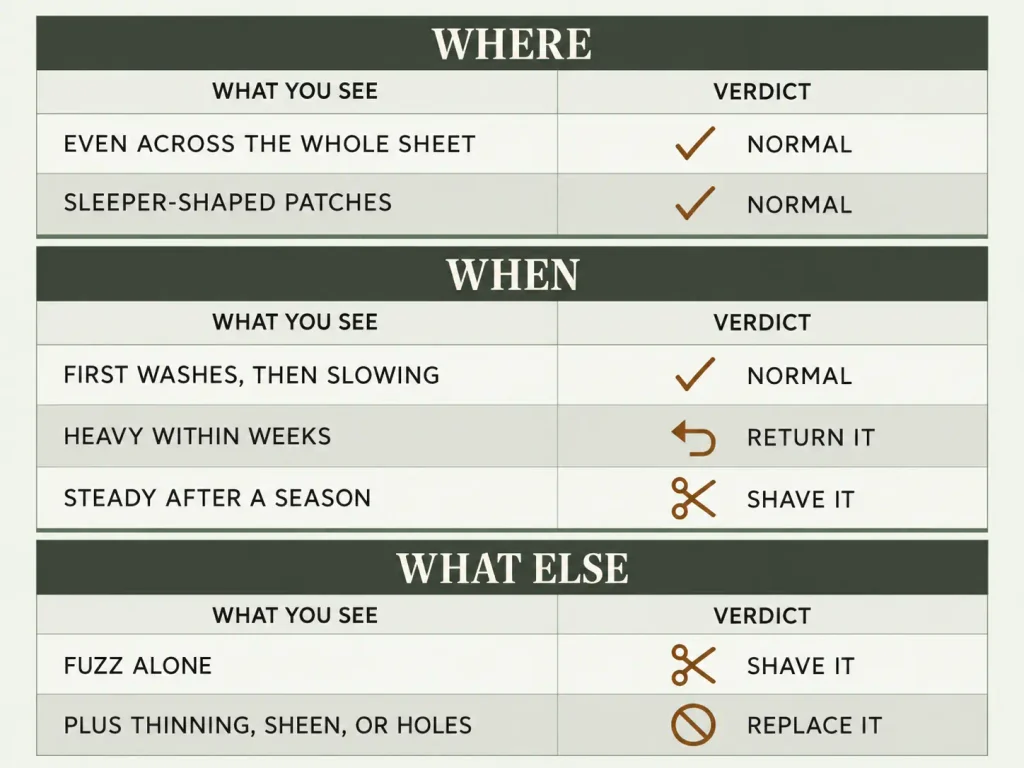
Where. Evenly across the whole sheet, including margins nobody sleeps on, means finishing shed. Normal. In sleeper-shaped patches at the heels, knees or hip, it is friction, and that is expected on any sheet you sleep on hard.
When. Fuzz that appears in the first few washes and then slows is the finish doing what the finish does. Heavy pilling inside a few weeks of normal use is not. That is an under-denier or badly finished set, and it is a return, not a project.
What else. Pilling with thinning, with a flattened sheen where the weave has gone glassy, or with the first small hole, is a structural verdict rather than a surface one. At that point you are past pilling entirely: thin spots and holes are broken yarn, and that judgment belongs to a different article.
The Honest Timeline
Nearly all brushed microfiber shows some pilling within the first year. That is a property of the finish, and it follows from the mechanism rather than from a wash-count study somebody ran, because nobody tracks the mild end past a few months. The fast end is documented well enough by the people living it: a set “pulled after 2 washes and 3 weeks of use,” four sets gone in eighteen months.
That pattern is not bad luck. It is buying at the bottom of the GSM range, repeatedly. Which is why the generic advice to replace sheets at two or three years travels badly here: it was written for cotton, and it tells you nothing about a fiber whose first year is decided at the factory.
For the other end of the range, a MALOUF Double Brushed Microfiber Sheet Set is the fair example of the fiber done properly: sub-1-denier filament polyester, brushed on both sides by a manufacturer that says so on the package instead of hiding behind an invented thread count. And the flaw is right there in its own name. The second brushing pass is exactly what makes it softer and what gives it loose surface fiber from day one. Buying the better-finished set does not buy a set that will not fuzz; it buys one whose fuzz plateaus instead of continuing.
Shave It, or Replace It
On normal fuzz, shave it. An electric shaver like the Pionix Extra Power Fabric Shaver, 35W with a rotating blade turning at 12,000 RPM under a guard net, takes the surface balls off in a session, and its flaw is structural rather than a defect: it removes what is on top and cannot touch the raised ends underneath, so the fuzz returns after the next wash, and on heat-fused pills it drags rather than cuts cleanly. Which is the honest version of the whole move. Shaving buys a month, not a fix, and the technique that makes it last longer than a week is its own article.
It is the wrong move on a set that is also thinning. Well, it is not wrong so much as pointless, because you will do the work, the fuzz balls will come back on the next wash anyway — that is the re-pilling every shaver owner discovers — and the sheet will still be spent underneath. “Finished,” for a microfiber set specifically, is not a date and it is not a wash count.
It is the moment the checks come back structural: flattening, thin patches, a sheen where the nap used to be, heat-fused pills across the sleeping zone. That is structural wear, not surface fuzz, and no shaver returns any of it.
Listen to it. Drag a fingernail slowly across a healthy brushed microfiber sheet and it is silent and soft. Do the same across an area that has been through too many hot dryer cycles and there is a faint dry rasp, because the raised ends have hardened and the filaments underneath have flattened. That sound shows up in the sleeping zone months before there is anything to see.
And a set that is too fuzzy for the bed you sleep in every night is often still perfectly good for a bed somebody sleeps in four times a year. Retiring it downward is a real option, not a consolation prize, and there is a whole argument for where a microfiber set still earns its place.
What to Take to the Linen Closet
The fuzz on a brushed microfiber sheet was manufactured before it was ever worn. The nap that makes it soft is raised fiber ends, and raised fiber ends tangle. Judge the set by where and when the pills arrive, never by whether they arrive at all.
Wash it alone, away from towels, and out of a hot dryer. That removes the two things that genuinely accelerate it, and what happens over the following week is the fabric telling you what it would have done on its own.
Fuzz alone is not a finished set. Fuzz plus thinning, a flattened sheen, or a first hole is, and nothing on the market brings that back.
The wash twenty check: after a season of washes, look at the outer third of the sheet, the part nobody sleeps on. Still smooth while the middle is pilled? The fabric is sound and you are looking at friction. Margins gone fuzzy too? The finish is spent and the set is running out.
So strip the bed tonight. Run the set on its own, warm, no towels, and pull it out of the dryer faintly damp. Give it a week, then look at the margins. That costs nothing and it answers the question better than any label will.
Frequently Asked Questions
01Does pilling mean poor quality?
Not on a brushed microfiber set, where early fuzz is the finish shedding the fiber ends that brushing raised on purpose. Heavy pilling within weeks, or pilling alongside thinning and a flattened sheen, is a quality signal worth acting on.
02Does pilling ever stop?
The finishing fuzz slows after the first several washes because the supply of raised ends runs out. Friction pilling does not stop while you sleep on it. The tell is whether new fuzz still arrives after a clean, towel-free wash.
03What are the downsides of microfiber sheets?
For pilling specifically, the raised nap that makes it soft is the same thing that tangles into fuzz. Odor retention, static and how many structural years it has left are a separate argument, covered in what you give up with microfiber.
04What sheets are best to avoid pilling?
Long-staple cotton in a percale weave is the answer the bedding threads keep landing on. The label words to look for are Pima, Supima, Egyptian or plain long-staple, and the buying decision belongs to sheets that do not pill.
05How to reverse pilling on sheets?
You can remove existing pills with a fabric shaver, but you cannot reverse the raised fiber ends that make them. That buys weeks of a smoother sheet, not a cure, and the technique is in shaving pilled sheets.





Tried it on your own bed?
No comments yet. Tell us what you changed, and what the sheet did after a few washes.