






What’s in here6 sections
The set that pilled on you probably was not the cheap one. That is the part that stings: you paid extra for a word on the package, and five months later the sheet has a fuzzy gray patch where your hip goes. Pilling is not bad luck and not a mystery. Fiber ends work loose from the yarn and knot under friction, and that is the whole of it.
The catch is that the two things deciding how fast it happens are almost never printed on the listing you bought from. What is printed (long-staple, Pima, percale, 600 thread count, “hotel quality”) either points at one of those two specs or deliberately points away from them, and telling the two kinds of words apart is the entire skill. Here is what the label really tells you, what to ignore, which fiber and weave combinations hold, and what wash twenty proves.
Quick Answer
No fabric is pill-proof. Resistance is decided by staple length first and weave second, and a listing rarely states either outright. Translate the marketing words into those two facts — long-staple or Pima for the fiber, percale or sateen for the weave — and you can judge a set before you buy it.
What the Label Is Actually Pointing At
Every durability word on a sheet package is a proxy for one of two specs, and working out which one a given word is pointing at does most of the job for you.
The first spec is staple length: how long the individual cotton fibers are before they get spun into yarn. It is not a marketing adjective. It is one of six properties cotton is formally graded on, alongside length uniformity, strength, micronaire, color grade and trash content, and it is the one that predicts pilling. According to Cotton Incorporated’s own fiber-grading standard, “This is a critical measurement because the staple length of cotton affects yarn strength, evenness, and efficiency of the spinning process.”
The causal chain from there is one line long. Longer fibers mean fewer loose ends poking out per inch of yarn, and those loose ends are exactly what friction grabs and rolls into a ball. Long-staple cotton runs roughly 1⅛ to 1⅜ inches; short-staple cotton is a mess of little ends waiting for a knee to rub them together. That is why cotton sheets are sorted by staple length long before thread count matters, and why a listing that names its fiber has already told you more than one that names its thread count.
So here is the sorting exercise. The words pointing at staple length are long-staple, extra-long-staple, Pima, Supima and combed. The words pointing at the weave are percale, sateen and flannel, plus jersey, which is really a jersey knit rather than a weave at all and behaves like one.
Sateen is sometimes printed as satin weave, meaning the same construction applied to cotton. Everything else on that package, and there is usually a great deal of it, points at neither.
Count the spec words on a listing before you read the description. A set that prints a fiber name and a weave word has given you two facts. A set with four paragraphs of copy and a four-digit number has given you none, and it is usually the more expensive of the two. The volume of text on a package runs inversely to how much of it is a specification.
There is a second graded property worth knowing about precisely because nobody sells on it: length uniformity, which measures how much the fiber lengths in a batch vary. The same grading standard notes that “Cotton with a low length uniformity index has a high variance in fiber length which can make processing difficult and ultimately result in lower-quality yarn.” No listing anywhere prints it. It is a large part of why two sets that both say “100% cotton” in the same typeface can behave nothing alike after a season.
The community already understands this at street level, even without the vocabulary. Ask r/BuyItForLife for a sateen recommendation and the first reply back is not about color or price. It is “does it pill?” People who have been burned treat the weave word as a risk signal, which is the correct instinct arrived at the expensive way.
The Three Words to Ignore, and the One Number That Is a Warning
The three words most likely to be printed largest on the package are the three that tell you least about whether the set will pill.
“Egyptian” is geography. It means Gossypium barbadense grown in the Nile Delta, and it is a perfectly legal, perfectly accurate label that certifies precisely nothing about fiber length: Egyptian names where the cotton grew, not how long the fiber is. What buyers reaching for the word actually want is the long-staple property Egyptian cotton got famous for, and those are two different claims. They are also more different than anyone would like: most sets carrying the word fail a DNA test for the fiber they claim.
“Bamboo” describes the raw material before processing, not the fabric that came out. Nearly all of it is viscose or lyocell made from bamboo pulp, and those two wear nothing alike, so the word on its own predicts exactly nothing. (Hold that thought: the lyocell half gets paid off in the next section, because it is the one case where the bamboo word earns something.)
“Hotel quality” certifies nothing at all. No standards organization issues it, no test sits behind it, and anyone may print it. The same goes for the rest of the claims a package carries in that register, and for the categories built on them: anti-pill sheets, non-pilling sheets and performance fabric are shop headings, not specifications. The irony is that what hotels actually put on their beds is plain percale, the least glamorous thing in the category, chosen because it survives industrial laundering.
Then there is the number, and this is where the section earns its keep. A manufacturer can twist two thin threads into a single 2-ply strand and count each thread separately, so a fabric that is honestly 300 single-ply threads gets relabeled 600. The sheet is not finer. It is the same cloth counted twice, spun from thinner, weaker individual threads, and thinner, weaker threads are precisely what abrades and works loose under friction fastest.
Above roughly 400 on a plain cotton listing, a big number is evidence of thinner yarn, not better cloth. Thread count inflation is the most reliable tell in the category, and it hides in plain sight on the front of the box.
That arithmetic is visible in the product itself once you know to look for it. An inflated-count sheet tends to feel denser and heavier in the hand rather than finer, because dense and heavy is literally what it is. The weight that reads as quality in the shop is the same weight that reports back as fuzz at wash twenty.
None of which makes every 600-count set a bad set, and this is where the reading order matters more than the number. The ELINEN 100% Supima Cotton Sheets print 600 thread count on the front, and that figure is inflated exactly the way every 600-count figure is inflated: two plies, counted twice, thinner threads than a single-ply equivalent. The set is still a good one, and the reason has nothing to do with the number. The fiber underneath it is named, and it is Supima.
Read the fiber first and the count last and you get the right answer. Read them the other way around and you have learned nothing except how to overpay for a bigger integer.
So the practical inversion, stated plainly: on a cotton listing, a modest thread count sitting next to a named long-staple fiber beats a four-digit number sitting next to no fiber detail. Every time.
The Combinations That Hold Up
Once fiber and weave are the only two questions you are asking, the field narrows fast, down to about four combinations worth buying and a couple worth walking past.
Long-staple cotton in a plain weave is the default answer and the one to beat. The fiber brings few loose ends to the surface, and the 1/1 percale weave anchors every single crossing, so there is barely any exposed yarn sitting up where friction can reach it. That is also why percale outlasts sateen at equal fiber, and the float length is why. The sibling article carries the full durability verdict; here it is just a filter you apply to a listing.
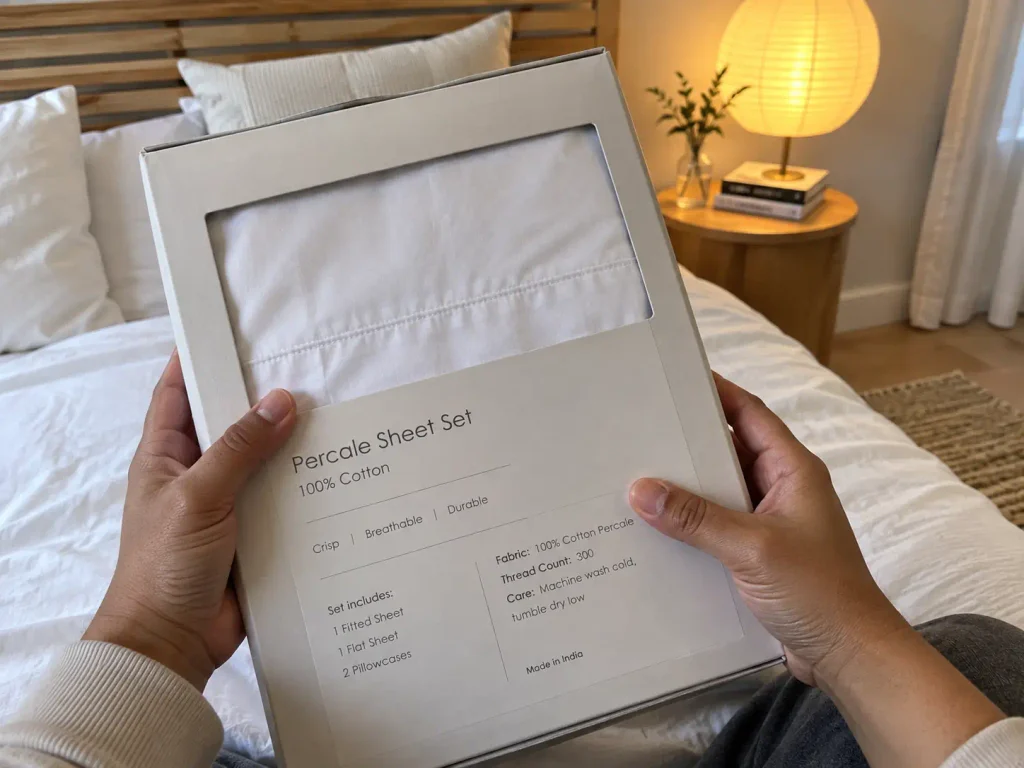
The Tuft & Needle Supima Cotton Percale Sheet Set is useful mostly as a picture of what a properly specified listing looks like: it names the fiber and it names the weave, in that order, without a paragraph of adjectives in between. It is also worth knowing what the Supima trademark actually certifies before you pay for the word.
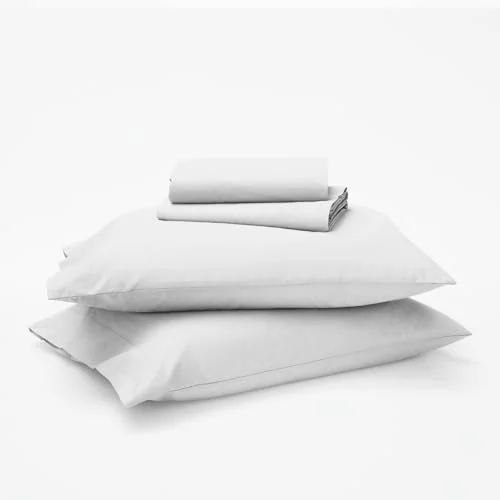
And if the last section left you unwilling to trust the word “Egyptian” ever again, that is the correct reaction but not the whole story. The California Design Den Certified 100% Egyptian Cotton Percale Sheet Set is the version of that claim that carries third-party verification behind it, a Good Housekeeping seal and OEKO-TEX Standard 100, in a percale weave with a 16-inch pocket. What is worth paying for there is the certification, not the word: certified is the exception in this category rather than the standard, so the same buyer still has to check the next listing, and the one after that, one at a time. A reader who simply wants long-staple cotton and does not need the Egyptian provenance specifically has cheaper routes to the same durability.
Linen resists pilling by a completely different route, which is why cotton logic barely transfers. Flax fiber is long, stiff and low-fuzz to begin with, so there is very little surface nap for friction to work into a ball. Staple-length arithmetic hardly applies here. The number to look for on a linen listing is GSM, grams per square meter, the fabric weight the mills call grammage, and the good listings print it. The Sijo Stone Washed Organic French Linen Bed Sheet Set is GOTS-certified French flax, stonewashed so it arrives already softened, and it carries the standing linen flaw nobody can engineer away: it will never look ironed, not on night one and not ever. Stock was also thin as this was written, with no other GOTS-certified linen sitting ready to replace it.
For a linen listing doing the thing this whole article is asking listings to do, the DAPU 100% French Linen Sheets print their weight right on the label: 170 GSM. That is the spec rather than the adjective, which is refreshing, though 170 sits at the light end of the range. It still resists pilling structurally — that is the fiber’s doing, not the weight’s — but it reads noticeably less dense in the hand than a heavier linen, and it is worth reading how long linen lasts, banded by GSM before deciding whether light is what you want. The short version is that linen earns its price above a certain weight.
Lyocell, and only lyocell, is where the bamboo word stops being empty. Closed-loop lyocell processing produces a stronger, more uniform fiber than generic viscose does from the same pulp, and uniformity is the property doing the work. The ettitude 100% Lyocell from Organic Bamboo Sheet Set is the clean example: CleanBamboo lyocell throughout, OEKO-TEX Standard 100 Class 1, a 17-inch pocket, and a closed-loop non-toxic solvent process stated outright rather than implied. Its flaw is structural and you should weigh it: it is woven as a sateen, so it carries the float tradeoff from two paragraphs ago. The fiber is helping; the weave is not. Stock was down to a few units as well, and no equivalent true-lyocell alternative turned up to name beside it.
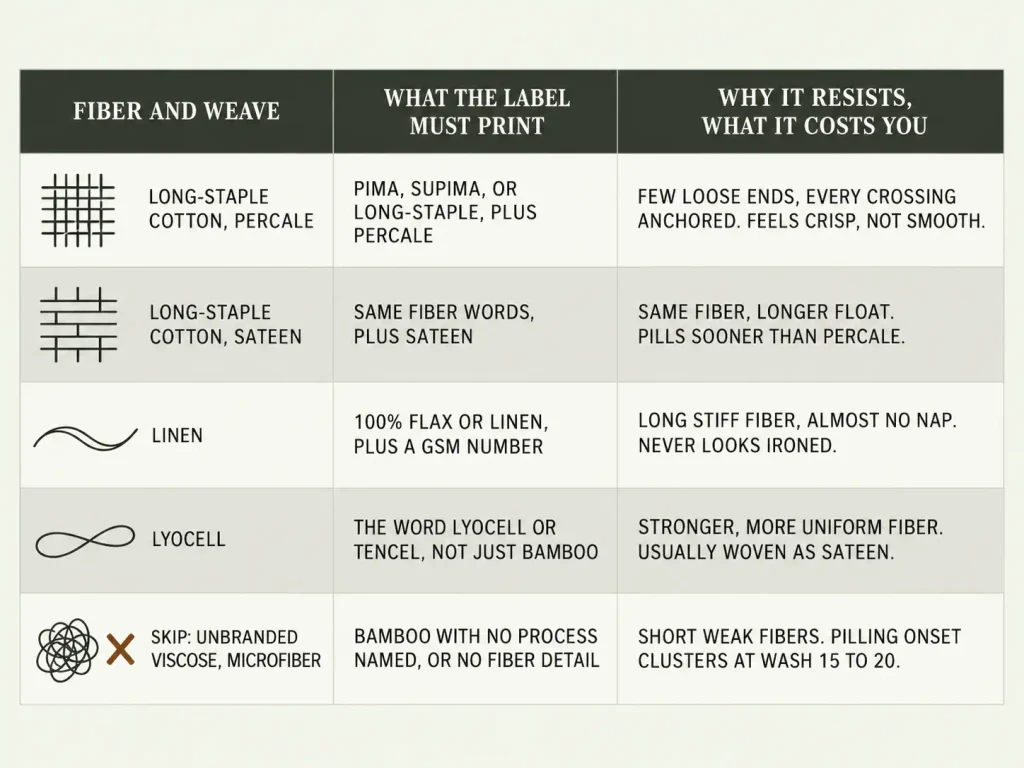
| Fiber and weave | What the listing must print | Why it resists, and what it costs you |
|---|---|---|
| Long-staple cotton, percale | Pima, Supima or long-staple, plus the word percale | Few loose ends, every crossing anchored. Costs you the glide: it feels crisp, not smooth |
| Long-staple cotton, sateen | The same fiber words, plus the word sateen | Same good fiber, longer float on the surface. Pills sooner than percale at equal fiber |
| Linen | 100% flax or linen, and a GSM number | Long stiff fiber with almost no nap to roll up. Costs you the ironed look, permanently |
| Lyocell | The word lyocell or Tencel, not just bamboo | Closed-loop processing gives a stronger, more uniform fiber. Usually woven as sateen, so the float still applies |
| Skip: unbranded viscose, microfiber | Bamboo with no process named, or no fiber detail at all | Short weak fibers and a surface that fuzzes early. Reported pilling onset clusters around wash 15 to 20 |
Which leaves the skip list, and it is short. Unbranded viscose sold as “bamboo” with no process named is the big one, with community-reported pilling onset clustering around wash 15 to 20. Rayon and viscose are the same thing under two names, so neither word tells you how the pulp was processed, and bamboo viscose is simply that process applied to bamboo pulp.
Microfiber belongs on the list too, though for its own reasons. It is finely split polyester, and the fiber breakdown that fuzzes its surface starts long before anything structural fails: microfiber fails on a comfort clock, not a structural one, and the sibling article has the timeline.
And then the quiet one: any cotton listing that names no staple length at all. Not a bad one, just silent. Silence on that spec is a specification in itself.
The best argument for buying on spec rather than on branding came out of that same r/BuyItForLife thread, from someone describing a plain, brand-less Costco set that went roughly ten years of weekly hot washes and high-heat drying, and finally failed at a seam. Not at a pill. A hole where the stitching gave, on a sheet whose surface was still intact.
Nobody in that thread could name the brand. The spec had done the work.
If a cotton listing will not tell you the staple length in any form, assume it is short-staple and price it accordingly in your head. Mills that spin long-staple cotton pay more for the fiber and say so on the package, because saying so is how they justify the shelf price. The ones that stay quiet are quiet for a reason.
One more thing about where pilling shows up, because it is not evenly spread. A respondent in that thread reported the pills clustering in two specific places, a patch at the hip and a patch at the heel, and traced it to sleeping in underwear and socks rather than pajamas, so skin met sheet directly all night in exactly those two spots. A restless sleeper wears a set faster than a still one for the same reason.
A hot sleeper who spends the night tossing and turning is simply running more of that friction across the same patch. A set is rarely pilling all over. It is pilling where somebody moves.
None of which is a buying question anymore once the pills are there. A fabric shaver, a pill remover or a lint roller will clear a surface that has already gone, but clearing it is housekeeping rather than a fix: the fiber that left the yarn is not going back in. This article is about not needing one.
What Wash Twenty Tells You
Everything above is a prediction, and the only test that settles it runs in your own machine over about five months.
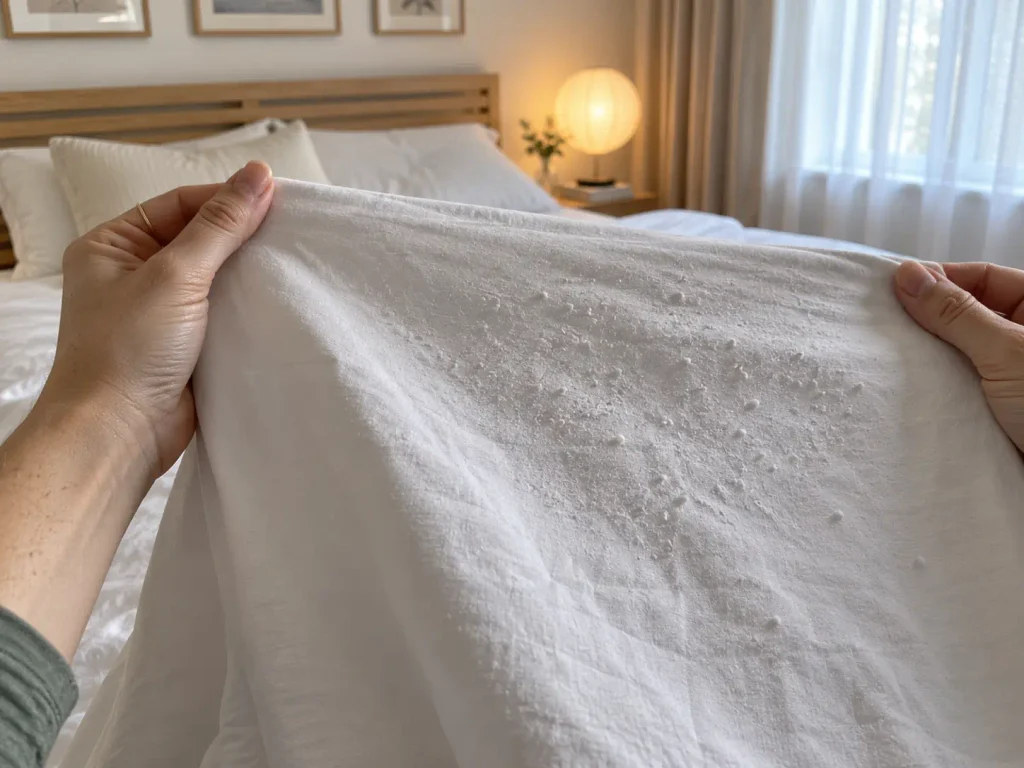
Twenty washes is the number because it is roughly where the finishes have gone. Wash count is the only honest clock here: not months owned, not nights slept, but how many times the fabric has been through the abrasion of a full cycle.
Whatever the mill applied to make the fabric feel good in the shop has washed out by then, and what is left is the yarn being judged on its own merits. That includes the finishes sold as features. Wrinkle resistance and shrink resistance are applied treatments on most cotton sheets, and applied treatments leave.
Anything you conclude before that is a review of a finish. Week one lies about almost everything.
When you check, do it properly: take the sheet to a window and look along the surface at a low angle rather than straight down at it. Raking light catches a raised fuzz that flat overhead light hides completely. And start at the friction zones, hip and heel, not at the middle of the sheet, which is the part that gets the least contact and will look fine longest.
Here is the one that surprises people. On a genuinely good set, the first pills usually turn up not on the sleeping surface at all but on the underside of a deep-pocket fitted sheet, down where the elastic casing pulls the fabric around the mattress edge and rubs it every time anyone gets in or out. That is friction against the mattress, not against skin. It is the one place nobody thinks to look, and it is the earliest honest signal you will get.
Then there is the variable that can undo a good purchase entirely, and it is sitting in your laundry room. Silicone-based fabric softener reduces yarn cohesion. It loosens the grip that holds fiber ends inside the yarn, which is precisely the grip that stops a pill from starting.
The bottle is working against the set you just chose carefully. Skipping it protects a sheet more than any “anti-pill” claim on a package ever did. A gentle cycle, a cold water wash, a mild detergent and no harsh chemicals do more for a good set than any additive sold to rescue a bad one. Line drying, or any air drying at all, spares the fabric the tumble that works ends loose in the first place, and the pillar has the wash-count diagnostic and the point where it is worth replacing along with the full order of operations.
The natural next move after learning softener hurts is to reach for a rinse additive instead, so save yourself the trip: the rinse-cycle trick that does not touch pilling is covered next door.
What counts as a pass? Community reporting puts disappointing viscose sets fuzzing visibly by wash 15 to 20, while sets people are happy with hold their texture through 30 to 50 and beyond. So a set showing pills before wash twenty was mis-specified rather than mistreated. That is a buying result, not a laundry result, and no wash routine was going to save it.
The upper bound is that decade-long Costco set that gave out at a seam. That is what a correct fiber and weave choice actually buys you: not immortality, but a sheet that wears out somewhere other than its surface.
Write the month on the care tag in laundry marker the day a new set comes out of its first wash. Twenty weekly washes lands about five months later, and nobody remembers when a sheet entered the rotation — which is exactly why people judge a set on how it felt in week one and then argue about it forever.
The Short Version
Read a listing for two things and two things only: whether the fiber’s staple length is named in some form, and which weave word appears. If neither is printed anywhere, that absence is your answer, and it is a complete one.
Treat a four-digit thread count on a cotton listing as a warning rather than a feature. It usually means two thin plies counted twice, and thin plies are what friction breaks first.
And remember that linen and true lyocell get there by structure instead of fineness, so they are judged on GSM and on processing, not on staple length. Different questions entirely, asked of a different fiber.
After about five months of weekly washes, take the sheet to a window and look along it at a low angle, starting at the hip and the heel and then flipping the fitted sheet to check the mattress edge. A set that was chosen right will still read smooth exactly where the friction was worst.
Before you buy anything to replace it, pull up the listing for the set that pilled on you and read it again with those two questions in hand. Most of the time the answer was printed there all along. Or it conspicuously wasn’t, which is the same answer.
Frequently Asked Questions
01What sheets are best to avoid pilling?
Long-staple cotton in a percale weave, linen, or true lyocell. Each resists for the same underlying reason: few loose fiber ends at the surface, or a weave that anchors the ones there are. Percale locks every thread crossing; linen has almost no nap to begin with.
02What kind of sheets are soft and don’t pill?
Long-staple percale, which softens through washing rather than through an applied finish. The tradeoff is honest: it will not feel silky on night one, and that crispness is exactly what it is trading for durability. Sateen gives you night-one softness and pills sooner.
03Do high thread count sheets pill more?
Above roughly 400 on a cotton listing, often yes — because the number is usually reached by twisting two thin plies together and counting both. Thinner threads abrade faster. Read the fiber name instead: a 300-count Supima beats an 800-count unnamed cotton.
04What are the best bed sheets that don’t bobble?
Bobbling is pilling under another name, so the answer is the same two specs: staple length first, weave second. In practice that means long-staple cotton percale, linen above a decent GSM, or a set that names lyocell rather than just bamboo.
05Is anti-pill actually a certified claim?
No. No standards organization issues an anti-pill certification for bedding, and anyone may print the phrase. Lab test methods do exist — Martindale, Circular Locus, Pilling Box and Random Tumble — but a fabric can grade differently depending which one ran it, and a package claim is not a graded result.





Tried it on your own bed?
No comments yet. Tell us what you changed, and what the sheet did after a few washes.