







What’s in here6 sections
A forum poster bought a 600-thread-count sateen set, and it started pilling inside two weeks of first use. He ran an electric lint remover over the fitted sheet, got about a month of quiet out of it, and then the same sheet pilled again in the same place.
That story has a mechanism behind it, and it is not a bad shaver: a pill is not dirt sitting on the surface of the sheet, it is the sheet’s own fiber, already torn loose from the yarn, tangled into a ball and still tethered by a few anchor fibers that are themselves on their way out. A shaver cuts the ball off flush. It does not put the fiber back, and the yarn it came out of is thinner than it was yesterday.
So the useful question is not whether you can fix sheets that already pilled, because pilling does not reverse; it is whether there is enough sound fabric left underneath to be worth twenty minutes of your evening, and that is something you can check tonight with a bedside lamp.
Quick Answer
Pilling cannot be reversed. Removal is cosmetic. What decides whether it is worth doing is the fabric under the pills, in this order:
- Hold the pilled area up to a lamp, pulled gently taut.
- Even, opaque weave underneath? Shave it, and you are buying real time.
- Brighter, hazier patch? Stop. No tool fixes thin.
- Match the technique to the weave, shallowest setting on sateen.
- Wash it in a mesh bag and recheck that same spot in two washes.
- Pills back in the same place twice? The fabric is finished.
What a Fabric Shaver Actually Does to a Pilled Sheet
The search results for this question are full of pages promising to restore a pilled sheet, and that one verb is doing a great deal of quiet work. Before reaching for any tool it is worth knowing what is physically being taken off the sheet and what is not. And if you want the upstream half of the story, what makes a sheet pill in the first place is a fiber-length argument that belongs to its own page.
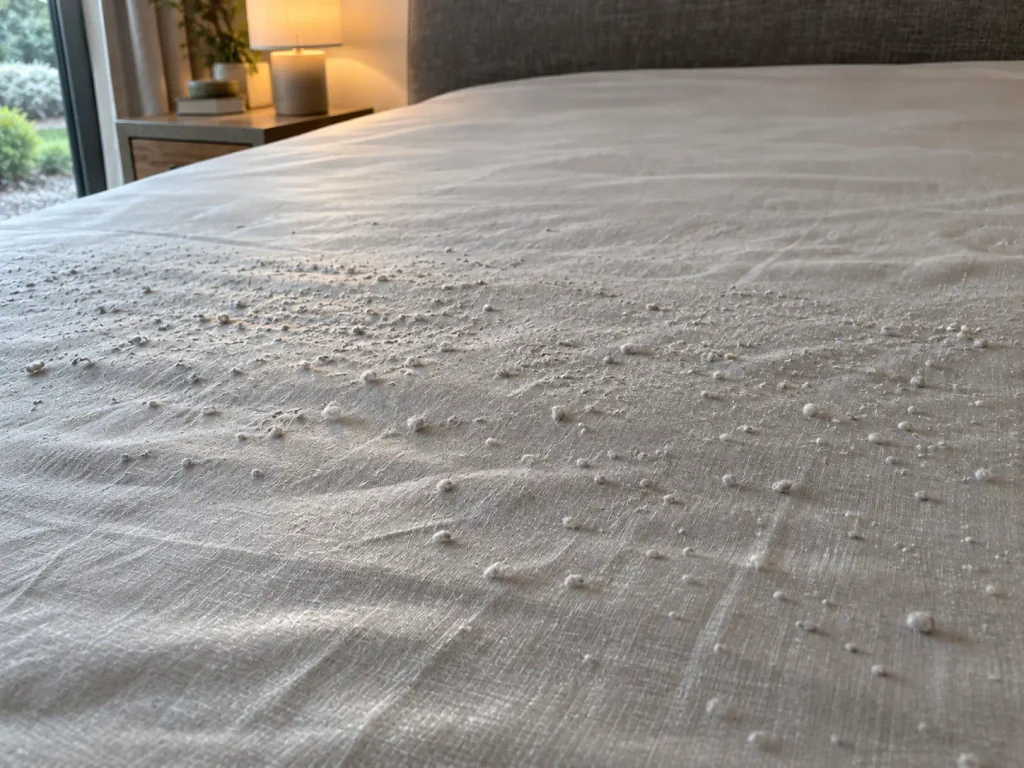
A pill arrives in four stages, and every one of them is mechanical. Friction lifts surface fibers out of the yarn, so they stand up as fuzz. The fuzz rubs against itself and entangles. The tangle rolls and grows into a ball.
And that ball stays put because a handful of unbroken anchor fibers are still holding it to the fabric, until those fracture too. Nothing in that sequence is a stain, a deposit or a residue. It is your sheet, migrating.
Which is also why two identical sets on two different beds fail at different speeds. The same standard notes that pilling resistance varies more with conditions of use and individual sleepers than between replicate specimens in a lab. Tossing and turning is the abrasion, and pressure points are where it lands, so the sleeper does as much to the outcome as the sheet does.
Which means the shaver is doing exactly one thing: cutting the ball off where it sits. The fiber that walked out of the yarn stays walked out. You end up with a smooth surface and a slightly thinner yarn than you started the evening with, and that trade is fine, as long as you know it is a trade.
Fiber type decides whether the pills leave on their own. Short-staple cotton pills and then sheds: the balls snap off in the wash and vanish, which is why a cheap cotton set goes patchy rather than fuzzy. Polyester and microfiber have far too much tensile strength to break, so nothing snaps off and the balls simply accumulate, month after month. That is the reason microfiber pills long before it ever wears through and the reason a microfiber set looks worse every season while a cotton one just looks tired.
Here is the part that should settle any nerves about eyeballing this. Even the laboratory eyeballs it. In the standard lab test for pilling resistance, specimens are tumbled and then compared to reference photographs. According to ASTM International, “The observed resistance to pilling is reported on an arbitrary scale ranging from 5 (no pilling) to 1 (very severe pilling).”
The same standard says counting individual pills is not recommended, because of the time it takes. There is no instrument that reads out a percentage of fiber damage. Trained technicians look at the fabric and rate it. So can you, and the next section is how.
Run a fingertip across a freshly shaved patch and then across the fabric right beside it. The shaved side is smoother and it is also thinner — you can feel the step at the border between the two. That step is the honest measure of what the tool took, and nobody mentions it.
One more thing about timing, because it reframes what shaving is for. The forum set pilled within two weeks of first use. Two weeks is inside the honeymoon window, before any wash count means anything, which tells you the set was going to do this regardless of how it got laundered.
The usual advice would send that person to their laundry habits. Their laundry habits had barely had a chance to matter.
The shaver was the first thing that got reached for because it was already in the house. That is the correct instinct. It is just not a cure.
Hold It to a Lamp Before You Shave Anything
If the pills are coming off either way, the question that actually decides your evening is what sits underneath them. This is the check the entire topic skips, and it takes about ten seconds.
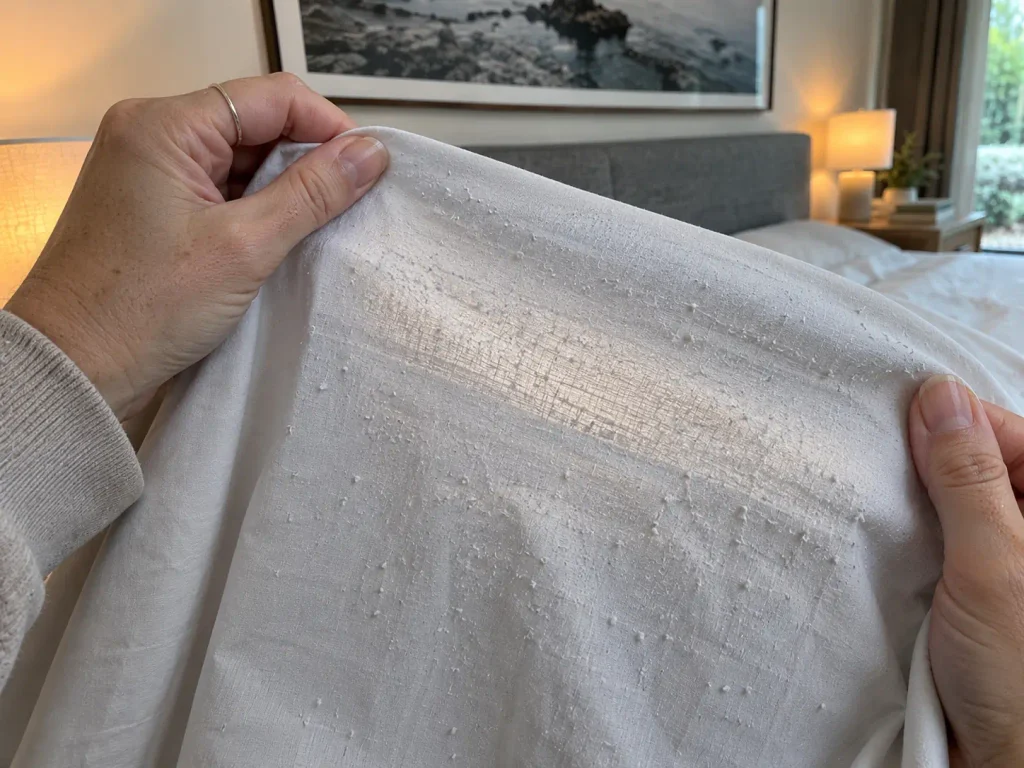
Strip the sheet off the bed. Hold the pilled area up between a lamp and your eye, and pull it gently taut. Gently, because stretching a woven fabric hard opens the weave and makes any sheet look thin (which is how you talk yourself into replacing something that was fine).
Now ignore the pills entirely. You are reading the fabric between them.
A sheet that passes shows an even grid. The light comes through uniformly across the whole patch, the weave reads as a regular pattern, and there is no brighter zone where the yarn has gone sparse. That fabric still has structure. Shave it, and you are buying real time rather than tidying up something already over.
A sheet that fails shows a brighter, hazier patch exactly where the pilling is worst. That haze is the yarn that has already given its fiber to the balls you were about to cut off, and shaving it removes the last thing bridging that area. The next wash opens it. This is the one case where the tool genuinely makes things worse, and it is invisible from above.
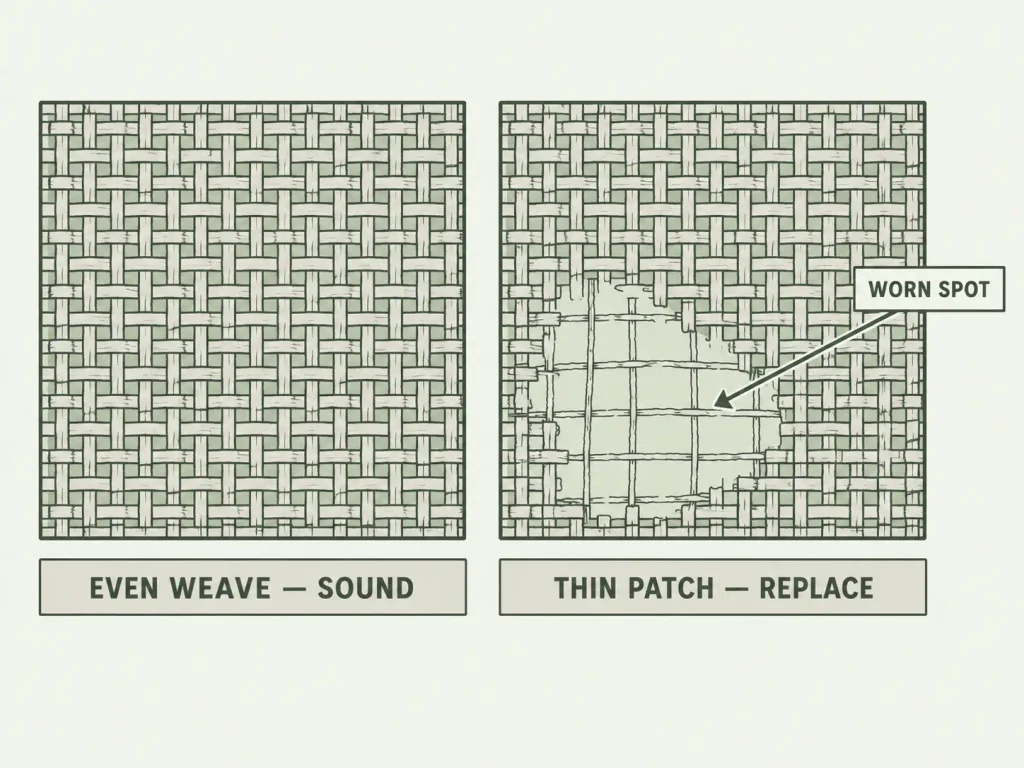
Why do the pass and the fail look identical from above? Because pills sit proudly on the surface, and a proud surface hides what is happening underneath it. That is how every “just shave it” guide on the internet can be written in complete good faith by somebody who never checked, and still be wrong about half the sheets it reaches.
Two practical notes, because the test is easy to run badly. Use a bare bulb or a lampshade with light actually coming through it, not a ceiling fixture behind you, because what you need is light passing through the fabric rather than bouncing off it.
And compare, always. Hold the pilled patch to the lamp, then slide the sheet across and hold a section that never gets slept on to the same lamp. The hem near the foot of the bed works, or the tuck-under on the far side, or the top half of a flat sheet that never meets a knee. Thinness is almost impossible to judge in isolation and obvious the second you have the same sheet, same light, two places.
The honest middle case is the one that needs saying out loud, because it is the most common result. Plenty of sheets come back neither clearly even nor clearly hazy: slightly brighter at the pilled patch, nothing you would call sheer. That sheet gets shaved, and the shave becomes the test. You are not diagnosing it tonight; you are starting a two-wash clock on it, which is exactly what the last section of this article is about.
Do not test the middle of the fitted sheet. The thin patch shows up first where a knee or a heel parks — one side, roughly a third of the way down from the head. Hold that to the lamp and you get your answer in one look instead of four.
There is a fiber-length tell buried in the result, too. Staple length is the measurement, and long-staple cotton runs roughly one to one and a half inches, extra-long above that, short-staple under an inch. Shorter fiber means more loose ends per inch of yarn, and every end is raw material for a new pill.
A set that fails the lamp test almost always has been failing it since month one. The thinness did not arrive last week, it just became visible last week.
And the forum poster’s second clue was not the fitted sheet at all. It was the pillowcases starting to go too. When a second piece of the same set, abraded by a completely different part of you, begins failing the same way, the verdict stops being about one bad patch and becomes about the fabric. Normally each piece of a set is running its own clock, which is why two of them failing together is worth more than either one alone.
The Technique Changes With the Weave
A sheet that passes the lamp test has earned twenty minutes. But the tool that clears a percale cleanly is the same tool that opens a hole in a sateen, and the difference is not the machine. It is what the blade meets when it gets there.
Before the tool question, a word on the methods that circulate for this and what they actually do. Most people call them lint balls or fuzz balls rather than pills, and the words get used for two different things: loose fuzz that has not tangled yet, and a pill that has.
A lint roller lifts loose fuzz off the surface and nothing else; it has no purchase on a pill that is still anchored by fiber, so it clears the debris and leaves the problem. The razor method, dragging a disposable razor across the cloth, works on a sweater and is the riskiest thing you can do to a sheet: there is no depth guard, the blade rides on whatever tension you happen to be applying, and a bedsheet is thinner than anything that technique was invented for.
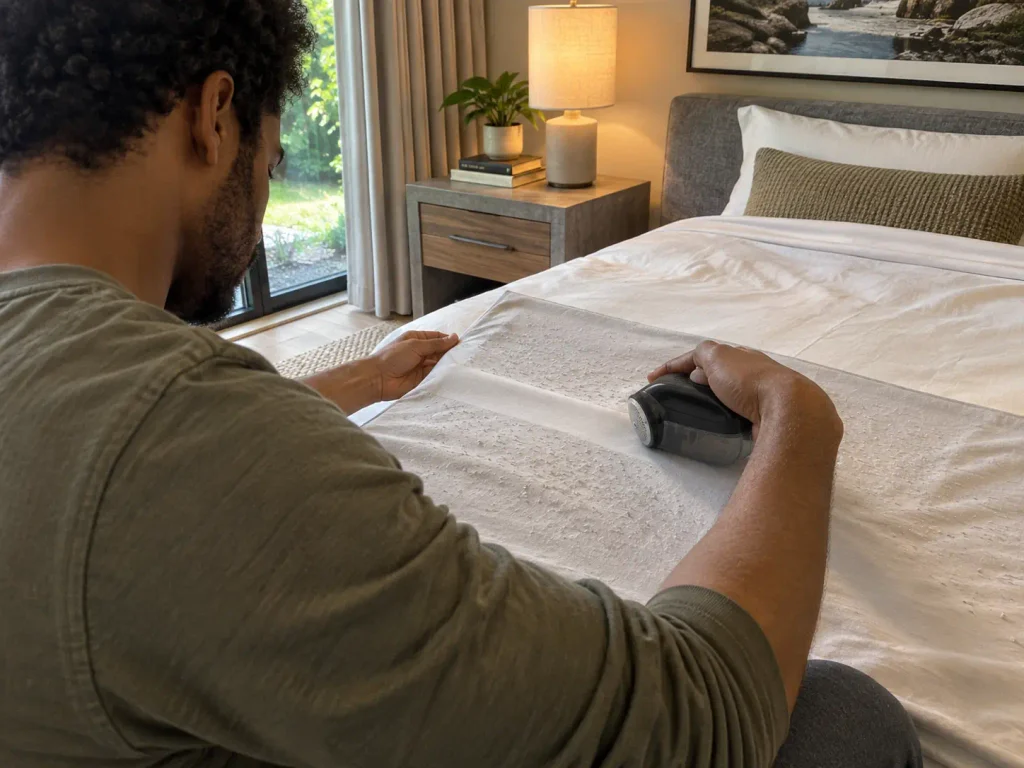
A battery-operated fuzz remover sits between the two, and it is fine as long as it has a guard you can adjust. What separates the tools that work from the ones that do not is whether they cut the ball off at a controlled height or scrape at the fabric and hope.
So there are two honest options for fabric pilling on a sheet, and they differ by how much can go wrong.
Start with a manual comb rather than a motor, especially on anything you were unsure about at the lamp. The Multi-Fabric Sweater Comb for Pills and Fuzz is a diamond-edged scraper with no battery in it, and its listing names sheets explicitly rather than treating bedding as an afterthought. Nothing spins, so on a fabric that has already lost some thickness it physically cannot bite through to the other side.
Its flaw is the obvious one: it is slow, and working a whole fitted sheet by hand will make your wrist complain long before you finish. It is the careful first attempt, not a weekly routine.
Percale is a plain over-under weave. Every stretch of yarn is locked down short, no floats, nothing loose for a blade to catch and lift, and percale’s plain weave leaves no exposed float to abrade in the first place. It is the most forgiving fabric under any depiller. Work in one direction, light pressure, and the weave itself resists being cut through by accident.
That forgiveness is why a motor makes sense here, and why the depth guard is the only specification worth reading on one. The Pionix Extra Power Fabric Shaver runs a 35W motor at 12,000 RPM behind a multi-depth blade guard, and that dial is the entire reason a shaver belongs in a bedding article rather than a sweater one — one machine, three fabrics, three settings.
Sateen is where the dial stops being a convenience. A sateen floats yarn over several threads before tucking it under one, and each float in that weave is a long unsupported span of yarn, so the blade meets long, loosely anchored stretches rather than short locked ones.
That is the failure mode with this tool: the wrong depth guard bites the fabric instead of skimming the fuzz, and on long floats it is genuinely easy to open a hole with a setting meant for something thicker. Shallowest guard. And keep the fabric flat rather than stretched over a knee, because tension lifts a float straight up into the blade.
Work over a table, not over the mattress. On a mattress the fabric sinks away under the blade, the guard loses the flat surface it measures its height from, and the depth setting you chose so carefully stops meaning anything at all.
Flannel is not a weave at all. It is a napped finish, brushed cotton raised out of the surface with a wire roller. The nap is what you bought, so an aggressive pass removes the product along with the pills. Use a deeper guard, make one pass, and accept a result that looks less clean than a percale would.
It also keeps shedding for a wash or two afterward, which is normal and not a sign the shave failed. Worth knowing that jersey is a knit and flannel is a finish before you treat them as the same problem.
Microfiber is the fabric where shaving is genuinely the only route, because those pills will never break off by themselves. It is also the fabric where they come straight back for exactly the same reason. Shave it, yes, and then read the next section before you expect it to hold.
Jersey is the honest exception. A jersey knit is looped rather than interlaced, and its real failure mode is permanent stretch at the corners, not fixable pilling. A shaver on a jersey sheet is the wrong tool aimed at the wrong problem.
Linen deserves a word too: linen’s slubby surface is uneven on purpose. A slub is a thick spot in the yarn, not a pill, and shaving one off removes fabric for no reason at all.
| Weave | What the blade meets | Setting | What goes wrong |
|---|---|---|---|
| Percale | Short yarn stretches, locked down over-under, no floats | Standard, light pressure, one direction | Little — the most forgiving fabric under a blade |
| Sateen | Long floats passing over several threads, loosely anchored | Shallowest guard, fabric flat not stretched | A float lifts into the blade and the guard cuts a hole |
| Flannel | A brushed nap, not a weave: the surface is the product | Deepest guard, one pass only | An aggressive pass shaves off the nap you paid for |
| Microfiber | Pills too strong to snap off on their own | Standard, shaving is the only removal route | Nothing, except that they return on the same schedule |
Last piece, and it is about what happens after the shave rather than during it. Most re-abrasion is not earned in bed, it is earned in the drum, against zippers and hooks and whatever rough thing shared the load. An OTraki Large Mesh Washing Bag is 43 by 35 inches, rated to 176°F, and sized for a sheet rather than for socks. Be clear about what it does: it fixes nothing on its own, and if the fabric is pilling because the fiber is short, a bag only slows the return down.
Why the Same Spot Pills Again, and When That Means Replace
A shave that looks like a cure on Sunday night is being judged far too early. The honest verdict arrives two washes later, in the same square foot of fabric.
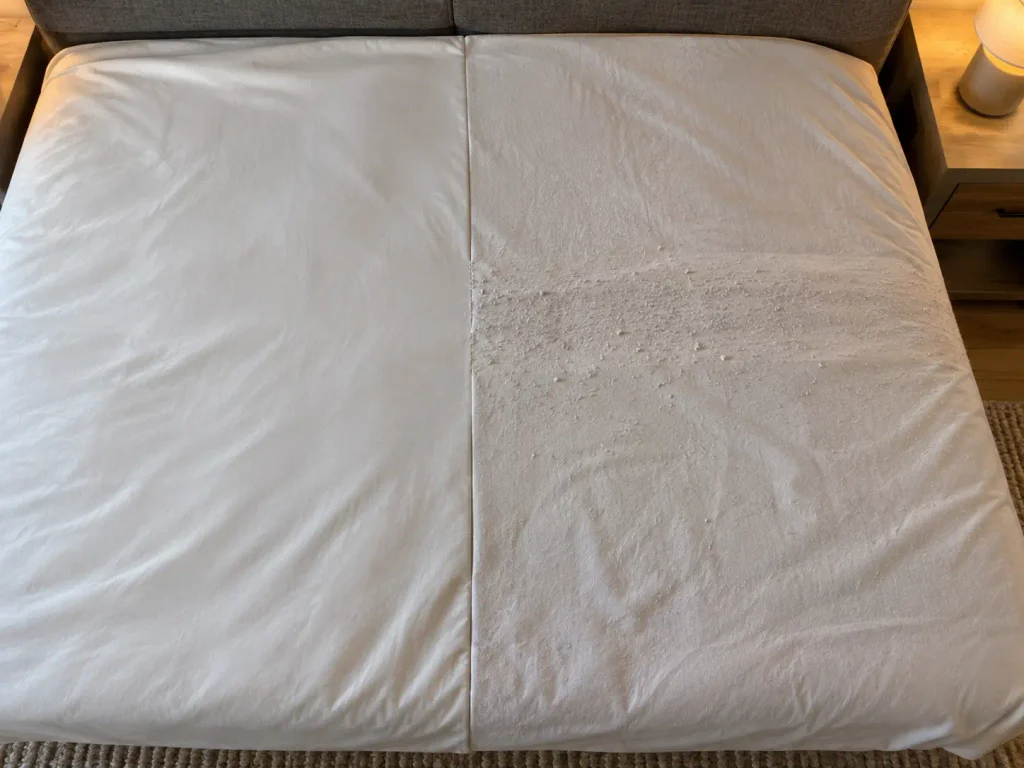
It comes back in the same place for a reason that has nothing to do with luck or with the tool. Shaving removes the pills; it does not remove the broken fiber ends they grew out of. Those ends are still in the yarn, still protruding, still catching on everything they touch.
The patch that pilled first is by definition the patch with the most exposed ends, so it is the patch that will pill first again. Recurring pilling in one location is a fiber breakage problem, not a cleaning one, and re-pilling on the same square foot is the clearest reading you will get of it. Every competitor writes “pills may return” and stops there. This is why.
The timeline is the number nobody prints. The forum account runs about two weeks to first pilling, one shave, then roughly a month before that same fitted sheet pilled again in the same place. Weeks, not seasons. That is the order of magnitude to plan around, and it should change how you feel about the twenty minutes — it is maintenance, not repair.
So here is the rule I would use, and it is a rule about the second time, not the first. Shave once, and watch that patch. If it pills again within a couple of washes, the yarn there is still actively shedding fiber, and every further shave is taking material off a sheet that is already losing it.
That is the replace signal. It is the line between cosmetic wear, which shaving genuinely addresses, and structural wear, which it cannot touch. Repair vs replace is decided there, and it is the point at which you replace sheets rather than keep working on them. Not a calendar, not a thread count, not how old the set is.
And if it is the fitted sheet specifically that keeps going while the rest of the set holds, when the fitted sheet is the piece that keeps failing is its own diagnosis.
Before you put the shaved sheet back on the bed, note where the patch was relative to the seam — third of the way down, left side, whatever it is. Two washes later, go straight to that spot with a hand. You are not judging the sheet, you are judging that square foot, and you will not find it again by memory once it is smooth.
Week one lies worse here than almost anywhere else in bedding, because a freshly shaved sheet is engineered by the process to look new. The set that actually survived is the one where the cleared patch is still smooth twenty washes later. Anything short of that is a set on a countdown you have not started measuring yet.
There are laundry changes that genuinely help, and they all do the same thing: remove abrasion. Wash cooler, wash the sheets in a bag, keep the load light enough that the fabric tumbles instead of being scoured against a zipper, and dry on low or pull them out damp.
Worth being specific, because “wash gently” is the kind of advice that means nothing at the machine. A gentle cycle or a delicate cycle cuts the agitation, which is the mechanical action lifting fibers out of the yarn in the first place. A cold water wash keeps fibers from swelling and relaxing, and swollen fibers work loose more easily; there is no hygiene argument for a hot water wash on sheets that are washed weekly anyway, and a warm water wash is the most anybody needs.
Use a mild detergent rather than a harsh detergent built for grease and mud, and skip the fabric softener entirely: it coats fibers and makes the surface slicker rather than stronger, and on a napped finish it flattens the nap you are trying to keep. Low heat drying or air drying does more for a pilling sheet than anything else on this list, because a hot tumble is a long session of fabric abrading against fabric. Line drying is the gentlest of all, if you have somewhere to do it.
And stop overloading the washer: a packed drum means the sheets scour each other instead of moving through water. Washing separately from towels and anything with a zipper removes the roughest abrasion in the load outright. Rotating sheet sets helps for the same reason, by halving how often any one set goes through the machine.
None of it reverses a single broken fiber. All of it slows the clock down, which is the only category of help available at this stage.
Wash twenty is still the honest verdict: a shaved sheet that is smooth twenty washes later was worth saving. And the vinegar rinse does not touch this either. It works on something real, just not on this.
The usual advice is to keep shaving until the sheet is visibly worn through. After enough relapse stories that follow the exact same shape, the second relapse holds up much better as the line. A hole is a very late signal.
If the lamp test failed, or that patch has gone twice, the set is finished and the question changes from repair to replacement. The MALOUF Double Brushed Microfiber Bed Sheet Set is the honest budget-tier answer if what you want is a working set on the bed this week. Its flaw is the whole reason to say it out loud: microfiber pills because of what the fiber is, so replacing microfiber with microfiber restarts the identical clock at wash one. If you are tired of that clock rather than tired of that sheet, a 300-thread-count cotton percale set breaks the cycle instead of repeating it, and what to read on the label before buying the replacement is where that decision properly belongs.
Conclusion
Three things to carry out of this. A pill is fabric that already left the yarn, so shaving removes the ball and not the damage. Nothing reverses pilling, and any page promising to restore a pilled sheet is selling you a verb.
The lamp decides whether the twenty minutes are worth spending: even, opaque weave means shave it; a brighter, hazier patch means no tool will help and the shave will make it worse.
And match the tool to the fabric: comb before motor, shallowest guard on sateen, deepest on flannel, table rather than mattress.
The wash-twenty check: two washes after the shave, run a hand over the same square foot you cleared. Still smooth, and the set has real time in it. Rough again, and the yarn there is still shedding.
That is the replace signal, and it shows up long before any hole does.
The giveaway is in the hand, not the eye: a finished sheet starts to feel softer and looser than the rest of the fabric rather than smoother. That is missing fiber, and it never comes back.
Strip the bed tonight and hold the worst patch up to the bedside lamp. That one look decides whether the next twenty minutes are worth spending, and it costs nothing.
Frequently Asked Questions
01Can pilling be reversed?
No. A pill is fiber that has already broken loose from the yarn, so taking it off is cosmetic and the fabric underneath stays thinner than it was. Shaving buys time; it does not restore the sheet.
02How can I remove pilling from my bed sheets?
Lay the sheet flat on a hard surface and work a fabric shaver or a manual comb across it in one direction. Match the depth guard to the weave: shallowest on sateen, deepest on flannel, standard on percale.
03Does pilling mean poor quality?
Usually short-staple fiber or a loose weave, yes, but not always. How much you move in your sleep changes the rate as much as the sheet does, which is why two identical sets pill differently on two beds.
04Why do my bed sheets get fuzz balls?
Surface fibers work loose under friction, tangle with each other, and roll into balls held on by a few unbroken anchor fibers. Synthetics keep theirs because the fiber is too strong to snap off and fall away.
05How long does shaving pilled sheets last?
Weeks, not seasons. One documented account got about a month before the same fitted sheet pilled again in the same place, and a second relapse in the same spot means the fabric is finished.





Tried it on your own bed?
No comments yet. Tell us what you changed, and what the sheet did after a few washes.