







What’s in here6 sections
Search this question and page one argues with itself. The top organic result is a forum thread calling it “chemically impossible” for vinegar to soften fabric, and the four blogs sitting underneath it all say the same thing: add half a cup to the rinse. Nobody on that page reconciles the two.
The tests that grade how much a fabric pills, the tumble tests and the rub tests, only ever change four things: the fiber, the yarn, the weave and the finish, and not one of them has ever measured what went in the rinse water. So here is what vinegar genuinely does, what actually decides whether a sheet pills, why those two keep getting confused, and the one move that changes the outcome.
Quick Answer
No. Vinegar cuts detergent and mineral residue, not fiber breakage. It can make an already-pilling sheet feel smoother by stripping the film that was exaggerating the texture, but it never touches staple length or weave, the two variables that decide whether a sheet pills at all.
What a Vinegar Rinse Actually Does
Before deciding whether vinegar fails at pilling, it is worth being fair to it. It does do something real in a wash, and that something is the reason the advice spread as far as it did.
Why Sheets Come Out of the Wash Feeling Stiff
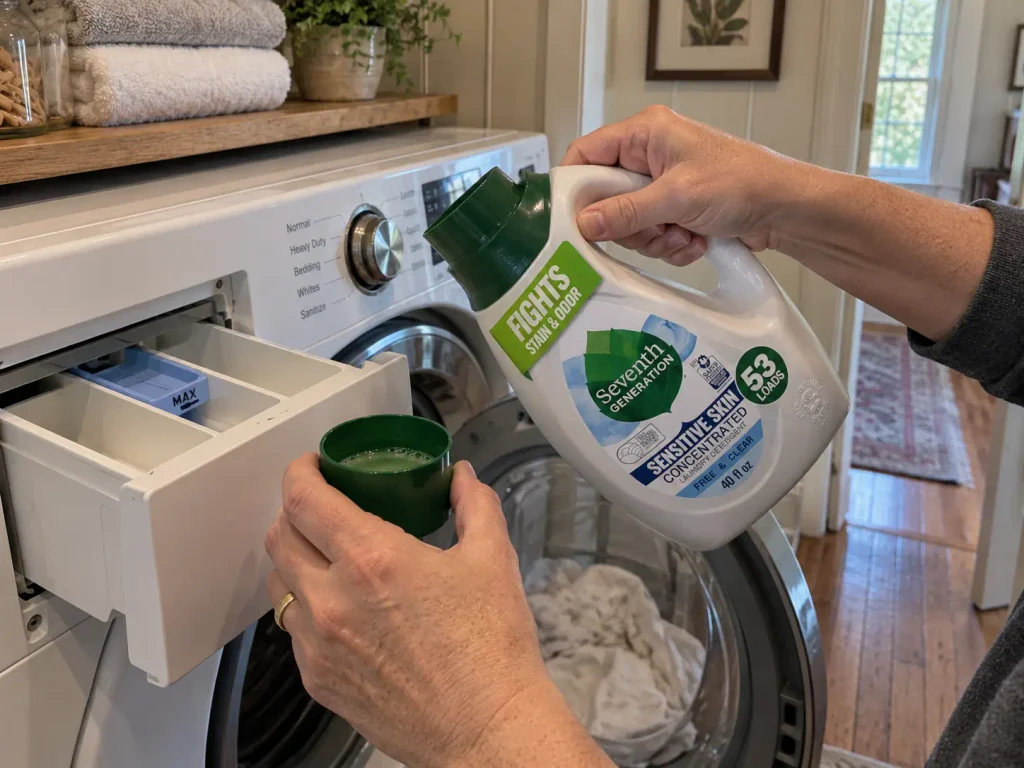
Laundry detergent runs alkaline on purpose, somewhere around pH 9 to 10, because that is what lifts oils and soil off cloth. When the rinse is incomplete, some of that alkalinity stays behind in the fibers, and in hard-water areas it brings calcium and magnesium along with it. What you feel the next morning is not the cotton changing. It is a thin mineral-and-soap film sitting on top of the cotton, and it makes a perfectly healthy sheet feel coarse, dull and slightly crunchy.
That matters because “this sheet feels rough” is one complaint covering two completely different problems. A film rinses off. Pilling does not, because what actually makes a sheet pill is the fiber itself coming apart, not something landing on it. Same sensation under your hand, opposite causes, and the whole confusion on page one starts right here.
The crunch also is not evenly distributed, which is the part nobody mentions. It is worst on the fitted sheet, and that is not a coincidence: the fitted sheet is the piece that goes into the drum balled up around itself, so it is the piece that rinses least completely of anything in the load.
What the Acid Does to That Residue
White vinegar is roughly 5% acetic acid. In the rinse, and specifically the rinse dispenser rather than the detergent drawer, that weak acid neutralizes the leftover alkalinity and acts as a mild chelator on the calcium and magnesium, loosening the mineral deposits enough that they wash away instead of drying onto the cloth.
The convention across independent laundry-care sources is about half a cup per load, though one of the blogs ranking for this query puts it at a quarter. Pick a number, use it in the rinse, move on. This is not a how-to.
Here is the limit, and it is the whole article in one line: vinegar has no fiber-softening or fiber-strengthening chemistry of its own. Nothing in it makes a cotton molecule softer, longer or stronger. The softening people feel is completely explained by subtraction — something was removed, and the cloth underneath was always like that.
Vinegar in the detergent drawer does nothing useful, because it meets the detergent while the detergent is still working and partly neutralizes it. It belongs in the rinse dispenser, where there is nothing left to cancel out. If your machine has no rinse dispenser, add it by hand when the rinse starts, not at the beginning of the cycle.
The Part Nobody Says Out Loud: It Is Undoing a Mistake
The laundry-care writers who actually explain the chemistry all land on the same uncomfortable point, and it is the one the recommendation blogs skip. If a vinegar rinse is noticeably softening your sheets, that is a signal about your detergent, not a win for the vinegar. You are running enough detergent that it cannot fully rinse out, and then adding a second product to remove the leftovers of the first.
The free fix comes first and it costs nothing: measure the dose down. Most people pour to the line molded into the cap, which is sized for a heavily soiled full load in hard water, and bedding is neither. Halve it for one wash and see what happens to the hand-feel. If the crunch goes away without any additive at all, you never had a vinegar problem or a pilling problem — you had a measuring problem.
If the crunch stays after you cut the dose, the detergent itself is leaving more behind than it should, and a concentrated, no-additive formula like the Seventh Generation Concentrated Laundry Detergent, Free & Clear rinses cleaner because there is less in it to strand in the fibers in the first place. Its flaw: unscented does not read as “clean” to everyone who associates fresh laundry with fragrance, and it still has to be dosed properly, since the bottle does not measure itself.
What Actually Decides Whether a Sheet Pills
So vinegar cleans up after the detergent. Pilling is a different event entirely, and the people who test it for a living have already written down what causes it.
A Pill Is Broken Fiber, Not Dirt
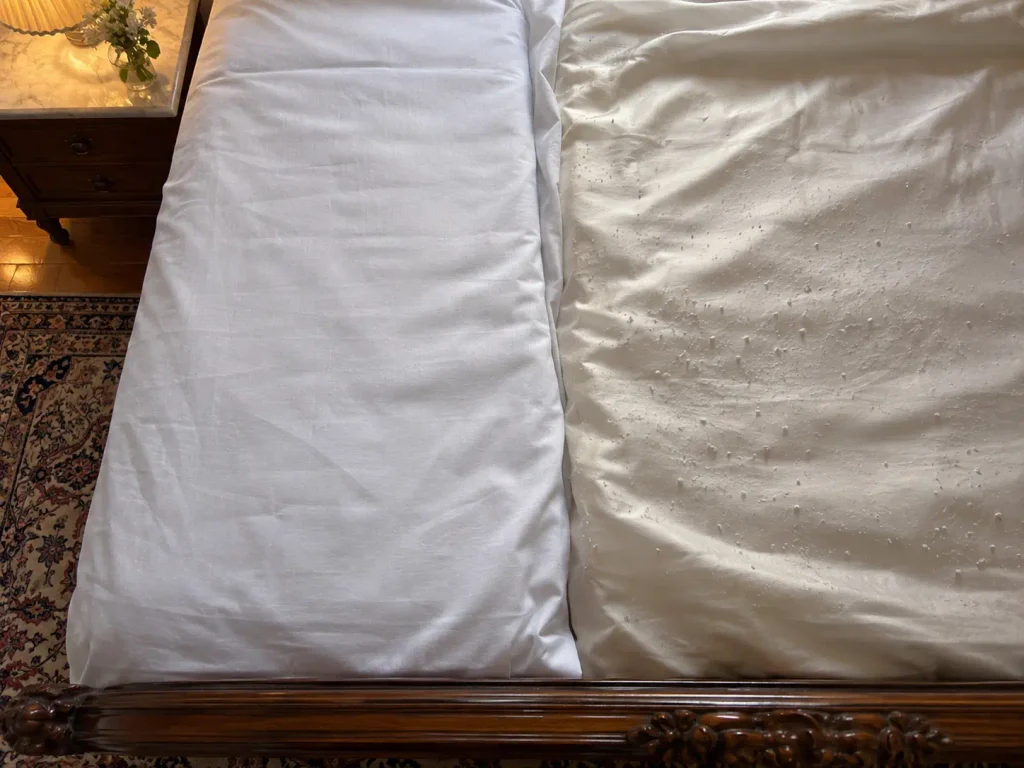
A pill is not something that landed on your sheet. It is your sheet. Repeated friction breaks fiber ends free from the yarn, those loose ends migrate to the surface, and continued rubbing knots them into a little ball that stays anchored to the fabric by the fibers that have not broken yet.
That is a structural change to the yarn surface. Nothing dissolves it, because there is nothing foreign there to dissolve.
Read that sentence twice, because every wrong answer about vinegar and pilling comes from skipping it. A rinse additive works on deposits. A pill is not a deposit.
What the Test Methods Measure, and What They Ignore
If a rinse additive affected pilling, it would show up as a variable in the tests. It appears in none of them.
ASTM’s own definition of what causes pilling is right there in the scope text of the random tumble method: pilling propensity is affected by type of fiber or blends, fiber dimensions, yarn and fabric construction, fabric finishing treatments and refurbishing method. That is the official list. Vinegar is not on it, and neither is anything else that goes in the rinse water.
The methods themselves say the same thing by what they physically do. The standard lab tests for pilling resistance that a university textile lab runs, from D3511 to the D3512/D3512M random tumble to the D4966 and D4970 Martindale abrasion tests, all work by tumbling or rubbing a specimen against itself or against an abradant. Every one of them varies friction, fiber or construction. None of them varies wash chemistry, because a hundred years of testing has never found a reason to.
When a care claim is real, there is usually a test method behind it that somebody can name. Flame resistance has one. Colorfastness has one. Shrinkage has one. Pilling has four. If a product or a tip claims to change something that is measured by a standard, and it is not a variable in that standard, the claim is about how the cloth feels, not about what the cloth is doing.
Staple Length Sets the Clock, Weave Sets the Speed
The pillar settles the mechanism and this node is not going to re-argue it, so here it is compressed: staple length decides whether, weave decides how fast. Short-staple cotton, fibers under roughly an inch, shows visible pills at somewhere around 20 to 30 wash cycles, because short fibers leave more loose ends per inch of yarn and every one of those ends is a pill waiting to happen. Long-staple cotton at 1.125 inches and up holds out far longer for the same reason in reverse.
Then the weave sets the pace at equal fiber. Plain weave, one thread over and one under, keeps each yarn locked down with very little of it exposed. Twill floats more. Sateen floats four over one, which is exactly why it feels smooth and exactly why it abrades first, because there is more yarn sitting up on the surface with nothing holding it.
It is the same staple-length math that decides what a cheap set costs you, approached from the receipt instead of from the replacement date.
And pills do not arrive evenly across a set. They show up first on the panels that take weight and movement, which is why the fitted sheet and the pillowcases go long before the flat sheet does. Check those two and you are checking the set.
Why Vinegar Feels Like It Worked
Both sides of that page-one argument are describing something real, which is why neither one has been able to finish the other off. The confusion has a mechanism, and it is worth naming precisely.
Two Problems, One Complaint
Residue and pills live on the same surface and produce the same sentence out of the same person: this sheet feels rough. One of them is a film you can rinse off. The other is fiber you cannot. Because the complaint is identical, the cure for one gets credited for the other constantly, and there is no way to tell them apart by feel alone, which is precisely the situation that lets four blogs and one blunt forum thread both be partly right and stay that way for years.
Strip the residue and the hand-feel improves the same night. The sheet is genuinely smoother against your skin, and every single pill is still exactly where it was. That is the entire illusion, and it is a convincing one, because the improvement is real and immediate.
What a Rinse Can and Cannot Lift
You cannot rinse a pill away. A rinse works on things that are stuck to cloth, and a pill is made of cloth — anchored by fibers that are still attached to the yarn underneath.
Acetic acid at 5% has no quarrel with cellulose, and even if it did, the fiber knot is mechanical rather than chemical. There is no bond to break. You could soak a pilled pillowcase in vinegar overnight and it would come out cleaner, softer to the hand, and identically fuzzy.
So the Reddit answer is right about the fiber and wrong to imply nothing happened, and the four blogs recommending the rinse are right about the effect and wrong about the cause. Both halves of the SERP are reporting honestly. Neither is describing the same variable.
Using It as a Test Instead of a Cure
Once you know that, vinegar becomes useful in a way none of those pages suggests: as a diagnostic. Run one rinse with it on a sheet that feels rough. If the roughness disappears, it was residue, and the real fix is upstream at the detergent cap.
If the roughness survives the rinse, it is pilling, and that is a fiber verdict rather than a laundry one. No wash routine is going to talk it out of what the staple length already decided.
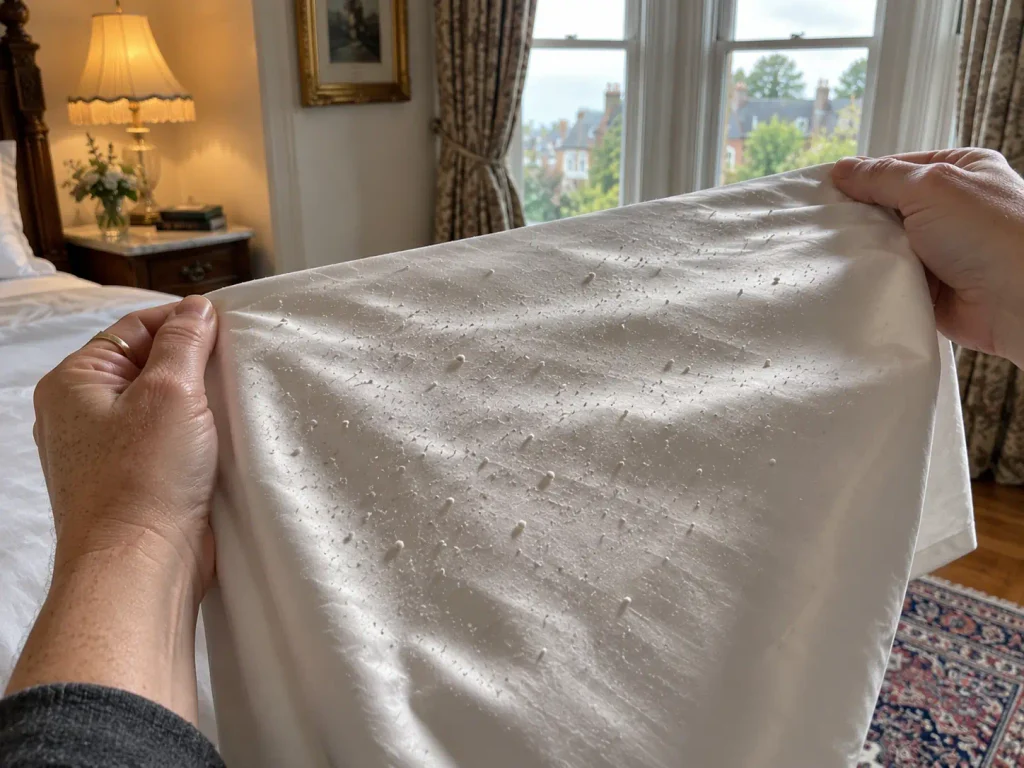
But the better test is free and takes about four seconds. Hold the panel at a low angle to a window, so the light rakes across the surface rather than hitting it flat. Residue vanishes in raking light. Pills do not: each one throws a small shadow, and a sheet that reads smooth to your hand while catching the light in dots was never a detergent problem at all.
Do the raking-light check on the fitted sheet while it is still on the mattress, in the morning, before you make the bed. Stretched flat and lit from the side by a window, pills stand up and cast shadows. The same sheet folded in a linen closet hides them completely, which is why most people first notice pilling at the exact moment they are least able to do anything about it.
What Vinegar Will Not Fix, and What Actually Would
Knowing what the additive cannot do leaves an obvious question, and the answer splits cleanly in two: one thing removes the pills you already have, and a different thing slows down the ones you do not have yet.

The Free Moves, First
Friction is the variable the standards actually name, so anything that lowers friction is doing real work, and the best of it costs nothing. Wash on the gentle cycle in cold water, or lukewarm water if the sheets need it, rather than hot water, since agitation is abrasion by another name and a hot water wash buys you nothing a longer soak would not. Cut the load size, because sheets packed into a full drum have nowhere to go but against each other.
Keep bedding away from towels, which shed, and away from anything carrying a zipper, a hook or a Velcro tab, because those are abraders with a handle on them. And if it goes in the dryer at all, tumble dry low and pull it out slightly damp instead of running a long high heat cycle to the end. Heat does not cause pilling on its own, but forty minutes of tumbling is forty more minutes of the same rubbing that caused it, and air dry costs nothing but time.
That is the list. No purchase required, and it moves the date further than any bottle will. What it will not do is rescue a set that was short-staple to begin with, which is the part worth knowing before you go shopping for a fix: thread count on the package tells you nothing about this, and a high number reached by twisting two thin yarns together gives you more surface to abrade, not less.
For the Pills Already There
For pills that have already formed, mechanical removal is the only removal. An electric fabric shaver cuts the tangled fiber off the surface with a rotating blade behind a guard, which is the one thing that physically works on a knot that no rinse can dissolve.
The Pionix Extra Power Fabric Shaver runs a 35W motor at 12,000 RPM, which is enough to clear a queen fitted sheet without stalling on a dense sateen. Its flaw is the honest one and it is worth stating plainly: it removes the pills that are there and changes nothing about the fiber that is generating them. In the forum thread that matches this article’s case best, a 600-thread-count combed cotton sateen set started pilling within two weeks of first use, a shaver cleared it completely, and about a month later the pills were back on the same panels.
The shaver tells you something the first time you use it, though, and it is worth paying attention to. If the canister fills fast on the fitted sheet and stays nearly empty on the flat sheet, the set is not failing uniformly. Those two pieces are on different clocks, and the fitted one is running out first.
For the Pills Not There Yet
Everything left is friction reduction, and the free version above is genuinely the first move. Past that, the structural one is keeping the bedding from abrading against the drum and against itself. A mesh wash bag does that: the OTraki Large Mesh Washing Bag is 43 by 35 inches, which is the rare size that actually holds a queen set rather than a sweater, and it is rated to 140–176°F so a warm wash will not deform it. Its limit is exactly what you would expect: it lowers the friction, it does not remove it, and on short-staple cotton it slows the clock rather than stopping it.
Two things that get recommended for this do nothing at all, and skipping them is free. A lint roller lifts loose fluff off the surface and leaves every anchored pill exactly where it was, because the pill is still attached to the yarn. And liquid fabric softener is the worse idea of the two: it works by depositing a waxy film on the fiber, which is one more coating to mask what is happening underneath, and on a sheet it also costs you the absorbency you were paying for.
Which is the honest close. Neither the shaver nor the bag changes staple length or weave, and those two decided the outcome before the set ever reached your machine.
Pilling is the early warning of a sheet’s life, not the end of it — pilling shows up long before any hole does, which is why a set can look finished and still have months of structural life in it. But keep a rough wash count in your head, because it is the number that settles this: a set pilling by wash ten and coming back a month after every shave has told you what it is. The variable left is the sheet itself, and that is a replacement decision rather than a laundry one. The pillar has the full picture on why sheets pill and what to buy instead.
The Short Version
Vinegar cuts detergent and mineral residue, and it does it well. It never touches the broken fiber that a pill is made of, because that is a different problem sitting on a different layer, and no acid has an opinion about a knot.
What decides pilling was decided before the sheet reached your wash. Staple length sets whether, weave sets how fast, and every standard test method confirms it by what it bothers to measure. Use the rinse as a diagnostic instead of a cure: roughness that disappears was residue, roughness that stays is the fiber, and no additive is going to argue with that.
After a season of washes, check the fitted sheet and the pillowcases in raking light rather than the flat sheet. If they throw dots of shadow while the flat sheet stays smooth, the set is on its way out regardless of what has been going into the rinse dispenser.
Tonight, run one load with half the detergent you normally use and nothing else added. If the sheets come out softer, the problem was never pilling.
Frequently Asked Questions
01Does vinegar stop pilling on sheets?
No. It removes detergent and mineral residue, which can make a pilled sheet feel smoother, but it does nothing to the broken fiber a pill is made of. The pills stay exactly where they were.
02Does adding vinegar to laundry actually soften fabric?
It softens by subtraction, not by coating: it strips the alkaline detergent and hard-water film that was stiffening the cloth. If the effect is dramatic, the real finding is that your detergent dose is too high.
03Can pilling on sheets be reversed once it starts?
The pills can be removed with a fabric shaver. The pilling cannot be stopped. On short-staple cotton expect them back within weeks on the same panels, because the fiber generating them has not changed.
04How much vinegar do you put in a rinse cycle?
Roughly half a cup of plain white vinegar in the rinse dispenser, never the detergent drawer. Some guidance goes down to a quarter cup. Doing it daily for years is the actual risk, not the amount.
05What actually stops sheets from pilling?
Long-staple cotton and a plain weave, chosen at purchase. After that, less friction: a gentler cycle, smaller loads, no zippers in with the bedding. Nothing in the rinse water affects it either way.





Tried it on your own bed?
No comments yet. Tell us what you changed, and what the sheet did after a few washes.