







What’s in here8 sections
- What Actually Makes a Bed Warm (and It Isn’t the Fiber Name)
- The Winter Stack, Piece by Piece, in the Order It Goes On
- The Sheets: Weave, Weight, and What the Label Hides
- The Duvet or Comforter: Fill Power, Tog, and the Cold Seams
- Two People, One Bed, Two Different Winters
- What the Set Looks Like After a Season of Washes
- Build the Bed Before You Buy Anything
- Frequently Asked Questions
There is a bed somewhere tonight with every warm thing in the house piled on it, and the person under all of it is still cold at four in the morning. Three blankets deep and the cold is coming from underneath. Nothing on that bed is wrong. The order is.
No fiber generates heat: every warm layer works by holding still air near you, and the whole game is how much air a layer traps and whether the layer above crushes it flat. So here is the winter bedding set, piece by piece, in the order it goes on, with the number that decides each one. Layering bedding is the skill; the bed layers are just the parts list. Wool, down and the thickest flannel on the shelf are all doing the same job, and doing it badly if you stack them wrong.
Quick Answer
A winter bedding set is two or three pieces swapped or added, not a new bed: a heavier sheet, a warmer top layer, and often a topper underneath. The order matters more than the fabric name, because a layer put on in the wrong place cancels the one below it.
What Actually Makes a Bed Warm (and It Isn’t the Fiber Name)
Everybody knows somebody who bought the thickest thing in the store and is still cold. That is not bad luck and it is not a defective blanket. Weight is not warmth.
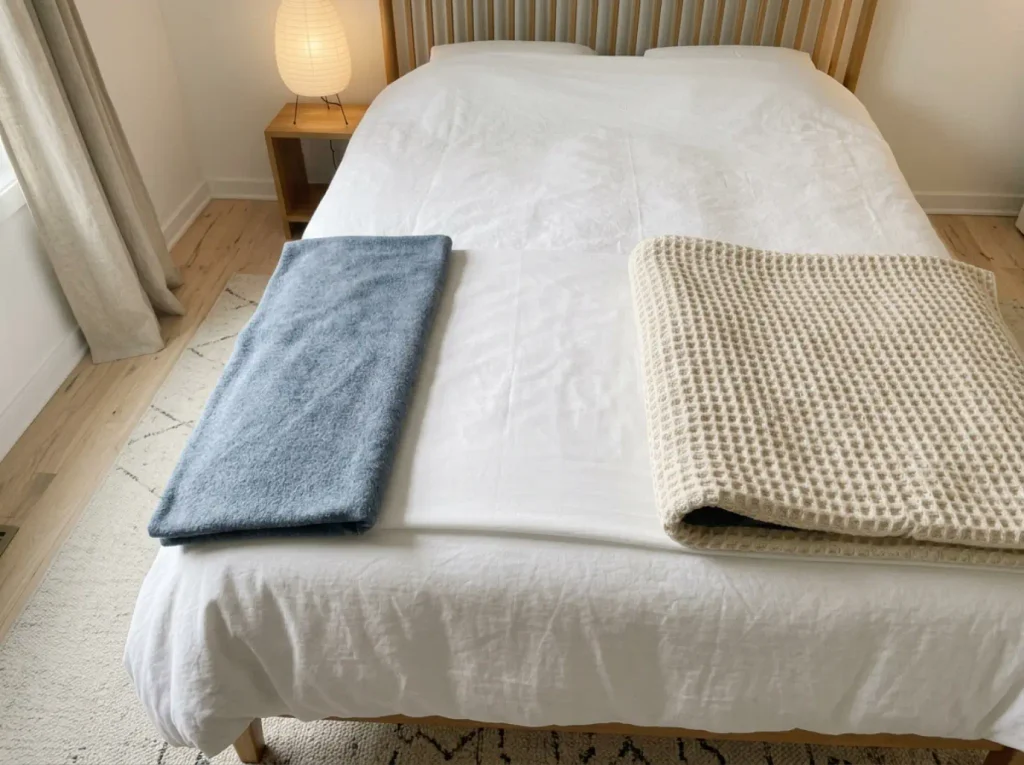
A dense, heavy blanket laid over a lofted duvet squashes the loft out of it, and a squashed duvet is a thinner duvet, so the bed loses more from the layer you did not touch than it gains from the one you added. Seasonal bedding is a weight problem before it is a fabric one, and that is why this article is about sequence at all.
Trapped Air Is the Whole Mechanism
Nothing on your bed makes heat. You make the heat; the bedding only decides how much of it stays near you. Every insulating fabric does the same job, which is to hold a pocket of still air between your skin and the room. That is all thermoregulation means on a bed: the layers manage the heat you already make.
Down does it with clusters that spring apart. Merino wool does it with crimped fibers that will not lie flat. A napped cotton does it with a fuzz of lifted fiber ends. The fiber is only the machinery for holding air, which is why the fiber name on the package tells you so little on its own.
Still is the operative word. Air that moves carries heat away instead of holding it, and that is the tension the r/BuyItForLife thread named better than any retailer has: cozy but breathable. Those two pull against each other structurally. Breathability is the other half of that word: a layer that traps enough air to keep you warm also slows the escape of the moisture you give off all night, and most winter bedding copy is written as though that trade does not exist.
Weave and Nap: Why Brushing a Cotton Makes It Warm
Flannel is not a fiber. It is a finish. A woven cotton goes through a machine with fine wire brushes that lift the fiber ends out of the surface of the cloth, and that raised fuzz is the nap. The nap holds air. That is the entire trick, and it is why a brushed cotton feels dramatically warmer than the same cotton unbrushed without being much thicker. Double-brushed means both faces got the treatment.
A sateen does something different and gets confused with it. Sateen floats four threads over one, which closes the surface and makes it smooth and slightly warmer than a percale, because there are fewer gaps for air to move through. Smooth is not the same as insulating, though.
Sateen closes the fabric; a nap opens a fuzzy layer above it. For January, the nap wins.
Where the Numbers Live: GSM, Fill Power and Tog
Three numbers govern a winter bed, and each one applies to exactly one kind of layer. Mixing them up is how people end up comparing a sheet to a duvet.
- GSM (grams per square meter) is the number for a woven layer: sheets, blankets, throws. Flannel runs 160 to 170 GSM at the entry tier and 190 to 200+ GSM in the heavyweight band.
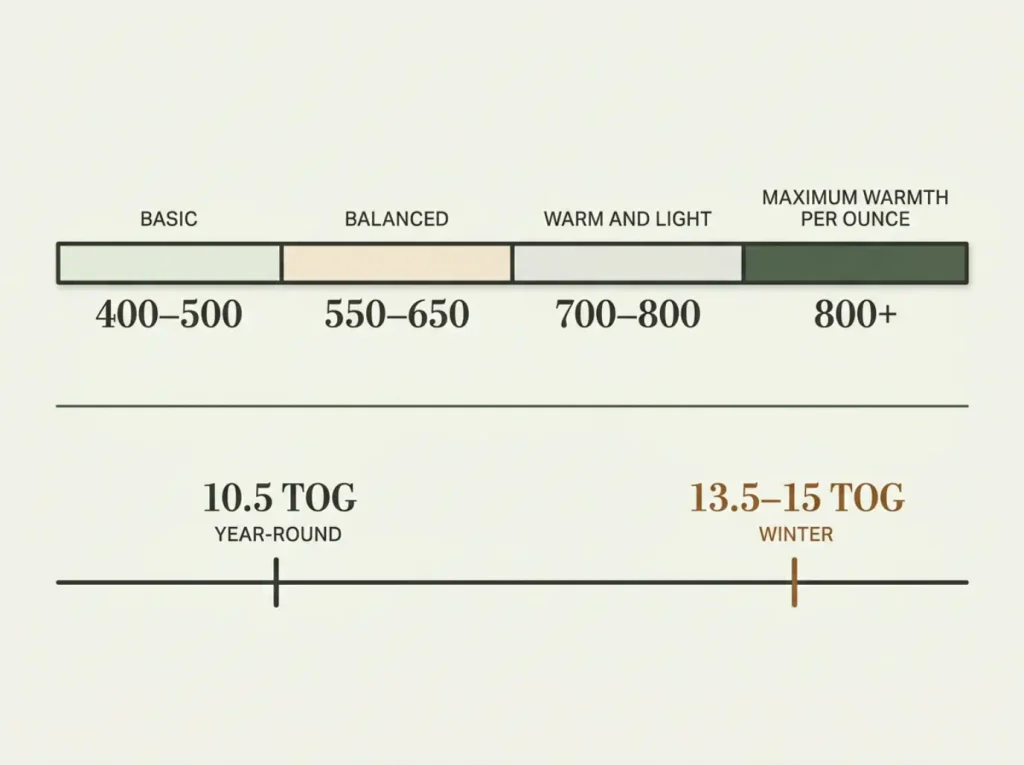
- Fill power is the number for a lofted layer: duvets, comforters, toppers. 400 to 500 is basic, 550 to 650 is balanced, 700 to 800 is warm and light, 800+ is maximum warmth per ounce.
- Tog is the number for the whole top layer as a system, and it is the one that says “warm enough for January”. A year-round duvet sits near 10.5 tog; a winter-weight one at 13.5 to 15 tog.
None of the four guides ranking above this one prints a single figure of any kind. They run on adjectives, and an adjective is not a measurement. When a brand does claim its fabric was tested for warmth, there is a real AATCC test method behind the claim, not just marketing language, a standardized way to measure thermal resistance that a legitimate number traces back to. If a warmth claim traces to nothing, it is an adjective wearing a lab coat.
If a flannel set will not print its GSM anywhere on the package or the listing, assume it sits at the bottom of the entry band. The heavyweight mills print the number, because the number is what they are charging for. Silence is a specification too.
The Winter Stack, Piece by Piece, in the Order It Goes On
Most people who are cold in winter already own four of the seven things they need. They have put them on in an order that undoes half of them. This is the section that costs nothing to act on, so do it before you buy anything.
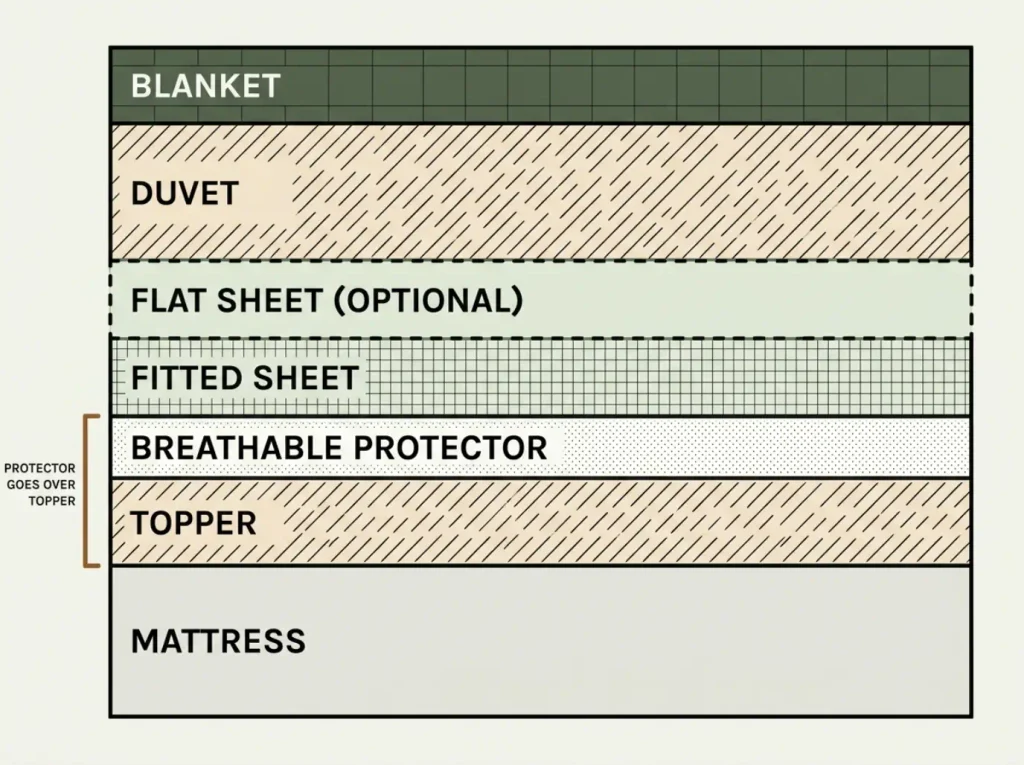
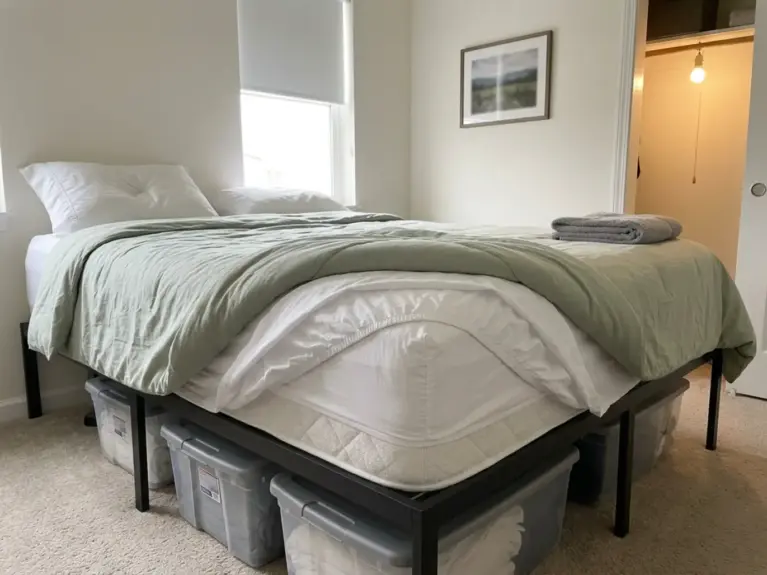
From the mattress up: mattress → topper → breathable protector → fitted sheet → flat sheet (optional) → duvet or comforter → blanket on top, last. That is the order, and it is the article’s actual answer.
The Layer Under You, Which Nobody Counts
Count the layers on a bed and almost everybody counts up from the sheet. But a mattress is a large cold object in a cold room, and it spends all night pulling heat down out of you through the one surface you are pressed flat against for eight hours. No duvet fixes that, because a duvet is above the problem. Not one of the four guides on this SERP mentions the under-layer at all.
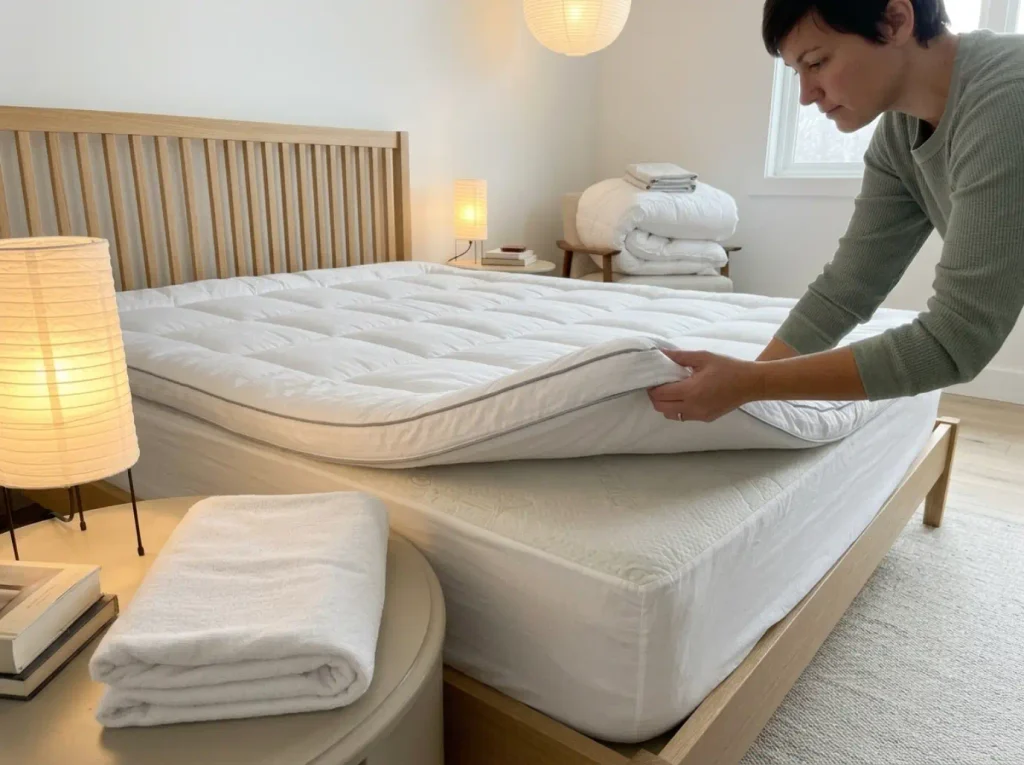
A mattress topper is insulation under the sleeper, and it is judged by the same fill logic as a duvet: how much air the fill holds and how well it resists being compressed by your own weight. The HYPREST Pillow Top Mattress Topper is a queen with a cotton face and a 1300 GSM down-alternative fill, which is a stated figure in a category that almost never gives one, and an 8 to 24 inch pocket. Two honest problems with it: there are only ten units in stock as this is written, and if it sells out there is no equivalent topper on Amazon that also declares its fill GSM, so the thing that makes it worth naming is also the thing that makes it hard to replace. And that 8 to 24 inch pocket is generous at the bottom end, which means on a slim mattress it can sit loose and shift.
The Protector Problem: A Sealed Backing Undoes the Layer Beneath It
Here is where a bed built correctly goes wrong. A mattress protector with a vinyl or film backing, placed on top of a topper, seals it. The insulation is still physically there, and it is now under a sheet of plastic that neither air nor moisture crosses. You paid for a layer and then wrapped it in a raincoat.
Worse, the damp you give off overnight has nowhere to go and collects at exactly the depth where you can feel it.
A cotton-terry face with a breathable backing protects the mattress without the seal. The Nestl Premium Cotton Terry Mattress Protector is the version of this that keeps turning up in this cluster: a cotton terry face over a TPU backing, which breathes considerably better than vinyl. Its flaw runs in two directions.
TPU is still a plastic barrier, so on a bed already carrying a full winter stack it is the layer where damp warmth collects first if nothing above it ventilates. And the terry face adds real bulk under the fitted sheet, so a sheet that was already tight over a deep mattress plus a topper will fight you at the corners. Check the pocket depth on the sheet before you add anything underneath it.
What to Add, What to Swap, What to Leave Alone
The topper goes under the protector, not over it. Almost every product page shows it the other way around, because the protector is what they are selling, and a protector on top of a topper protects the topper. Put it underneath and it protects the mattress, which is the thing you actually bought it for and the thing you cannot wash.
Past that, a winter set is two or three pieces changed, not a bed replaced. Swap the sheet, change the top layer, keep the duvet you already own.
And the retailers’ idea of a complete set includes a piece plenty of households never use at all: one family in the r/BuyItForLife thread runs fitted-sheet-only, no top sheet, which halves both the cost and the laundry. That’s it. Nothing bought yet.
The same stack logic runs backwards for the person on the other side of the year, where one wrong layer undoes three, in either direction. A sealed protector traps heat in July for the same reason it traps damp in January.
The Sheets: Weave, Weight, and What the Label Hides
Stand in front of two flannel sets that look identical and are priced differently, and there is usually nothing on either box to tell you which one you want. This section is how you tell.
Flannel Is a Finish, Not a Fiber
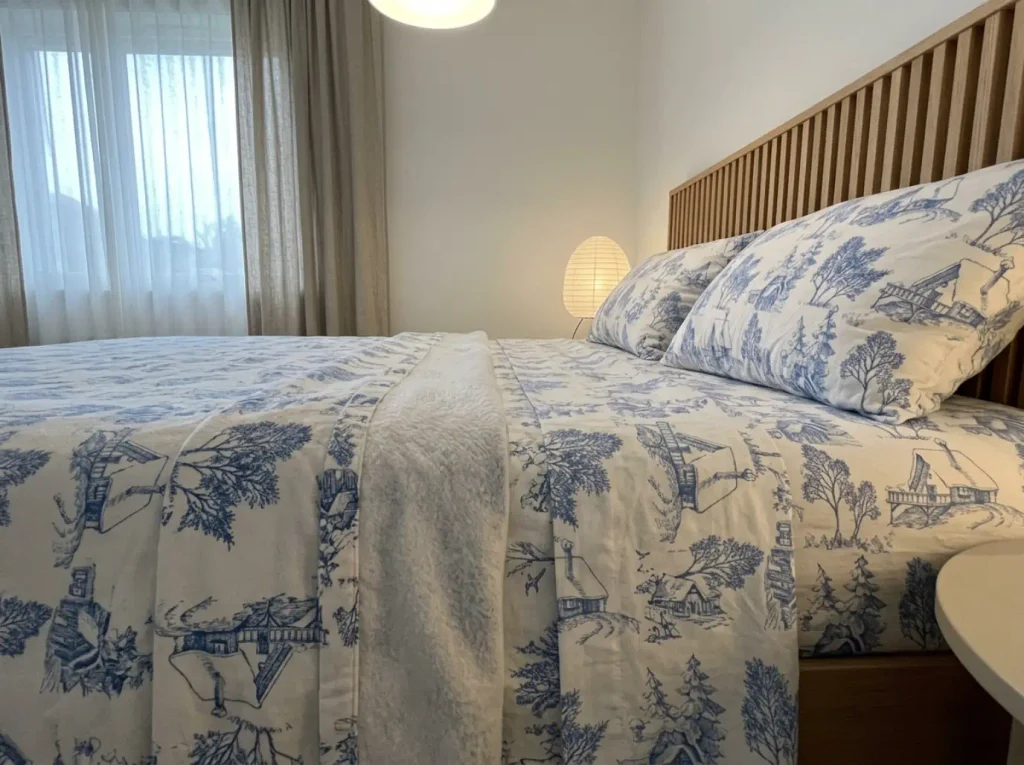
Since the nap is applied to a woven cotton rather than being a material of its own, two sets both honestly labeled flannel can behave nothing alike. The cloth under the nap is where the weight is. Brush a thin, loosely woven cotton and you get a fabric that feels wonderful for a month and then gives up; brush a dense one and you get a sheet that survives winters. The word on the label describes the last step of the process, not the cloth.
The GSM Band That Separates a Winter Sheet From a Marketing Word
160 to 170 GSM is the entry tier: a real flannel, a normal winter sheet, fine in a heated bedroom. 190 to 200+ GSM is the heavyweight band, and the difference is one you can feel through your hand before you sleep on it. A set that will not state its GSM is telling you which of the two bands it is in.
Thread count is the number people reach for instead, and for winter it is close to useless. The Company Store states flatly that a higher thread count means a tighter weave that is better for cold weather, with no caveat attached, and the caveat is the whole story: counts above 400 are commonly reached by twisting thin plies together and counting each ply separately. That is denser, not finer, and it is certainly not warmer.
Weave tightness does matter to warmth, but the count on the box is not how you read it. If you want what a thread count actually tells you, it is a manufacturing decision reported as a quality score.
The first wash of a new flannel set produces an alarming amount of lint and everybody expects it. It is the second wash that tells you what you bought. A good weave stops shedding; a loose one keeps going, and by then it is already fuzzing at the hem.
Which Sheet Goes On for Winter
Brushed cotton and flannel are the two finishes worth the seasonal swap. Flannelette is the same napped cloth under its older name, and jersey knit sheets sit alongside them as the third warm option, softer and stretchier but prone to going baggy.
Linen sheets are the one respected fiber that does not belong here on its own, because the loose weave that makes linen so good in July is the same weave that lets your heat straight out in January. A sateen is a mild upgrade over a percale for cold weather and not a winter sheet by itself, and a cotton blend with polyester in it will trap heat while doing much less with the moisture. And plain-weave cotton holds up better than its reputation in this category: the r/BuyItForLife poster who tracked their sets across winters reported clearance percale still holding up well after repeated washes, in the same thread where a fashionable blend fell apart.
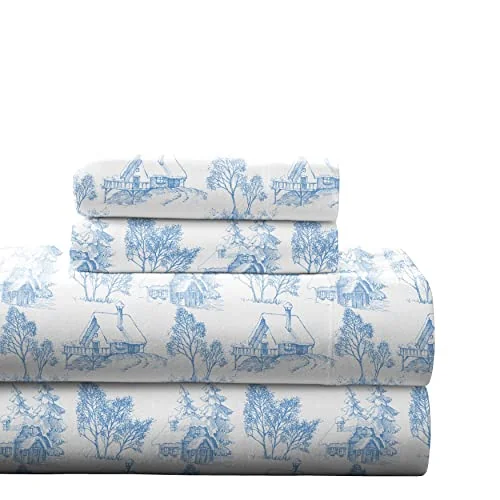
Flannel is not automatically the right call, either. In a bedroom that already runs warm, or beside a partner who does, it is too much fabric, which is the branch covered in when flannel sheets are worth it and when they’re too much.
The Duvet or Comforter: Fill Power, Tog, and the Cold Seams
Two duvets on a shelf, both saying warm. One is warm and light. The other is heavy and has cold stripes running through it. Nothing on the front of either package tells you which is which.
Fill Power Is Warmth Per Ounce, Not Warmth
This is the misreading that costs people money. Fill power measures how much space an ounce of fill occupies when it lofts, so it is an efficiency figure. A 500-fill duvet can be exactly as warm as a 700-fill one; it simply needs more ounces to get there.
Which means it is heavier, drapes tighter, and crushes more of its own loft under its own weight. High fill power buys you the same warmth with less mass sitting on you.
If down is out of the question, 600 to 700 fill power in a down alternative is the band to look for on the label, as Reviewed’s down-vs-alternative testing breaks down. Look for the number, not for the words hypoallergenic or plush, neither of which describes warmth. The full comparison of down against down alternative, on warmth rather than on price is a separate argument this section does not need to re-run.
Baffle-Box Versus Sewn-Through: Where the Cold Stripes Come From
Baffle-box construction sews internal fabric walls inside the duvet, creating three-dimensional compartments that let the fill loft to its full height and stay put. Sewn-through stitching skips the walls and pinches the top and bottom faces directly together, which is cheaper and faster, and every stitch line becomes a place where there is almost no fill between you and the room. Those lines are thin cold stripes running through the duvet in a grid. Two duvets of identical fill power are not the same duvet.
You can find them without looking. Run a flat hand slowly across a sewn-through duvet in raking light and you feel the stitch lines as cool ridges before your eye picks them out. Do the same on a baffle-box duvet and the hand finds nothing, because the surface is continuous. That is the whole thing you paid the difference for.
Picking the Tier for the Room You Actually Wake Up In
Choose against the room, not the thermostat. A poorly insulated bedroom with 19°F outside can sit near 50°F overnight even with the thermostat set to 60 to 65°F, because the thermostat reports the hallway and you are sleeping next to a cold wall. The sleeper in the Feathered Friends thread weighing Medium against Arctic for a New England winter was reasoning through exactly this and reaching for the warmer tier for exactly this reason.
And the usual advice is to buy a dedicated winter-weight duvet. I’d skip it. An all-season duvet with a blanket over the top reaches winter tog more cheaply, and unlike the winter-weight duvet it is not wrong for the other eight months of the year. You take the blanket off in April instead of hauling a duvet to a storage bag.
Two People, One Bed, Two Different Winters
A couple buys a compromise set so that neither of them will be uncomfortable, and ends up with two uncomfortable people. A temperature mismatch is not a fabric problem, and one shared top layer has one tog: it cannot be right for a hot sleeper and for somebody who is cold in the same bed. This is the case the entire retail SERP ignores and the top organic result is built on, which tells you something about who is writing and who is sleeping.
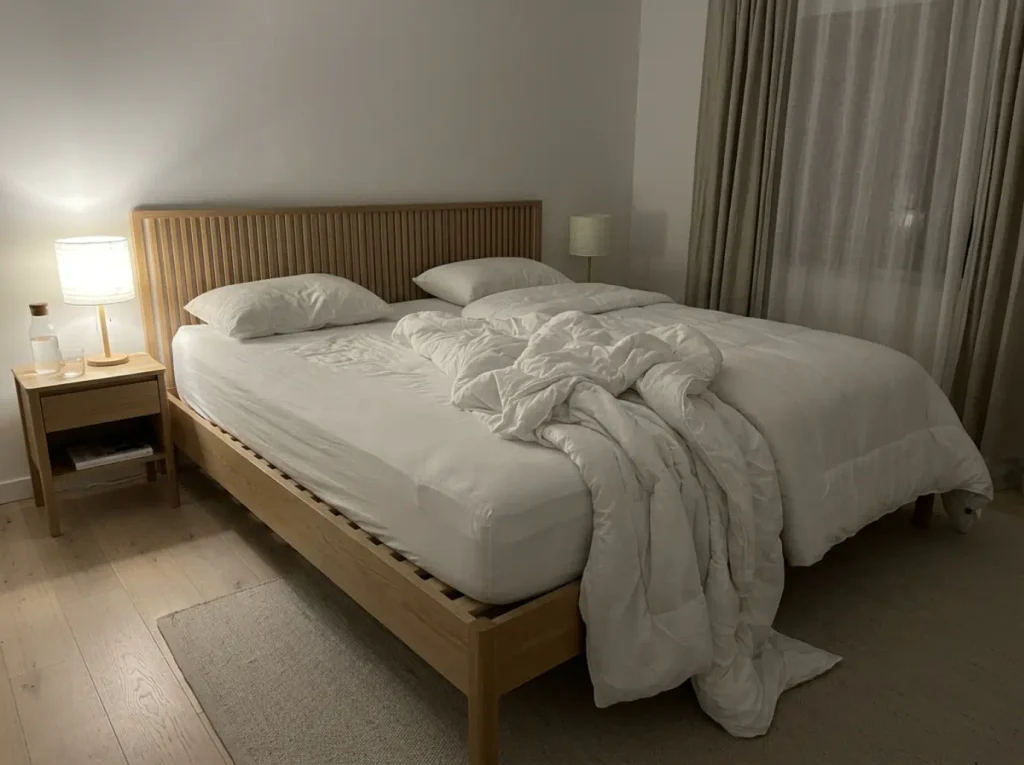
Why a Compromise Fabric Is Not a Compromise
A shared top layer has one tog. One. It cannot serve two people who need different ones, because there is no arrangement of a single duvet in which the cold sleeper is warm and the warm sleeper is not roasting. Buying a middle fabric does not split the difference; it gives both of you something neither one asked for.
And the honest version of this comes from the thread itself. A couple with opposite temperature needs settled on cashmere-blend sheets as the compromise everybody could live with, and watched them go pilling like crazy at about the one-month mark, care instructions followed. The compromise was not the compromise it looked like, twice over: wrong on temperature, and gone by February.
Two Duvets on One Bed: Sizes and How It Actually Looks
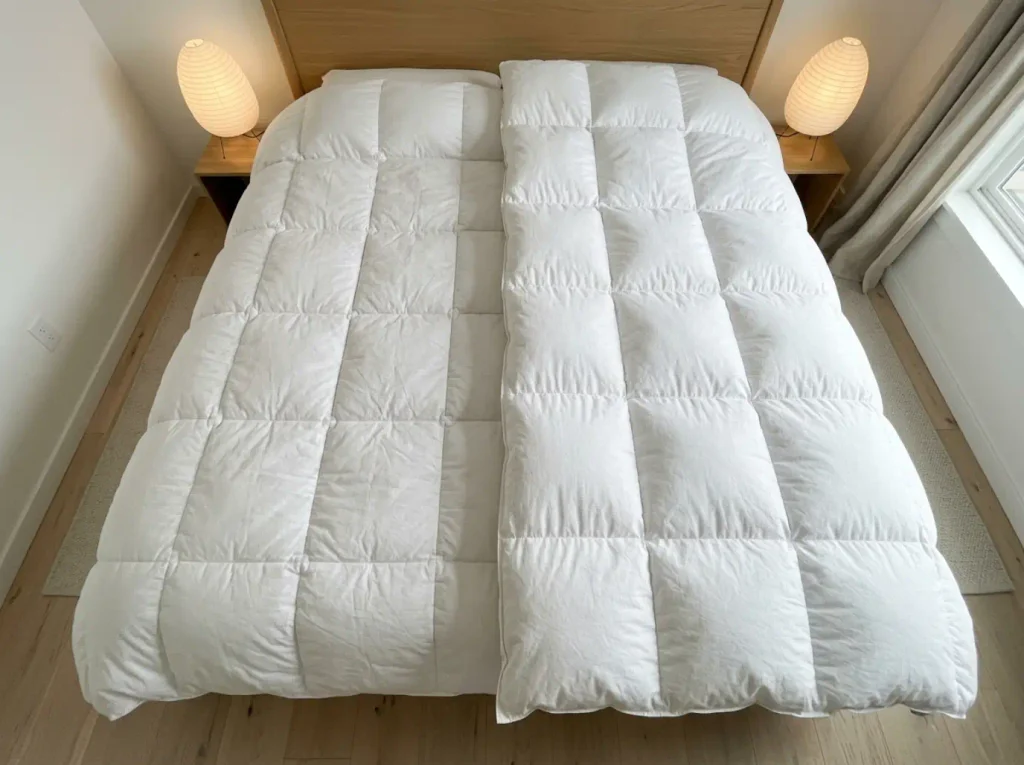
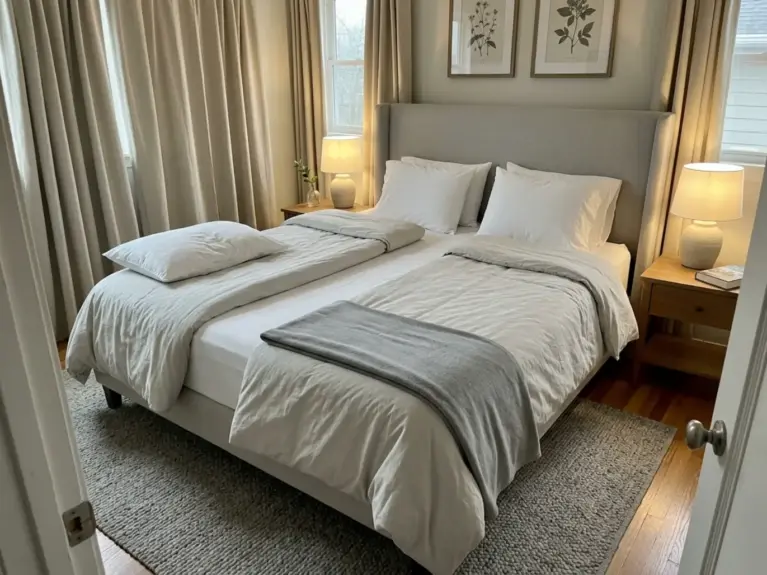
The fix is structural, not textile. Two separate twin or twin-XL duvets on one bed give each sleeper an independent fill power and tog under one shared bedspread, each in its own duvet cover. In the r/BuyItForLife thread this is reported as a solved problem rather than a sacrifice: two twin flannel comforters on one bed, one per sleeper, through a New England winter.
Before buying anything, check the spare room. Plenty of households already own two twin duvets from a guest bed or a kid’s bed and can run the arrangement tonight for free, which is also the cheapest way to find out whether you can live with how it looks. Sizing: two twin or twin-XL inserts at 64 by 88 inches sit side by side across a queen or a king with a channel of fitted sheet showing between them, and a coverlet or quilt over the top closes that gap if it bothers you.
If the spare room comes up empty, the Utopia Bedding Twin Duvet Insert is the second independent insert at exactly that size, an all-season down-alternative fill at the cheap end of this fix compared with a dual-zone heated pad. Its flaw is the one nobody warns you about, and it is not about warmth.
Two twin duvets change how the bed looks. From the doorway you see two soft ridges and a strip of sheet between them instead of one flat plane, and that, not the temperature, is the real reason most people who try it go back. The warmth works the first night. Anybody who cares more about how the bed photographs than how it sleeps should know that before the second insert arrives, not after.
When the Fix Is Not Bedding at All
Sometimes the gap between two sleepers is wider than any pair of duvets can cover. A dual-zone heated mattress pad gives each side its own control across roughly 77 to 115°F, which is a hardware answer to an asymmetry no fabric can solve, and it sits under everything else in the stack rather than replacing any of it. The same split-top-layer thinking runs from the same split top layer, from the overheating side when the mismatch is the other way around.
Try the two-duvet bed for a week before you buy the second insert, using whatever is in the spare room. What you are testing is not the warmth, which works on night one. You are testing whether you can walk into the room and see two ridges instead of one plane without it bothering you.
What the Set Looks Like After a Season of Washes
Everything on this list feels wonderful in week one. Week one lies, because week one is measuring a finish and a factory press. The only question worth asking is what the set looks like in March.
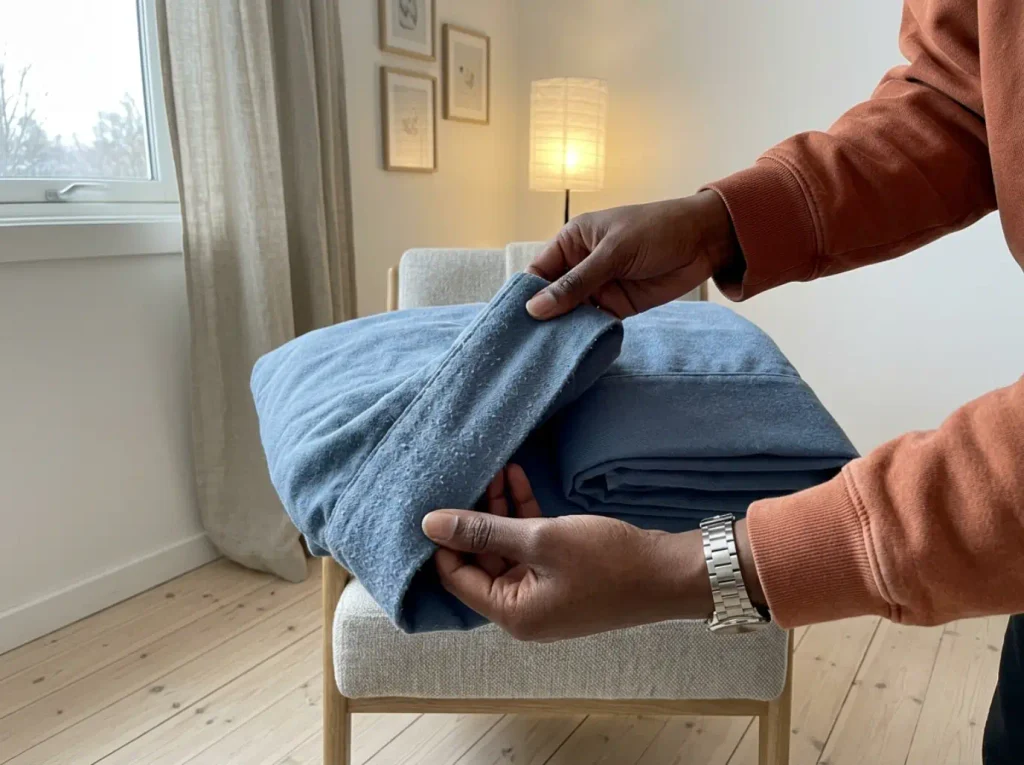
What Fails First, by Fiber and by Construction
Brushed and blended knits pill first, and they do not take a season to do it. Cashmere sheets are the clearest case: the cashmere-blend set in the thread was pilling at roughly one month with the care label followed, which is a structural outcome rather than bad luck: short fibers in a blend, lifted into a nap, then rubbed between a forearm and a duvet for eight hours a night. Friction-prone brushed surfaces fail in weeks, and no retail copy in that category says so.
Plain-weave cotton is the quiet winner in the same thread. Clearance percale holding up well across repeated washes, and two twin flannel comforters that held up to multiple washes through a New England winter. The community’s own bar is multi-year — the same poster’s verdict on cheap winter bedding is that it rips or pills or generally falls apart within a year, and plain weaves keep clearing it while fashionable blends do not.
One label that will not help you here: an OEKO-TEX STANDARD 100 certification, which tests for harmful substances rather than warmth. It is a real certification and it means something real, which is that the set passed a harmful-substances test. It says nothing about whether the thing pills by wash twenty, and it is often the only badge on the box.
The Pieces That Reward Buying Once
Wool is the outlier, and the outlier in an unexpected direction: it is not fragile, it is demanding. A wool blanket outlives nearly everything else in the stack, which is why it is worth treating as furniture rather than as a throw blanket, and it asks for hand washing or dry cleaning to do it, which is a genuine problem in a house that washes bedding every week.
The Desert Breeze Alpaca & Sheep Wool Blanket is the wool answer with a stated blend rather than wool-ish language: 50/50 alpaca and Peruvian sheep wool, Merino and Dorset, woven in Peru with a reinforced binding, in the heavyweight class for genuinely cold rooms. Its flaw is exactly the care problem above, plus the fact that it is the most expensive single piece in this entire stack. This is the splurge of the list, and anybody planning to put it through a normal wash cycle is going to have a bad Saturday. For the cotton pieces the opposite is true: a cold water wash and air drying take years off the wear, because most of what kills a brushed cotton is heat and tumbling, not the washing itself.
For a fraction of that, the Utopia Bedding 100% Cotton Thermal Blanket is 100 percent cotton at 350 GSM in a honeycomb weave built specifically to hold air, and it goes in the washing machine, which is the whole argument for it. Its flaw is density: honeycomb cotton is markedly less dense than an alpaca-wool blend, so in a genuinely cold bedroom it works as an added layer over the duvet rather than as a one-for-one substitute for wool. Both belong to a wider comparison of the warm blankets worth the top layer.
What to Check Before Next Winter
Flannel does not fail evenly, and knowing where it fails first turns a vague impression into a decision. It goes at the top hem of the flat sheet and along the long edges of the fitted sheet — the two places a forearm and a duvet drag across all night — while the middle of the sheet still looks new enough to fool you. Check those two edges in March. A set that survives is a set worth keeping in rotation, which raises the separate question of how many sets you actually need to rotate.
Build the Bed Before You Buy Anything
Three things to take away from all of that.
- Fix the order first. The topper goes under the protector, the blanket goes on top last, and a sealed protector may be quietly cancelling the layer underneath it right now. None of that costs anything.
- Ask every layer for its number. GSM for the sheet, and 190 to 200+ for a genuinely heavyweight flannel. Fill power for the duvet, 600 to 700 for an alternative. Tog for the whole top layer, 13.5 to 15 for winter. A layer that will not give you a number has told you something.
- If two people sleep in the bed, stop hunting for the one duvet that suits both. There isn’t one. Two twin inserts is the answer, and it works the first night.
The wash-twenty check is a March job and it takes thirty seconds: the top hem of the flat sheet and the long edges of the fitted sheet. Smooth after a winter of washing means buy the same set again. Fuzzed and pilling on the edges while the middle looks fine means the weave was loose and the GSM was probably at the bottom of the band, whatever the package said.
Tonight, before buying a single piece, strip the bed and put it back in the order above. Sleep on it a week and see what is actually missing. If the order is right and the room is still beating you, the problem has moved: that is a bedroom that is cold no matter what is on the bed, and it is a different job. And when it is over, the same logic runs in reverse for what comes back off the bed in spring.
Frequently Asked Questions
01What is the best type of bedding for winter?
A brushed or flannel cotton sheet at 190 GSM or above, a duvet chosen by fill power rather than by weight, and a blanket on top. The order they go on matters as much as the pieces themselves.
02What is the warmest bedding for winter?
A lofted duvet with high fill power over an insulating topper, not the heaviest pile of layers you can assemble. Weight compresses loft, and compressed loft holds less air, which makes the bed colder.
03What are the best quality bed sheets for winter?
Plain-weave cotton and flannel sets that state their GSM. Above 190 GSM is genuinely heavyweight; brushed blends feel best in week one and are the ones community threads report pilling fastest.
04What goes first in a bed?
The mattress topper goes on first, then a breathable protector, then the fitted sheet. Putting the protector under the topper is the common mistake, because it then protects the wrong layer.
05Do I need a whole new bedding set for winter?
Usually no. Most people change two or three pieces, the sheets and the top layer, and keep the duvet they already own, adding a blanket over it instead of replacing it.



Tried it on your own bed?
No comments yet. Tell us what you changed, and what the sheet did after a few washes.