






What’s in here8 sections
- What a Hot Flash Actually Does to a Bed
- The Layer Underneath Decides Everything Above It
- Weave and Fiber, or Why Two “Cooling” Sheets Behave Oppositely
- Building for Recovery Instead of for Cooling
- When One of You Is Flashing and the Other Is Freezing
- What the Bed Can Fix, and What It Can’t
- The Three Things Worth Keeping
- Frequently Asked Questions
You wake at three with the fitted sheet cold and wet high on your back, and the duvet already on the floor from an hour ago. The flash itself is over. It ran about three minutes, and the rest of the night now belongs to a wet piece of cotton pressed against your shoulder blades.
Those are two different problems. The flash is physiological and short. The damp sheet is a textile problem that lasts exactly as long as the fabric takes to let the moisture go.
Choosing bedding for menopause night sweats only ever solves the second one, and the honest version of this article starts by admitting that. What follows is what the bed can and cannot do, then the four layers from the mattress up in order, because the least permeable one sets the ceiling for every layer above it.
Quick Answer
Bedding cannot stop a hot flash. It can only cut the recovery afterward, by drying fast and coming off in one motion. That makes the fix a system — the protector, the fitted sheet, the top layer, and how they stack and strip — rather than one fabric with the word cooling on the package.
What a Hot Flash Actually Does to a Bed
The event is short. According to The Menopause Society, a flash typically runs one to five minutes, and it happens to as many as 80% of women, over a mean of seven to ten years.
So the bed is not being asked to handle one bad night. It is being asked to work nightly, for years, which is why “felt cool in the store” is the wrong test entirely. The five minutes are not the part your bed is dealing with. The next forty are.
What ruins the rest of the night is the microclimate. Sweat that cannot evaporate keeps heat sitting at the skin, and that blocks the natural overnight drop in core body temperature of roughly 2°F that the rest of your sleep is built around.
Sleeping in a hot, humid pocket measurably raises wakefulness and cuts both slow-wave and REM sleep. The cost is not comfort. It is the deep part of the night, the sleep architecture itself.
This is also why “the room isn’t hot” proves nothing. One r/Bedding poster described waking absolutely soaked in a room held between 59 and 72°F, and traced it not to the thermostat but to a duvet that would not let anything through. A cold room and a sealed bed are perfectly capable of coexisting, and if you have been arguing with the thermostat for two summers, that is probably the argument you have been having.
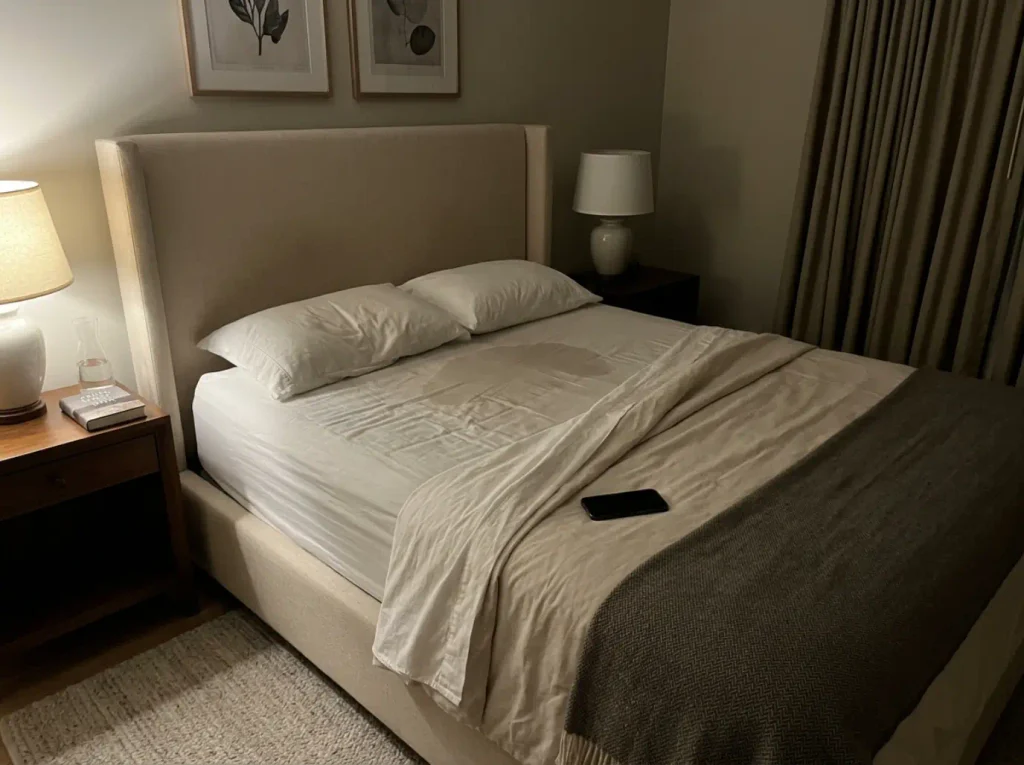
The damp patch tells you the same thing, if you look at it. It has a shape and a position: high on the fitted sheet, roughly where the shoulder blades sit, about the size of two hands laid side by side. Anybody who has stripped a bed at four in the morning knows it is never centered and almost never at the hips.
That patch is not evidence about you. It is evidence about which layer was holding the moisture and where it had nowhere to go. Which is the whole reason this article reads the four layers of a bed, from the mattress up instead of starting at the sheet.
The Layer Underneath Decides Everything Above It
Here is the discovery a lot of readers make the expensive way. You buy the sheets that were recommended, the ones that genuinely do wick, you put them on, and you still wake up damp. The sheet was not lying. It moved the moisture down and the moisture hit a wall.
TPU, PU and Vinyl: Which One Lets Vapor Out
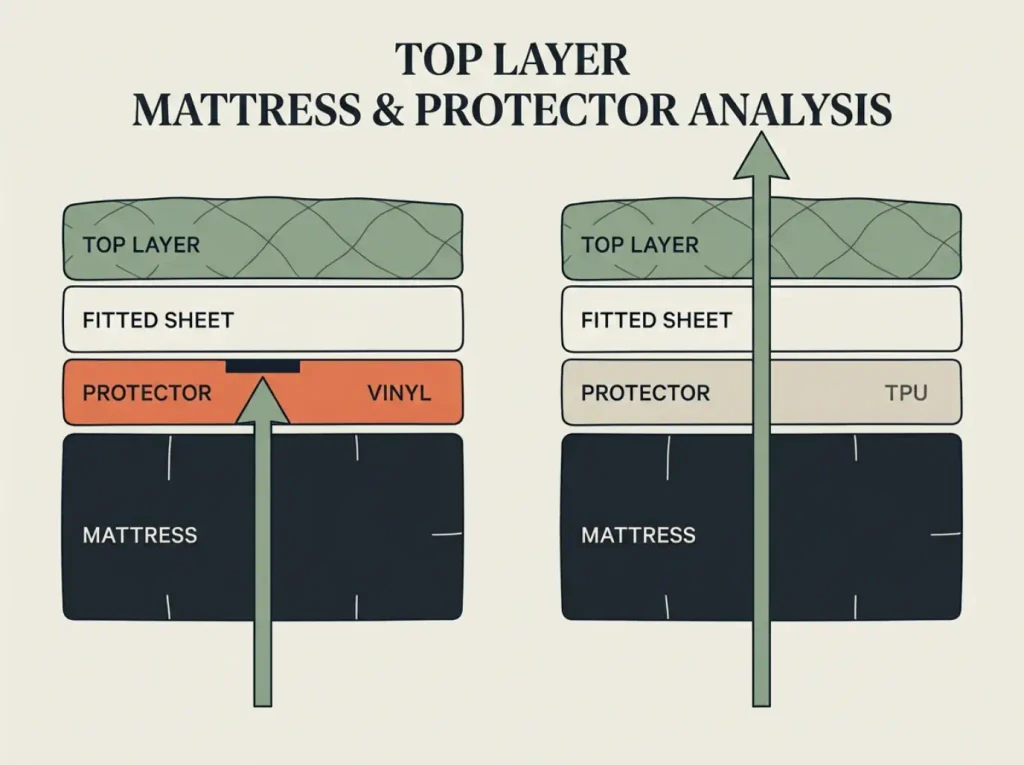
A mattress protector has a membrane, and there are three common kinds. What you want from it is the property outdoor gear calls waterproof breathable: liquid stopped in one direction, vapor allowed through in the other.
TPU membranes let water vapor escape while still blocking liquid, which means sweat can evaporate away instead of pooling under you. Vinyl and PVC backings do not do that at all; they are closed to vapor as well as to liquid, and they carry chemical-safety questions of their own around phthalates and the chlorine compounds used in production. Basic PU sits between the two, workable but thicker and stiffer.
None of that is printed on the front of the package in a way that helps you, which is where a proxy comes in handy: TPU is the membrane most GOTS-certified organic protectors use, because it clears the stricter chemical requirements. When a listing will not name its membrane, a GOTS mark is a reasonable bet on what is inside it.
The Crinkle You Hear Is the Membrane, Not the Mattress
That plasticky rustle when you roll over is not your mattress. It is the protector announcing what it is made of. TPU is thinner, more flexible and quieter; the loud ones tend to be vinyl or the cheaper end of PU. It is the rare case where your ear gets to do the testing for you, at no cost, at midnight.
What to Check Before You Buy Another Sheet Set
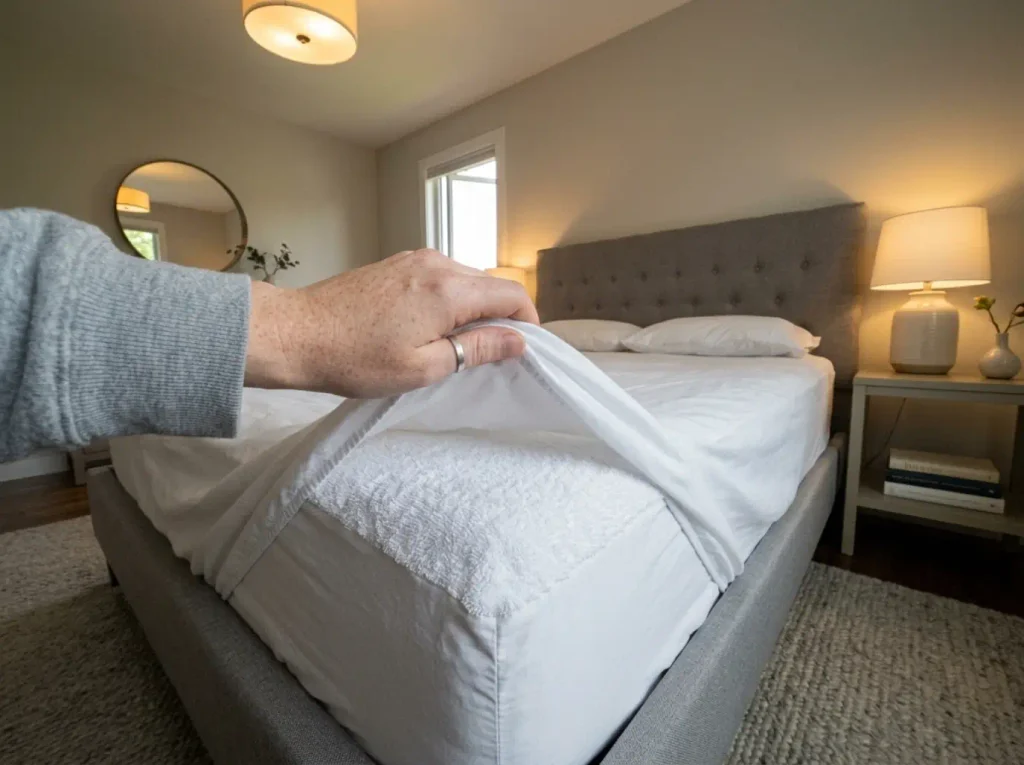
Before you spend anything, pull the fitted sheet off one corner and put your hand on the protector underneath. Shiny, stiff, and it crinkles? That vinyl backing is your ceiling, and every sheet you buy above it will be working against it.
Swapping the protector costs less than a sheet set, and it is the layer almost nobody checks, because it is the only layer you never see. This is what “one wrong layer undoes the other three” means in practice, and the wrong layer is usually the one at the bottom.
Do the corner lift before you shop. Peel the fitted sheet off one corner, press your palm flat on the protector for a few seconds, and lift it. If your hand comes away warm and slightly damp, that membrane is holding everything the sheet hands down to it, and no sheet you buy on top will fix it.
Once the free check is done and the answer is bad, the replacement worth having is a cotton face over a TPU membrane, which is the combination the mechanism above argues for.
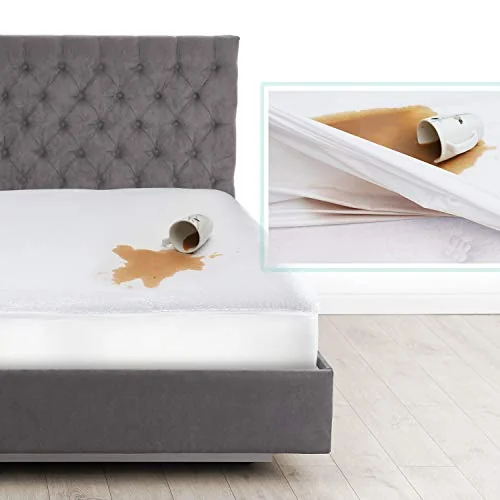
If you want the full comparison of which protectors actually breathe, that belongs in its own article. What this section needs you to take away is smaller and more useful: the ceiling is set from below.
Weave and Fiber, or Why Two “Cooling” Sheets Behave Oppositely
Two sets can carry the same fiber, the same certification and the same word on the front of the bag, and behave in opposite directions at three in the morning. The variable doing that work is the weave, and it is printed on the listing far more often than people notice.
Percale Sits Off the Skin, Sateen Lies Against It
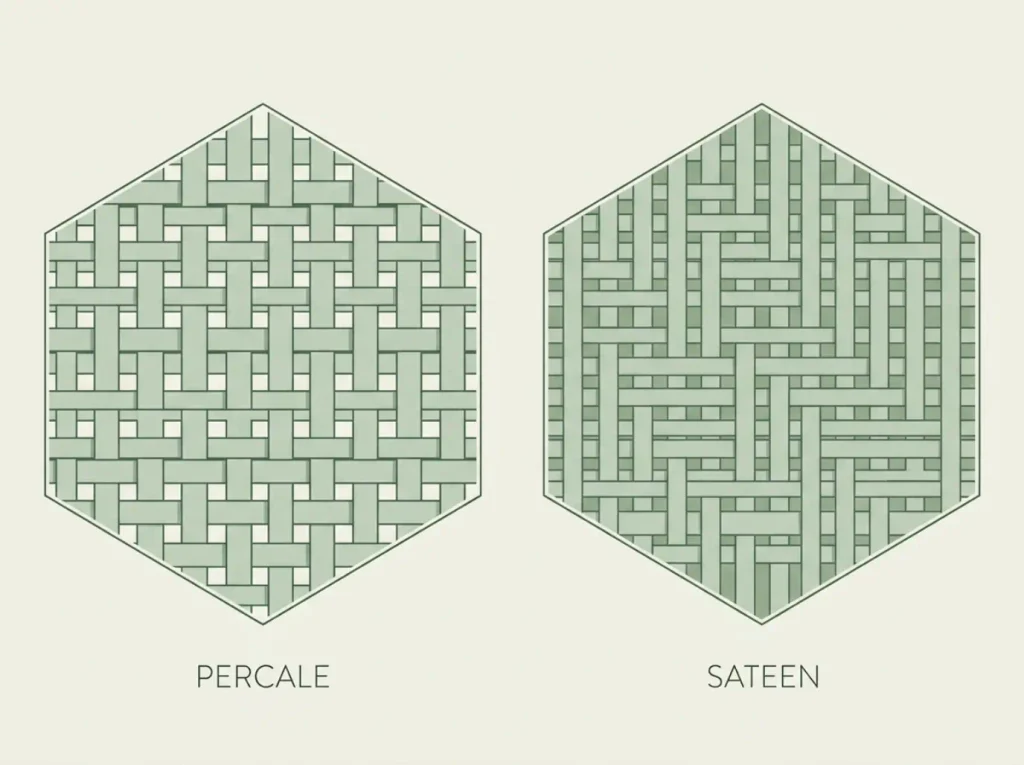
Percale is a plain 1/1 weave — one thread over, one under. That structure leaves gaps, and it holds itself slightly off the skin. A twill, for comparison, runs its floats on a diagonal and sits somewhere between the two.
Sateen floats four threads over one, which makes it smoother and heavier and puts more surface directly against you, with fewer gaps for air to move through. Same cotton, opposite behavior. If you sleep through flashes, the weave already made the decision before you read the fiber content.
Thread Count Above 400 Is Density, Not Fineness
The number on the box is measuring the wrong thing for this reader. Above roughly 400, thread counts are usually reached by twisting thinner plies together and counting each one, so what you get is denser and warmer, not finer. Grammage — the fabric’s weight in grams per square meter, or GSM — would tell you far more, and almost nobody prints it.
An 800-count sateen can sleep hotter than a 250-count percale and be technically accurate about every claim on its packaging. If you want the longer version of what a thread count actually tells you, it is a whole subject on its own. For tonight, treat any count above 400 as a warmth signal rather than a quality one.
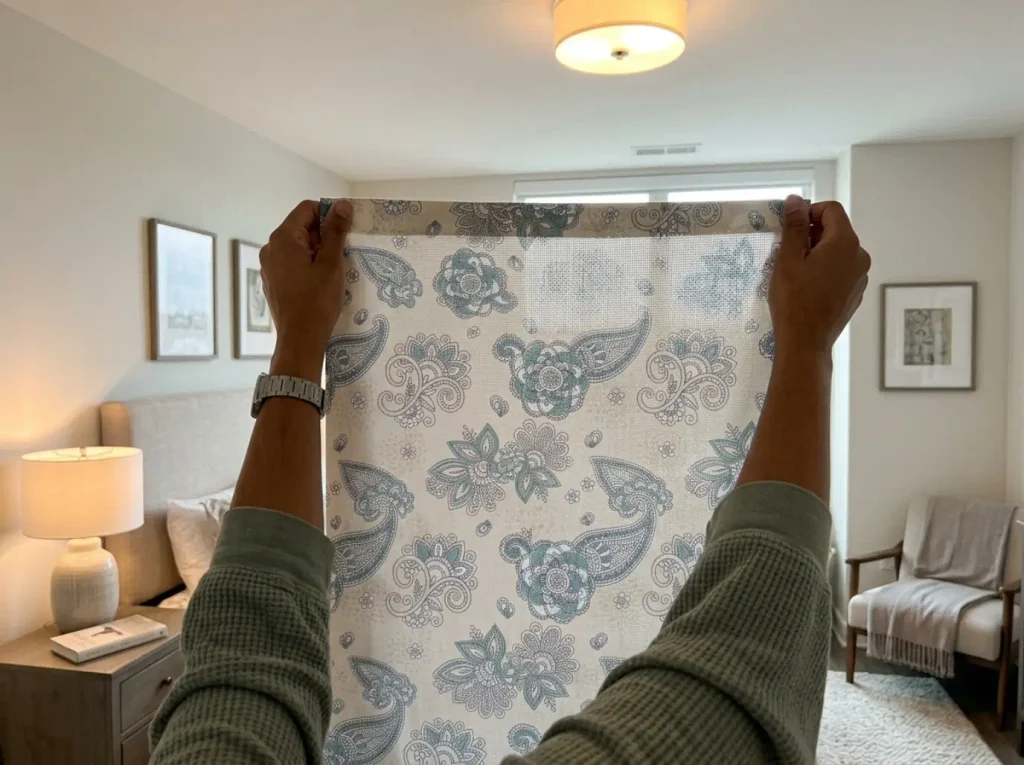
There is a five-second test that beats the package. Hold a sheet up to a lit window: percale shows its 1/1 grid as thousands of tiny points of light coming through. Sateen gives you a dull sheen and no grid at all. That is the weave telling you what it is, without a brand in the way.
Do the lit-window test on the sheets already on your bed before you buy anything. Hold a corner up against a lamp or a window. Points of light coming through the grid means percale. A soft sheen with no visible grid means sateen — and if you have been sleeping hot on a set you were told was cooling, that sheen is usually the answer.
The percale set worth building on is the one that prints its whole spec, because a brand willing to state single-ply and a pocket depth is a brand agreeing to be checked.
The Bamboo on the Package Is Two Different Fabrics
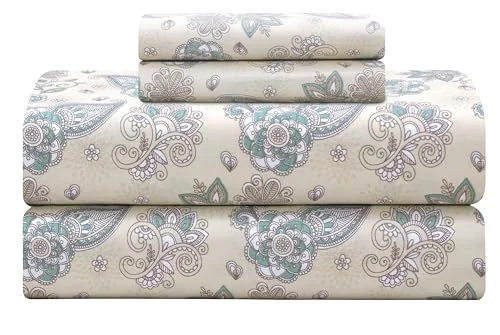
On r/AskWomenOver40, the highest-voted reply to a night-sweats plea was simply that bamboo sheets and pillowcases helped, and three separate commenters piled on with variations of “came to say this.” Bamboo is the community’s reflexive first answer, and it is not wrong. It is imprecise, because the word covers two very different fabrics.
Almost everything sold as bamboo is bamboo viscose or rayon, a regenerated cellulose made with chemical solvents. Bamboo lyocell is the other one, made in a closed-loop solvent process, and it is the bamboo-derived fabric that measures differently for moisture handling. The same process gives you eucalyptus-sourced Tencel, which behaves much the same way. That is the whole difference between bamboo viscose and bamboo lyocell, and it is the difference the label almost never makes for you.
The ettitude 100% Lyocell from Organic Bamboo Sheet Set is the lyocell version with the spec attached — CleanBamboo lyocell, OEKO-TEX Standard 100 Class 1, a 17-inch pocket — and it suits the sleeper who wakes cold and clammy rather than hot and dry. Its flaw is the weave it comes in: it is a sateen, so it breathes less than a percale even though the fiber itself handles moisture well, it is the premium option of this group, and sateen shows pilling on the slept-on side sooner than a plain weave does.
Cotton, meanwhile, absorbs rather than wicks. That is not a defect, it is why percale is the structural baseline, but it does mean cotton is not the fast-recovery answer when the flashes come often, and that distinction is what the next section is built on.
Building for Recovery Instead of for Cooling
You have probably been shopping for the coldest-feeling fabric in the store. Move the target. The question is not how cool a sheet feels when you get into it at eleven. It is how dry it is at 3:20 after a flash at 3:15.
The Window Between Flashes Is the Real Spec
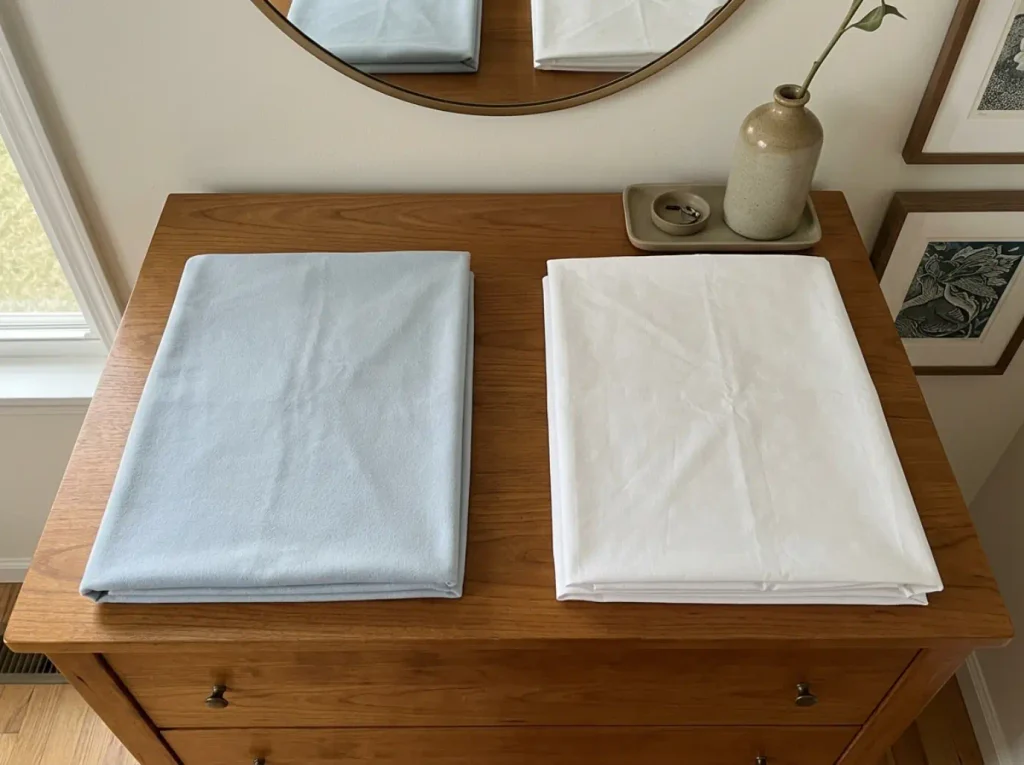
Performance quick-dry fabrics shed about 90 percent of what they absorbed within an hour at room temperature, with the fastest getting there in around thirty minutes. Cotton has no comparable figure, because it absorbs instead of wicking.
Now the honest part, and it needs saying before anyone builds a purchase on it: that 90-percent-in-sixty-minutes number is textile-testing convention, measured on performance fabrics in general. It is not bedding-specific measured data, and nobody has published dry-time tested against a hot-flash interval. Applying it to a fitted sheet is a reasoned extrapolation, and this article would rather name it as one than dress it up as a lab result. What survives the caveat is the direction: a fabric built to release moisture releases it in a window measured in tens of minutes, and a fabric built to absorb it does not.
That reframing is the whole point. Sheets read by weave and weight rather than by the word on the box is the general framework; applied to flashes, the spec you actually want is dry time, and no package prints it. Drying speed is the number that would settle most of these arguments, and it is the one number nobody publishes.
When Percale Isn’t Enough
The usual advice, and the advice this article has been giving for two sections, is a good percale. For flashes that come once or twice a night, that is right. But if they come often or heavily, passive breathability runs out of road: an absorbent fiber cannot release what it took in fast enough to be dry before the next one. That is where a purpose-built moisture-wicking fabric does a job cotton structurally cannot.
The PeachSkinSheets Cooling Bed Sheets for Hot Sleepers are the version of that with a certification attached: a brushed performance microfiber with a moisture-wicking finish, deep pockets, OEKO-TEX certified, which most microfiber sets sold on the same promise are not. Two flaws, both stated up front. It is synthetic, and the brushed hand feel is distinctly different from a natural fiber — if you like cotton against your skin, you will notice on the first night. And whether the wicking finish holds up over years of washing is not something any source measured, so treat it as a warning rather than a fact: finishes tend to leave, and this one has no published lifespan.
Here is the counterintuitive part, and it is level-three stuff: the fabric that dries fastest is rarely the one that feels coolest to your hand in the store. Brushed performance microfiber feels warmer dry than a cold, smooth sateen. It is also the one that is dry again before the next flash. Shop with the second criterion.
The Room Is a Slow Layer, So Start It Early
Before you buy any of it, deal with the room, because it is free and it is the slowest-moving layer in the system. A room temperature of roughly 65–68°F is the usual target, and the timing matters more than the number.
Everything in the room — the mattress, the frame, the walls, the books — holds heat and gives it back slowly. Ventilation counts as much as temperature here, because moving air carries the humidity out and a sealed cool room still traps it. Cooling the air at 11:30 for a bed you got into at 11:15 is a scramble. As one commenter put it, you set the AC hours before bed, not after the flash starts.
Give the room a two-hour head start. Set the fan or the AC when you start getting ready for bed, not when you get into it, and pull the covers back off the mattress while you do — an open bed sheds the heat it stored during the day, and a made one keeps it. It costs nothing and it changes the temperature you start the night from.
And fabric has a ceiling, which is worth saying because most articles will not. One poster who spent years cycling through cooling sheets and fans found neither did anything, because “my body heat just stays on whatever I’m touching.”
For some sleepers the limiting layer is the mattress or the mattress pad, not the sheet, and no fifth sheet set is going to change that. If that is you, the next thing to try is subtraction rather than purchase: drop the top sheet entirely for a week and see whether one less layer does more than one better one. Knowing when to stop buying sheets is more useful than another recommendation.
When One of You Is Flashing and the Other Is Freezing
The duvet comes off at three. Twenty minutes later it goes back on, because the other person in the bed woke up cold. Both of you are now awake, and neither of you got what you needed. This is the case nobody in the search results addresses, and it is not a fabric problem at all.
One Duvet Cannot Serve Two Thermostats
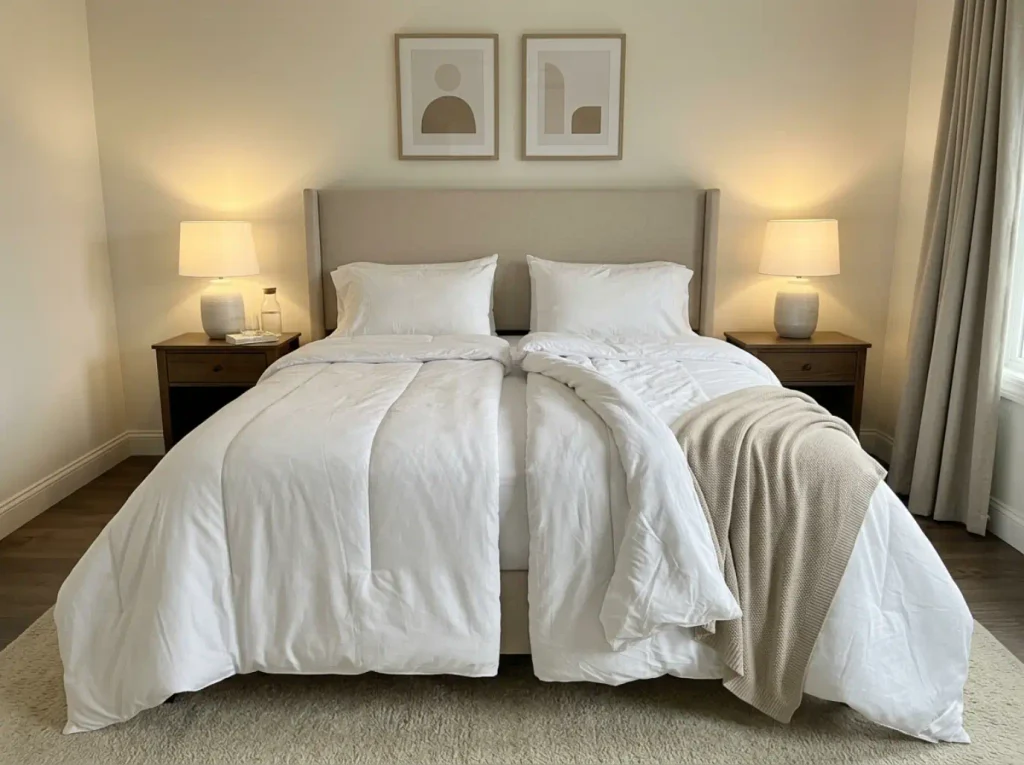
A duvet with a single fill weight has two states. On, or off. It cannot come off in stages, and it cannot be warm on one side of the bed and absent on the other.
So whichever state it is in, it is wrong for one of the two people under it. No fill, no shell fabric and no amount of money spent on a better version of the same object changes that, because the problem is the geometry of a shared bed, not the quality of the object.
Two Twin Inserts on One Mattress
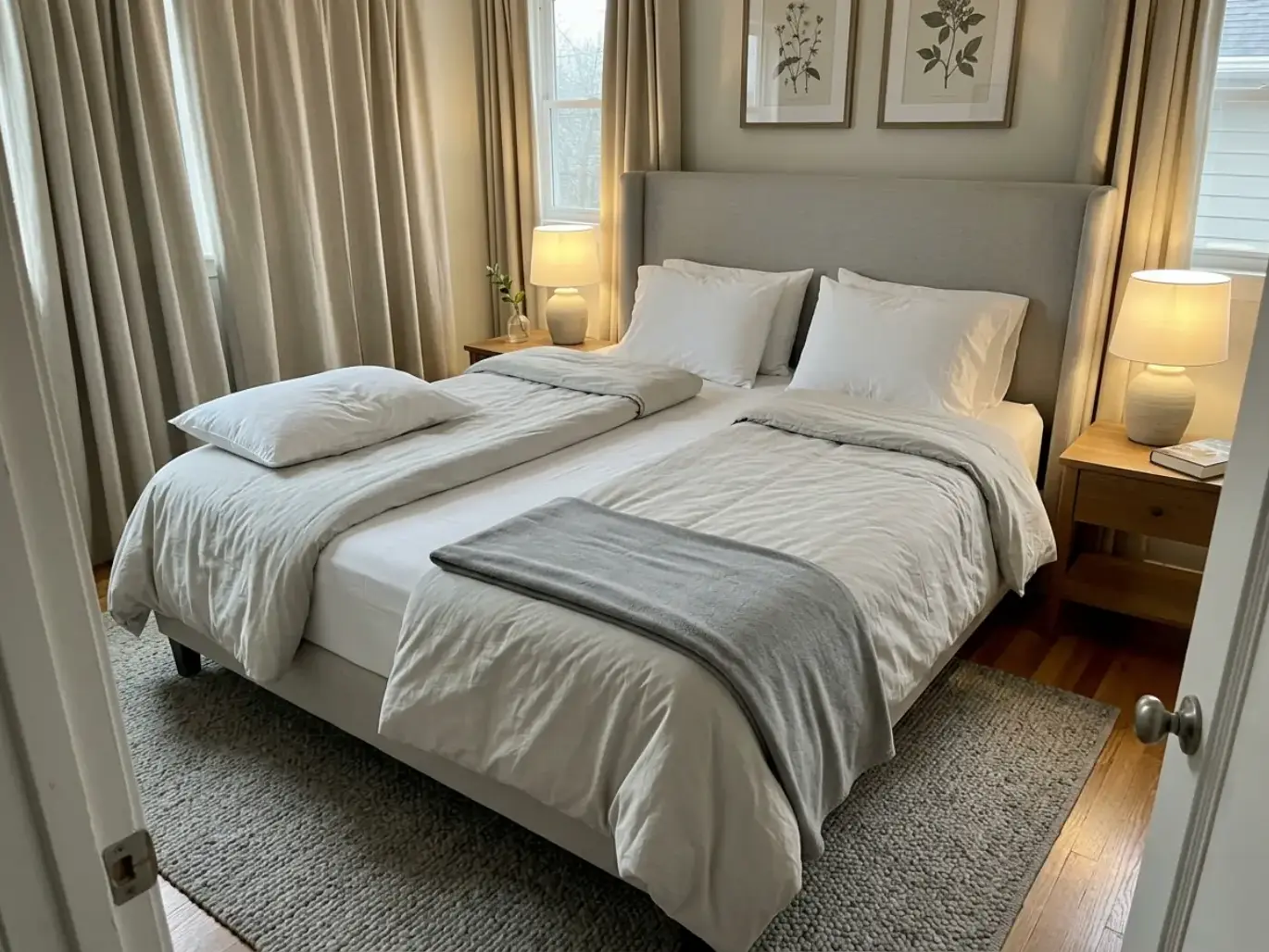
Split the top layer. One twin-size insert per sleeper over one shared fitted sheet, and now removal is a one-motion, one-person act: you throw off your own layer at three and the other side of the bed never registers it. Each insert gets its own duvet cover, so the wash cycles stay separate too.
This is also the cheap version of the split king, which solves the same asymmetry by buying two mattresses. Mainstream press calls the escalation of this problem a sleep divorce, meaning separate beds or separate rooms. Splitting the top layer is the step before that, and it is a much smaller step.
Try it free first. You almost certainly have a spare duvet in a closet, or a folded blanket that can go on one side only for a week. The principle is separation, not a purchase, and a week tells you whether the separation is what you needed.
Test the split with what is already in your closet before you buy a second insert. Put the spare duvet on your side and leave the shared one folded on theirs for a week. If you stop waking your partner when you throw yours off, the separation was the fix — and now you know what size and weight to buy instead of guessing.
If the free version works, the Utopia Bedding Twin Duvet Insert is a lightweight all-season down-alternative twin, 64 by 88 inches, with corner tabs and a breathable microfiber shell. Down-alternative means a polyester fill, which is worth knowing for two reasons: it washes without the fuss real down needs, and it is rated by weight rather than by the fill power figure printed on down inserts. The point is that it is light enough to come off in one motion and cheap enough that buying two is not an event.
Its flaw is a size problem and you should know it before it arrives: a single twin insert on a queen or a king leaves gaps down the sides. It works as one sleeper’s personal layer, when the other sleeper has their own. It does not work as the bed’s only covering.
What This Fixes That a Cooling Comforter Doesn’t
This is the anti-sell case in full. Two inexpensive twin inserts do something a single premium comforter cannot do at any price, because the limitation was never the fabric. It was one object serving two thermostats.
There is a give-away that a split bed is real and not styled: a twin insert on a queen leaves a strip of bare fitted sheet running down the middle. Every photograph of this setup hides that strip. Every actual bed running it has one, and it is also the reason the arrangement only works when both sleepers have their own, because one twin and one king duvet just relocates the tug-of-war. If your partner is the one sweating rather than you, what changes when the night sweats are not menopausal is the next thing worth reading.
What the Bed Can Fix, and What It Can’t
Every competitor gestures at “see a doctor if it’s severe” and moves on without ever saying what the bedding is and is not capable of. Here is the line, drawn once and clearly.
Bedding cannot shorten a physiological event that runs one to five minutes. Nothing on this page changes how long a flash lasts, how intense it is, or how often it comes. What the bed changes is what happens to the moisture afterward, and how fast the layer over you comes off. That is a real improvement and it is worth building for, and it is also all of it.
Past that line it is not a bedding question. The Menopause Society notes that flashes occurring more than ten times a day, lasting over five minutes, or disrupting sleep, work or daily activities are worth raising with a healthcare provider.
That is a threshold, not a reading of your situation. This article does not know your situation and is not going to pretend to. For the fuller version of when it is the bed and when it isn’t, the sibling article owns that question.
What a Season of Washes Actually Tells You
The honest gap, said out loud: no community source found for this article tracked a set past wash twenty. Nobody has published what these fabrics look like after a year of nightly flash-recovery washing, which is exactly this use case. The threads are full of week-one impressions and nothing else, so rather than invent a wash-count anecdote, this article says the data is not there.
What you can check yourself after a season is specific. Hold the percale up to a lit window again and see whether the grid still comes through. Look at the used side of a sateen for the beginning of pilling, which shows up on the slept-on half long before the rest.
Then test the finish. Flick water at a wicking sheet and see whether it still beads or has gone flat — finish wear-off is silent, and that is the only way to catch it. Press the protector and listen for whether it crinkles the way it used to.
The wicking finish is the sneaky one, because it goes without announcing itself. There is no visible change at all. The sheet simply stops being dry by the time you would have fallen back asleep. That is why the test is the night, not the look.
And washing every night is its own problem: it is the fastest way to age any of these fabrics, and a hot wash temperature ages a wicking finish faster still. The routine that keeps a set alive is a separate subject. Washing bedding after night sweats so the smell doesn’t set covers it properly. If you are still not certain the bedding is involved at all, there is a method for that too: three nights to find out whether it is the bedding, one variable at a time.
The Three Things Worth Keeping
Read the bed from the bottom up. The protector’s membrane sets the ceiling for every layer above it, and it is the one layer nobody ever checks because it is the one layer nobody ever sees.
Buy for dry-time, not for how cold a fabric feels in the store. The window between flashes is the specification that matters, and the fabric that wins it usually feels warmer to your hand than the one that loses.
If you share the bed, split the top layer before you buy a better one. Two twin inserts solve a geometry problem that no single comforter can solve at any price.
After a season, hold the sheet up to a lit window. If the percale grid still shows, the weave is intact and the set has years left. If a wicking sheet has stopped being dry by the time you would have fallen back asleep, the finish has gone, and no amount of washing brings it back.
Tonight, pull the fitted sheet off one corner and put your hand on the protector underneath. If it crinkles, you found the ceiling before you spent a thing.
Frequently Asked Questions
01What bedding is best for menopause night sweats?
A vapor-permeable protector, a percale or wicking fitted sheet, and a top layer you can throw off on your own. The system matters more than any single fabric, and the protector is the layer that sets the ceiling for the rest.
02Do cooling sheets help with hot flashes?
They cannot shorten a flash, which is a physiological event. A fast-drying sheet shortens the wet, uncomfortable part afterward, and that is the half the bed actually controls.
03Is bamboo or cotton better for night sweats?
Bamboo lyocell handles moisture differently from ordinary bamboo viscose, and cotton percale breathes best of the cottons because of its open 1/1 weave. The weave matters as much as the fiber in both cases.
04Does a mattress protector make night sweats worse?
A vinyl or basic PU-backed one can, since it blocks vapor as well as liquid and traps the moisture the sheet passes down. A TPU membrane lets vapor through while still keeping the mattress dry.
05Should two people share one duvet if only one gets night sweats?
Two separate twin inserts over one shared fitted sheet let one sleeper throw off their layer without waking the other. Try it with a spare duvet from the closet before buying anything.



Tried it on your own bed?
No comments yet. Tell us what you changed, and what the sheet did after a few washes.