


What’s in here7 sections
Lie on your side and the mattress holds your hip and your shoulder on two small patches while the gap at your waist stays open. Lie on your back on a different bed and the middle takes you down, hips first, until the sheet bows around you. Both beds get the same advice (buy a topper), and every topper box answers with the same two words. Firm vs soft is a pair of seller’s labels for two different failures, not two grades of one thing, and a topper can push a bed toward either one.
Below you get the side to try first by sleeping position and body weight, the base that has to be sound before that rule means anything, a one-night test that shows which failure your bed makes, and the point where the question stops being about the bed.
Start with the row that matches you, then read the last column on your own bed before you trust the row.
| Sleeper | The failure to expect on a bed that is off | Side to try first | Check first |
|---|---|---|---|
| Back or stomach sleeper | Hips travel low into a soft bed and the middle dishes | Firm | Whether the fitted sheet bows at the hip line by morning |
| Side sleeper | A hard bed holds the hip and shoulder on small patches | Soft | Whether the bed gives at all under the hip and shoulder |
| Lighter, under about 130 lb | A firm layer that barely compresses under a light load | Soft | Whether the layer gives at the hip line |
| Heavier, over about 230 lb | A soft layer that compresses through to the bed beneath | Firm | Whether the sheet shows a dish where the hips were |
| Combination sleeper | Two failures in one night, one for each position | The side for the position held longest | Which position the night ends in |
Soft and Firm Fail in Different Directions
The seller’s two words sound like two grades of one thing, as if firm were simply more of what soft has less of. Shopping from that picture goes wrong early, because the words describe the layer, and what decides the purchase is the bed underneath it. A bed that lets your hips travel low needs a layer that pushes back.

A bed that holds your hip on one small patch needs a layer that gives. Put the same topper on both and you get opposite results, which is why a label on a box cannot pick your side for you. Your bed picks it, and you can read what your bed does in a single night.
A topper moves a bed in either direction
A topper is an extra layer that sits on the mattress and changes how its top feels. Sleep Foundation puts the range in two sentences: plenty of people use one to soften a bed that is too firm, and the right one can also add firmness to a mattress that is too soft. Toppers usually run between 1 and 4 inches thick, and that thickness is the whole reach of the product.
It can change the first few inches under you. It cannot change the mattress below those inches.
Hold on to that limit, because it sorts the two directions. A firmer layer on a soft bed works on the surface you sink into. A softer layer on a hard bed works on the patch your hip lands on. A support-group post shows the first case in plain words: a reader writes that “a new mattress isn’t in my current budget” and asks for a topper that makes the bed feel firmer.
Some sleepers say a firm latex topper suits them very well. Most people do not ask which topper is the best one; they describe a direction, and the direction is the whole question.
Firmness in a topper is a construction choice more than a single number. Sleep Foundation notes that toppers vary in firmness levels and materials, and that some provide firm support while others conform closely to the sleeper. Two things set it: what the layer is made of (memory foam, polyfoam or latex, for a start), and how deep the soft part runs over the firm part underneath.
The split topper later in this guide shows the second one at its simplest, the same two foams in the same 3 inches, with the gel layer 2 inches deep on one half and 1 inch deep on the other. Change the depth of the soft layer and you have changed the feel with nothing else touched, which is also why two toppers that carry the same word can sleep differently.
What each side does under the hip
Lie down on a soft layer and the hips, which carry the most weight, go in first and furthest, so the hip line drops below the shoulders and the ribs and the bed makes a dish. Lie down on a firm layer and the surface barely gives, so the load stays on the hip and the shoulder as small patches instead of spreading along your side. Why a surface does that, layer by layer, is worked through in what the surface does under your hips; here it is only the premise the rest of this guide stands on.
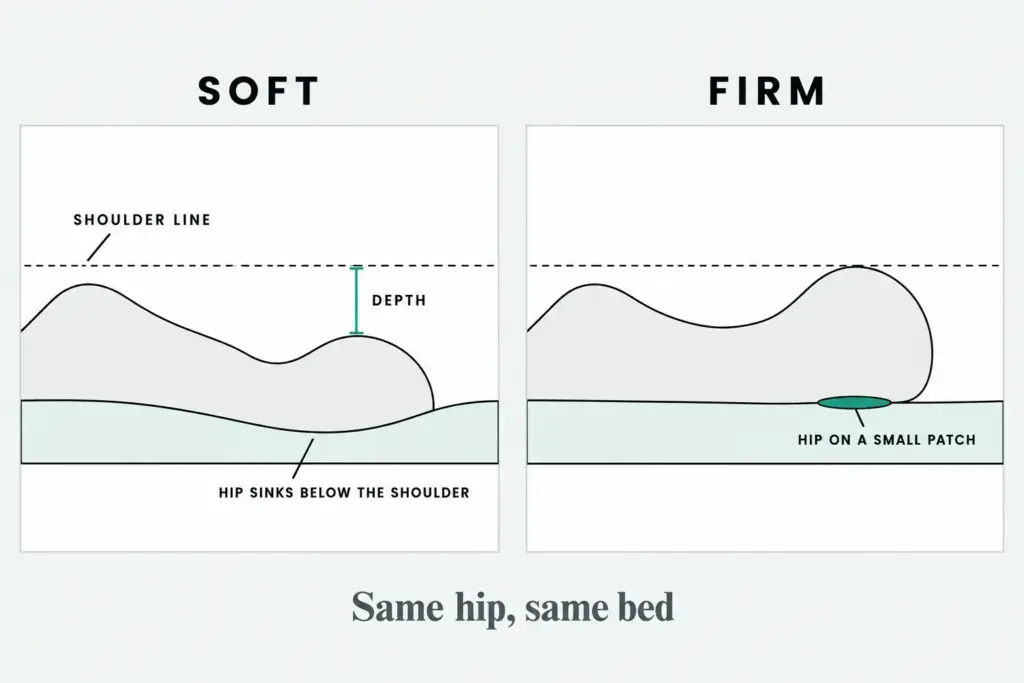
The two failures leave different evidence by morning. A soft bed leaves a broad, shallow dish at the hip line, and you can see it in the fitted sheet in daylight. A firm bed leaves nothing: no dish, no mark, only a surface that stayed flat while your weight sat on a few points of it.
That asymmetry matters for everything that follows. You can see one failure and you have to feel the other, which is why the test later in this guide asks where the weight sat during the lie-down, and not only what the sheet shows afterward.
Medium-firm is the word that tries to split the difference, and it is a seller’s word on a seller’s own firmness scale. Two brands can print it over layers that behave differently, so a box that says medium-firm has not told you which way it will push your bed. This guide never needs that scale. It needs the failure.
Read the sheet in side light, not overhead light. Kneel at the edge of the bed with a lamp on the floor and look along the fitted sheet toward the far side: a shallow dish at the hip line shows as a shaded oval, and a ceiling light flattens it into nothing.
Position and Weight Pick the Side to Try First
With soft and firm sorted into two failures, the next question is which one a given sleeper meets first. Sleeping position and body weight answer that better than any label on a box. What follows is a buyer’s rule of thumb, a place to start the test rather than a verdict, and it assumes a sound bed, which is the next section’s job. Take the position first, then the weight, and keep in mind that both come with edges.

Back and stomach sleepers: start on the firm side
Sleep Foundation’s rule for these two positions is that they typically need firmer toppers with less contouring. The mechanism is easy to see from the back. Lying face up, the heavy middle of you, the hips and the lower torso, sits at the center of the bed while the head and the legs are lighter at either end.
Any layer that lets the center settle further than the ends makes a bowl, and you lie in the bowl. A firmer layer with less contouring resists that settling, so the hip line stays closer to the shoulder line. Stomach sleeping asks for more of the same: the front of the hips presses down with nothing holding up the waist, so a layer that lets the hips sink drags them even further below the ribs.
So the firm side is where a back or stomach sleeper starts, and the soft side is what they would pick only if the bed turned out to be the other failure, a hard bed that holds the hips on a small patch. The sheet is the check. A broad dish at the hip line in the morning says the layer let you in too far.
Picture the ordinary case. You sleep on your back, the mattress seems soft in the middle, and the first topper you pick up is labeled medium-firm. The table’s first row says firm, and the sheet in the morning is what proves or disproves it.
If the dish is there, the firm side is the right start. If the sheet is flat and the bed felt hard under your hips, the bed was never soft, and a firmer layer would only have made a hard bed harder.
The obvious pick has a person it does not fit, and it is worth hearing from one. Some sleepers say firm mattresses never worked for them, though they never stayed on one for more than a week or so, and they may just need more time to adjust. That is the problem with testing a rule by living with it: a week cannot separate the wrong side from a side you have not adjusted to yet. A reading of the bed does not have that problem, because the bed is not adjusting.
Side sleepers: start on the soft side
For side sleepers Sleep Foundation says the opposite: they generally need more hug and a slightly softer topper that cushions the shoulders and hips. On your side the loads change shape. The surface under you is no longer one broad area but two pressure points, the hip and the shoulder, with the waist hovering between them.
The give a seller calls pressure relief is the give at those two points, and it is what the soft start buys. A firm surface holds those two points on small patches while the waist gets nothing, and a layer that gives lets both points sink into the surface and the waist settle toward the bed. The soft start is about getting the hip and the shoulder to sit in the surface instead of on it.
There is a way to see which of the two your bed is doing. Lie on your side and slide a flat hand under your waist. If the hand passes through with room to spare, the surface is holding you at the hip and the shoulder and leaving the waist in the air, which is the firm failure.
If the hand is pinned, the surface has given enough to meet the waist. It is a reading of the bed, not of you, and it takes less than a minute.
And the shoulder on top is its own story, because it never touches the mattress. That one is a pillow question more than a topper one, and where the top shoulder lands covers it from the pillow side, which is the half of the problem no layer on the mattress can reach.
Body weight moves the line
The same position does not need the same side at every weight. Sleep Foundation puts two cutoffs on it: people under about 130 pounds typically need a softer option, and people over about 230 pounds usually get the most support from a firmer topper. Between the two, position decides.
The mechanism is load. A foam or latex layer compresses in proportion to what is on it. A light sleeper on a firm layer may never press it far enough to use any of its give, so a layer sold as supportive behaves like a board under them.
A heavy sleeper on a soft layer compresses it all the way, so the layer stops being a cushion and the hips end up resting on whatever is beneath. The same 3-inch topper is firm at one weight and soft at another, which makes the word on the box a statement about a person who is not you.
The cutoffs are cutoffs, not cliffs. At 125 pounds you are five pounds from the line and the rule hardly knows you; at 235 you are in the same spot at the other end. People near either number should treat the starting side as a coin toss that the test, not the table, settles. (Most sleepers live in the wide middle, where position alone decides and the weight band adds nothing.)
The cheapest record of the position you finish in is the morning itself. Note which shoulder you wake on top of and which way the pillow is turned for three mornings in a row, or ask whoever sleeps beside you for a one-line report before you move.
Combination sleepers pick the position the night is mostly spent in
If you turn over several times a night, the rule hands you two answers, firm for the back and soft for the side. Pick the position the night is mostly spent in. The position you fall asleep in is often not the one you wake in, so run the rule in the position you hold through the first stretch of the night, then again in the one you end in, and let whichever stretch is longer choose the side. A sleeper who drops off on the side and spends most of the night on the back is a back sleeper as far as a topper is concerned.
The same choice shows up at the pillow, where the loft you need depends on the position you hold, which is why pillow by sleep position reads well next to this section. Two sleepers in one bed with opposite starts are a separate case, and the back pain guide linked above gives them a section of their own; this guide stays with one sleeper and one bed.
Put together, the rule reads in this order, and each step can overrule the one before it:
- Position gives the starting side: firm for back and stomach, soft for side, the longer stretch of the night for a combination sleeper.
- Weight can move it: a softer start under about 130 pounds, a firmer one over about 230.
- The base can cancel both. A bed that is down at the hip line sends the question somewhere else.
- The lie-down has the last word, because it reads the actual bed and the first three read a type of sleeper.
The Base Comes First: Where the Rule Stops
Everything above assumes a sound base, a bed that is not sagging. When it is not, the answer flips, and a topper becomes a poor place to spend money. This section covers what the base does to the rule, the free thing to do before any purchase, and how to read a dent so the label does not read it for you.

A sagging bed flips the answer
Sleep Foundation says that if a mattress is sagging or has lasting indentations, a topper won’t resolve its issues. The layer lies on the surface it is given, and a dip in that surface comes through it. Consider what that does to the rule.
A back sleeper on a bed with a lasting dip at the hip line reads as the soft failure, with the hips traveling low, and the rule says buy firm. But a topper laid over a dip mostly follows it, so the shape under the sleeper is still the dip, now with a different top layer. The rule sent the buyer to the right side of firm and the wrong part of the bed.
A softer surface is not the same as a lower one, and the difference is the whole section. A surface that feels soft is a layer that gives under load and recovers when the load leaves. A dip is a surface that stays down after the load has gone.
The first is the layer’s behavior, and a topper can change it. The second is the base’s behavior, and a topper can only cover it. A dip that is still there when no one is on the bed belongs to the base, however the bed feels when you lie on it.
The back pain guide has a base check before you spend anything, and its result decides whether anything in the previous section applies to you. If the check says the base is down, the firm-or-soft question goes to the back of the queue.
A dip also forges the evidence the one-night test relies on. The dish you will look for in the morning is exactly the shape a lasting dip leaves, so a bed that is down at the hip line will show a dish whatever layer is on it, and it will look like a soft failure that a firmer layer should cure. That is why the base is read first and with no one on the bed.
A dish that is already there before you lie down is not a reading of the layer. It is a reading of what the layer is resting on.
The free fix before the topper
The free change comes first, and it sits under the mattress, not on top of it. A bunkie board under the mattress is one of the changes that is often said to help back pain. Read that line for what it names: a change to the base, made instead of buying another layer.
A bunkie board is a thin, flat platform that goes under a mattress, and the people who reach for one are fixing what the mattress rests on. The thread was about toppers, and the cheapest answer in it was not a topper at all, which is worth noticing before you open a shopping tab.
The order that costs nothing runs like this:
- Take the topper, the protector and the sheet off, and look at the bare mattress in daylight.
- Look at what the mattress rests on, because anything under it that gives will be passed up through it.
- Only then ask what goes on top, and let the lie-down in the next section choose the side.
Look at the bare mattress before you touch the bed linen, and look at it from the foot, not from above. A lasting dip shows as a shallow bowl in the sheet in daylight even before anyone lies down, and the made bed is the one place it cannot hide.
Read the dent, not the label
Firm, plush, medium: none of those is a measurement of a dent. Two beds can share a label while one holds its shape and the other keeps your outline. So read the dent.
You are not measuring anything. You are deciding between two stories, either the layer is soft or the base is down, and the only difference between the stories is what the surface does when you are not on it.
Sorted into three cases, it comes out like this. The bare mattress shows a lasting dip with no one on it: the base or the mattress is the question, and the side of firm is not yet. The bare mattress is flat and the sheet dishes at the hips only after you lie there: the layer is soft for you, and the firm side is the start.
The bare mattress is flat and hard, with the hip and the shoulder on small patches during the lie-down: the layer is firm for you, and the soft side is the start. Three cases, three different next moves, and none of them was settled by a word on a box.
Pillow height is the other thing that gets blamed on a mattress, and pillow height against the mattress is where that sort is made. It is worth ruling out before a topper is on the table, because a topper chosen to answer a pillow’s question will answer it badly on any side of firm.
A One-Night Test That Names the Failure
With the base sound, the choice is still a guess. A showroom lets you lie on four beds; a return window rarely lasts long enough for the real answer to show. This section replaces the guess with one night’s reading of which failure your bed makes, then shows a two-sided topper as a way to run the same test on both firmnesses without owning two. The test is this guide’s own method, not a measured result: it asks the bed what it does, and it never asks what hurts.
Set up the night
Make the bed the way you sleep on it, with nothing new on top. If you are testing a topper, put it on the way it will live there. Decide in advance what you are reading, which is where your weight sits and what the surface does. Then take three readings.
Change nothing else that night: the same pillow, the same sheet, the same room. If a new pillow arrives the same day as the topper, you will be reading two layers and crediting one. And if someone shares the bed, run the test on your half and leave theirs as it was, because the reading is of the surface under you.
- At lights out, lie in the position the table named for you and stay put for the first stretch of the night. Notice whether your hip goes lower than your shoulder and ribs, or whether the surface holds the hip and the shoulder on small patches.
- Turn into the position the night usually ends in, give it a few minutes, and read again with the same two questions.
- In the morning, do the morning check before smoothing anything: kneel at the side of the bed and read the fitted sheet in daylight or side light, as in the Pro Tip above. The half of the sheet that holds the shape of the night is the half to read.
Do the morning reading soon after you get up, before the sheet is smoothed and before the layer has had time to recover its shape, because a surface that has been tidied is a surface that has forgotten the night. Then write one word on a piece of paper: dish, patch or neither. It sounds like a small step, and it is the one that stops the next purchase from being decided by how you felt on a good or a bad day.
Read the two failures
A dish at the hip line, and a hip that sat lower than the shoulder and ribs during the lie-down, mean the bed is soft for you. The failure is the soft one, and the layer to try pushes back, which is the firm side. A flat surface with no dish in the sheet, where the hip and the shoulder sat on small patches during the lie-down, means the bed is firm for you.
The failure is the firm one, and the layer to try gives, which is the soft side. If you read a dish in one position and patches in the other, you have a combination sleeper’s two beds in one mattress, and the position held longer decides.
When the reading and the table disagree, the reading wins. The table is a guess about a type of sleeper; the lie-down is a reading of the bed in front of you. (A night is also not a month. The month-three check belongs to the back pain guide, and one night is enough to name a direction, not to promise the layer will hold it.)
Take a back sleeper whose table row says firm. In the first stretch of the night your hips feel lower than your ribs, and in the morning the sheet shows a broad shallow oval at the hip line. You also tried the side position for a few minutes and found the hip and the shoulder sitting in the surface without strain.
That is a dish on the back and nothing on the side, so the bed is soft for the position you spend the night in. Try the firm side, repeat the lie-down, and look for the oval to shrink. If it does not shrink, the layer is not the variable, and you are in the next section.
The third result, neither, is covered in the next section, because it is a result of its own and it points away from the topper.
A two-sided topper tests both sides on the same bed
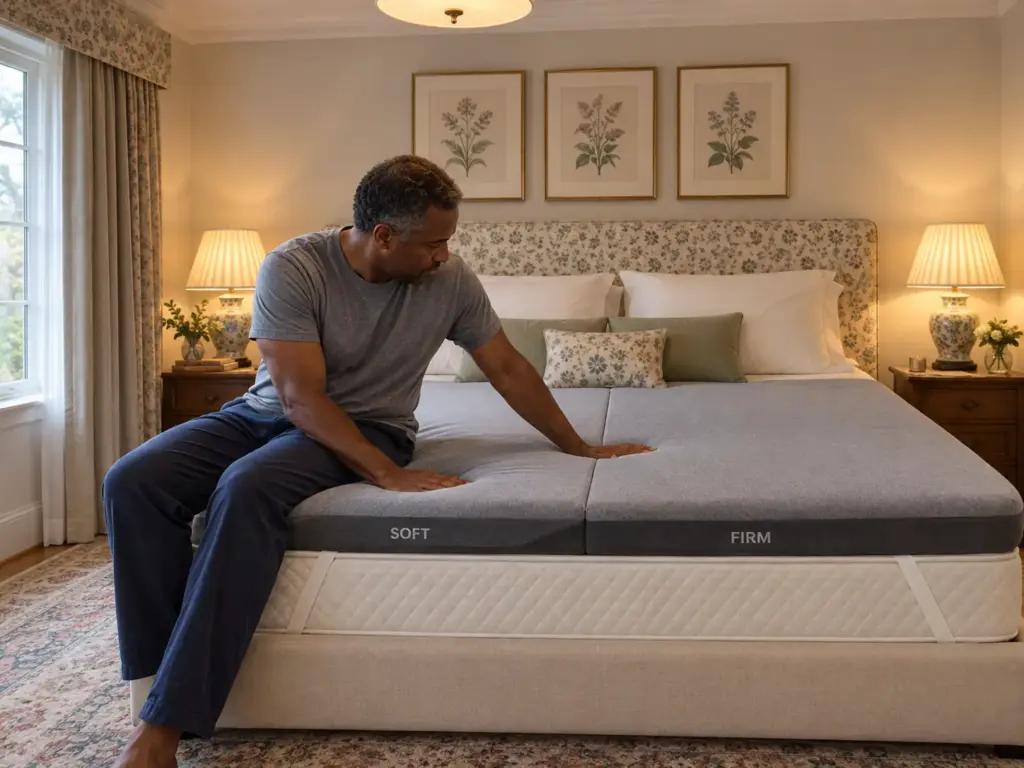
You cannot try a firm topper and a soft topper on the same mattress in the same week without owning two, unless one piece carries both. A split topper, called dual zone in its own listings (a dual-surface topper), does: one half is built softer and the other firmer, and you lie on one half, then on the other. The PERLECARE Dual Firmness Mattress Topper is the one read for this guide where a single piece gives both firmnesses, and it comes in the Full size here (54 by 75 inches, 3 inches thick). By its listing, the left half is 2 inches of gel foam over 1 inch of support foam, which the seller calls a medium-firm feel, and the right half is 1 inch of gel foam over 2 inches of support foam, which it calls firmer.
The foam is polyurethane, described as CertiPUR-US certified, and the listing says the topper is certified by OEKO-TEX. It prints no density, so “medium firm” and “firmer” are the seller’s words, and the difference between the halves is layer order, not a number you can compare with another product. By construction, the medium-firm half has twice the gel depth of the firmer half, 2 inches against 1, so a hip has twice the soft depth to travel through before it reaches the support foam. That is a test of exactly the quantity this guide cares about: how far the hip goes before the layer pushes back.
Two reviewers’ lines belong in the decision, both from the Queen and King listings of the same family. On the Queen, a reviewer says that after it is “used enough it becomes softer losing its firm side”. The same review adds: “It gets more soft in the middle than at the head or foot.” On the King, another reviewer writes that it doesn’t fit perfectly and that “there is a little lift to the corners, despite using the straps”.
The first is why a one-night test cannot see month three: the firm side softens, by that account, in the middle first, which is where the hips lie. The second is a fit note, so expect to tuck and check a corner. This is the card to read with a skeptical eye.

Used as a test, it works like this. Sleep the first night on the half your table row names and read it as described above. On the second night move to the other half, and read it the same way.
The free options come first, and the base check comes before the topper. This one only answers the one thing the base check cannot, which is which direction the bed wants to go.
Put the two nights side by side and the pattern usually names itself. If the first half leaves a dish and the second half leaves a smaller one, the bed was soft for you and the firmer half is the direction. If the first half leaves a dish and the second half leaves a flat sheet with the hip held on a small patch, you have crossed the line from one failure to the other, and this bed’s answer sits somewhere between the two halves, where a single layer of either build may not land.
If both halves leave the same sheet, the layer is not the variable. Write each night’s word down. Two words on a piece of paper are a better record than a feeling about two nights.
A foam topper that arrived rolled or boxed needs time to open out fully, and a layer that has not finished expanding reads firmer than it will be. Lay it flat on the bed and let it sit before the first lie-down, or the night you read is not the layer you own.
When the Answer Is Not a Topper
The test gives you a direction when it works. This section covers the night it does not, when both sides read the same and neither one changes how the bed behaves, and the point where the question moves off the mattress. It is shorter than the others on purpose, because the honest answer here is short.

What the same result on both sides tells you
Run the night on the soft side and again on the firm side, and sometimes the bed reads the same on both: no dish, no patch, nothing to choose between. That is a result. This is an editorial rule of this guide, not a finding from anywhere else: if the bed shows no difference between the two sides, the topper was never the question.
A layer that cannot change what you read on the surface has nothing else to offer, and a third layer, or a fourth, or a different foam, will tell you the same thing at greater expense. It also helps to say out loud what the other possibilities are, because they are short. The base is down and the base check missed it.
The pillow is doing a job the mattress is being blamed for. Or the surface is simply fine and the question you came in with was never about the surface. None of those is answered by buying another layer, and a second topper tested the same way is a second chance to get the same reading.
At that point the bed stops being the subject, and one line carries the rest. Mayo Clinic’s guide to back pain says to contact a healthcare professional for back pain that “Lasts longer than a few weeks.” The same list includes back pain that “Causes weakness, numbness, or tingling in one or both legs.” Either one goes to a doctor or another healthcare professional first, before the bed is changed again, and nothing in this guide reads or explains them.
What the bed can still sort is the ordinary part. When it’s the bed and when it isn’t separates a rough morning into what a mattress, a pillow or a room can change and what none of them can. Come back to the layers once that is settled.
What month three can add that one night cannot
One night shows direction, not durability. Whatever the test names, it names it for a layer on its best behavior. The firm side of a split topper is reported to soften with use, in the middle first.
That is one reviewer’s account and not a trend, but it points exactly where a night cannot look. The back pain guide owns the longer check, and judge it at month three, not on night one is where it is laid out. There is no month-by-month account of this topper to lean on here, so none is offered.
What to look at later is concrete. Repeat the lie-down in the same position, with the same pillow, and photograph the sheet in the same light. A dish that has grown in the middle of the firm half is the softening that reviewer describes.
Corners that have crept up are the fit note from the King listing. A sheet that looks the same as it did in the first photo is the best result a layer can give, and it is allowed to be boring. Whatever you see, compare it to night one, not to a memory of how the bed felt in the store or in the box.
The free next steps, in order. If the answer is the base, fix the base. If it is the pillow, take the pillow sort from the previous section. And if nothing changes between the sides and no layer you add changes what you read, stop buying layers, because a layer is a good answer only to a question the surface can ask.
Photograph the fitted sheet from the foot of the bed in the same light, once on the first morning and again at each later check. Two photos side by side show a softening dish that memory will smooth over, and they cost nothing.
Name the Failure Before You Pick a Side
Three things carry out of this guide.
- Firm and soft are two failures, not two grades, and position and weight say which one to try first: firm for back and stomach sleepers and for heavier sleepers, soft for side sleepers and for lighter ones.
- The base decides whether that rule applies at all, so a dip that stays with no one on the bed comes before any purchase.
- One night names the failure: a dish at the hip line points to the firm side, small patches point to the soft side, and the same reading on both sides says the topper was never the question.
Once the layer has months on it, look at the firm side again, in the dish at the hip line, because that is where a reviewer reports the softening first.
Tonight, before you buy anything, start from the bed you have: run the lie-down in your own position and write one word on a piece of paper: dish, patch or neither. Check what the mattress rests on. If it is the base, fix the base, and in the morning look along the sheet in side light to see what the night left on it.
Frequently Asked Questions
01Can a mattress topper make a too-soft mattress feel firmer?
Yes, a firmer topper can add firmness to a soft mattress, because Sleep Foundation notes a topper works in both directions, but it only changes the top layer. A lasting dip in the mattress stays a base problem and comes through the topper.
02What thickness of mattress topper is best for back pain?
Toppers usually run 1 to 4 inches thick, per Sleep Foundation, and thickness changes the feel and the height of the bed, not the side of firm you need. The back pain guide gives thickness its own section, starting from the bed you already own.
03Will a topper fix a sagging mattress?
No, a lasting dip sits in the mattress or in what it rests on, and Sleep Foundation says a topper won’t resolve a sagging mattress or lasting indentations. For some people, a bunkie board under the mattress is the change that made the difference.
04What kind of mattress topper is best for back pain?
The one that corrects the failure your bed makes: firmer over a bed that lets the hips sink, softer over a bed that holds them on a small patch. The one-night test in this guide names which failure that is, before you buy anything.
05Does the firm side of a dual-firmness topper stay firm?
One reviewer on the Queen listing of the PERLECARE family says the firm side softened with use, and the listing prints no density to check it against. That is one account, not a trend, so read the firm side again after months on the bed rather than trusting night one.





Tried it on your own bed?
No comments yet. Tell us what you changed, and what the sheet did after a few washes.