Cooling Sheets That Stay On, at Mattress Plus Two Inches
Cooling sheets that stay on need mattress + topper + 2 inches of pocket, plus all-around elastic. The slicker the weave, the less grip the fabric contributes.
 Alfredo Ramses Textile engineer · 2 September 2026 · 17 min read

What’s in here 7 sections
- Why the Corner Pops Off, and It Is Only Ever Two Things
- Measure the Mattress With the Topper Already On It
- All-Around Elastic, and Why Cooling Fabrics Grip Worse
- Try the Four-Dollar Fix Before You Buy Another Set
- What Happens After Twenty Washes, and the Bed That Folds
- Conclusion
- Frequently Asked Questions
You wake at three with the fitted sheet balled under one shoulder and a bare corner of mattress against your arm. You have already replaced this set once.
A fitted sheet holds by elastic tension around a perimeter, which means it can only fail two ways: the perimeter is too short for the bed, or the elastic never ran the whole perimeter to begin with. Everything else people blame, the brand and the fabric and the thread count, is downstream of those two. So here is the number to measure, why the slickest cooling sheets that stay on are the hardest ones to keep on, and what to try before you spend anything.
Quick Answer
A fitted sheet pops off for one of two measurable reasons: the pocket is shallower than your mattress plus topper, or the elastic sits only in the four corners instead of running the full hem. Shop a stated pocket depth of mattress + topper + 2 inches, paired with all-around elastic. The word “cooling” on the package settles nothing.
Why the Corner Pops Off, and It Is Only Ever Two Things
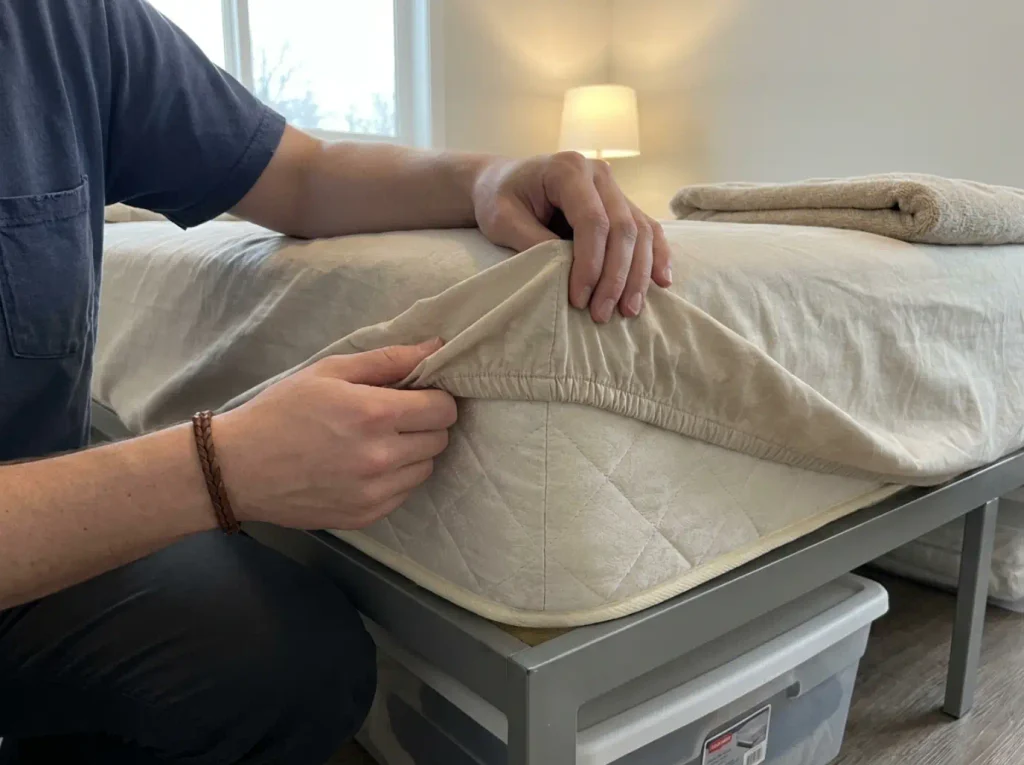
Somebody who has bought three sets and blamed three brands has usually been fixing the same fault twice and never touching the other one. There are two, they are independent, and they need different answers. The first is a size fault: the pocket is shallower than the mattress plus whatever is stacked on top of it, so the sheet is already stretched to its limit lying still. Any turn in the night takes it past the edge, and it goes.
The second is a construction fault. Corner elastic grips at four points and leaves the four sides hanging slack. On a mattress under about ten inches that is usually enough, because the corners are not carrying much.
Past that height the same four points are holding a load nobody sized them for, and the sheet will let go on a high-profile mattress that is technically the right size. This is why “get a deeper pocket” is bad advice half the time.
The clearest proof they are separate faults comes from the people living with both. In one r/BuyItForLife thread on fitted sheets that slip, a poster on a twin, with correctly sized twin sheets, no mattress topper and nothing exotic, reports the sheet “comes off like every night” because they move a lot in their sleep. Size was never their problem.
In the same thread, several other people solved theirs entirely by getting the right size and never touched the construction. Same symptom, opposite fault, and no roundup separates them.
And there is a third cause that is not the sheet at all. The same thread turns up a bed pushed against a wall with a headboard, where the pillows lean back every night and quietly walk the sheet off the top corners over the course of a week. Nobody connected the pillows to the sheet until another commenter named it. That is a mechanical load applied nightly from the wrong direction, and no purchase addresses it.
Here is the part that makes the size fault so hard to diagnose: a shallow pocket does not tear loose in one dramatic pull. It creeps. Each night the corner climbs a fraction further up the mattress corner, holding a little less, until one turn takes it over the edge, which is why the failure always seems to arrive suddenly after weeks of the set being fine.
It was failing the whole time. You just could not see it from on top of it. This article is about fit and construction rather than temperature; if you came for the temperature side, what actually makes a sheet sleep cool is a separate mechanism entirely.
Measure the Mattress With the Topper Already On It
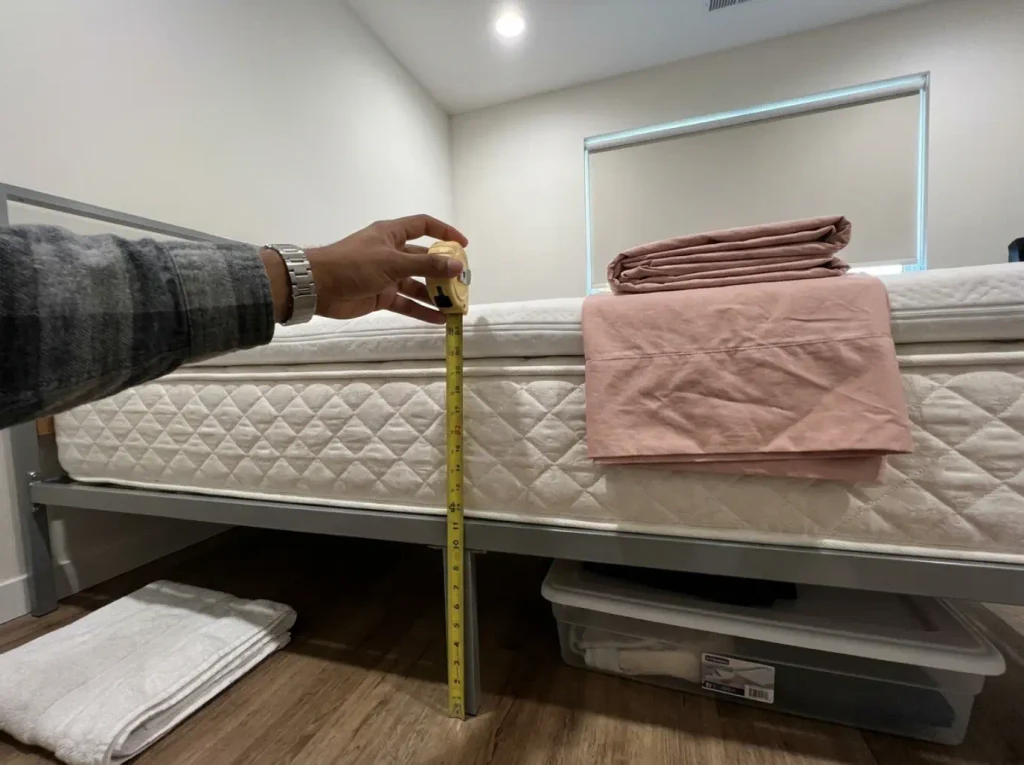
Here is the number, and it is the one nobody in this search result prints: mattress height + topper height + 2 inches of slack equals the pocket depth to shop for. Measure it yourself, at the bed, with the topper already on, from the platform to the top surface. Not from the mattress spec sheet, and not from the number on the box the mattress came in.
Run a normal bed through it. A 12-inch hybrid with a 3-inch topper on top is a 15-inch bed, and it needs a 17- to 18-inch pocket. The mattress’s own honest “12 inch” spec is the wrong number to shop with, and it is exactly the number most people trust, which is how somebody ends up with a correctly-labeled sheet that pops off a correctly-measured mattress.
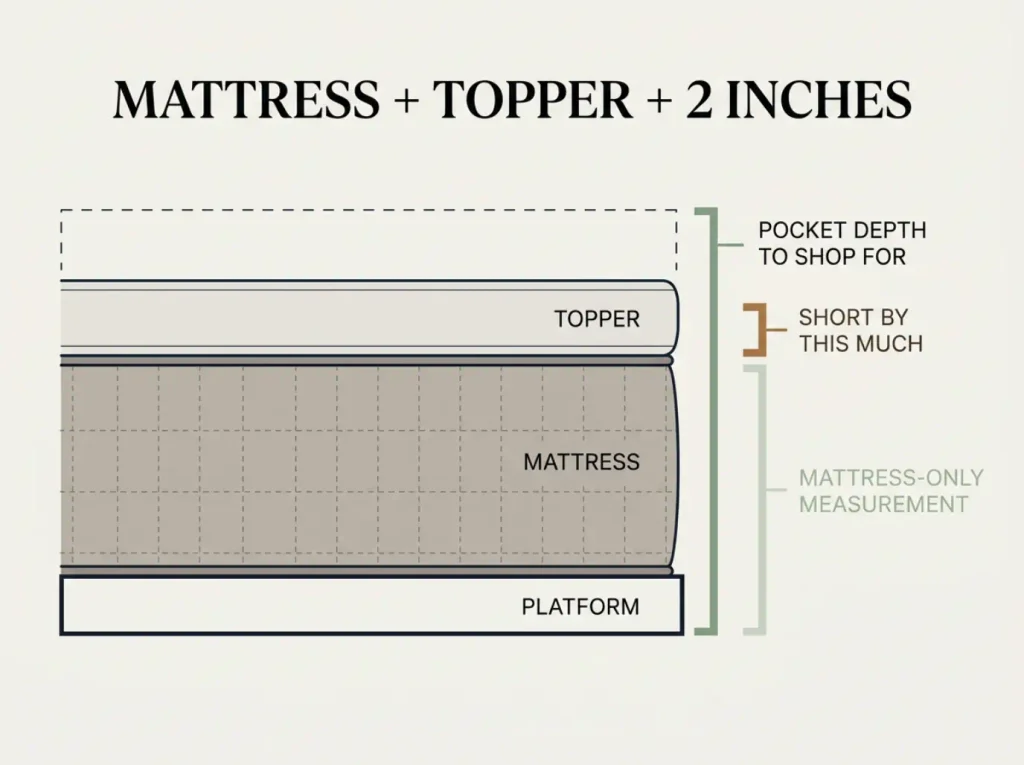
The 2 inches are not padding, and they are not a safety margin in case you measured badly. The elastic has to grip under the mattress edge, tucked beneath the bottom face, pulling inward. A sheet that reaches the bottom corner and stops is holding on with nothing tucked, which mechanically is the same as not holding on at all. Two inches is roughly the minimum that lets the hem turn the corner and pull from below.
Which brings up the only shopping signal that means anything here. A manufacturer who prints an exact pocket number is a manufacturer who measured. A listing that says “deep pocket” or “extra deep pocket” and leaves it there has told you nothing, because deep pocket is not a size, it is a mood. No sheet size chart on a product page substitutes for the tape in your own hand, because the chart describes the mattress the brand imagined, not the one you stacked a topper on.
The ALPHA HOME Deep Pocket King Sheet Set in washed cotton percale is the discipline done right: 100 percent cotton percale, enzyme stone washed, and a stated 16-inch pocket you can run through the formula before you click anything. Its flaws are worth saying plainly: stock is down to a handful of units and the colorway is pink, so treat it as the example of a label written honestly rather than the set to go buy. The Feather & Stitch percale further down carries the same 16-inch pocket and is fully in stock.
What that formula is worth in avoided purchases: the same thread has a poster with an 18-inch memory foam mattress who bought and gave away roughly ten fitted sheets before landing on an 18-to-21-inch deep-pocket set that finally held. Ten sets. That is the retail price of one sentence of arithmetic nobody printed.
Measure at the corner, not in the middle. A pillow-top or quilted-cap mattress is thicker through the center than at the corner where the sheet actually has to close, and measuring the fat part sends you one size too big — which then slides around instead of gripping. The corner is where the sheet does its work, so the corner is where the tape goes.
All-Around Elastic, and Why Cooling Fabrics Grip Worse
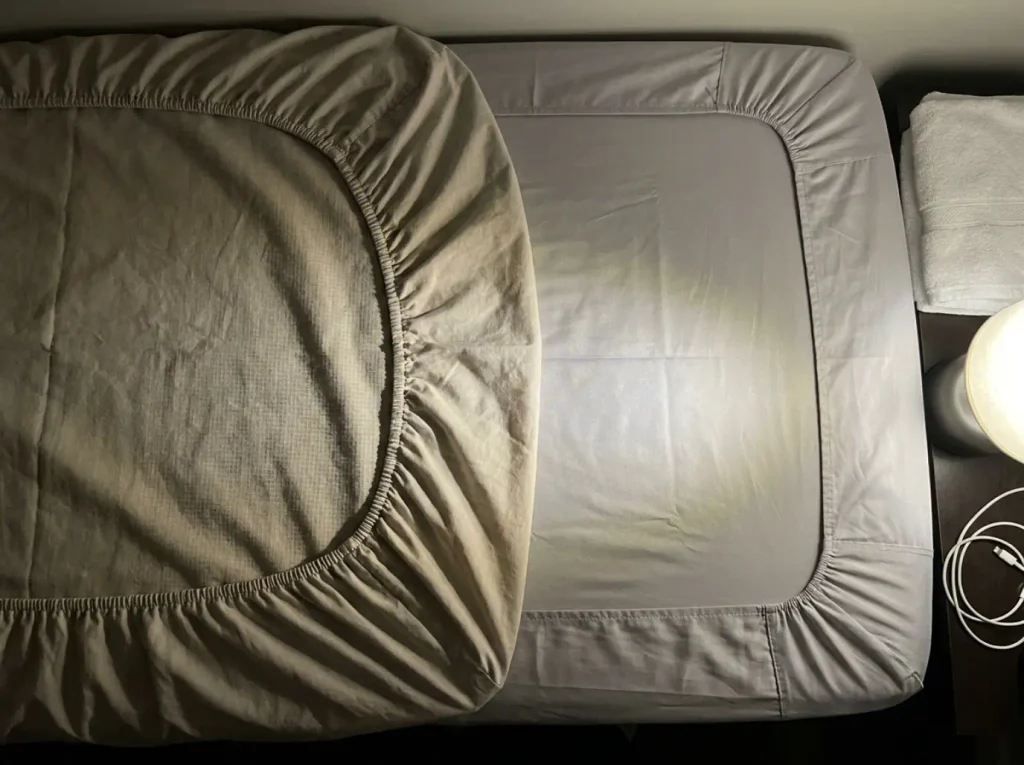
If the size is right and the sheet still goes, you are looking at the hem. All-around elastic, sometimes sold as 360 elastic, runs through the entire perimeter of the hem, so tension is spread across every inch of the edge and no single corner is the weak link. Corner elastic concentrates the whole load on four points. That is the real mechanical difference between the two sheets on the shelf, and it is usually not printed on either box.
Worth knowing that you have no certification to lean on here either: the standards body that writes the industry’s home-laundering test methods has standardized how to measure dimensional change after washing, but nobody certifies elastic retention. You are on your own reading construction.
Now the weave, plainly. Percale is one thread over, one under — a grid, matte, with the texture of the yarn standing up off the surface. Sateen floats four threads over one, which lays long unbroken lengths of thread across the face. A true satin weave does the same thing with filament yarn and takes it further.
That float is what catches light as sheen and what feels smooth under a hand in a shop. If you want the whole argument, the full percale and sateen comparison goes deeper than one section can.
And here is where the two halves of this article meet. A floated surface is a low-friction surface, a slippery fabric in the plain word for it. Against the corner of a mattress it slides, where percale’s over-under texture bites and holds a little of its own weight.
So the fabric that reads as cool and smooth to the hand is the fabric contributing the least grip, and the elastic gets no help from it. Cooling and staying put pull against each other structurally, which is not a thing anyone selling either one has an interest in mentioning.
What that means with a cart open: on a slick weave (sateen, satin, bamboo viscose in particular, a smooth microfiber) all-around elastic stops being a nice extra and becomes the only thing holding your bed together. On a percale you have margin. On a sateen you have none.
The community got to this without the vocabulary, incidentally: at least four commenters in that same thread independently landed on the same trade-off in their own words, that sheets with polyester in them resist wear but are slippery, while all-cotton ones wear out faster but are more clingy. That is the friction argument, arrived at from the mattress up.
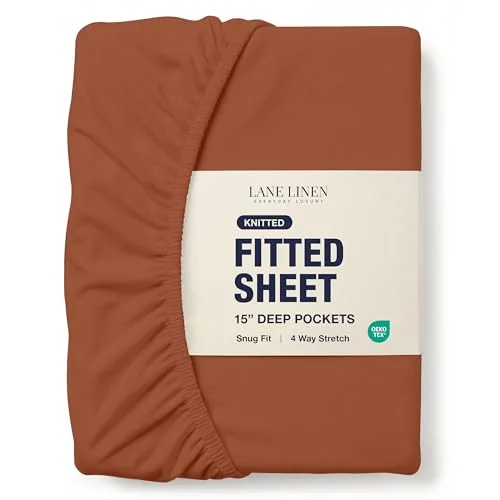
If going synthetic to solve a grip problem feels like the wrong trade when the whole reason you are here is heat, take the cotton road instead. The Feather & Stitch 100% cotton percale set is 300 threads of single-ply cotton in that one-over-one weave, with a 16-inch pocket printed where you can find it, and the weave’s own texture does part of the holding that a sateen makes the elastic do alone.
Its flaw is the same property: it feels crisp under a hand, never slippery, and it will never give you the smooth hotel hand a sateen gives. That crispness is the grip. You cannot have one without the other.
The tell, if you want to check a sheet you already own, is at the corner seam rather than the face. Pinch a sateen fitted sheet at the corner and pull: the fabric slips against itself before the elastic even engages. A percale corner grabs its own weave first. That is why a percale forgives a pocket that is half an inch short and a sateen does not forgive anything.
Try the Four-Dollar Fix Before You Buy Another Set
You are probably one click from buying a fourth set. Don’t, yet. Three things cost nothing or nearly nothing, and between them they solve one of the two failure modes outright.
Re-measure first, with the topper on, using the number from two sections up. Several people in that thread discovered the entire problem was a size they had assumed and never actually checked with a tape. It is the cheapest possible diagnosis and it takes ninety seconds.
Second, if your bed is against a wall with a headboard, pull it out a few inches and see whether the pillows stop walking the top corners loose. Free, and it fixes a cause that no sheet purchase in the world addresses. While the bed is out, tuck the flat sheet with hospital corners rather than shoving it under: a folded corner holds itself and stops the top layer from dragging the fitted sheet with it every time somebody turns.
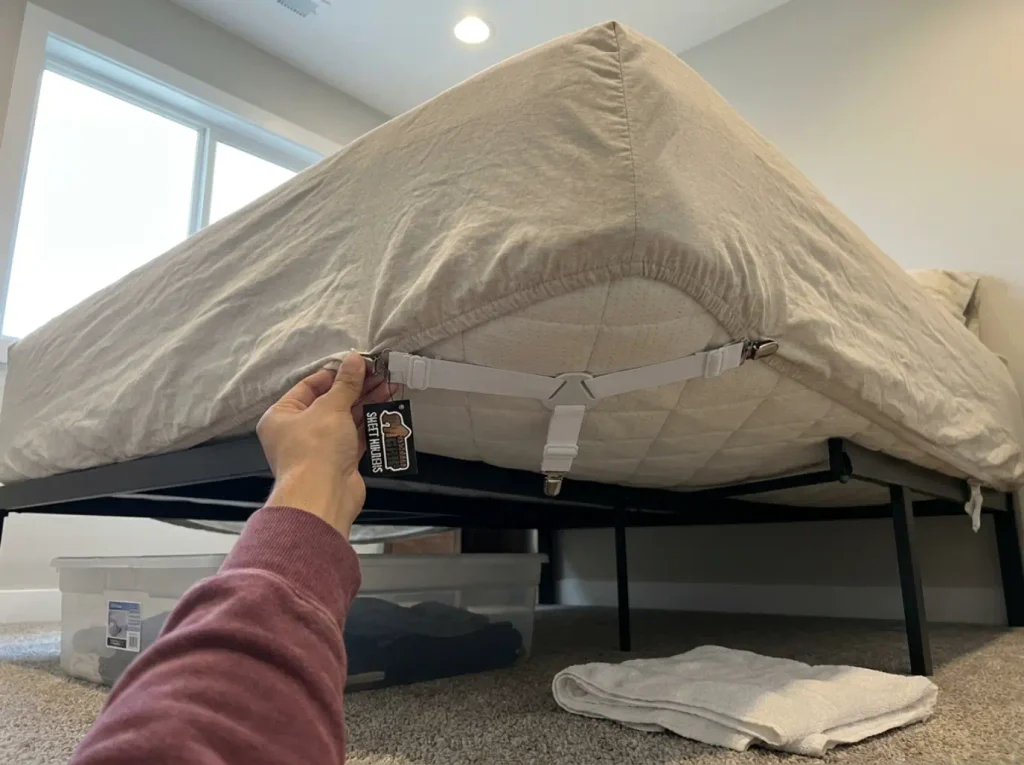
Third, the straps. Corner anchor straps, sold variously as corner clips, sheet suspenders or cross-under straps, run a strip of elastic diagonally beneath the mattress and pull two adjacent corners toward each other, which adds the perimeter tension a corner-only sheet never had in the first place. That is not a hack, it is the missing half of the construction.
The GORILLA GRIP fitted bed sheet holders are the version with metal clips that stretch to 25 inches and fit anything from a twin to a California king, and they are the exact category of thing the thread names over and over. One poster says flatly that the clip-on straps they picked up for about a dollar a strap “has saved us,” on a bed shared with someone they describe as a major flipper and flopper all night.
But be clear about what they can and cannot do, because nobody selling them will be. Straps fix a construction fault. If your pocket is genuinely shorter than the bed, a strap just pulls harder on a sheet that already has nothing left to give — it buys you nights, not a repair, and the corner will still go, later.
That distinction is the entire reason the two failure modes came first in this article. Also from the same thread and worth naming because it sounds strange and works: a flannel fitted sheet laid directly on the mattress, under the real sheet, purely for the grip of a brushed surface against a slick one. A textured mattress protector does the same job if you already own one.
Clip the straps diagonally across the underside, corner to opposite corner, not straight along one edge. A straight run just shortens one side and pulls that corner off first, which is how people conclude the straps “didn’t work.” The diagonal is what turns four separate corner grips into one tensioned perimeter, and it is the whole trick.
Work through those three before you spend, and then decide whether a new set is warranted at all, which is a fair question to ask about what the cooling label is actually adding before you pay for it a fourth time.
What Happens After Twenty Washes, and the Bed That Folds
The set fit perfectly in March and pops off in September. Nothing shrank. The mattress did not grow. The elastic is tired, and the wash is what tired it.
Elastic degradation is a real, documented wear-out mode, and it happens independently of how the fabric itself is holding up. Repeated stretching, repeated wash and dry cycles and above all dryer heat degrade the elastic in the hem on their own schedule.
Patent literature on fitted-sheet grip design names it outright as the failure the inventions exist to solve. Not one article ranking for this query mentions it, which is why so many people conclude a sheet “was fine and then just stopped fitting” and go looking for a defect that is not there.
Now the trade-off nobody states, and it is a genuine one. AAFA recommends washing bedding at 130°F or higher for dust mites. That same heat, and the hot tumble dry that usually follows it, is precisely what shortens the elastic’s working life. Two reasonable goals, pulling in opposite directions, and most advice hands you one rule and pretends the other does not exist.
The split is easier than it sounds: wash hot if you need to, then tumble dry low or line dry it. Wash water does far less damage to the hem than a hot dryer does, and the hem is the part that decides whether the sheet still works, the same compromise that comes up in washing bedding hot without wrecking it.
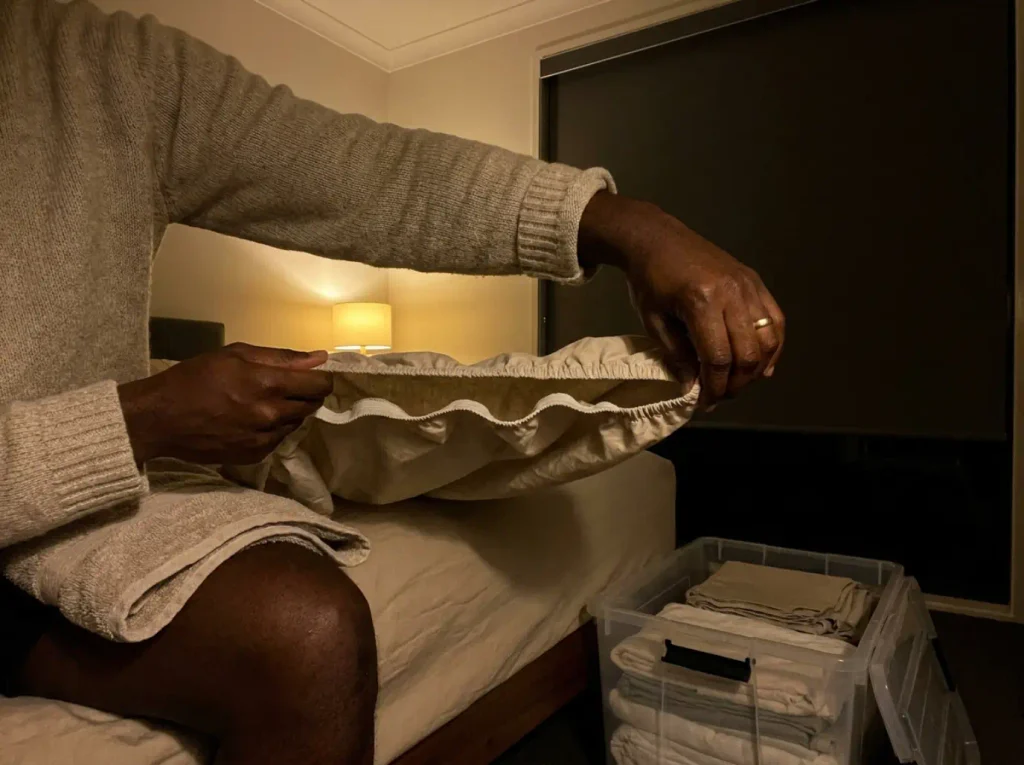
To find out whether a set is finished, check the hem and ignore the corner. Stretch six inches of the elastic casing between two hands and let go. Elastic that still has life snaps flat; elastic that is done stays stretched and lies wavy. The fabric can have years left when the hem is finished, which is exactly why a sheet that “suddenly stopped fitting” looks perfectly fine.
One bed shape needs a different sheet rather than a bigger one, and it gets misdiagnosed constantly. A split king, sold as split-top or flex-top, has a seam roughly a third of the way down from the head so each side can raise independently on an adjustable bed base. A regular fitted sheet fights that frame every time it moves, however deep its pocket is, because the sheet is one continuous surface and the bed is not. This is a flex problem, not a fit problem, and buying up a size makes it worse rather than better.
The N&Y HOME StretchSnug Split Top King set is a sheet built with an actual head split and a 4-way stretch knit so each half can travel with its own side of the frame. Read the flaw carefully before you click: this is for split or flex-top adjustable frames only. On a standard bed it does nothing at all except put a seam across the top third of your mattress, and stock is thin, so it is a narrow answer to a narrow problem and no one else should buy it.
The long view is genuinely mixed, and it is worth saying so rather than promising durability. One poster in that thread reports Brooklinen sheets at about six years that “only get better with time.” Another says Target’s Threshold performance sheets, four years in, are “very soft now and never slip.”
Against those, the poster whose correctly sized twin sheet still comes off nightly. Longevity is real and it is not evenly distributed. And when a set is finally retired, which weave outlasts the other usually decides how much of it was still good when the hem gave up.
Conclusion
Measure the bed with the topper on and add two inches. That one number ends most of these failures before a purchase happens, and it is the number the box will never do for you.
If the size is already right, the fault is the elastic, and you are looking for all-around rather than four corners. Expect a slick cooling weave to need it more than a percale does, because the percale is doing some of the gripping itself and the sateen is doing none.
Try the straps and pull the bed off the wall before buying anything. Between them they cost a few dollars and they solve one of the two failure modes outright — and if they don’t, you have learned which fault you actually have, which is worth more than a fourth set.
After a season of washes, stretch six inches of the hem’s elastic casing and let it go. If it lies wavy instead of snapping flat, the sheet is finished at the hem no matter how good the fabric still looks, and drying low instead of hot is what buys you the next season.
Go measure the bed tonight, topper included, and write the number down. Then look at the sheet you already own and see whether it ever had a chance.
Frequently Asked Questions
01How do I stop my bed sheets from coming off?
Measure the mattress with the topper on and add two inches — that is the pocket depth you need. If the size is already right, add elastic corner straps clipped diagonally underneath, and pull the bed away from the wall so leaning pillows stop walking the sheet loose.
02Why does my bedsheet keep coming off my bed?
One of two reasons. Either the pocket is shallower than the mattress and topper together, or the elastic sits only in the four corners instead of running the whole hem. They look identical from on top of the bed and they need completely different fixes.
03What are the best sheets that don’t fall off the bed?
Ones with all-around elastic and a stated pocket depth that clears your mattress plus topper by two inches. A printed pocket number is the signal that somebody measured; “deep pocket” on its own is not a size and tells you nothing.
04What is the best material for cooling bed sheets that stay on?
Percale. Its one-over-one weave leaves texture on the surface that bites into the mattress, where sateen and bamboo viscose float threads across the face and slide. You give up some smoothness under the hand and you get grip the elastic no longer has to supply alone.
05Do fitted sheet straps actually work?
On a sheet with corner-only elastic, or a restless sleeper, yes — they add the perimeter tension the sheet never had. On a pocket that is genuinely too short they only delay the failure, because they are pulling on fabric that has already run out of reach.
Leave a comment
Slept on something we got wrong, or found a set that held up? Say so here. Your email stays private.