


What’s in here10 sections
- How the Bed Turns a Night Into Waking Up Sore
- Sort the Ache by Where It Sits
- The Free Test: One Change, Counted in Mornings
- The Pillow Goes First, and Its Height Is Set by Your Shoulder
- The Gaps at the Waist and Behind the Knees
- The Mattress Is the Second Suspect
- When It Stops Being a Bed Question
- Judging a Change Beyond the First Week
- Change One Thing Tonight, Then Count
- Frequently Asked Questions
You sit up and the neck stops a few degrees short of turning, or the low back needs a minute before it will straighten. Nothing that happened yesterday explains it, which is how waking up sore, with a stiff neck, a sore back or plain morning stiffness, turns into a shrug about age. The bed is the one place you are held still for hours, so whatever shape the pillow, the gap at the waist and the mattress set is the shape you stay in, and a sore morning reads that shape back to you. Below, you sort the ache by where it sits, change one thing and count the mornings, then work through the pillow, the gaps, the mattress, the one clause that belongs to a doctor, and how long a change deserves before you judge it.
Quick Answer
Waking up sore usually means the bed held one shape all night: pillow height at the neck, a gap at the waist or knees, an arm underneath, a mattress sagging under the hips. Change one thing at a time. Numbness, tingling, weakness, swelling or warmth in one spot, or no change after several weeks, goes to a doctor.
How the Bed Turns a Night Into Waking Up Sore
Morning soreness is already there when you sit up, so it is easy to blame the day before. The bed is the better first suspect: for hours it is the only thing touching you, and unlike the afternoon, you do not pick a new shape every few minutes.
The Shape the Bed Sets Before You Fall Asleep
Four things set it. The pillow decides how high the head sits against the shoulder, and that fixes the angle of the neck. The gap at the waist, and for a back sleeper the gap behind the knees, decides whether the spine bridges empty air or rests on something.
The arm that ends up under you decides how the shoulder is loaded, and where the pressure points land. And the mattress under the hips decides how far the heaviest part of you sinks compared with the shoulders.
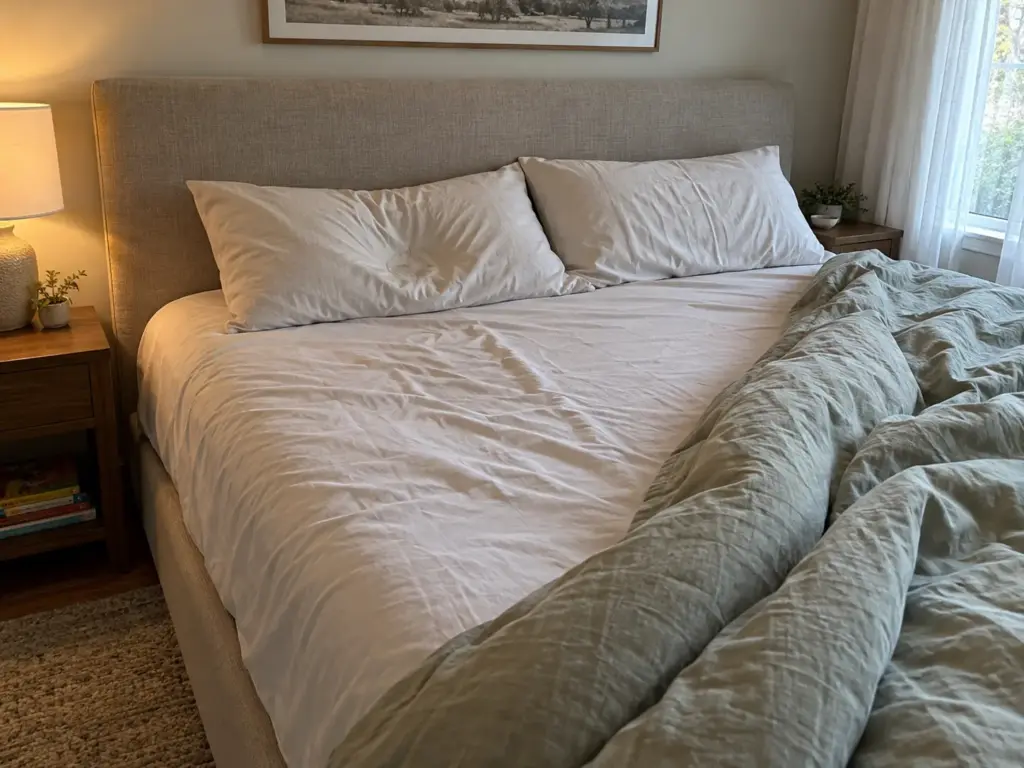
Move any one of the four and the whole shape shifts. Leave all four off by a little and you get an ache that looks like it came from nowhere. The evidence is on any bed before it is made: the long crease down the bottom sheet and the dent in the pillow are the night’s own record of the shape you held.
Why a Small Error Adds Up by Morning
Awake, a neck held a few degrees off gets corrected without a thought. Asleep, nothing interrupts it. No one adjusts a pillow while asleep, so a small error is held for as long as the night lasts, and a small error held that long stops being small. An ache with no injury behind it has a plain name among sleepers: they say they slept on it wrong.
That phrase is more accurate than it sounds. It puts the cause in the sleeping, and the sleeping is the part of the day you can change with a pillow, a towel or a mattress.
What the Bed Cannot Explain
This guide covers the bed and the room. What goes on inside you is a different question, and it gets one clause, in the section on when to stop changing things. A bed that fits does not promise a morning with no ache ever. A reader who fixes the shape and still wakes the same has an answer too, and the later sections say where it leads.
Sort the Ache by Where It Sits
Before anything is bought, say where it hurts, because each place points at a different part of the bed. The table is the map; the three sections after it say what to do with each row.
| Ache place | What the bed is doing | Change first | Where it goes |
|---|---|---|---|
| Neck | Pillow too high or too low against the shoulder | Pillow height, then the arm | Neck and pillow height sections |
| Shoulder | Arm pinned under the pillow or under you; pillow edge short of the shoulder | The arm and the pillow edge | Shoulder sections |
| Low back | An open gap at the waist, or hips sinking | The gap first, the mattress second | Gap and mattress sections |
| Hips, on the side you lie on | Mattress giving way under the hips | Leave it as the control; judge it last | Mattress section |
| Numbness in a hand, arm or leg | Not a bed row | Nothing to buy or move | The doctor clause |
Neck and Shoulder: Think Pillow Height and the Arm
A sore neck that will not turn the whole way points first at pillow height at the neck: a pillow that stands too high or too low against the shoulder tilts the head for the whole night. A shoulder that aches on the side you lie on points at the arm under the pillow, which is where the arm ends up when the pillow cannot hold the head. The fit changes again when the shoulder is wider than the pillow edge, and that case has its own piece.

Before you get up, note which side the ache sits on and whether it is the side you lay on. It is the first clue the bed gives, and it costs nothing.
Note the side with your first movement, before the shower or any stretching. By breakfast the memory has smoothed over, and the side is the one clue the bed hands over for free.
Low Back: Think the Gap and the Mattress
A sore back that eases as the morning goes on, or that follows the side you lay on, points toward the bed’s shape and the mattress under it. Lower back soreness on waking that clears by midday is a common pattern, and it often prompts the question of whether it is just getting older. The usual answer is no, and it is not worth chalking it up to aging.
The first stop is the gap at the waist, the empty space between the mattress and the curve of the lower back, which a towel or the right pillow can close. The mattress comes after, in its own section, once the cheaper changes have had their mornings.
The Place That Is Not a Bed Question
Numbness or tingling in an arm or hand is not a row of this map. If that is the ache, it goes to the piece on a numb arm in the morning and to the doctor clause further down. Nothing in this section explains it.
The Free Test: One Change, Counted in Mornings
The map says where to look. This section says how to find out whether it was right: change one thing, count the mornings, and leave everything else alone. Two changes in one week leave no way to tell which one worked.

Why Pillow First and Mattress Second
The mattress is the biggest thing in the room, so it gets blamed first. The better call is the pillow, for reasons that are about cost and reversibility, not certainty: a pillow is cheaper than a mattress, it can be undone, and its height can change in an evening. That order is our reasoning, not a finding from a study.
While the pillow is being tested, the mattress stays exactly as it is, which turns it into the control. If the mornings move when only the pillow moved, the pillow did it. A fairly expensive pillow bought for neck and shoulder tightness can bring no improvement at all. A test run first on the pillow already owned would have said so before the money did.
How to Keep the Count
One small notebook on the nightstand, one line each morning: sore, same or better. Nothing else. Change one thing, keep the line going, and do not judge on the first morning. A change gets a run of mornings, not one, and that tally is the morning count.
The line written after the first night is the one least worth trusting, since anything new feels different once. The pattern shows in the lines after it, and a notebook is the only place it can show.
Add one letter to each line for the change in force: P for pillow, T for towel, M for mattress. A month on, the page shows which change sat under which run of mornings, and a switch you made and forgot cannot hide in it.
Two Sleepers, Two Sets of Mornings
In a shared bed the test splits in two. One sleeper’s change is not the other’s, and a pillow that fixes one person’s neck leaves the partner’s morning where it was. Each sleeper keeps their own notebook and changes their own thing.
When the mattress proves to be the problem and the two sleepers cannot agree on one, two Twin XL mattresses side by side, one per partner, is a workaround. Couples who made that switch often have very little back pain afterward.
The Pillow Goes First, and Its Height Is Set by Your Shoulder
The test starts with the pillow, and that choice rests on something measurable: not the label, but how far the shoulder stands from the ear. Below are the rule, the free change that applies it, and the one product that turns the change into a nightly adjustment.

Height Comes From the Shoulder, Not the Label
In a 2025 Beihang University study of pillow height for side sleepers, nine side sleepers lay on pillows 8, 10, 12 and 14 centimeters high (roughly 3 to 5.5 inches), with and without neck support. A height calculated from shoulder width and pillow height predicted the slope of the neck. Nine people in a lab is a pointer, not a verdict, but it points where the fit points: the right height is set by the shoulder, and a number printed on a label is one number for every shoulder.
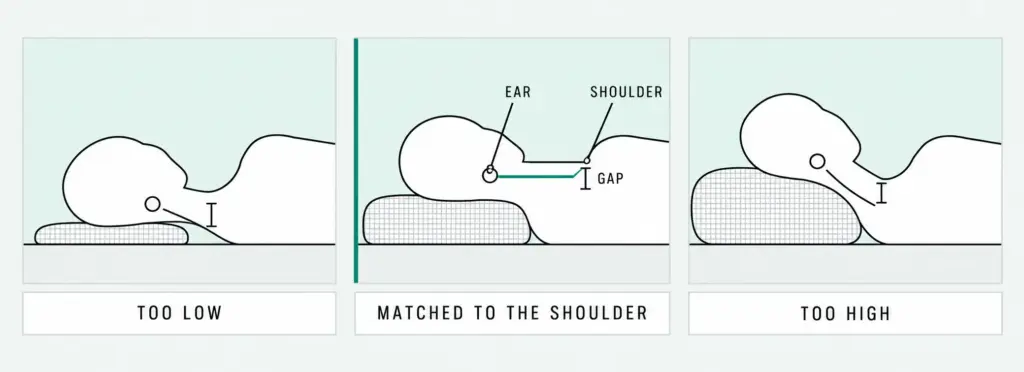
A wider shoulder leaves a bigger gap between ear and mattress for the pillow to fill, which is why pillow height for side sleepers is worked out from the shoulder before anything else. Your sleep position changes what neutral alignment means for the neck, so back and stomach sleepers set the pillow loft differently, and that work lives in the guide that says to measure the loft, don’t guess.
The Free Change: Take Fill Out or Add It
Before any purchase, open the seam or zipper of the pillow you already own and take out, or add, a handful of fill. If the pillow has no opening, fold a towel and slide it under the case. It is the cheapest test in this article, and a real one: a pillow that sat too low gets a handful in, one that sat too high gets a handful out, and then the notebook does the judging.
After a week the fill has moved from where you put it, so the pillow is re-read, not trusted. Loft and firmness are two numbers, and this change moves only the first.
Count the handfuls. “A bit more” cannot be repeated, but “two handfuls out” can, and it lets you put the pillow back exactly where it was if the notebook says the mornings got worse.
When the pillow you own cannot be opened, or its fill is spent, the same change can be built in. The Coop Home Goods Original Adjustable Pillow is cross-cut shredded memory foam mixed with microfiber, 20 by 30 inches in Queen, with extra fill in the box, and its cover unzips so the loft moves one night at a time. That is the one-change test inside a pillow.
It comes with two complaints worth weighing. A 3-star review from July 2026 says the current foam is “light and airy” and that what is called shredded “looks more like cubes.” A 4-star review from 2018 says the cover “gets HOT” against the face, and the reviewer ends up flipping the pillow “about 4 times a night.” For a sleeper who runs warm, that second line decides whether it earns a place on the bed.
When Comfort and a Straight Neck Disagree
The same study found that a medium individualized height with neck support gave the cervical curve closest to natural standing and the lowest force on the neck. The authors found that comfort tracked the calculated height only moderately or weakly, so the height people liked best was not always that one.
So “it feels fine” does not prove the neck is straight. The pillow that feels best in the first minute can be a different pillow from the one that keeps the neck level for hours. When a pillow feels fine and the mornings stay stiff, believe the mornings in the notebook.
The Gaps at the Waist and Behind the Knees
The pillow decides the top of the spine. What happens under the waist and behind the knees is decided by the gaps in the bed, and the mattress cannot fill them for you.

Where the Gap Is and What Fills It
The gap sits at the waist and, for a back sleeper, behind the knees. For a side sleeper it is the space between the knees and the waist line. Left empty, it lets the frame drop toward the mattress, so the spine and hips hold an angle they would never hold standing.
The readers’ version is plainer. A side sleeper can wake with what feels like a bad pulled muscle in the side unless a pillow sits between the knees. Why the pillow you place there drifts by morning is argued in the piece on why the pillow drifts by morning, which owns that half.
The Free Fill: A Rolled Bath Towel
Roll a bath towel until it is about as thick as the gap, and set it at the waist, or under the knees if you sleep on your back. Right is thick enough to close the gap without lifting the hips off the mattress. The roll flattens over a week, so re-roll it tighter when the notebook line starts to slide back.
Check the thickness lying down, not standing. Slide a flat hand into the gap at your waist: if it passes with no push, the gap is still open; if it jams, the roll is too thick.
When a Bolster Does the Same Job
A half-moon bolster does what the towel does without a second pillow in the bed. The 5 STARS UNITED Knee Pillow for back sleeping is a half-moon of memory foam with a removable, washable anti-pill cover, and it sits behind the knees to close that gap. A bolster is meant to hold its shape longer than a towel roll, though the reviews are mixed on how well it does.
Amazon’s summary of its reviews says size gets mixed feedback and that some owners report it losing its form. A 3-star review from October 2026, by a verified buyer, says it was comfortable under the knees “but it’s a little too low, I needed it a little higher.” That makes the towel more than a stand-in: the thickness that worked for you is the height to look for.
The Mattress Is the Second Suspect
The pillow and the gaps are cheap to change. The mattress is not, and the evidence for blaming its firmness is thinner than it feels. In this test it stays the control.

What a Medium-Firm Mattress Has, and Has Not, Been Shown to Do
According to a 2021 systematic review of 39 studies in the *Journal of Orthopaedics and Traumatology*, “Results of this systematic review show that a medium-firm mattress promotes comfort, sleep quality and rachis alignment.” Rachis is the spine. Firm is not automatically better: it was the medium-firm result that came out ahead on comfort and alignment.
The same review is less sure about pain: “Literature findings are discordant on the type of mattress that might prevent onset of back pain.” So the mattress is a suspect, not a proven cause, and the medium-firm result is no promise that a firmer bed ends sore mornings. How much of a back ache belongs to the pillow and how much to the mattress is the question of pillow height vs mattress.
The Sag That Hips Feel
A mattress that sags shows up in readers’ reports as hips that sink below the shoulders. A memory foam mattress that is worn out can be tied to back pain. It is a reader’s report, not a measurement.
The bed gives one sign for free. Strip the bottom sheet and sight along the mattress at hip height: a hollow where the hips lie is a sag.
Why the Mattress Waits Its Turn
It is the most expensive change, the hardest to undo, and the one where the evidence is mixed. So the order holds: the pillow and the gaps get their run of mornings first, with the mattress untouched. Only when those have had their run and the mornings have not moved, and nothing in the next section applies, does the mattress get judged.
When It Stops Being a Bed Question
Everything above assumes the bed is the cause. This section says when to see a doctor, once, and then the article goes back to the bed. It is a hand-off, not a diagnosis.

The Signs That Go to a Doctor
Mayo Clinic’s neck-pain guidance says to see a healthcare professional if neck pain persists after several weeks of care at home, radiates down an arm, or comes with headache, weakness, numbness or tingling. It says to call 911 for severe neck pain with muscle weakness, after an injury, or with a high fever.
How the numbness started decides the route, not how the pillow feels. Mayo Clinic’s numbness page sends numbness that begins suddenly, covers a whole arm or leg, or comes with weakness or confusion to the emergency room, and numbness that builds gradually, comes and goes, or affects only part of a limb to a healthcare professional. Swelling or warmth in one spot, or a joint that is hot, swollen or will not take your weight, also belongs with a doctor, and the last of those is urgent. The bed side of a numb arm has its own piece, which counts the minutes it takes to clear, but it does not replace the call.
Soreness That Does Not Move With the Bed
If none of those signs apply, the sections above stand and the count goes on. If several weeks of changes, made one at a time and written down, have moved nothing, that is the same point where Mayo draws its line, and it is time to bring the notebook to a professional. When it started, which side, what you changed and when are things they can use.
Waking headaches have their own bed-side piece in pillow headaches. A headache that arrives with weakness, numbness or tingling is on the list above.
Judging a Change Beyond the First Week
The first morning after a change lies, because almost anything feels different once. This section sets how long a change gets and when a pillow is spent.

Why Week One Lies
A new pillow’s first nights are novelty. The new height, the new fill and the new feel all read as different, and different gets mistaken for better. That is why the count keeps going past them. The notebook is also the record that tells you whether a change held after a month.
If the line moved and stayed moved, the mattress never needed to be judged. If it did not move and the doctor clause above does not apply, the mattress is next.
When the Pillow Is Spent
A pillow flattens with use, and when it is spent depends on its fill, not on a year on the calendar. The piece on how often to replace pillows, by fill not by year sets the replacement clock for each fill.
The free check is in your hands. Fold the pillow in half and let go: if it does not spring back toward its old shape, it has lost height, even when it feels fine against your cheek because you have grown used to it.
Change One Thing Tonight, Then Count
Three things to keep:
- The bed holds you in one shape all night, and the sore place shows where that shape was off.
- Change one thing at a time, pillow first, and let the notebook count the mornings.
- Numbness, tingling, weakness, swelling or warmth in one spot, or no change after several weeks, goes to a doctor.
A month from now, read the notebook straight through. Has the line moved, and does the pillow still hold the height you gave it? If the line slides back as the fill settles, add a handful again: the pillow is the part of this bed that keeps changing.
Tonight, pick one change with the pillow you already own: open the seam and take a handful of fill out, or put one in if it has been sitting low, or roll a towel for the waist or behind the knees. In the morning, ask whether the sore place has moved, even a little, before asking whether it has gone.
Frequently Asked Questions
01Can a pillow or mattress make you wake up sore?
Yes, either can hold you in one shape for hours, and a shape that is slightly off shows up as a sore spot by morning. That makes the bed the first thing to test. The evidence for the mattress is mixed, so the pillow goes first.
02Should I change the pillow or the mattress first?
Change the pillow first, because it costs less than a mattress, can be undone and is easy to test on its own. Leave the mattress alone as the control while you count mornings. That order is our reasoning, not a finding from a study.
03How many mornings does it take to know a change worked?
There is no fixed number of mornings, so keep a one-line tally for each change and judge the run, not the first morning. Several weeks of changes with no difference at all is the point where Mayo Clinic says to see a professional.
04Is a medium-firm mattress the answer?
Not by itself: a 2021 review of 39 studies associated medium-firm mattresses with comfort, sleep quality and spinal alignment overall. Its findings on which mattress prevents back pain were discordant, so treat medium-firm as a starting point, not a prescription.
05What if two people in one bed need different support?
Test one change at a time for each sleeper, because a fix that suits one person can work against the other’s. That is the same answer seen from the other side of the bed.





Tried it on your own bed?
No comments yet. Tell us what you changed, and what the sheet did after a few washes.