







What’s in here7 sections
You bought the sheets, the comforter, the pillows and the protector on one receipt, and three years later you are standing in the linen closet trying to work out whether “the set” is done. It is not one question. Only the sheets have been through a hundred wash cycles; the insert has been through two.
And the difference is not only how often they get washed. A down insert re-lofts after every compression while a polyester one mats down and stays there, so two comforters bought the same afternoon can already be on completely different clocks.
A full bedding set runs four separate ones. This piece names all four, gives you the single check that replaces four memorized tables, and points at the piece that is actually overdue. It is almost never the sheets.
Quick Answer
A bedding set has no single lifespan. Sheets run 1–5 years, a comforter 10–20 for down or 5–10 for down-alternative, a mattress protector 1–3, and pillows are judged by the fold test rather than a date. Replace what fails its own check, not the set.
Why “the Set” Is a Shopping Word, Not a Lifespan
The four pieces arrived in one box, and that is the entire extent of what they have in common. From the first wash onward they are four separate objects living four separate lives, in four different places on the bed, touched by four different amounts of skin. A set is a purchase unit. Retailers bundle by bed size and by color, because that is how people shop, and nobody has ever bundled bedding by service life.

For most beds it is worse than that, because the pieces never started together in the first place. Staggered buying is the normal case: the sheets came with the set, the pillows were replaced last spring, and the mattress cover has been on there since before the current mattress. “The set” is already four different ages on the day you start wondering about it.
The wash count is what pulls them apart, and it pulls hard. In the three years since that receipt, the fitted sheet, the flat sheet and the pillowcases have been stripped, washed, dried and remade somewhere north of a hundred times. The insert has been washed twice, maybe. The protector went in whenever somebody remembered it was there.
Wash cycles are what age cloth: the agitation, the heat, the detergent, the stretch of pulling a fitted corner over a mattress while it is still slightly damp. The sheets have aged three or four times faster than anything else you bought that day. That is also why how long sheets themselves actually last is measured in loads rather than birthdays.
Then there is contact. The fitted sheet takes the skin, the oils, the drool and the abrasion of a frame turning over forty times a night. The layer directly above it takes almost none of that, because the sheet took it first. Every piece on that bed is being protected by the piece below it, and the piece at the bottom of the stack is the one being protected by nothing at all.
Ask real people how often they replace one of these items and you get an answer with no shape to it. In the same r/Bedding thread, u/WinterRevolutionary6 wrote, “Decades at a minimum. I got new pillows when I got my own place separate from my mom’s house. She still has the same pillows from before” (7 upvotes), while a few comments down u/Mobile_Kangaroo3337 said, “I replace my pillows every month because I keep destroying them and hugging them while I sleep. I flatten them so much it hurts my head after 1 month.”
Same object. Two people. Two orders of magnitude apart on when it is finished. That spread is not people being wrong. It is proof that a calendar was never the measuring instrument.
And watch what happens to the phrase people reach for. Still fine is always a structural judgment: it looks alright, it springs back, no holes. It says nothing about the second clock running in parallel underneath, which we will get to.
One more thing worth knowing before the ranges. On every set ever made, the first thing to die is the corner of the fitted sheet, where the elastic meets the hem. That panel takes the wash and the stretch of every strip-and-remake, which is why a set can look perfect folded on the shelf and fail at the one place nobody inspects.
The Four Clocks, and What Sets Each One
Here are the four ranges side by side, and the useful part is not the numbers themselves but how far apart they sit. The spread between the shortest and the longest piece of one set is roughly a factor of ten. Stop asking how old the set is and start asking what is inside each piece.
Sheets run 1–5 years. Budget cotton and poly blends land at 1–2; good long-staple cotton gets to 3–5. The wash count decides it, not the date. The Feather & Stitch 100% Cotton Percale Sheet Set is the reference set for this range: 300 threads, single-ply, 16-inch pocket, with the spec printed where you can read it. Single-ply at 300 is not the highest number on the shelf, and that is exactly the point. A higher number on a neighboring package is usually the same yarn counted a second time rather than a finer one, which is how 600 thread count turns out to be 300 counted twice. Fiber shifts the range too: bamboo sheets run on a shorter clock than the weave suggests, closer to 2–3 years, and it has nothing to do with how good they feel in month one.
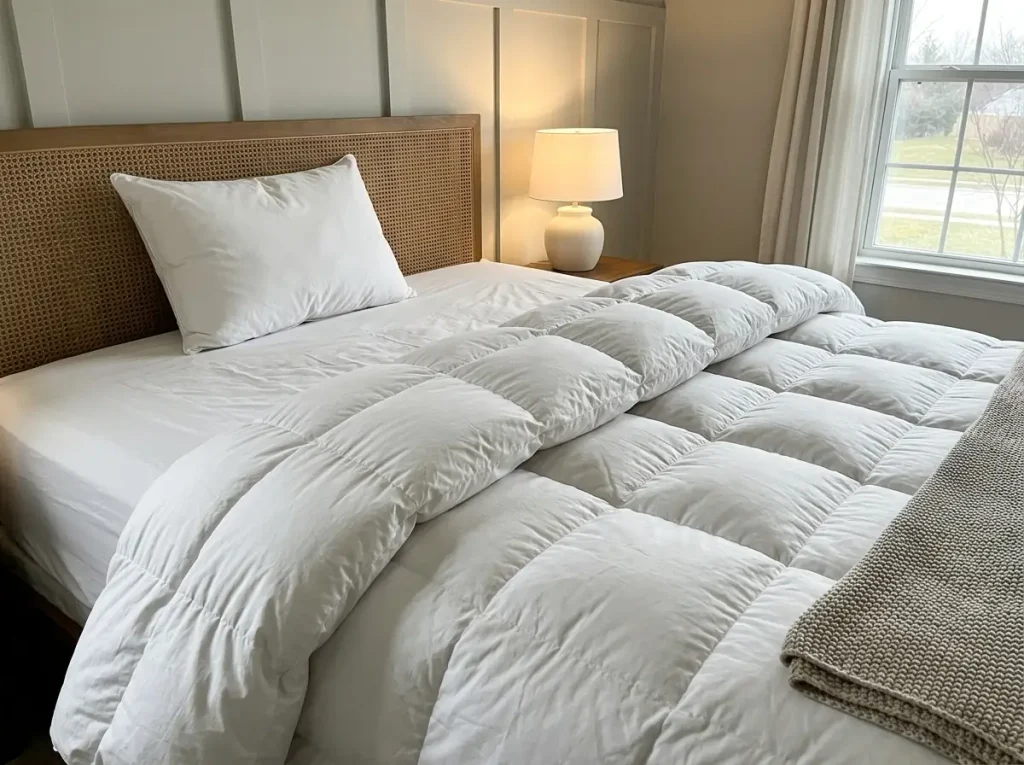
A comforter runs 10–20 years in down, 5–10 in down-alternative. The fill is the whole story. Down is a three-dimensional structure that springs back open after being crushed, over and over, for decades; synthetic fill is a mat of fibers that compresses, tangles and stays tangled. That is why the puredown Goose Down Comforter is built as a 3D baffle box: walls of fabric sewn between the shell layers so the down has a chamber to re-loft into instead of sliding into the corners and leaving cold stripes. Fill power is the number that describes exactly that springiness, and at 800 it is high enough that the loft is the thing you are buying. Its flaw is a real one: it needs a cover. Used bare, sweat and skin oils soil it long before it fails structurally, which puts a ten-year insert on a two-year clock. If you want down against the cheap fill, and what each one does after a decade, that is its own article.
Pillows are judged by the fold test, not a calendar. Fold it in half. Let go. If it springs back open, keep it; if it lies there folded, it is done, whatever the receipt says. The test works regardless of fill, which is the reason it beats every year-range ever printed. The Canadian Down & Feather Co. Soft Support Microfiber Down Alternative Pillow states its fill type and its 260-thread-count cotton shell on the listing, which is the bar worth holding every pillow to. You cannot judge a clock on a label that will not say what is inside. Its flaw is written into the fill: down-alternative mats sooner than down, so this is the pillow most likely to fail the fold test first. For the full version, the fold test and how often pillows actually need replacing has it.
A mattress protector runs 1–3 years, and it is the one that fails silently. A cracked membrane gives no stain, no smell and no visible sign. It just stops working.
And the duvet cover is the fifth piece nobody counts, at 2–5 years, because it absorbs all the direct contact and all the wash load that the insert is spared. It is the sacrificial layer. That is a job, not a defect.
That last one explains the strangest thing about a well-run bed: an insert that has lived under a cover its whole life often needs washing only once or twice a year, so it can be structurally sound at year ten while the cover over it has been bought twice.
Write the month and year on the care label of each piece in laundry marker the day it goes on the bed. Not to replace it on a schedule, but so that in three years you are reading a date instead of guessing at one, and the pillows are always older than anybody guesses.
The Weakest Link Is Almost Never the Sheets
If the four clocks all run at different speeds, then the useful question is not which piece is oldest but which one has gone longest without attention. That is rarely the thing you strip off the bed every Sunday.
Inspection frequency tracks wash frequency, and nobody plans it that way. It just happens. Wash day is an inspection: you pull the fitted sheet off, you see the corner, you feel where the weave has gone thin, you notice the pilling on the side that gets slept on.
Nothing else on that bed gets looked at on any schedule at all. The insert goes into its cover and disappears for a year. The pillows go inside their pillowcases and are never seen out of them again. The protector lives under the fitted sheet, which means it is under two layers of things you do look at.
That protector is the piece most likely to be failing right now. Its actual job is a barrier, and the Asthma and Allergy Foundation of America rates zippered allergen-resistant covers as very effective at controlling dust-mite contact for households managing allergic reactions. Encasement is the mechanism there, not the terry face you can feel. When the membrane cracks, the terry face still looks new and feels new. Nothing tells you.
The Nestl Premium Cotton Terry Mattress Protector is built the way this piece should be built: a cotton terry face over a TPU backing, which is a breathable membrane rather than a vinyl sheet. The backing on a protector decides whether it breathes more than anything printed on the front.
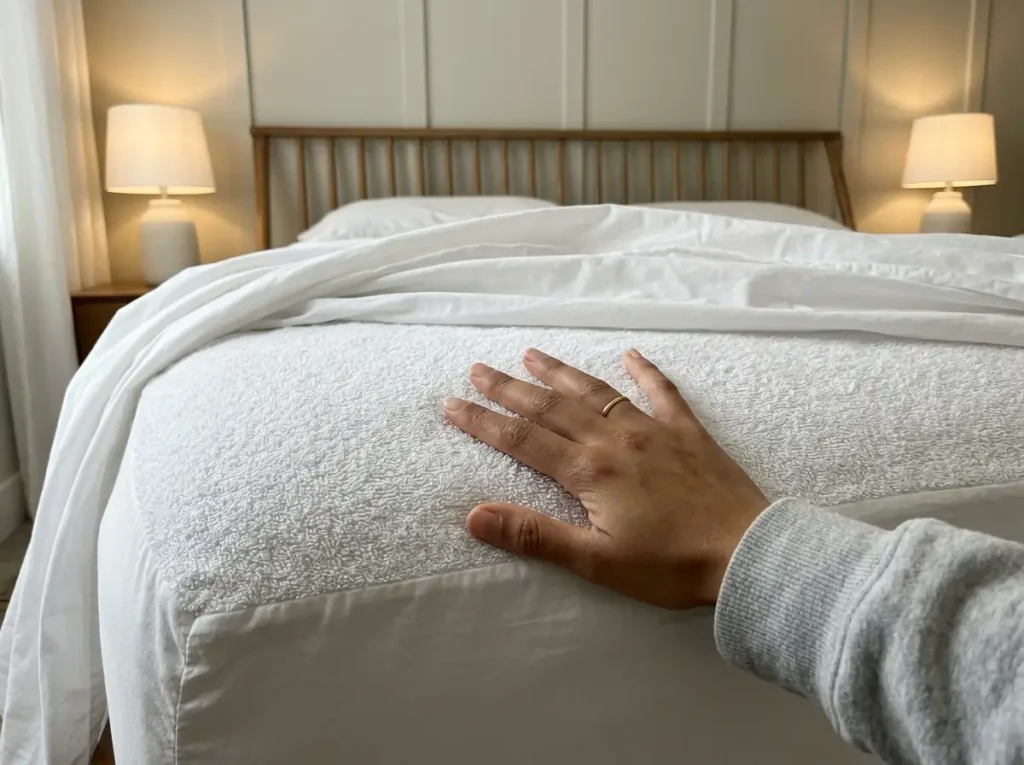
Its flaw is the flaw of the whole category: it fails silently, so this is the one piece you check by hand rather than by eye. Run a flat palm slowly across it. A membrane that has gone brittle crackles like paper under the terry instead of giving with it.
Here is what the gap between advice and reality looks like from behind a counter. A mattress-store employee, u/BridgesAreBurning, put it plainly: “I think it’s recommended to replace them every couple of years but a lot of people I see have pillows in the 5-10 year old range.” The recommended number and the actual number are not the same number, and they never have been.
Protectors are stranger still, because they mostly do not wear out at all. They get ended. u/sarahbellah1 described it exactly: “I had the original for most of a decade before a run-in with my dryer melted the backing. They’re dryer safe but my dryer was melting lots of things for a while because I didn’t realize the lint trap tunnel needed to be vacuumed.”
A decade of quiet service, then one nameable event. That is the shape of most protector failures, and it is why nobody catches them on a calendar.
So the practical rule: age alone does not tell you which piece is due. Protection history does. The piece that has gone longest without a wash or without something between it and skin is the one asking, regardless of how new it is.
Two Clocks on the Same Piece: Structural and Hygienic
Everything so far has treated each piece as having one service life, which is convenient and slightly wrong. Every item on that bed is running two clocks at once, and passing one of them says nothing about the other.
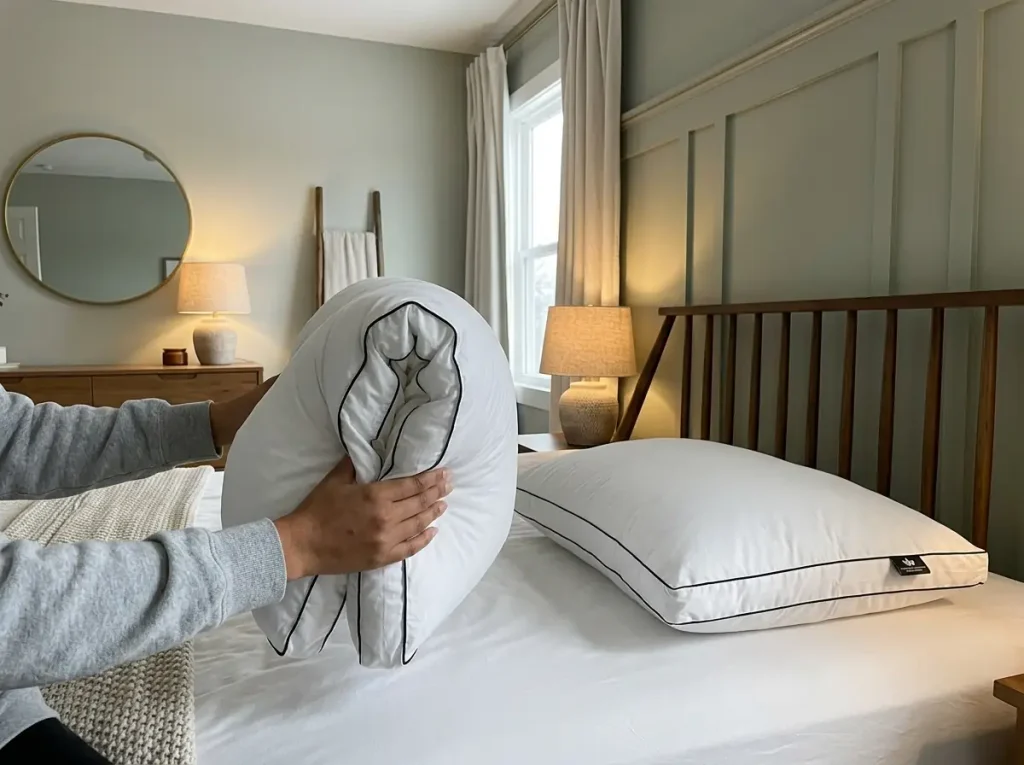
The structural clock is the one you can answer by looking and touching. On pillows it is the fold test. On cloth it is the two-of-four rule: thinning fabric you can see light through when you hold it to a window, a seam letting go or a hem starting to fray, pilling that comes back after every wash, elastic that no longer holds a corner. Any two of those four signs of structural wear and the piece is finished, whatever year it was bought.
Discoloration is the one sign on that list people over-read. A pillowcase that has gone dull, or a flat sheet with the yellowing that comes from body oils rather than from a spill, is telling you about the hygiene clock, not the structural one. It washes out or it does not, and either way the cloth underneath is as strong as it was last month.
The hygiene clock runs on wash frequency and on protection, and it is nearly invisible. It is built out of the things a bed collects every night without anybody noticing: skin cells, body oils, and the dust mites that live on the first two. Its one honest tell is an unusual smell that survives a wash, and by then it has been running a while.
AAFA notes that a two-year-old uncovered pillow can be roughly a tenth dust-mite debris by weight. Read that against the fold test and the whole point lands: a pillow can spring back perfectly and still be the dirtiest object in the room. Both facts are true on the same morning, about the same pillow.
Which brings the useful asymmetry. A duvet cover or a protector resets the hygiene clock without touching the structural one, and that is why a cheap washable layer buys years on an expensive unwashable piece.
The community says it better than the industry does. u/coffeeandapieceofpie, top comment in its thread with 38 upvotes: “Mattress protector, because it’s easier to wash the mattress protector than the mattress.” That single sentence is the entire logic of this article. u/Accomplished_Age2480 put the same idea as a flat verdict: “A mattress protector (not mattress pad) is the only real way to save the life of the mattress.”
So here is the shared method, and it works on all four pieces, plus the mattress topper if you have one.
First: can you see light through it, has a seam gone, does a corner still hold? That is structural, and structural failure means replace. Second: when was it last washed, and has anything been between it and skin since? That is hygienic, and hygienic failure means wash it or add a layer.
Third, and this is the one people get backwards, if a piece fails the first question no amount of the second saves it. A spotless worn-through sheet is still a worn-through sheet. This is also why a replacement schedule written in years is the wrong tool: two questions asked of the actual object beat any date you could have written down in advance.
One detail that only shows up on a shared bed: run the fold test on both pillows at once rather than one at a time. One side almost always fails a full year before the other, because one of you sleeps on your side and the other flattens the thing under an arm all night. Comparing them side by side is the only way to notice that the two halves of a “pair” stopped matching a long time ago.
Do the light test at the corner, not in the middle. Hold the fitted sheet up to a window where the elastic meets the hem. That panel takes the stretch of every remake and thins there first, so it shows you the failure a season before the flat center does.
What Actually Buys Another Season
None of this is an argument for replacing more often. It is an argument for knowing which piece is asking, and three of the four respond to something that costs nothing at all.
Free first, and it is the one that moves the most: keep multiple sheet sets in rotation instead of running one into the ground. The wash count per set halves, both sets outlast a single set used continuously, and you have never bought anything you would not have bought anyway. You have only changed when. How many sets you actually need, season by season covers the count.
Two more that cost nothing. Flip and rotate pillows the way you would a mattress, so the same spot is not taking the head every night. And go gentler on the dryer than you think you need to: tumble dry low, or line drying when the weather allows it, because heat is what cooks the elastic in a fitted sheet long before the woven panel gives out.
The cheap move comes straight from the community. u/FinalBlackberry: “Every few years if I like the pillow. I keep pillow protectors on them and fluff them in the dryer with wool balls every so often.” A protector plus periodic re-fluffing defers the replacement without deferring the maintenance, which is the only honest way to defer anything.
On wash temperature, there is a real number and it is worth having. AAFA’s guidance is washing bedding at 130°F or hotter, weekly, followed by a hot dryer cycle. That is the actual figure behind “hot wash,” not whatever your machine’s dial happens to call hot.
Check the care instructions first, though. Not every fiber will take 130°F without shrinking or losing its finish, and when the label and the guidance disagree, the label wins. That is the trade: the hottest wash a piece can survive, not the hottest wash a mite cannot.
Storage is a clock too, and it is the one people forget entirely. The off-season piece needs to breathe, and a sealed plastic bin traps whatever residual moisture was in the fill on the day you put it away, then holds it against that fill for six months.
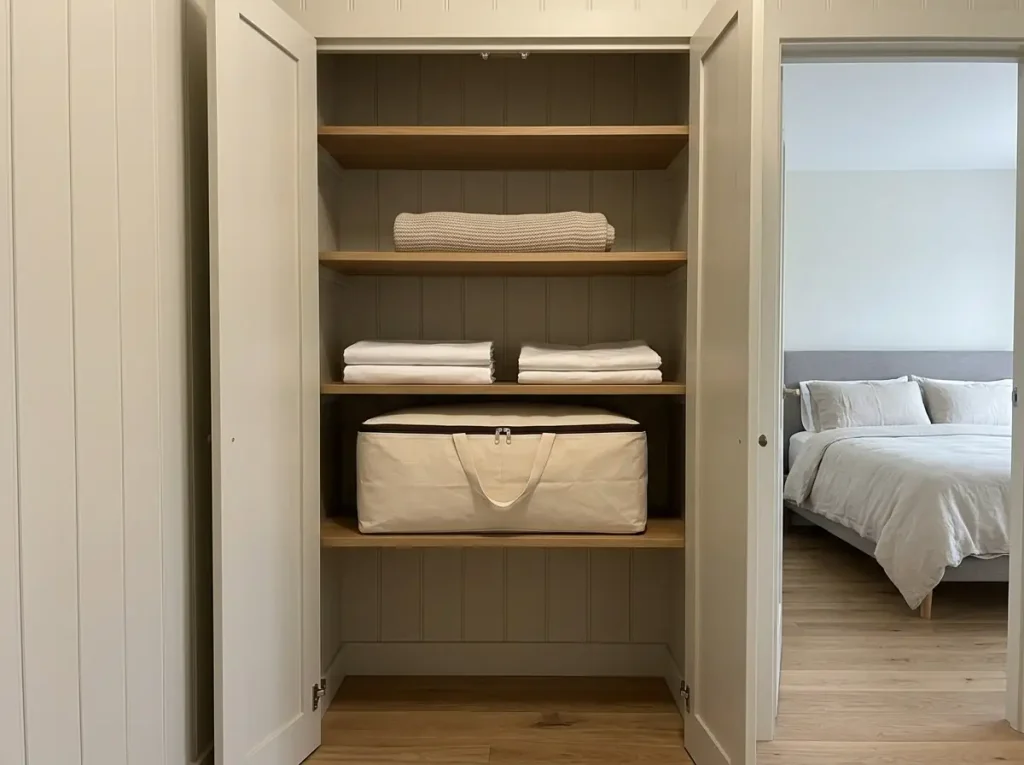
What that piece wants instead is a breathable storage bag. The 2 Pack Cotton Storage Bags for Duvets, Blankets are 10oz cotton canvas with a three-zipper closure, which is the whole spec that matters here: the canvas exchanges air, so the fill dries rather than sits. The flaw is worth stating plainly. It does not forgive putting something away damp, because canvas breathes, it does not dry anything for you.
And you will know if you got that wrong. A comforter stored slightly damp comes out the following season smelling faintly of the cupboard rather than of nothing, and that smell is in the fill, not the cover. Washing the cover will not shift it.
Then the honest part. The verdict on any of these pieces is at wash twenty, not week one, because almost everything feels good after the first wash. The finish is still on it in week one. By wash twenty the finish is gone and you are sleeping on the actual fabric, which is the only thing that was ever going to matter.
Some clocks are set by the fiber rather than by the format, and those are somebody else’s article. Linen runs on its own clock, set by GSM. What you give up with microfiber is durability traded against feel. And percale outlasts sateen, and the weave is why.
Air the off-season comforter on the bed for a full day before it goes into storage, even if it came straight out of the dryer. A dryer gets the shell dry well before the core of the fill is, and that gap of residual moisture is the whole reason a stored comforter comes out smelling of the closet.
Conclusion
Stop dating the set from the receipt. Date each piece from its last wash and its last honest look, because those are the two events that actually age anything on that bed.
Check the piece you never see first: the protector, then the pillows. The sheets get inspected by default every time you strip the bed, so they are the one thing that will not surprise you.
And when you are unsure about any piece at all, run the two questions: can you see light through it, and when did anything last come between it and skin. The first kind of failure is final. The second is a wash.
The wash-twenty check: after a season of laundry, hold the fitted sheet up to a window at the corner where the elastic meets the hem. That panel thins first, and it thins before anything else on the set gives you a reason to go looking.
Pull the fitted sheet off tonight and put a flat hand on the protector underneath. That is the whole audit, and it costs nothing.
Frequently Asked Questions
01How often are you supposed to replace your bed sheets?
Every 1–2 years for budget cotton and poly blends, and 3–5 years for good long-staple cotton. The wash count decides it, not the date on the receipt. A set washed weekly ages roughly twice as fast as one in a two-set rotation.
02When should you throw away bed sheets?
When you can see light through a thinned panel, a seam has gone, or the fitted corner no longer holds. Pilling and fading on their own are cosmetic, not structural, and a faded sheet with sound corners has years left.
03How many years should you keep a comforter?
A down insert lasts 10–20 years and a down-alternative 5–10. The fill decides it: down re-lofts after being compressed, synthetic fill mats and does not recover. Keep either one under a cover and it reaches the top of its range.
04How long is too long without washing sheets?
About two weeks is the outer limit for sheets in regular use, and weekly is the standard. AAFA’s guidance for households managing dust-mite allergies is weekly at 130°F or hotter, followed by a hot dryer cycle, where the care label allows it.
05Do you have to replace a whole bedding set at once?
No, and replacing a full bedding set together throws away pieces with years of service left in them. The four pieces run on different clocks, so replace whichever one fails its own structural check and leave the rest on the bed.





Tried it on your own bed?
No comments yet. Tell us what you changed, and what the sheet did after a few washes.