


What’s in here8 sections
- What a Pillow Does to the Neck While You Sleep
- Where the Ache Sits Tells You Which One to Check
- How the Pillow Reaches Your Back Depends on How You Lie
- Free Changes Come Before Any Purchase
- A New Shape Feels Wrong First: The Clock
- Where the Bedding Stops and a Doctor Starts
- Tonight’s One Swap and the Month-Three Gap Check
- Frequently Asked Questions
You sit up with a stiff neck and a dull ache spread across the shoulder blades, and the pillow is the first thing your eyes land on. So, can a pillow cause back pain? It can, in one particular way: a pillow fixes the head at a single angle for hours while the muscles of the neck keep working to hold it there, and a few centimeters of loft change how hard they work.
This article reads the ache by where it sits, sorts pillow from mattress, and says where the bed stops. If the pillow turns out to be the suspect, you can set up a pillow by loft and gap from there.
Quick Answer
Yes. A pillow can contribute to pain, mostly in the neck and upper back, because it holds the head at one angle for hours. It reaches the low back only indirectly, and it is rarely the only cause, so check the mattress and your sleep position before blaming the pillow alone.
What a Pillow Does to the Neck While You Sleep
The answer starts above the shoulders, not in the low back, so it helps to know what a pillow holds and for how long before you try to read any ache.

The angle your head holds for hours
A pillow is a gap-filler. On your back it fills the space between the back of the head and the mattress; on your side it fills the much larger space between ear and mattress, a gap set by the width of your shoulder. Whatever angle the pillow chooses, the head stays there for hours, and the neck and shoulder muscles never fully rest while they hold it.
A 2021 review of pillow height research says that a lack of head and neck support may alter the alignment of the cervical spine and bring a sore neck, an ache between the shoulder blades and morning stiffness. In other words, neck alignment is the pillow’s job whether you notice it or not. It also reports, citing earlier studies, that pain and discomfort go with higher and longer electrical activity in the neck and shoulder muscles. Both findings point the same way: the pillow’s reach is the upper back and neck first (upper back pain is its usual signature), and lower back pain only by a longer route.
Too high, too flat, too soft, too worn
A pillow fails in four ways, and each one hands the neck a different job. Too high pushes the chin toward the chest and keeps the neck bent all night (the height mechanics, and how a new pillow settles, are covered in when a pillow is too thick).
Too flat lets the head tilt toward the mattress, and sometimes the answer is to fold it before you replace it. Too soft sinks under the weight of the head and stops holding anything, so the gap closes anyway. Too worn has lost its fill, and from the sleeper’s side it behaves like the soft one with a lumpy surface. A label such as cervical, orthopedic or contour names a shape, and the shape still has to be checked against your own gap.
Some sleepers describe the first of these: a pillow that is a bit fluffy, neck and back pain, and a switch to a thin memory foam one, or to no pillow at all. Same pillow problem, the opposite direction of the fix.
Why nobody can hand you one correct height
The research on height is smaller than the confidence around it. The 2021 review is plain about it: “Many hypotheses have been proposed regarding the optimal pillow height, but there are still no firm conclusions.” It adds that most height studies lean on comfort ratings, and comfort shifts with age, gender and individual perception. A feeling makes weak evidence for what a neck needs.
The one number that travels, 10 cm, comes from a 2015 study in the Korean Journal of Spine. It measured 16 healthy adults aged 20 to 30, lying on their backs, with the pillow raised from none to 10 cm to 20 cm; the measured curve of the neck increased with each step, and the authors recommended 10 cm. That is their number for that group in that position. It says nothing about a side sleeper, whose gap is set by shoulder width, and nothing about a shoulder wider than average.
So the test that holds up is a measured gap, not a figure from a study or a label. A pillow can feel perfect propped up reading and be wrong lying down, because the shoulder only joins the equation once you lie on it. The pillow’s job is to fill the distance between ear and mattress and leave the neck in line with the rest of you, and only your shoulder knows how big that distance is.
Judge a pillow lying down in the position you actually sleep in, never propped up. Ask someone to take a photo from behind with your head on it: the line from ear to shoulder shows a gap that your own feel will not.
Where the Ache Sits Tells You Which One to Check
Knowing that a pillow can hurt does not tell you whether yours does, and reading the ache by its location sorts most of it before anything is bought.

Neck and upper back, worst when you wake
The pillow’s territory is the neck, the top of the shoulders and the stretch between the shoulder blades, and it is loudest on waking, after hours at the same angle. Pain tends to follow a location: the neck and upper back are more likely to be affected by a pillow, though the lower back can be affected too in some cases. That is a pattern, not a diagnosis, but it matches where the 2021 review places the pillow’s effects. If your ache sits up there and the pillow is old, overfull or sized for a different shoulder, the pillow goes first on the list.
Low back that follows the mattress or the side you lie on
The pillow, the mattress or both can be to blame, but back pain, as opposed to head and neck pain, points toward the mattress. Lower back pain that is there whichever pillow you use, or that changes with the side you lie on, points at what is under you rather than what is under your head.
A third poster shows how easily the pillow gets blamed by mistake. Their mattress was two months old and sat on a 20-year-old box spring; with the mattress on the floor they could feel the support improve, and they still woke with a sore back. The foundation, its age and what the mattress rests on belong on the suspect list before the pillow does. And since a pillow reaches the low back only indirectly (the next section covers that route), a low-back ache with a comfortable neck points away from the pillow first.
A free swap that tells you more than a purchase
The self-check is simple: sleep a few nights on a different pillow, or on a different bed in the house, and watch whether the ache moves. The ache that moves when the pillow changes is the pillow’s; the one that is still there on a different pillow in the same bed is the bed’s. The swap is the only way to tell them apart, which is why it comes before any purchase. If it moves with the pillow, the loft-and-gap setup is where to start.
Change one thing per swap. A different pillow and a flipped mattress in the same night leave you with a result and no idea which change produced it. Keep everything else exactly as it was, and write down where the ache sat each morning.
How the Pillow Reaches Your Back Depends on How You Lie
Between the head pillow and the low back sit the knees and the pelvis, and that route runs differently on your back, on your side and on your stomach.
On your back: the knees are the route
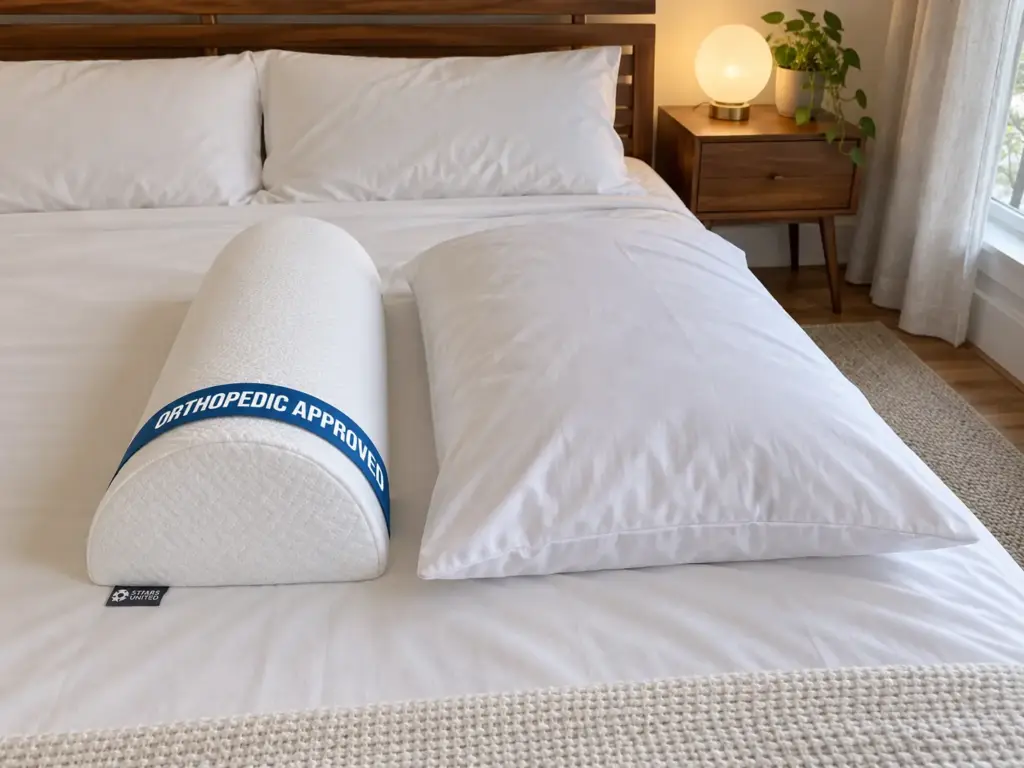
A bolster under the knees is a common practice for back sleepers who feel it in the low back. The reasoning offered is that it changes how the knees and pelvis sit, but that mechanism is habit rather than a settled finding, so read it as something people do, not as something that relieves pain. A rolled towel or a spare pillow under the knees tests the idea for nothing before you buy a bolster.
If you want the purpose-made shape, the 5 STARS UNITED knee pillow is a half-moon bolster that slides under the knees while you lie on your back. What it cannot offer is proof: no controlled trial turned up for the knee route, so it earns its place as a bedding layer to try, never as a treatment. Choosing the pillow for your head in this position is a separate job, covered in pillows for back sleepers.
On your side: the same route, a different place
Side sleepers use the same idea in a different place, a pillow between the knees. It is named here as a practice, not recommended as a product, because the reasoning behind it is the same borrowed one. What side sleeping does demand is the most from the head pillow, since the gap from ear to mattress is the width of your shoulder, a much bigger distance than a back sleeper ever has to fill.
On your stomach: the neck twist comes first
On the stomach the head is turned sideways for hours, so the neck is the first to complain, well ahead of the back. A tall pillow also tips the head up and back, which is the opposite job from the one it does for a back sleeper: the same pillow does opposite things in opposite positions. For many stomach sleepers the best pillow is a thin one or none, which matches the advice given earlier.
If you want a thin one, the BLISSBURY stomach sleeper pillow is flat memory foam at 2.6 inches, the thinnest of the pair here. A pillow this thin fills a narrow gap, so if you roll onto your side at some point in the night, a wide shoulder leaves the head short of support. That is the trade, and it is yours to weigh against how much you actually stay on your stomach.
When the shoulder is wider, the Bluewave Ultra Slim gel memory foam pillow runs 2.75 inches, a hair taller. That extra 0.15 inch is a small step, not a promise, so let the width of your shoulder pick between them. Neither is a treatment; each is only a lower pillow for a head that was riding too high. The buying side of this position lives in pillows for stomach sleepers.
Free Changes Come Before Any Purchase
The last section ended on things to buy, but the swap, the fold and the mattress check settle more than a second pillow does, and they cost nothing.

Rule out the bed first
Look under the pillow before you look at the pillow: the mattress, the foundation, how old the box spring is. Putting the mattress on the floor for a night is a test of the bed rather than a fix, but it tells you whether the support underneath is the problem. A new mattress also changes the pillow. One that was fine on a thinner old mattress sits too high after the mattress is replaced, because the gap between ear and mattress changed, not only the comfort.
After any mattress change, retest the pillow from scratch. The height you were used to was set against the old surface, and a firmer or thicker mattress raises the whole sleeper, which shrinks the gap the pillow has to fill.
Fold, stack and swap what you already own
A flat pillow can be folded to find the height that feels right, and two thin ones stacked do the same job; an overfull one can lose a handful of fill. Try those first, and borrow a pillow from another bed in the house for a few nights. If a purchase does turn out to be needed, plan the return before you order, because what a return can’t test matters: a return window covers a pillow that arrived wrong, and says nothing about whether the height was.
A New Shape Feels Wrong First: The Clock
When a pillow is swapped or reshaped, the first nights feel wrong whether the change was right or not, so this section gives you a clock for telling adjustment from a pillow that is not working.

Adjusting to a new shape
A new shape asks the neck to hold a different angle, and the first nights feel unfamiliar either way. No study has put a number on how many nights that takes, so you get a way to judge instead of a count. Discomfort that eases while the gap stays the same is adjustment. Discomfort that does not change, or that moves with the pillow, is information about the pillow.
Judge it over weeks, not by the first night. The outer limit of the clock is counted in weeks, and the last section says where it ends. In between, watch the fill. Fill that settles in the first week is not a flaw; fill that is flat again after a month is.
Test a height without buying a second pillow
An adjustable fill lets you try heights on one pillow: take fill out, keep it, put it back. The Coop Home Goods Original Adjustable Pillow, Queen is cross-cut memory foam and microfiber at 20 x 30 inches, with extra fill included, so you can remove some to lower the loft and add it back if you went too far. It is the one fill here you can measure and change month to month.
The limit is that the height still gets set by feel, and the 2021 review calls feel weak evidence. So set it by the gap between ear and mattress in your usual position, not by how it feels sitting up. A height you tuned is only worth tuning if it holds, which is why fill that holds its height is worth comparing before you commit to one.
Change the fill in small handfuls and give each change several nights before the next. Take out too much at once and you lose the reference point, so you cannot tell whether the last change helped or the one before it.
Where the Bedding Stops and a Doctor Starts
The pillow, the mattress and the position are the parts of this that can be changed at home, and some of what hurts is not theirs.

Pain that does not change when the pillow or the bed changes, that comes with headache, weakness, numbness or tingling, or that outlasts the free changes above, is a question for a doctor, whatever the pillow is doing. Mayo Clinic’s neck pain guide puts the clock in a single line: “Persists after several weeks of self-care.” This article does not say what the pain is, or whether a pillow can treat it. It only sorts what the bed can change.
One more bedding-side fact is useful to carry into that appointment: a pain that follows you from your own bed to a hotel bed or a guest room is not the bedding’s. Until you are seen, the free changes stay worth doing, since they cost nothing and tell you something either way.
Tonight’s One Swap and the Month-Three Gap Check
Three things to keep. A pillow can contribute to pain, mostly in the neck and upper back, through the angle it holds for hours. Where the ache sits, and whether it moves when the pillow changes, sorts pillow from mattress better than any label does. And the free changes come first: a swap, a fold, a look at what the pillow rests on.
For later, once the pillow has been on the bed for a few months, lie in your usual position and look at the gap between ear and mattress again. If it matches the gap you set in the first week, the fill is holding; if you have been bunching the pillow up each night to get that gap back, the fill is done and pillow replacement is next.
For tonight, sleep on a different pillow from another bed in the house and leave everything else as it is. In the morning, skip the question of whether the night felt perfect and notice one thing: whether the ache sits in the same place it did before.
Frequently Asked Questions
01How do I know if my pillow is causing back pain?
Watch where the ache sits and whether it moves with the pillow: neck and upper back point to the pillow, while low back that stays put points to the bed. Sleep a few nights on a different pillow, or a different bed, and see which way it goes.
02Is sleeping without a pillow better for back pain?
Nothing shows that sleeping without a pillow is better, and the research on pillow height has no firm conclusions either way. A thin pillow or none is common practice for some stomach sleepers; back and side sleepers still have a gap to fill, and shoulder width sets it.
03Can the wrong pillow cause back pain?
Yes, the wrong pillow can contribute, mostly to neck and upper-back pain, and to the low back only indirectly through the knees and pelvis. It is rarely the only cause, so check the mattress and your sleep position as well.
04How long should a new pillow take to feel right?
No study gives a count of nights, so judge a new pillow by whether the gap holds and the ache changes over weeks, not by the first night. Fill that settles in the first week is normal; fill that is flat again after a month is not.





Tried it on your own bed?
No comments yet. Tell us what you changed, and what the sheet did after a few washes.