

What’s in here7 sections
- Foam or Latex: What the Core Does With Heat
- The Latex Route, and What It Leaves Open
- The Layers Above the Topper Count Too
- Gel and Cooling Infusions Offset Heat, They Don’t Remove It
- Testing Heat Without a Lab, and When It Isn’t the Bed
- Change the Layer Above the Topper First, Then Run the Swap
- Frequently Asked Questions
You get out of bed with your back feeling held, which is what the thick block on the mattress was bought for, and then your palm lands on the bottom sheet and it is warm in the exact outline of where you lay. A topper for back pain without heat has to avoid that pairing, and the box is no help, because it answers the heat question with a single word. A topper is a thick block between you and the mattress, and how much warmth it keeps is set by the block’s structure, by its cover, and by everything you stack above it. Below you get what the core does with heat, the latex route and what it leaves open, the layers above the topper, how far a gel infusion goes, and one test that fits inside three nights.
Quick Answer
Yes, a topper can hold your back without sleeping hot. Three layers set the heat: the core (dense memory foam keeps warmth, latex and open-cell foam let air through), the cover, and what sits above the topper. The word cooling on the box settles none of them, so change the protector and the fitted sheet first.
Foam or Latex: What the Core Does With Heat
Which topper holds a back comes down to density, not firmness, and that rule stays in force here. What it leaves out is that density cuts both ways. The packed foam that keeps your hips from sinking also fits closer to you, and a close fit leaves less room for air, which is where a dense topper’s heat retention comes from. A hot sleeper with a sore back is therefore choosing between two good properties of the same block, and the place to see the trade is the core, before the cover or the label gets a vote.
Why dense foam holds the warmth you give it
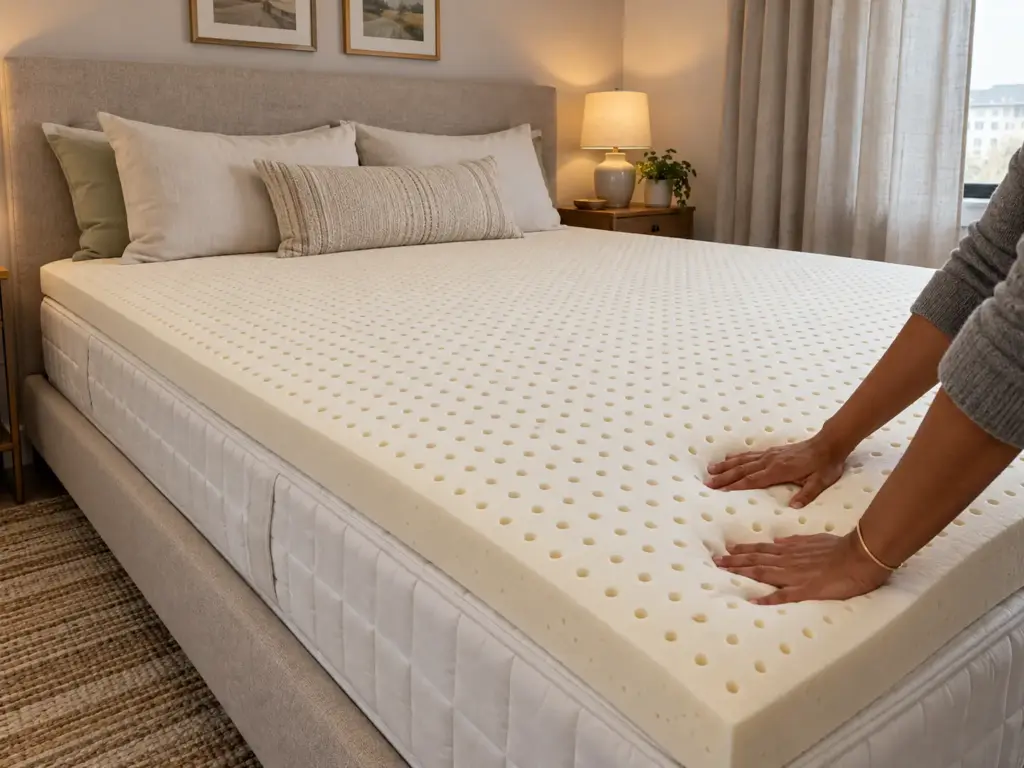
Memory foam is made to soften as it warms and to close around whatever presses on it. That is the feature a back sleeper is paying for, since a block that closes around the hips gives pressure relief by spreading the load instead of letting the heaviest part of the frame drop through. It is also the mechanism of the heat. More of you touches foam, foam is a poor conductor, and the warmth you give it has few ways to leave, so the block traps heat and the heat buildup shows in the second half of the night. It sits in the block, and the block hands it back. More density means more material and less open space per cubic inch, so the effect is strongest in the toppers that hold a back best.
Latex is something you sleep on, and memory foam is something you sleep in: it wraps around you as you sink into it. Sinking in is the comfort and the heat in one move.
None of this is a measurement taken on a particular topper; it is how the material is built, and it predicts a verdict you can check. The first minute on a fresh block feels cool because the block is at room temperature and has taken nothing from you yet. The verdict arrives later in the night, once it has absorbed what you gave it, which is why a topper that feels cool when you lie down tells you very little.
When you get up, rest the back of your hand on the spot where your hips lay, then on the far edge of the topper where nobody slept, then on the bottom sheet over the same spot. The gap between the first two is the warmth the block kept. If the sheet is the warm one and the block is not, the heat is stopping in the layers above the core.
Open cells and latex: where the air goes
Air leaves a bed two ways, through the material or around it. Foams with a more open-cell structure, where the cell walls are thin or broken so air can pass from one cell to the next, let some through when you press on them, and a block that pushes back instead of wrapping gives the air more edges to escape along. Latex goes a step further in many toppers: it is poured and cured as a block with rows of holes through it, so there are channels besides the rubber itself. The two common processes, Dunlop and Talalay, differ in density and in how hard the block pushes back, and if a listing does not say which one it is, you are guessing.
That is the structure. The evidence is thinner than the structure suggests. Some people who switch from memory foam to latex say the bed feels much cooler, though the room was warm at the time, and a warm room changes any comparison. A room that warm cannot separate the foam from the air around it, so the change could be the latex, the weather, or both.
“Latex sleeps cooler” is easy to repeat, and a lead is all that comment supports. Some sleepers run memory foam on top of latex and do not sleep hot, but that is one bed, with no measurement, and the reverse order has not been checked. It is still worth keeping, because it points at what the later sections turn on: the order of the layers matters as much as the layers.
What the standard measures, and what it leaves out
If you go looking for a number, the foam industry’s reference is a set of test methods. According to the ASTM foam standard, D3574, “These test methods apply to slab, bonded, and molded flexible cellular products known as urethane foams.” Two things follow from that sentence. A figure quoted from the standard speaks about polyurethane foam, and latex is not named in it, so it says nothing about how a latex topper breathes.
And a lab method on a cut sample says nothing about a night on your mattress, under your sheets, in your room, because a cut sample has no sheet over it and no sleeper turning on it. The four toppers in this article print no figure from a test like that. What their listings print are sentences, and sentences are the next thing to read.
The free change to try before you buy a second topper
Before a second topper goes in the cart, look at what is above the one you own. The protector, the fitted sheet and the cover are cheaper to change than a 4-inch block, and on a hot bed they are very often where the warmth stops. That stack gets its own section below, and the changes in it cost nothing. Do those first, and use the rest of this section to know what to ask of a core if you still want a different one afterward.
The Latex Route, and What It Leaves Open
If the core is the problem, the other core is latex. The straight answer about the two latex toppers here is that almost no buyer evidence sits behind their heat claims, so what follows is a structure, two labels and a lot of blank space, and the sensible way to use it is as the first half of a test.
What a latex topper is, and why people pick it for heat
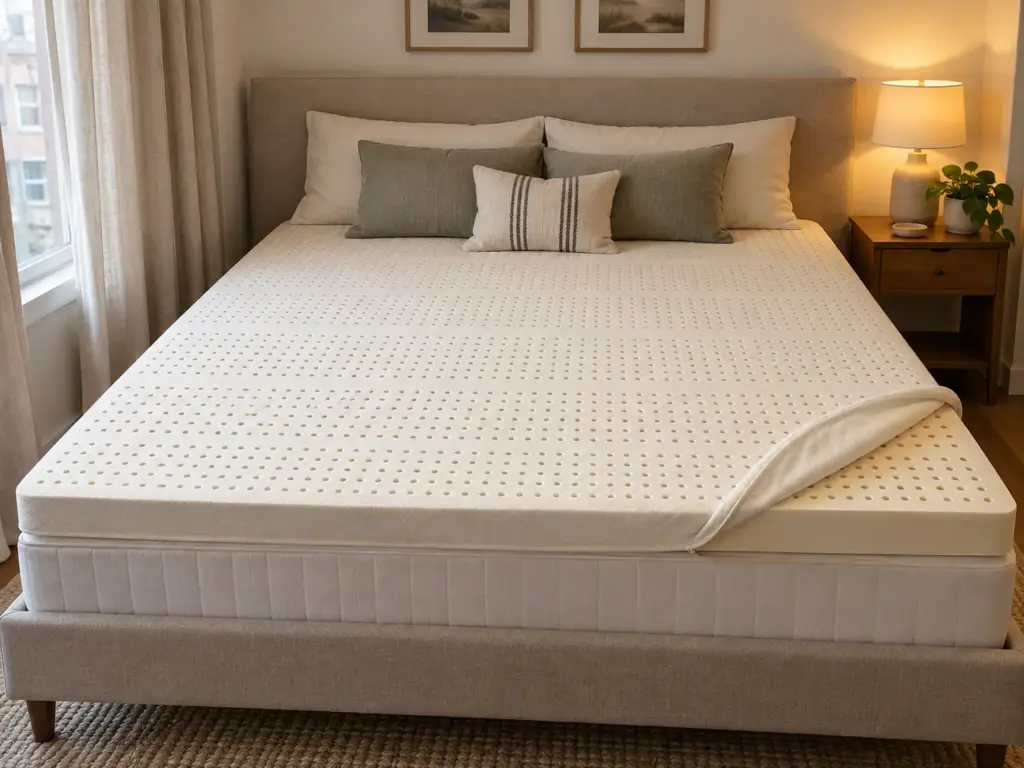
A latex topper is a slab of rubber-tree latex, molded and cured into a springy block. It is heavy, it pushes back where memory foam gives way, and many are perforated. People reach for it when a foam topper sleeps hot because the structure promises two things memory foam does not: a surface you sit on instead of in, and channels for air. Natural latex also tends to be firm and resilient, which suits a back that wants a level surface.
The label side deserves a slower read. “100 percent natural latex” describes the material. “Cooling”, printed as a special feature on one of the listings, describes a hope: no mechanism follows it, no hole pattern, no density and no airflow figure. A word on a package is not a measurement, and with latex the structure is the claim, so the structure is what to ask about.
The pick with a thin file: ARyako
The ARyako topper is 4 inches of 100 percent natural latex in a firm feel, listed at 59 by 79 inches, with “Cooling” under special features and no reason given. Its file is thin: 3 ratings averaging 3.4 stars, and the only complaint with text is one 1-star review from November 2025 saying the topper is “not as thick as you are paying for in the description”. One reviewer, so it stands as one reviewer’s complaint and not as a trend.
It still matters for a reason beyond the stars. Thickness is the spec the rest of the stack is built around, the sheet pocket and the firmness among them, and a block that arrives thinner than listed moves every other number.
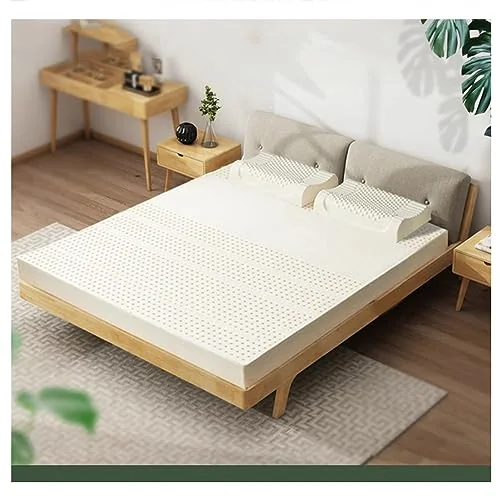
Nothing in that file speaks to heat, in either direction. What the listing gives you is a promising structure, a label that cannot be tested from the page, and a handful of buyers’ worth of evidence.
The budget latex, and the label that contradicts itself
The budget latex is the Queen 4 inch firm natural latex topper, the same class as the ARyako at 60 by 80 by 4 inches. Its listing describes “dense convection ventilation holes” meant to improve airflow and prints no hole pattern, no density and no airflow figure, which makes it a claim of the same kind as the Cooling label. It also contradicts itself on firmness: the title says Firm and the description says Medium-Firm, and those are two different beds, so which side of firm to try for your position and weight decides whether it suits you before heat even comes up. And it has no reviews at all, so whoever buys it is the first to report on it.
What no buyer has reported yet
Put the two latex listings side by side and the gap is plain. Neither has a buyer who says it slept cool, and neither has one who says it slept hot. The claim that latex sleeps cooler rests on how the material is built and on a few individual experiences in warm rooms, which is enough to try it and not enough to count on it.
If latex is where you are headed, buy it as one half of the test in the last section, with the room and the sheets held still, and decide after the nights. The free changes in the next section come first for exactly this reason: they cost nothing, and they tell you whether the core was ever the problem.
The Layers Above the Topper Count Too
A topper is one layer in a stack, and the layers above it (the protector, the fitted sheet, the cover) decide how much of what the core releases ever gets out. A topper is only as good as what it sits on, which means the mattress below. The same logic runs upward, and the changes up there are free.
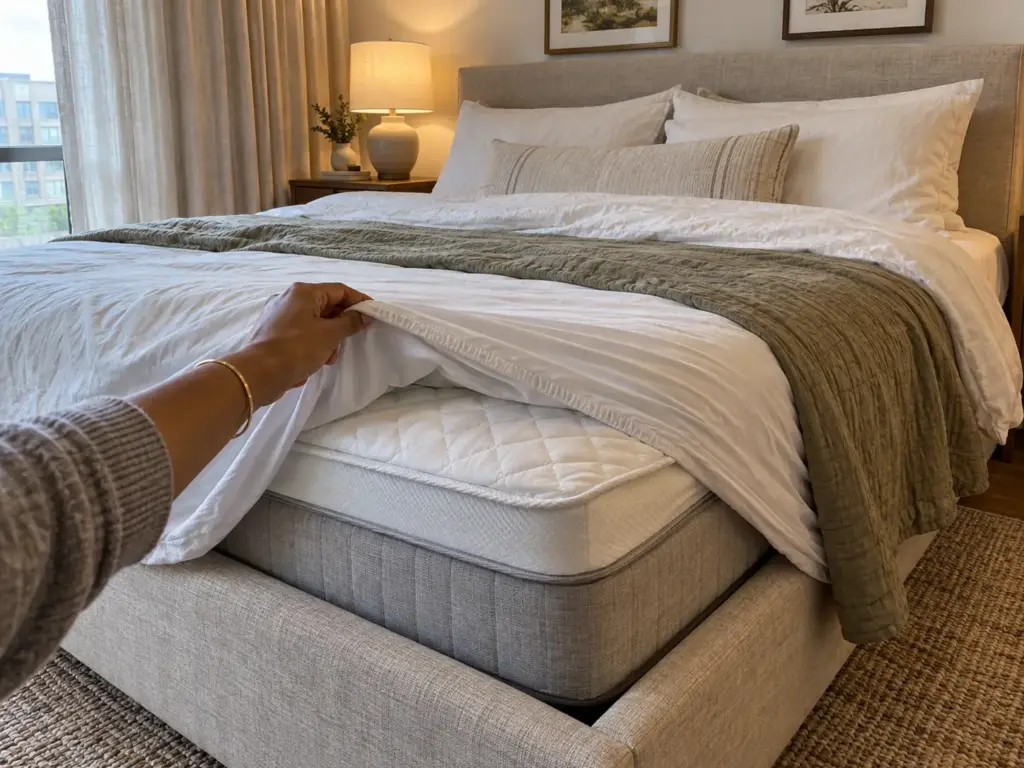
The protector backing: a layer that can seal what the core releases
A protector with a sealed backing can undo an open core. The foam or latex lets warmth and moisture move toward the surface, and if the next layer is a membrane that does not pass vapor, it stops there, directly under the sheet you lie on. The result is an open block under a closed lid. The protector backing that traps heat has its own article, and the short version of it is that the material of the backing decides whether vapor gets through.
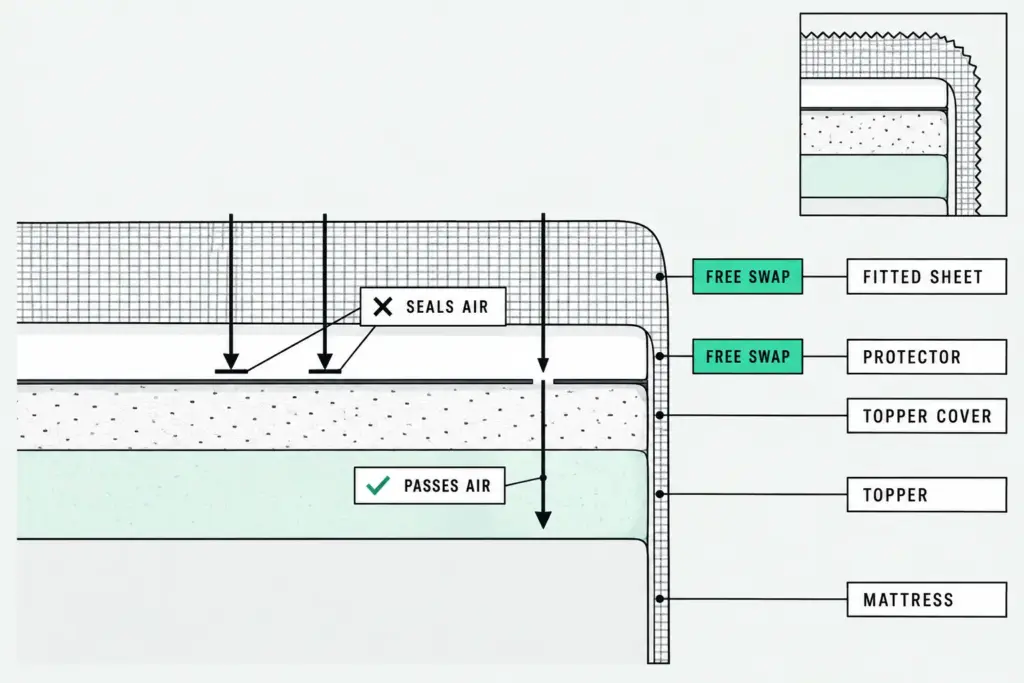
Where the protector sits matters before you swap anything. Over the topper, it is the first suspect. Under the topper, it shields the mattress and has no line to your sheet.
One buyer of a 3-inch gel foam topper, who calls it a mattress protector in the review, wrote, “I sure woke up hot although it said it was a cooling mattress protector.” The review does not say what else was on the bed, which is the point: a topper’s label and a topper’s stack never travel in the same sentence.
The free change is to take the protector off for a week, keep the same sheets, and note only the second half of the night. If that half changes, the protector was the layer, and the next move is a different backing, not a different topper. If nothing changes, put it back. A protector earns its place on a mattress you cannot replace, and nothing in this section argues for a bare bed forever.
The cover that comes with the topper
The cover is the thinnest layer in the stack and the one closest to your sheet. Whether the listing says breathable cover or cooling cover, there are three things to read on it: the fiber, how it is built, and whether it comes off. A cover that is mostly polyester moves moisture only as far as its knit lets it; cotton takes moisture in and gives it up slowly; a cover quilted with fill adds a layer of padding between you and the foam.
“Bamboo” on a cover label usually means viscose, a fiber spun from cellulose, and what matters is the percentage. A cover sold on “40 percent bamboo fiber” is 60 percent something else, and one gel foam topper has exactly that cover.
A removable, machine washable cover is a cover you can change when it ages, which is how a topper stays pleasant after the foam has settled. The cover is worth reading and rarely worth replacing. It is the protector and the sheet that give you something to change tonight.
The fitted sheet and the pocket that stretches over all of it
The fitted sheet is the layer on top of everything, and with a thick topper it is usually the one under tension. The buyer from the protector paragraph got a set of cotton sateen deep-pocket sheets over the mattress and the new topper, “but it sure would be nice to have a few extra inches to work with.” That is a sheet that fit, on the edge. A sheet pulled that tight flattens the cover beneath it and presses out the small amount of air a knit or quilted surface holds, so a cover that could pass air under a loose sheet behaves like a closed one under a stretched sheet.
This is a mechanism, not a measurement, and it takes thirty seconds to check on your own bed. Cooling sheets that still fit a thick bed covers the pocket numbers.
The second change is the weave. A plain-weave percale leaves small gaps between its threads for air, where a sateen is woven to lie dense and smooth, and a lighter fabric also weighs less on the cover below it. Choosing one by weave and weight, not thread count is the whole rule. And do not add a second mattress pad on top of the topper to fix the feel; it is one more layer holding warmth next to you.
Slide your flat hand between the fitted sheet and the topper cover at the middle of the bed. If your palm lifts the sheet with no effort, the sheet is resting on the cover. If the sheet is drum-tight and the corners are fighting to stay under, it is pressing the cover flat, and a deep pocket sheet is the fix.
Gel and Cooling Infusions Offset Heat, They Don’t Remove It
The foam toppers with gel, copper or graphite in them are the ones sold as cooling, and the people who bought them disagree about whether they are. That disagreement is more useful than either side of it.
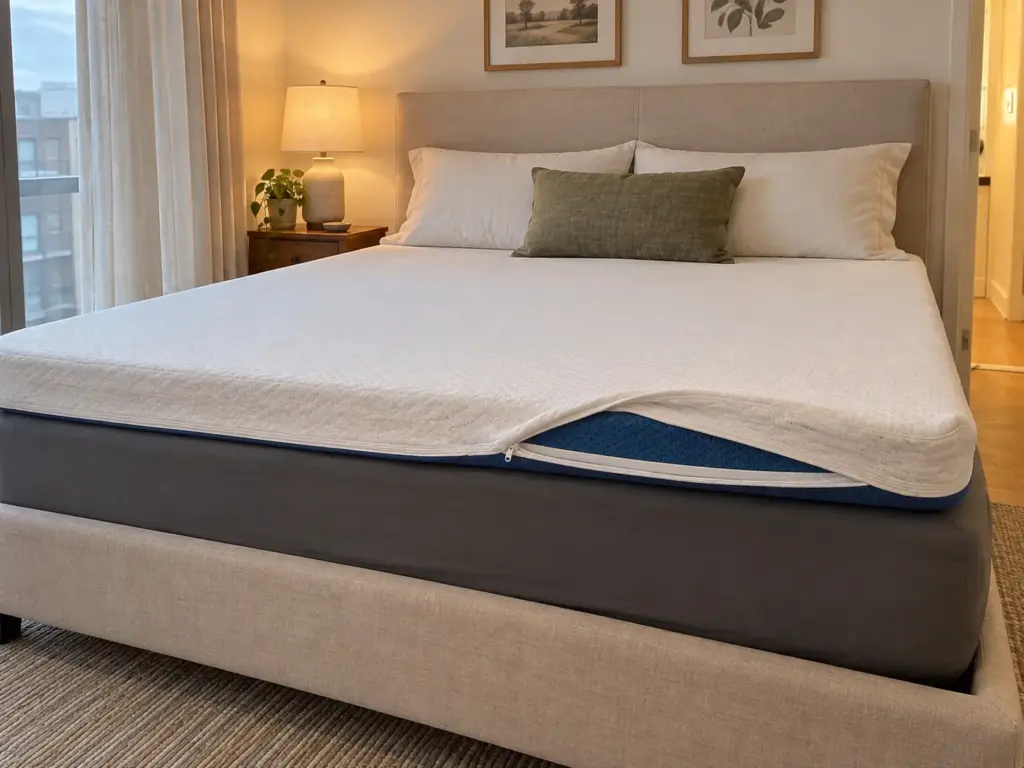
What an infusion changes and what it leaves in place
Gel, copper and graphite are additives: particles or swirls mixed into the foam, sold on the idea that they pull warmth away from the surface faster than plain foam does. Suppose that works at the surface. The block under it is still the same dense memory foam, with the same cells, the same density and the same close fit, so an infusion reads best as an offset on the core and not as a different core.
Where it would show is the first part of the night. Where it would run out is the second part, once the block has taken what you gave it, and that is where the buyers below split.
Two gel toppers, and the buyers who disagree about their heat
The Viscosoft topper is the gel foam with the biggest file here: 4.4 stars from over 15,000 ratings. It is a single 3-inch block of high-density memory foam (over 3 pounds per cubic foot, the seller’s number) with gel in it, a removable washable cover and a medium-firm feel. The listing says the foam “draws heat away” and “optimizes airflow”, which are the seller’s sentences with no figure behind them.
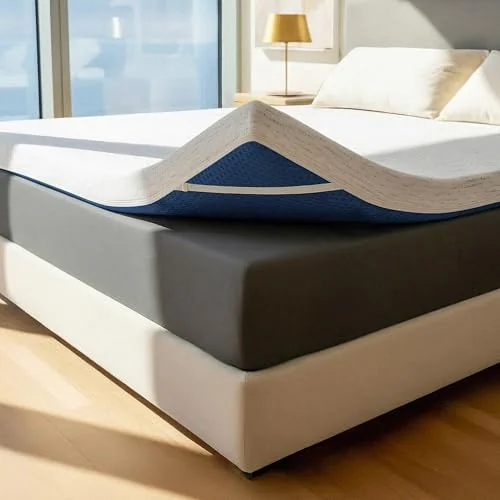
The heat lines deserve to be read whole. A King-size buyer in Canada gave it 3 stars in September 2026 and wrote that it “runs very hot! At first its cool then in middle of the night its like an oven.” That is the first-half, second-half pattern the infusion mechanism predicts.
A buyer using it on a hospital bed wrote, “Evidently the pad is not cooling”. On the other side, a 5-star reviewer who kept posting updates from 2017 to 2021 wrote that “it doesn’t sleep hot either like my Temperpedic Cloud does.” And an August 2026 buyer rated it 4 stars and declined to judge: “summer is here and quite muggy and everything is hot so it would be unfair to rate body heat from this pad just yet.” That reviewer’s other sleeper, at 200 pounds, found the topper cave in the middle.
Read side by side, the same gel foam is an oven for one buyer and not hot for another. Only one of them names the season, and none says what was under or over the topper, which is why the previous section matters: a topper’s heat cannot be read off a review that does not say what it was wearing. A 2-inch buyer wrote only “Somehow it feels cool”, a first-touch verdict, and first touch is the verdict the first minute always gives.
Before you trust a heat review, find two things in it: the month it was written and what else was on the bed. A July review from a muggy room is a report about July, and one buyer above said exactly that about their own.
The seller’s word versus the sheet over it
The cheaper gel foam is the VALUXE 3 Inch Gel Memory Foam Mattress Topper, rated 4.3 stars by 2,877 buyers, with a cover that is 40 percent bamboo fiber and 60 percent polyester. Read the fiber split first: the cover that carries the bamboo name is more than half polyester, and bamboo on a label usually means regenerated cellulose, not the plant. The listing promises “superior breathability”, a claim standing where a test should be.
Its buyers split the way the other gel foam’s did. A 1-star reviewer in September 2026 wrote, “As summer temperatures increased, I noticed this topper retained a tremendous amount of heat,” while a 5-star reviewer two weeks later wrote, “It is very breathable.” The buyer from the stack section woke up hot on the first night. And a 3-star reviewer on a soft base found it “not firm enough to support my body weight”, with “uncomfortable pressure points on my hips”, though it should be fine “on a FIRM base.”
What decides the night in either case is the layer touching you. The cover and the sheet are that layer, and the sheet touches you makes the case for the sheets themselves: the cool feel of a surface fades in seconds, and the fabric that stays against you through the night is what sets the second half. A seller’s word about the foam and a sheet pulled tight over it are two statements about the same bed, and only one of them is printed on the box.
Testing Heat Without a Lab, and When It Isn’t the Bed
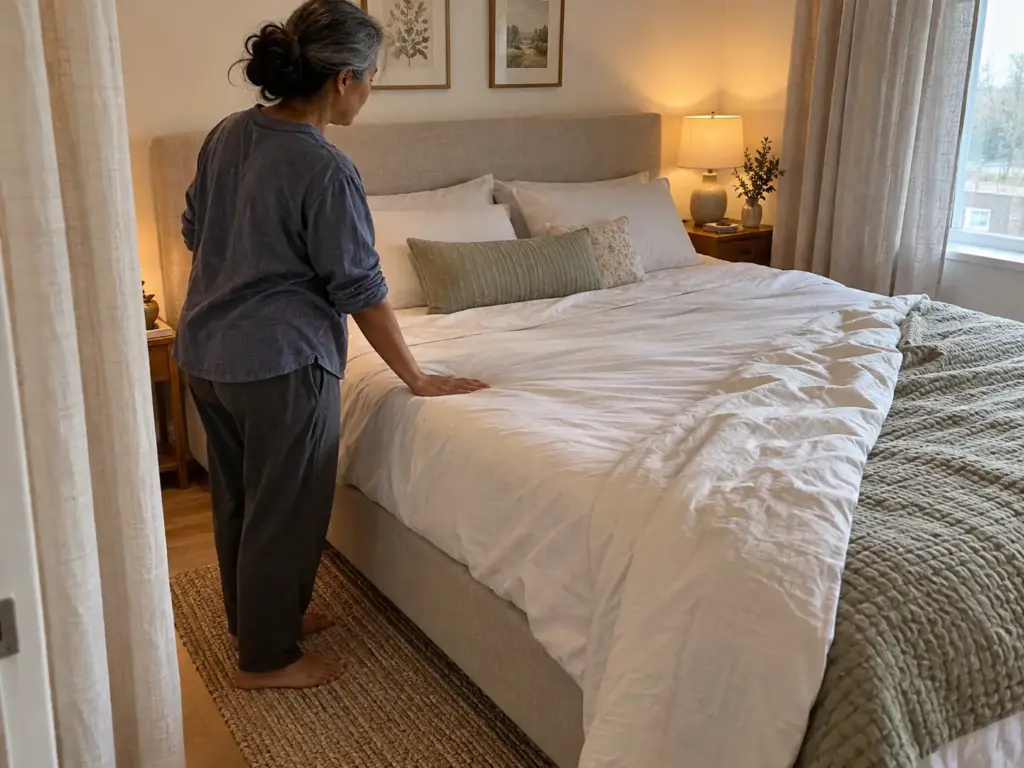
A heat number taken with an infrared thermometer or a thermal sensor is a reading of a surface, usually within a minute of taking it out of the box. That is a fair test of a first impression, and it cannot see a night or a foam that has been pressed for months. So here is a test that fits in three nights, and the one place where the answer is not in the bedding.
What the one-minute surface test shows, and what it can’t
A one-minute surface reading answers a narrow question: how quickly does a new, room-temperature surface take on or give back warmth? That is useful for comparing a first touch. It cannot answer the question that wakes you in the second half of the night, which is how much warmth the whole stack has kept by then. The reading is taken on a new sample, without a sheet, a protector, a room or a sleeper who rolls over.
Two things follow. Do not treat a number from such a reading as the answer for your bed, and do not treat the absence of a number as the absence of an answer. What is left is your own bed, and it is the better instrument because it includes everything in the way.
A three-night swap that holds the room still
Run a swap, not a diary. Keep the room, the sheets and the protector the same, and change one thing per night.
- Night one: topper off, same sheets on the bare mattress.
- Night two: topper on, protector as it is.
- Night three: topper on, protector off.
For each night, note only the second half: warm or not. One word per night is enough. This is the removal test run for heat; that article runs it for sink, lock, slide and dip, and the version here changes one layer at a time and watches one thing.
Name the room as a confound, because a warm room changes what any comparison shows. If the room differed between nights, repeat the night that was off. A swap is three nights on one bed with no lab behind it, and it still tells you more about your bed than a cut sample does.
Put a cheap room thermometer on the nightstand and write down its number each of the three nights. If the nights differ, the swap is comparing rooms, not toppers, so repeat the one that was off before you decide anything.
Straps, a slipping topper, and a spare minute for the edges
- On the corner straps, one of the two gel toppers has a buyer who says “the adjustable straps are good and keep it in place”; the other has a buyer who says the straps “work just OK”, because on a tall mattress the strap does not reach far around the corner.
- A topper that slides leaves a bunched cover and a stretched sheet, which feeds the pocket problem above; the slide itself belongs to the removal test.
- Once a week, press the corners flat and look at where the sheet pulls, since an edge that creeps in is a sheet under strain.
When it is not the topper: see someone
Sort out the heat first, and then there is a question that does not belong to the bed. Mayo Clinic’s back pain guide says, “there doesn’t appear to be one type of mattress that’s best for people with back pain.” No topper settles that, and no layer change does either. The same guide puts back pain that lasts longer than a few weeks among its reasons to see a doctor, and new bowel or bladder problems, a fever, or a fall or injury among the reasons to get care promptly.
This article cannot read any of that. Add to the list anything that arrives with the pain and is not about the bed: numbness or weakness, pain that wakes you night after night, and sweating that does not ease when you change the layers.
The layers are the part you can test. Three nights to find out is how you separate what the bed does from everything else, and if the answer is not the bed, this is the one place where the article stops and a doctor starts.
Change the Layer Above the Topper First, Then Run the Swap
Three things hold for any topper that has to support a back and keep from sleeping hot:
- The core sets how much warmth the block holds: dense memory foam keeps it, while latex and open-cell foam let air through.
- The stack above the topper can seal in what the core releases, so the protector and the fitted sheet are the first things to change.
- The word cooling on a box settles nothing; the three-night swap does.
The check for later is the second half of the night once the topper has been slept on for months: whether it warms sooner than it did, and whether the block comes back to full height after you get up.
Tonight, take the protector off, or put on the lightest-weave fitted sheet you own, and leave everything else alone for three nights. Then notice only the second half of the night. If it changes, you have found the layer, and layer by layer covers the rest of a hot bed for a sleeper who runs warm.
Frequently Asked Questions
01Do mattress toppers make your bed hot?
Some do: dense memory foam holds the warmth you give it, while latex and open-cell foam let air move through the block. The protector and sheet on top can seal in what the core lets go, so test the layers before blaming the foam.
02Why does my mattress topper make me hot?
Usually one of three layers is holding the heat: the core, the cover, or the protector and fitted sheet stacked above the topper. The three-night swap above separates them. Sweating that does not ease when you change layers is a question for a doctor, not for the bedding.
03What is the best cooling mattress topper for back pain?
No topper is best for every back, and the word cooling on the box is not a measurement; a core that moves air under a light stack beats the label. Start from density, not firmness, then change the layers above.
04Are mattress toppers bad for back pain?
Not by themselves; the trouble starts when a topper sinks, locks, slides or dips, and you can check each of those at home. The checks are here. Back pain that lasts more than a few weeks is a doctor’s question.
05Does a latex topper sleep cooler than memory foam?
By structure, latex passes more air than a dense memory foam block, but no buyer report here measures a night, and the listings print no airflow numbers. Run the three-night swap on whichever you buy.



Tried it on your own bed?
No comments yet. Tell us what you changed, and what the sheet did after a few washes.