



What’s in here7 sections
- What Counts as Broad Shoulders When Nobody Gives a Number
- Where the Top Shoulder Lands on the Pillow
- Why Firm Has to Mean More Under a Wider Shoulder
- Free Changes First, Then the Pillows Worth a Trial
- The Test a Box Cannot Run
- Three Checks to Keep and One to Make Next Month
- Frequently Asked Questions
“Broad shoulders” is a phrase printed on pillow boxes and typed into product pages, and it never arrives with a measurement. You can stand at the foot of your own bed, holding a pillow you already own, and still not know whether the word is about you. What the label prints is a height; what the bed decides is how much of that height survives once a shoulder and a head are both resting on it. This guide covers the one sign the bed shows, where the top shoulder lands, why firm earns its place under a wider frame, the free changes that come before any purchase, and the trial that settles it.
Quick Answer
A broad-shouldered side sleeper needs a firm, stable loft that holds the head level while the top shoulder stays off the pillow, not the tallest number on the box. Lie on your side for a few minutes and check the head line: if it tilts toward the mattress, the pillow has spent its height before your head arrived.
What Counts as Broad Shoulders When Nobody Gives a Number
No threshold exists for broad shoulders: no width in inches, no share of the frame, no test. So the question moves off the person and onto the bed, where it has an answer you can see in a photograph.
The Two Markers People Use, and Why Neither Is a Measure
Without a number, people reach for a marker. Some people call themselves broad-shouldered side sleepers because normal wetsuits do not fit them across the shoulders. That tells you the frame is wide for a wetsuit cut. A pillow is cut differently, so the label answers a question the pillow never asked.
The second marker fails in the opposite direction. Others assume they are broad, buy a high pillow, and find out their shoulders are not as broad as they thought, and the pillow is too high. Put the two side by side and the label misleads both ways: the self-description can be wrong, and the height on the box knows nothing about you. Any inch band for “broad” printed on a package has no method behind it, which is why this guide states none.
The Sign the Bed Shows: Does the Top Shoulder Reach the Pillow
Lie on your side with your head where it normally rests. The lower shoulder sinks into the mattress, and that is the mattress doing its job.
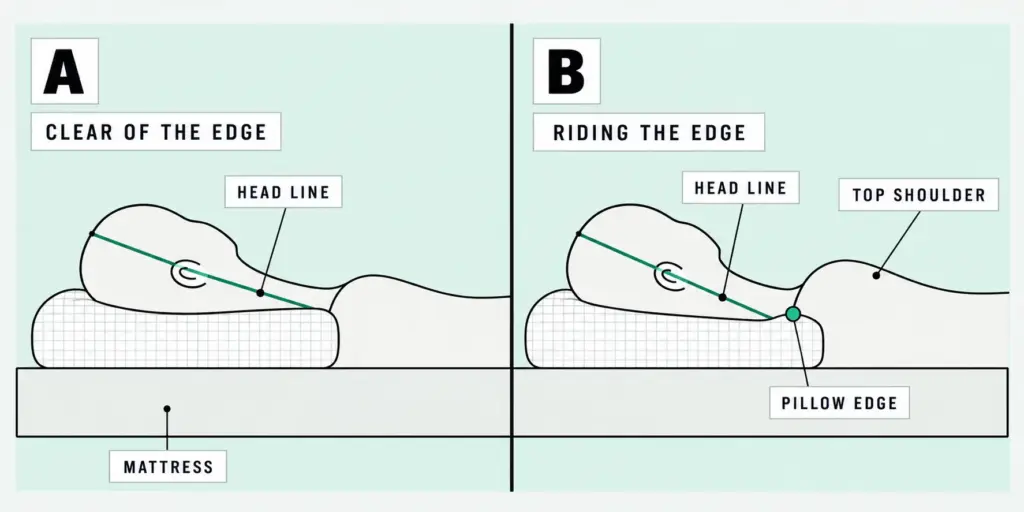
The question is the upper one. On a narrow frame the top shoulder stays above the pillow or behind its edge. On a broad one it travels toward the pillow and rides onto the lower edge, or leans against it.
That is the sign. If the top shoulder reaches the pillow, the pillow is meeting a frame wider than it was cut for, whatever you would call yourself in a shop.
A Free Check With Tape and a Phone
You need low-tack tape, a phone and one other person for thirty seconds.
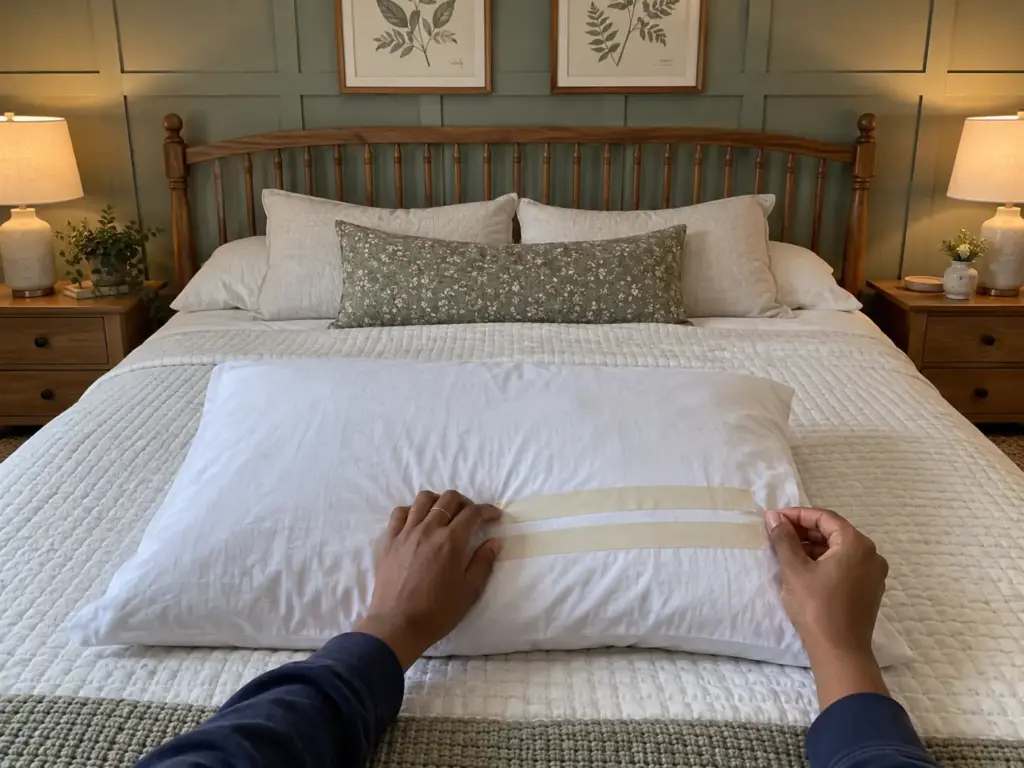
- Stick two strips of tape across the lower third of the pillowcase, a few inches apart, so they mark the band where a shoulder would arrive.
- Lie on the side you sleep on, head in its usual spot, and stay there a few minutes.
- Have the other person photograph you from behind.
- Look at where the top shoulder sits against the tape.
A shoulder that rides onto the strips has reached the pillow. A shoulder that stays above them has not. It is a check of the bed, not a measurement of you. The formula for the height itself is not redone here: the height rule that comes from the gap at your shoulder has it.
Leave the tape on after the photo. The next morning, a strip that is creased or dragged sideways was under the shoulder at some point in the night, and that tells you how far the shoulder traveled once you stopped holding still for the camera.
Where the Top Shoulder Lands on the Pillow
The photo shows where the shoulder reaches. What matters next is what it does when it gets there, because a pillow that is the right height for a narrow frame can be the wrong pillow for a wide one.

When the Shoulder Rides Onto the Pillow, It Takes the Height
A pillow fills the gap between the head and the mattress, and the lower edge of that pillow is exactly where a broad frame’s top shoulder arrives. Once it does, the pillow carries two loads: the head, and the shoulder with the weight of the arm hanging from it.
The shoulder presses the edge down, the foam gives under it, and the head, resting on the same piece of foam, follows the dip. The height printed on the box is spent on the shoulder before the head gets any of it. The pillow’s side also starts working as a second surface under the arm, which is a job it was not designed for.
The mattress changes the landing, too. On a soft mattress the lower shoulder sinks, the gap under the head closes, and the same pillow ends up taller against the head than the label says. And the dent that stays toward one edge of a pillow marks where the shoulder has been landing, not where the head has been resting. What decides whether that edge holds or gives is the fill, and which fill holds up under a shoulder has a guide of its own.
The Cut-Out as a Bet on Your Shoulder
A cut-out pillow carves a notch so the shoulder has somewhere to go. That is a bet on where one shoulder will be. If your top shoulder arrives at the notch, the bet pays. If it arrives a few inches off, on a broad frame where the notch tends to run shallow, the edge still presses where it was meant to give.
The Coop Home Goods Original Cut-Out Adjustable Pillow (cross-cut memory foam, adjustable fill, Queen) is the example of that bet here, not the fix for it. A 5-star reviewer writes that “my shoulder finally has a place to exist,” and a 4-star side sleeper credits the cut-out section for the end of the neck pain that other pillows gave.
The cost shows up in the same reviews. The fill is packed so tightly that air cannot flow, and a 4-star reviewer says a good portion of buyers mention the heat; taking fill out helped, and a satin case helped a little more.
A 3-star reviewer describes neck soreness and headaches that built over weeks, got traced to the pillow only by sleeping on an old flat one, and surfaced almost six months in, past the return window. If you try it, keep the return window in your calendar. The load from the top arm is a separate question, and a body pillow for the arm answers it better than any notch.
Why an Adjustable Fill Lets You Move the Edge Instead of Buying a New Height
Buying another height is the first instinct when a pillow lands wrong. With a shoulder riding onto the pillow, that is often the wrong lever, because the trouble is where the edge sits, not how tall the whole thing is.
An adjustable fill gives you the lever: take fill out, or add it, and the pillow’s reach under the arm changes with it. An adjustable-fill pillow can be dialed to the right level, and it can still feel soft. The whole idea comes down to one clause: you can add or take away fluff, which a fixed-fill pillow will not let you do.
The Coop Home Goods Original Adjustable Pillow (cross-cut memory foam and microfiber, 20 x 30 inches, extra fill in the box) is the pillow that community points to.

Why Firm Has to Mean More Under a Wider Shoulder
A pillow can look full on the bed and turn into a pancake ten minutes after the head goes down. That is the whole argument for firm, and it is a mechanism, not a taste.
A Taller Gap to Carry Means a Fill That Cannot Sink
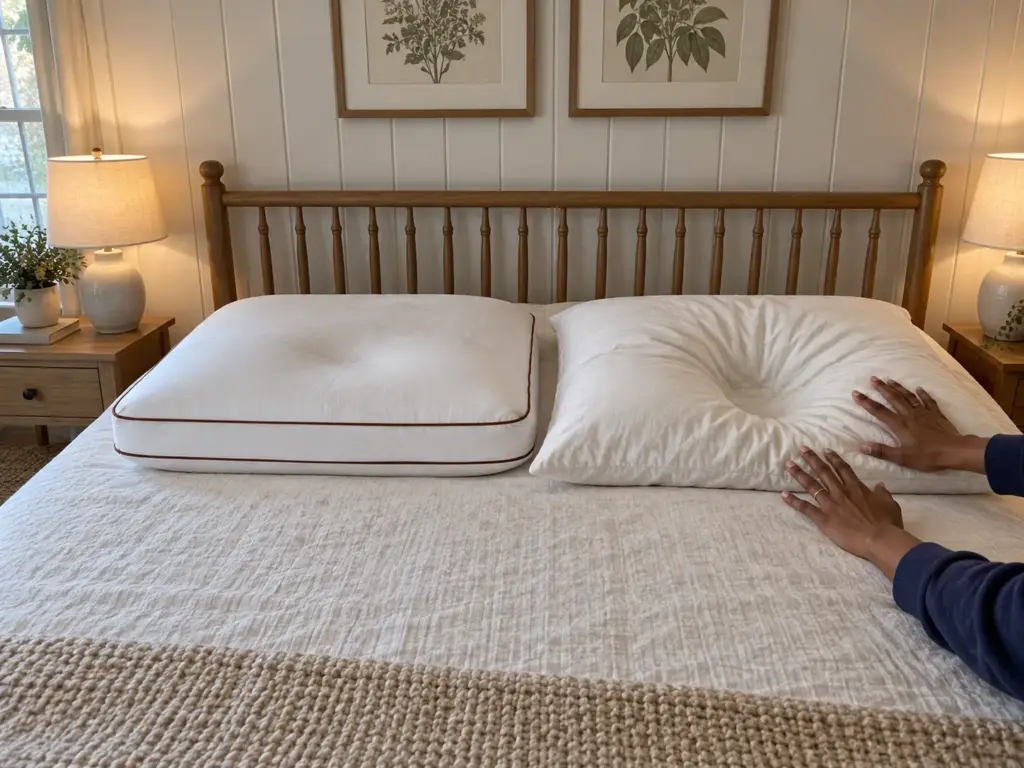
On a wider frame, the gap between the mattress and the ear is taller, and the head has to be carried across it. A fill that compresses under the head hands that height back, and the neck takes the difference. Firm, read properly, means a fill that holds its shape under load, not one that feels hard when you press it with a hand.
The advice that comes attached to the word “broad” is to go one step firmer, and this is the reason it works: the extra firmness is there so the height you chose is still the height at four in the morning. The inches printed on a box are the loft at rest; effective loft, the height left once a head is on it, is the number that counts, and a seven-inch pillow that settles to three under a head is a three-inch pillow. That is why loft and firmness as two numbers matters more here than on a narrow frame.
What “Flat Once I Put Weight on It” Is Telling You
A common complaint from broad-shouldered side sleepers is that every pillow seems to go flat once weight is on it. Read that carefully. The pillow is not flat on the bed; it loses its height under the head. A pillow can pass every test you run on it at rest and fail the only one that counts, which is why the word on the box is not enough: what a firmness label actually names is narrower than it sounds.
Press a flat hand into the pillow, lift it, and count how long the dent takes to fill back. A fill that keeps a hand-shaped dent has no business under a head carried across a wide gap.
Latex is the fill the mechanism points to, because it springs back. The Saatva Latex Pillow (shredded latex core, listed at 6 to 7 inches in the high-loft version) does not keep that promise for everyone.
A reviewer of the 6 to 7 inch version writes that it “sinks down to almost nothing” for a side sleeper and is going back; another says it feels flat and lumpy, “like a quilt folded.” One King unit arrived with its latex bag about a third full and sewn shut, so there was nothing to add. Other buyers find the high loft too tall, and one side sleeper calls the same height right. Try it with the return window in hand, and judge it by the second week, not the first night.
Mattress Sink, and Why Stacking Two Pillows Lands Too High
Firm is decided against your mattress firmness, not alone. The sink or squish of your mattress plays a critical role in the pillow thickness equation. On a soft mattress, where the shoulder already sinks, a firm pillow ends up higher than a soft one would, and what looked like the right firmness on a shop shelf sits too tall on your bed.
Stacking is the fix that looks obvious. Stacking a hard pillow under a soft one can land slightly too high, and it can bring shoulder and neck pain on waking. Two layers add height, but they do not add it evenly: the soft one compresses and the hard one does not, so the stack changes angle as the night goes on. Where the height comes from matters as well, and shredded and solid foam hold it in different ways.
For the cheaper line, the Isotonic Indulgence Side Sleeper Pillow has a gusset (a strip of fabric sewn between the top and bottom panels to give the pillow sides), an alternative-to-down fill, a removable 500-thread damask cover and a 36 x 20 inch shape. Its listed thickness of 7.7 inches is the tallest of the five pillows in this guide, which makes the height check more important, not less. It is also soft. One buyer returned it, writing that it is “sort of like the cheap hotel pillow that squishes down when you put your head on it,” which is the opposite of what a wide shoulder asks for.
Another reviewer found the gray strip along its side showing through a white case, even under a protector.
Treat it as the budget option that still has to pass the hand test.
Free Changes First, Then the Pillows Worth a Trial
Nothing in the last three sections needed a new pillow. Do those first, and only then think about the third one you might buy.

Change One Thing a Week
When the shoulder is the thing eating the height, the first call is to move the pillow, not to raise the pillow height. The changes below go in order, free first.
- Move the pillow so the top shoulder falls clear of it, with its lower edge tucked up toward your neck instead of under your shoulder.
- If the pillow you own has a zipper, take fill out, or put some back, a handful at a time.
- Change the pillowcase, or the layer under it.
Change one, wait a week, and judge by the morning. Two changes at once tell you nothing about either, and when a pillow is too thick is easier to read when only one thing moved.
The Pillow That Lets You Take Fill Out
Taking fill out is the lever you control, and the Layla Sleep Adjustable Fill Kapok Pillow (shredded memory foam with kapok fiber, King) is built around it. One reviewer, a side sleeper, took about three nights to find the amount that worked and says not to give up too soon. The pillow is large and heavy.
A 4-star side sleeper reports foam that shifts toward the top of the head and a pillow that has to be flipped every night, and a King buyer found the weight meant the arm could not be tucked under it.
A 2023 unit arrived with about half the fill of older ones, with some harder pieces mixed in, and Layla said extra fill was not available.
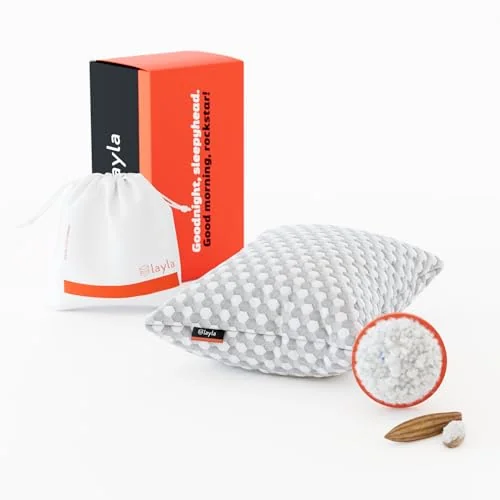
Keep the bag the extra fill comes in. A pillow that lets you store what you take out is the only kind where a wrong guess can be undone, and an adjustable pillow without that bag turns every mistake into a permanent one.
The Cheaper Way to Get a Wide Pillow
The cheap pillow in the last section is soft, so paying less there buys the wrong thing. The cheaper route is the pillow you already own: take fill out of it or add some before buying anything, and use the tape check to see whether the shoulder still reaches it. A budget pillow earns its place only when it passes the hand test, and what you give up with a cheaper side-sleeper pillow is height that holds.
The Test a Box Cannot Run
After four sections of mechanism and picks, the only thing left that decides is the sleeper on the pillow. No listing can test that, and neither can this guide.

Keep the Receipt and the Return Window Open
The reviews of these pillows show what finding out late costs. One buyer discovered after almost six months that the pillow was the problem and found the return window already shut; another received a King unit that could not be refilled. Judge in the first weeks, change one thing at a time, and decide before the window closes. A pillow that goes wrong at week six is cheaper to send back at week three.
What to Look At After a Month
Check three things. First, whether the dent in the pillow has moved toward the shoulder side. Second, whether the tape strips from the first test now sit outside the area where the shoulder lands, if you repeat the photo. Third, whether the mornings are better.
And do it one change at a time, with measuring a side sleeper’s loft as the method if you want a number to compare.
Look at the pillowcase of a month-old pillow. A worn or rubbed patch on the shoulder side is the shoulder’s address: it has been landing there, whatever the photo showed on the night you took it.
When It Is Not the Pillow
Numbness, tingling or arm weakness goes to a doctor, and so does a shoulder or neck that does not ease after several weeks of bed changes. The pillow is not the question then. If numbness is what brought you here, how many minutes a numb arm takes to clear is the guide to read first, and the line it draws is the same one.
Three Checks to Keep and One to Make Next Month
Three things carry over. “Broad” has no number, so the sign is whether the top shoulder reaches the pillow. The shoulder that lands on the pillow takes its height, so the adjustment that matters is where the edge sits, not the figure on the box. And firm means a fill that does not sink under a taller gap, with each pick here carrying a flaw you weigh against it.
The check for later: after a month, look for the dent that has moved toward the shoulder side and the worn patch on the case, because those two show what the shoulder has been doing when no camera was pointed at it.
Tonight, put the two strips of tape across the pillowcase, have someone photograph you from behind, and judge where the shoulder lands. In the morning, notice which strip is creased.
Frequently Asked Questions
01How do I know if I have broad shoulders for choosing a pillow?
No measurement settles it, so test it on the bed: lie on your side and see whether your top shoulder reaches the pillow. Put two strips of tape across the lower third of the case, have someone photograph you from behind, and see whether the shoulder rides onto them.
02Is a firmer pillow better for broad shoulders?
Usually, because a firmer fill holds the height that a wider shoulder gap needs instead of sinking under the head. On a soft mattress, though, a firm pillow ends up higher than it looks, so judge the two together with loft and firmness as two numbers.
03Can I stack two pillows to get the height?
You can, but a hard pillow under a soft one tends to land the head too high, and the two layers compress differently as the night goes on. One adjustable pillow you can fine tune is the cleaner route, and when a pillow is too thick shows how to read it.
04Can an adjustable pillow work for broad shoulders?
Yes, when you can take fill out or add it and the fill holds its shape under your head. Watch for the two flaws these pillows share: heat against the face, and fill that drifts toward the top so the pillow needs flipping.
05How long should I try a new pillow before deciding?
Judge the first mornings, change one thing a week, and decide before the return window closes. A pillow that goes wrong at week six is cheaper to send back at week three.





Tried it on your own bed?
No comments yet. Tell us what you changed, and what the sheet did after a few washes.