

What’s in here8 sections
- Tencel Is a Brand Name, Eucalyptus Is a Tree
- What the Word “Tencel” Buys You That “Eucalyptus” Doesn’t
- The Certificate on the Box Is Answering a Different Question
- Neither Word Predicts How Long the Sheet Lasts
- The Number That Would Tell You, and Nobody Prints It
- Eucalyptus, Bamboo, and the Same Process from Different Wood
- What to Read on the Tag Instead
- Frequently Asked Questions
You are standing in the aisle with two flat packages, one in each hand. One says TENCEL™ Lyocell in a serif typeface with a trademark symbol clinging to it, the other says eucalyptus sheets in friendly lowercase, and the two of them are not priced the same. Squeeze both through the plastic and the fabric feels identical, because in most cases it is: lyocell is made by dissolving wood pulp in a solvent and pushing it back out as a continuous filament, and both of those packages are describing that same process from opposite ends. One names the company that ran it, the other names the tree it started as.
The question tencel and eucalyptus raises is not which one is the real thing. It is which of the two words on the front is a guarantee and which is a description, and what neither of them will tell you about the set you are going to own for the next three years.
Quick Answer
Tencel is Lenzing’s brand name for lyocell, and lyocell almost always comes from eucalyptus pulp, so on a sheet label the two words usually point at the same fabric. But unbranded “eucalyptus” can legally be spun from beech, birch or spruce, and it carries no closed-loop production guarantee.
Tencel Is a Brand Name, Eucalyptus Is a Tree
The two words are not competing with each other, and that is the whole confusion. One names who made the fiber. The other names what it was made from. A package can honestly carry both, and the better ones do.
What lyocell actually is, from wood to thread
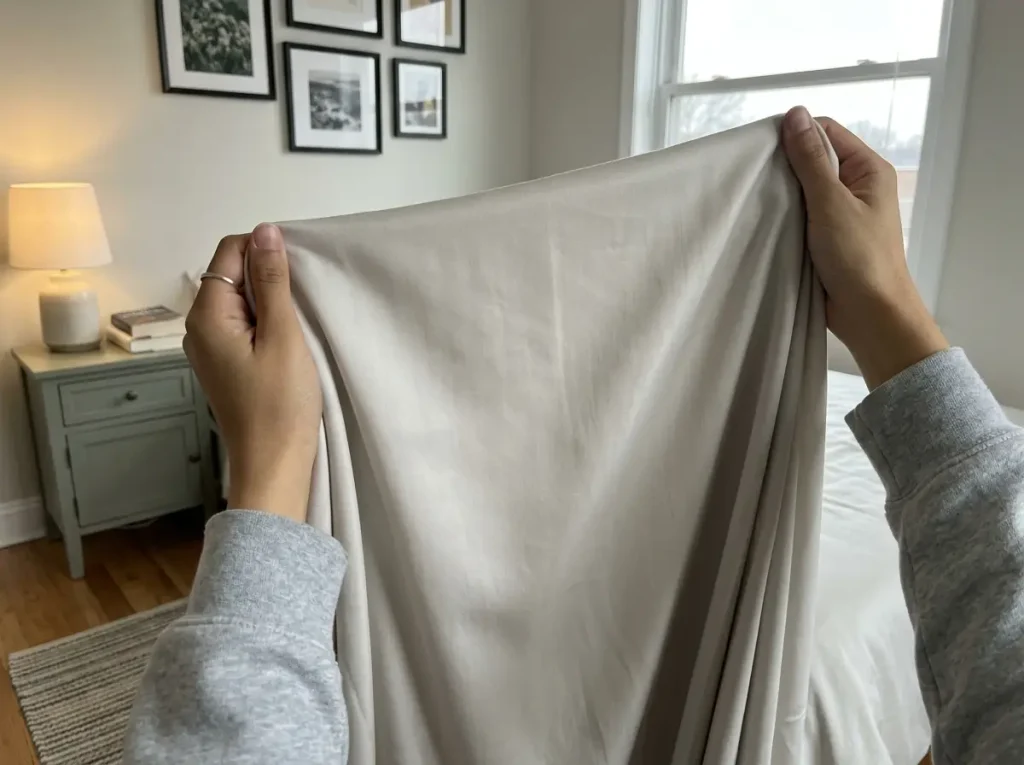
Lyocell is a fiber, not a fabric and not a plant. Hardwood is chipped and cooked into pulp, the pulp is dissolved in a solvent bath until it is a thick amber syrup, and that syrup gets pushed through a spinneret, a plate of holes finer than a hair, into a bath where it hardens back into cellulose. What comes out the other side is a continuous filament: one unbroken strand, kilometers of it, as opposed to cotton, which arrives as short fluffy staples that have to be twisted together before they are long enough to weave.
That difference sounds academic in the aisle. It decides almost everything about how the finished sheet behaves, and it is why lyocell sits where it does between viscose and silk in the fiber routing under this whole family.
Here is the part that only shows up once the set is on the bed: a lyocell sheet’s hand is set at the spinning stage, not the finishing stage. It arrives smooth rather than being made smooth. There is no starch to wash out, no resin doing temporary work, so the first night on a new lyocell set feels oddly anticlimactic — it does not have the stiff, papery newness a fresh percale has, and people read that as the set being already broken in.
It isn’t. That is just what a filament does.
Why “Tencel” appears on some packages and not others
Tencel is a registered brand belonging to Lenzing AG, an Austrian producer, and it covers the lyocell and modal fiber that Lenzing itself makes. It is a maker’s mark, in the same sense that Lycra is a maker’s mark for elastane. Any mill anywhere can produce lyocell and sell it honestly as lyocell. Only a mill buying Lenzing’s licensed fiber can print the word Tencel.
That is why the tag inside the sheet says something drier than the box does. The label legally has to name the generic fiber, “100% Lyocell”, because under US textile labeling rules bedding is a covered product and has to be identified by generic fiber name and percentage by weight. “Eucalyptus” is not a generic fiber name the FTC recognizes for that purpose. So a listing that talks about eucalyptus all the way down the page and never once prints the word lyocell is skipping the one word the rules actually require, which tells you something about how carefully the rest of it was written.
Eucalyptus is not the only wood it can come from
Eucalyptus dominates because it suits the process: it grows fast, it does not need irrigation, and it yields a lot of pulp per acre. But beech, birch and spruce all go into lyocell too, and none of them change what the fiber is. This is why shoppers end up typing “eucalyptus/lyocell/tencel” into a search box as one long string. The labels taught them the three words go together, without ever teaching them which one is doing the work.
What the Word “Tencel” Buys You That “Eucalyptus” Doesn’t
If the two words describe the same fabric, the obvious question is why one of them costs more. The answer is not the tree.
The closed loop, and what the number actually measures
“Closed-loop” reads like a sustainability slogan, and it is actually a recovery rate. The solvent that dissolves the pulp is NMMO, and Lenzing’s own closed-loop production data puts solvent recovery above 99.8 percent, meaning less than two parts in a thousand leave the system. That is a measurable number about a specific plant, not a feeling about a forest.
It has a measurable consequence, too. Against generic unbranded lyocell, Lenzing’s Higg Materials Sustainability Index figures put Tencel lyocell at up to 39% lower fossil-fuel depletion, 53% lower global warming impact, 69% lower water consumption and 60% lower eutrophication. Read that gap carefully, because it is the entire argument of this section: an unbranded mill can use the exact same eucalyptus and still run a dirtier, thirstier process. The wood was never the variable.
What unbranded eucalyptus lyocell does and doesn’t promise
So what does “100% eucalyptus lyocell” on a package actually guarantee? That the fiber is lyocell. That is the complete list. Not where it was made, not what the solvent recovery rate was, not whether anybody measured it.
None of which is a reason to avoid unbranded sets. Plenty of them are perfectly good cloth, and the brand name is not a quality ranking. It is a reason to stop reading the two words as interchangeable when only one of them is attached to a company that publishes numbers.
Where the guarantee stops
And now the honest limit, because this is where most articles on this subject quietly stop and let you assume more than they said. The guarantee is Lenzing’s, and it ends at the fiber. The mill that bought that fiber chose the yarn, chose the weave, chose the finish and chose how to sew the corners of the fitted sheet, and Lenzing certified none of that. You are holding a claim about origin, not a claim about the cloth on your bed.
The Certificate on the Box Is Answering a Different Question
The other word on these packages is OEKO-TEX, and it gets read as a general badge of goodness when it is a narrow, specific and genuinely useful test of something else entirely.
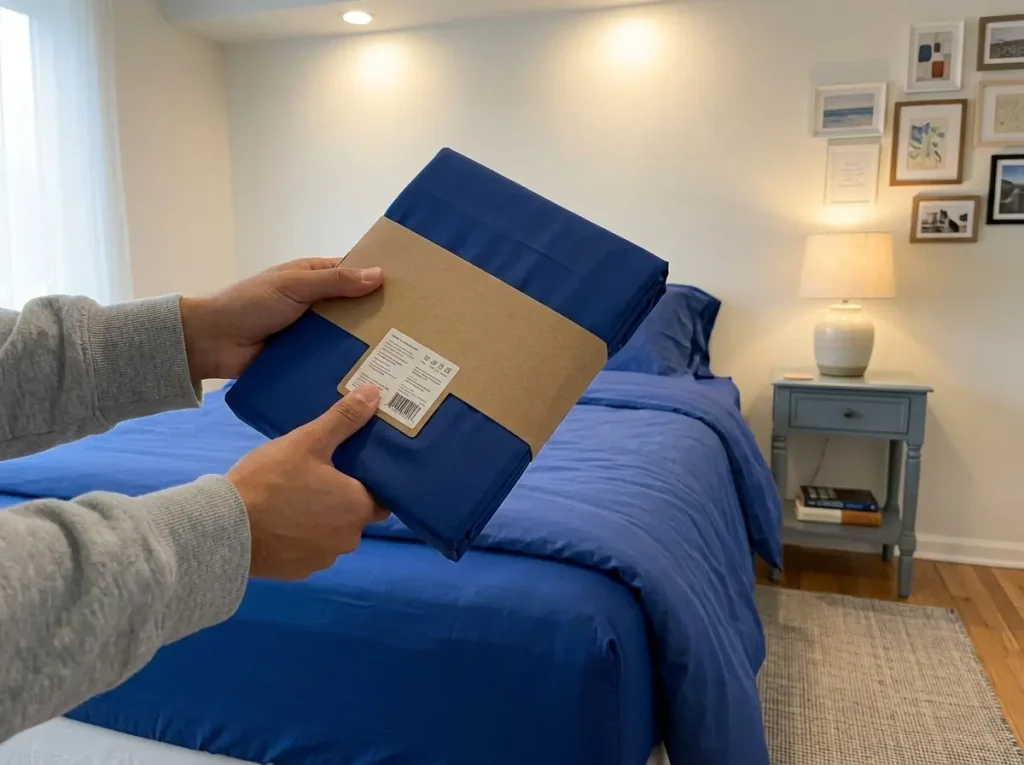
What Standard 100 tests, and how often
Standard 100 tests the finished fabric against more than a thousand regulated substances: the cloth, the thread, the elastic, the label itself, everything in the finished article. It is a chemical-residue pass or fail, and the certificate expires: it has to be re-tested every twelve months. Worth knowing about what Standard 100 actually tests for is that it applies per batch, which means it is a statement about a run of fabric rather than about a brand. The same name on the box next year is not automatically the same certificate.
What it deliberately says nothing about
Standard 100 is not an organic label and it is not fiber-specific. It applies identically to lyocell, cotton, polyester or a rug. It says nothing about which forest the pulp came from, nothing about whether the fiber is Lenzing’s, and, this being the one that matters most for what comes next, nothing at all about how long the sheet will last.
Those are separate marks doing separate jobs. FSC and PEFC certify the forestry behind the pulp, GOTS certifies organic fiber content and the processing around it, and neither of them is what a Standard 100 number means. A set can carry one and not the others, which is why a listing that names four acronyms in a row is not four times as certified. It is telling you four different things, and only one of them is about the chemistry against your skin.
The brand name is answering a traceability question, the certificate is answering a safety question, and neither one is answering a durability question. Two different claims, both useful, neither one the one you probably want.
The same goes for the adjectives further down the listing. Moisture-wicking, hypoallergenic, breathable, temperature regulation. On a lyocell set these are usually describing the fiber itself rather than a treatment applied to it, and that distinction is worth more than either word. Lyocell absorbs into the filament instead of holding damp on the surface, which is what people are feeling when they call it cooling, and there is nothing there to wash out.
A finish sprayed on at the end of the line behaves differently: it works beautifully for a season and then it is gone. Neither the certificate nor the brand name tells you which of the two you bought, and no listing volunteers it.
Before you compare anything else, read the tag for those two specific things. Most of the price spread between two sets that both say “eucalyptus” on the front is explained by which of them are present, and it costs nothing to check.
Two words decide whether a listing is being specific or being vague: the registered brand name and the certificate number. Search the product page for “lyocell” and for “Standard 100”. If a page says eucalyptus eleven times and lyocell zero times, it is selling you the tree.
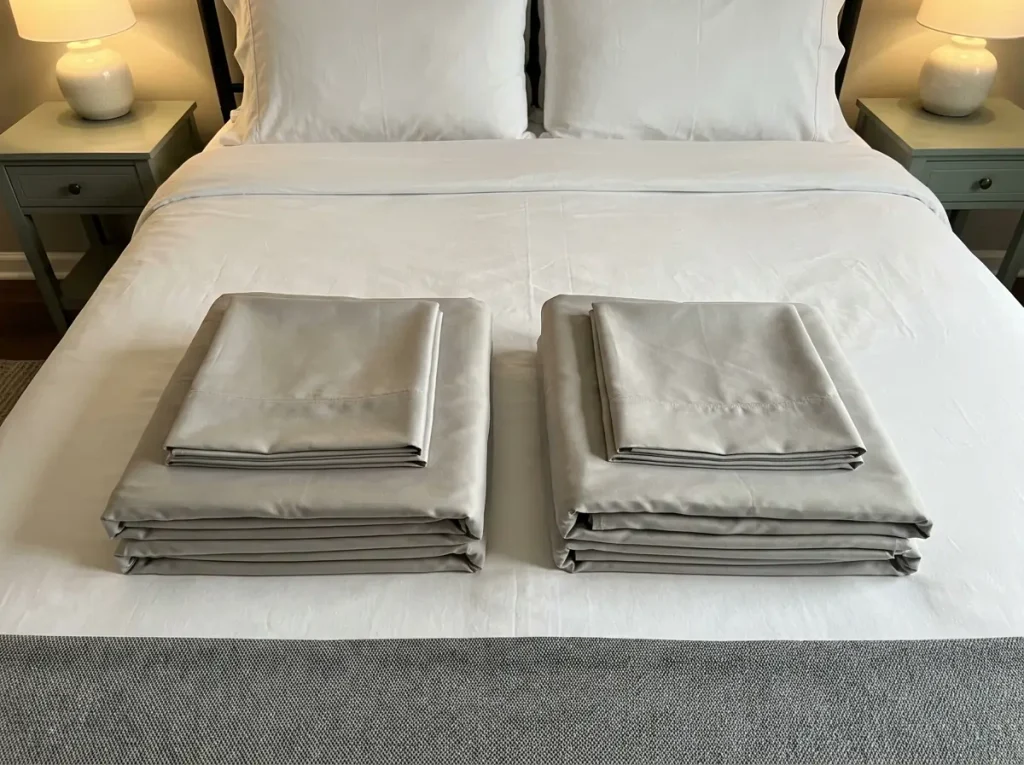
As a worked example of a tag that carries both at once, the DTY Bedding Premium Silky Soft Tencel Lyocell sheet set is 100% Tencel-branded lyocell in a 320-count single-ply sateen with an OEKO-TEX Standard 100 number and a fully elasticized pocket rated to 18 inches. The registered mark and the certificate, on one package, which is rarer on this shelf than it should be. Its flaw is in that pocket: fully elasticized all the way around is generous on paper, and it also means the elastic pulls hard at the corners with use, which is the exact stress point that fails in other brands spinning this same fiber. Nothing about the two words on the front makes this set immune to that.
Neither Word Predicts How Long the Sheet Lasts
Everything up to here has been about the fiber, and the fiber turns out not to be the thing in question. Two sets carrying identical fiber claims can end up in completely different places by month eighteen.
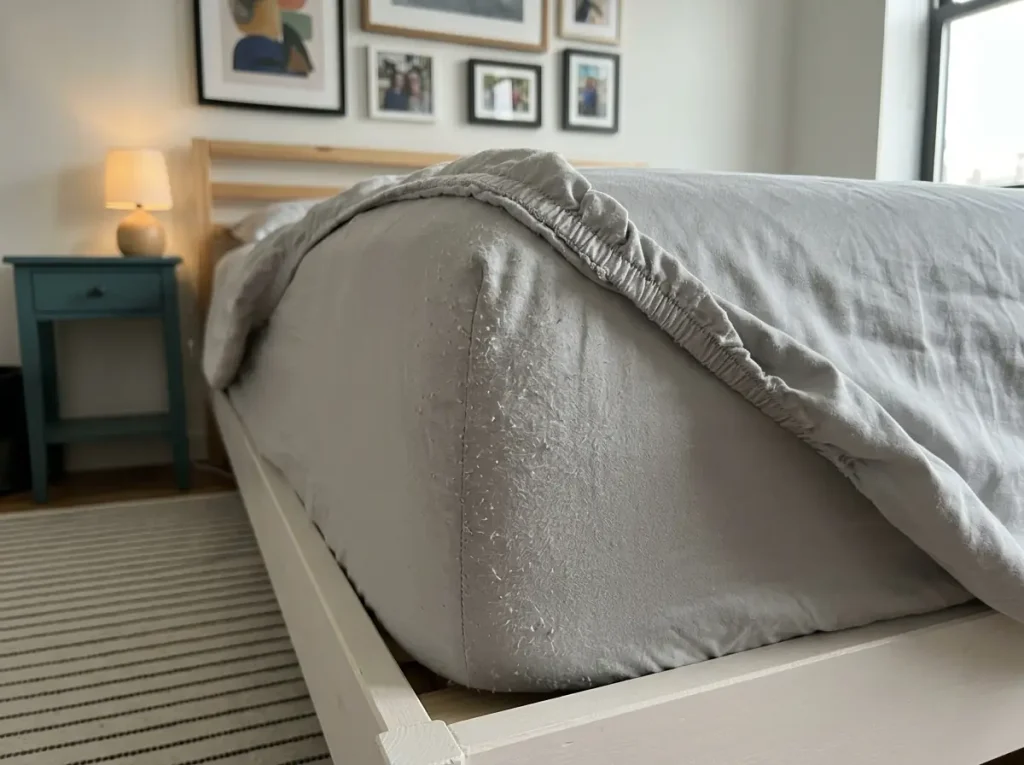
The corner, at month fourteen
One Trustpilot review of a eucalyptus lyocell brand opens with the line “I absolutely loved these sheets for a short period of time,” which is a sentence that tells you the ending before it starts. What follows is the fitted sheet, torn.
And she is not alone: across independent reviewers of that same brand, the fitted sheet is reported ripping or holing at 13, 14, 16 and 18 months of ordinary use, by people who say they followed the wash instructions exactly. One buyer, assuming the first was a defective unit, bought a replacement and got the identical failure the second time. Another alternated two sets on the same bed specifically to spread the wear, and the lyocell fitted sheet still went after roughly six months of half-time use.
Read the vocabulary those reviewers use and the pattern gets sharper. Ripped. Shredded. Tore. Holes.
Nobody describes a slow fade. That language is not the language of a fabric wearing out; it is the language of something giving way at a seam. And it is always the fitted sheet, always at the corners, in sets whose flat sheet and pillowcases are still perfectly fine.
A separate reviewer, who otherwise loved the hand of the fabric, described the pilling coming on “something fierce”.
Worth keeping those two words apart, because pilling is surface wear and tearing is construction, and they fail on different clocks.
The brand with that public record is Sheets & Giggles, whose eucalyptus lyocell sets sit at 2.0 out of 5 on Trustpilot across a small sample, 67% of it one-star, with the tear reports above attached to it. That record is the reason it is named here rather than hidden inside a vague “some brands”: you can go and read the same reviews yourself, and a small sample of angry reviewers is not the same evidence as a large one, so read them rather than taking the number.
Same fiber, different maker, different outcome
Now the counter-example, which carries as much weight as the failure. The Sijo AiryWeight sheet set is also 100% lyocell derived from eucalyptus, Austrian-sourced with a PEFC forestry certification behind the pulp, and it is the one the press testers at outlets like Real Simple and Architectural Digest keep landing on. Its flaw is right there in the name: AiryWeight means less fabric per square meter, so it reads thinner and less substantial under you than a heavier sateen, and if you like a sheet you can feel the weight of, this is not that sheet.
Same three words on the front. Opposite outcomes. That is the finding.
Why the fiber name can’t carry this
The mechanical reason is not mysterious. The corner of a fitted sheet is a construction question. How the elastic is anchored, whether the seam is reinforced, how much fabric the pocket has to stretch across a mattress it may be undersized for. The fiber name governs exactly none of that.
Neither does it govern the weave, and the float length of a sateen is one of the reasons a lyocell sateen pills where a tighter weave wouldn’t, which is the argument how long a sateen float actually survives carries in full.
There is one more variable, and it is the only one on this list you control. A continuous filament is smooth, which is exactly why anything that coats it shows. Fabric softener leaves a film that sits on the surface of lyocell instead of soaking in, dulling the sheen and blunting the very absorbency the fiber was bought for, and bleach attacks regenerated cellulose faster than it attacks cotton.
Heat is the other one: a tumble dry on high shrinks the fabric against seams that are not shrinking with it, which loads the elastic corner every single cycle. A cold wash on a gentle cycle with a mild detergent, then out of the dryer while still slightly damp, or onto a line to air dry, is not a maintenance ritual, it is just removing the three things that shorten the clock. Whatever the care label on your set says wins over any of this; it was written by the people who made the cloth.
The practical consequence is the thing nobody puts in a review written in week one: the failure is asymmetric. The flat sheet and the pillowcases routinely outlive the fitted sheet by years, which is why the fix people actually land on is not replacing the set.
When the fitted sheet goes, buy the fitted sheet, not the set. Reviewers of these fabrics keep the flat sheet and pillowcases running for years past the bottom sheet. Check before you buy whether the brand sells the fitted sheet on its own — that single fact is worth more than the certificate.
The Number That Would Tell You, and Nobody Prints It
The fiber name is settled, the certificate is narrow, and there is one specification left that would actually separate two sets. It is the one missing from every package.
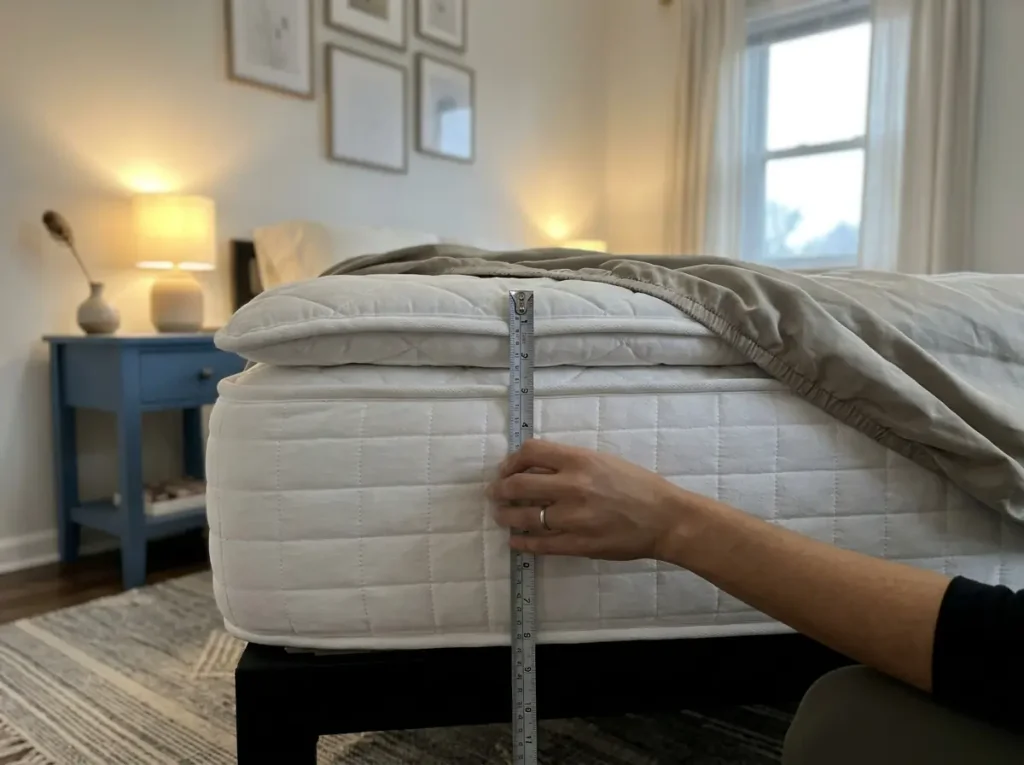
Why the count means something different here
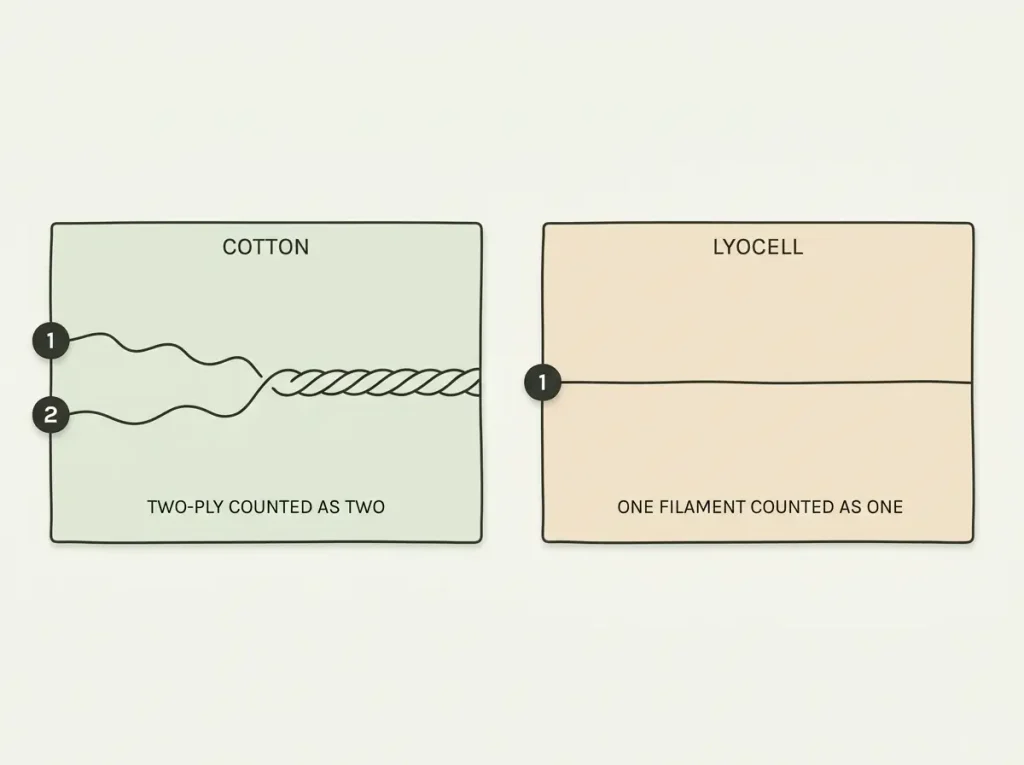
Thread count on cotton is inflatable, and everybody now knows the trick: twist two thin plies into one thread, count both, print the doubled number. There has never been a binding FTC rule against it, only guidance that count should be disclosed alongside ply, so a “600 thread count” that is really 300 two-ply says so. Convention, not regulation. What thread count is actually counting is the full version of that arithmetic.
On lyocell the arithmetic barely applies. Tencel filament runs at very fine deniers, with the micro grades sitting at or under 1.0 dtex, and it is continuous, so there is no short staple that needs twisting into a ply in the first place. There is no multi-ply trick available to run.
Which sounds like good news, and it is, except that it also means a moderate count on lyocell is not the compromise the same number would be on cotton, and most shoppers apply the cotton instinct anyway and conclude a 300-count lyocell set “feels cheaper than the number suggests.” It doesn’t. The number was never measuring the same thing.
GSM, and the fact that nobody prints it
The number that would separate two lyocell sets is GSM, grams per square meter, or grammage if you are reading a mill’s own spec sheet: the weight of the fabric. It predicts drape, it predicts how the sheet sits on you in July, and it predicts whether “AiryWeight” means airy or means thin. It also predicts the thing lyocell is quietly bad at: wrinkle resistance is a function of weight and finish here, and a light filament sateen creases in the basket while a heavier one hangs out of it. It appeared in none of the seven sources this article was built against, and it appears on almost no package.
So you are judging weight by hand. The live sets in this category all sit in a sane 300 to 320 sateen range anyway, which means the count has stopped being a signal between them. Nobody is selling a 1000-count lyocell set, and that absence is itself informative.
Lift the package. Read the maker’s own description of the weight, since when a brand bothers to name its weight it usually means something. That’s the whole method.
Pocket depth, which the fiber never governed
The second free check, and it comes before any of this: measure the mattress with the topper on, then add two inches. That is your minimum pocket depth. Sets in this category spec 15 to 20 inches of deep pocket, and a pocket fighting a mattress taller than it was cut for is exactly the corner stress from the section above, arriving early and by your own hand. It is the elastic band at that corner taking the load every time somebody sits down on the bed, not the fiber.
The fiber story says nothing whatsoever about fit.
Measure the mattress with the topper already on it, then add two inches, and treat that as the floor rather than the target. “Fits up to 18 inches” means the elastic will reach 18. It does not mean it will stay there for eighteen months.
Eucalyptus, Bamboo, and the Same Process from Different Wood
One more word turns up in this aisle, and it sits closer to eucalyptus than the packaging on either would suggest.
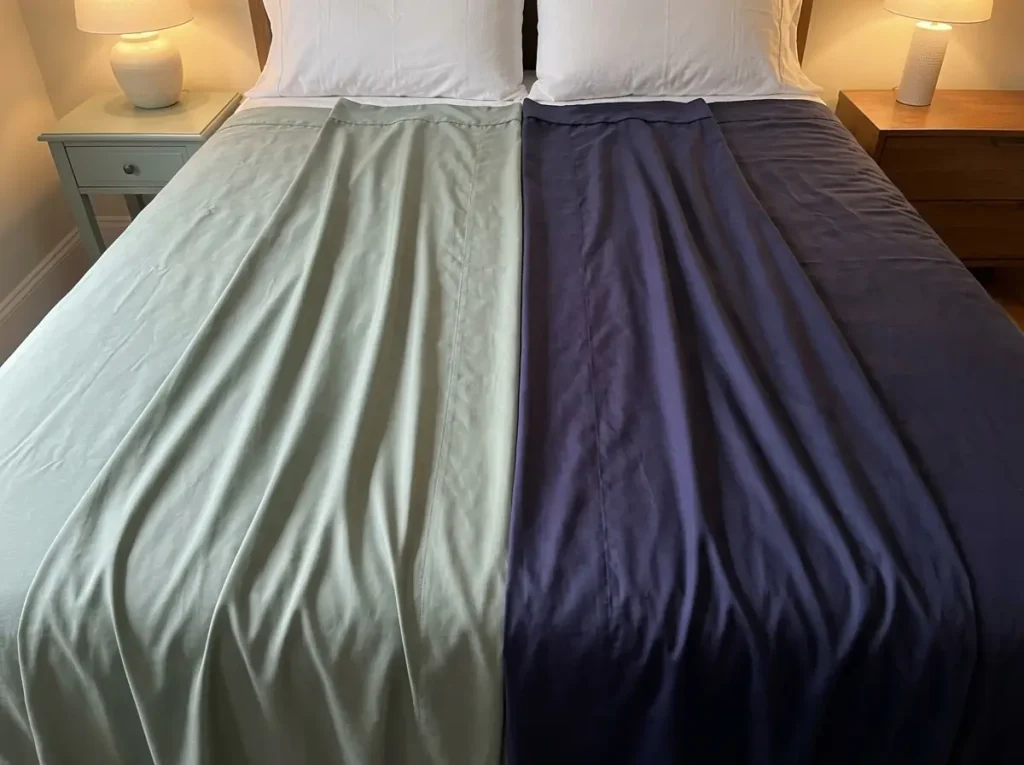
Same process, different tree
Bamboo can be made into lyocell by the same closed-loop route. The plant changes; the process does not.
Which means the ambiguous word on this shelf is not “eucalyptus”. It is “bamboo,” because bamboo reaches fabric by two completely different manufacturing paths and the front of the package rarely tells you which bamboo process ended up in the bag. Bamboo viscose and bamboo lyocell share a plant and share almost nothing else.
Which word on a bamboo package is doing the work
So here is the reading rule that survives this entire article, and it is short enough to use in a shop: the process word is the informative one, the plant word is the marketing one. Lyocell, viscose, modal: those tell you how the cellulose was handled. Eucalyptus, bamboo, beech: those tell you what it was before anyone handled it, which is the part that matters least.
Neither wood wins, and the honest version of “where each lands” is unglamorous: they land in the same place for most sleepers, both usually woven as sateen, both handling moisture the way cellulose does rather than the way polyester does. That is also where lyocell lands for a hot sleeper — the one construction in the bamboo family that genuinely earns the reputation the whole family claims.
| What the label says | Wood and process | What the word guarantees |
|---|---|---|
| TENCEL™ Lyocell | Eucalyptus (usually), closed-loop solvent recovery above 99.8% | Lenzing made the fiber, and publishes the numbers |
| Eucalyptus lyocell | Eucalyptus, lyocell process, mill unnamed | Only that the fiber is lyocell |
| Bamboo lyocell | Bamboo, same closed-loop lyocell process | The cellulose went the lyocell route, not the viscose one |
| Bamboo (bare) | Bamboo, process unstated — usually viscose | The plant. Nothing about how it became cloth |
The cleanest illustration of the third row is the ettitude sheet set made from organic bamboo lyocell: a sateen in 100% lyocell with an OEKO-TEX Standard 100 Class 1 certificate, a 17-inch pocket, and the closed-loop solvent process spelled out on the listing rather than implied. Its flaw, for a reader who arrived here from the eucalyptus question, is straightforward. This is bamboo, not eucalyptus, and it carries ettitude’s own CleanBamboo name rather than the Tencel mark, so if what you specifically wanted was Lenzing’s traceability, you do not get it here.
And one thing this comparison still does not settle: durability. That belongs to the maker, on both sides of the table.
What to Read on the Tag Instead
Tencel is the brand, lyocell is the fiber, eucalyptus is the tree. A package carrying all three is being precise, not repetitive, and the redundancy you thought you were seeing was three separate facts stacked up.
The brand name buys traceability of the fiber. The certificate buys a chemical-safety pass on that batch of cloth. Neither of them buys durability, and durability is what you were actually shopping for. The word that predicts what you will own in two years, the weight of the fabric and the construction of the corner, is not on the box at all.
So judge it at wash twenty, not at week one. After a season of washes, check the two bottom corners of the fitted sheet before you look at anything else. The flat sheet and the pillowcases of these sets routinely outlive the fitted sheet by years, so the corner is where the verdict shows up first, and it shows up as a tear rather than a fade.
Before you buy anything, go read the tag on the set already on your bed, and on the duvet cover while you are there: the fiber name, the certificate, the pocket depth. If that set has survived a year, you have just learned more about what to buy next than any package in the shop is going to tell you.
Frequently Asked Questions
01What are the downsides of Tencel fabric?
It wrinkles readily, it shows skin oils sooner than cotton does, and the fitted sheet corner is its documented failure point across independent long-term reviews. The sateen weave that gives it that smooth hand is also the weave that pills first on the side you sleep on.
02What are the downsides of eucalyptus sheets?
The same fabric, so the same downsides, plus one more: an unbranded eucalyptus label tells you nothing about the mill that made the fiber or how much solvent it recovered. That is exactly why the OEKO-TEX number matters more on an unbranded set than on a Tencel-branded one.
03What is the closest fabric to Tencel?
Bamboo lyocell, which is made by the same closed-loop process from a different plant. Modal is the next closest, and it is also a Lenzing fiber. Cotton sateen is the closest thing in appearance and behaves nothing like it once it is damp.
04Is Tencel modal the same as Tencel lyocell?
No. Both are Lenzing brands and both start as wood pulp, but modal is a different fiber process and comes out softer, stretchier and much less crisp. On a bed, modal usually turns up in jersey sheets and lyocell in sateen ones.



Tried it on your own bed?
No comments yet. Tell us what you changed, and what the sheet did after a few washes.