Do Bamboo Cooling Sheets Work? The Weave Decides
Don't buy bamboo sheets for the fiber. It's viscose, it measures no cooler than cotton, and the sateen weave it's sold in is what's keeping you warm.
 Alfredo Ramses Textile engineer · 2 September 2026 · 16 min read
What’s in here 7 sections
The word “bamboo” on that package is doing something the fabric is not. Whatever is on your bed right now was almost certainly a stand of grass that went into a chemical bath and came out as regenerated cellulose, and cellulose does not remember what it used to be. So the honest version of do bamboo cooling sheets work is not a question about a plant at all. Below: what the fiber actually is, why the weave settles the temperature before the fiber gets a vote, the one bamboo that genuinely runs cool, and the four things to check on your own bed before you change a single sheet.
Quick Answer
Rarely, and not for the reason on the label. “Bamboo” sheets are bamboo viscose or rayon, a chemically regenerated fiber that measures no cooler than cotton in the lab. The weave and the finish do the cooling, and most bamboo sets are sold in sateen, the weave that releases heat worst.
What “Bamboo” on the Package Actually Is
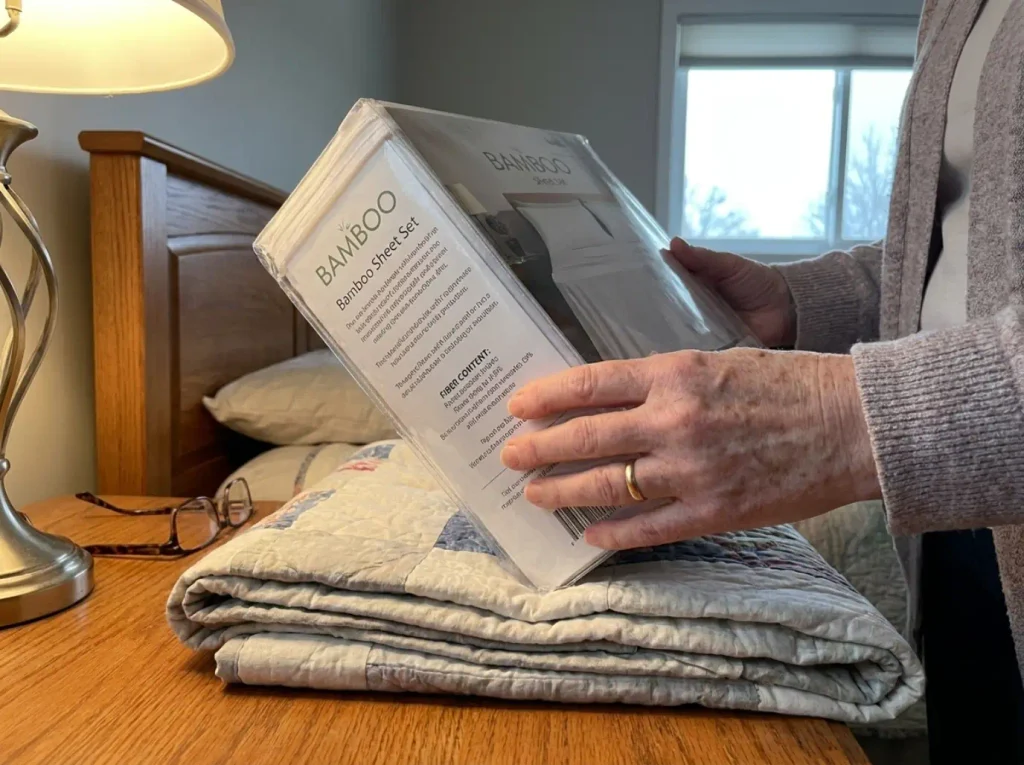
Turn the package over and look for the fiber content. If it says “100% bamboo,” you are holding a label that is not legal in the United States. If it says “100% rayon from bamboo” or “viscose from bamboo,” you are holding the honest one, and the honest one is the one that reads worse on a shelf.
Nobody buying sheets thinks rayon sounds like an upgrade. That inversion is the whole reason the mislabeling keeps happening: the compliant package loses the sale to the one sitting next to it.
Here is the chemical processing the word is hiding. Bamboo goes in as woody pulp, gets dissolved in caustic soda and carbon disulfide, gets pushed through a spinneret, and comes out as regenerated cellulose. That fiber is viscose, also sold as bamboo rayon. True bamboo fiber — the plant mechanically crushed and retted into a linen-like thread — does exist, and essentially nobody makes sheets out of it, because it comes out coarse.
Whatever the standing plant was doing about moisture or microbes did not survive the bath, because there is no bamboo structure left in the thread. It is cellulose that used to be bamboo, the way paper is a tree that used to be a tree. If you want the chemistry itself and what it means for skin, that is what “viscose” means once you take the word apart, and it is a separate question from the temperature one.
This is not a semantic quibble a blogger invented. The FTC’s own Textile Fiber Rule on bamboo labeling says a textile can be called bamboo only if it is made directly from actual bamboo fiber, and that rayon sourced from the plant has to say so. Enforcement has teeth: sellers have already been fined over $3.1 million for this exact mislabeling since 2021. Bedding sellers, specifically, for putting the plant name where the fiber name belongs.
Buyers get there on their own, too. In the r/Bedding threads on bamboo the greenwashing objection shows up unprompted from people who just wanted sheets, one poster flatly calling the plant name a marketing move rather than a textile, and it draws pushback from other buyers who assumed the plant and the fabric were the same thing. Both sides are arguing about a label, not a bed.
Bamboo modal and bamboo lyocell exist as well, and they are different processes rather than different plants. Which one you have matters, and we will get to it.
Read the sewn-in care tag, not the box. The box is marketing copy and the tag is a legal document. The fiber content on the tag is the one the FTC can act on, and it is where “viscose” or “rayon” shows up after the front of the package has quietly dropped it.
Why the Weave Beats the Fiber
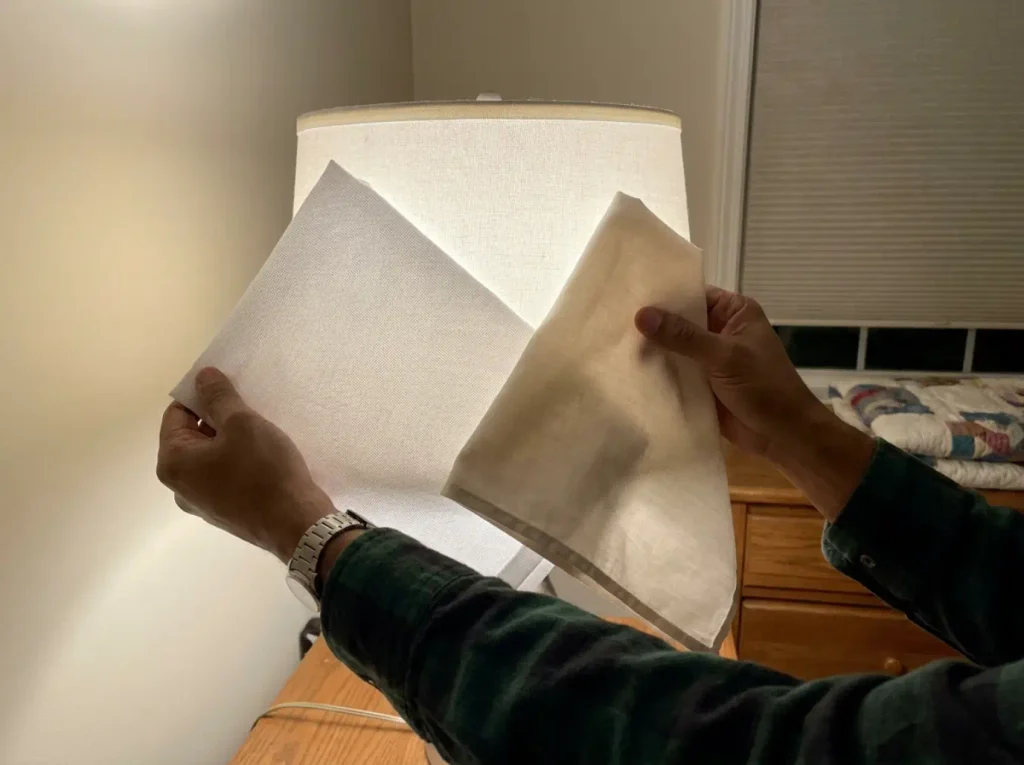
Two sheets, same fiber, and one of them sleeps noticeably warmer. Nothing on either package explains it, because the thing doing the work is not printed anywhere.
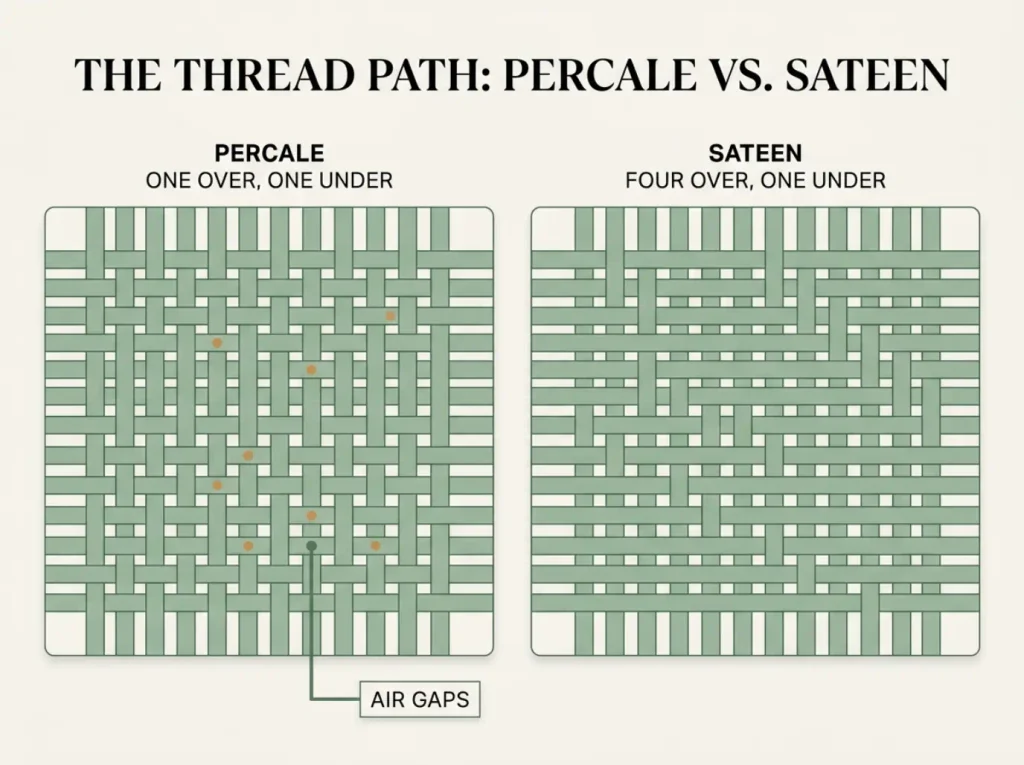
Percale is one thread over, one thread under: a plain grid with gaps in it, and gaps move air. Sateen floats four threads over one, which is what produces the sheen, and what closes the surface. There is no grid left for air to pass through.
Hold both up to a lamp and you can see it in three seconds. The percale shows points of light coming through the weave, and the sateen glows evenly because there is nothing to see through.
That closed surface is why sateen feels smoother against skin and why the heat has nowhere to go. Breathability is not a property the fiber owns; it is a property of the holes, and sateen has fewer of them.
The other number worth knowing is grammage, sold as GSM, which is simply how much fabric is there per square meter. A heavier sheet holds more heat regardless of what it is spun from, and nobody prints it on a bamboo package. If you want the full teardown, that is percale against sateen, thread by thread.
This is also why the fiber comparisons people reach for miss. Long-staple cotton in a percale outperforms bamboo viscose in a sateen, and a microfiber sheet, polyester spun fine and sold cheap, traps heat harder than either. Packages carrying the phrase “cooling technology” are worth a moment on this point: nobody certifies those two words, and there is no test standing behind them.
Now put a number on the fiber side. A comparative study in the Journal of Consumer Sciences measured regenerated bamboo fabric’s water vapor resistance at 5.9 Pa·m²·W⁻¹, which is comparable to cotton and to ordinary viscose rayon, with no statistically significant advantage.
Separate work comparing bamboo and cotton in a warm environment lands in the same place: both have low thermal conductivity, and how the fabric handles moisture tracks the weave and the finish, not where the cellulose came from. The fiber is not the variable. It has never been the variable.
Which brings up the contradiction printed on the same package. Almost every bamboo sheet set on the market is woven sateen, because the silky drape is the entire selling point and percale would take it away. So the word “cooling” and the construction choice are arguing with each other across two inches of cardboard, and the construction wins every night.
This is where the r/Bedding hot sleeper’s night three comes from. The set felt cool and silky climbing in, and by three in the morning they described waking drenched, then too cold to get out of bed because they were soaked. That is not a bamboo outcome. That is a sateen outcome wearing a bamboo label.
The TOSMO Luxury Cooling Sheet Set is the default configuration written out in full, and worth naming precisely because it is typical rather than because it is a pick: 100% bamboo viscose in a sateen weave, OEKO-TEX certified, 16-inch pocket depth.
Its flaw is the article’s whole argument: it is viscose, regenerated rayon rather than woven bamboo, and the fiber does not measure differently from cotton in a lab, while sateen is precisely the weave that releases heat worst. The certification is real and settles a safety question about what is left in the fabric. It does not settle a temperature one, and OEKO-TEX has never claimed it does.
You already own the test. Take a sheet you know sleeps hot and one you know sleeps cool, hold each against a bare bulb, and look at the light. The one that shows a grid of pinholes is percale. The one that glows like a single sheet of paper is sateen, and that difference will predict the temperature better than any word on either label did.
The One Bamboo That Genuinely Runs Cool
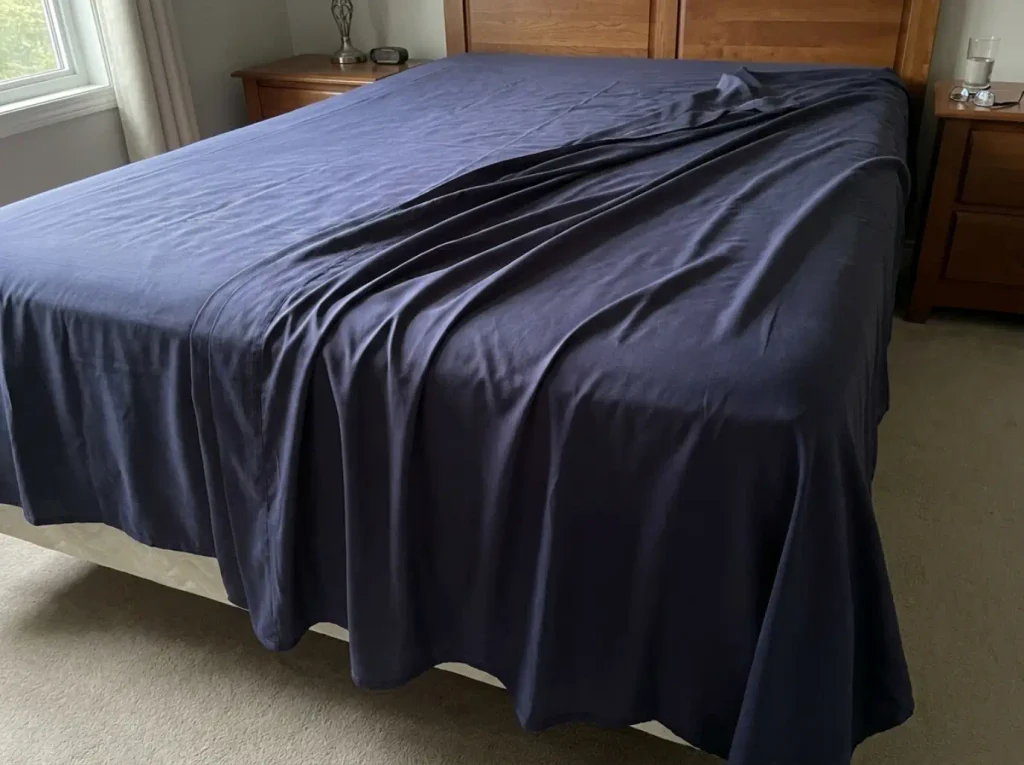
After two sections of taking a label apart, the fair question is whether any bamboo is worth buying. There is one, and the word that identifies it is on the tag if you know to look past the first one.
Lyocell is a closed-loop solvent process, and closed-loop manufacturing is the whole distinction. No caustic soda, no carbon disulfide, an organic solvent that is recovered and reused rather than discharged, and a fiber that comes out with a different structure and a genuinely different hand.
“Bamboo lyocell” and “bamboo viscose” are two different fabrics that happen to share a plant, and the word that tells you which one you are holding is the second one, not the first. Tencel is a brand name for lyocell, which is why Tencel and eucalyptus turn out to be the same conversation. The plant is the least important variable in the sentence, and always was.
Worth knowing what the other certifications on these packages cover, while we are reading tags. GOTS, the Global Organic Textile Standard, certifies organic fiber content and processing conditions. Neither it nor OEKO-TEX measures how a sheet behaves at two in the morning, and neither one pretends to.
One caution on the numbers brands print alongside the word. There are named, repeatable ways to measure this: the AATCC’s own standardized moisture-wicking test methods: TM195 for liquid moisture management, TM197 for vertical wicking, TM198 for horizontal. When a brand says its fabric wicks some specific percentage faster, the question is whether that figure came from one of those, or from a private study with no published method or sample size. A brand citing its own unnamed research when a public standard exists for the exact claim is making a weaker argument than it sounds like.
The ettitude 100% Lyocell from Organic Bamboo Sheet Set is what the exception looks like when you can actually buy it. It is 100% CleanBamboo lyocell made through that closed-loop route, OEKO-TEX Standard 100 Class 1, 17-inch pocket depth.
Its flaw arrives fast, and from verified buyers rather than from critics: pilling and pulls on the top sheet after roughly three or four gentle-cycle washes, on a set that costs several times what a good cotton percale does. A separate buyer reports that the thick folded hem on the fitted sheet runs noticeably warm against the neck. The better process buys a better fiber. It does not buy immunity from the wash.
And there is a limit built into the fabric itself that the sales pitch never mentions: lyocell in sateen is still sateen. The process fixes the fiber; it leaves the construction exactly where it was.
A bamboo lyocell sateen set is one improvement away from the problem rather than two, which means the reader who upgrades on the strength of the word “lyocell” alone lands on a smoother, better-made version of the same closed surface. That is a real improvement. It is not the improvement they thought they were buying.
Check the Bed Before You Change the Sheets
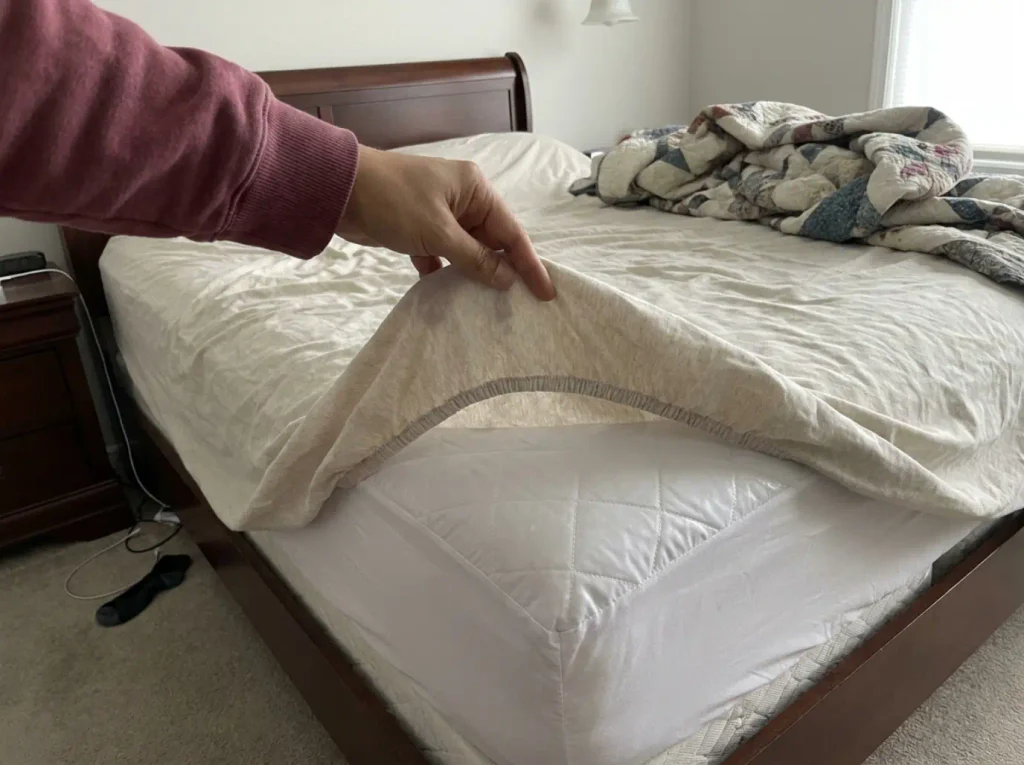
The sheet gets blamed because it is the layer touching your skin. It is usually not the layer doing the damage, and the things that are cost nothing to test. This section runs against the four things that actually decide whether a sheet sleeps cool, applied to one fiber and one bed: yours.
Start under the sheet. Peel the fitted sheet back and look at what is on the mattress. A polyester-membrane mattress protector is a raincoat, and no fiber above it can move moisture that has nowhere to go once it reaches the plastic. This is the single most common culprit for a damp morning and most people never look, because the protector went on once, years ago, and became furniture. Free to check tonight.
Then read the thread count. Anything above 400 is usually reached by twisting two thin plies together and counting both of them, so the number describes a denser fabric rather than a finer one. A high-count sateen is the warmest thing on the bed while its label reads like the premium option, which is what a thread count over 400 is really counting. Single-ply in the 300 range, in an open weave, beats it for sleeping cool and costs less.
Then look at how you wash it. Fabric softener leaves a coating on the fiber and hot drying bakes it in place, and that coating is what ends the wicking. Not age. A cold water wash on the gentle cycle, a mild enzyme-free detergent, no softener, tumble dry low or line dry. The community’s own cheapest fix is exactly this, and it is free: skip the softener and the high heat for a month before deciding the fabric failed.
Then measure the mattress. Deep-pocket bamboo sets commonly run 16 to 17 inches, which sounds generous until there is a topper on the bed. Measure the mattress depth with the topper on it and add two inches. That is your minimum.
The pocket-depth failure has a tell worth knowing, too: the fitted sheet holds three corners and lets go of the fourth, always the same one, because that is the corner you pull first getting in. People report that sheet as defective. It is a quarter inch short.
And if it is a shared bed, check both halves. One of you runs hot and the other reaches for a blanket, and a single sheet cannot be two temperatures. Before replacing the set, try separate top layers over the same fitted sheet — the fitted sheet is the one that has to fit, and the layers above it are where two people stop having to agree.
If you have run all four and still want a different sheet, the honest answer is a weave change, not a fiber change. The Feather & Stitch 100% Cotton Percale Sheet Set is that change written plainly: 100% cotton in a one-over-one percale, 300 thread count single ply, 16-inch pocket, and a fraction of what the lyocell costs. Its flaw is the one you will feel on the first night: percale will never have sateen’s sheen or its soft drape, it is crisp rather than slippery, and if what you liked about the bamboo was the hand rather than the temperature, this will disappoint your fingers while it fixes your sleep.
What Happens by Wash Twenty
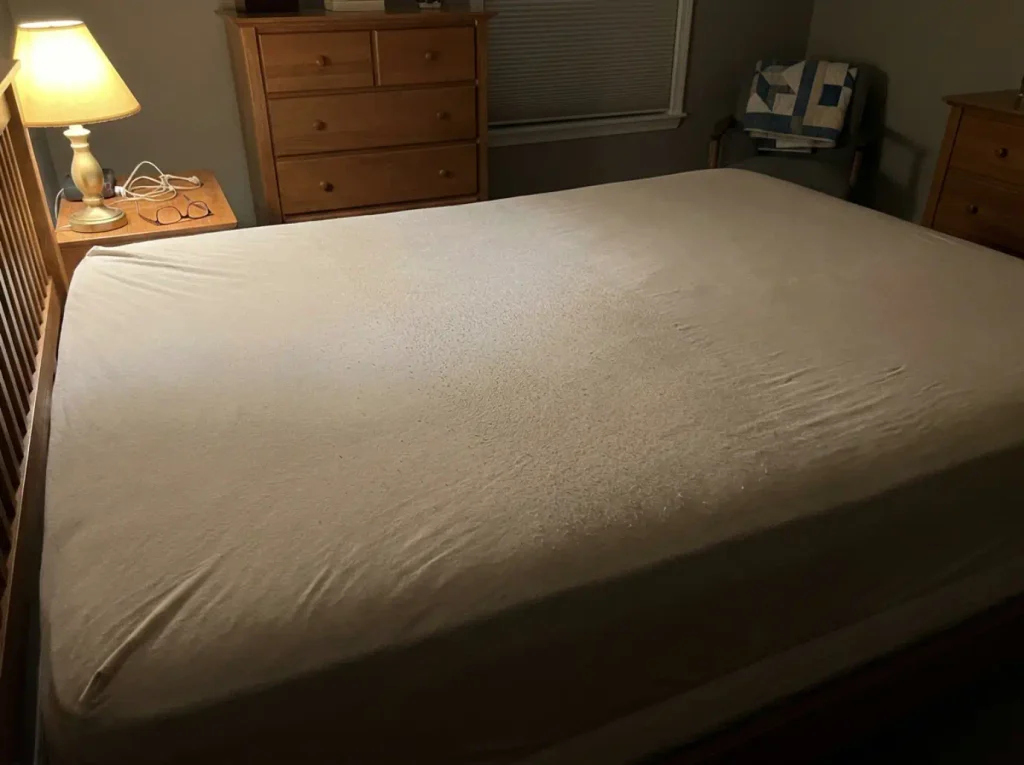
Everything feels good after the first wash. That is what the first wash is for. The question nobody in this category answers is what the set is doing in month six, when it still looks fine and quietly stopped working.
Bamboo viscose is reported to pill, thin out and stop wicking within six to twelve months. That figure comes from a lyocell seller taking a swipe at its competitors, which is worth saying out loud, but it matches what buyers report independently.
The cooling fades well before the sheet looks worn, which is why people end up replacing sets that appear perfectly good and cannot articulate why. Paying more buys no extra time either: that verified buyer’s lyocell set pilled at three or four washes.
And an r/Bedding sleeper with restless legs wore visible holes through bamboo sets inside a year, more than once, describing the same fabric as incredibly soft and not in the least bit durable in a single breath. Softness and lifespan are not the same purchase.
The pilling does not arrive evenly, either, and it does not announce itself. It starts as a haze you feel before you can see it, and the real tell is that the sheet stops sliding under you when you turn over. The set that felt slippery in week one now catches slightly on skin, and that catch is the surface fibers standing up just before they ball.
Because the thinning starts where your weight rests, the fitted sheet goes first and the flat sheet and the pillowcases stay fine, so the set fails unevenly rather than wearing out together. Look at the middle third of the fitted sheet under a raking light. That is the review.
There is one more layer to this, and it applies to every fabric sold on a feeling. The finish is the part that leaves. A resin or silicone hand-feel finish is what makes a set feel cool and smooth in the store and it is gone in a season of washes, leaving the fabric you actually bought. That is why the twentieth wash is the honest review and the first one is an advertisement, and it is also what you give up going down a tier, because the cheap sets lean hardest on the finish to carry the first impression.
The usual advice is to buy the better fiber and expect it to last longer. After enough of these wash reports, I would rather buy the better construction: a single-ply percale in a moderate count has less to lose, because nothing about how it sleeps depended on a coating in the first place. Whether the word “cooling” on a package buys anything at all over a plain sheet is whether the cooling label adds anything at all, and it is a shorter answer than this one.
If you share the bed, run the free checks on both halves separately before you buy anything. One sleeper’s chronic heat is not solved by changing the other side’s fabric, and a viscose sateen set that runs warm for the hot sleeper often reads as a genuine upgrade for their partner, which is how a set ends up defended and resented in the same bedroom.
The Short Version
“Bamboo” is a raw material, not a fiber. Read past it to “viscose,” “rayon” or “lyocell,” because that second word describes what you will actually sleep on, and only one of the three was made in a closed loop.
The weave decides more than the fiber does. A bamboo viscose sateen and a cotton percale are not close, and the percale is the cooler one. Any bamboo set sold on a cooling claim while woven in sateen is contradicting itself.
Look under the sheet before you replace it. The protector, the thread count and the wash routine account for most of the heat people blame on the fabric, and all three are free to check.
The wash-twenty check: after a season of washes, look at the middle third of the fitted sheet under a raking light. If the surface has hazed and the sheet has stopped sliding when you turn over, the cooling is already gone even though the set still looks new.
So, tonight: strip the bed and look at what is between the sheet and the mattress. Wash the set with no softener, dry it low, and sleep on it for a week before you buy anything at all.
Frequently Asked Questions
01What is the downside to bamboo sheets?
They are viscose rather than woven bamboo, and they are sold almost exclusively in sateen, the weave that releases heat worst. Durability is the second problem: pilling within six to twelve months is commonly reported, and the wicking fades before the sheet looks worn out.
02Are there any cooling sheets that actually work?
Yes, but the ones that work do it through weave and weight, never through the word on the package, which nobody certifies. An open percale in a moderate single-ply thread count outsleeps most sets marketed as cooling, and it does not depend on a finish that washes out.
03Why do I sweat so much with bamboo sheets?
Most likely the sateen weave and whatever sits under the sheet, not the bamboo itself. A polyester-membrane mattress protector traps the moisture the fabric moved, and a thread count above 400 makes the fabric denser rather than finer. Check both before changing the sheet.
04Is cotton or bamboo better for hot sleepers?
The weave settles it before the fiber gets a vote: a cotton percale beats a bamboo sateen, and a bamboo percale beats a cotton sateen. Compare construction first, then fiber, as the full bamboo against cotton comparison for hot sleepers lays out.
Leave a comment
Slept on something we got wrong, or found a set that held up? Say so here. Your email stays private.