Cheap Cooling Sheets — Percale Costs the Same at $35
Don't pay more for a cooler bed. Percale breathes by its weave at any price — what $35 actually cuts is staple length, and it shows at wash ten.
 Alfredo Ramses Textile engineer · 2 September 2026 · 23 min read
What’s in here 7 sections
The search itself carries an assumption: that “cheap” and “cooling” pull against each other, and that a $35 set is the watered-down version of a $350 one. For the cooling part, that assumption is wrong.
Percale is a plain weave, one thread over and one under, and that structure leaves gaps for air to move through. The gaps do not get bigger when the price goes up. Four things decide how hot a sheet sleeps: the fiber, the weave, the weight in grams per square meter, and the finish. The price tag only touches one and a half of them.
So the useful question about cheap cooling sheets is not whether they can sleep cool. It is what the low price actually cuts, and when you find out.
Quick Answer
Yes, a sheet set under $50 can sleep genuinely cool, as long as it is a cotton percale. Airflow comes from the weave, and the weave is identical at any price. What the low price cuts is staple length and finish durability, and that shows up around wash ten, not wash one.
What “Cooling” Actually Costs, and What It Doesn’t
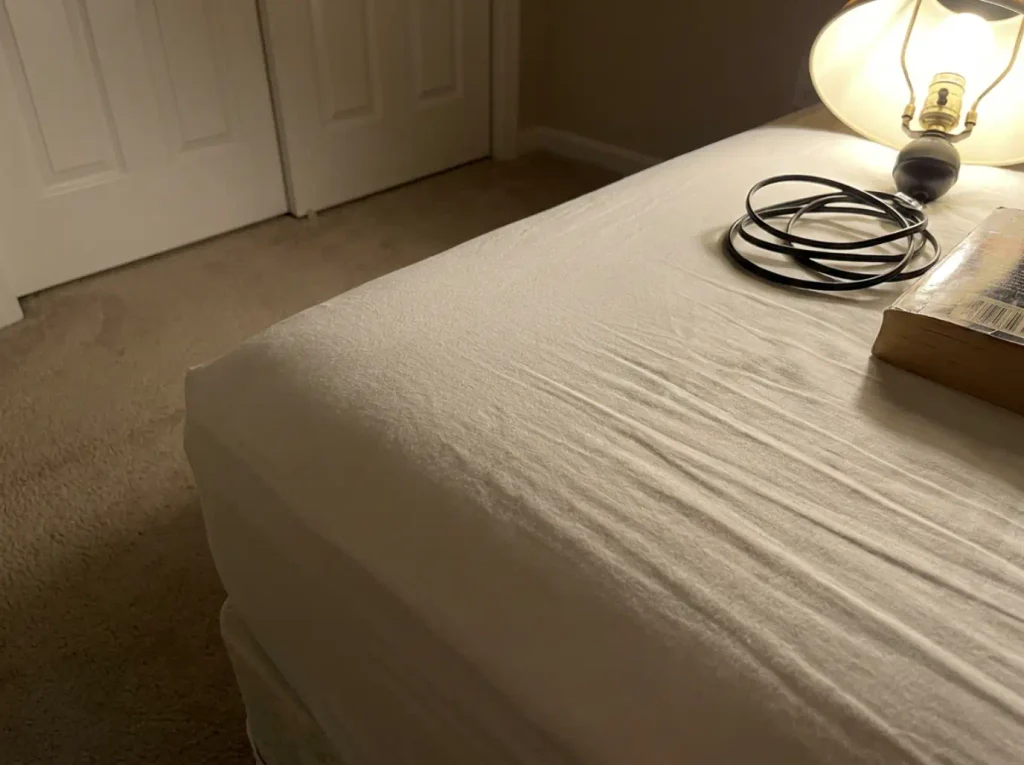
Two listings sit side by side at nearly the same money. One is a 200-thread-count cotton percale. The other is a synthetic set with a four-figure number on the front and the word “cooling” in the title.
You have been told for years that the cheaper option must be worse at everything, so you assume the temperature question is decided by which one you are willing to spend more on. It is worse at some things. Temperature is not one of them, and what actually decides whether a sheet sleeps cool has nothing to do with what you paid.
Percale is a structure, and structures don’t have a price
Percale is a plain weave: one warp thread over, one weft thread under, repeated across the whole cloth. That over-under alternation is what makes the fabric flat and slightly open, and the small regular gaps between the crossings are the airflow. When people say a percale feels crisp and cool, that hand is the structure they are describing.
Nothing about that structure changes with money. The loom does the same thing on a $35 set that it does on a $350 one. A weave is a geometry, and geometry does not have a price tier. When a listing says percale and it is telling the truth, the breathability is already settled before you look at anything else on the label.
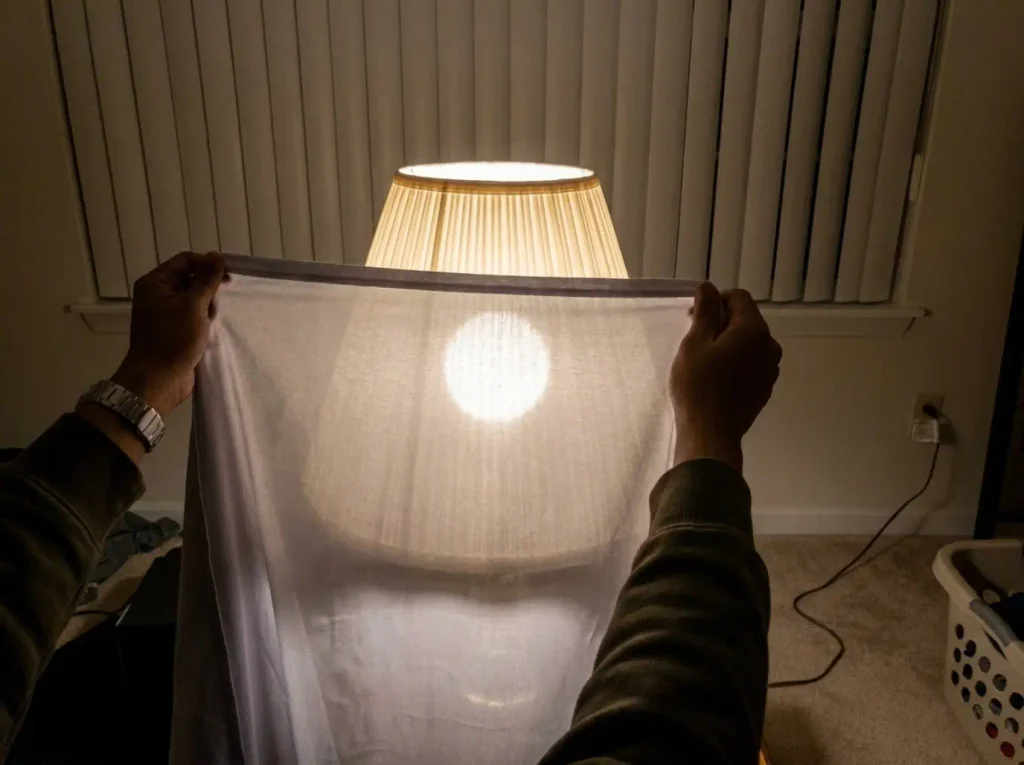
Hold a percale sheet up to a window before you wash it the first time. A true plain weave shows a faint regular grid where the light comes through the crossings. A brushed synthetic sold as percale shows nothing but a haze, because the brushing has closed the surface. It is the cheapest fabric test there is, and it works on a set you already own.
The four things that decide heat, and which one the money touches
The fiber decides whether moisture gets absorbed into the thread or shoved along its surface. Cotton takes it in. Polyester does not. The weave decides whether air can move through the cloth at all.
The weight, measured in grams per square meter, decides how much material is sitting on you: cotton sheeting runs roughly 110 to 170 GSM, microfiber 90 to 120. And the finish is whatever was applied on top after the fabric was made, which is usually what you are feeling when a set seems remarkable in the store.
Price buys the fiber quality and part of the finish. That is it. It buys none of the weave and almost none of the weight. Which means the two variables most responsible for how a summer night goes are already free.
Where the money does show up is in the fiber’s name. Pima cotton and Supima cotton are long-staple grades, and lyocell is a regenerated cellulose fiber with its own drape, and all of them sit above this tier, and none of them beats a plain weave for airflow. They are buying you a different hand and a longer life, not a cooler night.
And “cooling” is not a fifth variable, because it is not a measurement. Nobody certifies it, no standard defines it, and nothing stops any manufacturer from printing it. What “moisture-wicking” means on a package is the same kind of claim: a description of a behavior nobody is measuring. At the budget tier, what usually carries both words is polyester.
Why nobody prints the GSM
GSM is the honest number, and it is the one number you will almost never find on a sheet listing. Thread count sells because it is big and it goes up. Grammage does not sell, because 130 sounds like nothing and because a heavy fabric is not automatically a better one, and it depends entirely on what you want the fabric to do. So the number that would let you compare two sets in five seconds is the one the industry leaves off.
You are left judging it by lifting the set, which sounds unscientific until you have done it twice. A percale in the right range has a papery snap to it and very little drape. If it flops over your hand like a t-shirt, something has been brushed, and brushing is the enemy of the gaps.
Thread count on a percale sits lower than people expect, and that is normal rather than a warning sign. As Sleep Foundation’s thread-count guide explains, percale and sateen simply run different thread-count ranges. Percale averages 180 to 200, sateen 250 to 300 at equivalent quality.
A 180 on a percale label is the weave behaving correctly. The thread count sweet spot people repeat is a sateen number wearing a percale’s clothes, and comparing the two is comparing different things and concluding the wrong one.
One more thing about the first week, and it is the reason so many reviews are useless. A new percale is crisp partly because of starch, not only because of structure. Wash it five times and the finish is gone, and what is left is the actual fabric you bought.
That is the first honest look you get at it, and almost nobody waits for it. The running verdict across several r/Bedding threads is exactly that: the question was never whether a set sleeps cool. It was how many washes before it pills. The wash count, not the price, is the number that settles a budget set.
What a $30-50 Set Actually Is
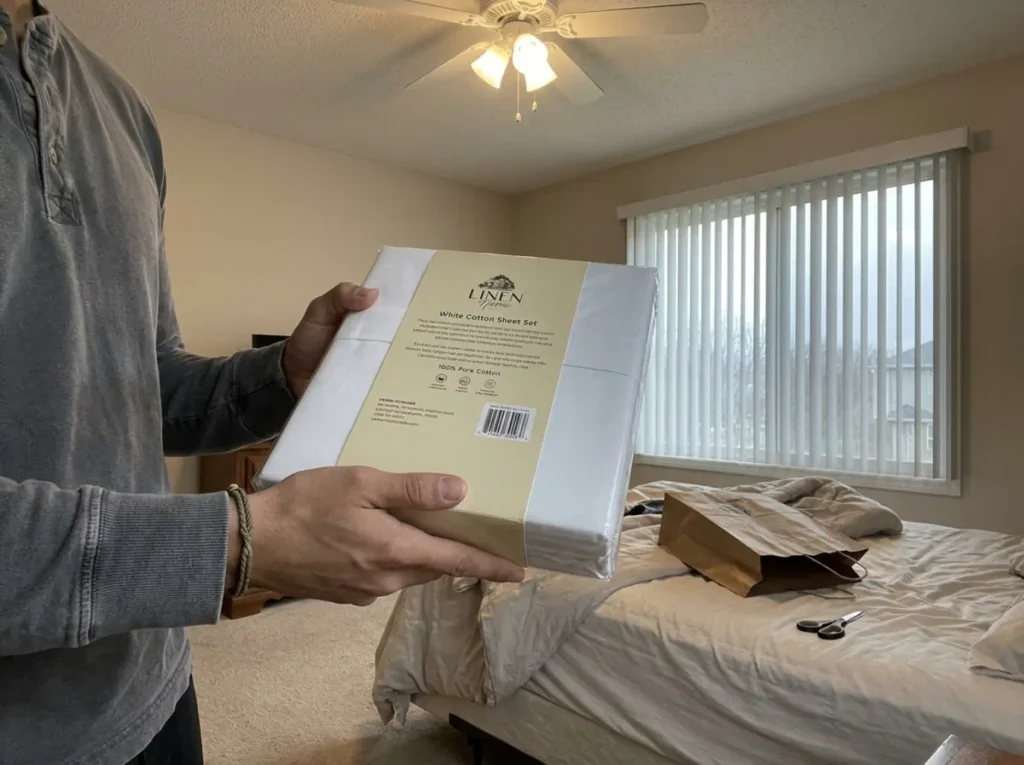
Somebody who has read forty of these listings would tell you the same thing in one sentence: the good cheap sets tell you four things, and the bad ones tell you one number. That is the whole reading test at this price, and it takes about eight seconds to apply once you know what the four things are.
The four things an honest cheap listing tells you
The weave. The fiber. The thread count. The pocket depth.
A budget listing that states all four in plain language is a listing with nothing structurally embarrassing to hide, because each of those four is a claim that can be checked against the sheet in your hands.
That check applies to every piece in the bag, not just the fitted one: the flat sheet and the pillowcase come off the same bolt of cloth and fail the same way. A listing that gives you a giant number, a mood photograph and the word “cooling” is giving you the one claim nobody can check.
That is not a guarantee of quality. It is a filter, and at this price a filter is what you need. You are not choosing between a great set and a mediocre one. You are choosing between a set that is what it says it is and a set that is hoping you never look.
The Linen Home 100% Cotton Percale Sheet Set passes that filter and is the reason the filter is worth stating. It names its weave (percale), its fiber (100% cotton), its thread count (200) and its pocket depth (15 inches) on the label, and it carries an actual OEKO-TEX Standard 100 certificate number rather than a vague safety badge. It sits at 4.2 stars across more than fifteen thousand ratings, which is the kind of volume where a set with a structural problem has usually been found out.
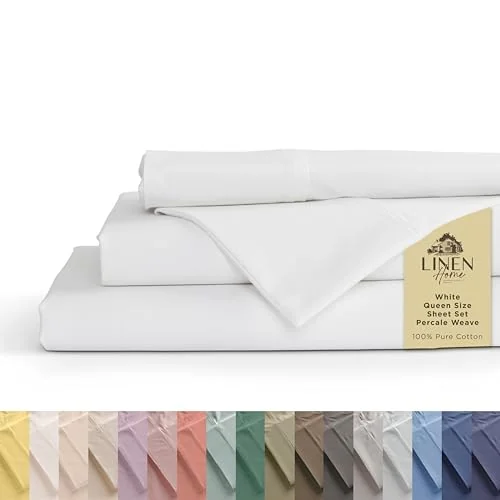
About that pocket number, since it is one of the four and the one most often misread. The depth on the package is the reach of the elastic, not the depth it will hold. A set that says it fits up to 15 inches will stretch onto a 13-inch mattress with a topper and stay there, and will fight you on anything more.
You find that out the first morning you wake up with the corner bunched under your shoulder, which is not a failure of the elastic. It is two inches of mattress the sheet was never sized for, and on a deep pocket mattress it is the spec that disqualifies a set before the fabric ever gets a hearing.
The number that lies, and the number nobody prints
At this tier a percale in the 180 to 250 range is normal and correct. Above roughly 600, the number stops describing what you think it describes. High counts are usually reached by twisting two or three thin plies into one yarn and counting each ply separately, so an 800 is often 400 real threads wearing a costume.
The result is a denser, heavier, warmer cloth than the honest lower number would have given you. That is the high thread count myth in one sentence, and it matters here because on a budget listing the four-figure count is doing marketing work, not quality work. If you want the full version of what a thread count number is actually counting, that is its own subject.
The number that would tell you something is the GSM, and it is not there. So you are back to lifting the set, and to the one spec the listing structurally cannot give you: staple length.
Nothing on a $35 package will tell you whether the cotton was long or short before it was spun, and staple length is the thing that decides when the pilling starts. That silence is not a specific brand being cagey. It is the whole tier.
What OEKO-TEX certifies, and what it doesn’t
OEKO-TEX Standard 100 certifies the finished product against harmful substance levels: the fabric, the thread and the dye are tested against more than a thousand regulated and unregulated substances for skin contact. That is a real test and a real certificate, with a number you can look up.
And it says nothing at all about weave, fiber quality or durability. A set can be certified and pill in six months, because those two claims are not related. Budget listings lean on the certification for the reason anybody leans on anything: it is the claim that is easiest to earn. Read it as “safe to sleep on,” not as “built to last,” and it stops being misleading.
Worth adding, because it complicates the tidy version of this story: the pilling threads on r/Bedding are not about unbranded listings. Titles like “HELP sheets pilling” and “DO NOT purchase 300tc percale sheets from Land’s End” are about named-brand percale from established retailers. The risk of a short-staple set is not confined to the obviously generic end of the shelf, and paying a familiar brand’s markup does not buy you out of it.
The Synthetic Cooling Trap
Now the other listing. Same money, sometimes more, and it sounds like the upgrade: a four-figure thread count, double-brushed, and the word “cooling” doing all the persuading.
This is where the real failure at this budget happens, and it is worth being precise about what the failure is. It is not spending too little. It is spending it on a fiber that cannot do the job the label promised. Synthetic cooling sheets are not a cheaper version of the cotton ones. They are a different product answering to the same word.
Why a four-figure thread count on polyester means nothing
An 1800 on a synthetic listing is a real number in the sense that somebody counted something. It is meaningless as a temperature signal, because on a synthetic the fiber has already decided the outcome before the weave gets a vote. You cannot weave your way out of polyester.
Cotton takes moisture into the fiber itself. Polyester does not; it pushes moisture along the surface and calls that wicking, which works beautifully in a running shirt with air moving over it and works badly under a duvet where there is nowhere for it to go. That is why a microfiber set feels genuinely cool to the hand in the store and warm against a back at three in the morning. A trash bag is also cool to the touch.
The finish is temporary; the fiber is not
Double-brushed microfiber is brushed on both faces to make it feel soft, and the brushing is what thins it. You are getting softness by abrading fiber ends up out of the surface, which is fabric you no longer have holding the cloth together. The softness is real. It is also borrowed.
That is the distinction the whole category rests on: a finish is a temporary property of a fabric and a fiber is a permanent one. Every treatment sold as cooling sits on the surface, and surfaces wash off. The polyester underneath is there for the life of the sheet. If you want the longer version, what microfiber actually is under the marketing is a subject in its own right, and it is less flattering than the listings suggest.
A verified purchaser on one of the biggest of these listings put the arc plainly. After about ten days and a single wash, done cold on gentle with minimal detergent and low heat, everything the label asks for, the set was thin enough that “you can see the Kleenex logo on the tissue box through the sheet.” Their phrase for it was the equivalent of one-ply toilet paper. The same buyer notes an earlier cotton blend from the same household still went pilly within a couple of years, which is the honest complication: cotton is not immune, it is just slower.
The set that costs the same and does less
Here is the sharp version, and it is the reason this section exists at all. The synthetic set marketed on the cooling word frequently costs the same as or more than an honest cheap percale, and it performs worse at the exact thing it is named after. The trap is not a cheap product. It is a correctly priced product sold on a claim its fiber cannot make good.
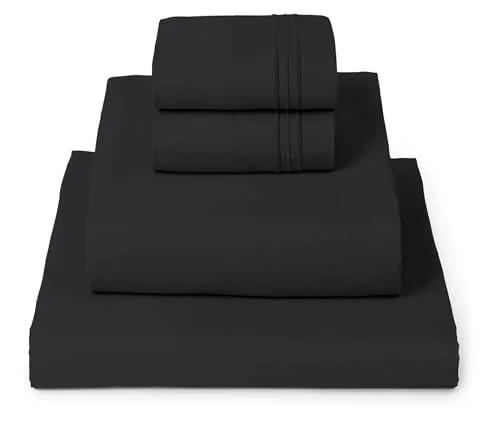
The set below is that object. It is here as evidence, not as a recommendation. It is what the paragraph above is describing, so you can see what the listing looks like when you meet it.
Pilling on a brushed synthetic does not look like pilling on cotton. It goes shiny before it goes bald, and the sheen shows up in a patch roughly the shape of a sleeper, right where hips and shoulders have been working against it. That patch is usually the moment somebody finally turns the sheet over and reads a label they never read when they bought it.
The same question gets asked with a different fiber in the starring role, and it deserves the same treatment. The same question asked about bamboo lands in nearly the same place, because bamboo viscose is also a fiber sold on a cooling claim that the weave has to make good on.
Wash Ten to Twenty, Which Is Where the Money Shows
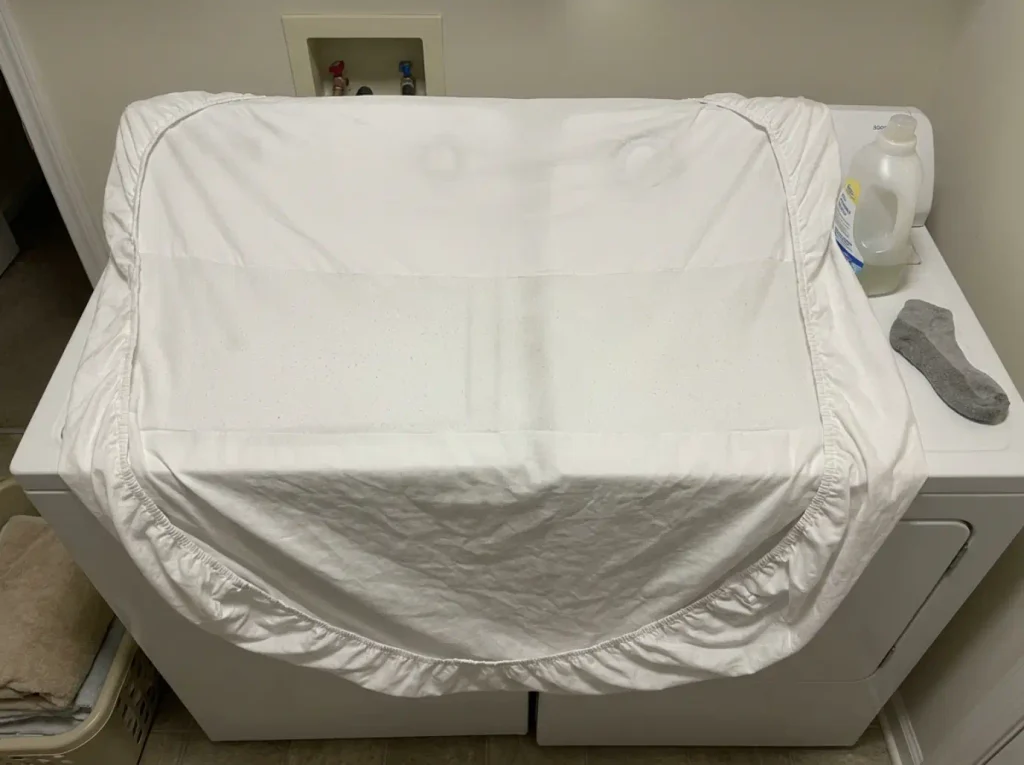
Week one lies. Almost every set feels good after the first wash, which is why the reviews are worthless and why the roundups test five washes and stop. The question a friend actually wants answered is what the bed looks like at the end of a summer.
Staple length, and why it decides everything the price touches
Cotton fiber comes off the plant in lengths, and the length is fixed before anything else happens to it. Spin short fibers into yarn and you get many more loose ends poking out per inch of thread. Every one of those ends is a place where friction can start rolling fibers into a ball. Spin long ones and there are far fewer ends to begin with.
That is the entire mechanism, and the numbers are not subtle: short-staple cotton fiber is the one that pills first, often within 20 to 30 wash cycles, while long-staple resists visible pilling past 100.
Same weave. Same care. Different fiber, and a gap of roughly four to one in how long the set stays presentable. This is what staple length is and why the label avoids the word, and the avoidance is not accidental.
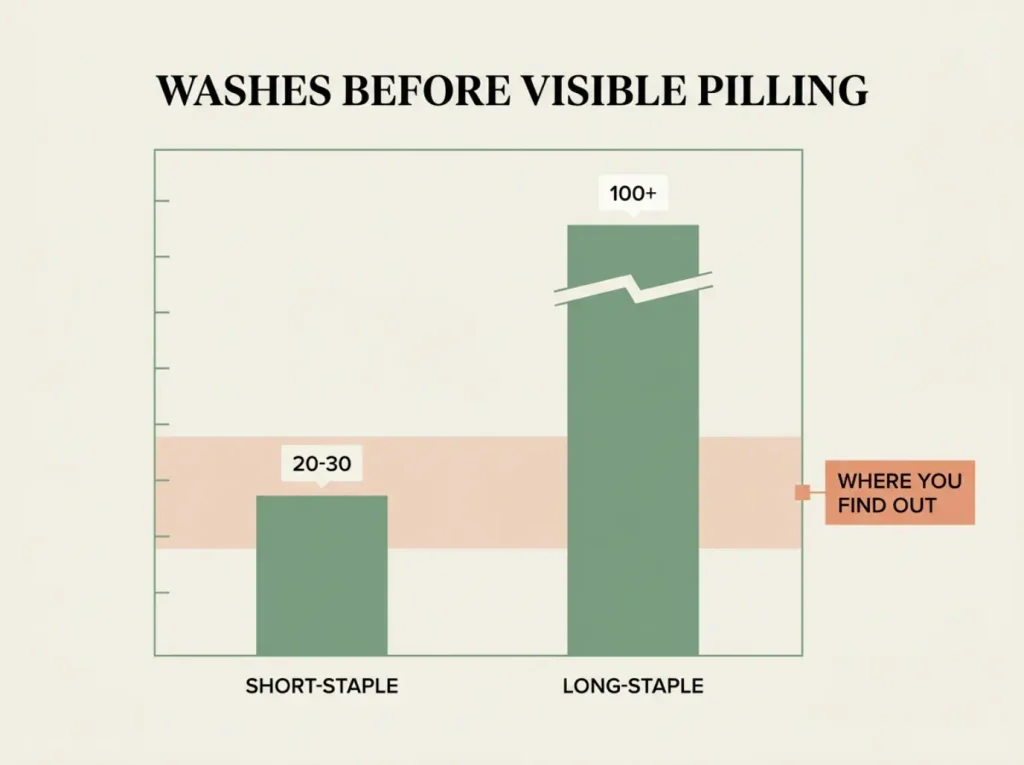
So the trade at $35 to $50 is not cooling versus not-cooling. It is roughly 12 to 18 months of pilling-free use against several years, on a set with the identical weave and the identical airflow.
That is a real cost and worth knowing before you buy. It is also a completely different cost from the one the search assumed you were paying. Which weave you chose still matters more than what you paid for it, and which weave lasts longer once the washes add up is the other half of that answer.
Pilling also does not arrive evenly, which is why folded-in-the-closet inspections tell you nothing. It shows up first as a band across the middle of the fitted sheet where hips and shoulders move against the cloth all night, and on the top sheet only where a knee has been. A set that looks perfectly fine in the linen closet can be finished on the bed.
The finish leaves around wash ten
Whatever treatment sits on a budget set, the coating that made it feel cool in the store or the sizing that made it feel crisp, is gone in about ten washes. What is underneath is whatever the fabric always was.
On an honest percale that is good news, because the fabric underneath is a plain weave in cotton and it was doing the actual work the whole time. On a synthetic sold on a cooling finish, wash ten is when the product you were sold quietly stops existing and the product you bought takes over. Same sheet, both times. Only one of them survives the reveal.
Skip liquid fabric softener and dryer sheets on any cotton percale, cheap or not. Both work by depositing a waxy coating on the fibers, which closes the gaps that were doing your cooling and leaves the fabric feeling softer and sleeping warmer. If a percale has gone stiff, half a cup of white vinegar in the rinse does the job without coating anything.
The hot wash a cheap synthetic quietly takes away from you
There is a second cost to a delicate set, and nobody counts it. AAFA’s guidance on washing bedding at 130 degrees or above is one of the two things that actually controls dust mites in a bed. A fabric that can only be washed cold, because the finish will not survive heat or because the synthetic will pill faster if you push it, has given that option up for the life of the set.
Cotton percale takes a hot wash without complaint. It is the least glamorous advantage it has and possibly the most practical one, and it never appears in a comparison because it is not a feature anybody thought to sell.
The community’s own answer to all of this is the thread titled “Broke but tired of cheap sheets,” and the advice that keeps coming back in it is to stop replacing a $20 set every year and buy one better set instead. That is right, and it needs one correction: the treadmill is almost always built out of synthetic sets, not out of honest percale. A $35 cotton percale that lasts a year and a half is a different proposition from a $20 microfiber set that goes see-through in a season, and lumping them together as “cheap sheets” is how people end up concluding that budget bedding cannot work.
The Moves That Cost Nothing, and the One Step Up
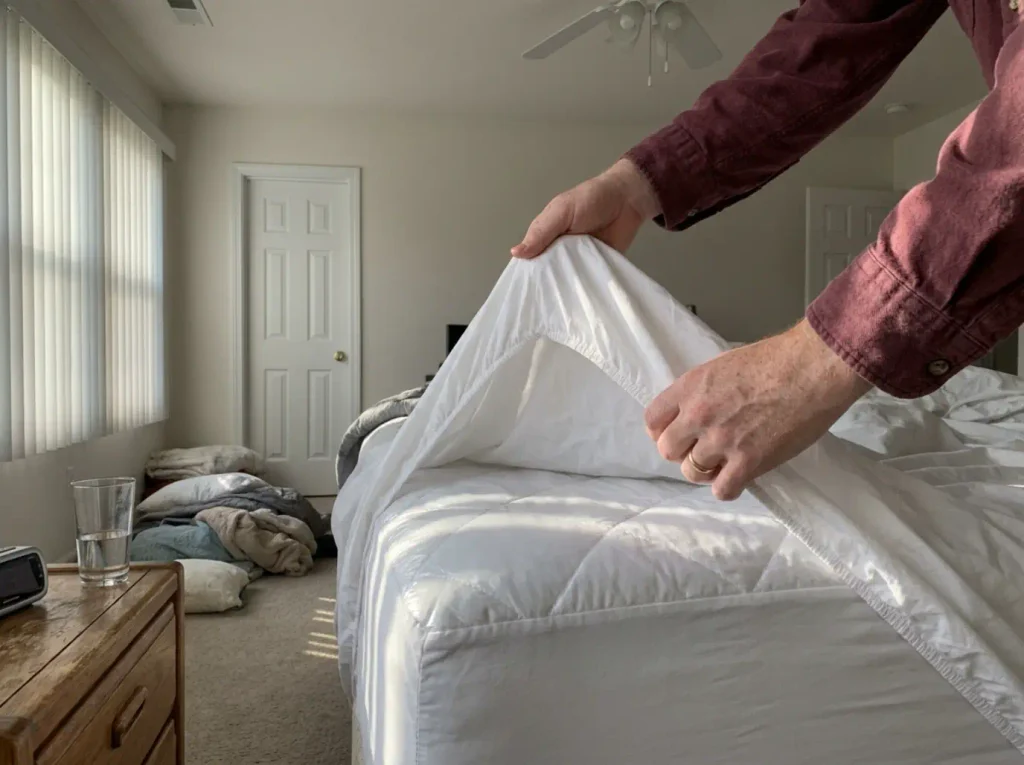
Before you spend anything at all, there are three things to rule out, and two of them are free. Most damp mornings at this price point trace back to something that was never the sheet, which is inconvenient for an article about sheets and true anyway.
Take the top sheet off first
Take the top sheet off tonight and sleep under the duvet cover alone for a week. It costs nothing, it takes four seconds, and for most hot sleepers it does more than any fabric change will.
The reason it works is that the top sheet is the layer that gets thrown off at two in the morning, not the duvet. It is an extra layer of trapped air between you and a cover you were probably going to keep anyway, and removing it takes the whole stack down by one without changing anything you own. Try it before you buy, because if it fixes the problem you have learned something about your bed that no sheet purchase would have taught you.
Look under the sheet, then look at the room
Then lift the fitted sheet and look at what is under it. A polyester mattress protector is a raincoat, and it is the single layer that the largest share of damp mornings trace back to. Nothing you put on top of it gets through it: not percale, not linen, not a $350 set. People replace sheets twice before they ever check the protector, because it is the one layer of the bed nobody thinks of as a layer.
And then the room, which the sheet cannot argue with. A foam mattress stores heat and gives it back all night; a bedroom above 68°F fights every layer on top of it. Neither is a bedding problem, and both are worth ruling out before you conclude the fabric failed you.
A fan moving air across the bed changes more than a fabric swap does, and it is already in the closet. If you share the bed with a cold sleeper, that fan is also the only fix here that one of you can have without the other losing anything.
Measure the mattress with the topper already on it, then add two inches, and buy for that number. Measuring the bare mattress is how a 15-inch pocket ends up two inches short, and the corner you sit on to put your shoes on is always the first one to pop. If you share the bed, measure it made rather than stripped — a mattress protector and a topper together are easily an inch and a half nobody counted.
If you buy, buy the weave
When you do buy, buy the weave and not the number. At $35 to $50 an honest percale that names its four specs beats a synthetic marketed on the cooling word every single time, and it is not close. That is the whole verdict, and it is worth holding onto if you are also wondering whether the cooling label is worth paying for at all at any price.
Moving one rung up the ladder is a reasonable thing to do, as long as you know what you are buying. A Feather & Stitch 100% Cotton Percale Sheet Set is the same plain weave at 300 threads with a 16-inch pocket, and the step up does not buy a cooler bed, because the weave already decided that, and it decided it identically at 200. What it buys is longer before the pilling starts, plus two extra inches of pocket if your mattress needs them, and even here it is not an extra-long-staple percale, so the runway is longer rather than unlimited.
The other honest answer is to keep the cheap percale and launder it carefully. Cold wash, gentle cycle, minimal detergent, low heat or a partial air-dry: that is the community’s standard workaround, and it genuinely extends the runway. It also does not change the fiber. You are slowing the clock, not stopping it, and that is a fine deal at this price as long as nobody has told you otherwise.
Once the sheet question is settled you still have a comforter, a protector and a topper to sort out, and each of them is a bigger temperature lever than the last twenty dollars of sheet budget would have been, and the rest of the bed on the same budget is the next thing to work through.
Conclusion
Percale breathes by its weave, and the weave is the same at $35 as it is at $350. The cooling half of “cheap cooling sheets” is not where the compromise lives, and the search that brought you here was built on the assumption that it was. Budget cooling sheets are a real category, not a contradiction, as long as you know which half of the promise the money was buying.
What the low price actually cuts is staple length and finish durability, which buys you roughly 12 to 18 months of pilling-free use instead of several years. That is a real trade and worth going in with your eyes open about. It is also a different trade than the one you thought you were making.
And the failure mode at this budget is not spending too little. It is buying the wrong weave with the money you did spend, because a synthetic marketed on the cooling word costs the same and does less.
After a season of washes, check the band across the middle of the fitted sheet where hips and shoulders move against it — not the folded stack in the closet, which lies. That band is where a short-staple set tells you what it always was.
Take the top sheet off tonight and sleep under the duvet cover alone for a week. Then lift the fitted sheet and look at what is under it. If the bed is still hot after both, you are buying a weave, and you already know which one.
Frequently Asked Questions
01What are the best cooling sheets on a budget?
A cotton percale that names its weave, fiber, thread count and pocket depth on the label. For sheets under 50 that spec transparency is the whole test, and it is a better budget pick filter than any star rating. A listing hiding all four is hiding the same thing every time, and the thing it is hiding is usually the fiber.
02Do cheap cooling sheets really keep you cool?
The percale ones do, because the weave decides airflow and the weave is identical at any price. The polyester ones marketed as cooling do not, whatever the thread count says, because the fiber pushes moisture along the surface instead of taking it in.
03How long do cheap sheets last before they pill?
Roughly 12 to 18 months of normal use for short-staple cotton, with pilling starting around wash 20 to 30. Long-staple cotton resists past 100 washes. That gap is what the extra money buys, and it is the only thing it buys.
04Is a high thread count worth it on cheap sheets?
No. Counts above about 600 are usually multi-ply yarns counted twice, which makes the fabric denser and warmer rather than finer. On a percale, 180 to 250 is normal and correct, and a low number there is the weave behaving properly.
05Are microfiber sheets cooler than cotton?
No. Microfiber feels cool to the hand and traps heat against a sleeper, because polyester pushes moisture along its surface instead of absorbing it. A trash bag is also cool to the touch. Cotton takes the moisture in, which is the difference that matters at 3 a.m.
Leave a comment
Slept on something we got wrong, or found a set that held up? Say so here. Your email stays private.