


What’s in here7 sections
- What Your Top Arm Does All Night, and What a Pillow Can Catch
- The Free Arm Support to Try Before You Buy Anything
- How to Place a Body Pillow So the Top Arm Stays Up
- Where a Body Pillow Stops Helping
- One Change a Week, Judged at Week Three
- Hold the Arm Tonight, Read the Pillow at Week Three
- Frequently Asked Questions
You wake on your side and the top arm is lying in front of your chest, folded inward, nowhere near where you left it, and the shoulder it hangs from is already complaining. That is the morning that sends people looking for a body pillow for shoulder pain. An arm with nothing under it goes wherever gravity sends it once the muscles let go, and the shoulder it hangs from carries the trip all night.
A long pillow has one real job here, which is to give that arm something to lie on, and a smaller second job, which is to move a little of the torso’s weight off the mattress side. What follows covers the free fix before the pillow, where the pillow goes, where it stops helping, and how to judge it over weeks, while which fill and loft hold up a shoulder is settled in the shoulder guide and not repeated here.
Quick Answer
Yes, for one job. A body pillow holds your top arm where it cannot roll forward and in, which is what pulls on that shoulder when you sleep on your side. It changes the load on the joint. It does not treat what hurts, and it makes things worse if it sits too high.
What Your Top Arm Does All Night, and What a Pillow Can Catch
The shoulder that aches in the morning is rarely the only one working. A side sleeper has two shoulders doing two different jobs, and a pillow reaches one of them far better than the other, so it pays to name which is which before anything goes into the bed.

The top arm rolls forward and in
Once you are asleep, the muscles that held your top arm up let go. The arm is a heavy limb hanging off a joint built for reaching, not for carrying, and with nothing beneath it the arm drops forward across the chest and turns inward as it falls. The top shoulder takes that pull for as long as the arm stays there, which is hours, and rolling to the other side only moves the pull to the other shoulder.
The morning check shows it. The arm is almost never where you put it when you lay down. It is found in front of the chest with the forearm folded against the sheet, and the shoulder feels as if it has been working all night. A pillow that works is one that leaves the arm in the same place at dawn that it was set at bedtime.
The bottom shoulder carries the torso
The bottom shoulder has the opposite problem. It sits between the mattress and the weight of the upper frame. University of Iowa Health Care lists avoiding direct pressure on the painful shoulder, and sleeping on your back or on the opposite side, among the things to try at home, and that advice is about the shoulder on the mattress. A side sleeper in the Sleep Foundation community described fiber pillows that “quickly flattened, and my shoulder kept taking the pressure,” and the sentence works for any layer: pressure goes wherever the support gives out first.
What the pillow changes and what it leaves alone
Put the two jobs side by side and the pillow’s reach shows. The top arm needs something in front of it to lie on, and a long pillow does that well. The bottom shoulder needs part of the torso’s weight moved off the mattress, and a pillow does that only a little, by letting you lean into it. One position covers the first job and part of the second, and rolling onto your back takes the bottom shoulder out of the problem entirely, at the price of finding out whether you stay there.
None of this reaches the reason a shoulder hurts. The pillow edits the load, meaning where the arm sits and how much the mattress side carries, and it has no say in the cause. Hold that distinction through the rest of the article, because every placement below is judged by whether the arm stays put and the morning feels different, never by whether anything has been fixed.
The Free Arm Support to Try Before You Buy Anything
Everything above can be tested with a pillow already in the house, and it should be, before a new one is bought. A free test costs a night and answers the only question that matters at this stage: does giving the top arm something to lie on change how the shoulder feels in the morning?

A bed pillow you already own, under the top arm
Drag the spare pillow over from the other side of the bed, fold it in half lengthwise, and set the fold against your chest so the arm lies across the top of it with the forearm along its length. University of Iowa Health Care lists using pillows to support the arm and upper body among the things to try at home, so this is a standard first move and not a hack. The stacking version is an old answer as well: sleeping with a body pillow and another one on top holds the arms for shoulder pain, which is the same idea with more height.
A loose spare pillow has a habit of drifting. It slides toward the chest, rides up, or ends the night on the floor, and the one that stays put is the one with some weight and some grip. But whatever you use, the test only counts if the pillow was still under the arm when you woke.
Put the spare pillow in a plain cotton case before you fold it. Cotton grips a cotton sheet, so the fold stays against your chest, while a slick polyester or satin case lets the whole thing glide away the moment you shift.
On your back, with one arm held up
The same idea works with no side to lie on. On your back, slide a pillow under the arm of the sore side, forearm and elbow both on it, so the arm rests on something instead of the mattress sloping away beneath it, and use a rolled towel if the pillow comes out too tall (some people add a thin pillow between the knees as well, which steadies the hips and leaves the arm question exactly where it was). The waist-gap version of this move, a pillow under the knees and what drifts out of place by morning, is worked through in pillow position for back sleeping. Lying on your back also takes the bottom shoulder off the mattress, the other half of what University of Iowa Health Care suggests.
The catch is that plenty of side sleepers do not stay where they were put. Set this up for a few nights (three is plenty for this one) and notice where you wake up, because a position you abandon by midnight is not a test of anything.
The bed angle, tested before anything else
The same university guidance adds that sleeping semi-upright may help because lying flat can change how the shoulder rests. A recliner, a wedge, or two or three pillows stacked behind your back, tests that for a night without buying a thing. Run it as its own night. Two changes in one night leave you unable to say which one did anything, and the whole point of the free tests is that the answer, whichever way it goes, tells you what to buy or not buy next.
How to Place a Body Pillow So the Top Arm Stays Up
Once the free test points at the arm, a body pillow earns its place, and the question shifts from whether to where. The choice of model is covered in which length and fill to buy, so this section assumes a long pillow (the kind some sellers label a shoulder pillow) is already on the bed and asks what to do with it.

Arm across the top, forearm along the pillow
Lie on your side with the pillow in front of you, standing up against the chest and not the chin. The top arm goes across the top of it with the forearm lying along its length, so the pillow carries the weight of the arm instead of the shoulder. Its job is to stop the arm rolling inward, which means it belongs at the chest, where the arm falls, and not up by your face where the arm would have to reach for it.
Two checks tell you whether it sits right. For the reach, lie still for a minute. If the top shoulder feels drawn toward the pillow, the pillow is too far forward, so pull it back toward your chest until the arm settles onto it without stretching, or better, until you stop noticing the arm at all. For the height, the arm should drape over the pillow and not be lifted by it, and if your hand ends up higher than your shoulder, the pillow is too tall for this job.
Fill is the lever. The Coop and Oubonun listings both say the fill can be added or removed, and a MedCline reviewer puts the advice plainly: “You can take stuffing out to get a better personalized fit.”
Reviewers describe the same placement from different angles. One Coop reviewer found it “comfortable for my arm to lay across it,” another rests the arm “both high and lower” on it, and an Oubonun reviewer wrote that “propping my arm and my knee up on it while it’s in front of me really takes a lot of pressure off.” None of those lines has anyone hugging the pillow. The arm lies on it, which is the placement that matches what the arm actually does.
Of the three pillows here, the Coop Home Goods Original Adjustable Body Pillow is the one where the filling comes out through the zipper, so the height under the arm can be set, and the arm can lie across a 20 x 54 inch shape of cross-cut memory foam and microfiber without being propped high. Two things go against it in the reviews. The cover grabs the bedding when you turn, which one 5-star reviewer called “wrestling with a bear,” and a one-star reviewer from 2018 reports a seam that ripped after a single machine wash with the fill out and foam everywhere. Read the care label before it goes near a machine, and expect to fight the sheet on every turn.
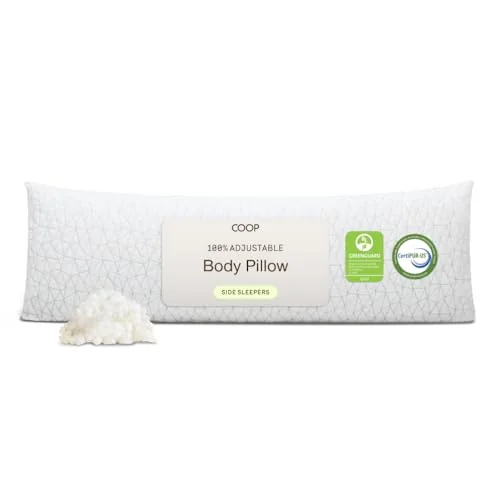
The Oubonun Full Body Pillow for Side Sleeper is the cheaper way into the same length class: 21 x 54 inches, polyester fill that the listing says is adjustable. The saving is in the filling, which is polyester and not memory foam. One 4-star reviewer said “my head sinks like it’s in quicksand,” so the fill is soft, and a 5-star reviewer found that “my arms is higher that it should be to wrap it,” which means it sits tall out of the box. Taking fill out brings the height down but leaves the softness, so check how the arm settles before keeping it.
Take fill out a handful at a time and lie down on the pillow between handfuls. Stuffing goes back in slowly through a zipper, so it is far easier to remove too little and repeat than to remove too much and start over.
The J around the torso, for the bottom shoulder
The second job belongs to the bottom shoulder, and the shape that claims it is the J. The MedCline J-Shaped Full Length Body Pillow, 22 x 50 x 6 inches of shredded memory foam with adjustable fill, is described in its listing as a J that wraps the torso. The arm rests along it, and the bottom shoulder may come a little off the mattress, which is the shape’s logic and not something the listing measures: a slight lean forward into the pillow moves some of the torso’s weight onto foam, and “a little” is the honest size of it. Lean much further and the arm ends up beneath the pillow, which is the failure in the next section.
The reviews put a timeline on it. A three-star reviewer got about three weeks of the best sleep from the pillow and then a back that hurt “so bad one morning,” worse on every night it was used, and called it too fluffy for the back. A pillow that feels right in week one and wrong in week three is a test that has not finished, which is why the last section of this article is about weeks and not nights.
Once a long pillow fills the space in front of your chest, the pillow under your head matters differently, because the neck now rests against the arm’s pillow instead of lying free. How tall the head pillow should be against your shoulder width is worked through in setting the pillow height by the shoulder, and it is worth checking before blaming the body pillow for a stiff neck.
Stacked, when one is not enough
A long pillow compresses under the weight of an arm, and for some arms and some shoulder widths that compression leaves the arm lower than it needs to be. The answer is a second pillow on top of the body pillow, which restores the height with no new purchase. The risk is the Oubonun reviewer’s complaint in reverse: stack too much and the arm rides above the shoulder, which is the same problem as a pillow that sits too tall.
Add the second pillow only after the first has been tried alone, and add it as the one change of that week. Which of these placements suits you depends on whether the night is spent on a side or on the back, and pillows by sleep position covers the loft that goes with each.
Where a Body Pillow Stops Helping
Everything above holds only while the arm stays on top of the pillow and the pillow stays at the right height. This section is the three ways that stops being true, and it matters as much as the placement, because a pillow that is wrong for the night feels like the right one for about ten minutes.

The arm ends up underneath
The simplest failure comes first. A one-star MedCline reviewer wrote that “it hurts my neck … if you sleep with your arm under the pillow,” and the sentence describes a mechanism more than a defect. A tall, firm pillow pressed against the chest has two ways to take the arm: over the top, where it should go, or underneath, where the arm becomes a lever pushing the head sideways and the neck pays.
The fix is almost never a different pillow. It is the pillow’s position and its height. If the arm keeps slipping under in the night, the pillow has drifted away from the chest or is too tall for the arm to climb, so draw it back, take fill out, and check in the morning where the arm was. The check works because the pillow does not move the arm on its own: it only gives the arm somewhere to stay, and when the somewhere is too high or too far away, the arm picks the gap beneath instead.
The pillow sits too high or too soft
Height is the quiet error. Out of the box, a long pillow is often stuffed full, and full means tall under an arm. An Oubonun reviewer found that “my arms is higher that it should be to wrap it,” and a Coop reviewer warned that “if the fill is too high, it puts my hip and back out of alignment,” which shows the height problem reaching past the shoulder to the rest of the line of the frame.
Firmness fails in the other direction. A pillow that is too soft collapses under the weight of the arm and drops it back to where it started, and the “quicksand” reviewer was describing exactly that.
The number listings lead with is length, 50 or 54 inches, and it decides far less than the height at the chest. The same length at two different fill levels is two different pillows for the same arm. A reasonable test is the hand-and-shoulder line from the placement section: if the arm is propped above the shoulder, the pillow is wrong however long it is, and the cure is fill out. If the arm sinks below the pillow’s far edge, a stacked second pillow or a firmer fill is the cure.
When the pain follows you onto your back
Three cases sit outside what a body pillow does at all. The stomach sleeper has the arm up by the head, and a long pillow in front of the chest has nothing to hold. The sore side on the mattress is still on the mattress, and the pillow in front of it moves only a little of the torso’s weight. And pain that does not move with position keeps showing up wherever you put the arm.
University of Iowa Health Care states the limit for that last case in plain words: “Others wake with discomfort even when sleeping on their back or opposite side.”
And that is the edge of what a pillow can do. Position, arm support and bed angle all change load, and a pain that stays the same when the load changes is not a load problem. The next section sets how to know you have reached that edge instead of guessing at it.
One Change a Week, Judged at Week Three
A pillow is a test that runs over weeks, not a purchase judged on the first night. This section sets how to run that test so the result means something, and where its limits sit.

One change a week, written down
Make one change, keep it for the week, and write one line each morning: where the arm was when you woke, and how the shoulder felt before you did anything. A line is enough (a note on your phone works). Two changes at once make the notes useless, because a better Thursday could be the new pillow, the lowered fill, or the night you slept on your back, and nothing in the notes can tell them apart.
The order is the one this article has followed: the free spare-pillow fold first, the bed angle second, a body pillow third, a stack or a lower fill after that. Each stays for its week. If a change helps, keep it and stop. If it does not, undo it and move on, and do not add a new change on top of a failed one.
What week three shows
Week one lies. A new pillow is at full height, the first nights are novel, and almost everything feels better than it did, so the likely reason a pillow earns early praise is that the fill stands tallest on the first nights, which is a guess about fill and not a measured fact. The three-star MedCline reviewer is the useful case: about three weeks of excellent sleep, then a back that hurt every morning on the nights the pillow was used. Week three is where the early novelty is gone and what remains is how the pillow actually sits.
A body pillow also flattens. Another MedCline reviewer put the upkeep in one line: “You do have to fluff it up on occasion or it gets a bit flat.” That is the check for later, and it works in both directions: a pillow that was right at the start may need a handful of fill out by week three because the arm has settled into it, or a shake and a fresh height after months of use.
Shake the pillow out at bedtime every night of the test, not just the first. A half-flat pillow in week three reads as a pillow that stopped working, when the only thing that changed is how much loft it still has.
When it stops being a pillow question
When to see a doctor is not a pillow question, and the clinical clock is shorter than the pillow test’s three weeks, so the shorter one wins. According to the University of Iowa Health Care guidance on shoulder pain at night, “Consider seeing a provider if the pain regularly disrupts sleep, limits everyday activities, or does not improve after one or two weeks of home care.” Do not wait for week three on a pain that matches that sentence.
Sudden swelling, heat or loss of movement; numbness or weakness in the hand; and pain after a fall or a lift belong in the same bucket: a doctor, not a pillow. Everything else in this article is about the bed, and stops there.
Hold the Arm Tonight, Read the Pillow at Week Three
Three things carry over from the page to the bed.
- The pillow holds the top arm and eases the bottom shoulder a little. It never touches the cause.
- The free test goes first: a pillow you already own, folded at the chest, one change per night.
- Placement decides the result. Keep the pillow at the chest, the arm on top and the hand no higher than the shoulder, and take fill out until all three are true.
For later, look at the pillow before you look at the shoulder. A body pillow that has been slept on for months sits lower than the day it arrived, and the height you found in week three is not the height it holds in month five. If the arm starts slipping again, check the pillow’s loft before anything else, and give it a shake or put a little fill back.
Tonight, fold the spare pillow in half, slide it into a cotton case if it is in a slick one, set the fold against your chest and lay the arm across it. In the morning, skip the question of how the shoulder feels and ask where the arm is. If it is still on the pillow, you have the answer, and the next change can wait a week.
Frequently Asked Questions
01Will a body pillow help with shoulder pain?
A body pillow can take load off your top arm and your bottom shoulder, but it does not treat whatever is causing the pain. It changes where the arm sits and how much weight the mattress side carries, and that is all it changes.
02Which body pillow is best for a side sleeper with shoulder pain?
Length and fill decide it more than shape, and a pillow whose fill you can take out lets you set the arm’s height yourself. A pillow around 50 to 54 inches long with a zipper does that job, and the guide linked in the placement section covers the picks.
03Should the body pillow go in front of me or behind me?
In front of you, standing against the chest, with the top arm lying across it and the forearm along its length. A pillow behind you props the torso but does nothing for the arm, so it only makes sense for a back sleeper who wants the pillow under one arm.
04Can I use a body pillow if I sleep on my back?
Yes, as a support under one arm, not as a barrier on either side, with the pillow resting beneath the forearm and elbow. Slide it under the forearm and elbow so the arm rests on it. A stomach sleeper gets little from it, because the arm is up by the head and the pillow has nothing to hold.
05How long should I try a body pillow before deciding?
Three weeks, with one change at a time and a line written down each morning, because the first week flatters almost any pillow. Week one flatters a pillow because the fill stands tallest, so the verdict belongs to week three, once the novelty is gone and the pillow has settled.





Tried it on your own bed?
No comments yet. Tell us what you changed, and what the sheet did after a few washes.