


What’s in here10 sections
- Five Objects Sold for Back Pain, and the Part of You Each One Touches
- Side Sleepers: The Gap Behind the Head and a Free Test
- Back Sleepers: What Goes Under the Knees
- Stomach and Combination Sleepers: Why the Pillow Gets Thinner
- Fill, Heat and What Month Three Does to Height
- What Orthopedic, Cervical and Lumbar Mean on the Grid
- Two Sleepers, One Bed
- When the Bed Is the Mattress and When It Is a Doctor
- Measure the Gap Tonight, Then Measure the Pillow at Month Three
- Frequently Asked Questions
Pillows for back pain turn out to be five different objects sold under one phrase: a head pillow, a knee pillow, a flat pillow for under the stomach, a lumbar pillow and a wedge pillow. The box never says which part of you each one touches, and that is what decides whether it does anything at all. A head pillow only sets the height of the head and neck, while the spine below it is moved by the mattress and by whatever fills the space between you and the mattress. So this guide starts with a free test, a folded towel and a measured gap, then goes one sleeping position at a time, through the fill and what month three does to it, the label words, the shared bed, and the one place where the bedding stops being the story.
Quick Answer
A pillow sets the height of your head and neck, so it can keep them in line with your spine. It does not treat back pain. Measure the gap between your head and the mattress first, and if the pain does not move when the pillow does, that is a doctor’s question.
Five Objects Sold for Back Pain, and the Part of You Each One Touches
Search for a pillow for lower back pain and the grid hands back a head pillow, a knee pillow, a hip pillow, a lumbar cushion or a wedge: different parts of you, one word. Sorting them by what they touch is the only way to know which one can change the line of the spine at night and which one only cushions.

The head pillow sets one number: the gap between head and mattress
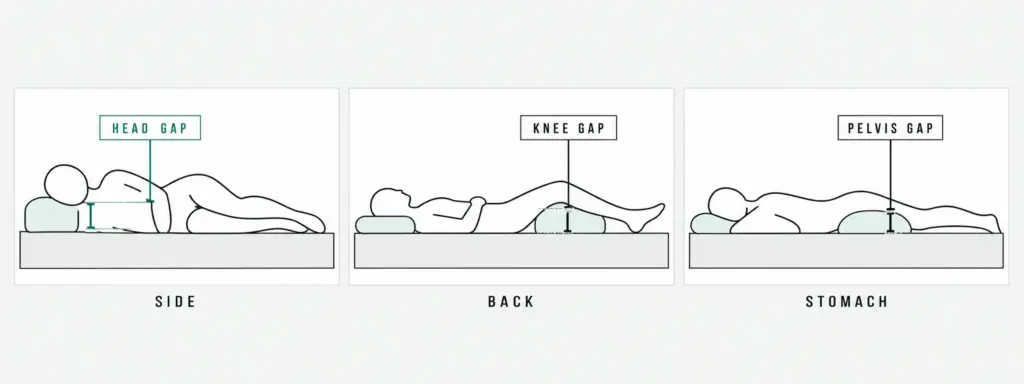
Lie on your side and picture the distance from the mattress to the middle of your head. That distance is your shoulder width plus however far the mattress gives under the shoulder, and it is the only number a head pillow answers to. Fill it and the neck sits in line with the rest of the spine, the straight line people mean by a neutral spine or spinal alignment.
Leave it short, or overshoot it, and the neck bends, and the spine follows the bend down. How tall a pillow should stand for each position has its own page, pillow loft by sleep position, so this guide stays with the gap itself.
The gap is not unique to the head. According to the University of Rochester Medical Center’s guide to sleeping posture, “Depending on your sleeping position, additional pillows can help keep your spine in the correct position.” That sentence is the map of the whole category: pillows go into the spaces between a sleeper and the mattress, and each space belongs to a different part of you. The head pillow sets one number, and every other object in this guide fills some other gap.
Shopping by the phrase on the box is how the wrong object ends up in the wrong place. A lumbar cushion tucked under the head fills a gap it was never shaped for, and a head pillow bought to reach the waist cannot, because it stops at the shoulder. The tell that the head pillow is the wrong object is that the gap is still wrong after the pillow changes: three heights tried, the same hanging neck every morning, and the missing support sitting somewhere else on the bed.
The objects that act on the legs and hips
A back sleeper has a space under the knees. The University of Rochester Medical Center (URMC) says a small pillow behind the knees supports the natural curve of the lower back, and it does that through the legs and hips, the lumbar curve reached from below, which is why the object is a knee pillow (also sold as a leg pillow) and not a head pillow moved down the bed. A side sleeper has the space between the knees, and a stomach sleeper has the space under the pelvis, where URMC suggests a flat pillow under the stomach and pelvis to keep the spine in better alignment.
Line them up and the order is plain. The head pillow acts on the neck, the knee pillow on the legs and so the hips, the stomach pillow on the pelvis. Each one reaches the spine from a different end, and none of them stands in for another. The next three sections take them one position at a time.
Lumbar cushions and wedges: what could not be checked
Lumbar cushions and wedges are the two objects this guide makes no claim about. No measurement for either could be confirmed, and a claim without one is the same catalogue talk this guide is taking apart. What can be said is narrow: neither a lumbar pillow nor a wedge pillow is a head pillow, and neither should be asked to do the head pillow’s job.
Side Sleepers: The Gap Behind the Head and a Free Test
A side sleeper has the widest gap of the three positions, from the shoulder to the ear, so “too low” and “too high” show up here first. It is also where the cheapest test in this guide lives: it costs one folded towel.
The towel test, before any purchase
This is the article’s own method and it is offered as a method, not a clinical protocol. It finds a number, and a number is what a pillow can be matched to.
- Lie on your side on the bed you actually sleep on, with no pillow, in the position you take as you fall asleep.
- Slide a folded towel under your head and add them one at a time, until your head sits level with the middle of your spine, the nose pointing neither at the ceiling nor at the mattress.
- Have someone photograph you from behind, or prop a phone at the foot of the bed on a timer. The line from the back of the head down the spine should read as straight, not bowed.
- Measure the stack with a ruler and write the number down.
That number is the gap. It is not a pillow size: it is the height the pillow has to hold once a head is resting on it, which is why a pillow’s printed loft and the stack rarely match, since foam gives some height back under weight. Keep the number, because every section after this one points back to it.
Fold every towel the same way. A towel folded in thirds and one folded in half are different heights, and the stack only means something when each layer is the same unit. Use one towel as your ruler for the whole test and for every retest.
Counting the mattress into the gap
Shoulder width gets quoted as the whole answer, and it fails the moment the mattress is soft. A shoulder that sinks an inch or two closes an inch or two of the gap, so the pillow that is right on a firm mattress is too tall on a soft one, and the reverse holds just as well: a firm mattress leaves the gap wide open and asks for more pillow. This is why a friend’s perfect pillow tells you almost nothing. Shoulder width and head size both feed that number, along with the mattress, and you can only get it from your own bed.
Patience is the other cost. A new height feels right or wrong on the first night mostly because it is new. The second night is the honest one, when the neck has stopped reacting to the change and starts reporting on it.
Adjustable pillows often need a wait before the loft is right: buyer reviews on Amazon describe a few nights of adjusting to find the right amount of filling. Give a new height two or three nights, and redo the towel stack if anything under it changes, a mattress topper added or a mattress flipped.
The pillow that lets the height come out
Free first: hold the stack against the pillows you already own. If one of them sits within a fold of the number, the purchase is unnecessary, and the fix is the pillow you already have. The pillow that goes in the closet because it was too tall may only be a fold away from right.
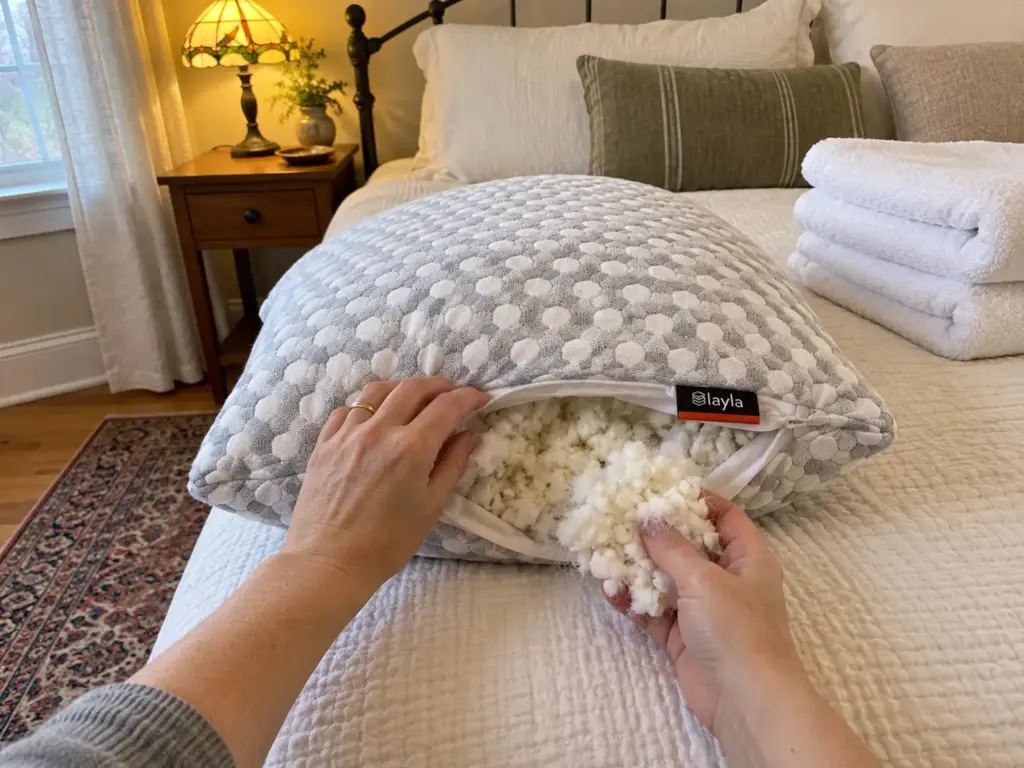
When none of them is close, an adjustable loft pillow turns the towel test into something that stays in the bed. The Layla Sleep Adjustable Fill Kapok Pillow is shredded memory foam mixed with kapok fibers inside a zippered cover, in King size. You open the zipper and take the fill out by the handful until the height lands on your number. Because the foam is shredded, taking a handful out lowers the pillow evenly, which a solid block cannot do.
The catch is in the reviews: a 2-star reviewer (Ed Jolly, 3 Jan 2023) found the newer pillow “seemed to have about half of the filling,” and the review summary on the page says it “doesn’t maintain shape after 6 months and becomes very flat.”
That second line is a summary of many reviews, not one person. An adjustable pillow can be lowered or topped up, but one that arrives light has nothing to add when month six asks for it.
If the worry is paying for a mistake, what you give up with a cheaper side-sleeper pillow is laid out on its own page, and this guide does not argue it. And if the gap that bothers you is lower down, between the knees and the chest, that is a different object entirely: body pillows for side sleepers.
Back Sleepers: What Goes Under the Knees
A back sleeper has the smallest gap behind the head and a second gap lower down, between the knees and the mattress. That second gap is where a second object earns its place.
The head pillow for a back sleeper: low, and why
On your back, the shoulders and the back of the head rest on the same surface, so the gap behind the head is only the curve of the neck. The towel stack for this position is the shortest of the three. Too tall and the chin is pushed toward the chest, the neck held in a forward bend for hours, which is the opposite of neck alignment.
A thin pillow is the usual answer, and it has its own failure: a soft one can collapse to almost nothing under a head, so the number that matters is the height under load, not the one on the tag. How a pillow holds a low height through the months has its own page, pillows for back sleepers that hold their height, and this section points there.
The knee pillow: the object that touches the legs
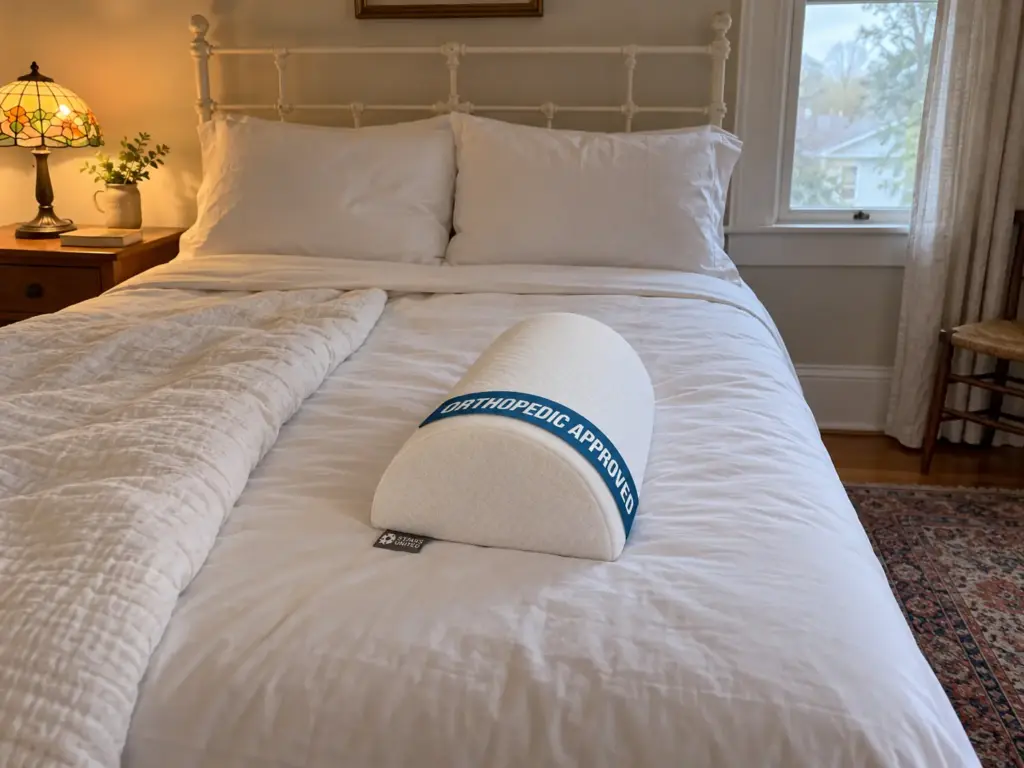
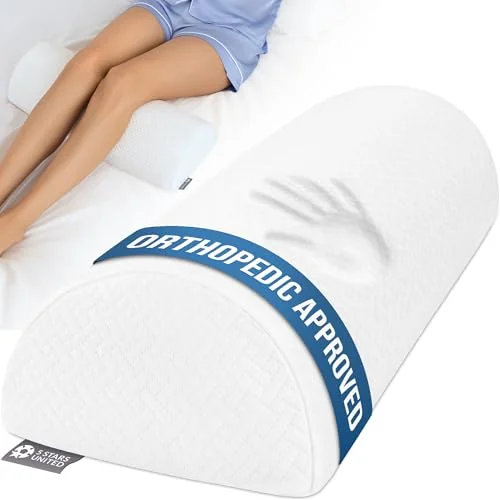
The space under the knees is a different gap with a different object, and it acts on the legs and hips, not the neck. The 5 STARS UNITED Knee Pillow for Back Sleeping is a half-moon bolster with a memory foam core and a removable knit cover, 20.4 x 7.8 x 4.8 inches in Standard (the manufacturer’s numbers). What it fills is a space under the knees. What it cannot do is fix a head pillow that is the wrong height.
Its weak point is height, and the reviews are specific. A 3-star reviewer (maricela mata, 12 Oct 2026) says “it’s a little too low, I needed it a little higher,” and the review summary calls its shape retention “mixed,” with some owners saying it holds its form and others saying it loses it. A height problem is the one a towel catches before the money is spent.
Roll a bath towel to the width of a forearm, lie on your back and slide it under your knees. Measure it lying down, then unroll it a turn at a time. The thickness that feels right is the number to look for on any knee pillow, and it is more reliable than a size on a page.
What the listings promise and this article does not repeat
The Amazon page for this pillow goes beyond fill and shape and makes health claims. Those are the seller’s. In this guide a pillow’s job is to fill a space, so none of those claims is repeated here.
The cover is the part with a certificate. The listing says the knit cover carries OEKO-TEX STANDARD 100, and OEKO-TEX’s own description of the STANDARD 100 label says it is a label for textiles tested for harmful substances. That is a fact about the cover. It says nothing about how high the foam stands or how it ages.
Stomach and Combination Sleepers: Why the Pillow Gets Thinner
The stomach sleeper is the odd one out. Face down, the head turns to one side and the gap behind it nearly closes, so the pillow that matters moves from under the head to under the pelvis.
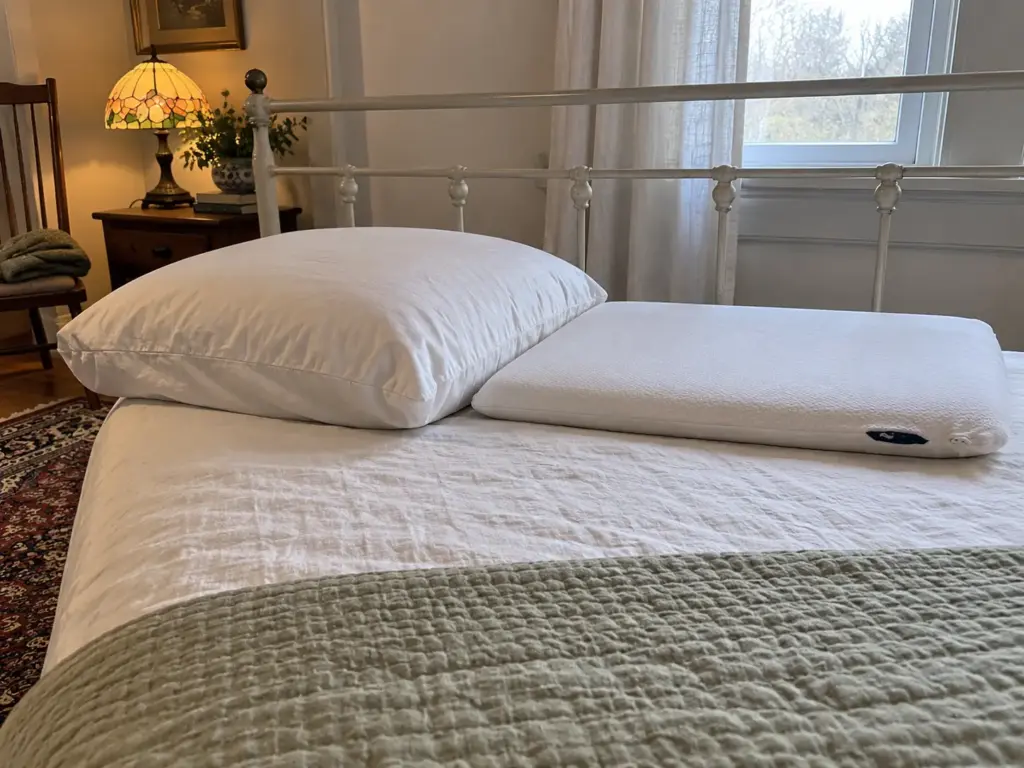
The flat head pillow and the pillow under the pelvis
A tall pillow under a face-down head tips the head back and holds the neck twisted for the night, so the head pillow for this position is the thinnest one that still keeps the neck from dropping, or none. URMC points the other support lower: a flat pillow under the stomach and pelvis can help keep the spine in better alignment. The towel works here too, a thin fold under the pelvis tells you whether the shape suits you before any object is bought. Pillows built for this position, and how they compare with adjustable ones, are covered in pillows for stomach sleepers.
When a towel is not enough, the Bluewave Bedding Ultra Slim Gel Memory Foam Pillow is the thin option: gel memory foam, 2.75 inches high, Standard size at 25 x 16 inches, with a removable machine-washable cover of 60% polyester and 40% viscose. The washable cover matters on a pillow you press your face into. The weak point is smell. A 3-star reviewer (HFN, 24 Dec 2025) reports “the odor that is very difficult to get rid of” and says it is worse in the thicker version, so air it before the first night and expect a wait.
When you change position in the night
A combination sleeper has three gaps and one pillow. The side position needs the most height, the back less, the stomach almost none, so the pillow ends up as a height that tolerates two positions and is perfect for neither. That is a trade-off, not a fix, and it is worth saying so before a purchase pretends otherwise.
The side position sets the ceiling, since it has the widest gap, and the back and stomach nights pay for it. For people who change position through the night, pillows for people who change position works through the three positions at once.
The cheap thin one and the pricier thin one
The BLISSBURY Stomach Sleeper Pillow is a thin flat memory foam pillow at 2.6 inches. Set it next to the Bluewave and the difference is about a seventh of an inch: it does the same job at a lower height, and the lower-cost one does not do less. What it gives up shows in one place.
The only report on it comes from a comparison inside a 5-star review of the Bluewave (Jasonw357, 24 Nov 2025), where the reviewer says the BLISSBURY “bottomed out pretty easy” and was “too thin for me.” That is one reviewer comparing the two, written in praise of the other pillow, so it is a warning and not a verdict.
At this height the foam has very little to lose before it is a sheet.
Fill, Heat and What Month Three Does to Height
Everything above assumed the pillow keeps its height. This is the section that checks the assumption, because lost height is what moves the spine, and the loss is slow enough that almost nobody counts it.
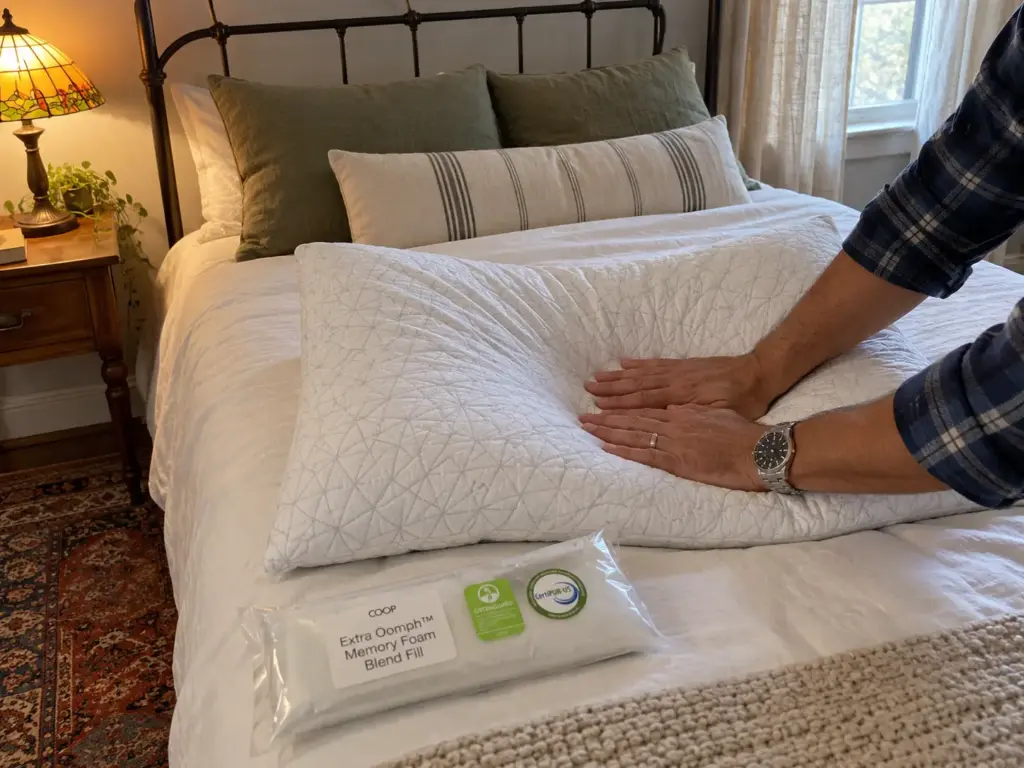
What each fill gives up first
Start with the shape of the loss. A fill that clumps does not lose height evenly: the middle, where the head presses, goes first and the edges stay tall, so the pillow dishes.
Each fill has its own way of going, and down alternative, polyester fiber and buckwheat each settle on their own schedule; what each pillow fill does by month six has the full account. Here it is enough to follow the one fill this guide recommends from, shredded foam, through the reviews.
A 4-star Layla reviewer (MiRey, 16 Apr 2020) flips the pillow every night because the pieces of foam shift toward the top of the head. That is the same loss, read as a chore.
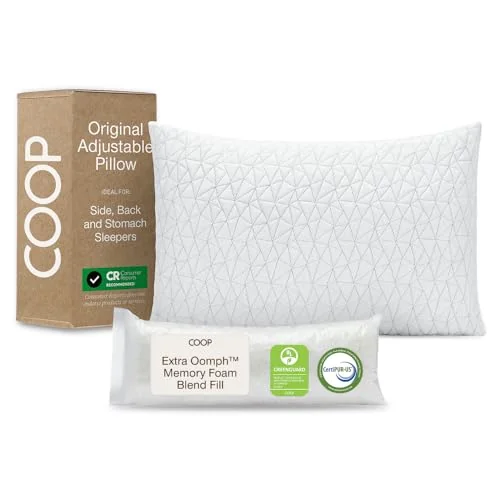
Adjustable fill earns its place here, for one reason: it lets the owner put back what time took. The Coop Home Goods Original Adjustable Pillow comes with a bag of extra fill, and the fill is cross-cut memory foam, 76% visco polyurethane foam and 24% polyester gel fiber, in a Queen at 19 x 29 inches. A 4-star reviewer (Oliver, 17 May 2018) added about 40 percent of the extra fill. For how the cross-cut fill compares with a solid block, read shredded versus solid memory foam.
Its weak point is the fill itself. A 3-star reviewer (NahaniWhereUAt, 10 Jul 2026) says “what they call shredded looks more like cubes,” and describes the current fill as light and airy where the original was dense and weighed a ton. That is a reminder that a fill can change between versions, so a glowing review from 2015 may describe a different pillow from the one on the shelf today.
Heat, briefly
Foam holds heat, and breathability is the claim to check; the Coop reviews say where it shows. A 4-star reviewer (Oliver, 17 May 2018) reports that on the side the cover “gets HOT,” and flips the pillow about four times a night to find a cool face. How foam and heat go together is covered in are memory foam pillows better, so this guide leaves it at one clause: if you are a hot sleeper, count the cover in the decision.
Reading the pillow at month three
When to replace a pillow is the question behind the whole section. URMC recommends replacing pillows every year or so. That is a recommendation, not a measurement, and no source used for this guide gives a figure for how much height a fill loses by month three.
So none is invented here. What exists is a check you run yourself, and it needs one number from the first day.
The day a pillow arrives, stand it on a table, measure its height with a ruler and write the number on the care tag with a marker. Do it again at month three, in the same spot, after a good fluff. The difference between the two numbers is the height your pillow lost, and it is the only version of that figure you will ever get.
The towel test closes the loop. If the stack from the side-sleeper section no longer matches the pillow, the pillow is the thing that moved, and you know by how much.
Before it goes in the bin, two free fixes come from the owners. A 5-star Coop reviewer (Diane R., 12 Sep 2026) put a pillow that arrived compressed in the dryer on low for about 15 minutes, and a 5-star reviewer (Isaac L., 21 Jul 2015) kneaded a flat middle back to the center by hand, after nearly two weeks of use had already started to flatten it. When neither works, how often to replace a pillow, by fill gives the clock for each type.
What Orthopedic, Cervical and Lumbar Mean on the Grid
The product grid sells these three words as if each meant a shape. This section says what is on the label and what is not.

Words with no number behind them
A grid of identical orthopedic pillows is hard to sort because the word does not sort them. No standard for orthopedic, cervical or lumbar turned up in the sources used for this guide, so treat each as a category a seller picked and not a spec a lab measured. That is not the same as saying none exists, and nothing here claims it. It means the word cannot be the reason to buy, because there is no number it commits the seller to.
Take the same approach with contour and with any firmness word: the word names a feel, and the feel varies by seller. A cervical pillow and a contour pillow are names a seller picks, and none of the sources used for this guide ties either name to a measurement.
Even the numbers a listing prints can mislead. Queen at 19 x 29 inches is length and width, which sizes the pillowcase and says nothing about the one measurement this guide keeps returning to, the height. A shopper scrolling the grid is comparing the wrong column, and the fix is to read down to the row that gives the height and the fill, then ignore the adjective above it.
A listing that gives no height at all has answered half the question. If you want the version of this argument for firmness, what firmness labels actually name walks through it.
What a certification does cover
A certificate answers a narrow question. OEKO-TEX STANDARD 100 tests the textile for harmful substances, and its Product Class 2 covers products in direct skin contact such as bed linens; the page does not name pillows or fill. So a pillow’s cover can be certified while the loft is anything at all. The Coop listing names CertiPUR-US and GREENGUARD Gold for the foam, and those are the manufacturer’s claims, cited here without a link: they describe the material, and neither word is a height.
Ask the pillow for two numbers instead: the loft in inches and the fill. Both are things a pillow can answer, and they are the pair that lets you check it against your towel stack.
The Bluewave page gives both, a 2.75-inch height and a cover that is 60% polyester and 40% viscose, and that is what a useful listing looks like: a number you can lay a ruler against and a material you can ask a question about.
The cover composition matters as a separate fact, since the cover is the part that touches the face and the part that comes off for the wash, while the fill underneath is what decides the height. The reasoning behind the pair is in two numbers for loft and firmness.
Two Sleepers, One Bed
Everything above was chosen for one person. In a shared bed, the pillow set for one back changes the other sleeper’s night.

Two positions, two pillows
One sleeper on the side and one on the back have two different gaps and one mattress, so a single pillow height cannot be right for both. The common answer is a compromise height, a pillow somewhere in the middle, and it fails both sleepers in opposite directions: too tall for the back sleeper, too short for the side sleeper.
The structure that works is two pillows set to two numbers. The shared-bed advice in the reviews is short and practical: a Layla reviewer (5 stars, 23 Jun 2026) puts it as “buy 2,” a plan that stops the pillow from being borrowed, and a 5-star Coop reviewer (Diane R., 12 Sep 2026) notes that a husband decided to try it.
An adjustable pillow shows how fast a single pillow gets shared. Each sleeper’s own towel stack and own number are the starting point, and the guide to pillows by sleep position covers the position side of it.
The order of operations matters more than the pillow. Each sleeper runs the towel test alone, in the position they fall asleep in, and writes the number down. Only then does a pillow get chosen, and the choice is two separate ones: an adjustable pillow for whoever is unsure of the number, a fixed one for whoever is sure.
Where the two sleepers differ by a fold or less, one model can serve both. Where they differ by more, forcing them onto the same height is how a partner ends up awake with a neck that was fine the week before.
Put a different pillowcase on each person’s pillow. Two matching adjustable pillows filled to different heights get swapped, and a swapped pillow looks like a pillow that stopped working.
What a shared mattress does to both gaps
The mattress is the one thing the two sleepers cannot set separately. If one side is softer, or one sleeper is heavier, the softer or loaded side sinks, and that changes the shoulder-to-ear gap for the lighter sleeper next to it. So retake the towel test with both of you in the bed: the first sleeper lies down, the second gets in, and then the stack is built, since the dip changes the numbers.
Two sleepers on one soft mattress can each need a different pillow than they would alone, and a topper that changes the dip changes both numbers at once.
Heat is the same story: reviews of both adjustable pillows mention the cover running warm, but there is no measurement of what one sleeper’s pillow does to the other’s night, and none is claimed. A pillow that can be refilled lets each person keep a number without negotiating over it, which is the one real advantage of the type in a shared bed.
When the Bed Is the Mattress and When It Is a Doctor
Everything so far fixes a gap. Some nights the gap is not what is wrong, and this section says where the bedding stops.
When a sagging mattress is the gap
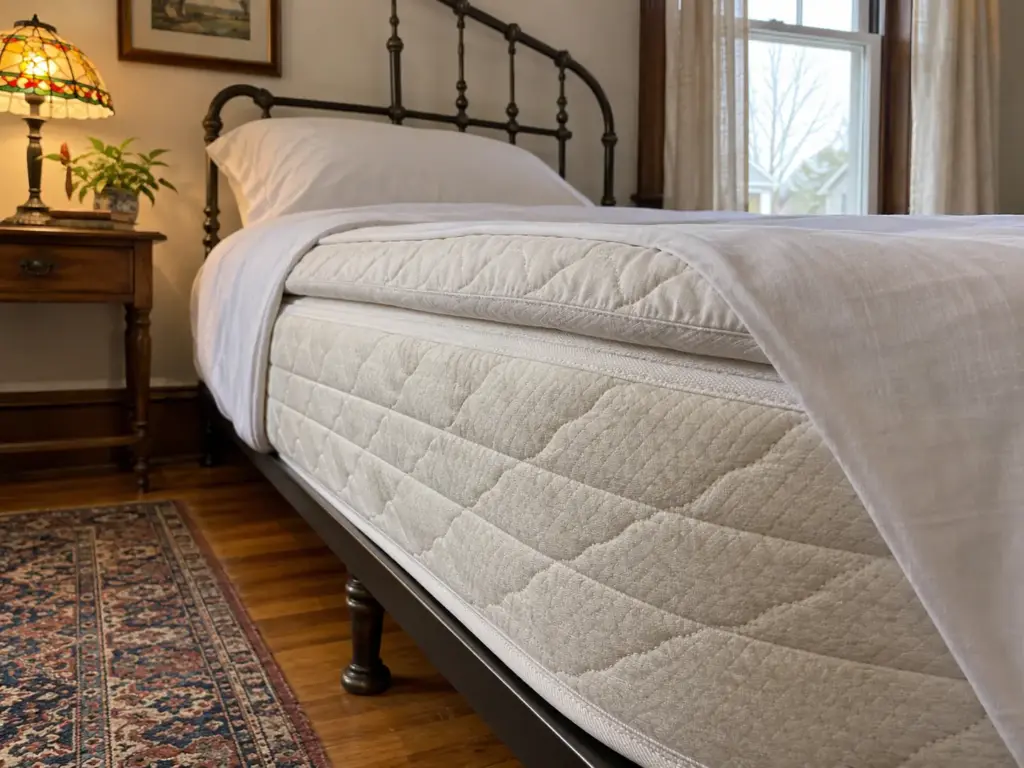
The mattress is the other half of the setup. A topper, a flipped mattress or a dip in the middle changes every gap above it, so a pillow chosen for one mattress stops fitting when the mattress changes.
Which mattress or topper to choose is a separate question, and this guide leaves firm versus soft for those pages to answer.
The counter-view belongs here too: some people say a pillow will not do much for back pain. Treat that as a view, not as advice. A pillow fills a gap and the rest of the bed is a different question.
When the pain does not move with the bed
This is the one place in this guide that sends you away from the bed. According to the NHS guide to back pain, “It usually improves within a few weeks but can sometimes last longer or keep coming back.” If it does not behave that way, if the pain wakes you at night, runs down a leg, comes with numbness or weakness, or does not change with the bed over weeks, that is a doctor’s question, and the NHS page lists the rest. This guide cannot say what the pain is or what to do about it, and no pillow in it is offered as an answer to that.
Back to the bed: the towel, the ruler and the second night are all still yours to use.
Measure the Gap Tonight, Then Measure the Pillow at Month Three
Three things carry the rest of this guide. A head pillow sets one number, the gap between your head and the mattress, and a folded towel finds it for free. The other objects act on other parts of you, the knees, the hips, the pelvis, and two of the five, lumbar cushions and wedges, could not be checked, so no claim is made for them. And a pillow loses height before it loses anything else, so the second night and the third month are the honest ones.
The check for later is the same towel stack. Run it again at month three, set it against the height you wrote on the care tag, and the gap between the two numbers is what the fill has lost.
The free change to make tonight: fold the towel, measure your gap, and notice whether the morning changes. If after a few weeks of changing the bed it does not, that is the doctor’s question.
Frequently Asked Questions
01What pillow height works for a side sleeper with a sore lower back?
A side sleeper needs a height that fills the gap from shoulder to ear, with the mattress counted in, so the neck stays level with the spine. Find it with the folded-towel test. If the soreness does not move over weeks of changes, that is a doctor’s question.
02Should a back sleeper put a pillow under the knees?
A pillow under the knees fills the space between the knees and the mattress, and URMC says it supports the natural curve of the lower back. It does not treat anything. Check the height with a rolled towel first, because one reviewer found a knee pillow too low.
03How thick should a pillow be for a stomach sleeper?
A stomach sleeper needs a thin head pillow or none, because the gap behind a face-down head is nearly closed. Under the stomach and pelvis, URMC suggests a flat pillow. The thin options in this guide run between 2.6 and 2.75 inches.
04How often should you replace a pillow that has gone flat?
URMC recommends replacing pillows every year or so, but the clock depends on the fill. Measure the pillow on day one and again at month three to see the loss. How often to replace a pillow, by fill gives each type.
05Do orthopedic pillows work for back pain?
The word orthopedic names no loft or fill, so it cannot tell you what a pillow does. Ask for the loft in inches and the fill, and match them to your towel-stack gap. If the pain stays the same across several changes of pillow, see a doctor.





Tried it on your own bed?
No comments yet. Tell us what you changed, and what the sheet did after a few washes.