


What’s in here13 sections
- What a Level Neck Looks Like on Your Own Bed
- Too High or Too Flat: The Two Errors and the Morning After Each
- The Free Test: A Folded Towel and a Week of Mornings
- Height by Sleep Position, Without the Chart
- What the Fill Does Under a Head, Heat Included
- Shape: Contour, Crescent, Hollow and Flat
- Firmness and a Pillow You Can Set
- Cervical, Orthopedic, Ergonomic: Words With No Standard Behind Them
- Where the Height Is After Month One
- Beyond the Pillow: The Mattress, the Knees and the Other Side of the Bed
- When It Is Not the Pillow
- Fold the Towel Tonight, Measure Again at Month Two
- Frequently Asked Questions
You buy a pillow for neck pain, and for about a week it feels like the answer. Then the fill packs down and the head drops back, or the pillow was tall from the first night and the neck spends hours bent forward. Many pillows either feel great for a week and then flatten out, or they are so tall that the neck stays bent all night.
The head weighs several pounds and all of it rests on the pillow, so a few centimeters of height change the angle of the whole neck, and a pillow is judged by its height, not by the word printed on the box. This guide covers the two ways a pillow goes wrong, a free test with a folded towel, what fill and shape do, the label words, where the height is after a month, and the point where the problem stops being a pillow.
Quick Answer
No single pillow is best for neck pain. The right one keeps your neck level with your spine in the position you sleep in most, and its fill still holds that height after a month. Stiffness that stays the same when the pillow changes is a doctor’s question, covered under When It Is Not the Pillow.
What a Level Neck Looks Like on Your Own Bed
Two things move the right answer before any pillow is chosen: the line the neck is supposed to follow, and the surface the pillow sits on. Both can be checked on the bed you already own.

The line, seen from the side
Level means the neck follows the same straight line as the spine under it, what is often called neutral alignment: ears roughly over the shoulders when you lie down, chin parallel to the ceiling instead of tucked toward the chest or tipped back. Nothing about it needs a lab. Prop a phone beside the bed, film ten seconds of yourself settling into your usual position on your usual pillow, and freeze the frame.
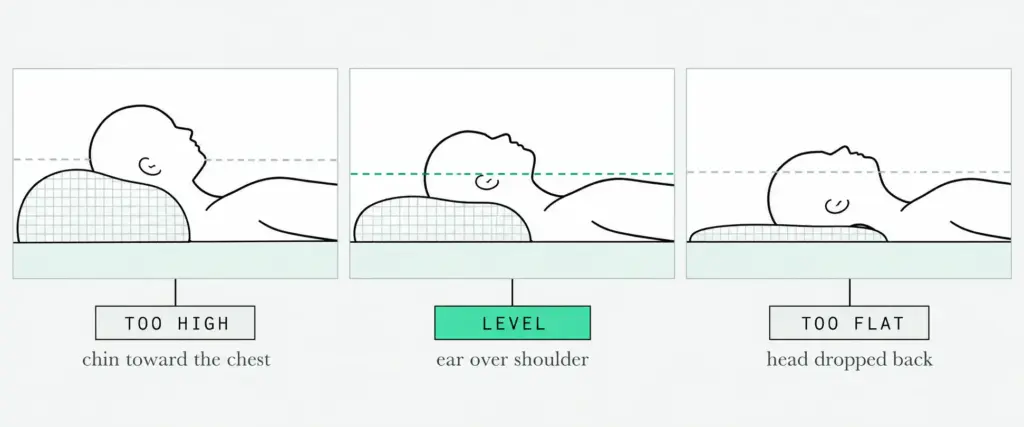
From the foot of the bed a wrong pillow looks like any other pillow, because the front view hides the angle completely. The frozen frame does not. Treat it as a measurement, not a verdict: it shows the angle of the head on that pillow in that bed, and it says nothing about why a neck hurts.
How a soft or firm mattress moves it
A pillow fills the gap between the head and the mattress, and the mattress decides how big that gap is. On a firm surface the shoulder stays on top and the gap stays wide. On a soft one the shoulder sinks in, the gap closes, and the same pillow now stands too tall for the head. A back sleeper has a small gap on either mattress, while a side sleeper has the largest gap and the one that changes most with softness.
Why the same pillow can be right in one bed and wrong in another
So a pillow that a friend swears by can be wrong in your bed without anything being wrong with the pillow: another mattress, another shoulder width, another sleeping position. A tall pillow may be a fine pillow on a firmer bed, so the height has to be judged against the mattress. The gap is the number that travels from one bed to the next, which is why the rest of this guide keeps coming back to it.
Below the shoulders the spine has a gap of its own, and the back has its own gap to fill in a separate guide that follows it down the mattress. This one stays with the head and neck.
Too High or Too Flat: The Two Errors and the Morning After Each
Pillow trouble at the neck comes from one of two directions, and the two are fixed in opposite directions. That is why adding a second pillow helps one sleeper and hurts the next: it corrects one error by committing the other.

Too high: the neck bent forward
A pillow that stands taller than the gap lifts the head and pushes it toward the chest, so the neck is held bent for as long as you stay in that position. On the back, the chin ends up pointing at the breastbone. On the side, the head rides above the line of the spine and the neck bends sideways, which is the “bent all night” of the thread.
The fix for this error is height taken away, never a second pillow added. The tests for when it is the pillow and when it isn’t live on the too-thick page.
Too flat: the head dropped back
The mirror image: a pillow lower than the gap lets the head drop. On the back, the chin tips up and the head tilts away from the chest. On the side, the head sinks toward the mattress and the neck bends down with it.
Flat is also what a good pillow turns into, because fill packs down. A pillow can be right on night one and wrong by night eight, with nothing wrong with the buyer’s judgment on the day of purchase. When it has gone flat, our guide says to fold it before you replace it and walks through that test.
What the lab measured
A 2016 PeerJ study on pillow height and the neck set one cervical pillow at four heights, from 110 to 170 millimeters (about 4.3 to 6.7 inches), under ten healthy adults lying on their backs, and ran the results through a computer model of the head and neck. Going from the lowest height to the tallest raised the cervical angle, the paper’s measure of how the head sits on the neck, by 66.4 percent. The curve of the cervical spine in the lower neck, measured as lordosis distance, was shallowest at the lowest height: 5.41 millimeters, against 6.77 at the tallest. Those two numbers are the two directions of the two errors, measured in a model.
Read the limits before the numbers. The volunteers averaged 26 years old and had no chronic muscle pain, the pillow was a single B-shaped cervical design, and each height was held for thirty seconds. It is not neck-pain data, and it cannot say which height is right for a given neck. It does show that height moves the angle, and the tests below need nothing more than that.
Which one you are, with one week of notes
This is a test, not a diagnosis. Use the frozen frame from the first section for a chin-to-chest check: a chin pointing toward the chest, or a head riding above the shoulder line, leans toward too high; a chin tipped up, or a head sinking below the line, leans toward too flat.
Then keep a notebook beside the bed with two columns: the height of the pillow that night, and one number from 0 to 10 for morning stiffness in the first hour after getting up. After seven mornings the page shows which way the number moves when the height does.
The two errors side by side, as something to look at on the bed rather than something to feel:
| What the head does | What to look at on the bed | What to change first |
|---|---|---|
| Too high: the head is lifted and pushed toward the chest | In the side-profile frame, the chin points toward the chest or the ear sits above the shoulder line | Take height away: remove a fold or a handful of fill, never add a second pillow |
| Too flat: the head drops back or sinks toward the mattress | In the frame, the chin points up or the ear sits below the shoulder line, and the pillow is thinner than it was | Add height: slide a folded towel under the pillow, one fold at a time |
The Free Test: A Folded Towel and a Week of Mornings
Before a pillow gets bought, the bed already holds what is needed to measure one: a towel, the pillow you own and a notebook.

The towel under the current pillow
Fold a bath towel to the width of the pillow and slide it under the pillow’s lower half. Each fold adds a fixed amount of height, and taking it out removes the same amount, so the whole test comes down to a number of folds. Put the pillowcase over pillow and towel together: a bare towel slides toward the edge of the bed by morning, and the test is over before it started.
The gap between head and mattress is the number the towel adjusts, and pillow height against the mattress is worked through at length in its own guide. What matters here is the consequence: the towel adds the missing height, and one fold less takes away the surplus.
One change at a time
Change the height and nothing else. Same pillow, same position, same sheets, and the towel is the only thing that moves. Three nights with one fold added, three nights with one fold removed, and a seventh night on whichever setting scored better.
Three nights at each height, because the first night at a new height is never the verdict. If the position changes together with the height, or the pillow changes together with the position, the notebook can no longer say which of them moved the number.
Write down the folds each morning and a 0 to 10 score for the first hour after getting up. If nothing moves with the height, the pillow was never the lever, and the last section says where that leaves you.
Score the neck before the shower and the coffee change the answer, and write the score next to the number of folds. One morning is noise. Three mornings at the same height are a reading.
Why one pillow, not two stacked
Two pillows slide against each other and tilt the head, because the top one rests on a surface that is not flat and can rotate. One pillow, or one pillow with a towel folded inside its case, holds a single angle all night. The drift itself, the pillow that is somewhere else by morning, is followed through in why the pillow drifts by morning.
A pillow does not have to be expensive to hold the right height. A cheap memory foam pillow can still be a good buy when its height suits the sleeper, and height is the variable that counts.
Height by Sleep Position, Without the Chart
Side, back and stomach sleepers need different heights, and the reason is geometry, not preference. The rule on the sleep-position page is to measure the loft, don’t guess, and this section is the reason behind the rule.

Side: the shoulder sets the height
A side sleeper has to fill the space between ear and mattress, and the width of the shoulder is the largest part of that space. A wide shoulder on a firm mattress needs a tall pillow; the same sleeper on a soft mattress, where the shoulder sinks, needs a lower one. A pillow with a side wall, called a gusset, fills the space beside the neck without raising the top. The Beyond Down Side Sleeper Pillow, King has a 4.5-inch gusset around a polyester gel-fiber fill, in a 300-thread-count cotton cover (a number that describes the cover, not the fill).
Amazon’s review summary says some find it “flattens too easily” and that neck support is “mixed,” so treat the gusset as a shape to try with the return window open, not as a height to trust.
What you give up on the cheaper end of this category is laid out in what you give up on a cheaper side-sleeper pillow, which owns the side-sleeper picks.
Back: the smallest gap
A back sleeper has the smallest gap of the three, because the back of the head sits close to the mattress and the shoulders add nothing to it. That also makes the back sleeper the easiest to push forward: a tall pillow tips the head toward the chest within minutes. For this position a pillow that stays low and keeps its loft beats one that starts tall and settles, and the picks are on the page for pillows for back sleepers that hold their height.
Stomach and combination sleepers
A stomach sleeper turns the head to one side for hours, so any height under the head tilts the neck backward as well as turning it. A thin pillow, or none under the head, is the point of that position, and it is geometry, not a medical claim.
Combination sleepers need one pillow that survives two heights, which is where fill that can be set earns its place (the sections on fill and on firmness come next). One check works for all positions without any chart: look at the dent in the pillowcase when you wake. Centered, pushed to one side or barely there, it tells which position you actually slept in, and that is the one to measure for.
What the Fill Does Under a Head, Heat Included
Fill decides how a pillow holds its height and how it handles warmth, and the same word on two boxes can mean two very different things under a head. The full account of what each fill does by month six lives on the fill page, so this is the neck’s version.

Memory foam and latex: the height that stays
Solid foam and latex are shaped blocks. They push back evenly and keep their outline, so the height is the height they were cut to. That is an advantage when the height is right and a permanent problem when it is wrong, because nothing in the pillow can be changed. Both also hold heat: foam is an insulating cell structure, and the head is a heat source pressed into it.
Dense latex pillows are often said to hold their shape longer than memory foam and to run cooler, though that is an opinion and not a measurement.
Down and polyfill: the height you rebuild
Down and polyester fiber fill compress under the head and need fluffing to come back. Fluffing returns the height, partly, and the part that does not return is what a flat pillow is. The trade is steady upkeep for a height you can set, and feather pillows are the usual choice for that, because you can adjust them to your liking.
Kapok, buckwheat and shredded blends
Kapok is a plant fiber from seed pods, light and springy. Buckwheat is hulls, which shift and hold the shape pushed into them. Shredded memory foam is foam torn into pieces, so it can be moved, removed and topped up.
What the three share is a loft that can be adjusted, which is the point of the section on firmness and fill that comes out. Shredded fill against a solid block is the comparison on shredded versus solid memory foam.
Fill and heat
Three layers decide how warm a pillow sleeps against the cheek: the fill, the cover and the pillowcase. The case is the cheap lever. A tightly woven or synthetic case holds heat against the face, which a hot sleeper notices first, while an open cotton weave such as percale lets it leave, so a changed case changes the temperature without changing the height. New foam also carries a smell for the first days, and a tight case keeps that smell next to the face; airing the pillow before the first night is the free answer.
Shape: Contour, Crescent, Hollow and Flat
A shaped pillow changes where the height sits, not just how much of it there is: a contour pillow puts the height under the neck and lowers it under the head. The label cervical is taken apart in its own section further down, and this one only describes the shapes.
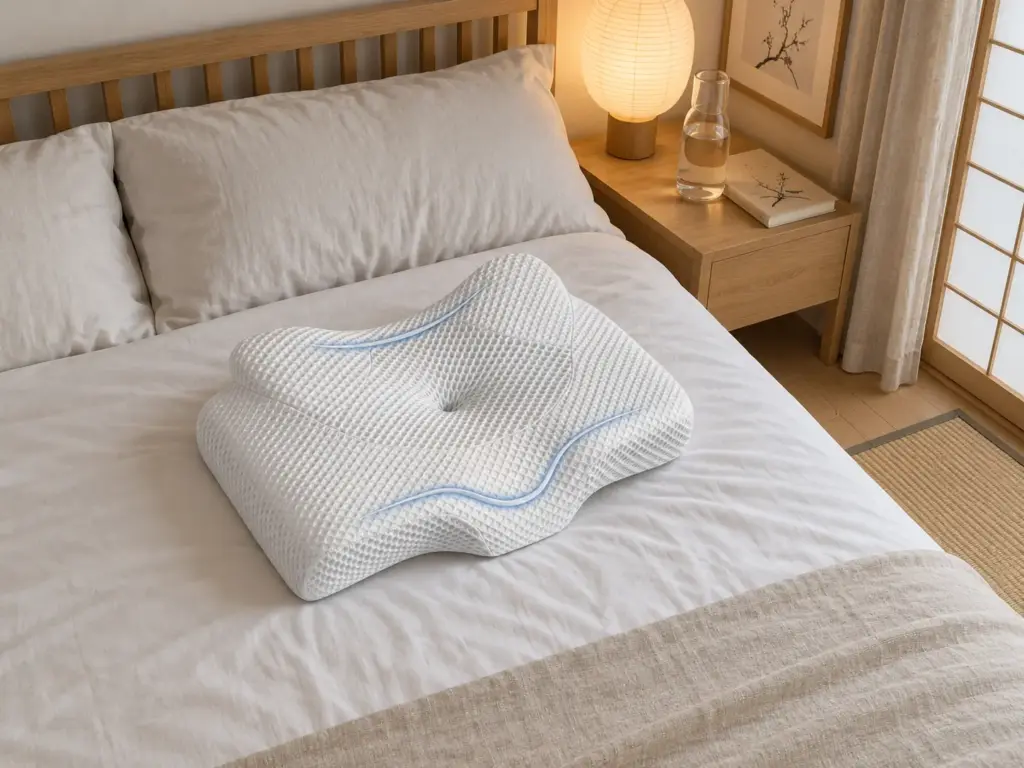
Contour and cervical: height under the neck
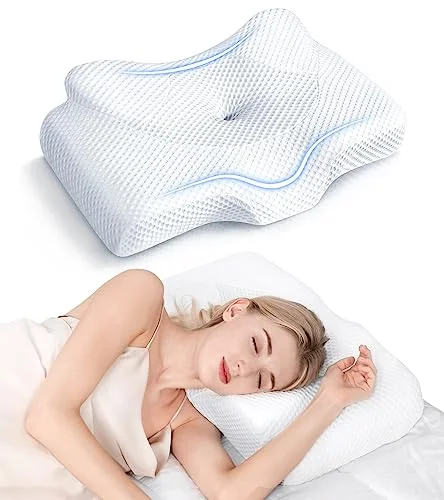
A contour pillow has a raised rim along one long edge and a dip under the skull. The neck rests on the rim, the head sits in the dip, and the head ends up lower than it would on a flat pillow of the same overall thickness. That only works if the head actually lands in the dip: a head that sits on the rim is lifted exactly the way a too-tall flat pillow lifts it. Some pillows are built with higher sides than the middle, and the head belongs in the lower center.
Crescent, U and cut-out
Crescent and U shapes wrap the sides of the neck or the shoulder, and a cut-out removes material where the shoulder or ear would press. Each is shaped for one position, usually the side or the back, which is why combination sleepers feel the edge of the dip when they turn. The shape that fits on the back is the wrong shape ten minutes later on the side.
Hollow centers and what the dip is for
A hollow center cradles the head, and the cradle sets the height as well as the position. The Osteo pillow is hollow memory foam, 25.5 by 16.5 inches in Queen, and its height changes by turning the pillow 180 degrees: 5.2 inches one way, 4.1 the other, with a removable insert. Those are the maker’s numbers for a new pillow, not for month three. The dip works well for the sleeper it is cut for and fights every other position, and the first-night impression can be firm: Amazon’s review summary says some find it too hard, and the listing asks for 48 hours of airing before first use, so even the first night here is not the verdict.
Firmness and a Pillow You Can Set
Firmness and height are two numbers, not one, and a pillow whose fill can be removed lets the buyer fix the second after the first night.

Firm and high are not the same thing
Firmness is how hard a pillow presses back, and loft is how tall it stands. A firm low pillow and a soft tall one can both be wrong for the same neck, in opposite directions, and a box that says medium has told you nothing about either. Our guide lays out why the two belong together as two numbers, not one.
Taking fill out until the line is level
An adjustable pillow ships with more fill than most sleepers want and lets the buyer take the surplus out. The Layla Sleep Adjustable Fill Kapok Pillow, King is shredded memory foam mixed with kapok fibers, and the maker’s copy says to unzip the cover and remove the amount of fill you want; it ships overstuffed. Remove a handful, film the side-profile frame again, and stop when the line from ear to shoulder runs level. Some foam crumb will end up on the floor, so spread a sheet first.
The risk of a pillow you can set sits in the review summary Amazon prints on the listing: it “doesn’t maintain shape after 6 months and becomes very flat.” That is a machine-written summary of reviews, not a quote from one, but it names the month when the height needs another check.
Take fill out over a bath sheet, a handful at a time, and keep what comes out in a bag. The crumbs land in one place, and if the next morning says you went too far, the fill is still there to put back.
What an adjustable pillow gives up
Its height depends on how much was taken out and on whether the fill that remains stays where it was put. A solid block cannot be set, and it cannot be set wrong either. Shredded fill can be set exactly and then drifts. The trade is control for upkeep: an adjustable pillow wants a recheck after the first week and a top-up when the height drops.
Cervical, Orthopedic, Ergonomic: Words With No Standard Behind Them
A pillow can call itself cervical, orthopedic or ergonomic and owe no one a measurement, which is why those words tell a buyer where the pillow is meant to sit and nothing about whether it will.

What the words claim
Cervical names the neck’s part of the spine, the cervical spine. Orthopedic borrows the vocabulary of bone and joint care. Ergonomic means shaped with use in mind. None of the three states a height, a firmness or a test a pillow must pass, and as far as a buyer can check, no standard defines any of them for a pillow.
Two listings can both say cervical, one with a hollow center and the other with a wave, and the word has not told you where either one starts in inches or what the neck will sit on.
What a manufacturer’s height claim is worth
The authors of the PeerJ paper wrote that manufacturer height claims “often lack scientific support and rigorous verification”. The honest reading is narrow. A listing’s height is the maker’s number for a new pillow, measured by the maker, out of the box. When the pillow arrives, measure it with a ruler: the figure on the listing and the figure on the bed can differ, and the second is the one the neck feels.
The clearest example in this guide is the Osteo listing. Its title says Neck Pain Relief, and its own note reads “not for medical use and cannot treat diseases.” Both sentences sit on the same page, and the second is the one to believe.
The pillow does what a pillow can do, which is to hold a height. This guide uses the note, not the promises around it.
The one honest question to ask of any listing
What is the height, and does the fill still hold it after a month? Everything else on a listing is a shape, a fiber or a word. The question has two halves for a reason: the first half is the maker’s number and the second half is the buyer’s test, and a listing that answers only the first has answered the easy half.
A return window or trial period long enough to cover a month is worth more than any of the three words. The length of the window is printed on the page and can be read in ten seconds, and a label cannot be returned. If the window closes before the month-two measurement from the next section, the pillow has not been tested, only tried.
Where the Height Is After Month One
A pillow is bought at its height on day one and lives at its height on day ninety, and the second number, the loft under the head by then, is the one that never appears on a box.
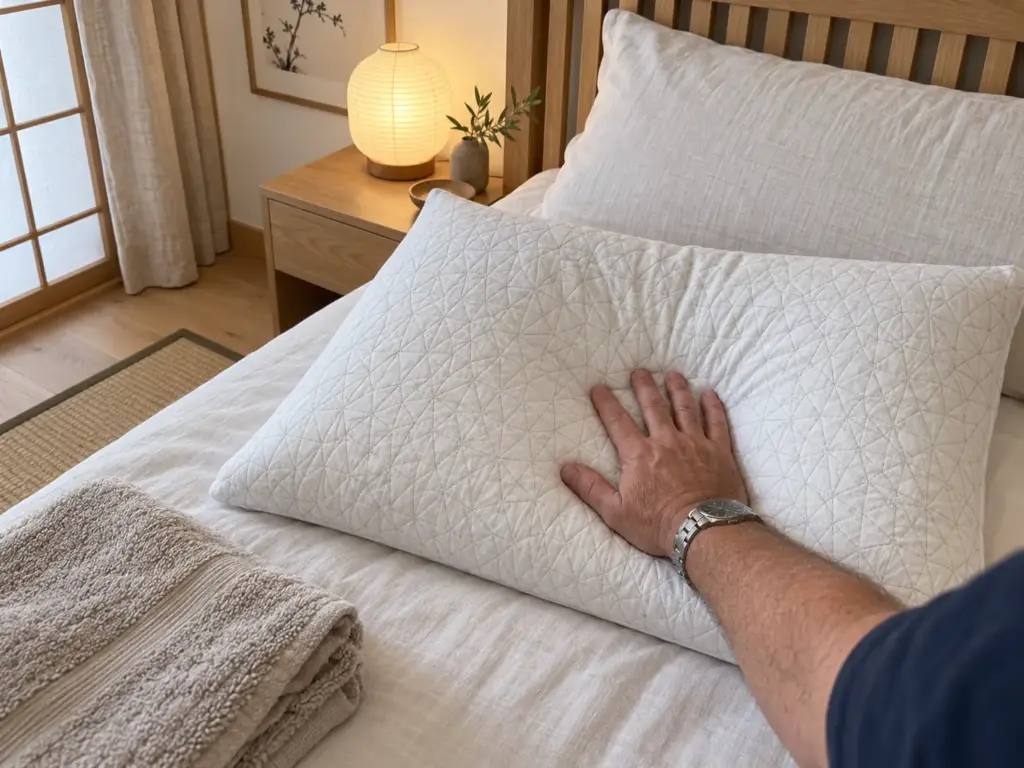
The first night is not the verdict
The PeerJ authors note that comfort perception may change after a period of adaptation, which cuts both ways. A pillow that feels hard on night one may be settling in, and a pillow that feels perfect on night one has not yet been through the part of its life where fill packs down. Week one is a poor judge in both directions, which is why the notebook in the free test counts mornings at a fixed height and not first impressions.
The number printed on a box is also the new pillow’s height, and for a neck the number that counts is the height still standing in month three. A pillow listed at the right height can be the wrong pillow ninety days later, and a pillow listed a little tall can settle into exactly the right one. The number depends on the fill, the sleeper’s weight on it and how often it gets fluffed.
What the lab does that a review cannot
Consumer Reports’ pillow tests load each pillow with 225 pounds for 96 hours at 98.6 °F and 80 percent humidity, then measure thickness and firmness as it comes out of the chamber and again after hand-fluffing. That is the closest published proxy to month three: four days under a weight, in warmth and moisture, measured twice, once as the pillow sits and once as it recovers. A review written in the first week can do neither part.
What the test cannot say is how fast a given foam loses height in a real bed, and there is no published rate for that which this guide can stand behind. The reports that exist are anecdotes, and they run from a week to years.
So the test has to be home-made: with the pillow flat on the bed, hold a ruler against it at the spot where the head rests and write down the height at night one, again at week two and again at month two. Same spot, same ruler, same method each time. A pillow that has used some of its height shows it in numbers long before it shows it in a photo.
A pillow used from the same side of the bed can wear thin first along the edge where the head settles, so measure at that spot and rotate the pillow before judging it.
Write the purchase date on the pillow’s care tag with a laundry marker, and measure on that date every month with the same ruler at the same spot. If the pillow is the only thing that changed between two readings, the difference is the pillow’s.
A cheap one, a good one and when to replace
A budget pillow can do the job if the height is right and the return window is open. A return is the buyer’s best tool, with a limit worth knowing: what a return can’t test is month three, because the window usually closes before the fill has had its say. The cure is the measurement above, taken while the window is still open.
How long a pillow lasts depends on its fill far more than on its age. Some pillows wear out in a few years. The clock for pillow replacement, per fill, is on the page about how often to replace pillows, by fill not by year, and the ruler tells you when your own has reached it.
For a fill that can be topped up when month two comes in short, the Coop Home Goods Original Adjustable pillow ships with extra fill included. Some sleepers find a pillow does not give them enough support, and that is the kind of verdict that month two decides, which is what the extra fill is there to answer.

Beyond the Pillow: The Mattress, the Knees and the Other Side of the Bed
The pillow is one part of a stack that also includes the mattress, the position of the legs and, in a shared bed, a second head.

The mattress under the shoulder
A mattress soft enough to let the shoulder sink lowers the height the head needs, and a topper that adds firmness raises it. After a new mattress or a new topper, the pillow is a new question, and the cheap way to answer it is to run the towel test again from the beginning. No mattress brand belongs in this answer, because the height is the variable and the brand is not.
A pillow between or under the knees
A knee pillow between the knees changes how the hips and the top leg lie for a side sleeper, and a small pillow under the knees changes how the legs and pelvis lie for a back sleeper. Either one alters the angle at which the shoulders and head arrive at the pillow, so the head may need a different height than it did without it. It is a change to the geometry of the whole bed. Make it, then rerun the towel test.
Two necks, one bed
Two sleepers in one bed need two heights, and one pillow cannot be both. A compromise height is too high for one of them and too flat for the other. The structure that works is two pillows, one each, each set to its own sleeper, and the same rule extends to a sleeper who changes position in the night, covered in three positions at once.
A shared mattress adds a wrinkle: it moves. A pillow that works until the other person turns over has met the change under the shoulder, because the mattress dips and the gap changes with it.
In a shared bed, change one sleeper’s pillow at a time and leave the other’s alone, with a notebook each. Two people changing at once cannot tell whose change moved the number.
When It Is Not the Pillow
A pillow is a bedroom fix, and some neck trouble is not a bedroom problem; this is the one place in the article that says so.

What stays with the bed
The height of a pillow can be tested, and the towel and the notebook are the test. If the number moves with the height, the pillow is the lever and everything above applies. If the number does not move, the pillow was never the lever, and no new shape, fill or label will move it. What the neck stiffness is, and what to do about it, is a question for a doctor, and this guide does not try to answer it.
What goes to a doctor
According to the NHS’s advice on when neck pain is worth a GP visit, “neck pain or stiffness that does not go away after a few weeks” is a reason to see a GP. The urgent referral signs are heaviness or weakness in the arms or legs, or pins and needles in an arm along with neck pain: NHS 111 or an urgent GP appointment. The NHS is the UK’s health service; the thresholds travel, the phone numbers do not.
Bring the notebook. Seven mornings of heights and scores is the thing a doctor can read in a minute, and it answers the one question the bed can: what the pillow did and did not change.
Fold the Towel Tonight, Measure Again at Month Two
Three things to keep:
- Height is the thing. Fill, shape and label matter only through whether the neck stays level with the spine.
- The free test goes first: one towel, one change at a time, seven mornings of notes.
- The fill has to hold the height past month one, so measure at night one, week two and month two.
At month two, set the ruler at the same spot you used on night one and compare the two numbers; a drop you can see in the side-profile frame means the pillow has stopped answering for its label.
Tonight, slide one folded towel under the pillow you already own, put the case over both, and in the morning write down the number of folds and a 0 to 10 score for the first hour. That page, not the name on the box, is what the next purchase should be measured against.
Frequently Asked Questions
01Which type of pillow is good for neck pain?
The right pillow keeps your head level with your spine in your main sleeping position and still holds that height after a month. Shape and fill matter because they decide whether that height lasts. A pillow does not treat neck pain.
02What can I change in my bed tonight if my neck is stiff in the morning?
Add or remove height with a folded towel under your current pillow, change only that, and write down how the neck feels for seven mornings. If the score does not move with the height, the pillow was not the lever, and the section called When It Is Not the Pillow picks it up from there.
03What pillows do doctors recommend for neck pain?
No particular pillow is prescribed for neck pain; what advice has in common is a height that keeps the neck level for the way you sleep. Pain that lingers is a doctor’s question, as the section When It Is Not the Pillow explains.
04Should I stack two pillows for my neck?
Stacked pillows slide against each other and tilt the head, so a single pillow at the right height holds the neck more steadily than two on top of each other. A folded towel inside the case or a pillow with removable fill sets the height without a stack.
05How long does a neck pillow keep its height?
A neck pillow keeps its height for as long as its fill does, so measure it at night one, week two and month two and compare the numbers. Pillows vary widely: some flatten within about a week, and others last about two years.





Tried it on your own bed?
No comments yet. Tell us what you changed, and what the sheet did after a few washes.