







What’s in here8 sections
- Who a Body Pillow Works For, by Sleep Position
- The Free Version Comes First
- Length Is Measured Against Your Leg, Not the Box
- Two People, One Bed: Which Shape Takes the Partner’s Side
- Fill and Heat: A Second Layer of Mattress Pressed Against You
- Cover, Wash and Month Three, and When It’s the Wrong Tool
- Fold a Pillow Tonight, Measure Before You Buy
- Frequently Asked Questions
You settle onto your side, and within a few minutes the top knee has slid off the one beneath it and landed on the mattress, while the top arm folds under your chin with nowhere to go. You wake with the long pillow you bought for exactly this lying somewhere around your shins. Body pillows are sold by shape and by how soft they look in a photo, and the box rarely gives the one number that decides whether yours will work: how far down your leg it reaches.
A body pillow is a spacer that works below the neck, holding the top knee and arm off the mattress, and it keeps doing that only if its length reaches where your leg actually lies and its fill neither packs flat by month three nor warms into a slab of foam pressed against you all night. Below: who it suits by sleep position, the free version to try first, length against your leg, the shared bed, fill and heat with three picks, and what the pillow looks like by month three.
Quick Answer
Yes for side sleepers, mostly no for back sleepers, and only a prop toward a half-side position for stomach sleepers. It works when it stops the top knee and arm dropping forward, which takes chest-to-ankle length and a fill that neither flattens nor runs hot. Try a folded bed pillow first; your head pillow still decides the neck.
Who a Body Pillow Works For, by Sleep Position
Whether a body pillow helps depends on how you sleep before it depends on which one you buy. The position decides where the pillow goes, what it holds up, and whether it is still in the bed by morning.

Side sleepers: the knee gap and the arm
On your side, two things fall forward the moment you relax: the top knee and the top arm. With nothing under them, the knee lands on the mattress in front of the lower leg and the arm either drapes across your chest or works its way under the head pillow. A body pillow fills both gaps at once. Naturepedic’s guide places it between the knees and ankles, with the upper end hugged so the arm rests on it, and that placement is the entire job.
It does nothing for your head, though. The head pillow stays where it is, and its loft is a separate decision you make with a separate pillow (if you are still choosing that one, start with a budget head pillow for a side sleeper). The long pillow sits below it and takes care of everything from the shoulder down. For the head side of the question, see how head-pillow loft changes by sleep position.
Stomach sleepers: a prop toward a half-side position
Flat on your front, there is no knee gap to fill and nothing for a long pillow to hold. What some stomach sleepers use one for is rotation. The pillow runs along one side, the top leg bends up over it and the torso tips onto it, so you end up a quarter-turn off flat, still mostly on your front but no longer pressed square into the mattress.
That changes the head pillow too. A face turned to one side on the mattress wants a low pillow, and a half-side position still wants far less loft than a true side sleeper’s; pillows for stomach sleepers covers that low-loft choice. The long pillow is only the prop that holds the rotation. Roll back flat during the night and it has nothing left to do.
Back sleepers and combination sleepers: the hard cases
On your back, both knees point at the ceiling and neither arm has anywhere to fall, so for most back sleepers the answer is no. The nearest use is under both knees, which an ordinary bed pillow does just as well; the decision that matters is the one in pillows for back sleepers. A long pillow laid behind the back belongs to side sleepers, as a stop that keeps them from rolling over.
Combination sleepers are where a heavy pillow’s best quality turns against them. Amazon’s summary of Coop buyers calls theirs “slightly heavy to move from side to side.” You fall asleep hugging it facing the wall, turn the other way in the night, and the pillow stays put, now behind you. Someone who changes position several times a night does better with a lighter, straight pillow, or none; pillows for combination sleepers deals with the head pillow that has to follow those turns.
The pillow that felt right in the first hour is often the one lying on the far side of the bed after you have rolled twice. One r/Bedding poster skips the purchase altogether and builds “a little u around me” out of ordinary bed pillows, and that is the place to start.
The Free Version Comes First
Before a 54-inch purchase, the same spacing job can be done with a pillow you already own. And what that free version cannot do is the real list of reasons to buy the long one.
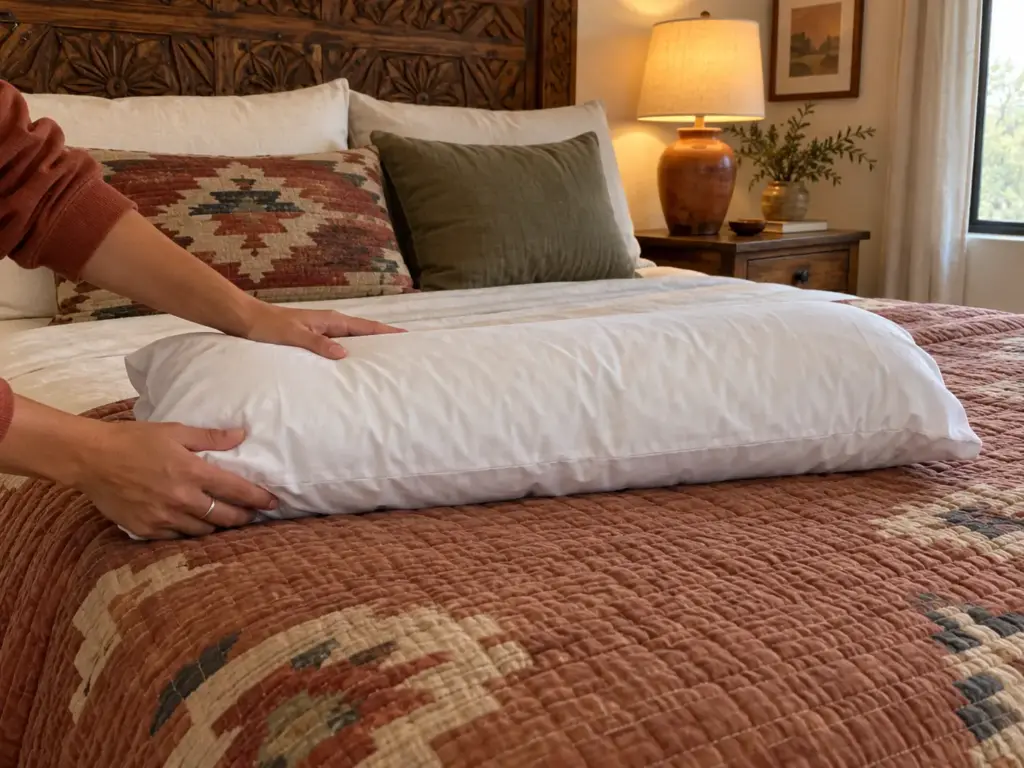
A bed pillow folded lengthwise between the knees
What makes a body pillow work is the spacer between the knees, not the long shape around it. Take a standard bed pillow, fold it along its length so it becomes a thick roll about as long as your thigh, and set it between your knees, a pillow between the legs being the oldest version of the idea. That is the same placement Naturepedic describes for a body pillow, minus the part that reaches up to your arm.
The fold doubles the loft, which matters: a standard pillow lying flat between the knees compresses to almost nothing under the weight of a leg. (Folded the short way, it becomes a cube that pops out within minutes.)
The community version goes a step further. The r/Bedding poster who builds “a little u around me with pillow” uses two or three bed pillows at once: one between the knees, one along the back as a stop, one under the arm. It is untidy, and the pillows drift apart by morning, but within a week it tells you which of those pieces you actually reach for, and that is information no box can give you.
Do not borrow the head pillow for the knees, either. Naturepedic’s guide is plain about it: “Make sure your head still rests on a separate pillow with enough loft to fill the space between your head and the mattress.” A folded pillow between the knees changes nothing about the space above your shoulder, so whatever you build down below, the pillow under your head stays where it is.
Slip the folded pillow into a pillowcase while it is still folded. The case holds the fold shut, so it stays a roll between your knees instead of springing flat an hour after you fall asleep. If it still ends up on the floor, look at which side of the bed it lands on before you shop: that side is telling you what shape you need.
What the folded pillow cannot do
Its limits are exactly the specs worth paying for. A bed pillow is not a cylinder: folded, it wants to spring open, and by the time you are asleep it has often unfolded and slid out. It reaches the knee and stops, so the ankles still stack one on the other.
Nothing supports the arm. And when you roll, it stays behind, with no second half waiting on the other side.
Each of those gaps maps onto something on a product page. The springing open is why foam and cluster fills are packed into a tube with a zip, which holds them in a round section that a folded rectangle never keeps. The ankle is the length question of the next section.
The arm is the reason a long pillow runs up past the chest at all. If none of those three bothers you after a week with the folded one, a long pillow solves problems you do not have, and a small knee pillow, or the folded bed pillow you already own, is the whole answer.
Give it a week of nights and watch where it ends up.
- On the floor on the side you face, most mornings: you need length and a fill that holds its shape between the knees. A long pillow is a real upgrade for you.
- Behind you, or in the middle of the bed: you turn more than a long pillow can follow. A small knee pillow, or a light straight one, will suit you better than a large curved one.
- Still between your knees, and you slept fine: the free version may be all you need, and you can stop here.
The third outcome is common enough that it is worth a week before spending anything. The folded pillow also answers a question you cannot answer in a shop: whether you like something pressed against you all night at all.
Length Is Measured Against Your Leg, Not the Box
The box prints a length in inches. The length that matters is how far down your leg the pillow reaches once you are hugging it, and the only tool that tells you that is a tape measure.
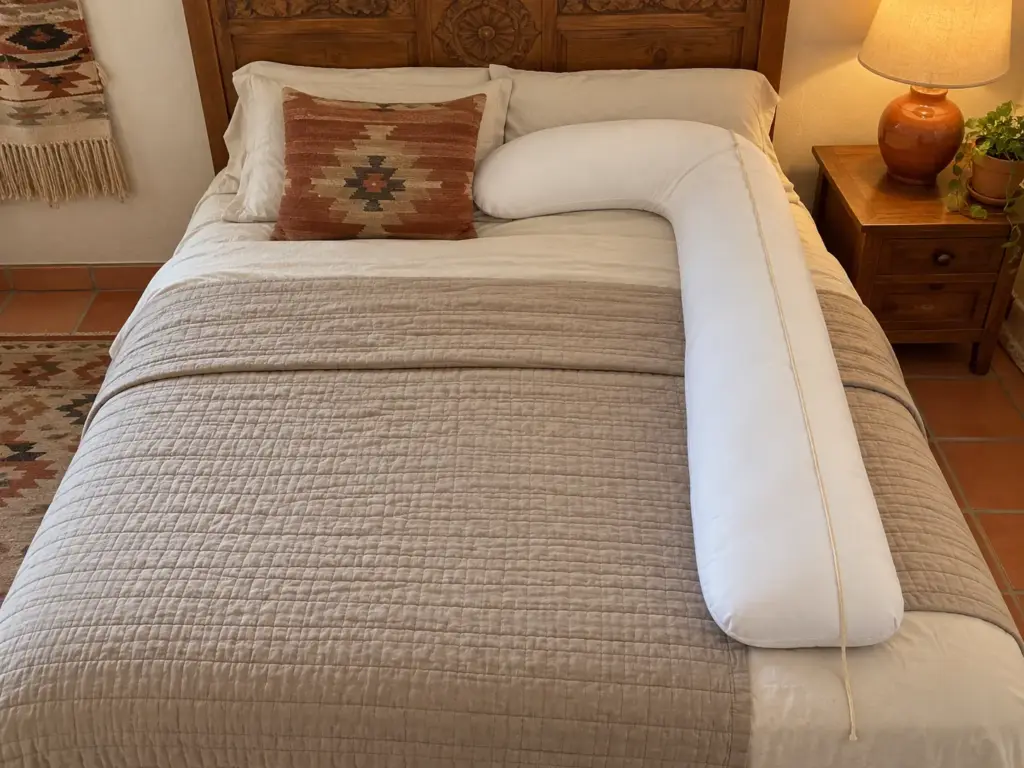
Chest to ankle, with a tape measure
A standard rectangular body pillow runs about 48 to 54 inches, and Naturepedic notes that even the six-foot ones are “not typically the full length of an adult’s body.”
Where that length lands depends on where you hold it. Pull the top end up under your chin, the way most people hug one, and on many adults a 54-inch pillow ends somewhere around the knee, leaving the ankles stacked. Slide it down so it starts at the chest and it reaches farther, but the arm loses its rest. To reach the ankle with the arm still on it, the pillow has to run roughly from shoulder to foot.
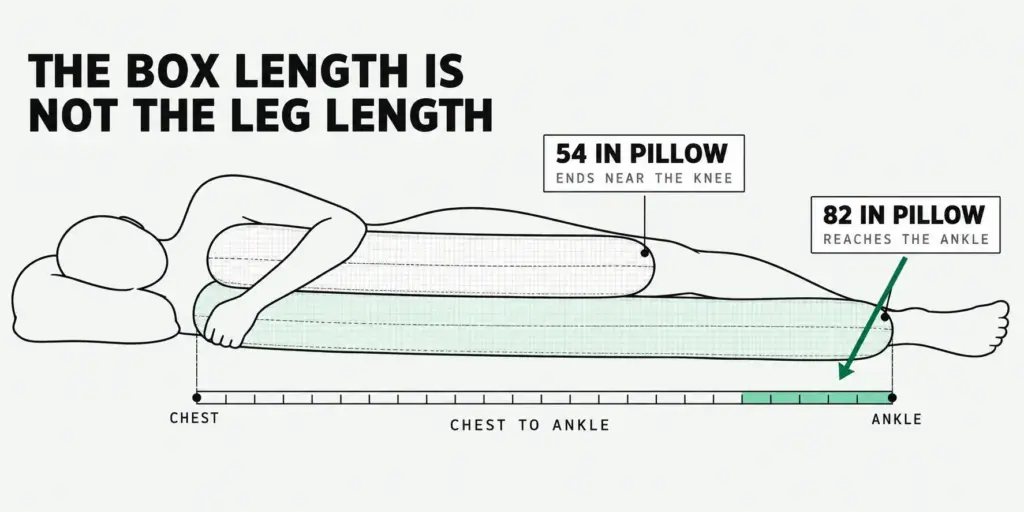
So measure the sleeper, not the pillow. Sizes vary more than the phrase “full length” suggests: MedCline sells a 45-inch pillow for people 5 ft 1 in and under and a 50-inch one for taller sleepers, Coop’s straight pillow is 20 by 54 inches, MedCline’s J is 22 by 50 by 6, and the extra-long models run to 82 inches. Those numbers only mean something next to your own.
Measure lying down, not standing. Lie on your side with the knees bent the way they bend at night, and have someone run a tape from the spot where your top arm rests down to the inside of your ankle. Standing, your legs are straight and the number comes out longer than the one your bed will see.
Width is the gap between your knees
Length decides where the pillow ends. Width and thickness decide what happens between your knees, and that is the part you feel first. A Coop reviewer measures the result as four to six inches of thickness between the legs once the pillow is squeezed, and that squeezed number matters more than the 20 or 22 inches printed as width, which is measured with nothing pressing on it.
Too thin, and the top knee still sinks toward the mattress. Too thick, and the top leg rides high and the arm has to reach over something closer to a bolster than a pillow.
Width also decides the arm: a 22-inch pillow hugged at the chest puts more between your arm and your chest than a 20-inch one. The wrong size usually reveals itself away from the bed, too: one Coop buyer found the case they bought “barely fits” over the pillow, and a three-star buyer at a warehouse retailer returned theirs “because it is not long enough.” Both are measurements somebody could have taken before the box arrived.
I, C, U and J: what each shape wraps
Naturepedic sorts the shapes into four. The I is long and straight, the standard. The C curves around one side of you.
The U surrounds both sides. The J has one curved end and one long straight side. (A wedge is a different tool, a sloped block that props rather than hugs, and it stays out of this comparison.) An I is a free-standing second pillow you can move, flip or toss off the bed; the C, U and J trade bed space for a position that is built in.
The U looks like the complete answer, since it covers your front and your back at once. Alone in a queen, it can be. In most beds it costs the most: it takes both sides of you, it needs to be climbed over to change sides, and it holds warmth on both sides of you instead of one. For a side sleeper who stays on one side, a J or a plain I does the knee-and-arm job without the rest of the footprint.
The four shapes, side by side:
| Shape | What it wraps | Bed it takes | Where it fails |
|---|---|---|---|
| I (straight) | The front: between the knees and under the arm | One lane | Nothing behind your back; stays put when you roll |
| C | One side of you, curving around the head end | A lane and a curve across the top | Built to face one way; changing sides means climbing over it |
| U | Both sides: the front and the back at once | Both sides of the sleeper, the partner’s lane included | Shared beds, and warmth on both sides of you |
| J | The front, with a curved end at one side | A lane and a hook | The curve sides with one direction; roll over and it is behind you |
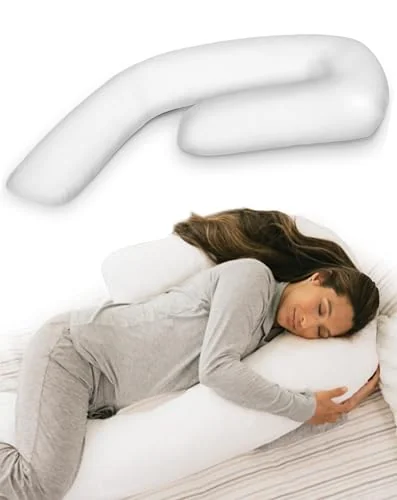
The J is the compromise for a side sleeper who shares a bed or does not want to be surrounded. Its straight side runs down between your knees like an I, and the curve gives the arm and the top of the pillow somewhere to sit without a second arm of foam reaching around behind you. If you sleep facing one direction most of the night, it is the shape that gives you the most for the least mattress.
Two People, One Bed: Which Shape Takes the Partner’s Side
A body pillow is bought for one sleeper and lives in a bed for two. The useful question is not which shape is most comfortable but which one leaves the other person their half.

A pillow that stays where you left it
Weight is what makes a good body pillow stay between your knees, and weight is what makes it a problem in a shared bed. Coop’s buyers describe theirs as “slightly heavy to move from side to side,” while a reviewer sleeping alone in a single bed found “it’s easy to move it to the other side of the bed.” Both are true. Alone, moving it is a choice; with a partner, the pillow you do not move ends up in the middle of the mattress, and one retailer review sums it up in its title: “It’s Like Another Person In the Bed.”
There is a second cost that shows up only under a shared duvet. A long pillow hugged under the covers drags the duvet with it every time you pull it across to the other side, so each turn you make takes a stretch of cover off your partner. Pull the pillow over the top of the duvet instead and it slides off; tuck it under and it takes the duvet along.
Neither is a disaster. Both happen every night.
The lane math: I, J, C and U against a shared mattress
Think of each sleeper as having a lane. A queen is 60 inches wide, so each of you has about 30, and a pillow 20 inches across lying beside you is two-thirds of your half before you have lain down. The I stays in one lane, along your front.
The J takes one lane plus a hook at the curved end, which reaches toward the headboard or the middle depending on how you turn it. The C and the U take both sides of you, which puts the back of the curve in the middle of the bed, in your partner’s lane. Naturepedic says it in a clause: U-shapes “can take up considerable space in a shared bed.”
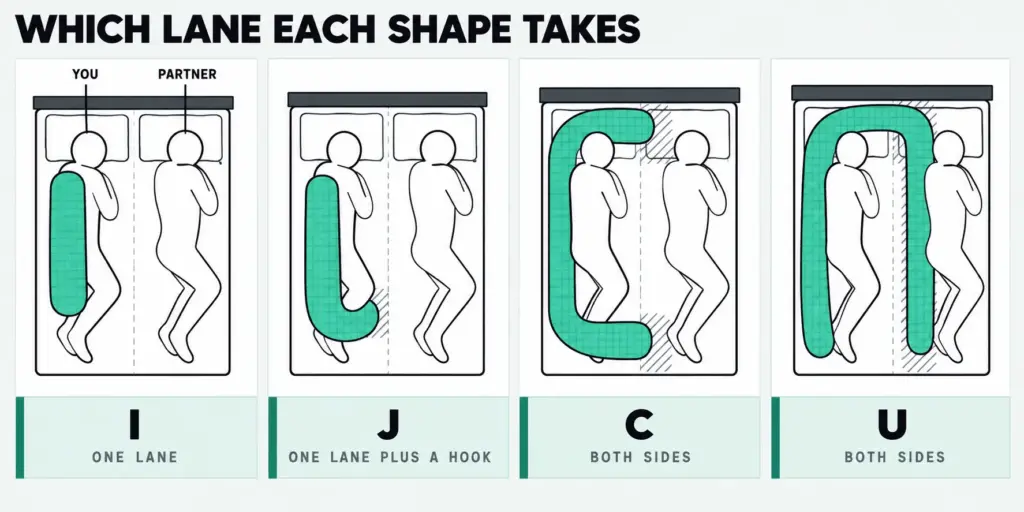
No maker prints how many inches of mattress its pillow consumes, so do the measuring yourself: lay the pillow in your half, lie down on it the way you sleep, and see what is left between the curve and your partner. For an I or a J, the answer is usually nothing that crosses the center. For a U, it is usually your partner’s shoulder room. And the bed size changes the verdict more than the pillow does; a U that is generous in a king becomes a third occupant in a full, and any of these shapes crowds a small bed.
Sleep on the edge side if you are the one with the pillow. A J turned with its curve toward the outside of the mattress keeps every inch of foam in your lane, and when you roll toward the middle, the straight side is the only part your partner meets.
When each sleeper gets their own
Sometimes both people want one. A r/Bedding commenter “got my husband and me each” a long pillow, an L-shaped one and a C-shaped one that also work as back support when they sit up to read. That is the two-of-something answer this blog gives for duvets, and it works the same way here: two pillows, two lanes, nobody negotiating over one.
The bill is mattress width. Two straight pillows on a queen leave each of you about 10 inches of mattress that is not pillow, which is fine if you both sleep on your sides facing out and tight if either of you sprawls. Two curved ones on a queen rarely work.
If you both want one and the bed is a queen, two I-shapes or one I and one J is the arrangement that leaves room for the people. On a king, the shapes open up. Before buying two of anything, try the folded-pillow week with both of you at once: it shows how much room each of you actually uses.
Fill and Heat: A Second Layer of Mattress Pressed Against You
A body pillow lies against you for the whole night, hugged, usually under the same duvet you are. It behaves like one more layer of mattress, except this one is on top of you and in front, so what it is filled with and covered in sets the heat before any word on the label does.

Solid, shredded and cross-cut foam
Memory foam softens with warmth and pressure. That is why it molds to the knee, and it is also why it holds heat where it touches you: the foam warms to your temperature and keeps it there. Sleep Foundation notes that a “common complaint about memory foam body pillows is that the fill absorbs heat.” Solid memory foam, a single block, has no path for air through it, and that is the heat retention people complain about. Shredded memory foam breaks the block into pieces with gaps between them, and Naturepedic says shredded constructions “generally allow more airflow than solid foam,” which is the breathability difference between the two. Cross-cut foam is shredded foam cut into more regular pieces, and in Coop’s pillow it is mixed with microfiber, which loosens the fill further. One maker takes the idea farther, blending 75 percent shredded memory foam with 25 percent down-alternative fiber for the same reason.
Shredded foam gets recommended as the answer to a hot pillow, and it is the better foam for a hot sleeper. But a long tube of shredded foam pressed against your front under a duvet is still several pounds of material warming to your skin temperature, with a gap for air only on the side facing away from you. If you already run hot, shredded is the less warm foam, not a cool pillow, and the fiber end of the next section is where cool actually lives.
The smell of a new foam pillow is a separate question. CertiPUR-US certification covers what is in the foam and what it gives off into the room: no formaldehyde, no heavy metals, regulated phthalates excluded, and VOC emissions under 0.5 parts per million. It says nothing about whether the pillow runs warm or how high it stays at month three. Read it as a statement about the air in the bedroom, which is useful, and not as a comfort rating.
Of the foam pillows with a full washing instruction and a way to fix a flat spot, the Coop Original Adjustable Body Pillow is the one to look at first. Its loft runs from 6 to 10 inches because the zippered cover opens and you can add or remove fill, which makes it the one long pillow here with the month-three repair built in. According to Sleep Foundation’s notes on it, both the fill and the cover go in the washer cold on delicate and tumble dry low.
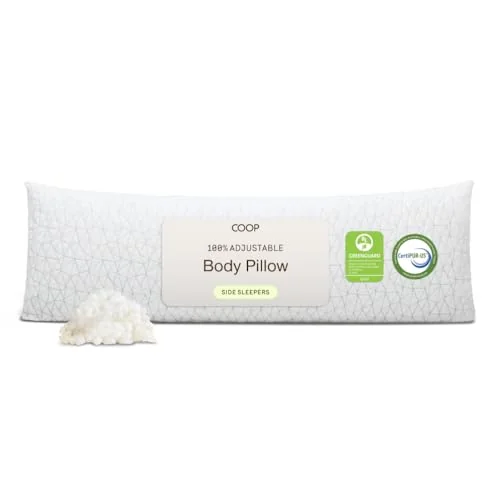
The heat complaint is specific. A four-star reviewer on its own listing warns that “anyone who considers themselves to ‘run hot’ is going to find this far too warm,” and found that a satin case helped without fixing it. Weight and smell are the two other complaints in Amazon’s summary, 217 mentions for one and 164 for the other. If you sleep warm and share the bed, all three point the same way: this pillow suits a cool sleeper who stays on one side.
Fiber fill, the cool and short-lived end
Polyester fiber (sold as microfiber, PET fiber, cluster fill or down alternative) does not soften with warmth the way foam does. The clusters keep their spring at skin temperature and leave air between them, so a fiber pillow runs cooler than any foam one, weighs less, and costs less. What it does over time is the other half of the deal: fiber does not compress evenly like foam, it clumps, and once the clusters have matted into lumps a dryer spin brings back only part of the loft.
That makes fiber the right fill for two kinds of sleeper: the hot one, and the one who wants to find out whether a long pillow is worth having before paying for foam. The Oubonun Full Body Pillow is the fiber pick with the deepest record behind it, close to 18,000 ratings, and it is the cheapest of the three here by a clear margin.
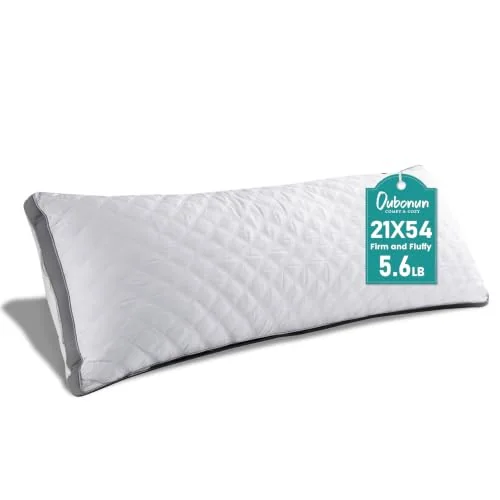
Four in ten of the people who bring up durability saying it failed is a lot for a pillow sold on not flattening. Treat the word on the box as an advertisement and the clumping as the expected end of fiber. And keep the anti-sell next to it: a folded bed pillow does the knee half of this pillow’s job for nothing. Buy the fiber one when the folded pillow has already shown you that you want length and something under the arm.
The cover is the other half of the heat
The fill decides how much heat the pillow stores. The cover decides how fast what touches your skin can move moisture away, and with a pillow pressed against your front for hours, that is the half you feel. Viscose (rayon, the “bamboo” on many labels) takes moisture into the fiber; polyester barely absorbs any and leaves sweat sitting on the surface; cotton sits in between and, woven as a percale, leaves gaps in the weave for air. Coop’s 60/40 polyester and viscose cover is a mix of the two ends.
The rule that holds for sheets holds here: the least permeable layer in the stack sets the ceiling, which is why a solid-foam pillow can undo a cool bed, as the layer that sets the heat ceiling in a bedding set explains. A cotton percale case over a foam pillow moves moisture better than the pillow’s own polyester-heavy cover. It will not remove the heat the foam stores.
That is what the satin-case reviewer found: the swap moved the heat and did not take it away, which tells you the fill was doing most of the work. If you wake with one side of you warm and the other fine, the warm side is the one against the pillow, and the fill is where to look next.
Do not judge a foam body pillow on its first night. Take it out of the vacuum pack in the morning, leave it to air in an open room for the day, then give it a low-heat dryer spin with the care label open beside you before it goes on the bed. Most of the smell and the flatness of day one belong to the pack, not the pillow.
Cover, Wash and Month Three, and When It’s the Wrong Tool
Week one lies about a body pillow the same way it lies about sheets. This section follows the pillow through the first night, the first wash, and the month it goes flat where your legs sit.

The first week: vacuum pack, smell and the dryer
Most foam body pillows arrive vacuum-packed, and they look broken. “Do not believe the pictures where it’s all flat,” one 5-star Coop buyer writes. “It comes vacuum sealed and you have to put it in the dryer for a little while.” Another thought “something was wrong, the package was so light & small,” and then found the pillow “really heavy” once it had been fluffed back to size.
The weight that surprises people on day three is the same weight that keeps it between your knees and keeps it from following you when you turn.
The smell follows the same timeline. It is strongest the day the pack opens and fades over a few days of air, which is why 164 mentions of odor sit beside a pillow most buyers keep. Give it the week before you decide anything about its height, its heat or its smell, because all three change in that week. Coop lists a 100-night sleep trial and a five-year warranty, according to Sleepopolis, which gives you the week and then some to find out.
Washing: the inside is the part that will not go in the machine
Care is a purchase spec, and for a body pillow it is the one most often skipped. Coop’s fill and cover are both machine washable, cold on the delicate cycle, and tumble dry low, and Sleep Foundation adds that the fill “must be completely dried,” which goes faster if the loose fill dries inside a delicates bag. That is the exception.
Other makers say to wash the cover only and spot clean the foam, one of them warning that “too much moisture can cause permanent damage.” Read the label on yours rather than any general rule, including this one.
Even when the whole pillow is washable, size gets in the way. A 54-inch pillow needs a commercial-size washer to turn freely, and a foam core takes hours to dry through; a damp center that feels dry on the outside is how a pillow starts to smell for a different reason. The longest owner report found on any of these pillows is an Amazon update titled “BEST PILLOW EVER!
JUST DON’T WASH IT!”, from a Coop owner whose pillows lasted seven years and who is buying again, with one warning: “just be mindful when washing them.” No one counts the washes. A pillow whose core will not go in the machine needs a cover that does the washing for it, and a protector as the layer that does the washing covers what that layer can and cannot keep out.
Buy the case after the pillow has been re-lofted, not with it. Measure the pillow at full height once it has had its dryer spin, then add a couple of inches to the width for the case. A case bought to the 20 by 54 on the box is the one buyers say barely fits.
Month three: flat where your legs sit
Around the third month, shredded foam “can start to flatten out” as it molds to the shape that presses on it most, and on a body pillow that shape is your legs. One Coop buyer put it precisely: “I knew that I could use just a tad more fill because of the way the pillow stayed flatter wherever my legs sat on it.” A r/Pillows poster says the same about a cuddle pillow that “has gotten too flat” to hold the gap between the knees.
Flat at month three is usually compaction and fill migration, the foam shifting toward the ends, not the end of the pillow. A low-heat dryer spin breaks the packed foam apart again; one reviewer answering a complaint about a flat pillow wrote simply “put it in the dryer, that’s why it’s flat for you.” If the spin is not enough, open the zip and push fill toward the section where your knees rest, or add some. Fiber fills behave differently: they clump rather than compress, and a spin loosens the clumps only partway, which is what the 66 negative durability mentions on the fiber pick describe.
The pillow is finished when it stays flat after a spin and after the fill has been moved or topped up. At that point it is the same question as any worn pillow, and the fold test for when a pillow is finished gives you a way to answer it in a minute instead of by feel.
When the pillow is not the problem
Sometimes a long pillow is the wrong tool. Back sleepers rarely need one. People who turn all night will drag it more than they use it.
And no body pillow changes what happens above the shoulders: the head pillow still decides the neck. If yours is adjustable, like the Coop Original Adjustable Pillow in Queen, a 20 by 30 inch pillow of cross-cut memory foam and microfiber, the loft is set by the fill you leave in it, though the same foam that holds heat in the long pillow holds it in this one too, and its heavy core takes a long time to dry after washing.
A body pillow changes how you lie in bed. If something hurts and stays the same whether the pillow is there or not, that is a question for a doctor or a physical therapist, not for a longer pillow. Everything on this side of that line is the bed: the length against your leg, the fill, the cover, and how it washes.
Fold a Pillow Tonight, Measure Before You Buy
Three things decide whether a long pillow earns its place in the bed:
- It is the second pillow, below the neck. Side sleepers use it for the knees and the arm, stomach sleepers use it as a prop toward a half-side position, and back sleepers mostly do not need one.
- Buy to your leg, not the box. Measure chest to ankle lying on your side, check the squeezed thickness between the knees, and pick the shape that stays in your lane if you share the bed.
- Fill and cover set the heat; month three sets the verdict. Foam with adjustable fill can be fixed when it flattens, fiber runs cooler and clumps sooner, and the head pillow still decides the neck.
Around the third month, squeeze the pillow along its length where your knees rest and compare it with the ends: if the middle has sunk well below them and a low dryer spin does not bring it back, move fill or start looking.
Tonight, fold your own bed pillow lengthwise, slip it into a case to hold the fold, and put it between your knees. In the morning, notice where it is. Between your knees, on the floor in front of you, or behind your back: each of those answers points to a different purchase, or to none at all.
Frequently Asked Questions
01Should side sleepers use a body pillow?
Yes, when its length reaches from your chest to your ankle and it stays between your knees through the night. Try a bed pillow folded lengthwise first: if you keep reaching for it, a long pillow is worth buying.
02What is the best body pillow for a side sleeper?
The best one is the one whose length matches your leg and whose fill matches how warm you sleep. Measure chest to ankle on your side, then choose adjustable foam if flattening worries you or polyester fiber if you run hot.
03How long should you keep a body pillow?
There is no fixed number of years; keep it until it stays flat after a low dryer spin and after moving or adding fill. Shredded foam can flatten around month three and usually re-lofts, while fiber clumps and recovers less.
04How are you supposed to lie on a body pillow?
On your side, with the pillow between your knees and ankles and your top arm resting on its upper end. Your head stays on a separate pillow with enough loft. Stomach sleepers bend the top leg over it to tip toward a half-side position.
05Do body pillows sleep hot?
Memory foam ones often do, because the foam warms to your skin and holds it. Shredded foam breathes better than a solid block, polyester fiber runs cooler still, and a cotton case helps with moisture without removing the heat the fill stores.




Tried it on your own bed?
No comments yet. Tell us what you changed, and what the sheet did after a few washes.