


What’s in here11 sections
- What a Pillow Can Change for a Shoulder, and What It Can’t
- The Free Changes That Come Before You Buy Anything
- Loft Against the Width of Your Shoulder, and the Mattress You Sleep On
- What the Fill Does Under a Shoulder
- Cut-Outs, Notches and Contoured Shapes
- Body Pillows and Arm Support
- The Mattress Under the Bottom Shoulder
- Counting the Weeks, Not the First Night
- When It Is Not the Bed’s to Fix
- Move the Load Before You Buy, Then Count the Weeks
- Frequently Asked Questions
You lie on the side that hurts, the top arm slides under the pillow, and by morning the first thing you notice is the shoulder rather than the neck. Looking for the best pillow for shoulder pain starts from a mismatch: a pillow is cut to hold a head, and a shoulder is a different load, made of the weight of the arm and the top shoulder plus the bottom shoulder sinking into the mattress. “Ergonomic” and “shoulder relief” on a box describe none of that. What follows sorts what a pillow can change from what it can’t, starts with the free changes, and then works through loft against shoulder width, what each fill does under a shoulder, how to read a cut-out, the arm pillow, the mattress, and the number of weeks it takes to know.
Quick Answer
A pillow cannot treat a shoulder, but the right fill and loft can stop it loading one all night. The arm and the mattress under the lower shoulder matter as much as the pillow, so change one thing a week and judge it by the morning. An ache that outlasts a few weeks of that is a doctor’s question.
What a Pillow Can Change for a Shoulder, and What It Can’t
Check which shoulder is sore in the morning. For most side sleepers it is the one underneath, and it tends to trade places when the sleeping side does. That pattern is why this is a bed question at all: the load follows the side you lie on. Split the night into three loads, the bottom shoulder, the top shoulder and the arm, and a pillow turns out to reach two of them well and the third barely.

The bottom shoulder carries the night
Lying on your side puts the weight of the torso onto one joint and a small patch of mattress, and that patch is where the pressure points form. How much of that the joint takes depends on how far the mattress lets it sink, which is a mattress question and gets its own section further down. The pillow under your head sets how the neck lines up with that shoulder, and no more than that.
What a second pillow can do is take weight off it. According to a 2021 body-pillow study in *Sleep Medicine Research*, “The most likely reason for disrupting a lateral sleeping position is excess body pressure distribution on the shoulder and hip.” In the same paper, a support held in front of the chest lowered the pressure measured at the shoulder, which is the pressure relief a shoulder pillow is sold on.
Read that with its limits: eight healthy young adults, pressure-mapped lying awake, not tracked across a full night. It shows a direction, not a cure. The feeling is often described as crushing the shoulders, which is the same finding in plainer words.
The top shoulder and the arm hang
The top shoulder has the opposite problem. Nothing is underneath it, so the arm falls forward across the chest or hangs off the edge of the pillow, and its weight pulls on the joint it hangs from. An arm tucked under the head pillow does the reverse, because then the shoulder holds it up for hours.
Either way, the arm is the load a pillow reaches best. What it needs is something to rest on, which is a cushion’s job and needs no special shape at all.
Where the head pillow’s job ends
The pillow under your head keeps the neck level with the spine, and it stops there. How tall it should be once you know your shoulder width is what pillow height for side sleepers, set by the shoulder works out, and the neck pillar covers the rest of the head’s side of the bed. The gap at the waist belongs to the back pillar. This guide stays below the neck, on the joint under the load.
One limit belongs here, said once: no pillow reaches the reason an ache exists. The last section deals with that, and everything before it is about the bed.
The Free Changes That Come Before You Buy Anything
Two of the three loads change with things already in the house. A folded towel or a spare pillow does the arm’s job for nothing, and the only way to know whether it worked is to change one thing at a time. Anything bought comes after that test, not before it.

Give the top arm something to rest on
Put a support in front of the chest, high enough that the top arm lies along it instead of falling past it. A rolled towel works, so does a spare pillow hugged loosely. Some sleepers fix it with whatever they have: an arm propped on a plush pillow, or a long pillow hugged to keep the shoulder and hip in alignment.
The weak point is that supports slide. A towel that is in place when you lie down is on the floor by morning, or has unrolled into a flat strip under your elbow, and a change that doesn’t stay put is not being tested. If it drifts, the reasons are covered in why a pillow position drifts by morning.
Roll the towel tight and slide it inside a spare pillowcase. A bare towel unrolls and skates on the sheet, while a roll in cotton keeps its width and stays where it was put. Judge a support by whether it is still in front of your chest when you wake up.
One change a week, in a notebook
Two changes in the same week tell you nothing about either one. Pick the towel, hold it for a week, and write down one line each morning: which side you slept on, which shoulder spoke first, how long it took to ease, and what changed since the last entry. A line, not a score. If the notebook shows no difference after the week, move on to the next change and leave the first one out, so the effects stay separate.
Reading the morning, not the first night
The first night with anything new is unreliable in both directions. A new pillow smells new and sits tall, a new habit keeps you half awake, and you wake up sure that something changed. The notebook is there for the morning of the fourth or fifth night, when the novelty has gone and what is left is the effect. That morning check is also the reading to keep when something else gets added.
Loft Against the Width of Your Shoulder, and the Mattress You Sleep On
Height gets one number on the box and two on the bed. The number on the box belongs to the pillow. The two that count are the width of your shoulder and how far your mattress lets that shoulder sink, because together they decide how big a gap the pillow has to fill.

The gap is the shoulder, not the head
On your side, the space between the mattress and the side of your neck is roughly the width of the shoulder, less whatever the mattress swallows. The pillow fills that space, and when it fills it right the head sits in neutral alignment with the spine; leave it short or overfilled and the neck bends toward one side. Loft is the word for its height, and the printed figure is the height on the shelf. The height that matters is the one after your head has settled into it, which is lower, and by a different amount for each fill.
That is the reason a figure copied from a chart is a starting point. Two pillows both labeled five inches can sit an inch apart under the same head, and neither label tells you which one it is.
How far the mattress lets the shoulder in
Mattress firmness moves the number. A soft mattress takes the bottom shoulder in and shrinks the gap, so a tall pillow overshoots. A firm mattress keeps the shoulder on top, widens the gap, and asks for more height from the pillow.
The same pillow can be right in one bed and wrong in the next, which is why a guest-room night proves nothing about the bed at home. What the words “soft” and “firm” actually promise is a different matter, covered in what the firmness labels name and what they skip.
A broad frame widens the gap again. That is a question of its own and gets only this sentence here.
Why one loft number is not enough
A rule like “side sleepers need six inches” fits exactly one pairing of shoulder and mattress and misses the rest, which is the argument of why pillow loft and firmness need two numbers. Height and firmness trade against each other too: a tall pillow that is also very firm holds the head up on a stack, while a tall soft one gives a little and comes down.
And the failure to watch for: a pillow that feels right as you lie down and wrong by morning has moved or flattened. Its height didn’t change on its own. That points straight at the fill, and at pillows whose height you can set by hand.
What the Fill Does Under a Shoulder
Fill is the one thing the box of a shoulder pain pillow does name, and the name stops early. It says foam, latex or fiber and never says what each does when a shoulder, not a head, presses on the side of it. For the longer view of each one, see what each pillow fill does by month six. Here the question is narrower: three fills, three behaviors under steady weight.

There is no pressure-mat comparison of these three fills under a sleeping shoulder to point to, so what follows is the mechanism of each and what buyers report. None of it crowns a winner.
Shredded foam: height you can change
Memory foam is the name that comes up first for pressure, and in its standard form it is also the version a Sleep Foundation community poster found “too firm” after testing pillows over a couple of weeks. Shredded foam is different in the way that matters for a shoulder: the pieces shift, so you can take a handful out and the height drops. Foam gives under steady weight and returns slowly, which means it holds a dent where the shoulder pressed. The trade-offs of the form are in shredded against solid memory foam and in what memory foam pillows give up.
The Coop Home Goods Original Adjustable Pillow is the adjustable-fill version: cross-cut memory foam with microfiber, 20 by 30 inches, with extra fill included in the bag. The adjustment is the reason to buy it and also the work it hands you, since the right height is found by removing fill a little at a time, and the extra fill then has to be stored somewhere.
Press a fist into the spot where your shoulder would rest, hold it a few seconds and let go. Count how long the dent takes to leave. Foam is slow to give it back, latex is quick, and packed fiber barely does. Run the same press again after three weeks of nights and compare.
Latex: pushes back
Latex does the opposite of foam: it presses back and returns quickly, so it follows a turn from side to back without keeping the shape of the last position. The Saatva Latex Pillow has a shredded natural latex core with a microdenier fiber layer and a cotton cover that machine washes. Latex against buckwheat is its own comparison, in latex against buckwheat.
The listing here is the King in High Loft, 6 to 7 inches, not the Standard loft of 4 to 5 inches, whose listings are not available. That changes the fit. By the gap logic above, six to seven inches suits a wide frame on a firm mattress and overshoots a narrow one on a soft bed. The flaw buyers report is for the Standard loft and likely carries over: the latex layer needs fluffing regularly to even it out.
Polyester fiber: comfortable first, flat later
Fiber is the soft one out of the bag. It is a mass of loose strands, and strands pack down under steady weight. A side sleeper in the Sleep Foundation community wrote that “Regular fiber pillows felt comfortable at first but quickly flattened, and my shoulder kept taking the pressure.” That is one report, and the same one anyone could write about a fiber pillow in a good bed: the comfort is front-loaded.
The Beyond Down Side Sleeper Pillow is the polyester side of the comparison: gel fiber fill sold as a down alternative, a 4.5-inch gusset, a 100 percent cotton cover, machine washable, in King. A gusset keeps the walls at a set height, but the fill inside is still strands. So the flattening report is the one to check at week three, and a flat pillow with a good cover is still a flat pillow.
Cut-Outs, Notches and Contoured Shapes
The shape is the part a buyer can see, which is why the contoured pillow, with a raised edge or a scoop cut into it, is the form shoulder pillows are usually sold in. The useful question about a shape is what it was cut to hold. A cut-out is only as good as the joint it was cut for.

What a shoulder notch is cut to hold
A notch or cut-out makes room for the bottom shoulder at the pillow’s edge, so the pillow can sit under the neck without lifting the head or shoving the shoulder. The idea is sound as far as it goes. It assumes you stay where you were put, though, and sleepers move, which is the reason why cervical pillows stop fitting when you roll over applies to every shaped pillow, not just cervical ones.
What “ergonomic” leaves out
“Ergonomic” and “shoulder support” have no standard behind them. They tell you the seller thinks the shape is clever, not what the shape was measured to do. Whether a side sleeper pillow is help or scam is a fair doubt. The way through is to ask what the fill does under a shoulder and where the cut is, and to ignore the adjective.
A shaped pillow also doesn’t change the fill beneath it. A cut-out in a fiber that flattens is a flat pillow with a scoop.
The cut-out that cradles the head
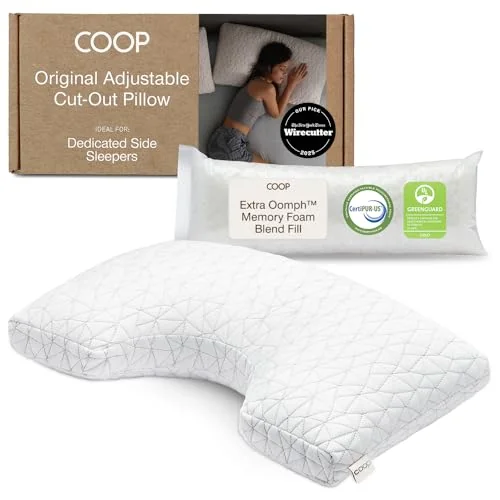
The Coop Cut-Out listing says its “ergonomic shoulder cut-out” “cradles your head and aligns your neck.” That is the brand’s own copy, and it gives the cut-out to the head, not the shoulder. It could still serve a shoulder sleeper, since a notch that holds the head steady also sits at the shoulder’s edge, but the listing does not say so, and the check is yours to run: lie on your side and see where the cut falls against the joint.
Body Pillows and Arm Support
The one aid with a measurement behind it is not a head pillow at all. It is something in front of the chest, where the top arm can rest. It belongs to the family of pillows sized to how you lie, which pillow by sleep position lays out.

What the study measured
The 2021 paper had two parts. In the first, eight healthy young adults lay awake on a pressure mat, and holding a body pillow cut the mean pressure at the shoulder, the hip and overall. In the second, ten healthy young adults slept with and without one while their sleep was recorded, and with the pillow they spent longer unbroken stretches on their side. The total time in each position did not change, and neither did how they rated their sleep.
So the claim has edges: a support in front of the chest lowers pressure and keeps people on their side longer, and it did not make anyone say they slept better. That is a modest result, and it is the best one in this guide.
Hugging a pillow versus propping an arm
These are different jobs. Propping an arm lifts it off the shoulder, so the pillow works as a shelf. Hugging holds the chest and knees steady, and the arm rides along. For a sore shoulder the shelf is the job you want, which is the same work as the free towel in the second section, done by something built to stay put.
Where the body-pillow guide takes over
Length, fill and which long pillow suits which bed make a buying question in its own right. The answer lives in best body pillows for side sleepers, by length and fill, and this article leaves that to it. From here, the point is the role the pillow plays, not which one to buy.
The Mattress Under the Bottom Shoulder
The pillow is the cheaper thing to blame, and the mattress is what the bottom shoulder lies on. Before buying a third pillow, ask which of the two is carrying the weight. Height only means something against the surface it sits on, as pillow height against the mattress shows for the back.

A pillow cannot fix a mattress that is too firm for your shoulder
A firm mattress holds the bottom shoulder up and sends the weight into the joint. A softer one lets it sink in until the spine follows the line of the bed. No pillow height changes that, because the pillow is above the shoulder and the mattress is under it. If you have changed pillows twice and the ache stayed on the same side, the next thing to look at is what is underneath.
What six months on a softer mattress looked like for one sleeper
One side sleeper found that shoulder pain went away on a mattress they had been sleeping on, and that hips stopped hurting, though they would not call it perfect. Take that as one person’s experience with a mattress, not a promise and not a rule. It is about the bed rather than the pillow, and it is a reason to look under the pillow before buying another.
The topper test before you replace anything
Replacing a mattress is the expensive way to run an experiment. A topper is the cheap one, borrowed or bought on a trial, laid over the mattress for a week while the notebook goes on. If the morning reading changes, the mattress was part of it.
Keep the week of the topper test to one variable: same pillow, same arm support, same sleeping side. If the morning line changes, the topper is the only thing that could have done it.
Counting the Weeks, Not the First Night
Every test above lasts a few nights, and nearly every pillow feels right on the first one. The first night shows you the finish and the novelty. A fill shows what it is over the weeks that follow.

What the trial period is really for
A return window helps only if you run a test inside it. Picture a thirty-day trial with twenty-two days left: the notebook method from the second section turns that into a test, and without it the window runs out on a feeling. There is a limit to what a return can settle at all, which is covered in why a return window cannot test a pillow.
The week-three check
Repeat the fist press from the fill section. Fiber is the fill that is often said to flatten within a couple of weeks. Latex is the one that needs fluffing to even out, as reviewers of the Standard loft say. Foam is the one whose dent either takes longer to leave or stays.
Then compare the dent and the height with what you saw on day one. Any difference between the two is the finding.
On day one, photograph the pillow from the side next to a ruler or a book of known height. Take the same photo at week three. A pillow that has lost an inch will show it in the picture before you feel it in your shoulder.
When a pillow has done its job
There is no month-six figure to offer here, because no account of a pillow past a few weeks turned up. What can be said is that the clock is set by the fill, not by the calendar. Fiber that stays flat after fluffing is finished, latex that no longer evens out is finished, and a foam that has stopped coming back is finished. Replacement timing by fill is laid out in how often to replace pillows, by fill and not by year.
When It Is Not the Bed’s to Fix
A bed can change a load. There is a point where the load is not the reason the shoulder hurts, and this section is the only place in the guide that covers when to see a doctor.

The clock the bed changes get
Give the bed changes a fair run, and give them a limit. University of Utah Health’s guide to when to see an orthopedic doctor puts the line at pain that lasts more than four weeks, pain that is no better within two to four weeks, or pain that is getting worse from day to day or week to week. A month of arm support, a topper test and one change a week is a fair attempt. When it hasn’t moved by then, it is a doctor’s question, and the notebook goes with you.
What puts a doctor ahead of a new pillow
Some things do not wait for the four weeks. The same Utah page lists trouble sleeping because of the pain, and numbness or tingling in the arm or shoulder, among the reasons to book an appointment as soon as possible. Harvard Health puts the general line this way in Harvard Health Publishing’s shoulder pain guide: “However, if the pain is getting worse or doesn’t go away after a few weeks, you should consult your doctor.”
That is as far as this guide goes. It doesn’t say what any of this is, what causes it or what to do about it, and no pillow in it is meant for that. Back to the bed: a rolled towel in front of the chest costs nothing, and it is worth making while you wait for the appointment.
Move the Load Before You Buy, Then Count the Weeks
Three things to carry out of this. A pillow moves load and does not reach a cause. The free arm support and one change a week come first, and anything bought comes after. And the weeks decide the pillow, not the first night.
The check for later: at three weeks, press the same spot you pressed on day one and look at how the pillow sits beside the ruler photo. If the dent stays, or the photo shows height gone, that fill has told you what it is.
Tonight, roll a towel, slide it into a spare pillowcase and hold it against your chest with the top arm over it. In the morning, note which shoulder spoke first and whether the roll was still there.
Frequently Asked Questions
01What kind of pillow is best for shoulder pain?
The best pillow is the one whose fill and loft match your shoulder width and your mattress, not one defined by a shape. Adjustable fill lets you set the height by hand, and a cut-out only helps if the fill beneath it holds.
02How do I stop my shoulders from hurting when I sleep?
Lower the load on the bed: rest the top arm on a support, change one thing a week and check the mattress under the lower shoulder. If the ache outlasts a few weeks of that, the last section above says when it becomes a doctor’s question.
03Where should I place a pillow to relieve shoulder pain?
Put a pillow in front of your chest so the top arm rests on it, and keep the head pillow under your neck. The arm should lie along the support instead of falling past it or tucking under your head.
04How long should I try a new pillow before sending it back?
Try it for a few weeks inside your trial window, changing one thing at a time and writing down each morning. The first night shows novelty, and fiber that flattens needs the weeks to show it.
05Is a body pillow better than a regular pillow for a side sleeper’s shoulder?
A body pillow is the one aid with a measurement behind it: in one small study it lowered pressure at the shoulder. The choice of length and fill is in the body pillow guide for side sleepers.





Tried it on your own bed?
No comments yet. Tell us what you changed, and what the sheet did after a few washes.