



What’s in here10 sections
- Pillow Height Comes From Your Shoulder, Not From the Label
- The Morning Check That Shows Which Way the Pillow Failed
- Change the Height for Free Before You Buy Anything
- Fill and Shape for the Side
- Some Side Sleepers Need Thinner, Not Thicker
- Month Six: Which Pillows Keep Their Height
- The Mattress Under the Pillow
- When the Pillow Isn’t the Problem
- One Change Tonight, One Photo Tomorrow
- Frequently Asked Questions
You rolled onto your side the way you do every night, and the pillow that felt fine all week did something different by morning: your head sat a notch below the line of your shoulder, or a notch above it, and your neck felt as if it had spent the night in a bad yoga pose. A pillow for side sleepers has one job, which is to fill the gap between your ear and the mattress, and on your side that gap is set by your shoulder, not by the loft printed on the package. This guide gets you to the pillow height that fits your shoulder: how to read it from your own mornings, what to change for free first, and which fills and shapes are worth buying after that.
Quick Answer
A side sleeper’s pillow misses in two directions: too low, so the head tips toward the mattress, or too tall, so it rides above the shoulder line. Photograph your side profile with the covers off, change the height one small step, and look again before buying anything. Pain that ignores the pillow for several weeks is a doctor’s question.
Pillow Height Comes From Your Shoulder, Not From the Label
A loft figure on a package was written for a generic sleeper. What the package cannot know is how far your shoulder stands out from your neck, and for a person lying on their side that distance is exactly what the pillow has to make up.
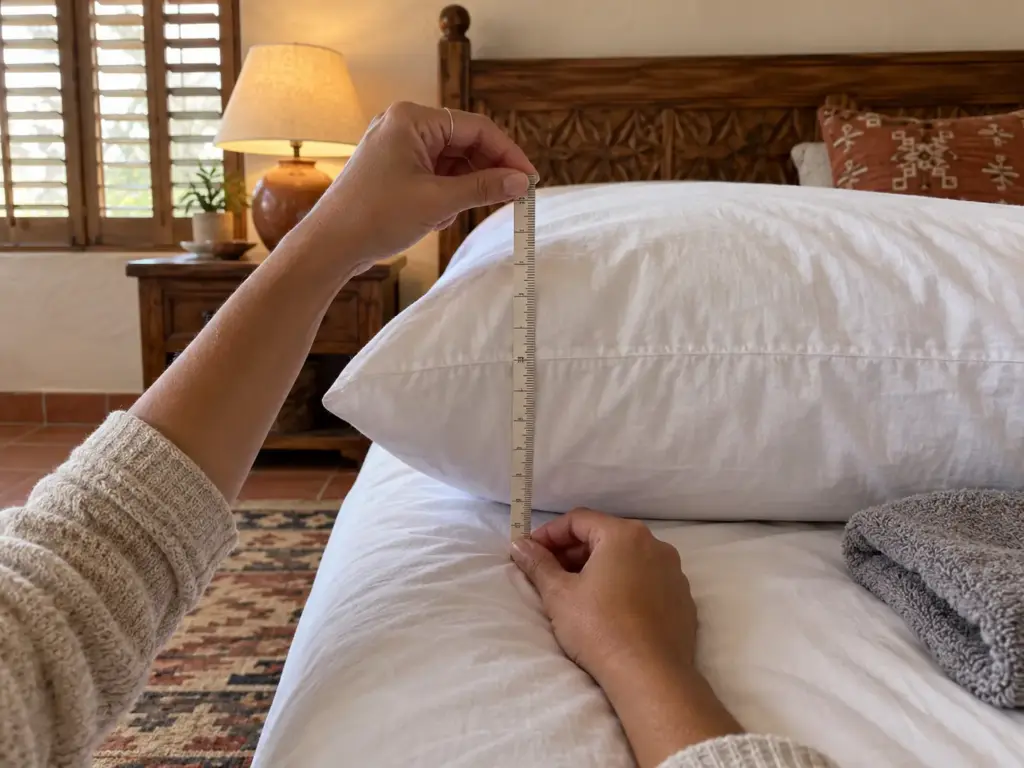
Why the shoulder sets the number
Lie on your side and the geometry is simple. The mattress takes your weight at the shoulder, your head hangs off the end of that shoulder, and the space under your ear stays empty until something fills it. A pillow that fills too little leaves the head tipping toward the mattress; one that fills too much pushes it up past the line of the spine.
The right pillow height is whatever closes the gap exactly, and the gap is wider on a broad shoulder than on a narrow one. Pillow makers call the goal neutral alignment: the head level with the spine when seen from the side. On your side, neck alignment comes down to the distance from ear to shoulder, which no label measures.
Researchers have tried to pin that down. In a 2025 study of nine side sleepers tested at four pillow heights, running from about 3 to 5.5 inches (8 to 14 centimeters) and measured with and without neck support, an index built from shoulder width and pillow height together predicted the curve of the neck well. That ties the right height to the person on the pillow, not to one loft figure.
Nine people is a small group and the pillows were foam-latex, so read it as a direction and not a verdict. The direction is still clear enough to build a routine on.
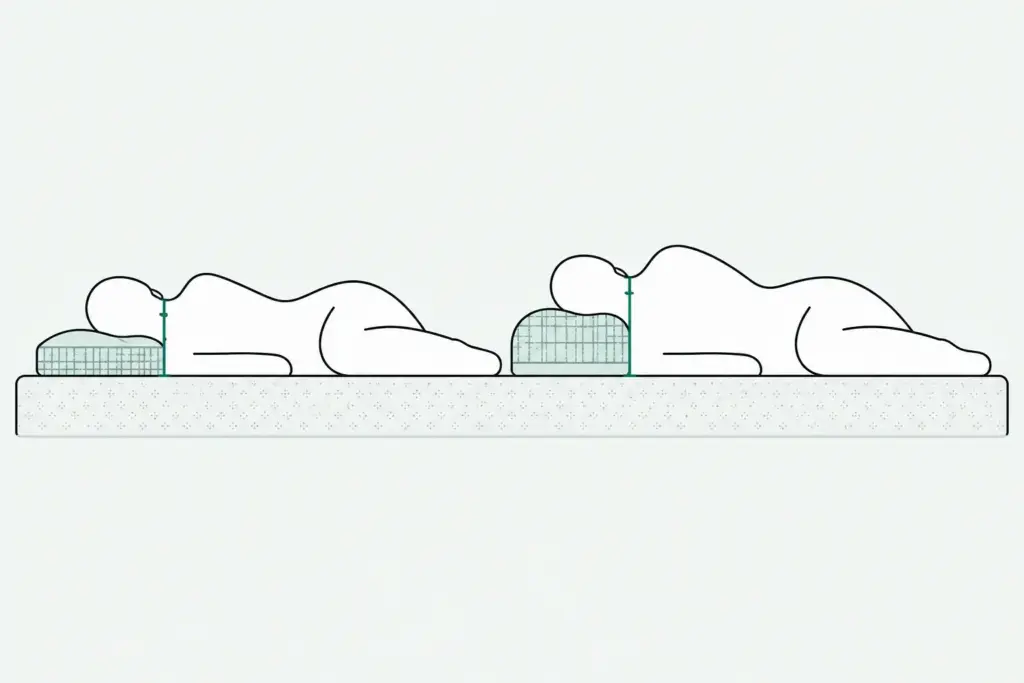
The same pillow can be right for one sleeper and wrong for their partner in a shared bed on the same night. Nothing is wrong with the pillow in that case, and nothing is wrong with either sleeper: two shoulders asked for two heights. The full gap mechanism for every sleeping position lives on the page that shows how to measure the loft instead of guessing it, so here the measuring is left to your own mornings.
Why the loft figures you read online disagree
Put three loft figures side by side and they do not agree. A widely quoted range for side sleepers is 4 to 6 inches. Another source treats anything above 5 inches as high.
The right height depends more on shoulder width than on any single number. Each can be sincere, because each is an average over people with different shoulders, and an average height fits no single sleeper.
The words on the package make it worse. Low, medium and high are brand words for pillow loft, with no standard behind them: one maker’s Medium loft lists a thickness of 6.5 inches, which is above the line another source draws for high. Same word, different pillow.
And a height number hides a second number. A soft 6-inch pillow compresses under a head and ends up lower than a firm 5-inch one at the same moment, which is why loft and firmness are two numbers, not one. Whatever figure you take from a box, it describes the pillow before your head arrives.
The Morning Check That Shows Which Way the Pillow Failed
A pillow that is too low and one that is too tall can feel the same when you wake, so the feeling cannot tell you which to change. Your own bed can, with no purchase and nothing more than a phone. What follows is a test built on the shape of a pillow: an inference you run, not a measured fact you take on trust.

Which side is tight, and where the pillow met the shoulder
Before you move in the morning, lie still and notice two things. The first is which side of the neck feels stretched: the side facing the ceiling or the side nearest the mattress. The second is where the edge of the pillow met the shoulder you slept on.
The reasoning is geometry, and it is an inference from the shape of the pillow, not a measurement. A pillow that is too low lets the head tip toward the mattress, and the ceiling-facing side of the neck is the one pulled long. A pillow that is too tall props the head up and away from the mattress, and the pull moves to the mattress-facing side. The edge adds a second clue: a pillow that rides up into the top of the shoulder is pushing back against it, which often means more height than the gap needs, while a pillow that stops well short of the shoulder leaves a stretch of neck with nothing under it.
Treat what you notice as a lean, not a ruling. The too-tall direction is the one people overlook, since a high pillow feels supportive, and it has a page of its own on judging a pillow by its mornings instead of its first lie-down: when it’s the pillow and when it isn’t. A lean is enough to decide which way to move first. The photo in the next section confirms it or overturns it.
Take a photo with the covers off
The camera finds what the feeling can’t. Lean a phone against a stack of books on the nightstand at mattress height, aimed along the side of the bed, or ask a partner to hold it at pillow level, and take a single photo from the side with the covers off. Some side sleepers have found, by asking a partner to photograph them asleep, that a tall pillow holds the neck out of line.
Read the photo for three things. A straight, roughly level line from the back of the head through the neck to the shoulders is the target. A head that points down toward the mattress says the pillow is too low.
A head that points up and away says it is too tall. A pillow can look perfect from the foot of the bed and wrong from the side, because the front view hides the one angle that counts.
Take the photo in the first minute, before you stretch or sit up. Moving rearranges the very line you are trying to read, and a photo taken a few minutes later flatters the pillow.
Put a strip of tape on the nightstand where the phone sits and keep the same stack of books under it. A photo from a different lens height makes the same pillow look taller or lower, so the week-one and week-three pictures only compare if the camera never moved.
Why the first night is a weak test
Putting a new pillow under your head and judging it on the first night feels like a test and works as a weak one. In the 2025 study, comfort ratings were “not sensitive” to the height index, so how a height feels on the night says little about how well it fits. By contrast, a 2009 trial of 106 side sleepers, one week per pillow, went the other way: each pillow got a week of mornings before it was judged, because one night is not a verdict.
The method that follows is plain: one change at a time, one photo each morning, from the same spot. Run as a hypothetical, it looks like this. Night one, nothing changed, and the photo shows the head tipping toward the mattress.
Night two, a hand towel folded once goes under the pillow, and the photo comes out level. Night three, a second fold, and now the head tilts up. You are back to night two, with an answer that took three photos and cost nothing. Had you changed the pillow, the towel and the mattress cover in the same week, you would still be guessing.
A level photo on one morning is one data point, not a settled height. Fill moves under a head, so a pillow that reads level on Tuesday can sag by Friday; keep photographing for a week before you call a height right. If two people share the bed, each takes their own picture, because the cleanest result of this check is often two different answers.
Change the Height for Free Before You Buy Anything
The check points one way or the other, and both directions can be tried tonight with what is already in the house. Change one thing, sleep, photograph, and only then decide on a second.

If the check says too tall: take height out
A tall pillow has more ways out than people expect. If you stack two pillows, take one away. If you sleep on a single pillow with a zipper, take fill out of it.
If it is a sealed block, try the flattest pillow in the house for a week, the guest-room one or the old one you kept in the closet: it is the cheapest experiment in this article, and the only cost is the walk to the closet. Start with whichever of these you can undo in a minute.
If the check says too low: add height under it
The mirror move for a low pillow is to add height beneath it, not on top. A folded towel placed under the pillow, not under your head, raises the whole pillow without changing how it feels against your ear, and a rolled towel slid under the lower edge tilts it up instead. A second, thinner pillow slipped inside the same case does the same job.
A soft, tired pillow can sometimes be doubled up, and it is worth knowing how to fold it before you replace it, since a fold adds height in a single move. One change per night, then the photo again.
Start with a hand towel folded once, not a bath towel in thirds. A small gap needs a small correction, and a big fold overshoots straight into the too-tall error you were trying to leave.
When the fill can do the work
A pillow whose fill you can reach changes the plan, because the height stops being a purchase and becomes a setting. The practical fixes here are a little dull. Give the fill a few nights to find the right amount, and when a pillow starts to deflate, add new stuffing.
The thread splits on whether it holds up. investedinterest and OrneryLavishness9666 like a pillow they can dial in, while Beautiful-Flan-5702 describes a house of failed memory pillows and a husband unhappy by about month six, a question that comes back below.
Both camps are describing the same material: shredded fill moves. It can be set right on night three, and it can be flat again later, which is the subject of the page on what each fill does by month six. If you take fill out, take it out in two sittings, not one. Remove a little less than you think you need, sleep on it, and take a second handful the next evening, because fill that has come out is easier to put back than to wish back.
Layla’s listing says the pillow ships overstuffed and that fill comes out through the zipper to set the loft, which is the manufacturer’s own claim and also the whole job. The Layla Sleep Adjustable Fill Kapok Pillow is shredded viscoelastic foam mixed with kapok fibers, sold here in King, and it is the one pick in this guide built around that move.
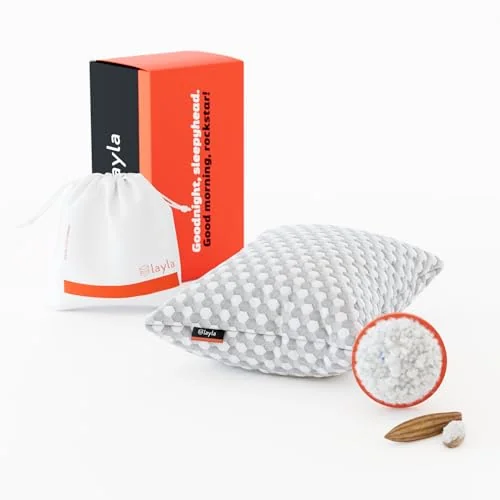
Keep the fill you take out in a zippered bag for a couple of weeks. If the pillow ends up too low, you have the exact material that came out of it, and nothing to buy.
Fill and Shape for the Side
Once the height is known, shape and fill decide whether it stays. A side sleeper’s pillow sits against the shoulder all night, so the side of the pillow matters as much as the top.
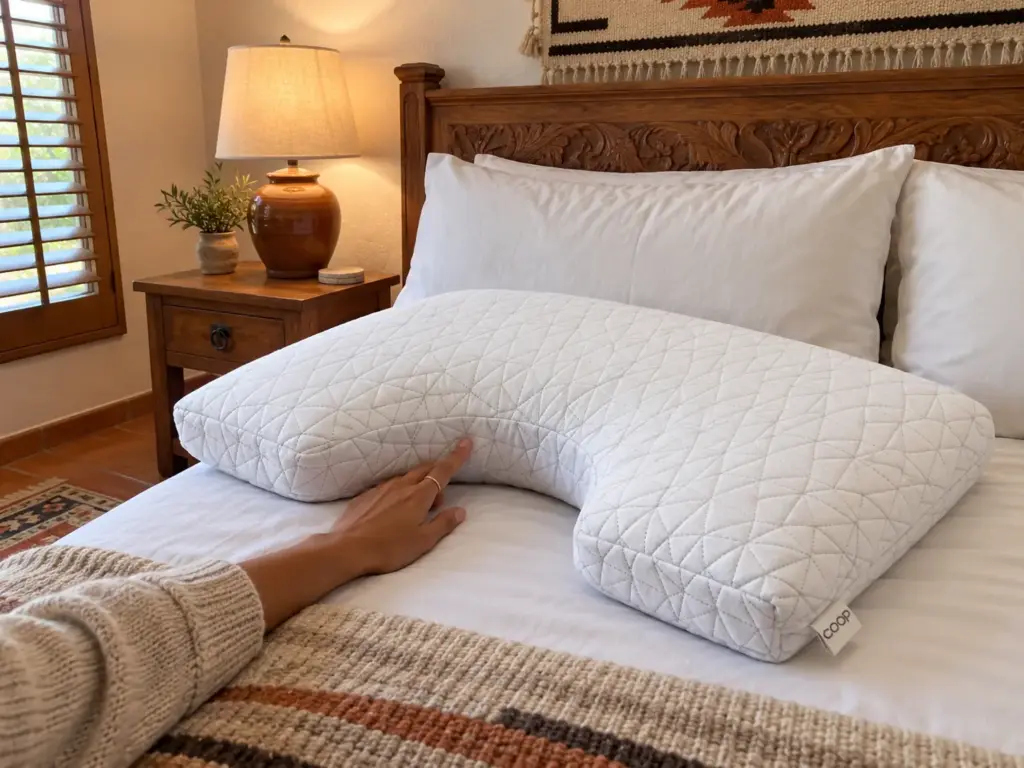
Cut-out, crescent and gusset: what the side panel does
Three features are sold as “for side sleepers.” A cut-out pillow has a notch taken from one edge so the shoulder has somewhere to go. A crescent pillow is curved to wrap toward the shoulder. A gusset is a strip of fabric along the sides that gives the pillow walls, so height comes from the box shape and not from a stack of fill.
A gusset is the feature side sleepers tend to rate highest, because it adds structure and loft at the edges.
Two other shapes show up in listings. A U-shape pillow wraps around the head and both shoulders, and a dual height design gives one side more height than the other; both answer to the same morning-check test. A knee pillow, the one kept between the legs, is sold to the same sleeper but does a different job: it works on the hips, not on this height question.
The Coop Home Goods Original Cut-Out Adjustable Pillow is the queen-size pick whose listing is written for side sleepers alone: 18 by 28 inches of medium-firm cross-cut memory foam with a shoulder cut-out, and fill that can be added or removed. The listing prints no loft, so the height is whatever your fill makes it, and no review text could be read behind its 4.3 of 5 rating.
A notch is a bet on your shoulder. Cut a little too deep for a small shoulder and the head can settle into the cut; a little too shallow for a broad one and the edge still presses where it was meant to give.
The Coop Home Goods Original Crescent Adjustable Pillow runs the same fill logic in a crescent written for back and side sleepers, which makes it the one for a person who turns over in the night. It prints no loft either, and no review text could be read behind its 4.3 of 5.
The Beyond Down Side Sleeper Pillow puts the gusset into numbers: a 4.5-inch side panel around polyester gel-fiber fill, with a cotton cover that is machine washable. It states a gusset and not a loft. Gel fiber is a down alternative, and down and down alternative differ by fill weight, not by name, which is the question to put to any pillow whose cover says down. Shredded memory foam has its own version of that question, answered on the page about shredded or solid, and which holds its height.
Contour shapes have less proof than their labels
A contour pillow, a cervical pillow, an orthopedic pillow and an ergonomic pillow are all labels, and a label is not an outcome. The 2009 trial of 106 side sleepers, one week per pillow, tested a foam contour pillow against regular shapes, and its authors, Gordon and colleagues, wrote, “There is no evidence that the use of a foam contour pillow has advantages over the regular shaped pillows.” That does not make contour shapes bad, and it does not prove regular shapes win. It says the name on the box does not buy a better morning, which leaves height and fill as the variables with a mechanism behind them.
When the other person sleeps on their back
In a shared bed, two people rarely need the same pillow, and the answer is usually two pillows, not a compromise. Some couples split the difference with two different pillow shapes. A back sleeper’s head sits over a much smaller gap, so the pillow that suits them is usually lower than yours, and pillows for back sleepers that hold their height are a different shopping list from this one.
If the side sleeper wants something to hold and the other does not, a body pillow for the side sleeper solves it without touching the other pillow. And if one of you is a combination sleeper who turns through the night, the crescent above exists for that, with pillows for sleepers who turn through the night covering the rest.
Some Side Sleepers Need Thinner, Not Thicker
The instinct for a sore side-sleeper morning is to add height: a towel, a second pillow, a taller shape. For some sleepers that instinct runs the wrong way, and the evidence is a photograph.

The photo that showed a tall pillow was the problem
A covers-off photo of your own sleep shows the same thing, which is a quick way to check. In shedtime’s words, “most advice I read suggested thicker for side sleep,” and the fix turned out to be thinner. One sleeper’s experience is not a measurement, and their shoulders are not yours.
What the story does show is how the error hides: a tall pillow feels supportive, because the head is held up, and the line from head to shoulder only shows in the picture. A pillow can feel right for two nights and wrong by the fifth, which is why the photo belongs to every morning and not only the first.
If you have already added a towel and the neck is no better, the mirror image is worth one night. Take the extra layer out, photograph, and set the new picture beside the very first one from before you changed anything. It is also the cheapest change in this article, because the pillow it needs is the one already in the house without its extra layer. And it shows you something the shopping pages never will: whether you were ever short on height at all.
A thinner pillow is not automatically a flat one, either. Taking out a stacked pillow or a handful of fill lowers the height and keeps the shape you already sleep on, so the comparison stays honest. Swap in a different pillow and you have changed height, firmness and fill in one go, which brings back the guessing the photo was meant to end.
Why the studies and the shelves disagree on “best”
Even the 2025 study that links height to shoulder width gives two answers to “best.” The lowest musculoskeletal force came at a medium height index with neck support; the best average comfort came at a lower index. So the height that looked best on paper and the height people liked most were different heights, among nine people, and the authors found comfort “not sensitive” to the index.
The shelves disagree for similar reasons. Line the numbers up and the split is plain: sources give ranges from about 4 to 6 inches, some call anything over 5 inches high, and one pillow’s listing states 6.5 inches.
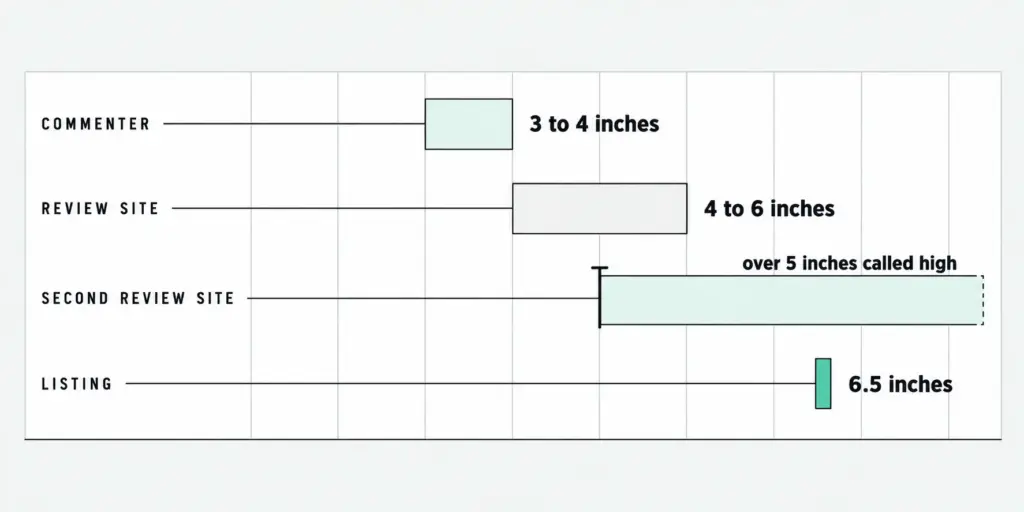
None of those figures is wrong about its own sleeper. A pillow height is one half of a pair, with a shoulder as the other half, and the pair is what a morning measures. Price does not settle it either; what the cheaper side-sleeper pillows give up is a separate question from which height fits.
One stated height to test against your own
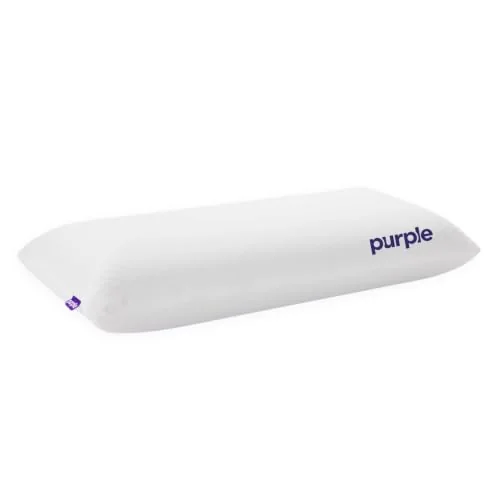
The Purple Harmony Pillow, Medium Loft gives the test a number: its listing states 6.5 inches. That figure sits above the other three, which is the point of using it. It is something to hold against your own morning, never a verdict on thicker or thinner. The pillow is a gel grid over Talalay latex foam, and only the Medium was checked for this guide.
To run it, measure the pillow you sleep on now, unpressed, with a ruler from the mattress to the top at its thickest point, and set that number beside 6.5. If your current pillow sits well below it and your photo comes out level, 6.5 inches is the tall error for you. If the photo shows your head tipping toward the mattress, it may be the first number in this article that fits.
Month Six: Which Pillows Keep Their Height
Every height in this article is the height on day one, and day one lies a little: fill compresses and shifts, and a pillow set right on a Friday is a slightly different pillow by the sixth month.
What happens at month six
The reports are consistent and unglamorous. Pillows eventually get flat, and some households go through several memory foam pillows before they find one that lasts.
OrneryLavishness9666 puts the upkeep in one line: “You do have to fluff it some to maintain the loft.” None of them counts washes, and none of this is a test; it is the pattern of the complaints.
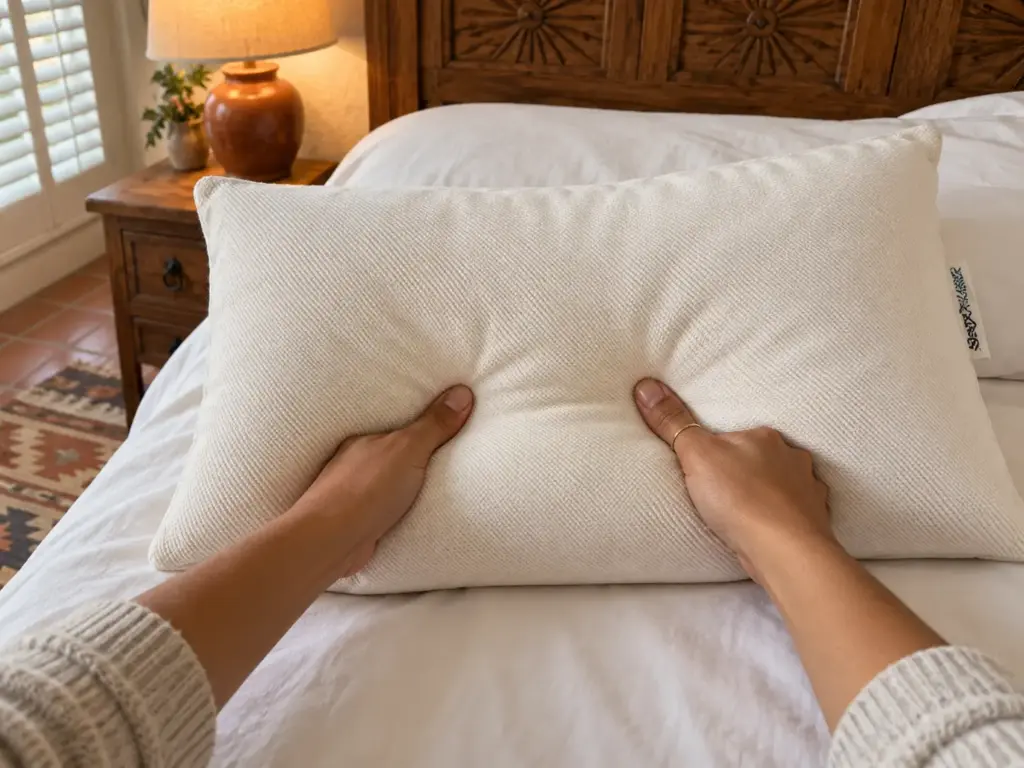
You may see it in your own bed first. Press a hand into the middle of the pillow, lift it, and watch the dent. A pillow in good shape fills it back in, and a tired one is slow to come back.
If the pillow is washable, look at it again after a wash: fill can clump in the machine and come out at a different height, and then the loft you measured belongs to a pillow that no longer exists. A pillow protector under the case keeps the fill clean between washes, so it gets washed less often.
Fluffing, adding fill and the pillow that cannot be topped up
Fluffing is maintenance, not a one-off. Shaking the fill back toward the middle returns loft that has only moved, and fill that has truly compressed needs more fill. That is why a pillow with a zipper is a setting and a sealed block of foam is a one-time bet. The Natural Latex Shredded Foam Pillow, King, Set of 2 is the second fill answer to the morning check: Sri Lankan natural latex, shredded, with an open-cell structure, in an organic cotton cover, so fill can be added or taken out as the dent changes.
Be careful with its evidence. Firm latex can feel right for side sleeping, but that is a different pillow from this one, so it is not this pillow’s record. Reviews for this one were locked at 4.1 of 5, and stock was limited when it was checked.
On the day you settle on a height, measure from the mattress to the top of the unpressed pillow at its thickest point and write the number on the care tag with a laundry marker. A month later the same measurement tells you in seconds whether the fill has lost height, which the dent alone can’t.
What a return window can test
A trial period tests the first nights, and the 2025 study already found first-night comfort to be a weak guide to height. It cannot test month six. Use a return window for what it can do: run the free-changes sequence above inside it, with photos, and treat the result as a starting height, not a final one. Whatever the window is called, the only test it adds is time, and it adds less time than the fill needs.
The Mattress Under the Pillow
The pillow is one half of a pair. How far your shoulder sinks into the mattress changes how big the gap is, so a pillow that was right on one bed can be wrong on the next, and the pillow that works at a friend’s house is the usual proof.
A softer mattress lets the shoulder sink
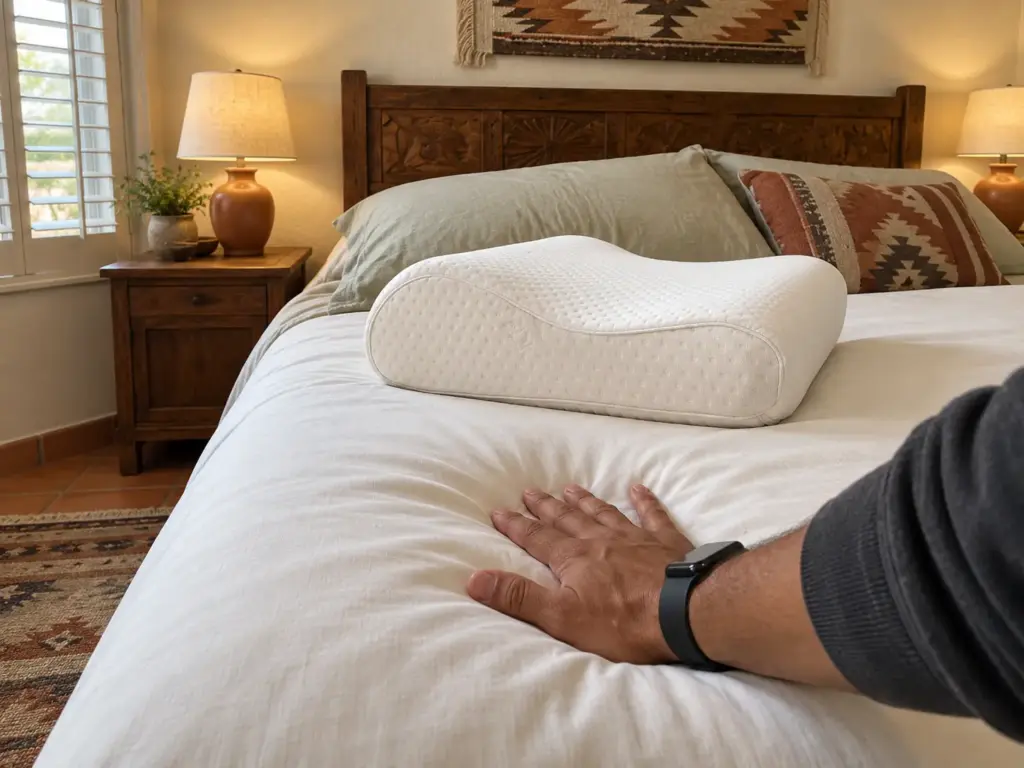
Mattress softness is the quiet variable, so think of the shoulder as a weight pressing into the bed. On a soft mattress it sinks, and the gap the pillow has to fill shrinks with it; on a firm mattress the shoulder stays up and the gap stays open. The same pillow therefore reads taller on a soft bed and lower on a firm one, and moving from the guest room to your own bed can change the morning without changing the pillow at all.
There is no figure to attach to this, so none is given. The instruction is to rerun the morning photo whenever the mattress changes, and to read about pillow height and the mattress under it if both are suspects.
Pillow firmness against pillow height
Firmness is the second variable. One source calls medium-firm to firm the norm for side sleepers, and the mattress moves that: on a soft mattress, where the shoulder is already sinking, a firm pillow can lift the head more than a soft one would. The TEMPUR-Pedic TEMPUR-Neck Pillow, Medium Profile, 2-pack sits at the firm end: one piece of TEMPUR-Material that the listing calls extra firm, with a comparison table showing heights of 3 to 4.75 inches across its profiles and no clear sign of which column is the Medium.
The listing also disagrees with itself about who the pillow is for. The table says back and stomach sleepers; the bullet text says side and back. Amazon’s AI summary of the reviews lands in the same place: some find it too firm, others like its feel, and the summary notes split reports on neck discomfort, some better and some worse. That is a summary and not individual reviews, and it is the only flaw text that could be read for this pillow.
When the Pillow Isn’t the Problem
A pillow can only change the height it is given, and this is the one place in the article that says what falls outside it. Neck pain that is still there after several weeks of the changes above, that gets worse in spite of them, or that travels down an arm is a question for a doctor and not for another pillow. So is neck pain that arrives with a headache, weakness, numbness or tingling.

Severe neck pain after an injury such as a car collision, a diving accident or a fall goes to emergency care, and so does weakness in an arm or leg. Those lines come from Mayo Clinic’s guidance on when neck pain needs a doctor, and nothing in this article is a reason to wait past them.
Everything else here stays on the bed: height, fill, shape and the mattress under them.
One Change Tonight, One Photo Tomorrow
Three things carry this whole guide:
- The shoulder sets the height, so a loft figure on a box is a starting guess and not an answer.
- Read the morning before you buy. A side photo with the covers off shows whether the head tips toward the mattress or rides above the shoulder line.
- Change one thing, then look again. Two changes at once turn the photo into a coin toss.
For later, compare the pillow’s morning thickness and its dent with the week-one photo, taken from the same angle. A pillow that has lost height shows it there before the fill report ever does.
Tonight, make only the one change the morning pointed to: pull a layer out of the stack if your head rode high, or tuck a hand towel folded once under the pillow if it tipped low. If you have not run the check yet, tonight’s change is the setup: the phone, the books and the tape mark. Tomorrow, before you stretch, take the side photo and lay it next to the first.
If the line from head to shoulder moved toward level, keep the change and write it down; if it moved the wrong way, undo it and try the other direction. From there, the full neck guide takes over with the towel test and the rest of the pillow choices.
Frequently Asked Questions
01What pillow height is best for side sleepers?
It depends on shoulder width, because the pillow fills the gap between your ear and the mattress, and your shoulder sets how big that gap is. Quoted figures run from 3 to 6 inches, so photograph your side profile and adjust one step at a time.
02Should a side sleeper use a thicker or a thinner pillow?
Either can be right, and the morning photo decides: a head lifted above the shoulder line wants less height, a head tipping toward the mattress wants more. Going thinner is often the fix when the pillow turns out to be the problem.
03Is a contour or cervical pillow better for side sleepers?
A 2009 trial of 106 side sleepers found no evidence that a foam contour pillow has advantages over regular shaped pillows, so the label is not a reason to buy. Height and fill matter more than the shape name, so check the morning photo first.
04How often does a side sleeper’s pillow need new fill?
There is no fixed number, so compare the pillow’s morning thickness with week one and add or fluff fill once it has flattened. Adjustable pillows can be topped up; sealed foam cannot, so it gets replaced when the dent stops coming back.
05Is a firm or soft pillow better for a side sleeper?
Firmness is the second variable after height, and one source calls medium-firm to firm the norm for side sleepers, though the mattress under it changes the answer. A softer mattress lets the shoulder sink, which can call for a lower pillow.





Tried it on your own bed?
No comments yet. Tell us what you changed, and what the sheet did after a few washes.