


What’s in here8 sections
- What Each Sleep Position Does to Your Spine Over One Night
- The Neutral Line, Joint by Joint
- The Set You Make Before the First Turn
- Switching Sides on Purpose
- The Morning Pause: Moving Before You Stand
- Counting Nights Until It Holds, and the Count That Hands It On
- The One Change for Tonight, and the Marks to Read Later
- Frequently Asked Questions
You wake in the same place every morning, the same morning stiffness along the neck or the low back, after a night you remember nothing of. The only thing that changed while you were out is the shape you held, and a spine does not know what the mattress cost; it knows the angle between head, shoulders and hips, and where each joint hangs when nothing under it is holding it up. That makes how to sleep when you keep waking up sore a question about posture first and shopping a long way second. Below: what each position does in a night, the neutral line, the set you make before the first turn, switching sides on purpose, the morning pause, and counting the nights until a change holds.
Quick Answer
Back or side keeps the spine closest to neutral, and the order of those two is contested. Six habits do the rest.
- Lie on your back, or on your side with the knees bent.
- Leave stomach sleeping, which strains the neck and lower back most.
- Choose the position at lights-out, while you are still awake.
- Take your arm out from under the pillow and set both arms the same way.
- Switch sides when you wake in the night instead of staying on one.
- Sit on the edge of the bed for a moment before you stand.
What Each Sleep Position Does to Your Spine Over One Night
Eight hours reads as one thing from the outside and as three different loads from the spine’s side, depending on how it is lying. This is the plain comparison before any advice, and the first thing to know is that the sources agree on the position to leave and disagree on the one to pick first.

Back: Closest to Standing, and the Arm Rule
Back sleeping is the position that looks most like standing: head, shoulders and hips lie on one plane and nothing is rotated, which is why NPR’s Life Kit reporter calls it the best for spinal alignment. The mattress takes the load your legs carried all day, and the spine rests in a shape it already knows. The one rule is for the arms. Cleveland Clinic says to set both arms the same way instead of flinging one over the head, because a single raised arm pulls the line of the shoulders out of square.
And the position you wake in is rarely the one you fell asleep in.
Side: Knees Bent, and Why the Sources Split on the Order
Cleveland Clinic lists side sleeping with the knees partially bent first for the back, and the bend is the point: bringing the knees up takes pressure off the lower spine. NPR puts the back first for alignment. Harvard says either one puts less strain on the neck than the stomach does, and ranks neither.
I would not choose between them from a table. For someone who has always fallen asleep on a side, the side with a bend is the position that survives the night, and the back is the better line on paper and the weaker bet in practice.
The order matters less than which position is still there at 3 a.m.
Stomach: The One All Three Sources Leave
Here the sources stop arguing. According to Harvard Women’s Health Watch on stomach sleeping and the neck, “Stomach sleeping forces the head to one side and puts pressure on your neck.” What pillow height does to that same pressure is worked out in pillow height for the neck.
NPR’s Life Kit segment on sleep posture quotes nurse practitioner Ellen Wermter: “Really, avoiding stomach sleeping is the biggest posture recommendation.” Face down, the head cannot stay looking forward; it is bent up or turned, which is where the neck strain comes from, and Cleveland Clinic adds that the position makes you more likely to twist the neck to the side. If you will not leave it anyway, the stomach-sleeper pillows are where the object gets decided.
The Neutral Line, Joint by Joint
“Neutral spine” sounds like a pose on an anatomy chart. In bed it is three checks you can run in the dark with no mirror and no one to look.

Head, Shoulders and Hips on One Line
NPR describes the line plainly: the neck lined up with the upper back, the chin over the center of the shoulders, the shoulders in line with the hips, and the head looking forward, neither bent up nor down. Lying down, that is a straight run from the top of the head to the tailbone, seen from the side, and it needs no ruler.
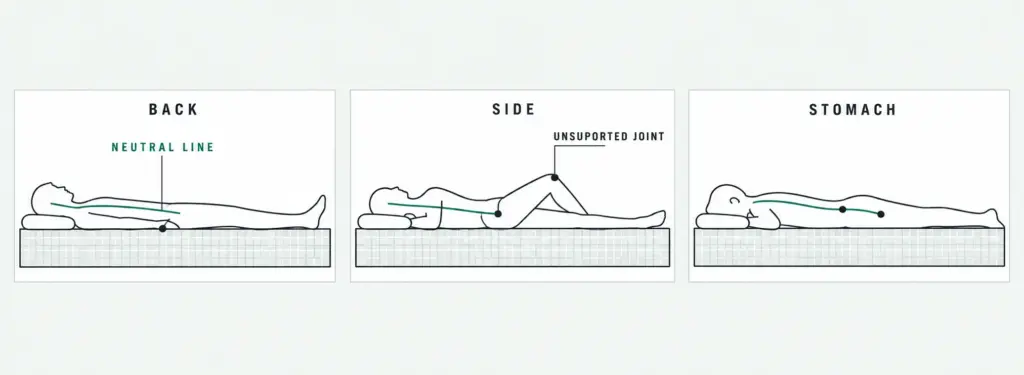
Cleveland Clinic is careful about what the line promises: a sleep position may support the natural curve of the spine or may not, so it works as a lever and never as a guarantee. The check reads the same in all three positions. The line can bend a little, but the head should point where the chest points. Back and side can pass; the stomach fails it by definition, which is the whole case against that position in one test.
Knees: The Bend Is a Posture Before It Is a Pillow
On the side, the knees come up off the mattress line: partially bent, not pulled into a tight fetal curl and not left straight. That is a posture before it is a pillow, and it asks for nothing but a decision at lights-out. The gap at the waist, and where the pillow sits relative to the waist, have their own page, and the knee pillow as an object belongs to the back guide. What stays here is the habit: whatever nothing holds drifts first when you roll, and an unheld knee straightens before the rest of the position does.
Arms: The Overhead Arm and the Arm Under the Pillow
Two arm rules cover most of it. On the back, both arms go the same way, as above. In any position, the arm does not go under the pillow, because the pillow’s job is the head. What happens when an arm goes numb down there has its own guide, the arm that goes numb under the pillow, and here the rule stays one line of posture: pillow for the head, arms beside you or, on the side, the top arm resting in front of you.
The Set You Make Before the First Turn
Which position is best is the easy half. The other half is when the position gets chosen, and for most sleepers it never is: at the end of a tired day the sleeper does not pick, the habit does, and it is always the oldest one. The minute at lights-out is the one place a choice fits, and it decides more of the night than the position itself.
Choose the Position While You Are Still Awake
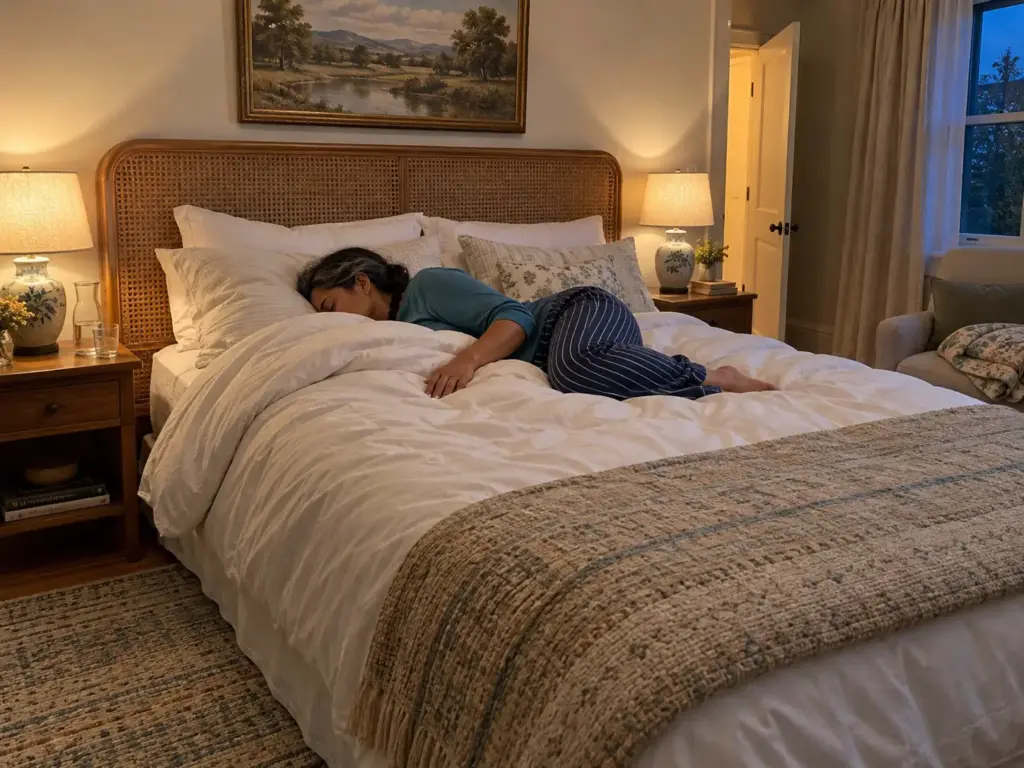
The position that feels right as the light goes off is the one you already know by heart, which is exactly why it is not the one to trust. The one to set is the position you do not know yet. Decide it in the last minute you are awake, put it to yourself in a clause (right side, knees up, arms down), lie down in it and stop adjusting. Cleveland Clinic says plainly that anyone used to one position every night will find changing it challenging, and what that means in practice is that the choice has to be made on purpose, every night, until it stops needing to be.
Change this one thing and nothing else in the bed for now, the way when it’s the bed and when it isn’t sets it up. If the morning changes, you know what changed it.
The Ten-Second Check: Head, Knees, Arms
Three checks, once each, before you let go:
- Head: your nose points where your chest points.
- Knees: on the side, both are up off the mattress line, partially bent.
- Arms: on the back, both set the same way; in any position, none under the pillow.
Ten seconds is the whole cost of this pre-sleep routine, and it is the first thing a tired sleeper skips. A check done every night is still done on the nights you are too tired to want it, so it only works as a fixed step.
Run the check in the same order every night: head, then knees, then arms. A check whose order changes is one that gets shortened when you are tired, and the arm is the step that gets dropped.
Why the Set Is Gone by Morning, and What to Do About It
A common failure is working your way out of the set position during sleep and ending up on your back, which is where the morning finds you. The set is a starting position, not a lock. It will break at some point in the night for most sleepers, and that is no reason to skip it, because a set that breaks halfway through still changed the load for the first half and left a position to come back to.
There is no sure-fire way of completely avoiding pain, but a routine of light stretching on waking helps. Nothing here is sure either. The routine helps, and a routine is what this section is for. A sleeper who runs through three positions in one night has a separate problem, the pillow for someone who rolls, and that guide takes it.
Switching Sides on Purpose
The set holds until the first roll, and a sleeper who always lands on one side puts that side under load all night. Switching sides is advice that fits on one line, which is why it rarely works: the line is easy and the pull back to the old side is not.

Why Staying on One Side Is a Habit, Not a Plan
Staying on the same side is not a decision anyone made. It is the side that has been slept on the longest, and you return to it the way a hand returns to the same pocket. Switching sides therefore has to be a method, not a resolution. Which side you start on matters less than whether you leave it at some point in the night; how high the pillow should be for a side sleeper is a separate question with its own answer.
A Cue You Can Set When You Wake in the Night
Lights-out is the wrong moment to switch, because the old side feels normal then. The moment to switch is the one when you wake in the night: you are already half out of the position, you have already let go of the old side, and the turn costs one decision instead of a fight. Make it the rule. If you are awake enough to notice the position, you are awake enough to change it, and the change is to the other side, knees up, arms down.
Loosen the top sheet and blanket at the foot of the bed. A tuck pulled tight across the toes holds the legs where they are, and a leg that cannot turn is a turn that does not happen.
What to Do When You Keep Rolling Back
You will roll back. On the second night of sleeping on the other side you wake on the old one anyway, and the temptation is to call the change a failure.
The roll is the failure, not the change. Move the cue earlier: switch at the first waking, not the second, and make the turn deliberate before you let yourself drift off again. And if you want an object to hold you on the new side, side-sleeper pillows is where those get weighed.
The night you switch is the night the old side feels strangest. That is also the night the count in the last section starts.
The Morning Pause: Moving Before You Stand
A night of good position can be undone in the first ten seconds out of bed, when morning stiffness meets a sudden stand, and those are the ten seconds most people spend already standing. The movement worth adding is small on purpose.

One Knee to the Chest, Three Seconds, Switch
Cleveland Clinic’s version: on your back in bed, bring one knee toward your chest, hold it for three seconds, then switch legs. Three seconds is the whole instruction. Stretching the instant your eyes open sounds like the obvious start, but a stretch that is a launch can cause a cramp. Stretching straight after waking can bring on a Charlie horse, so make it a slow lift and a short hold.
Some people wake about twenty minutes early to stay in bed and gently stretch and wriggle, so the pressure of standing is not so severe.
Sit on the Edge Before You Stand
Cleveland Clinic’s last step is to sit on the edge of the bed before standing. It is the shortest piece of the routine and the one that gets cut first. Another routine is an early alarm for a minute of stillness, then gentle movement, then getting up. The ache can take a while to go away, so the morning is longer than the first step, and the first step should not be a jump.
The full routine, one knee up for three seconds each side and then the sit on the edge, takes well under a minute. On a rushed morning cut the stretch and keep the sit.
When the Stretch Cramps
A stretch is worth keeping only if it does not make the next hour worse. If a knee to the chest brings a cramp, shrink it: a shorter hold, a smaller lift, or just wriggling the feet while you lie still, and let the stretch go for that morning. The sit on the edge still counts. This pause is the last step of the position, not a cure for anything, and the result gets read in the morning test in the pillar.
Counting Nights Until It Holds, and the Count That Hands It On
How many nights a new position needs to hold depends on the sleeper, and the only person who can count it is the one in the bed. So this section is a tally, and the same tally tells you when to stop counting and ask someone.

A Tally on Paper: One Change at a Time
Draw seven boxes on a Sunday at the kitchen table, one per morning. Each box gets two entries: the position you set the night before and the position you woke in, plus one word for how the morning felt. Keep the page on paper by the bed, not in a phone you will reach for before you have sat up. Change one thing at a time, using the structure in the one-change-at-a-time test; the tally adds the count to it.
A tally also protects you from the memory of a bad night. A morning that felt rough looks different on paper next to six that did not, and the reverse is just as true.
Write the position you set before the light goes off and the position you woke in before you move. Filled in at breakfast, the second entry is a guess; filled in before the first stretch, it is a record.
How to Read a Slip
A slip is a data point, and the two entries on each line say which kind. You set the right side and woke on the left: nothing failed, the cue from the switching-sides section needs to come earlier. You woke in a position you never set: the check before lights-out was skipped, and the line is telling you which night. You set it, held it, and still woke sore: the position alone did not move the morning, which is an answer too, and the next move is a different single change, not a second one stacked on the first.
Read the marks as a pattern across the week, not one line at a time. A page where the old position thins out is a habit settling. A page where it never thins out says the position does not suit this sleeper, and the position that holds is a better answer than the one that scored best on paper.
The Line Where the Count Goes to Someone Else
The same tally has a second job. Cleveland Clinic’s guidance on morning back pain draws the line at pain that worsens or comes most mornings for two or three months, and past that line the log is something to bring to a healthcare provider, not something to keep tuning alone. That is the whole referral: what the soreness is belongs to someone who can examine you, and this page does not guess. Until then everything here is bed and habit, and that part is yours to run.
The One Change for Tonight, and the Marks to Read Later
Three things to carry out of this page:
- Back, or side with the knees bent. Stomach is the one to leave, and the order of the first two is contested.
- Set the position awake at lights-out, and use the waking in the night as the cue to switch sides.
- Finish with the pause: a three-second knee, then the edge of the bed.
After a few weeks of marks, look at which mornings carry the slips and whether the rough ones cluster on the nights the set broke. That pattern is what you would show someone, and it tells you more than whichever position sounded best.
Tonight, choose your side before the light goes off, take your arm out from under the pillow, and write one line in the morning: the position you woke in. Notice whether it matches the one you chose.
Frequently Asked Questions
01How should I sleep so I don’t wake up sore?
Sleep on your back, or on your side with the knees bent, with your head looking where your chest points. Stomach sleeping puts the most strain on the neck and lower back. Choose the position before you fall asleep, not after the first turn.
02How do I stop waking up sore every morning?
Change one thing at a time, starting with the position you set at lights-out, and mark every morning so you can see which change moved anything. The one-change test gives the structure, and the last section above says when the marks go to someone else.
03What is the unhealthiest sleeping position?
Stomach sleeping is the one position Harvard, NPR and Cleveland Clinic all steer people away from, because the head stays turned to one side for hours. The neck takes the strain.
04How long does it take to get used to a new sleeping position?
The length varies by sleeper, and Cleveland Clinic says only that changing a long-held position can be challenging, so the answer is a count of your own. Mark each morning whether you woke in the position you set.





Tried it on your own bed?
No comments yet. Tell us what you changed, and what the sheet did after a few washes.