







What’s in here8 sections
- Affordable Starts With the Gap Between Ear and Mattress
- Which Cheap Fills Still Hold Their Height at Month Six
- What You Can Give Up and What You Can’t
- Three Pillows Worth Starting With, Each With Its Flaw
- Fixing a Pressed Ear With a Softer Top Layer
- Two Side Sleepers in One Bed, and When It Isn’t the Pillow
- Buy the Height, Skip the Finish
- Frequently Asked Questions
Lie on your side, slide a flat hand between your ear and the mattress, and the space you feel is wider than the pillow you bought to fill it, even though that pillow is still new. Ask around for an affordable pick for side sleepers and the answers cancel each other out: in one r/BuyItForLife thread the Coop is “perfect” for one person and “not it” for the next, and the only thing the thread agrees on is that “pillows are way too personal.” That disagreement has a reason. On your side, a pillow is a spacer for a gap that your shoulder and your mattress set between them, and a cheap pillow fails by losing height, not by looking cheap.
Below: the gap and how to measure it for free, what each cheap fill does by month six, what you can safely cut, five pillows with their flaws, the pressed ear, and two shoulders in one bed.
Quick Answer
A cheap side-sleeper pillow has one job: fill the gap between your ear and the mattress, roughly 4 inches for an average frame and more with broad shoulders, and still fill it at month six. Adjustable shredded fill is the cheapest route there. Cut the gel, the contour shape and the trial frills; never cut height that holds.
Affordable Starts With the Gap Between Ear and Mattress
The cheapest pillow is the one you do not have to replace by spring, and for a side sleeper that is decided by a measurement before any fabric or fill comes into it. Everything else in this article spends against that one number. Get it wrong and the best-reviewed pillow on the list is a guess; get it right and the plainest one can work.
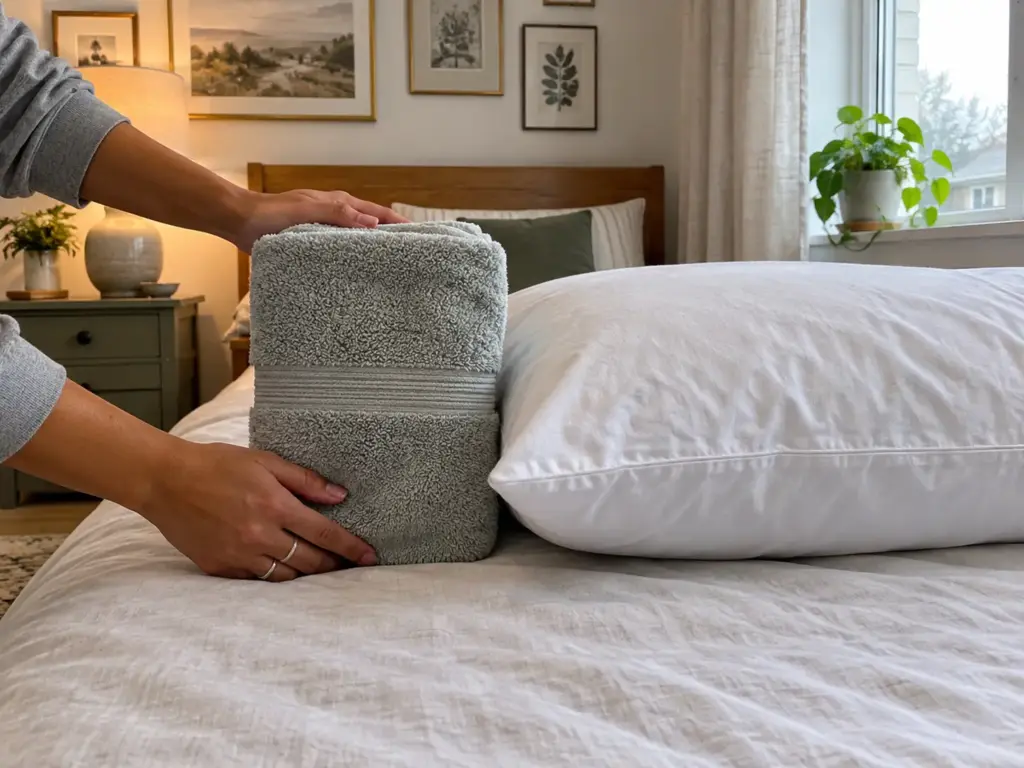
Measure the gap lying down, before you buy anything
When you lie on your side, your shoulder lifts your head off the mattress by roughly the distance from the side of your neck to the outside of your shoulder. The pillow has to fill exactly that space and hold your head level, not tipped down toward the mattress and not pushed up toward the ceiling. So loft is not a trait of the pillow. It is a measurement of you, on your bed, and the pillow either matches it or it does not.
The ear-to-shoulder gap is what you are measuring, and roughly 4 inches of loft fits an average frame, with broad shoulders asking for something closer to 5 or 6, and a true high loft pillow only makes sense at the far end of that range. Treat it as a starting range, not a target. Two people who wear the same shirt size can be an inch apart once they lie down, because one rolls the shoulder forward and the other sleeps with it square under them.
And the loft printed on the box is the wrong number to compare against. A listed thickness describes the pillow on a shelf; what matters is the height left once your head has pressed into it for a few minutes, and that differs from pillow to pillow. Measure the gap, then judge every pillow by what it does under weight.
Your own bed already tells you when the number is off, if you know where to look. A pillow that is too low leaves your head dropping toward the mattress, and a sleeper often answers that without waking up: the lower arm slides under the pillow to prop it, or the pillow gets bunched and folded at one end. A pillow that is too tall does the opposite, and you can end up rolling partway onto your front to get your head down. Both are the gap talking, and both cost nothing to read.
The test costs nothing and takes five minutes with a second person:
- Lie on your side on your own mattress, with the topper on if you use one, in the position you fall asleep in.
- Have someone slide folded bath towels (or a hardcover book with towels on top) under your head, one fold at a time, until your head sits level.
- Stay there a minute so the stack compresses the way a pillow would, then measure it with a ruler.
- Buy to that number. If you cannot get a number, do not buy yet.
Keep the towel stack folded on the shelf after you measure it. It is a working pillow for a week: if you sleep on it and wake with your arm shoved under your head, the stack is one fold short, and you just learned that without buying anything.
The thread that refuses to name one pick is right for the wrong reason. A recommendation is useless without your gap attached to it, and with the gap in hand you can read any listing in seconds. The seed article walks through how loft changes by sleep position if you switch between sides and back during the night.
Why a softer mattress asks for a thinner pillow
The mattress is the other half of the sum, and mattress firmness moves the number as much as the pillow does. A plush mattress lets your shoulder sink, which lowers your head toward the surface and shrinks the gap the pillow has to fill. A firm one holds the shoulder up and leaves more space under your ear. According to Consumer Reports’ pillow buying guide, “Firmer mattresses keep you from sinking in as much, leaving a larger gap between the mattress and your neck to fill.”
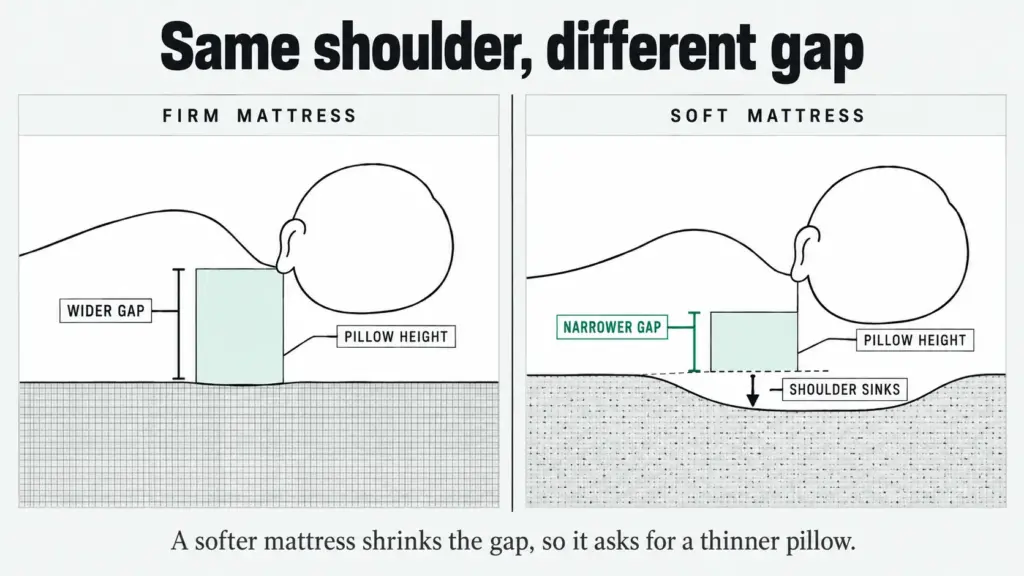
That is why the rule that side sleepers need a tall, firm pillow breaks on plenty of beds. On a memory foam mattress with a thick topper, your shoulder can drop far enough that a medium loft pillow is already the right height, and the tall one pushes your head up and tips it away from the mattress. The better call is to let the mattress decide first and the pillow second, which is exactly what the towel test does without you having to think about it.
The same logic runs backward, and it catches people out. You take the plush topper off to wash it, or you replace a tired mattress with a firmer one, and the pillow that suited you for a year suddenly “went flat.”
It did not. The gap got wider overnight, and the pillow stayed the same height. Measure again any time the mattress changes, before you blame the fill.
Which Cheap Fills Still Hold Their Height at Month Six
Week one lies. Almost any pillow feels right out of the bag, which is why so many three-star reviews open with some version of “great for the first two months.” The question for a small budget is which fill still holds your gap open at month six, when the cheap ones quietly give up.
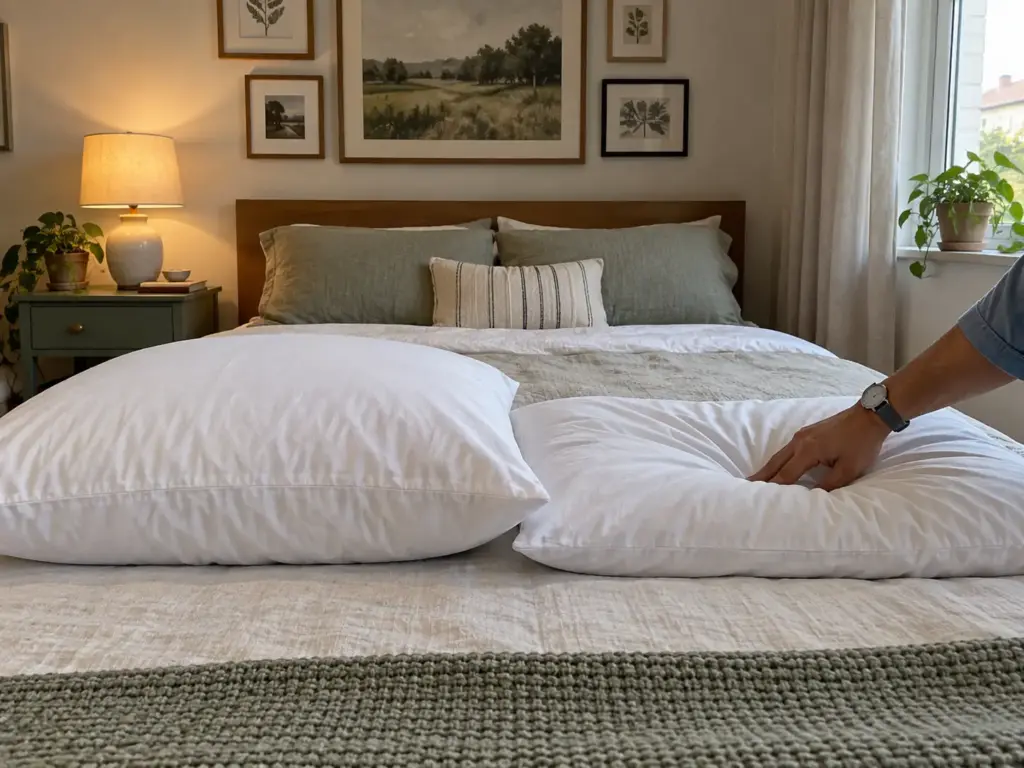
Shredded foam and polyester: height by the handful
Height retention is something you can measure, and the lab version of month six exists. Consumer Reports’ resilience test presses each pillow under an evenly spread 225-pound load at 98.6°F and 80 percent humidity for 96 hours, then measures thickness and firmness, then measures them again after fluffing it by hand. Warmth, moisture and weight, for four days straight: that is a compressed version of what your head does to a pillow every night.
Plain polyester fill is usually the cheapest thing on the shelf, and Consumer Reports notes it does not hold its shape well. Under warm, damp weight the fibers lie flatter against each other night after night, and fluffing moves them around without bringing all of the height back. This is the pillow the community describes as flattening like a pancake, a loss of shape retention that no cover can hide.
Shredded memory foam fails differently. The pieces do not lose their own height so much as pack together: under weight they slide into the gaps between each other, the air between them leaves, and the pillow gets lower and denser at the same time. A r/BuyItForLife commenter put it in two words when a second purchase of the same pillow arrived with smaller foam pieces that “meld together” and turn it stiff. Smaller pieces pack tighter, so the same weight of fill sleeps lower and harder.
Here the cheap fill has one real advantage, and it is a big one. Consumer Reports found that adjustable pillows tend to do better in its tests because they can be set to the person, and a pillow with removable fill and a zipper is the cheapest way to land on your exact number.
The same thread sums it up in the Coop’s favor: “Too thick? Pull out some of the foam. Not thick enough? They include a bag of more foam.”
Keep that spare bag. Once the fill packs down, a handful of fresh pieces puts the height back, which is the same move as an adjustable fill that gets topped up by month three for people who switch positions.
The tell that shredded fill has packed down is not visible from outside. The cover looks full and the pillow looks fine on the bed. What changes is what you do with it at night: you start folding it in half under your head, or bunching one end up, to get back the height it used to give you. If you catch yourself doubling it over, the gap has reopened.
Latex holds height, with its own price in weight
Latex behaves more like a spring than a pile. Consumer Reports describes it as having more spring to the touch and coming back to its shape faster after being compressed, and that is the property a side sleeper is buying: the height under your ear at the end of the night is close to the height at the start.
But a r/BuyItForLife commenter reports that “foam latex lasts a couple of years only,” and both things are true at once. The fast rebound is a nightly property. The two-year ceiling is about age. So latex can hold your gap better than polyester for most of its life and then give out on a schedule rather than slumping a little every month.
The other costs show up the day it arrives. Shredded latex is heavy, it can smell strongly of rubber for the first weeks, and the pieces feel like pieces: among the Amazon reviews of the set below, the recurring complaints are lumpiness and a pillow that is “hard on the ears and head” for some people.
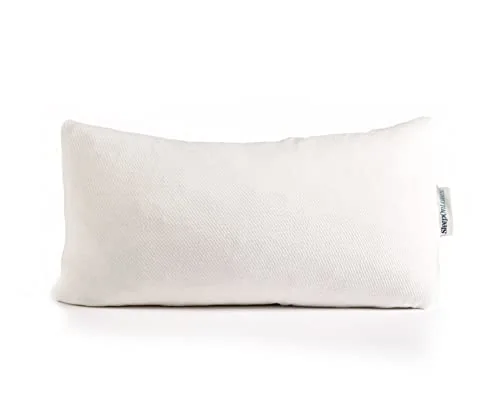
If the Natural Latex Shredded Foam Pillow set appeals because latex holds height, buy it knowing the trade: a heavy, lumpy pillow that can press hard on the ear, and a fill that one long-term owner says gives out in about two years.
Kapok and down alternatives: soft first, flat later
The soft fills are where cheap pillows feel best in the store and worst by summer. Consumer Reports notes that down flattens easily, that feather is firmer and springs back, and that kapok sheds moisture thanks to the waxy coating on its fibers. Kapok’s dryness is useful on a warm night, and it improves breathability for a hot sleeper. Its height is a different question, and the reviews of the pillow below answer it.
Most cheap “down alternative” pillows are polyester fiber in a shell, and they follow polyester’s curve: plump in the first weeks, lower after that. A pillow that blends shredded foam with kapok sits between the two families, with a softer surface than a pure foam core and less spring than latex.
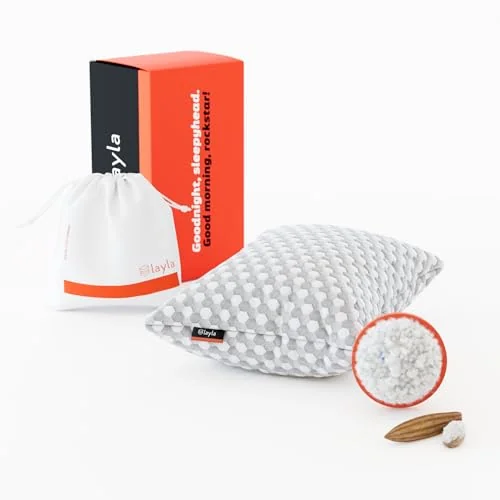
The Layla Sleep Adjustable Fill Kapok Pillow is the clearest case of week one lying in this whole list. Its reviews split along a calendar line, from “great for first 2 months” to “doesn’t maintain shape after 6 months and becomes very flat,” and some buyers describe two units of the same pillow that felt different from each other. If you buy it, treat the adjustable zipper as the point and plan on adding fill.
One fill comes up again and again among side sleepers without belonging on this list as a pick: buckwheat hulls. People who use them say they hold height as long as you do not move them, since the hulls lock together instead of compressing. They also rustle every time you turn your head, and they need a zippered cover, which is a trade some sleepers take happily and others never get used to.
As for how long any of this lasts, the long-term reports in the same thread are sobering. One poster who buys side-sleeper pillows regularly says “rarely do any last more than 15 months,” while others report a Bedgear still going at four years and a Panda at three. The cheap fiber and foam pillows in the Amazon reviews fail the same way, by height and not by the cover, somewhere between month two and month six. For the full picture by material, see the fold test and how long each fill lasts.
What You Can Give Up and What You Can’t
The title promised a trade, so this section lays it out in full. A cheap pillow gets cheap by dropping things, and some of those things never mattered to a side sleeper’s gap in the first place. Others are the gap.
Safe cuts: the cooling finish, gel, the contour shape and the trial frills
The box that says “cooling gel” is selling a material that can work against you. Consumer Reports points out that a cool gel layer can trap heat and moisture, which is the opposite of what the box promises. The cold you feel on first touch is not a cooling spec, and it is the first thing to go.
What moves heat in a pillow is air. In Consumer Reports’ testing, shredded foam and polyester pillows tend to stay cooler than solid foam, because the gaps between pieces let air move when you shift your head, while a solid block has none to move it through. So a cheap shredded pillow already has the property the gel is pretending to add.
Cut the gel. Cut any “cooling” finish too, which is a treatment on the cover that washes out on its own schedule.
Two more words on the box are safe to ignore. “Hypoallergenic” has no federal standard behind it, according to the same Consumer Reports guide. An “ergonomic” or contour shape is just that, a shape: a curve cut for one particular shoulder width, with no measurement printed that would tell you whether it is yours. A contour pillow that misses your gap by an inch is worse than a rectangle you can adjust.
Trial periods are a softer case. A long sleep trial is a safety net for guessing your loft wrong, useful but not a property of the pillow, and once you have measured your gap with towels you need the net much less. (Coop’s 100-night trial and five-year warranty are the maker’s terms, not a spec.) The same reasoning, applied to sheets and covers, is behind what the premium buys in bedding for hot sleepers: usually a finish, rarely the fabric.
The cut that costs you: height that does not hold
Everything a side sleeper needs from a supportive pillow comes down to height that is right and stays right, so that is the one place a cheap pillow cannot save. The table puts the whole trade on one screen.
| Feature | Why | Safe to give up? |
|---|---|---|
| Cooling gel or a cooling finish | Gel takes heat in and has nowhere to send it; the finish washes out | Yes |
| Contour or ergonomic shape | A curve cut for one shoulder width, with no spec behind the word | Yes |
| Long trial period | A safety net for guessing the loft, not a property of the pillow | Yes, if you measured first |
| Adjustable fill | The cheapest way to hit your exact gap and top it up later | No |
| Fill that holds height | The whole job; losing it reopens the gap by month six | No |
| A protector or a tight cover | Keeps sweat and oil out of a core you cannot wash | No |
The obvious way to save is the bottom-tier polyester pillow, replaced whenever it goes flat. Count it out, though: a pillow bought again and again can add up to more than one adjustable core topped up and kept, and you spend most of each cheap pillow’s life at a height that is already wrong.
A tightly woven cover belongs on the keep list too. Consumer Reports notes that a well-made cover helps a pillow last longer, and the reason is simple: shredded fill pokes at the shell every night, and a loose weave lets fine foam crumbs work their way out and lets sweat and skin oil work their way in.
Run the fluff test in the store aisle and again every few months at home: squeeze the pillow to half its thickness, let go, fluff it, and watch whether it climbs back to where it started. A pillow that stays low after fluffing has already lost the height you paid for, whatever its age.
The washable layer that protects the fill
Most of what wears a cheap pillow out comes from you: sweat, skin oil and warmth, every night. The free fixes come first. Wash the pillowcase weekly, fluff the pillow every morning (Consumer Reports suggests daily fluffing for anything that is not a single solid piece), and when a case starts looking tired, replace the case long before you replace the pillow.
Machine-washable pillows usually go through on cold; a solid foam slab should never go in the machine at all, and a shredded foam core is slow and heavy to dry, as the next section explains. A machine-washable cover on a core you spot-clean is the practical middle: the shell goes in the wash, and the core is left to air-dry rather than wrung out.
A core you cannot easily wash is best kept out of the laundry by a zippered layer over it, because a protector moves the stain onto a layer you can wash. That matters more for foam than for fiber: which pillows come clean and which do not mostly comes down to whether the core survives the drum.
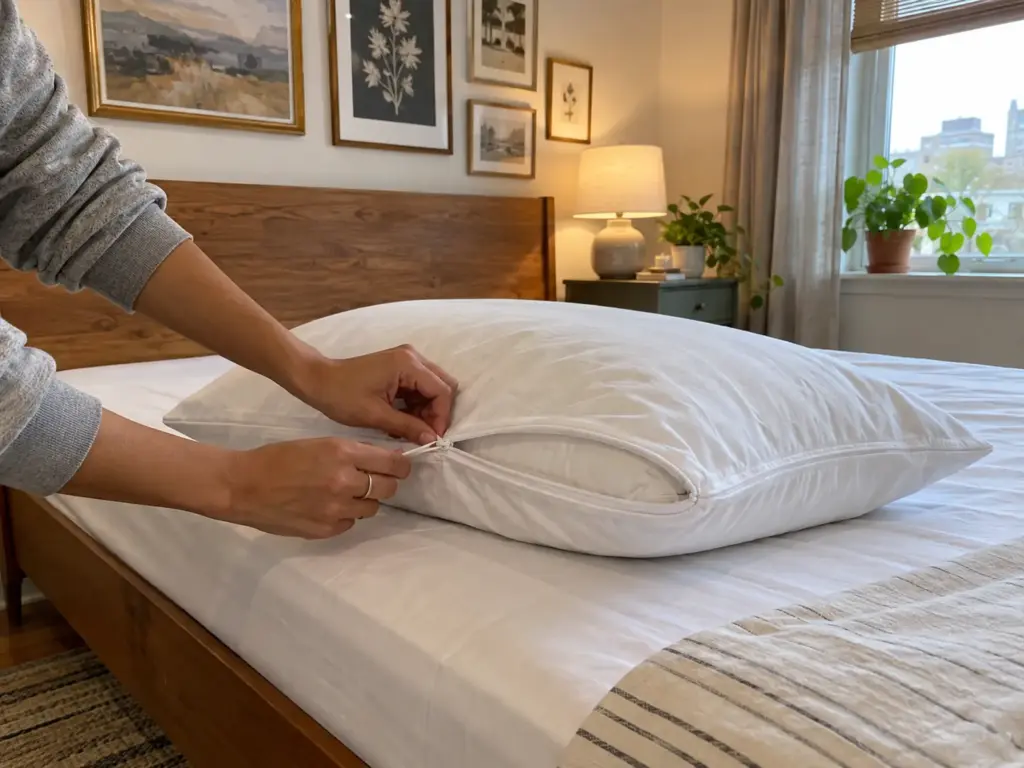
The FAUNNA 600TC 100% Cotton Pillow Protector, 4-pack is a plain example: cotton, a zipper and an OEKO-TEX certificate, four to a pack so two can be in the wash while two are on the bed. Know what you are buying. It is a protector for the fill, not a side-sleeper product, and it adds no height at all, so it goes on after you have the loft right, never in place of it.
Three Pillows Worth Starting With, Each With Its Flaw
With the gap measured and the cuts made, what is left is a short list of pillows that give a side sleeper height without paying for a finish. Not one of them is free of a complaint, and each complaint is written below next to its card.

Coop Original Adjustable: height by the handful
Before you buy anything, try the free version of this pillow’s whole idea on the one you already own. If it has a zipper and loose fill, take a few handfuls out or move the fill from the edges to the center, then lie down and check it against your towel number. Plenty of “wrong” pillows are just overfilled or underfilled versions of a right one.
When that is not enough, the Coop Home Goods Original Adjustable Pillow is the cheap route to an exact loft. The fill is cross-cut shredded memory foam mixed with microfiber (the Amazon listing gives 76 percent visco foam and 24 percent polyester gel fiber), it ships with a bag of extra fill, and the cover goes in the washing machine. The Queen measures 20 x 30 inches. You set it to your gap, and when it packs down a few months in, you add fill instead of buying again.
Set an adjustable pillow low and work up. Pull out more fill than you think on night one, store it in the spare bag, and add back a handful at a time over a few nights. Shredded foam settles under you, so a pillow set to your exact number on the first night can sleep a little tall at first.
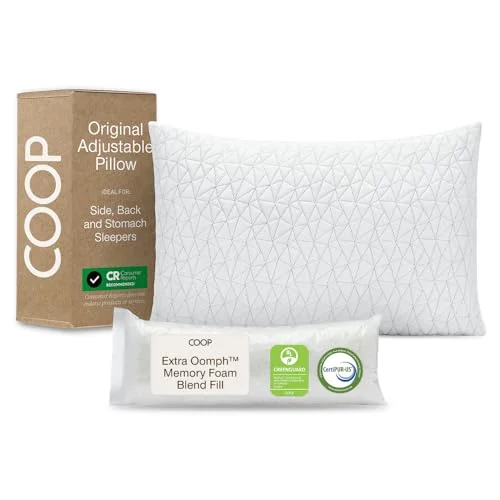
The Coop is the pillow everybody names first, and for a side sleeper with a dryer and a protector it earns that. It stops being the obvious pick if you wash pillows whole, or if you dry laundry on a rack. Wet shredded foam is the heaviest thing in the load: the pillow comes out of the washer as a sodden lump and out of the dryer still damp at its center, which is how the reviews that mention a mildew smell after the first wash start. Keep the core out of the machine, keep a protector on it, and the flaw mostly stays theoretical.
Beyond Down Side Sleeper: a gusset instead of foam
A gusset is a strip of fabric sewn between the top and bottom panels of a pillow, so the shell is a box rather than a lens that is fat in the middle and thin at the edges. For a side sleeper that matters more than it sounds. Your head does not stay in the exact center of the pillow, and a gusset carries the height out toward the edge where your cheek and shoulder end up.
The Beyond Down Side Sleeper Pillow puts that box shape around plain polyester gel-fiber fill, a down alternative, inside a 100 percent cotton cover. The gusset is 4.5 inches. There is no foam in it, which means the whole thing can go in the washing machine and come out without the drying ordeal of a shredded core.
Before you decide it is too low for you, fold a towel and slide it underneath. Fiber pillows lose some height under your head, and a single fold under a pillow that is otherwise right is cheaper than a taller pillow.
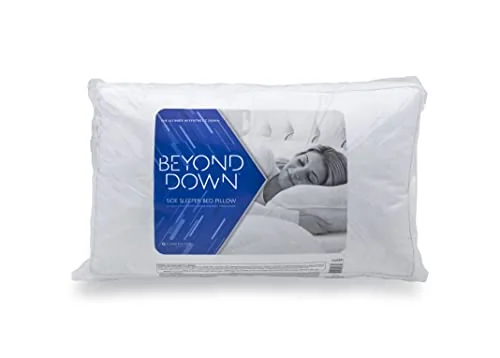
The Beyond Down reviews disagree on height in a way that tells you something: “flattens too easily” from one owner, “4 months and it fluffs right back up” from another. Fiber that gets fluffed every morning keeps more of its loft than fiber that does not, so the split is partly a split in habits. Pick it if you want no foam and a pillow that goes in the wash whole, and pass on it if you switch positions a lot, because its full height can be too much once you roll onto your back.
Isotonic Indulgence: tall and firm by shape
Broad shoulders change the arithmetic. If your towel test came out at 5 inches or more, most fiber pillows will need a fold under them forever, and the Isotonic Indulgence Side Sleeper Pillow is built tall from the start. It uses a down-alternative fill inside a side-sleeper gusset, with a removable damask cover, and the King measures 36 x 20 inches with a listed thickness of 7.7 inches.
Two numbers on that listing deserve a second look. The 7.7 inches is the listed thickness, not the height your head will sleep at, so expect it to sit lower once your head is on it, which for a broad-shouldered sleeper may be exactly right. And the cover’s 500 thread count describes the cover, not the pillow: a fine count on a removable shell tells you the shell is tightly woven and can be washed on its own, which is useful, and nothing about how long the fill will hold up.
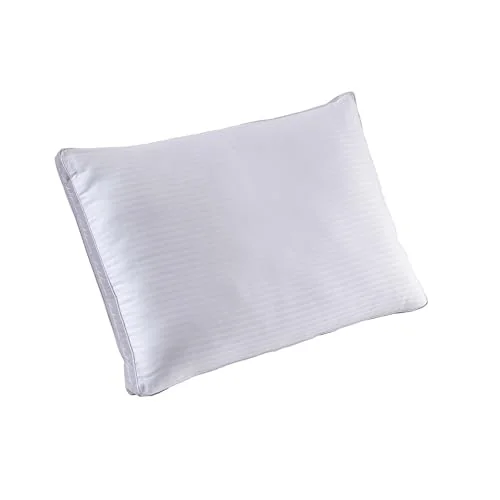
The Isotonic’s weak point is the fill, not the shape: “lost shape after 5 months, clumpy” and “filling separates to flatten” are the complaints that repeat. Fluff it daily and push the clumps back toward the center when you change the case. If you want the same budget with less risk of clumping, the Beyond Down with a folded towel under it gets a broad-shouldered sleeper close to the same height.
Fixing a Pressed Ear With a Softer Top Layer
Height solves half the side sleeper’s problem. The other half is the ear, and it shows up on pillows that are tall enough: you wake with your ear pressed flat and warm, and the pillow is still new. That is a layer problem, not a loft problem, and it has a cheap answer.
Why a firm, tall pillow still presses
On your side, the ear is the first thing that meets the pillow, and it carries a share of your head’s weight with no padding of its own. A soft surface spreads that load around it. A firm one, or a dense packed core, pushes back on the ear itself. That is why a latex or packed shredded pillow can hold your gap perfectly and still be “hard on the ears and head,” as the Amazon reviews of the latex set put it, and why pressure on the ear is a layer question before it is a loft one.
Memory foam adds a second effect. It molds slowly around whatever presses into it, so it can close over the ear instead of yielding under it. One thread has the best description of it: a solid memory foam pillow that “feels like I’m hearing my own ear,” because the foam seals around it like a cupped hand.
Then there is warmth. A dense foam surface can hold warmth against the same small patch of skin for hours, so a top layer that moves air matters more here than one that is only soft. That is one more reason shredded fill and fiber tend to beat a solid foam block for the surface your ear lies on.
A thinner soft layer on top, before a new pillow
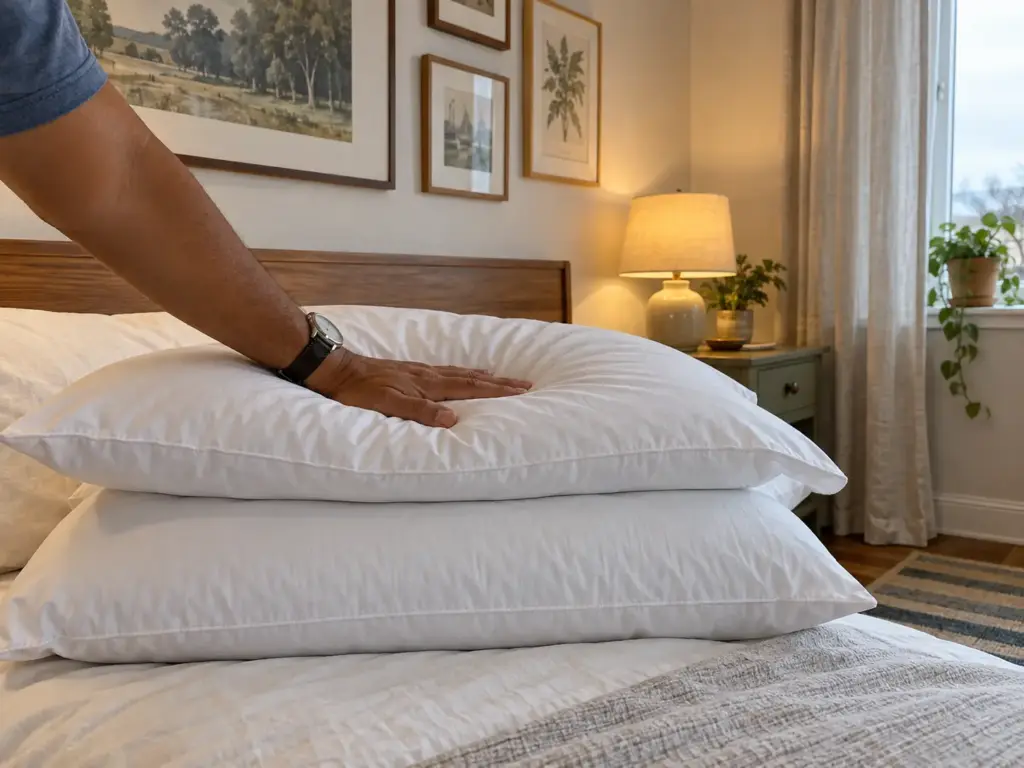
The fix the community lands on is a stack, not a replacement. Put a thin, soft pillow on top of a tall, firm one, so the firm one carries the height and the soft one takes the ear. You may already own the thin one: an old flat pillow, a down-alternative pillow that lost half its loft, even a folded fleece blanket. The cost is one pillow you probably have in a closet.
The stack only works if the total stays at your number, so take height off the bottom pillow to make room for the top one. With an adjustable core, that means pulling out roughly as much fill as the soft layer adds. Actually, the simpler move comes first: pull fill from just the top half of a shredded pillow and push it down toward the bottom, so the surface your ear meets is looser while the base keeps its height. Only if that is not enough do you need the second layer.
Measure a stacked pair together, lying on it, the same way you measured the towels. Two pillows that each look modest can add up to a full inch over your gap once they are stacked, and a softer surface that leaves your head tipped upward has just swapped one problem for another.
Changing the fill of the top layer works too. Some side sleepers in the same thread crammed medium- or light-density down pillows into shape over a firmer base, because down gives under the ear and the base underneath does the lifting. Whichever route you take, it is the same principle that runs through the towel test and adjustable fill for thin pillows: set the height with what you can adjust, and let the surface be soft.
Two Side Sleepers in One Bed, and When It Isn’t the Pillow
The last case is a bed with two shoulders in it, and the last honest answer is that sometimes the pillow is not the problem at all.

Two shoulder widths, two gaps
Two side sleepers are not one gap. If one of you has narrow shoulders and the other broad ones, the same pillow is too tall for one and too low for the other, and buying two identical pillows only guarantees that one of you is wrong every night. The answer is two pillows set separately: two adjustable cores, each pulled or filled to its own towel number. In the r/BuyItForLife thread, one couple each kept their own Coop going for two years this way; another pair gave up on foam and both settled on buckwheat and millet hull pillows.
Run the towel test twice, once for each of you, and each on your own side of the bed. That last part matters more than it seems. A shared mattress does not always wear evenly: the heavier sleeper can leave a softer hollow on their side, so the same mattress can hand the two of you different gaps even if your shoulders were the same width.
Write both numbers down. They are the only pillow specs in the house that belong to you rather than to a label.
The Natural Latex Shredded Foam Pillow set from the fill section comes as a pair, which looks made for this. It is, as long as you treat the two pillows as two separate settings and not as a matched set. Unzip both on day one, take fill out of the one for the narrower sleeper, and keep the spare pieces in a bag in case the other one needs them later.
Now the bed where one of you sleeps on your back and the other on your side. You can tell every time the pillows get swapped, because a back sleeper’s pillow is lower and flatter on purpose, and on its side it leaves the gap half empty. See how a back sleeper’s pillow differs before you pick one for the other half of the bed.
Pillows in a shared bed migrate: when the bed gets made in a hurry, they land on the wrong sides, and the swapped one sits wrong for whoever ends up on it. Two different pillowcase colors fix that for free.
There is also a workaround that suits a single side sleeper with a restless night: one thin pillow and one thick one. The thick one goes under your head, and you hug the thin one against your chest, which keeps your top arm and shoulder from rolling forward and narrowing the gap you measured.
When the mattress, not the pillow, sets the gap
The mattress moves the number, and Consumer Reports’ point about firmness cuts both ways. A mattress that has softened under the shoulder lets that shoulder sink further, so the gap shrinks and a pillow that used to be right starts to feel tall.
A mattress that is too firm for you holds the shoulder up and the gap opens. In both cases the pillow did not change. The bed under it did.
So before you replace a pillow that “stopped working,” lie down and run the towel test again. If the number is different from last time, the change is in the mattress or the topper, and the right fix might be adjusting the pillow you have rather than buying a new one. If the mattress dips visibly where your shoulder lies, no pillow will keep up with it for long.
Toppers deserve their own warning, because they change the gap in a single evening. A memory foam topper added for comfort lets the shoulder sink further, and the pillow that fit the bare mattress now sits tall. A topper taken off for washing, or for summer, does the reverse for as long as it is off.
With an adjustable core, the answer is a handful of fill in or out on the day the topper changes; with a fixed pillow, a folded towel underneath covers the bare-mattress weeks. In a shared bed with a topper on one side only (a common fix for two people who want different firmness), the two pillows end up set for two different mattresses, which is one more reason they should never be identical.
Pain that does not move with the pillow
If you have set the height to your gap, softened the layer under your ear, and pain stays the same whatever pillow is under you, that is a question for a doctor or a physical therapist, not for another pillow. What bedding can do ends at the height of the stack and the feel of the surface, and those are the parts worth getting right before anything else.
Buy the Height, Skip the Finish
Three things decide whether a cheap pillow works for a side sleeper. First, measure the gap between your ear and the mattress lying down, on your own bed, and buy to that number. Second, cut the cooling gel, the finish, the contour shape and the trial frills, and never cut the fill that holds height. Third, an adjustable core is the cheapest pillow that can be set to your number and kept there, and the fill you already own comes before any purchase.
Around month six, fold the pillow in half or squeeze it to half its thickness, fluff it, and see whether it springs back to the height you set. If it does not, add fill, and replace the pillow when more fill no longer brings the height back.
Tonight, the free change is the towel stack: measure, then sleep on a pillow set to that number, or with a folded towel under the one you have. In the morning, notice where your arm ended up. If it is no longer jammed under the pillow, the gap was the problem all along.
Frequently Asked Questions
01What are the best inexpensive pillows for side sleepers?
The best inexpensive pillows for side sleepers are adjustable shredded-fill or gusseted fiber pillows that you can set to your own ear-to-mattress gap. The Coop, the Beyond Down and the Isotonic in the picks section each do that, each with a flaw worth reading first.
02How high should a side sleeper’s pillow be?
A side sleeper’s pillow should fill the gap between ear and mattress, which is roughly 4 inches for an average frame and more for broad shoulders. A firmer mattress asks for a fuller pillow. Measuring your own gap with folded towels beats any number on a box.
03How do I know a cheap pillow has gone flat?
Squeeze the pillow to half its thickness, fluff it, and watch whether it returns to its old height; if it stays low, it has gone flat. Another sign is that you have started folding it double at night to get the height back.
04Does a cooling gel pillow matter for side sleepers on a budget?
A cooling gel layer is safe to skip on a budget, because Consumer Reports notes gel can trap heat and moisture once it warms up. Shredded foam and polyester pillows already stay cooler than solid foam, since air moves between the pieces.
05Is it worth paying more for a side sleeper pillow?
Paying more is worth it only when the extra buys fill that holds its height and a core you can adjust, not a finish or a fancier shape. Put any saving toward a second pillow for a stacked top layer or a washable protector.





Tried it on your own bed?
No comments yet. Tell us what you changed, and what the sheet did after a few washes.