


What’s in here6 sections
You go to bed fine, remember nothing of the night, and get up with the same ache in the same place as yesterday. Waking up sore from sleeping usually gets blamed on the mattress or the pillow, but a third thing lies over you the whole time: the cover. A sleeper turns many times a night without waking, and every turn is a small push against whatever is on top. Here is how often that happens, what a heavy or stiff cover does to a turn, what a cold room does to the shape you sleep in, and what your morning sheets record.
Quick Answer
A sleeper makes small corrections all night, and the bed decides how far they are allowed. Two bedding levers set that: the weight of the cover a turn has to push against, and the cold that curls you up and keeps you curled. Your morning sheets show which one held you.
A Night Is Full of Small Turns, and the Cover Is Over Every One
Talk about sleep position usually stops at the one you fall asleep in. The night is mostly what happens after that: a long run of turns, none of them remembered, each pushing against whatever lies over you. Two studies count those turns, and they count them differently, so the numbers sit side by side and never in one sum.

How Often a Sleeper Turns, in Two Studies That Count Differently
In a Japanese research-grant record of a 2002–2003 video study of sleeping positions, the 19 men among 29 healthy adults aged 19 to 31 averaged about 32 positional changes on the first recorded night and about 34 on the second (32.42 and 33.58 in the record). The researchers sorted what the camera saw into 28 patterns, each defined by the direction of the head, chest and waist together. That suggests what a turn is: three parts of the sleeper rearranging at once. The reading is ours, not the record’s.
In a 2017 accelerometer study of 664 working adults, the average came to 1.6 position shifts an hour, and a shift counted only if the angle changed by at least 30 degrees and stayed there for a full minute. Over the 7.5 hours in bed that the study reports as its average, 1.6 an hour works out to roughly 12 a night. That multiplication is our arithmetic; the study does not state it.
The video count catches every change between patterns, while the accelerometer count keeps only the big ones that stick. Neither is wrong, and neither can stand in for the other. Whether your night holds a dozen large shifts or thirty smaller changes, each one is a push against the cover.
The Side Is the Position the Cover Follows
The accelerometers also logged where the night was spent: 54.1% of time in bed on the side, 37.5% on the back and 7.3% on the front, and the study concludes that the side is the predominant sleep position in adults. For the cover, that settles a lot. On a side, the cover lies across the top shoulder and hip and has to travel with you when you roll to the other one.
The position you wake in is rarely the one you fell asleep in, and the sheet remembers the difference. Choosing a position and switching it on purpose is its own subject, covered in the position you set at lights-out. This piece is about what lies on top of whichever one you pick.
Why Your Own Count Is the Only Fair Test
In the video study each man’s count tracked across his two nights (r = 0.69), which reads as a personal habit rather than a shared average. A number from someone else’s night tells you little about yours. The fair comparison is your bed against itself: same sleeper, same pillow, one thing changed, a few mornings to compare. That is the one-change-at-a-time test, and it is the only measuring tool this article asks you to use.
Sometimes the count is felt rather than seen. Some sleepers describe a turn that cannot finish until the other arm gets free, and rolling over can feel like a whale breaching. That is a sleeper reporting resistance.
Part of what pushes back is the mattress, which is its own subject. The other part is whatever lies on top, and the next section takes that apart. (Toss and turn all you like: the cover is over every bit of it.)
A Heavy Cover Is a Push You Make at Every Turn
You can name your mattress and your pillow, but ask what the cover weighs and most people have never checked. It is still the one object you push against at every turn, asleep, with no say in the matter. None of what follows comes from a measurement of covers. It is reasoning from how a turn works, and your own morning sheet is the test.
Weight: What a Turn Has to Lift
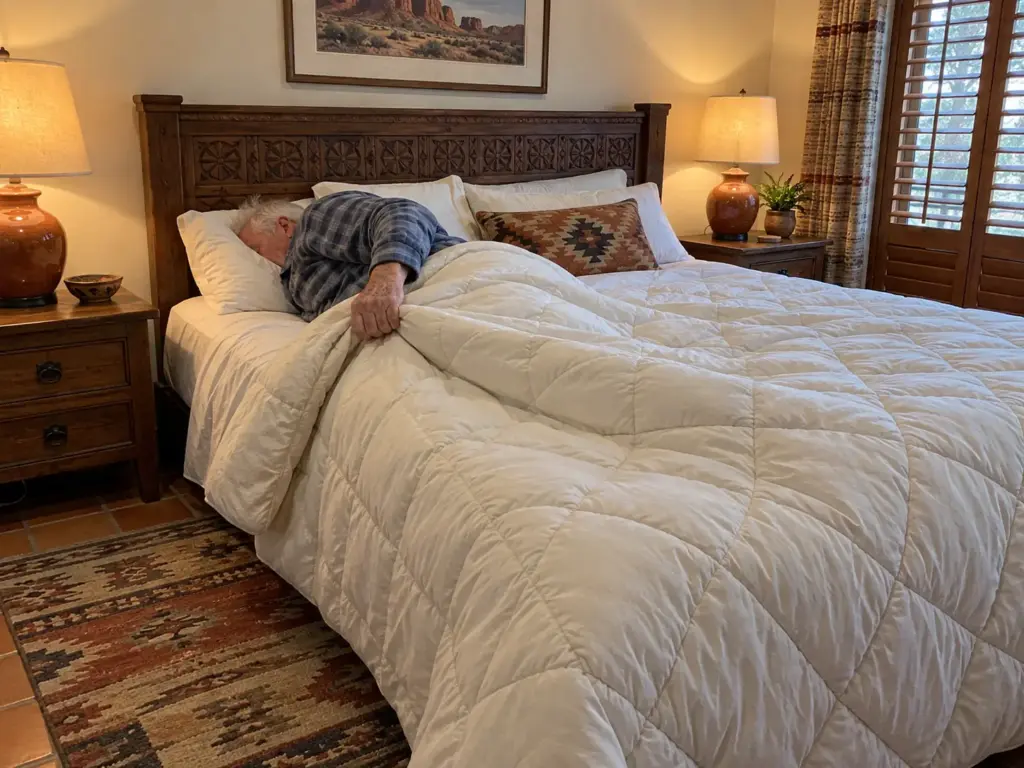
A turn on the side means the cover goes with you or gets left behind. Either way something moves: lifted over the shoulder, dragged across the hip, or shoved off. A heavier or stiffer cover asks more of each of those moves.
You make them without waking, so you never weigh the cost; the turn just gets a little shorter, or gets skipped, or finishes only after a second shove. No number attaches to any of this, and no cover has been given a turn count.
Picture yourself under a thick duvet chosen for the cold, one you have never once thought about while rolling over. It has been part of every turn since the day you put it on the bed. The instinct in a cold room is to add weight, because heavy feels warm.
But a bed in which the sleeper turns many times a night is a poor place for that instinct, since weight is paid for at every turn, not just at bedtime. The better call is warmth that does not add weight, and a restless night under a heavy cover is a fair reason to try it.
Loft: A Cover That Stands Off the Sleeper
Weight and loft are two different things. Weight is what you have to move; loft is the thickness of trapped air. A cover can be heavy and flat, a dense quilt that lies on you like a board, or light and tall, a duvet that stands off you and goes along with a lift of the shoulder.
Warmth comes from the air, not the heft, which is the whole argument of warmth that comes from trapped air, not from weight. How much fill it takes to get a given amount of air is a separate question, and warmth per ounce compares the fills directly.
A cover that keeps sliding off one shoulder is telling you something: it was stiff enough to be pushed aside rather than turned with. A cover that drapes comes along.
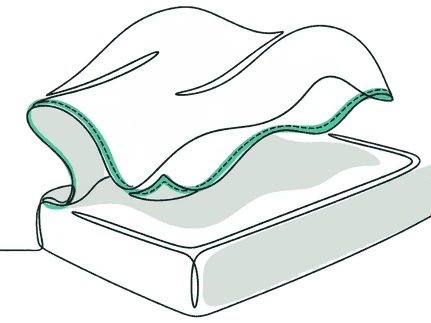
Hold the cover up by its top edge and let it hang. If it falls into soft folds, it will follow you around a turn. If it holds a stiff, flat shape in the air, expect it to be pushed rather than carried.
The Free Test Before You Buy a Lighter One
Nothing here needs a purchase. Take the lightest cover already in the house, a summer-weight one or a sheet with a single blanket, and sleep under it for a week with everything else the same: pillow, sheets, room. Then look at the sheets each morning and compare them with the week before. That is change one thing and count the mornings in its plainest form.
Run it in a week when the room is comfortable. In a cold week a lighter cover is also a colder one, the test mixes two changes, and the next section shows why the cold cannot be left out of the picture.
The Cold That Keeps You Curled
The cover is also what the cold pulls up. A sleeper in a chilly room reaches for more of it, and what that does to a posture is the subject here. The first half rests on a review; the second half is reasoning, and it says where the sourcing stops.

What a Cold Room Does to the Cover
According to a 2012 review in the Journal of Physiological Anthropology, when the room cools during sleep, more of the sleeper ends up under the cover, and the neck, shoulders and arms register the cold sooner than the legs and trunk. In plain terms: as the temperature drops you pull the cover higher, and the shoulder line is where you feel the cold first.
The same review describes the air between skin and cover as the bed’s own climate, held around 32 to 34 °C and 40 to 60 percent humidity in normal sleep. The cover keeps that pocket in place.
The authors state the consequence plainly. According to that same review, “the use of beddings and clothing during sleep is critical in supporting thermoregulation and sleep in cold exposure.” In a cold room the cover carries the warmth. The room does not.
A Curl Held Is a Curl Not Undone
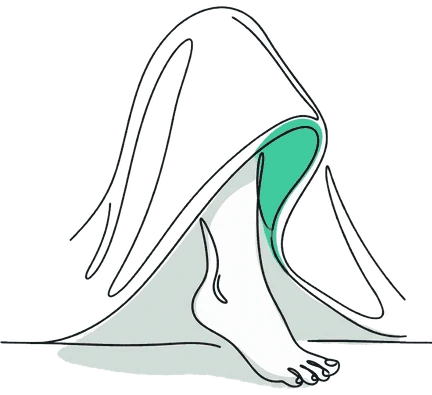
No source describes the posture itself, so this part is our reasoning, and the only direct evidence is what sleepers say. Some sleepers wake up curled into a fetal position. The logic is easy to follow: a smaller shape gives the cold less to find, so a cold sleeper draws the knees up, tucks the chin and pulls the arms in. And uncurling means leaving the small pocket of warmth the curl made, so a sleeper who stays cold stays curled.
If you keep the bedroom cold on purpose and wake folded in on yourself, this is your section.
Cold sleepers curl up without deciding to, and in our reading the pillow is left dented toward an edge rather than in the middle, so check that too. A curl is a position, and a position the cold holds in place is one you are not changing. Whether that matters for your mornings is what the sheets and the one-change test can show. What the bed controls is the cold.
Warmth From the Cover, Not From the Room
If the cover carries the warmth, the fix for a cold sleeper sits in the layers on the bed and not only on the thermostat. Building those layers is the job of a warm bed for a cold bedroom, built from the mattress up.
What belongs here is the link between the two halves of this article. Warmth that comes from loft lets a sleeper uncurl without a push, while warmth that comes from weight hands back the stiffness the last section took apart. Warm and light is a cover with air in it.
When a cold room has you reaching for more cover, add the warmth where the cold registers first: a layer whose top edge reaches the shoulder line, not another heavy block laid over the legs.
What the Morning Sheets Record
The night leaves a record that most mornings gets made over before anyone reads it. Reading it takes a minute, costs nothing, and tells you which layer held you and which one gave way.

What a Crease and a Dent Say
Everything in this section is our reasoning from how a bed gets rumpled, and your own sheets are the only proof. Think of the bed as a movement log. A deep sheet crease where a shoulder or hip sat is a place you stayed, while a wide, even rumple across the sheet is a night of moving. One deep crease and little else says you stayed put and the bed let you, a stillness that is worth a second look.
The pillow dent says the same about the head. A dent sunk far below the pillow’s own height, or pushed to one edge, is worth a look at pillow height for the side, which is a different job from this one.
Take a photo of the bed before you straighten it, three mornings in a row. Making the bed erases the evidence, and comparing three photos shows a pattern that one rumpled morning never will.
The Cover Pushed Aside, the Twist and the Pulled Corner
A cover found pushed to one side of the bed, or slid off the edge on the side you turn toward, is a cover that was shoved aside rather than carried through the turn. It points back to the stiffness in the weight section, and a duvet bunched into one corner of its cover says much the same. A cover found twisted across the chest tells a different story: the turn happened and the cover stayed behind, then wrapped around you as you went. A stiff, heavy one does that more than a cover that drapes.
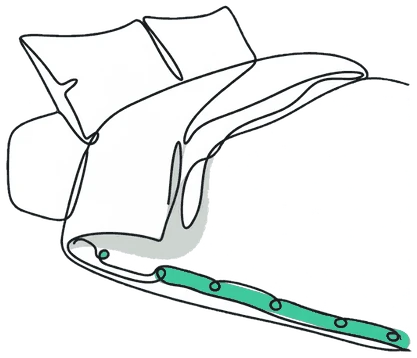
The corner is the third mark. A fitted sheet that has come off the mattress did not hold through the turns, and in our reading it is usually the corner at the foot, on the side you turn toward.
The top sheet tells the same story when it has been kicked loose. Grip is a matter of the sheet, and a fitted sheet that stays on at mattress plus two inches is where that gets sorted. Together with the crease on the sheet itself, that makes four marks: the crease, the cover pushed aside, the cover twisted across the chest and the corner lifted off the mattress.
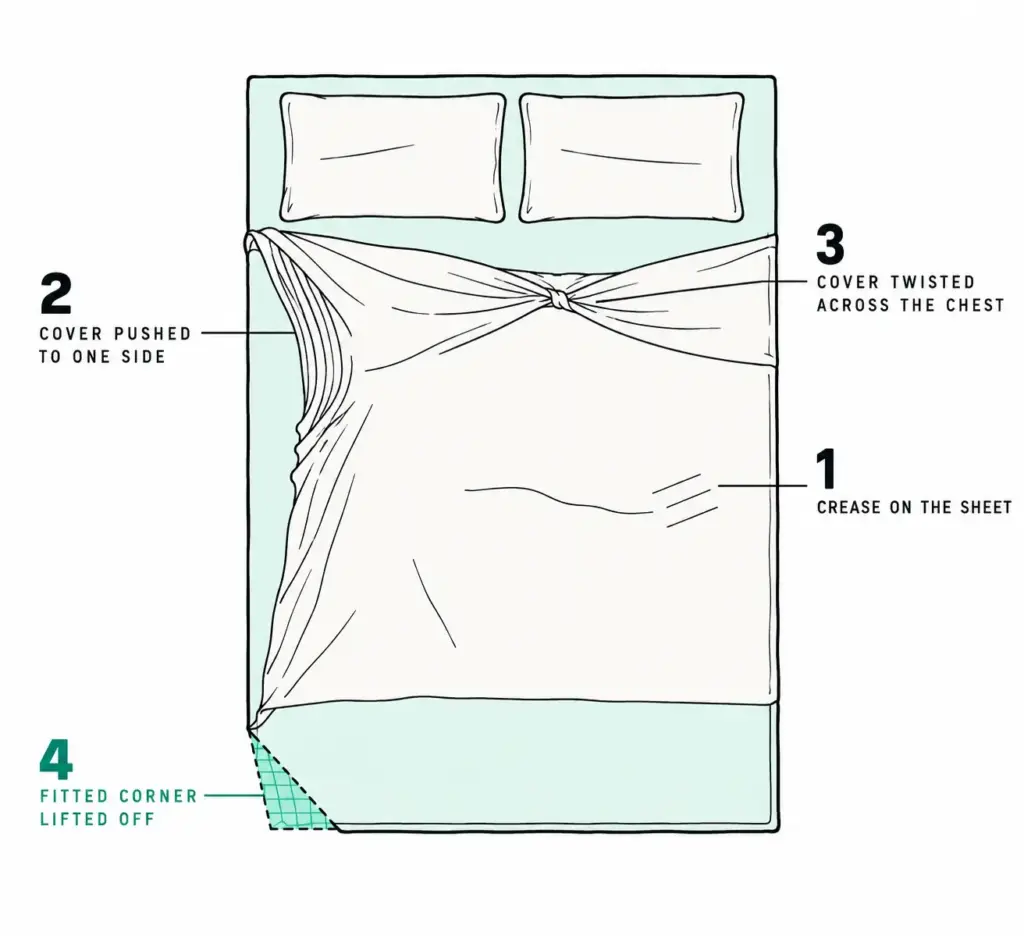
Read them as a set, not one at a time. A crease plus a pushed cover plus a lifted corner is a restless sleep in a bed that was in the way, and a quick morning check with your phone camera is all it takes.
A Hold Set on Purpose
Some sleepers do the opposite of freeing a turn: they set a hold. Hugging a pillow all night or keeping one between the knees can mean fewer sore wakings. That is reported, not measured, and it belongs with the rest of the evidence here: a bed that shapes the turns instead of leaving them to the cover. The objects themselves have their own pages: the knee pillow, and a body pillow that holds the arm.
A hold only works while it stays put, and the sheet tells you whether it did. A pillow that has wandered to the far side of the bed by morning was never holding anything, and why a pillow drifts by morning has the fix for it. Nothing in this section is a remedy for an ache; these are bedding choices, and your sheets are how you find out whether yours does anything.
When the Sheets Look Calm and You Still Wake Sore
A calm bed after a sore night is information too. It often means the bed held you still, not that the night was quiet: a heavy cover that was never pushed, or a cold that kept you in one shape. Lighten the cover and warm the layers first, one change at a time.
If the sheets stay calm, the cover is light, the room is warm and the ache still arrives, the question has left the bed. The threshold for that is written out in where the bed stops and a doctor starts. Numbness is a separate case with its own page, a numb arm in the morning. Until then, the bed is yours to change.
One Lighter Cover, Seven Mornings, Then Read the Sheets
The night is mostly turns, and the cover lies over every one of them. The weight of the cover and the cold that curls you are the two levers the bed gives you, and both show up on the morning sheets. The first change is free.
- A sleeper turns many times a night, and the cover is pushed at every one.
- Weight is paid for at every turn; loft gives warmth without the push.
- In our reading, a cold room holds a curl, and the morning sheets show which layer held.
When the season changes and a different cover goes on, read the sheets again. A new cover can leave a different record than the old one, and the old week’s photos are the baseline.
Tonight, put the lightest cover you already own on the bed and change nothing else. For a week, look at the sheets before you make the bed, and notice whether the cover is where you left it, whether the crease has moved, and whether the corner held.
Frequently Asked Questions
01Why do I wake up sore from my bed?
A bed can play a part when it limits how freely you turn, and the two levers it controls are a heavy cover and a cold room that keeps you curled. Your morning sheets show which of the two held you.
02How do I stop waking up sore?
Change one thing in the bed at a time and count the mornings, starting with a lighter cover for a week. That is the one-change test. It tests the bed; it cannot promise the ache ends.
03Does a heavy duvet make you wake up sore?
A heavy duvet may change how easily you turn, but how much is not measured for any cover. Your own morning sheet is the test: a cover pushed aside or twisted across the chest points to one that fought the turn.
04Should I sleep with a pillow between my knees?
Readers who hug a pillow or set one between the knees report fewer sore wakings. That is a report, not a measurement, and the object itself is covered in the back-pain pillow guide.




Tried it on your own bed?
No comments yet. Tell us what you changed, and what the sheet did after a few washes.