







What’s in here8 sections
- How Much Pillow Is Left Under a Stomach Sleeper’s Head
- The Free Test: No Pillow, a Folded Towel, the Pillow You Own
- Fills That Give Way and Fills That Fight Back
- What the Cheek Rests On: Case, Weave and the Cooling Claim
- The Bed Under the Pillow: Mattress, Hips and a Partner on Their Back
- Adjustable vs Thin Foam: The Picks
- Start With a Towel, Then Decide Whether to Build or Buy
- Frequently Asked Questions
You bought the pillow marked “medium,” the one sold to side and back sleepers alike, and by the second night you are lying face down with your cheek propped on a ridge of it and your face tipped up off the mattress. “Medium” on a pillow box describes a feel, not a height, and for stomach sleepers the height is nearly the whole question. Face down, there is almost no gap between the head and the bed left to fill, so a pillow that reads modest on its tag can still hold the face high: what counts is how much pillow remains once the head has sunk into it. This article starts with that measurement, then the free test to run before buying anything, which fills give way and which push back, what the cheek rests on, what the bed underneath adds, and finally the adjustable-versus-thin-foam picks (the other positions, and the version of the measurement with the mattress counted in, are in the pillow-by-sleep-position guide).
Quick Answer
A stomach sleeper needs the lowest pillow that keeps the nose clear: about 3 inches or less once the head has pressed it down, not on the tag. That takes a fill that compresses (down, fiber, shredded foam or latex), an adjustable pillow thinned by hand, or a thin foam slab bought at its height. The mattress counts too.
How Much Pillow Is Left Under a Stomach Sleeper’s Head
For a back sleeper, the measurement that decides a pillow is the gap between the back of the head and the mattress, read on your own bed. That logic still holds face down, but the gap almost disappears: the forehead, the cheek and the chest all sit close to the same plane, and the pillow is filling a space of an inch or two rather than the width of a shoulder. So the number printed on the tag, which was already only a starting point, stops being the number that matters at all.

Picture the two ends of it. You unzip a new pillow on a Sunday, hold up a 2.75-inch slab of foam, and it feels like nothing, like a seat cushion that forgot to finish growing. Then it turns out to be the first pillow you sleep through. Next to it on the bed sits the five-inch pillow you had before, which held your face so far off the mattress that your head ended up turned at a hard angle just to find somewhere to rest.
The Tag Loft Is the Starting Point, Not the Number
Loft is the height of a pillow lying flat with nothing on it, and a low loft pillow is one that starts near the bottom of the range. Mattress Clarity puts the face-down ceiling at “no taller than 3 inches” and says it checked that each of its picks could get that low under a head. Read that figure carefully: it is a ceiling for the height that is left once you lie down, not for the number on the box. A 3-inch tag on a firm pillow and a 3-inch tag on a soft one are two different heights by the time your cheek is on them. That later height is the compressed loft, and it is the only one that counts.

Bluewave sells its thin foam pillow in five heights, from 1.75 to 4 inches, which makes the problem visible. Two of those heights are over the ceiling before anyone lies on them. The other three are under it, and the tag cannot tell you which of the three your head needs, because the tag knows nothing about how far that particular foam sinks or what the mattress underneath is doing.
Most of the shelf is taller than that. A poster on r/Bedding, whose 5-inch memory foam pillow kept lifting their head, went hunting for something flatter and found that “most pillows are 5 to 6 inches.” The community word for it is overstuffed: a pillow sold taller than any face-down head can use.
In another r/Bedding thread, a stomach sleeper said the only pillow that ever worked for them was ten years old and “well broken in.” That is the whole lesson of this section in one line. A decade of nights did the compressing, and the height left at the end of it was the right one.
Two Pillows With the Same Tag, Two Different Heights at 3 a.m.
The height under your head is the tag loft minus the sink, and the sink depends on the fill. Sleepopolis makes the point in its review of the Belly Sleep pillow: a soft pillow and a firm pillow that start at the same loft end up at different heights under a head, because the soft one gives up more of itself. Two pillows can share a number on the box and still put your face at two different heights.
That turns one piece of shopping logic upside down. The thin slab looks like the obvious choice for a stomach sleeper, and often it is. But a soft down pillow can land lower than a firm foam slab with a smaller tag number, because down is mostly air and a head pushes the air out.
Mattress Clarity quotes Helix describing its own down and feather pillow as “pretty tall” when fully fluffed, and then says that once a head is on it, it “should flatten nicely.” A tall down pillow can still be a face-down pillow. The tag errs in the useful direction.
And the foam slabs have their own trick. A boxed foam pillow ships compressed, and Sleepopolis notes the Belly Sleep wants 24 hours to recover before it reaches its height. The first night on a new slab is a night on a pillow that is still growing (which is also why a first impression of “too thin” is worth a second night before it goes back in the box).
Measure with the pillowcase you actually sleep on already zipped or pulled over the pillow. On a slab under 3 inches, a quilted protector or a thick knit case is a share of the height your cheek meets, and leaving it off the reading makes every thin pillow look a little better than it will on the bed.
The 3-Inch Ceiling, and What It Is a Ceiling Of
The ceiling covers everything between your face and the mattress, not just the fill. A case, a protector, a pillow-top: each one adds to the stack. Even a protector on a thin pillow adds height, and on a 2.75-inch pillow that layer is a bigger share of the total than it would be on a 6-inch one.
The ceiling also moves with the bed. On a soft mattress, the chest and hips settle deeper than the head does, because the head is resting on a pillow that spreads its weight; the same pillow then reads taller relative to the rest of you. On a firm mattress the chest stays near the surface and a little more pillow fits. So treat 3 inches as the ceiling for an average bed, and expect your own number to sit lower if the mattress is plush or has a thick topper on it.
No source gives an at-home way to read the loft under the head, so this one is built from the sum. It is a way of reading your pillow, not a lab number, and it takes five minutes with a yardstick or the ruler app on a phone:
- Lay the pillow on the bed you sleep on, in its case, and stand the ruler upright beside the center of it. Read the height at rest.
- Lay a hardcover book flat on the center of the pillow and press it with one palm, about as firmly as a resting head. Read the height again from the mattress surface.
- Lift everything off and press the bare mattress beside where the pillow sat with the same book and the same palm. Note how far the surface gives.
- Your working number is the pressed pillow height, with the mattress give in mind: a mattress that sinks a lot will let your chest drop below your head, so aim lower.
Read it on a table first, if you like. Better still, read it on the bed, because the table hides the mattress’s share of the answer, and that share is the part that changes from one bedroom to the next.
The Free Test: No Pillow, a Folded Towel, the Pillow You Own
The measurement tells you what to look for. A free test tells you the number itself, and you can run it this weekend with what is already in the linen closet. Sunday afternoon, the pillow in one hand and a bath towel in the other: that is the whole kit, and it should come before any purchase in this article.

Try No Pillow First
Some stomach sleepers sleep with no pillow at all, and the first test is simply to join them for a night. Take the pillow off, lay a clean case flat on the mattress so your cheek still meets cotton, and lie the way you normally lie.
The test is not meant to prove anything about how you should sleep. It gives you a floor. If the face feels fine with nothing under it, the target is close to zero and almost any pillow on the market is too tall. If it feels like the head is sinking below the chest, you need something, and the next test tells you how much.
People improvise this in surprising ways. One r/Bedding poster sleeps face down on a single flat down pillow with “a squishmallow to balance my head” beside it, a stuffed toy pressed into service as a height adjustment. It is a homemade version of the same search: one flat layer, plus something soft to make up the difference.
The Folded Towel, One Fold at a Time
No source prints this test, so take it as a method rather than a finding. A bath towel is the most adjustable pillow in the house, because it changes height in steps you can count.
- Fold a bath towel in half lengthwise, then in half again, so you have a long strip about a hand wide.
- Fold that strip into a pad roughly the size of a pillowcase’s center. Lie face down with your cheek on it for a few minutes.
- If your face feels pushed up, take a fold out. If it feels like your head is hanging below your chest, add one.
- Stop at the fold where the face rests without being lifted. Press that pad with a book the way you pressed the pillow, and measure it.
That pressed pad is your number. Write it on something, because it is the figure you carry into the picks at the end.
One detail shows the towel is a fold too tall before the height does. Slip the folded towel into a cotton pillowcase and lie down, and the case pulls tight across the top of the stack, right where the neck of the case meets the opening. You feel the cotton strain before you feel the extra height. A loose case means the stack is about right; a drum-tight one means take a fold out.
Run the towel test for three nights, not one, and change the fold count by only one step each night. A towel shifts and flattens overnight, so a single night tells you about the towel as much as about you. If two nights in a row land on the same fold, that is the number.
The Pillow You Already Own, Thinned Out
The pillow already on the bed is the third free option, and the community has more ways to thin it than any shop has thin pillows. One r/Bedding poster opened a seam on a cheap cotton-fluff pillow, pulled out stuffing until it was low enough, and sewed it back up, adding that “the cheap old cotton ones we’ve had forever are the best.” Another bought a flat down pillow on purpose and found it “easily fluffed or flattened” to whatever the night called for.
A third took almost half the fill out of a wool pillow with an adjustable fill and bought a spare shell. That spare shell is a small piece of planning worth copying: if you take too much out, the fill is still there to put back.
Another commenter offers the deliberate version: “Buy a zippered case and fill it yourself.” That is the adjustable pillow, built from parts, and it is the logic every adjustable pillow in the picks below is selling back to you with a label on it.
Whatever you thin, measure the result the same way you measured the towel. The number you land on, pressed, is the one that decides between building a pillow and buying one already at height.
Fills That Give Way and Fills That Fight Back
The towel told you how low the head wants to go. A pillow only gets there if its fill is willing, and the label rarely tells you which fills are. Some collapse under a head and keep collapsing. Some push back with the same force all night, whatever height they started at.
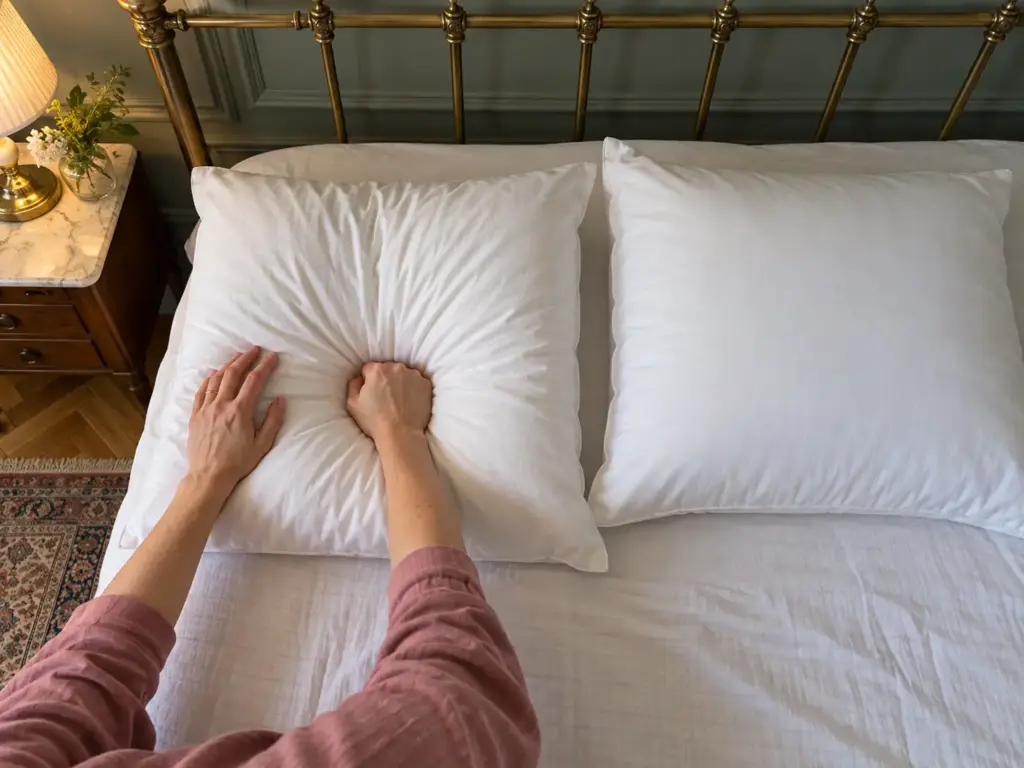
The store test hides the difference. Press a thumb into a down-alternative pillow and a latex one, and both give a little and come back. The question is what each does under a whole head for seven hours, and the thumb cannot answer it.
Down, Down Alternative and Microfiber — the Ones That Collapse
Down, down alternative and microfiber all work the same way at heart: most of the pillow’s volume is air held between clusters or crimped fibers, and a head pushes that air out. That is why they compress so far, and why a tall one can still end up low. Down clusters bounce back when the pillow is fluffed, and the distinction between down against down alternative is mostly a distinction in fill power, meaning how much loft each holds per ounce, and in how well each recovers.
For a stomach sleeper that collapse is useful. The fill does the thinning for you, at the spot where your cheek rests, and leaves the edges fuller, which is where your hand or arm tends to go. The catch is that collapse is not a fixed number. A fiber pillow flattened on the first night will come back some after a fluff, and no report read for this article says how much it tires over the months, so measure it again later.
The cheapest way to try this category is the Amazon Basics Down Alternative Pillow sold for stomach and back sleepers, a polyester down-alternative fill sold as a set. It is the plain case of a fiber that flattens under a head with no foam in it.
The reviews are split, though. Across its summary of more than 500 comments on softness, some buyers call it “not soft,” say the pillows “don’t fluff up,” and find them “too thick for stomach sleeping.” So the label’s promise of a stomach-sleeper pillow is one some heads find a size too big.
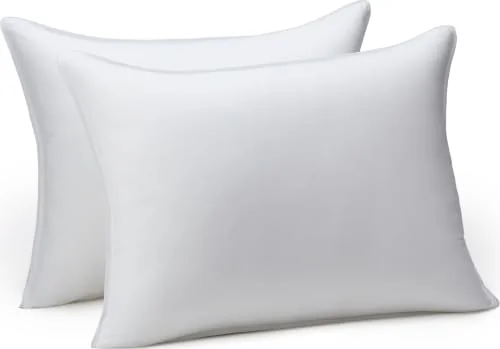
If your towel test landed near the top of the range, close to 3 inches pressed, a fiber pillow like this one has room to work. If it landed near an inch, a fiber pillow is more than you need and a slab is the better route.
Latex — the One That Springs Back
Latex behaves the opposite way. It is a springy foam with open cells, so air moves through it, and it pushes back against a head with roughly the same force from the first minute to the last. That recovery is the reason people love latex for side sleeping, where a pillow has to hold a tall gap all night.
Face down, the same quality works against you unless the height is already right. A latex pillow does not settle into a thinner version of itself. Whatever height it has under your head at midnight, it has at dawn.
Shredded latex gives you a way around that. The Natural Latex Shredded Foam Pillow, King, Set of 2 is open-cell natural latex in shreds, two pillows to the set, which suits this job better than a single pillow would: one gets opened and thinned to your towel number, and the other stays untouched as a spare or for whoever shares the bed. The review summary is plain about the shreds, describing foam pieces of irregular sizes, a firm feel for some buyers and a strong latex smell. Irregular pieces matter more on a thinned pillow, because with less fill there is less to even out the big chunks under a cheek.
A single-piece Talalay latex pillow solves the shifting problem completely, since there is nothing inside to migrate. It also removes every chance to adjust. The one-piece Talalay pillow the roundups describe comes in 4-inch and 5-inch profiles, both over the ceiling, so a one-piece latex pillow is a height you buy rather than one you make.
Shredded Foam — the One You Build by Hand
Shredded memory foam is where the adjustable pillows live, and they arrive overfilled on purpose. Mattress Clarity’s testers found that to reach about 3 inches on adjustable pillows like the Silk & Snow and the Snuggle-Pedic, a stomach sleeper has to remove “a good chunk” of the fill. So the pillow in the box is not the pillow you sleep on. You build that one by the handful.
Building it has a cost the product pages skip. The first time you open the zipper, foam crumbs end up on the floor, on the sheet and in the cuff of your sleeve. Mattress Clarity’s tester found the Snuggle-Pedic fill “can clump together well, but there are stragglers,” and the Silk & Snow came with an odor out of the box that had to be dealt with before the first night. An r/Bedding poster who tried adjustable shredded pillows summed up the feel in two words: “too lumpy.”
The common recommendation for a stomach sleeper is to buy an adjustable pillow and take fill out until it works. That advice holds when you are removing a third of the fill. It stops holding when you would remove most of it.
Sleepopolis says it would not recommend the TEMPUR-Cloud Adjustable to stomach sleepers for exactly this reason: getting it low enough means taking out “a sizable chunk,” and that means paying for fill you then store or throw away. If your towel test landed well under 3 inches, the better call is a thin slab bought at your height, and the adjustable pillow belongs to sleepers whose number sits near the ceiling or who want to change it over the year.
What happens to a heavily thinned shredded pillow by the third month (whether the remaining fill migrates to the corners and leaves a thin center) is not something any report covers yet, so it is worth checking yourself with the measure-fluff-measure routine described in the picks.
Thin an adjustable pillow in the empty bathtub, a handful at a time, and put what comes out straight into a zip-top bag instead of the trash, and close the inner zipper with a safety pin when you are done so the fill stays where you put it. The tub catches the crumbs, and the first night on the thinned pillow often says you went one handful too far. You will want that handful back.
What the Cheek Rests On: Case, Weave and the Cooling Claim
A back sleeper’s head meets the pillow at the back of the skull, through hair. A stomach sleeper’s face meets it with the cheek, the jaw and sometimes the nose, skin to fabric for the whole night. That makes the case and the cover a bigger share of the experience than in any other position, and it is the layer a pillow label says least about.

The question usually arrives as a surprise. The cooling cover felt cool in the store, the cheek is warm by the second hour of the night, and a hot sleeper wonders what went wrong. The answer starts with what that cool-to-touch side is actually made of.
A Bamboo Cover Is Viscose
Plenty of thin pillows are sold with a “bamboo” cover. According to the FTC’s bamboo textiles rule, “Textiles can only be called bamboo if they are made directly from actual bamboo fiber.” Fabric made by dissolving bamboo pulp and spinning it back into fiber has to be labeled “rayon (or viscose) made from bamboo,” because the plant goes through a chemical process that leaves a regenerated cellulose fiber behind, not a bamboo one.
So a “bamboo cover” on a pillow is a viscose or rayon cover, often blended with polyester. The thin pillows in this article print their blends: the Bluewave cover is 60 percent polyester and 40 percent viscose, the BLISSBURY cover 65 percent polyester and 35 percent rayon.
That is a useful habit in a label, and it tells you where any cool feeling has to come from. Not from the plant. From the knit, the weight of the fabric and how much moisture the cellulose fiber in it takes up, the property labels call moisture-wicking.
The same reading applies to what Tencel and eucalyptus mean on a label: lyocell is a fiber process too, not a plant.
“Cool to the touch” describes the first seconds. A smooth, fairly dense knit draws heat from your skin on contact, which is the chill you feel in the store, and then sits at your skin temperature like any other fabric. “Cooling” on a pillow is not a measurement, it has no standard behind it, and no source read for this article says how long any finish on a cover lasts.
The honest check is your own cheek after the first wash. If the cover still feels the way it did out of the bag, the cool feel came from the fabric; if it changed, it came from a finish. For the long-run view of viscose itself, see what bamboo viscose looks like by the twentieth wash.
The Weave Under the Cheek
A pillow cover is usually a knit: interlocking loops, stretchy, which is how a zip-off cover hugs a foam slab without wrinkling. A pillowcase or a pillow shell is usually woven: threads crossing at right angles, flatter and less stretchy. A percale case is matte and crisp, while a sateen case has a low sheen and lies smoother against the cheek. Face down, the difference is felt as texture against the cheek, and as how the fabric lies once the slab under it has sunk.
The Canadian Down & Feather Co. Soft Support Microfiber Down Alternative Pillow is the one pick here whose face surface is told in a spec rather than a word: a 260-thread-count, 100 percent cotton shell over a microfiber fill that collapses under a head, which puts it with the down-alternative pillows in the previous section. A woven cotton shell at that count lies flat, takes up moisture and stays breathable because the threads leave gaps, without the slick feel of a polyester knit. The reviews read for this article turned up no repeated complaint about it, which is worth saying plainly rather than inventing one.
The cheek also wears the case in a way no other position does. Face down, the same patch of fabric meets skin and its oils every night, while the rest of the case barely gets touched. That patch is the one that darkens and pills first, simply because it is the one in use. Washing the case often does more for it than any fiber choice.
The other cheek-surface choice is silk. The Cuddledown Mulberry Silk Pillowcase is 22 momme, grade 6A, 100 percent mulberry silk with an OEKO-TEX certificate, which is a full spec where most silk cases give a single adjective: momme is the weight of the silk, so the number tells you how much silk is in the cloth. Nothing read for this article tested it face down, and no repeated complaint turned up in its reviews, so the claim stops at the spec. Silk is a smooth, fine filament with little surface to snag, and it is the most expensive way to change the layer your face touches; the cotton case already on the bed is the comparison, and the case for silk as the surface that touches the skin is made in full elsewhere.
Put the pillow in its case with the zipper of the cover at the edge farthest from your face, and the case opening at the other side. Face down, the cheek finds every ridge on a thin pillow, and a zipper pull or a hemmed opening under the jaw is the thing that wakes you, not the foam.
Care: Cold, No Softener, Air Dry
The BLISSBURY listing prints a care line worth copying for every thin pillow: “Wash pillowcase (not foam) in cold water. Avoid bleach and fabric softeners. Air dry.” The Bluewave says the same in its own terms: the cover goes in the machine, and the foam core is hand wash only.
The softener ban has a mechanism behind it. Fabric softener works by leaving a thin, waxy film on the fibers, which is what makes a towel feel slippery. On a cover meant to take up moisture from a cheek, that film coats the very fibers doing the work, so the fabric soaks up less and feels warmer and clammier. Skip it on anything that touches your face.
The core rule is just as plain. A foam slab holds water deep in its cells and dries slowly, and the makers of both thin pillows say to keep it out of the machine. Keep the foam out of the machine, wash the cover, and own two cases so the pillow is never bare while one is drying. And a slab that smells out of the bag wants airing out for a day before its first night.
The Bed Under the Pillow: Mattress, Hips and a Partner on Their Back
The pillow is only half of the sum. A soft mattress lets the chest and hips sink and changes how tall the pillow reads; a firm one holds them near the surface. And if the person next to you sleeps on their back, they want a pillow this one fights. None of that is the pillow’s fault, and all of it changes which pillow is right.

The Mattress Counts in the Sum
Face down, most of your weight goes into the mattress through the chest and the hips, while the head rests on a pillow that spreads its load. On a plush mattress the chest and hips settle deeper than the head, so the same pillow reads taller relative to the rest of you. On a firm mattress the chest stays high and the pillow reads lower. Mattress firmness is the third number in the sum, after the pillow’s tag and its sink.
That is why two stomach sleepers can swear by opposite pillows. Picture one on a firm innerspring who finds a 2.75-inch slab fine, and another on a soft pillow-top who finds the same slab lifts the face. Neither is wrong. They are measuring on different beds.
It also means a change under the sheet changes the answer. A topper added for winter, or a mattress that has started to dip in the middle, moves the sum without anyone touching the pillow. If a pillow that suited you last spring now feels tall, check what happened underneath before you blame the fill.
A Flat Pillow Under the Hips Is Bed-Making, Not a Remedy
Some stomach sleepers lay a thin, flat pillow or a body pillow under the hips, a setup sometimes searched for as a pelvis pillow. This article treats that as what it physically is: another layer of the bed, with a height of its own, placed in a particular spot. It makes no claim about what it does for anyone’s frame.
As a layer, it changes a number you can measure. A layer under the hips lifts the middle of your side of the bed, which can change how tall the head pillow reads, so run the towel test again after adding it. If the head pillow now reads tall, take a fold out; if you take the layer away, the earlier number may need a fold back.
If you try it, use the same rules as the head pillow: something flat rather than plump, and something that does not migrate overnight. A thinned spare pillow works. So does the second pillow of a set, once the first one has been cut down for your head.
One Bed, Two Pillows — a Stomach Sleeper Next to a Back Sleeper
In a shared bed, a back sleeper partner has a real gap behind the head, and a stomach sleeper has almost none. One pillow height cannot suit both, and a matching pair of “medium” pillows bought as a compromise fails both sleepers in opposite directions: too tall for the face-down head, possibly too flat for the one lying on its back.
The answer is two different pillows, chosen by two different tests. You run the towel test face down; your partner runs the back-sleeper version of it and picks from pillows for back sleepers that hold their height. Matching cases keep the bed looking like one set, if that matters to you.
From the doorway, a bed like that reads as two heights: the partner’s taller pillow standing against the headboard, the thin one lying nearly flat beside it. It looks uneven. It is the right bed.
When the Arm Goes Under the Pillow
Many stomach sleepers slide one arm under the pillow, and the pillow has to make room for it. Bluewave’s listing says its ultra-slim pillow was designed for “stomach sleepers and arm-under-the-pillow sleepers,” which tells you the maker expects an arm in that space.
Treat the arm as another layer in the sum. A tall pillow plus an arm under it is a tall stack; a thin slab plus an arm is closer to the towel number. Pain or numbness that does not change when the pillow does is a question for a doctor, not for the bedding. Everything about height, fill and where the arm goes is the bed’s business, and the picks below are sorted with that in mind.
Adjustable vs Thin Foam: The Picks
There are two ways to reach the same low height. You can thin a pillow out by hand until it matches your towel number, or you can buy a slab already sold at that height. Neither is better in general. One suits a number near the ceiling and a reader who likes to tinker; the other suits a number well under it and a reader who wants to unbox and sleep.
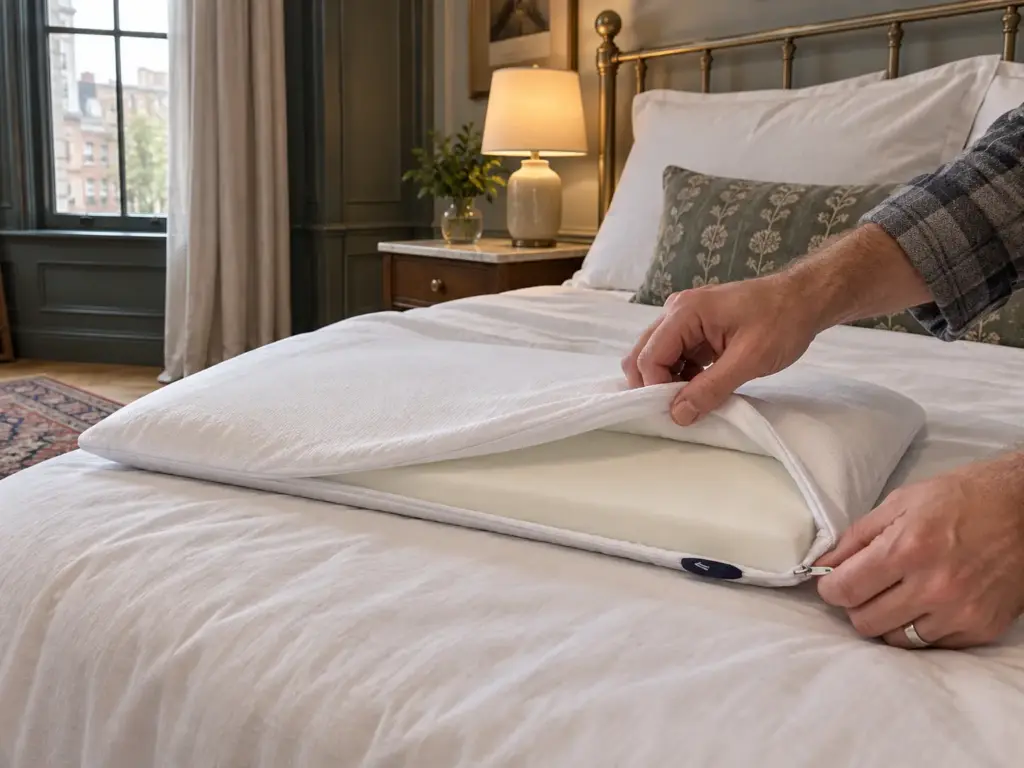
Picture both on the same afternoon. In one hand, a handful of shredded foam pulled out of a pillow you paid for. In the other, a 2.75-inch slab that feels like nothing. Each pick below says which side it is on and what goes wrong with it.
Adjustable: You Build the Height by the Handful
The Coop Home Goods Original Adjustable Pillow is the adjustable example, and the extra fill it ships with is exactly the point. The fill is cross-cut shredded memory foam mixed with microfiber, in a 20 by 30 inch queen size, and it arrives with an extra bag beyond what the pillow holds. A stomach sleeper takes most of it out, not adds more in. Mattress Clarity and Sleepopolis both note that face-down sleepers have to remove a large share of the fill on adjustable pillows like this one to reach a usable height.
The Coop fits a towel number near 3 inches, where you remove a moderate amount and keep a pillow with some substance to it. It also suits anyone whose number moves through the year, with a topper in winter or a partner who changes the bed, because fill can go back in.
It has two catches. The odor is the big one: thousands of Amazon reviews (3.7K at the time of writing) mention a smell out of the box, so plan on airing it out before the first night. At a low target, too, you are storing most of what you paid for.
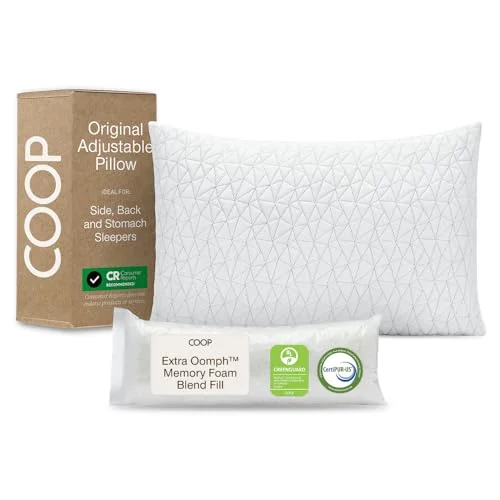
If your number is well under 3 inches, skip the adjustable pillow and go straight to the slabs below. You would be paying for a pillow and then emptying most of it into a bag.
Thin Foam: You Buy the Height
The thin pillow named most often for face-down sleeping is the Belly Sleep, a 2.5-inch gel memory foam slab, and it is currently unavailable on Amazon. The three below are the same class of pillow: one-piece foam, sold at a fixed height, nothing to remove.
Where the adjustable pillow asks you to build, these ask you to choose well once. That is why the towel number matters more here. A slab cannot be thinned, and it will not grow.
The Bluewave Bedding Ultra Slim Gel Memory Foam Pillow is the most useful of the three for one reason: it is sold in five heights, 1.75, 2.25, 2.75, 3.25 and 4 inches, so you can pick by your measured number instead of by a word. The standard size is 25 by 16 inches, the foam is a high-density, gel-infused memory foam at 3.25 pounds per cubic foot, and the zip-off cover is 60 percent polyester and 40 percent viscose, machine washable. The core is hand wash only, and that rule is not optional.
Its reviews show the sum at work. Among 128 negative comments about thickness, some buyers found it “too thin” and said it “feels like no pillow at all,” while another found the 2.75 “still seems too thick for stomach sleeping.” Same pillow, different beds and heads, which is the argument for measuring first. Several reviewers also mention an odor that lingered after unboxing.
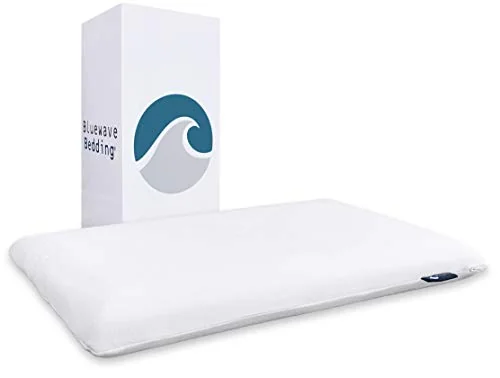
If your number lands between the Bluewave’s heights, go down a size rather than up. A slab that is a quarter inch low can be raised with a folded pillowcase under it; one that is a quarter inch tall cannot be lowered at all.
The BLISSBURY Stomach Sleeper Pillow is a 2.6-inch slab of CertiPUR-US certified memory foam with a cool-to-touch side, under a cover of 65 percent polyester and 35 percent rayon. It came up by name from an r/Bedding commenter looking for a flat pillow, and its listing prints the cover blend and the no-softener care line, which is more than most thin pillows tell you about the layer under your cheek. Put the cool side up, where the face goes.
It is not the cheaper of the slabs, and some reviewers say it does not earn the difference. One reviewer on the Bluewave’s page found the BLISSBURY “the softest” of the thin pillows but said it “didn’t offer much support,” which on a slab this thin is worth knowing before it is the only layer under your head.

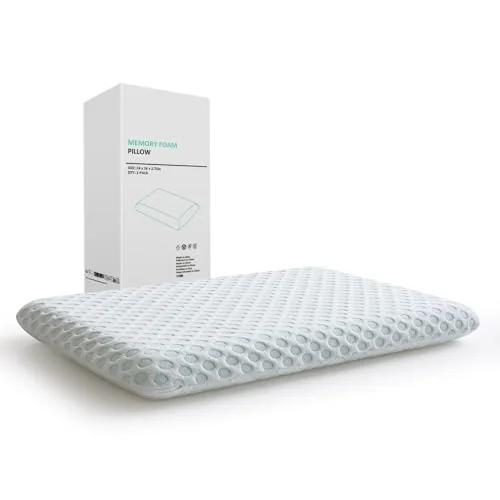
The Hcore Ultra Thin Pillow is the budget slab: 2.75 inches of memory foam with a gel side, two-sided so the cooler face goes up against the cheek and the plain face goes down. Reviewers compare it favorably with thin pillows that cost noticeably more, and if your towel number sits right around 2.75, it does the same job as the Bluewave at that height for less. The weakness is consistency: the review summary calls the thickness mixed, with some buyers wishing for more height on one side, so measure it pressed the day it has fully recovered from the box.
What the Thin Ones Are Made Of, and the Honest Gap at Month Three
All three slabs are memory foam, a polyurethane foam that softens with warmth and recovers slowly once the weight lifts. That slow recovery is why a thin slab feels like it molds to the cheek, and why the first minute on it feels softer than the tenth. Density is the number that says most about how a foam holds its shape, and of the three only the Bluewave prints it: 3.25 pounds per cubic foot is a figure most listings leave out, and density is the first thing to ask about when a slab has to hold the same height for a long time.
What none of the three has is a report from month three. There is no account, from reviewers or anywhere else read for this article, of what any of these slabs measures after months of nights and cover washes. So you will be the one keeping that record, and the method already exists in a lab. Read the sleep trial and the warranty terms before you thin or cut anything, so you know what the seller will still take back.
Consumer Reports’ pillow durability test loads a pillow with 225 pounds spread evenly across it, at 98.6 degrees Fahrenheit and 80 percent humidity, for 96 hours. Then, in its own words: “We measure the thickness and firmness of the pillow after we take it out of the chamber and again after hand-fluffing it.” The gap between those two readings is the part of the height that comes back, and the gap between the hand-fluffed reading and the original is the part that never comes back.
The home version needs no chamber. Measure your pillow pressed the week you buy it, the way you measured the towel. Measure it again after a few months, before and after a good fluff by hand. A foam slab that reads the same is holding up; a shredded or fiber pillow that only recovers after fluffing is telling you the fill is starting to tire, and how often to replace pillows, by fill and not by year picks up from there.
If you share the bed, run the check on both pillows, since they were bought for two different numbers and will age on two different schedules.
Start With a Towel, Then Decide Whether to Build or Buy
The number that decides a stomach sleeper’s pillow is the height left under the head once it has sunk, with the case on and the mattress counted in. The tag is where that number starts, and for a face-down head it is usually too tall.
Find that number for free before you spend anything. No pillow for a night, then a folded towel adjusted one fold at a time, then the pillow you already own, thinned. Whatever you land on, pressed and measured, is the figure you shop with.
Then choose how to get there. An adjustable pillow suits a number near 3 inches and a bed that changes; a thin foam slab suits a number well under it and a reader who wants the height fixed. Each pick above carries its weak point next to it, so you know what you are trading.
Once the pillow has been on the bed for a few months and the cover has been washed a few times, measure it pressed again, fluff it by hand, and measure once more: the height that comes back is the height you still own.
Tonight, take the pillow off, fold a bath towel to the count you guess is right, and sleep on it. In the morning, notice whether your face felt pushed up, or whether your head felt like it hung below your chest, and change the towel by one fold before the next night.
Frequently Asked Questions
01What is the best pillow for someone who sleeps on their stomach?
The best one is the thinnest pillow that keeps your nose clear and holds its height, about 3 inches or less once your head presses it down. That can be a thin foam slab or an adjustable pillow you thin by hand. The picks, sorted by which of the two they are, are in the last section.
02Should a stomach sleeper use a pillow at all?
Some stomach sleepers use no pillow, and a night without one is the first free test worth running. If your face sinks too low with nothing under it, a folded bath towel gives you a height you can raise one fold at a time until it feels right.
03Is memory foam or hybrid better for stomach sleepers?
Neither wins on fill alone, because height decides it first. A one-piece foam slab is bought at its height and stays there; shredded foam is built by hand and can clump; a foam-and-fiber blend sits in between. Pick the type that reaches your measured number.
04What type of pillow is best for side and tummy sleepers who share a bed?
Two different pillows, not one compromise, because a side sleeper has a much taller gap to fill than a stomach sleeper. Each sleeper measures their own height and buys for it. Matching cases keep the bed looking like one set.
05Can you take the fill out of an adjustable pillow?
Yes, that is the point of an adjustable pillow, and stomach sleepers usually remove fill, often a large share of it. Expect crumbs at setup, a smell to air out from new, and fill that can shift. Keep what you remove in a bag in case you went too far.





Tried it on your own bed?
No comments yet. Tell us what you changed, and what the sheet did after a few washes.