







What’s in here7 sections
You fold it in half, hold it, let go, and it just stays folded. Every article on how often to replace pillows tells you to run that test, and not one of them tells you what it measures or what a passing score looks like on your particular pillow. Here is the part nobody prints: a healthy latex pillow springs back in one to three seconds and a healthy memory foam pillow takes five to ten, so six seconds is a good result on one and a bad one on the other. Same fold, same hands, two different verdicts.
What follows is what that test is really reading, how long each fill had to begin with and why, the second clock running underneath the first one, what to do when the fill cannot be washed at all, and the point where a pillow stops being the thing worth adjusting.
Quick Answer
Every one to two years is the default, but the fill moves it and the fold test settles it.
- Start at one to two years, then adjust: polyester fails fastest, latex slowest.
- Fold it lengthwise, hold ten seconds, release. Still folded past fifteen seconds means done.
- Replace sooner for an uneven recovery, a permanent head dent, or a core you cannot wash.
What the Fold Test Actually Measures
The fold test is the one instruction every article on this subject gives and none of them explains, which is why it gets read as folklore. Fold the pillow in half lengthwise, hold it down for about ten seconds, and let go. What you are watching is not comfort and it is not cleanliness. It is fiber-level spring-back, and that is a material property with a number attached.
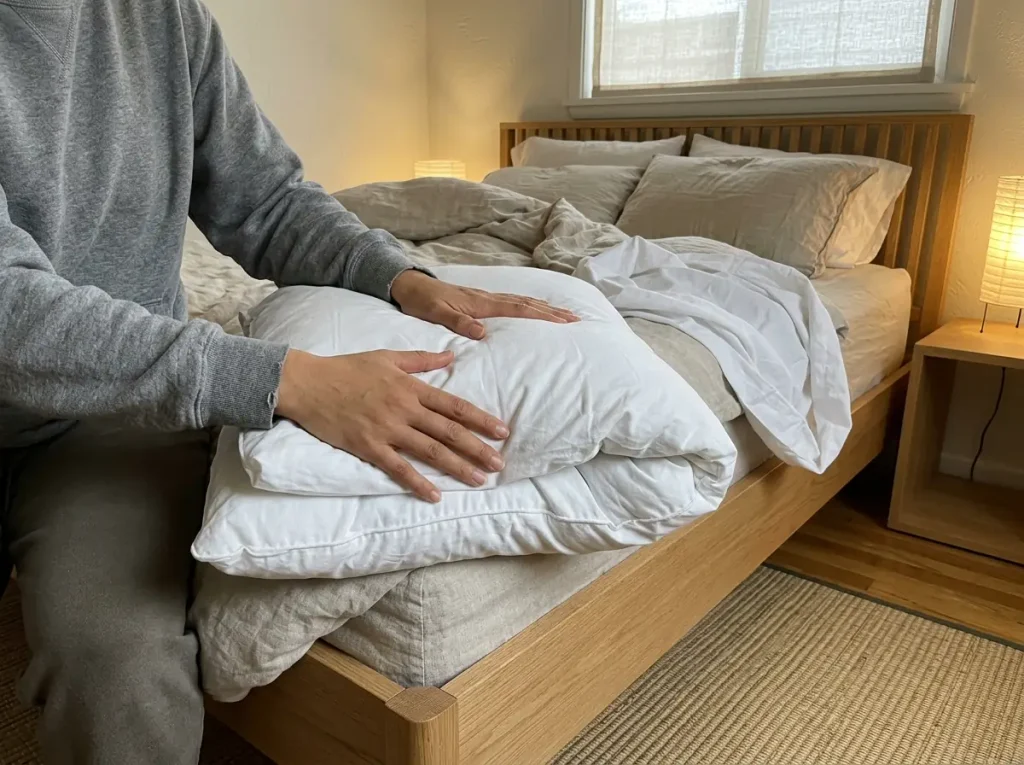
Healthy pillows do not all return at the same speed, and that is the detail the whole SERP leaves out. Latex comes back in one to three seconds. Down and feather take two to four. Synthetic fill runs three to six.
Memory foam is the slowest of the four at five to ten seconds, and the recovery times run from one to three seconds for latex up to ten for memory foam because of what each fill is made of, not because one of them is worn out.
A slow return on foam is that material behaving normally. Read it as a failure and you throw away a pillow with a year left in it.
So the real threshold is not a stopwatch reading per material. The signs you need a new pillow come down to two things, and both are easy to see. Anything that stays folded past roughly fifteen seconds is finished whatever is inside it. And anything that unfolds unevenly is finished too: a lump that rises on one side while a flat panel stays down on the other means the fill has migrated and stopped being one continuous structure.
That is the same shape of judgment as the same two-of-four rule that decides when a sheet is finished applied to fill instead of fabric, and it is more reliable than any calendar because it reads the actual pillow you own.
What the spring-back comes from is worth a sentence, because it explains why fills differ so much. Resilience — fill recovery, in plainer words — is a fiber’s ability to recover compressed volume, and it is measurable: wool recovers about 55.8 percent of its compressed volume in lab testing, more than nylon, silk or cotton, thanks to disulfide cross-links and a bilateral cortex that re-tensions like a coil spring (Hopkins, 1950, Textile Research Journal).
That property, and only that property, is what your hands are testing. Not how clean it is. Not whether it suits you.
Run the fold test in the morning, before the pillow has had all day to recover. A pillow tested at nine at night has been sitting empty for fourteen hours and will flatter itself. The one you want to judge is the one that just held a head for seven hours.
And the shoe test, the version where you fold the pillow over a shoe and see whether it flings the shoe off, fails on thin pillows for a boring physical reason. A flat stomach-sleeper pillow does not have enough loft for the shoe’s weight to compress anything, so it reads flat on a pillow that was designed to be flat. The test needs loft to have something to measure.
One expert in the allergy-clinic coverage of this question calls the shoe variant meaningless for thin pillows and nobody follows up on why. That is why.
How Long Each Fill Actually Lasts
The fold test tells you about the pillow you own tonight. The fill type tells you roughly how much life it had to begin with, and that is where pillow lifespan gets strange: ask how long do pillows last and the published numbers refuse to agree — two reputable sources will give the same material a two-year life and a fifteen-year life. Neither is lying. One is timing “still comfortable” and the other is timing “structurally intact”, and until somebody says which, the ranges look like noise.

Stated with their spread rather than as single numbers, they run like this. Synthetic and polyester fill: six months to two years. Memory foam: two to three years, three to four for high-density.
Down and feather: one to three years, with premium goose down cited a good deal higher by some sources. Natural latex: three to four years at the conservative end, with far longer figures quoted for solid Dunlop.
The spread inside each row is construction, not brand, in the same way construction decides the number, not the brand on the package on the sheet side of the bed.
Polyester dies first, and the mechanism is specific. Its crimp is heat-set during manufacturing rather than held by an internal restoring force, so under repeated compression it goes through viscoelastic creep: fiber-to-fiber slippage that starts on the very first compression cycle, part of which never recovers. That is why fluffing does not fix a flat synthetic pillow. The flattening is one-way.
The first night you sleep on a new polyester pillow already costs it loft it will not get back, which is why a cheap one feels different after a week and never returns to how it felt in the packaging. Week one is not the baseline. Week two is.
Foam and down fail on completely different terms, and the difference decides what you do next. Memory foam fails through cell-wall rupture and polymer chain scission, both chemically irreversible, so a permanent head dent is the material telling you it is done and no amount of airing changes that.
Down fails through cluster fragmentation and oil saturation, and on a lumpy pillow a proper wash with a low-heat tumble dry genuinely reverses the clumping. It does not un-break the barbules. Down is the one fill with a real repair story before replacement; foam has none.
Latex sits at the far end of that spread because its open-cell structure resists the compression creep that finishes polyester, and it is the fill that comes back fastest under your hands. If you want an anchor for what the long end of the range looks like in practice, a shredded fill like the Natural Latex Shredded Foam Pillow is 100 percent natural latex with that open-cell structure doing the work, and shredded rather than solid so it can be redistributed by hand. Its flaw is honest and worth knowing before you commit: the shredded fill can feel lumpy at first until it settles, and a latex pillow is noticeably heavier than a fiber one to move around or to strip.
Now the number that looks wrong. The same down lasts ten to twenty years in a comforter and one to three in a pillow, on identical raw material.
The gap is not the fiber, it is the duty cycle. A pillow takes a head’s full weight every night against a small area, gets washed several times more often over its life, and is packed into a fraction of the air volume a comforter’s baffle box gives the same down to loft in. Same material, much harder job.
The Second Clock Nobody Separates
Everything so far has been structural, and a pillow can be structurally fine and still be overdue. A second clock started running the day it came out of the packaging, and folding it will never tell you anything about that one.
It starts early and it is measurable. Rains et al. (1999, Clinical and Experimental Allergy) tracked Der p 1 on new synthetic and feather pillows across twelve months, and the synthetic ones reached roughly 19 µg/g, above the 10 µg/g mark associated with asthma symptom exacerbation. Jung and Lee (2004) detected allergen on new pillows inside three months.
Three months. The pillow in that study still passed every structural test you could give it.
It climbs fastest on synthetic fill, which is the same fill that loses the structural race first, so cheap polyester is the one case where both clocks agree and the decision is easy. Everything else is a split verdict.
Then there is the famous number, and this blog is not going to repeat it as a statistic. The claim that ten percent of a pillow’s weight is dead dust mites and droppings after two years traces back to Ohio State Extension materials rather than to peer-reviewed primary research, and the Asthma and Allergy Foundation of America’s two-year recommendation sits on a page that gives no citation for the weight figure at all. A dust mite researcher at Ohio State told Live Science in 2011 that there is no scientific answer to the parallel mattress version of the claim.
Directionally real, yes. A measurement, no. The two-year recommendation stands on its own; the percentage is folklore wearing a lab coat.
What this means at the bed is simple enough. A pillow that passes the fold test at eighteen months can still be due, because structural wear and hygiene load are not the same measurement and the two clocks need two different answers. The structural one is answered by replacing. The hygiene one is answered mostly by what sits between your head and the fill, which is the layer people quietly skip because it does not show at checkout, right up until the yellowing shows instead.
The practical reason to keep the two clocks apart is this: a wash resets the hygiene clock and does nothing at all to the structural one. Washing a pillow buys you something real, and what it buys is never more time on the fill. It is the same split as microfiber runs the same split between structural years and comfort months, where the thing lasts long after it stopped being good.
Write the month on the care tag in laundry marker the day you open a new pillow. Not the year, the month. Every argument about whether a pillow is two years old or four is an argument nobody can win, and a pillow is the one item on the bed with no purchase memory attached to it.
When the Fill Cannot Be Washed at All
“Wash it every few months” is the standard advice for slowing that hygiene clock, and for a large share of the pillows people actually own it is not advice. It is a description of how to ruin the pillow.
The line is hard and it runs through the middle of the market: memory foam and latex pillows should never go in the washer or dryer. Both materials absorb water and give it up slowly, which is a mildew problem rather than an inconvenience, and dryer heat attacks the structure that provides the support in the first place. There is usually no care instruction anywhere on the pillow that says this plainly, which is how a reader ends up standing in front of a machine with a foam pillow in their hands and no idea that the machine was never an option.
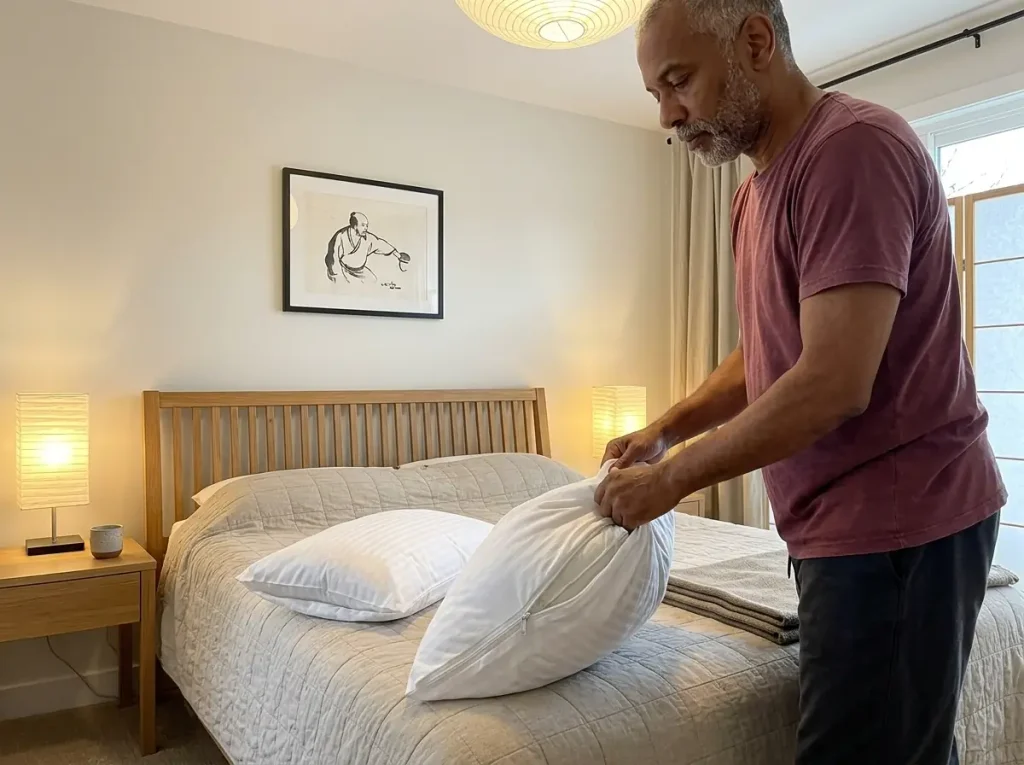
What replaces it costs nothing, and it comes before any purchase. The removable cover comes off and goes in the wash on its normal cadence. The core gets vacuumed with the upholstery attachment, and you spot clean where it needs it. Then it air-dries completely, and completely means longer than you think.
In practice, washing a foam pillow means washing about a tenth of it.
The other camp is genuinely washable. Cotton, polyester, feather and down pillows generally take a machine, care tag permitting: a gentle cycle in warm water with an extra rinse, then a low-heat tumble dry with a couple of tennis balls for down, then air dry the rest of the way so nothing stays damp in the middle. That cycle follows the wash order and temperature that actually strip body oils, because oil saturation is half of what finishes a down pillow.
A washable option like the Canadian Down & Feather Co. Soft Support Microfiber Down Alternative Pillow states its spec where most “hypoallergenic” listings do not, with a microfiber down-alternative fill in a 260 thread count cotton shell and OEKO-TEX Standard 100 certification. Its flaw ties straight back to the ranges above: microfiber down-alternative loses loft faster than latex across repeated washes, so being washable and being long-lived are not the same virtue, and this one buys you the first at the cost of some of the second.
For the fills you cannot launder, the hygiene clock can only be slowed from outside, which promotes the barrier layer from optional to structural. A protector like the FAUNNA 600TC 100% Cotton Pillow Protector is 100 percent cotton at 600 thread count with OEKO-TEX certification, and it states both numbers where most protector listings state neither. Its flaw, in writing: the zipper is noticeable under the pillowcase if that sort of detail bothers you, and a four-pack means buying more than you need if you are only protecting one or two pillows. What it buys is a washable layer standing in for a fill that can never be washed, which is the whole argument.
It is also the layer people quietly skip, because it sits next to the pillowcase at checkout and does not show — until the discoloration does, and by then the sweat and oils that caused it have been in the fill for a year.
A foam core that feels dry on the outside is not dry. Press the middle with the heel of your hand and hold for a few seconds. If it comes away even slightly cool, it is still holding water in the center, and that is the pillow that develops a faint damp-cupboard odor a week later. Give it another full day flat on a rack, not folded over a chair.
The gate changes the replacement date, and this is the part that is worth carrying away. When you cannot reset the hygiene clock from the inside, the replacement decision arrives sooner than the structural clock alone would suggest. A latex pillow that will hold its shape for four years may still be one you want to retire earlier, not because the latex gave out but because nothing ever washed it.
Where This Stops Being a Pillow Question
Everything above is about an object, and an object can be settled by looking at it. There is a line past which the pillow is simply the wrong thing to be adjusting, and it is worth naming plainly, because most articles on this subject imply the swap is the fix.

Here is a fact that reframes the whole replacement question for an allergy household. The AAAAI/ACAAI 2013 Joint Task Force practice parameter on dust mite control does not recommend buying a new pillow. It recommends an allergen-impermeable encasing, given a weekly hot water wash at 130 degrees Fahrenheit or above.
Encasement cuts Der p 1 exposure by roughly 90 to 99 percent, and Murray et al. (2017), a randomized trial in 284 mite-sensitized children with asthma, found a 45 percent drop in emergency visits over twelve months in the encasement group.
That protocol works on a pillow of any age. The guideline is about the bed, not about the calendar.
And the boundary, in one sentence: this article can settle the fold test, the fill and the wash, and it stops there. Whether what a sleeper is feeling comes from the bed is not a bedding question. Anything persistent is a conversation with a doctor rather than a purchase, and that is true no matter what the pillow scores when you fold it. The same distinction runs through the rest of this site, where structural failure and cosmetic failure are not the same verdict: what an object can explain about itself has an edge, and past that edge you need somebody qualified rather than a better guess.
The Short Version
Deciding when to replace pillows starts with the fold test, run tonight and read against your fill. Fifteen seconds still folded, or an uneven recovery with a lump on one side, is the verdict. A fixed number of seconds is not.
Treat the published year-ranges as a starting point rather than a replacement threshold you can set a calendar by. Polyester at the fast end and latex at the slow end are four times apart for reasons you can now name, and what actually decides the number is the fill and how hard it gets worked.
If the fill cannot be washed, the barrier layer stops being optional. It is the only lever you have on the second clock, and that clock does not care how well the pillow folds.
One thing about wash counts, because this blog usually judges bedding at wash twenty. A washable pillow gets four to eight washes in its entire life at a three-to-six-month cadence. There is no twentieth wash to wait for. The wash count that matters is the one it never reaches, and if a pillow is coming out of its fourth wash still lumpy, that is the fill telling you exactly what the fold test would have.
So: fold the one you slept on last night. Count the seconds out loud. Then read the care tag before you make any plans about washing anything.
Frequently Asked Questions
01When should you throw out pillows?
Throw it out when it stays folded past about fifteen seconds, recovers unevenly, or holds a permanent dent. Age alone is the weaker signal. A two-year-old latex pillow can be fine and a one-year-old polyester one finished.
02What is the 2-2-1 pillow rule and how does it work?
It is a memory aid, not a standard: replace pillows every two years, protectors every two years, pillowcases weekly. Treat the pillow figure as a default your fill type moves in either direction, fast for polyester and slow for latex.
03How often does the average person replace their pillows?
Roughly every three to five years in practice, which is well past when most fills stop supporting. Pillows fail gradually and never look broken the way a torn sheet does, so the replacement usually waits for a bad night rather than a check.
04When should you throw out down pillows?
Down is the one fill with a repair step to try first: a proper wash and low-heat tumble dry reverses clumping. If it comes out of that still flat, the barbules are broken and no wash undoes that.
05Can you wash a memory foam pillow to make it last longer?
No. Foam and latex cores should never go in a washer or dryer; they hold water, dry slowly and risk mildew. Wash the removable cover, vacuum and spot-clean the core, and let it air-dry completely before it goes back on the bed.





Tried it on your own bed?
No comments yet. Tell us what you changed, and what the sheet did after a few washes.