







What’s in here7 sections
“Medium loft” is printed on box after box of pillows, and it is an adjective dressed up as a measurement. You lie down on the new pillow, it feels fine for a minute, and then you notice your chin has drifted toward your chest, or your head has dropped back far enough that your chin points at the ceiling. For back sleepers the head already rests on the mattress, so there is no shoulder to clear: the pillow only has to fill the small gap between the back of the skull and the bed, and anything taller pushes the chin forward while anything flatter lets the head fall back. This article picks a back-sleeper pillow by that one gap, then walks through the free fixes that come before any purchase, what each fill is still doing at month three, what the box hides, and what changes when you share the bed with a side sleeper (stomach sleepers, side sleepers and combination sleepers are covered in the pillow-by-sleep-position guide).
Quick Answer
Back sleepers need a low-to-medium loft: the head already rests on the mattress, with no shoulder gap to fill. The 4 to 5 inches printed on many boxes is a starting point; the real number is the gap behind your head on your own mattress. Measure it, try the free fixes, then pick a fill that holds that height.
The Gap Behind Your Head Is the Whole Measurement
A height printed on a pillow is a fact about the pillow: at rest, in the box, with nothing on it. The height you need is a fact about you and the mattress under you. Those are two separate numbers, and they only meet once you lie down and the fill starts giving way under the weight of a head.
Pull them apart and most of the confusion around “medium loft” goes away. The reader who bought a medium pillow and still wakes with the chin tucked did not buy the wrong word. They bought a number that was measured on a table, for a bed and a head that are not theirs.
What “Loft” Actually Measures
Loft is the height of a pillow as it lies flat, uncompressed. That is how Consumer Reports’ pillow tests define it, and it is the number a maker prints. On the shelf, pillow loft comes in labels: “standard loft” usually means somewhere around 4 to 5 inches and “high loft” 6 to 7, while “low loft” is the label with the loosest definition, so a low loft pillow from one maker can stand taller than a standard one from another. The height that matters on the bed is a different one: what is left of that loft once a head has been on it for a few minutes and the fill has stopped moving.
Every fill gives up a different share. A solid foam slab sinks slowly and stays sunk until you lift your head. Shredded foam moves sideways, away from the center, so the middle thins while the edges rise.
Down and polyester fiber compress the most, because most of their volume is air trapped between clusters or crimped fibers, and a head pushes that air out. So the spec worth reading is the loft. Or rather, the loft minus whatever the fill surrenders under a head, which no box prints and no listing measures.
The target itself is easier to describe than the pillow. Consumer Reports puts the right loft at the point where your neck sits in a neutral position, and for a back sleeper that means a neutral spine: the neck in line with the spine and the shoulders in line with the hips. Seen from the side, the chin is neither tucked toward the chest nor lifted toward the ceiling.
That level position is what people mean by neck alignment, and a pillow that misses it shows up as head tilt: chin to chest on the tall side, nose to the ceiling on the flat side. The forehead and the chin sit at roughly the same height above the mattress.
That gives you a way to read the failure, too. A pillow that is too tall for your gap shows up as the chin pressed forward, and you feel the pillow pushing the back of your head up rather than holding it. A pillow that is too flat lets the head roll back, and you find yourself sliding a hand under it during the night.
Reviewers of the Tempur-Cloud describe both ends on the same product: one “needed a little more loft,” another says it “goes extremely flat.” Same pillow, different gaps.
Firmness is the other half of the spec, and it decides how much of the printed loft survives. Consumer Reports suggests back sleepers start with medium-loft, medium-firm pillows, and the pairing matters more than either word alone. A tall, soft pillow and a short, firm one can end up at the same height under a head, because the soft one gives up more of itself.
So when you compare two pillows, compare them loaded: press each one with a flat hand, about as hard as a resting head, and look at what is left. That pressed height is closer to what your neck will meet than anything on the label.
Why the Mattress Is Part of the Sum
Consumer Reports makes the point plainly: the position you sleep in and the mattress firmness (how soft your bed is) both decide how thick or firm the pillow should be. The second half of that sentence gets skipped, and it changes the answer more than the pillow does.
On your back, most of your weight goes into the mattress through the upper back, the shoulder blades and the hips. Mattress sink is what changes the sum: a soft mattress lets the shoulder blades sink deeper than the head does, because the head is lighter and it rests on a pillow that spreads its load. So the shoulders drop, the pillow stays roughly where it was, and the same pillow now reads taller relative to the rest of you. On a firm mattress the shoulders stay near the surface and the identical pillow reads lower.
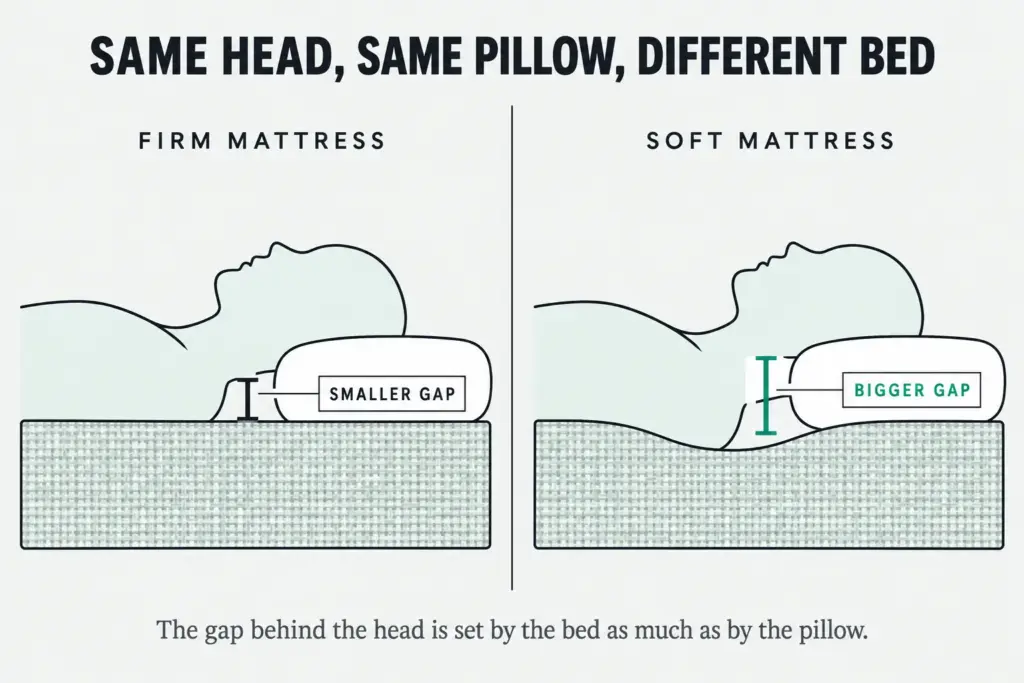
This is why the common advice to buy a medium-loft pillow works for some back sleepers and fails others with the same build. The advice assumes an average mattress. Put the reader on a plush pillow-top, or add a thick topper to a firm bed, and the shoulders sink further, the gap shrinks, and the medium pillow is now a tall pillow. The better call on a soft bed is a lower pillow than the box suggests, and the only way to know how much lower is to measure on that bed.
It also explains why a pillow that felt right somewhere else disappoints at home. A showroom mattress, a hotel bed, a guest room, a friend’s couch: each one sets its own sum. One Tempur-Cloud reviewer puts it as a warning to other buyers, to “use it on a medium firm mattress, not a firm one.”
That reviewer is describing the mattress, not the pillow. And it means a pillow tried anywhere but on your own bed tells you very little.
The same logic applies over time. A mattress that has started to dip in the middle, or a topper added for the winter, changes the gap without anyone touching the pillow. If the pillow that suited you last year now feels wrong, check what changed underneath it before you blame the fill.
The Home Test, Without a Ruler
No published figure can replace this test, because no published figure knows your mattress. It takes ten minutes, costs nothing, and uses things already in the house. Do it on the bed you sleep on, with the topper and the mattress protector in place, because each one moves the sum.
- Take every pillow off the bed and lie on your back in your normal position, arms at your sides.
- Have someone look at you from the side, at mattress level, or prop a phone on the nightstand and record a short video.
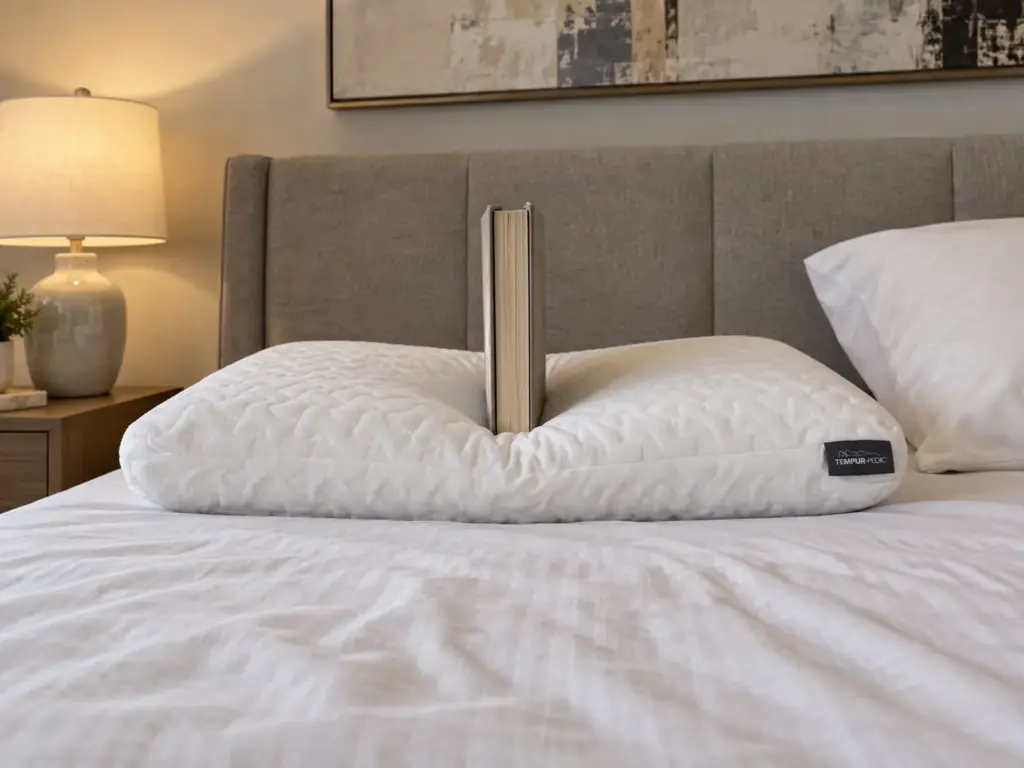
- Slide a folded towel or a hardcover book under the back of your head. Add folds or a second book until your chin and forehead sit level, with the chin neither tucked nor lifted.
- Stay there for two or three minutes and check again, because you will have relaxed and sunk a little.
- Get up carefully and look at the stack. That stack, compressed under your head, is your target.
- Now lie on your current pillow and repeat the side view. If your chin lands higher than it did on the stack, the pillow is too tall for you; if it lands lower, it is too flat.
No ruler needed. The stack is the measurement, and you can carry it to any pillow and compare by lying down. If you want a number to shop with, measure the stack while you press it gently with a flat hand, which is closer to what a head does than the stack standing loose.
Expect the answer to be lower than you thought. Most back sleepers who run this test have spent years on a pillow chosen for a different position, and the height that feels normal is just the height they are used to. Trust the side view over the feel.
Record the home test on your phone instead of judging it by feel. Prop the phone on the nightstand at mattress height, lens level with your ear, and film ten seconds on the stack and ten seconds on your pillow. The angle of the chin is obvious on a screen, and it is the one thing you cannot judge while lying down.
The Case for a Slab That Cannot Be Adjusted
Pillows you can open are the safer default for most back sleepers. A one-piece slab is the exception, and it earns its place in one specific case: a small gap and a mattress that is medium-firm rather than soft. That back sleeper needs a pillow that sinks to a low, even height and stays there all night, without fill drifting to the edges or bunching under the neck.
A slab does that because there is nothing inside it to move. The foam compresses where the head is and recovers when the head lifts. What it cannot do is change its height for you.
There is no zipper, no fill to remove, no way to trim it. You either measured right or you bought the wrong pillow, which is why the home test comes first.
Contour pillows, the ones sold as cervical pillows, are slabs with a built-in height difference: a lower flat side and a higher arched side. For a back sleeper the flat side is the one that matters, and it is judged the same way, by the stack. The word cervical on a box names a shape, not a treatment.
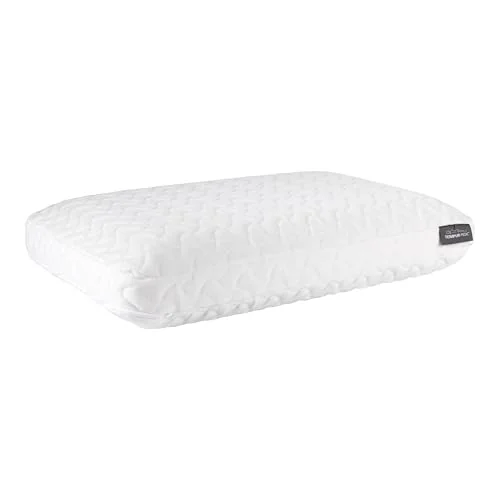
The TEMPUR-Cloud from Tempur-Pedic is this kind of pillow: a single piece of Tempur Material, listed at 5 inches and an extra-soft feel, under a removable polyester knit cover. On a head it settles lower than the listed height, and for a back sleeper with a small gap that settling is the reason to choose it. Reviewers describe the other side of the same behavior.
It “goes extremely flat” under some heads, so a bigger gap will not be filled. The slick knit cover gives a pillowcase nothing to grip, and one reviewer says “no pillow case will remain in place.” And the mattress warning above applies here more than anywhere, because a slab has no adjustment to compensate for the bed.
If the slab is a stretch for the budget, the cheaper flat pillow in the fill section below does a similar job with a different weakness. And if your home test landed anywhere near the middle of what a slab can do, an adjustable pillow is the safer bet.
Three Free Fixes Before You Buy Anything
If the home test says your pillow is off by a little, the cheapest answer is to change what sits under your head, not to shop. Each of the three fixes below costs nothing, and they come in the order you should try them: the pillow you already own first, then where it sits, then a substitute from the closet.

This is for the reader with a fourth pillow in the cart. The three already on the bed were each bought to fix the one before it, and none of them was ever measured against the gap. Before the fourth arrives, one of these may settle the question.
Take Out Half the Fill
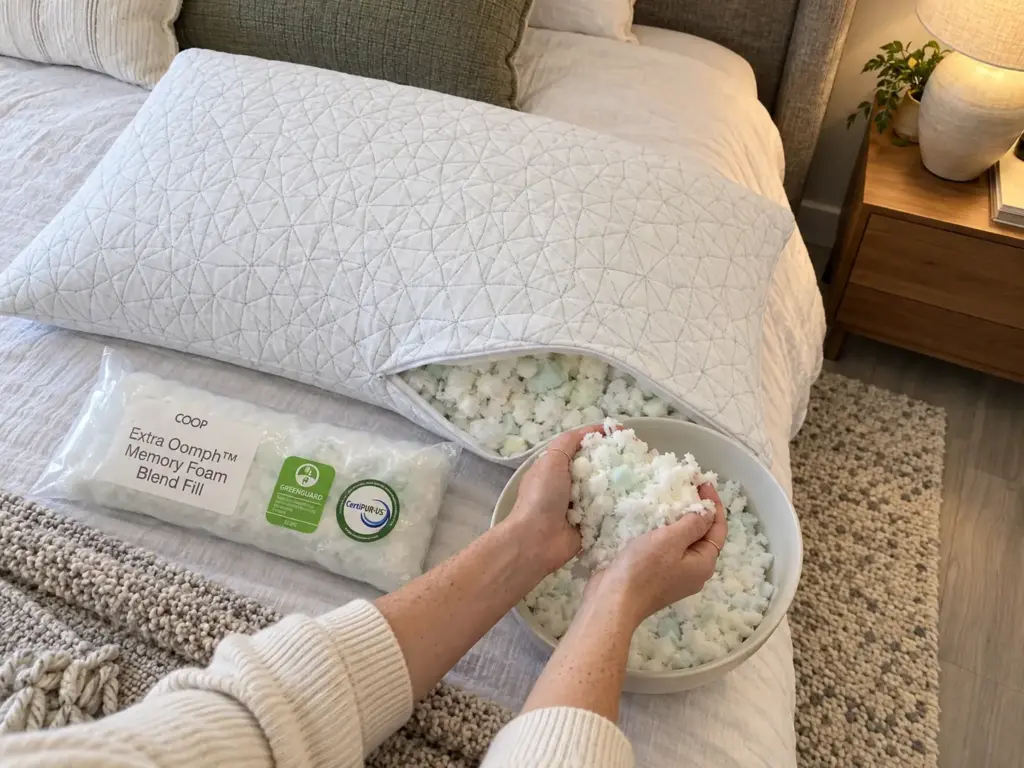
If you own an adjustable pillow, the one with a zipper and loose fill inside, you probably have not opened it. Most people don’t. According to Consumer Reports’ own testing notes, “Back sleepers may want to remove about half of the filling.”
Side sleepers, by the same advice, take out about a quarter. That difference tells you who these pillows are filled for when they leave the factory: someone with a shoulder to clear.
So an adjustable pillow judged straight out of the box is judged at the wrong height for your position. It is also judged at the wrong density, because it arrives compressed. Reviewers of the Coop Original describe theirs arriving “incredibly flat and soft” and needing a spin in the dryer on low heat, or a full day out of the plastic, before the fill opens up. Judge it before that and you are judging packing, not a pillow.
Take out half, as the testers suggest. Better still, take out a third first, sleep on it for two nights, then decide whether to remove more. The half figure is a starting point for an average back sleeper on an average bed, and you already know from the home test that your bed has its own opinion. Going in stages costs you two nights; going straight to half and overshooting means stuffing fill back through a zipper.
A few practical notes for the job itself:
- Open the pillow over a spare sheet or inside an empty bathtub, because shredded foam goes everywhere and clings to whatever it touches.
- Keep every bit you take out in a zip bag or a spare pillowcase tied shut. You will want it later, when the remaining fill settles.
- After each change, fluff the pillow hard and lie on it for a few minutes before running the side-view check again.
- Write the amount you removed on a piece of tape on the zip bag, so a second adjustment months from now starts from a known point.
Reviewers warn that pulling out the shreds is messy, and they are right (the sheet you work over will need shaking outside). That is a ten-minute nuisance against a new purchase.
Pull the Pillow Up and Keep It to One
The second fix is about where the pillow sits, and Consumer Reports is blunt on it: never sleep with your shoulders on the pillow. Shoulders off the pillow, on your back, means pulling the bottom edge of the pillow out from under your shoulders so it supports the head and the curve of the neck, nothing below. The same testers recommend a single pillow at night.
Both rules come back to the sum. When the lower edge of a pillow creeps under the shoulders, it lifts the upper back along with the head, and the pillow now props your whole top half at an angle instead of filling the gap behind your skull. Stack a second pillow on top and the sum doubles: two heights that were each chosen without your gap in mind, now added together.
The reason pillows creep is simple. You shift during the night, the pillow slides with your head, and by morning its edge is under your shoulder blades. A pillow pushed right up against the headboard has nowhere to slide. If your bed has no headboard, the wall does the same job.
When you make the bed, push the sleeping pillow flat against the headboard and put any decorative pillows on a chair, not on the bed. If they stay on the bed, they end up under your head by the end of the night, and you are back to a stack of two without having decided it.
A Rolled Sweatshirt Beats a Towel
The third fix comes from people who gave up on pillows altogether. In a r/BuyItForLife thread, a back sleeper asked for a pillow that keeps the neck neutral, and the reply that stuck was not a pillow at all. It was a rolled sweatshirt, a homemade neck roll, tucked at the base of the skull.
The poster had tried towels before and they never worked for them; the sweatshirt “works just right.” Another reply in the same thread describes a soft pillow with a rolled-up towel at the bottom edge to support the neck, which that commenter says a physical therapist had suggested. And the line that frames the whole thread is the original poster’s complaint that “all the shredded foam pillows and formed stuff didn’t work.”
The towel roll is the trick most people try first. The thread does not say why it failed for that poster, so here is the likely reason, offered as a guess and not a finding: terry cloth is a loose loop pile, and a rolled towel can compact into a flat oval under the weight of a head. A sweatshirt rolled tight is a denser knit and plausibly holds its diameter better, though all the poster reports is that it worked.
The roll does a different job from a pillow, too. It sits in the curve behind the neck, at the base of the skull, and fills the part of the gap a flat pillow leaves open. For a back sleeper whose home test showed a pillow that is fine at the head and empty at the neck, a roll can finish the job without buying anything.
To make it stay put, roll the sweatshirt tightly from the hem, sleeves tucked inside, and slip it into the bottom edge of the pillowcase under your usual pillow, or into a pillowcase of its own. Loose on the sheet, it ends up somewhere else by morning.
When Changing the Pillow Changes Nothing
Sometimes the fill comes out, the pillow moves up, the roll goes in, and the side view still looks wrong. At that point look at the mattress. Consumer Reports names mattress softness as part of the pillow decision, and a bed that has gone soft, or sagged in the middle where you sleep, changes the sum more than any pillow can correct.
A simple check: run the home test once on the bed and once on a rug on the floor. If the stack you need on the floor is very different from the stack on the bed, the mattress is doing most of the work, and the pillow is not where to spend money.
And one thing is outside the bedding altogether. Neck pain that has not eased after several weeks of changing what is under your head belongs with a doctor, not with a different pillow; Mayo Clinic’s own list of when to call a professional is short and worth reading. Everything else in this article stays with the bed.
What Each Fill Is Still Doing at Month Three
Week one lies about a pillow the same way it lies about a sheet. Every fill is at its fullest the week it arrives, and the loft you measured on day one is the most you will ever get from it. What decides a pillow is the month when the fill has had its weeks under a head and settled into whatever it is going to be.
A word on what is known and what is not. Consumer Reports says memory foam and latex hold height longer than polyester or down. Reviewers of these four pillows report what happened in the first days and, in a couple of cases, the first month or the first years.
None of those owner reports describes the third month on any of them. So what follows is what the fills do by construction and what the reports say up to where they stop, without inventing a month-three verdict that does not exist.
Down and Fiber: The Loft That Quietly Drops
According to Consumer Reports, memory foam and latex hold the right height without flattening as quickly over time as polyester or down. The reason is in the construction. A down or fiber pillow is mostly air, held in place by clusters or by crimped polyester fibers.
Each night a head pushes that air out and presses the fibers against each other, and each morning the pillow recovers a little less of it. The crimp that gives a fiber its spring relaxes; down clusters break and mat. The loss is gradual, which is the problem: the pillow drops a fraction at a time, and you adapt along with it.
The way most people notice is indirect. A fiber pillow that was right in January has become a different pillow by spring, and the usual response is to fold a second, older pillow under it. That makes the sum taller than it ever was and the neck angle worse than before, because two flattened pillows stacked together are rarely the height of one good one. If you find yourself folding pillows to reach a height, the home test will usually show you overshooting.
Fluffing helps for a night. Shaking the pillow, or a few minutes in a dryer on low with a couple of clean tennis balls, pushes air back between the fibers, but it does not restore the crimp. Expect the pillow to come back from fluffing a little lower each time.
Fiber comes under several names. Microdenier is a very fine polyester fiber made to feel like down, and kapok (a seed-pod fiber) and silk fill (mulberry silk floss) are plant and animal alternatives; all three tend to be light and to compress easily, so the same slow drop applies.
None of that makes fiber the wrong choice. A low, flat fiber pillow is the cheapest way to fill a small gap, and if the gap is small enough, the loss matters less because there is less loft to lose. The Canadian Down & Feather Co. Soft Support Microfiber Down Alternative Pillow is that kind of pillow: a polyester microfiber fill in a 260-thread-count cotton shell, made in a flatter “soft support” style, with the maker saying the microfiber washes better than down.
Treat its listing with care, though. One buyer measured theirs against the title and wrote, “Not sure how this pillow can be 2 in… I measure around 8 in,” and the page carries few enough ratings that one bad batch would show. So the adjective “flat” is the least reliable part of the listing. The fill weight printed on the page is the number to check, against the size, because more fill in the same shell means a taller, firmer pillow no matter what the title calls it.
Shredded Foam: Adjustable, Hot and Lumpy
Shredded memory foam solves the measurement problem and creates three smaller ones. The upside is that you can reach your gap exactly, by removing or adding fill. The downside is in the pieces.
Loose foam moves under a head, away from the center and into the corners, so over a night the middle thins and the edges rise. Over weeks the fill settles and compacts. The adjustment you made in week one drifts, and you knead the pillow back into shape or top it up from the spare fill.
Then there is the heat. Visco foam softens with warmth, which is what lets it shape itself to a head, and it holds that warmth. A four-star reviewer of the Coop Original says it “gets HOT” and that they flip the pillow “about 4 times a night” to reach the cool side. That is the most useful sentence in the reviews for a back sleeper, because a back sleeper’s head rests on the same spot all night, with the whole back of the skull in contact.
And then the smell. Odor is the complaint tagged most often on the Coop page, which fits what reviewers of foam and latex pillows call “airing out”: a stretch of days or weeks in which the pillow smells of the pillow. The smell fades with air, not with time sealed in a pillowcase, so the first week belongs on a chair by an open window.
With all that said, the Coop Home Goods Original Adjustable Pillow is the one pillow in this article that gets a back sleeper to a measured gap without buying twice. The fill is a cross-cut blend of 76 percent visco polyurethane foam and 24 percent polyester gel fiber, sold with an extra bag of it (reviewers call the shreds “the fluff”), inside a removable, machine washable zippered cover; the fill itself is spot clean only, per Consumer Reports. Take fill out as described above and stop when the side view says stop.
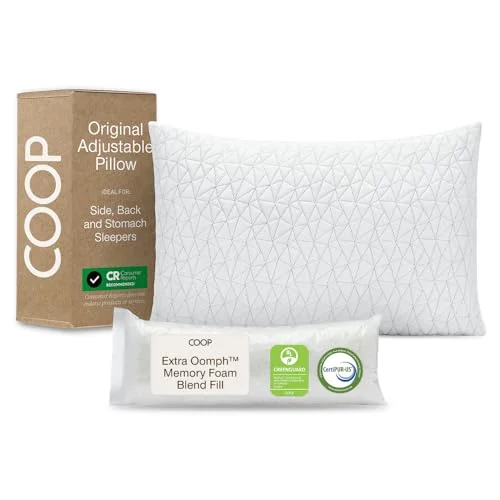
Keep the spare fill and the bag of shreds you removed. When the pillow settles, you will want to put some back rather than buy a new one.
Latex and Solid Foam: The Ones That Hold
Consumer Reports’ pillow-by-position guide ranks memory foam and latex as the fills that hold the right height longest. The two do it differently. Latex is rubber, and rubber is elastic: it pushes back against a head and returns to its shape the moment the head lifts, so there is no air to lose and no crimp to relax.
Talalay is one process for making latex foam, and it gives a lighter, more even block than other methods; shredded pillows use cut pieces of latex foam, so the pieces behave as fill rather than as a block. A solid foam slab recovers more slowly, but it has no pieces to migrate and no fibers to mat, so the height it sinks to on night one is close to the height it sinks to much later.
The reports that exist agree with the ranking, as far as they go. A reviewer of a shredded latex pillow says it held up with no loss of integrity after a bit over a month. A Tempur-Cloud reviewer, writing years in, still calls it a favorite.
Neither is a month-three report on a measured height, and it would be a stretch to read either one as such. What both say is that these fills do not show the early, gradual drop that a fiber pillow shows.
The trade is care. Consumer Reports notes that a slab pillow’s cover goes in the washer but its core is spot-cleaned only, and shredded fills are spot-cleaned too. So a solid foam or latex pillow cannot be washed back to life, and a stain on the core stays with it (here is what to do with a stain on foam or latex).
The wash never fixes loft on any fill, though. It cleans a cover; the height is decided by what the fill does under a head.
The Fold Test, for When the Pillow Is Two Years Old
Consumer Reports gives most pillows about two years, which is where the usual advice to replace every two years comes from. The check it suggests is a fold: bend the pillow in half (in thirds for a king) and let go. If it springs back open, the fill still has its recovery. If it stays folded, or opens slowly and halfway, the loft you measured on the first night is gone.
The fold works best on fiber and down, the fills it was made for. On the other fills, read the pillow differently:
- Shredded foam or latex: feel for clumps and for a thin middle. Knead it, add fill from the spare bag, and rerun the side view before deciding anything.
- Solid foam: it will not fold well even when new. Look for a head-shaped dent that is still there several minutes after you get up.
- Down and fiber: the fold is the test, and a pillow that fails it is not coming back with fluffing.
Whatever the fill, rerun the home test at the same time. The stack you need may have changed too, if the mattress has softened or a topper has been added. For the full schedule, see how often to replace a pillow, by fill. And once you have chosen, a pillow protector on the pillow you choose keeps the core out of the wash, which matters most on the fills that cannot go in it.
Write the month and year on the pillow’s care tag with a laundry marker the day it comes out of the box, and on an adjustable pillow add how much fill you removed. Two years from now the purchase date will be long forgotten, and the fold test means more when you know its age.
The Label Taken Apart: Cooling, Memory Foam, Adjustable
Three words on the box do most of the selling, and none of them is a spec. They work the way a thread count works on a sheet: a real property in there somewhere, and enough room around it for two very different products to wear the same word.

The reader this section is for bought the “cooling” foam pillow and flips it four times a night anyway. The pillow did what its construction says it would. The label described something else.
“Memory Foam” Can Mean Shredded Foam and Fiber
The Coop Original is sold as a memory foam pillow. Its fill is a cross-cut blend: about three-quarters visco polyurethane foam, about a quarter polyester fiber, in loose pieces that move by hand. The Tempur-Cloud is also sold as memory foam, and it is a single slab of foam with nothing loose inside it. Same two words, opposite behavior on a bed.
For a back sleeper the difference decides almost everything. The shredded one changes height when you open it and drifts as the night goes on. The slab holds one height and never changes it.
The shredded one can be tuned to your gap; the slab has to match it from the factory. One is heavy and slow to shape, the other shifts under your hand.
So when a listing says memory foam, look for the next word. “Shredded,” “cross-cut,” “blend” or a fiber percentage means loose pieces. “Solid,” “one-piece” or “molded” means a slab. And the percentage of fiber in a blend matters: the more fiber, the softer and lighter it is, and the more it behaves like the fiber pillows above as the months go by.
“Adjustable” Means a Zipper and a Bag of Fill
On a pillow, “adjustable” means one thing: the cover has a zipper and you can take fill out. Reviewers describe the reality in plain terms, a zipper and a bag of shreds, and they add that it is “messy to pull out the shreds.” Nothing about the pillow adjusts itself. Some brands sell the fill in removable inserts, small zipped pouches inside the cover, so each pouch comes out whole instead of as loose shreds.
It also means adjustable in one direction, at first. A new adjustable pillow arrives full, so the adjustment available is down. Going up again is possible only with the fill you kept or the spare bag in the box, which is why throwing the removed fill away is the most common mistake with these pillows.
And the adjustment is not a one-time job. Shredded fill settles, so a pillow tuned to your gap in the first week will need a handful put back some months later.
That is still a better deal than it sounds. A back sleeper who measures a gap and buys a fixed pillow gets one try. With an adjustable one, the first try is free to correct.
“Cooling” Is a Cover, Not a Fill
On a foam pillow, “cooling” almost always describes the outside: a cover knit from a synthetic that feels cool to the touch, or a gel layer or gel-infused fiber near the surface. A cooling cover, a gel foam top layer or a bamboo cover (viscose, in most cases) all work at the surface. Under them the fill is still foam, and foam holds the heat of a head against itself.
The cool feel in the store is the cover drawing warmth from your hand for a few seconds. Lie on it for an hour and the foam has caught up. The Tempur-Cloud, to its credit, is not marketed as cooling at all.
The memory foam pick is the obvious one for back sleepers, and Consumer Reports lists it among the fills to start with. For a hot sleeper it stops being obvious. A back sleeper presses the whole back of the skull into one spot for hours, and a fill that stores heat is the wrong fill for that.
Latex is the better call there, because it is made with an open-cell structure that lets air move through it, and shredded latex adds gaps between the pieces. It also holds height longer than foam blends, which is the other half of this article.
“Breathable” belongs to the cover too: it describes how air passes through a weave or a knit, and it says nothing about the fill underneath. Before buying anything, though, change the pillowcase. A cotton percale case over a pillow with a polyester knit cover puts a woven, moisture-absorbing layer between your head and the synthetic, and it costs less than any pillow. If the heat is still there, the fill is the cause.
The Natural Latex Shredded Foam Pillow, King, Set of 2 is the open-cell option: shredded natural latex from Sri Lanka in a removable, machine-washable organic cotton cover, adjustable by zipper like the Coop, two pillows to the set. The reviews are honest about the shreds. A four-star reviewer says it “has foam pieces of many irregular sizes and is somewhat lumpy to sleep on.”
A three-star reviewer who has bought solid latex pillows for 30 years says the shredded one has “no latex bounce back,” which is what you trade for the ability to adjust it. And a one-star reviewer says the latex smell was still strong after three weeks of airing out. The longest owner report on it runs a bit over a month, with no loss.
A pillow is also one layer in a bed of layers. A solid foam pillow can undo the cooling work of everything else on the bed, which is why it is worth checking against the bedding set that keeps hot sleepers cool before blaming the sheets.
Air a new latex or foam pillow out of its plastic and out of its pillowcase, on a chair near an open window, for the first several days. A pillowcase slows the smell down without stopping it, and sleeping on it from night one means breathing the worst of it at close range.
One Bed, Two Sleepers, Two Heights
Everything so far assumes one head on one pillow. A back sleeper next to a side sleeper has two gaps in the same bed, and no single pillow height serves both. That is the case for pillows that do not match.

The couple this is for bought a matching pair, and one of them has been quietly folding theirs ever since. Neither pillow is wrong. Each was right for one of them, at best.
Two Gaps, Two Pillows
The gap a side sleeper fills runs from the side of the head down to the mattress, past the shoulder. That is the width of a shoulder, and it is a large gap. The gap a back sleeper fills runs from the back of the skull to the mattress, a few inches at most. Same bed, same mattress, and the two measurements are not in the same range.
This is reasoning rather than a reported finding: no tester or owner report covers the shared bed directly. But it follows from everything above. A pillow tall enough for the side sleeper pushes the back sleeper’s chin forward.
A pillow low enough for the back sleeper lets the side sleeper’s head drop toward the mattress. Any height in between is wrong for both, in opposite directions.
So each of you runs the home test, separately, on your own side of the bed. The mattress is shared but it rarely sinks evenly, and a heavier partner on a softer mattress may need a lower pillow than the numbers suggest.
The same split can live inside one person, the combination sleeper. Plenty of back sleepers fall asleep on the back and wake on a side, and the pillow that suits the first position is too low for the second. Run the home test twice in that case, once on your back and once on your side, and you get two stacks.
An adjustable pillow can be set between them, slightly taller than the back-sleeper stack, and a shredded fill helps here because you can push it toward the edge you roll onto. It is a compromise, but a compromise inside one head is a smaller one than a compromise between two people, since you are the only one who has to live with it.
Two sleepers who both sleep on their backs are not exempt either. Two back sleepers on the same mattress can still need different heights, because a broader frame sinks the shoulders further and a heavier sleeper presses the mattress deeper. The test is the only way to know whether one pillow height will serve you both.
Why a Matching Pair Is the Wrong Gift
Pillows come in pairs on the shelf and in sets online, and the pair looks right on a made bed. But a matching pair of fixed pillows gives two different gaps the same height, which settles the question for one sleeper and not the other.
The logical answer is one adjustable pillow per person. Each of you opens your own and takes out a different amount: the back sleeper takes out a lot, the side sleeper a little or none. The latex set of two from the label section works this way, two pillows that look identical on the bed and end up holding different amounts of fill. The pair matches in looks, not in what is inside.
Heat adds a second reason. Foam holds the warmth of a head, and the Coop reviewers flipping their pillows through the night are describing one person and one pillow. Two foam pillows side by side do the same, twice, in a bed that is already warmer for having two people in it. If one of you runs hot, that person’s pillow is the place for latex, and the other can stay on foam.
Once two identical adjustable pillows are tuned to two different heights, mark them. A stitch of colored thread on the zipper pull or initials on the care tag stops them swapping places after every laundry day, which undoes the whole adjustment without anyone noticing.
When One Pillow Ages Faster Than the Other
Two pillows bought on the same day do not wear at the same rate. Each carries one head, in one position, for every night of its life, and a side sleeper’s head presses deeper into a smaller area than a back sleeper’s does. A year on, the pair that started identical can feel like two different pillows on the same bed.
So the fold test runs on each pillow separately, and the replacement can be one pillow, not the pair. Buying two because one has failed throws away the one that still springs back. The same goes for cleaning: if one pillow has yellowed and the other has not, look at the point where a worn pillow stops being worth washing for that pillow alone.
The bed is the shared object here, and the only thing worth agreeing on. How each of you sleeps on it is your own business, and so is your pillow.
Measure the Gap, Then Make the Fill Prove It
Three things change how a back sleeper picks a pillow:
- Measure the gap behind your head on your own mattress. The stack of books or towels that levels your chin is the target, and the mattress is part of it.
- Try the free fixes first. Take fill out of the adjustable pillow you already own, pull the pillow up to the headboard and keep it to one, and try a rolled sweatshirt before a towel.
- Choose the fill by what it will still be doing months from now. Latex and solid foam hold height; shredded foam can be tuned but drifts and runs warm; down and fiber lose loft gradually and quietly.
Around the two-year mark, fold your pillow in half and let go: if it springs back, the height you measured is still there, and if it stays folded, the pillow has become a different, lower one, whatever it looks like on the made bed.
Tonight, pull your pillow up so its lower edge clears your shoulders and push it against the headboard, with nothing stacked under it. Tomorrow morning, before you get up, notice where your chin is: tucked, level or lifted. That one observation tells you whether the pillow needs fill out, a roll under the neck, or nothing at all.
Frequently Asked Questions
01What type of pillow is best for a back sleeper?
A low-to-medium loft pillow in latex, shredded foam, solid foam or down alternative, sized to the gap between the back of your head and your own mattress. Latex and solid foam hold that height longest; an adjustable pillow lets you reach it exactly.
02What are the best pillows for both back and side sleepers?
An adjustable pillow you can unzip and take fill out of, so one pillow can be set between the two heights you need. If two people share the bed, each needs their own pillow, adjusted to their own gap.
03How thick should a pillow be for a back sleeper?
As thick as the gap behind your head once you lie on your own mattress, measured with a stack of towels or books until your chin is level. The 4 to 5 inches printed on many boxes is a starting point, and soft mattresses usually need less.
04How do I know when my pillow has gone flat?
Fold it in half and let go: a pillow that springs back still has its loft, and one that stays folded has lost it. Consumer Reports gives most pillows about two years, and down and fiber flatten soonest.
05Are memory foam pillows too hot for back sleepers?
They can be, because foam holds the warmth of a head and a back sleeper rests on one spot all night. Latex, with its open-cell structure, sleeps cooler, and a cotton percale pillowcase over a synthetic cover helps either one.




Tried it on your own bed?
No comments yet. Tell us what you changed, and what the sheet did after a few washes.