







What’s in here7 sections
- What a Protector Stops and What Gets Through
- The Protector Goes Yellow Instead of the Pillow
- Cotton, Knit With a Membrane, or a Full Encasement — Which One Backfires
- By Pillow Core: Where a Protector Buys Months and Where It Doesn’t
- Layer Order, Timing and the Wash Ladder
- A Protector Buys Months, and Its Own Color Tells You How Many
- Frequently Asked Questions
You unzip the pillow protector to wash it for the first time in months, and the pillow underneath has a yellow patch anyway, right where your cheek rests. Someone in a Facebook group posted exactly that after pulling off a supermarket protector, and every reply was a brand name, as if a better label would have changed it.
The package says “protector,” sometimes “barrier,” and neither word tells you what actually gets past it. So, does a protector help? It does, but not the way the package implies: the yellow is skin oil that oxidizes in whatever fabric holds it, and a protector only decides which layer that will be. Below is what a protector stops, what slips through, which construction backfires, and how it moves the date you replace the pillow.
Quick Answer
Yes, partly. A protector catches sweat, skin oil and drool before they reach the pillow’s shell, so the yellow forms on a layer you wash hot every month. It does not stop yellowing: oil and vapor slip past open weaves and zippers, and the protector yellows itself. Put on a clean pillow, it delays replacement without canceling it.
What a Protector Stops and What Gets Through
“Barrier” is printed on nearly every protector listing, and not one of them says a barrier against what. Whether pillow protectors prevent yellowing depends on three things that try to reach a pillow every night (liquid, oil and vapor), and each one gets through by its own route. Sort them out and the label starts to mean something.
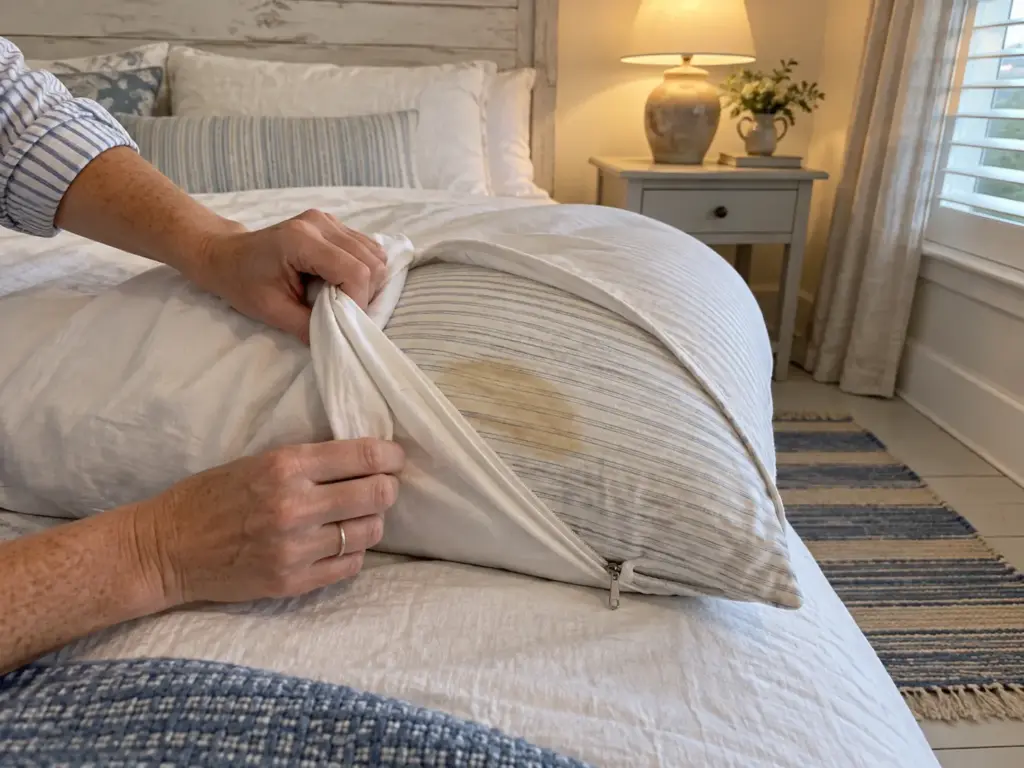
Start with the yellow itself, because it is not dirt. According to a sebum review in the NIH’s PubMed Central, “Squalene present in sebum was also found to be responsible for creating yellow stains on fabrics.” Squalene is one of the oils your skin makes, and it changes color slowly as it meets air and warmth. The oil is there from the first night, and the color arrives later, in whichever fabric held it.
Liquid and oil: what the fabric face and the membrane stop
A plain woven cotton protector does not hold liquid for long, because cotton wicks it straight in. What it does well is slow oil. A tight weave gives the oil less open space to move through, and that tightness has a number: Consumer Reports’ pillow protector explainer says to look for a pore size of no more than 6 microns on a tight woven protector.
Casper quotes 3 to 4 microns for its own. A knit, or any loose weave that prints no pore size at all, is a pillowcase with a zipper.
The second kind adds a TPU membrane (thermoplastic polyurethane, a thin film laminated to the back of the fabric). A sealed film stops spilled water, drool and most of the oil, because there are no gaps in it to wick through. But the 6-micron rule stops meaning anything here. On a protector with a membrane, the pore size of the face fabric is beside the point, and the film decides everything.
That Facebook post is the plain case of the first kind. A thin supermarket protector, no membrane and no stated weave, went on a pillow, and the oil walked through it at the speed of a pillowcase. It was never sealed in the first place.
Vapor, which most of them let through
Most of what you sweat into a pillow leaves you as vapor, not as drops. Cotton lets that vapor straight through. A TPU membrane lets it through slowly, by design, which is why listings call it “breathable.” Its breathability is the rain-jacket kind, not the percale kind.
The figure that would settle it is the film’s vapor transmission rate, measured in grams per square meter per day, and no pillow protector listing prints it.
Vapor carries almost no oil, so it is not what yellows the pillow. What it decides is how clammy a sealed protector feels on a warm night, which is the complaint the reviews keep coming back to.
The zipper line and the open end, where it still arrives
Even a good membrane has edges. An envelope-style protector leaves one end open, and your head spends a fair part of the night near that end, so oil reaches the pillow shell around the barrier instead of through it. A zipper is better, but the zipper tape is fabric, not film, and the stitching along it can leave a line of needle holes that no laminate covers.
So the oil finds the edges. When you strip a protected pillow, the first sign of trouble is rarely in the middle of the face. It is a pale oval or a faint line at the zipper end, along the seam, where the barrier stopped and the pillow shell began.
When the protector comes off, look at the pillow’s zipper end and seams before you look at its face. A tint there and a clean middle means the oil went around the protector, not through it: turn the zipper end away from your face, or move to a fully zipped one. A tint in the middle means the fabric itself is too open.
The Protector Goes Yellow Instead of the Pillow
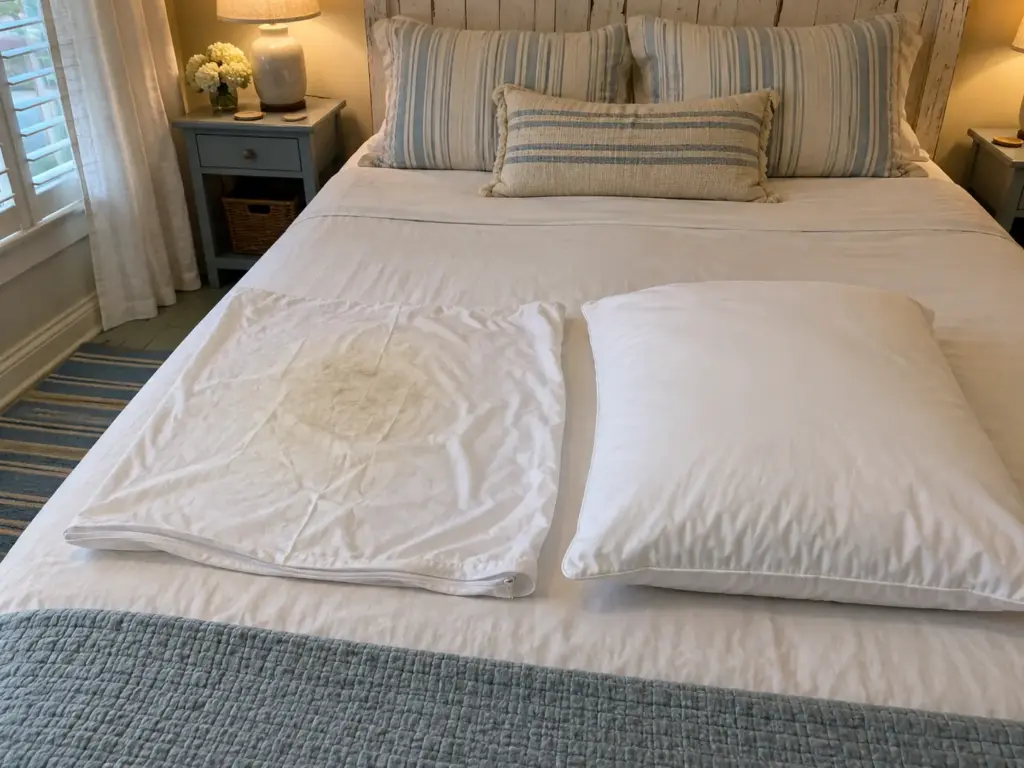
The protector does not get rid of the yellow. It receives it, and that is the whole benefit. You trade a pillow you can wash twice a year for a thin layer you can wash hot every month, and the oil goes where the hot water can reach it.
Why the oil yellows whatever it lands in
Skin oils, saliva, wet hair and lotion all end up in whatever fabric sits against your face. Skin oil does not care which fabric it soaks into. If the pillow shell holds it, the shell turns; if a cotton protector holds it, the protector turns, on the same slow schedule.
One post in a Facebook group says it plainly: “some of my cotton pillow protectors have gone yellow.” The yellowing did not fail to happen. It moved.
That changes how to read a cream-colored protector. The instinct is to call it a failure and buy a different brand. A protector that comes out of the wash a faint cream where your head lay, over a pillow that is still white, has done exactly its job. The one that failed is the protector that stays bright while the pillow under it goes yellow.
The same sebum review ties the smell to the same source: the fatty acids and triglycerides in skin oil are what give old fabric its stale odor. A protector you wash hot carries both the color and the smell out of the bed. And because the protector yellows on the same schedule the pillow would, its color tells you what the pillow underneath would look like by now without it.
What the wash does to a yellow protector (and what a hot wash cannot undo)
The best wash-months report on this comes from a commenter in r/LifeProTips: a protector under a 400-thread-count cotton pillowcase, the case washed hot with oxygen bleach every two to three weeks, the zippered cover about every three months, and “no discoloration at all” so far. The same commenter had used a low-count pillowcase before, and the pillows turned “nasty in no time.” The difference was not the protector alone. It was a dense outer case that slowed the oil, plus a hot wash that kept taking it away.
For a protector that has already gone cream, the replies in that Facebook thread agreed on the order: soak it in an oxygen booster, wash it hot, then dry it in the sun. That works on recent yellow. Oil that has sat in the fiber for many months oxidizes further and comes out only in part, and a tint that survives two of those washes is usually there to stay. Washing can even make it look worse, for reasons covered in why a pillow can come out of the wash yellower than it went in, and the same chemistry applies to the protector.
That is the real case for the cheap layer. A protector that stays cream costs you a protector, not a pillow. If the pillow underneath has caught some yellow anyway, getting it out depends on what is inside the pillow, and down, fiberfill and foam each take a different wash.
Protectors usually come in packs of two or four, so rotate them. One goes on the pillow the same day the other goes in the wash, which means the monthly wash never leaves the pillow bare for a night, and the drying time stops being a reason to skip it.
Cotton, Knit With a Membrane, or a Full Encasement — Which One Backfires
If the protector’s job is to catch oil and then be washed, what it is made of decides whether it does that job or just makes the pillow hotter, louder and puffier. There are three main constructions, and each fails in its own way. Before any of them, though, there is one layer you probably already own.
The free layer first: a second pillowcase underneath
The cheapest protector is a second pillowcase. Commenters in r/BuyItForLife describe it as a “double pillow-case”: an old or thrift-store case as the base layer, with the good one on top. The inner case catches the oil that gets past the outer one, and it costs nothing.
The same thread adds a refinement worth copying: two protectors under the pillowcase, washed on different rhythms, the outer one weekly with the pillowcase and the inner one every three to four weeks. One commenter put the fiber choice simply: “You want cotton if you sweat.”
A second cotton case is really a protector without a zipper. It loses at the open end, like any envelope, but it takes the hottest wash you have, is machine-washable without fuss, and dries fast.
Cotton woven with a zipper — the one that gets washed hot
For yellowing, the usual reach for a waterproof protector is the wrong first move. What gets the yellow out is a hot wash, an oxygen booster and a full dryer cycle, and plain cotton takes all three without complaint. Cotton with a zipper is the double pillowcase with the open end closed.
The FAUNNA 600TC 100% Cotton Pillow Protector is that construction: a cotton face, an invisible zipper, OEKO-TEX certification and a standard 20 x 26 inch size, sold as a four-pack. Read the 600 as “dense,” not “fine.” A count that high on cotton almost always means plied yarns counted more than once, and a dense weave is exactly what slows oil. (OEKO-TEX, for its part, certifies that the fabric was tested for harmful substances; it says nothing about what passes through.)
The maker claims it stays white past 50 washes, which is a promise, not a test. Buyers do report that it shrinks a little in the wash and fits tightly on standard queen foam pillows, so measure your pillow before you order, and judge the fit after the first hot wash, not straight out of the bag.
Knit with a TPU laminate — stops liquid, holds air
This is the construction most people picture when they hear “protector,” and the complaints about it are consistent. The original poster in an r/LifeProTips thread said waterproof ones “cause the pillows to hold air like a balloon (and then become vacuum sealed after you squeeze it all out), get too hot, and make noise.” Over in r/BuyItForLife, the verdict was that they “tend to be loud and uncomfortable to lay on.” A pillow that balloons under a sealed cover, crinkly every time you turn, is the one you keep punching flat all night.
The Guardmax Jersey Knitted Pillow Protector is an honest example of that trade: a polyester knit jersey face laminated to TPU, with a nylon zipper, in a four-pack. It stops liquid, which is its real job. One Amazon reviewer who liked it overall still wrote that it does not breathe, “or breath so slowly it’s the same as not breathable,” and that it balloons when you lie down; the customer summary is split on how waterproof it really is and on the zipper. The same reviewer’s workaround is worth taking: buy the queen size for a standard pillow, so the trapped air has somewhere to go.
Whether that film is the right call depends on how warm you sleep, and a hot sleeper should lean toward cotton. What a backing does to heat is covered in why some mattress protector backings trap night sweats, and the same logic applies on a smaller scale under your head. Bedding changes how fast sweat dries, not how much you sweat, and sweating that does not track with the bed is a question for a doctor.
The membrane also wears. Consumer Reports notes that repeated washing degrades a protector’s permeability, which is one reason the protector runs on its own clock, separate from the pillow’s.
The full encasement — seals the whole pillow
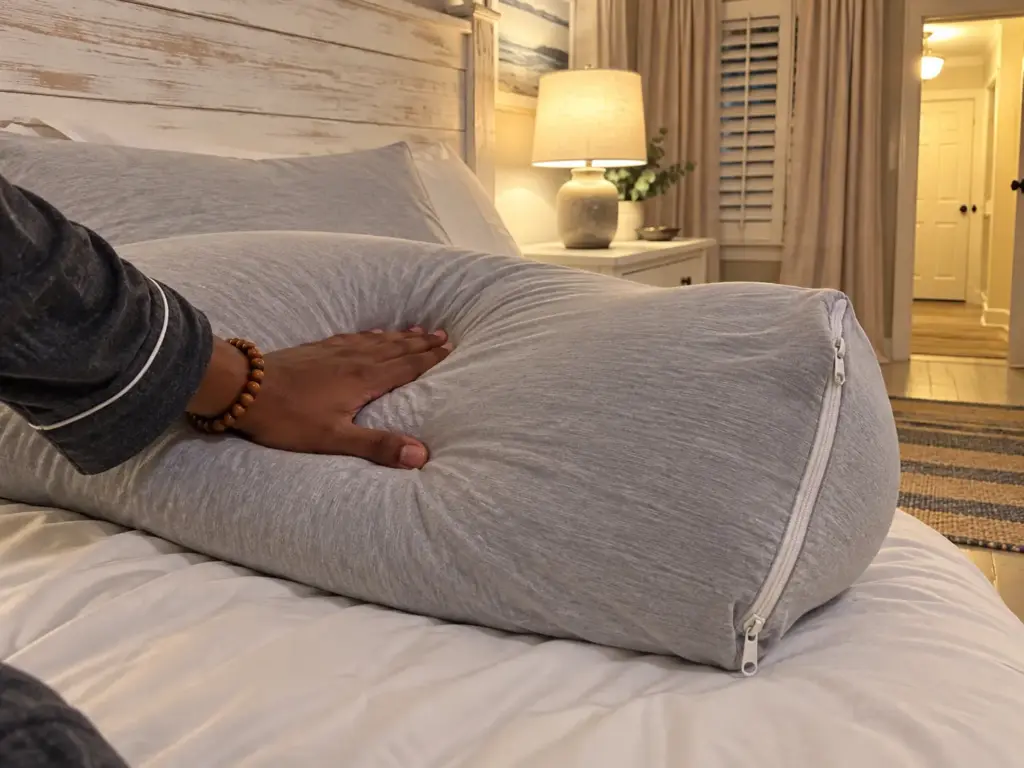
An encasement zips around all six sides, so there is no open end for oil to find. The HOSPITOLOGY Pillow Encasement Sleep Defense System pairs a polyester knit face with what it calls a “breathable waterproof membrane,” closed by a side zipper that lies flat, and it suits memory foam pillows that hold their shape; buyers have mixed opinions about airtightness, which in practice means air trapped inside the pillow.
Here are the three side by side.
| Construction | What it stops | What it lets through or costs you | Who it suits |
|---|---|---|---|
| Woven cotton, zippered (FAUNNA) | Slows oil with a dense weave | Liquid and vapor pass; shrinks a little in the wash | Anyone fighting yellow who sweats or runs warm |
| Knit with TPU laminate (Guardmax) | Liquid, drool and most oil | Vapor passes slowly; balloons, rustles, sleeps warmer | Spills, kids, cool sleepers |
| Full encasement (HOSPITOLOGY) | Liquid and oil on all six sides | Traps air inside the pillow | Memory foam pillows that keep their shape |
Read a protector listing for the material of the film, not the word “waterproof.” TPU or polyurethane passes some vapor; vinyl or PVC passes none, and under your head that means a damp pillow by morning. If the listing names neither and prints no pore size, it is a fabric case with a zipper, and you should treat it as one.
By Pillow Core: Where a Protector Buys Months and Where It Doesn’t
The same protector does very different work on different pillows, because part of the yellowing is the pillow’s own aging and has nothing to do with you. Sort pillows by what is inside and the verdict splits in two.
Down, feather and fiberfill — the shell takes the oil, a protector helps
On a shell-and-fill pillow, the yellow you see is mostly the cotton or polyester shell (the ticking) holding your oil, with the fill underneath slowly soiling as oil and moisture work through. That is exactly what a protector intercepts. Keep the oil off the shell and the fill stays cleaner, which pushes the pillow toward the long end of its life rather than the short one. How long that is depends on the fill, and how often to replace pillows by what’s inside them gives the pillow lifespan for each.
Consumer Reports, drawing on the Asthma and Allergy Foundation of America, gives a rule of thumb of replacing pillows every two years or sooner, and says a certified protector may extend that. Note the word “may.” A protector buys months, not years you can count in advance, and the only honest measure is the pillow itself at its next wash, every six months or so. If the shell comes out of the wash still white, the protector earned its keep that round.
Foam yellows from its own aging (photo-oxidation), and a protector cannot stop that
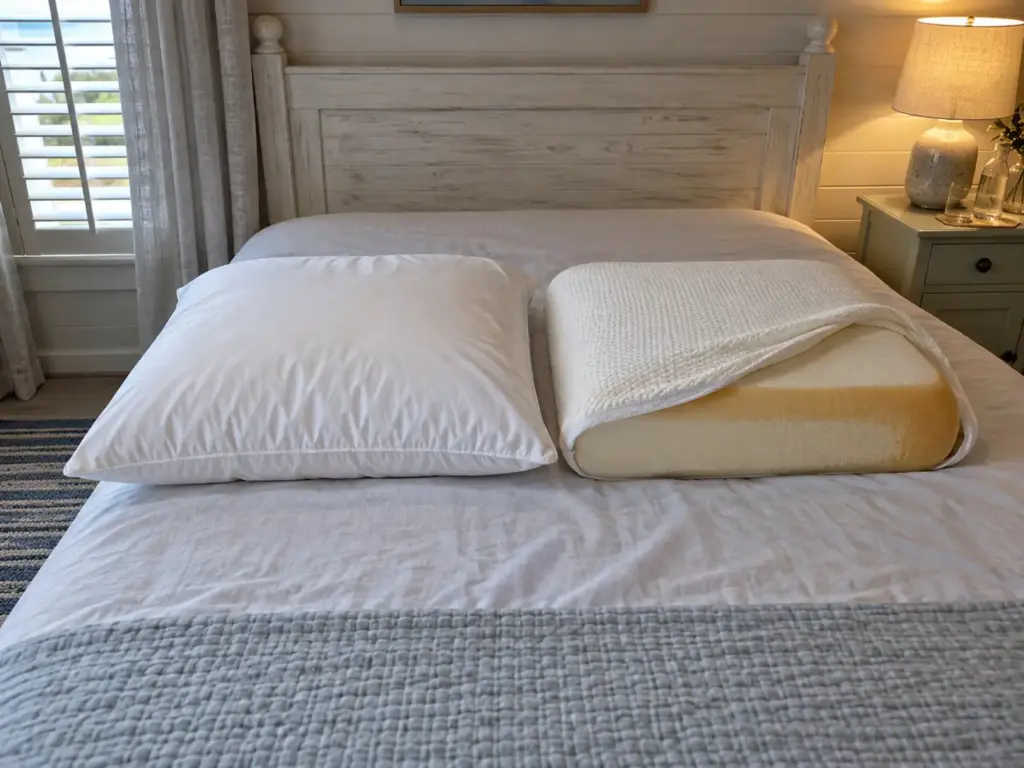
Picture a memory foam pillow under a spotless protector, turning amber at the edges anyway. That is not your oil. Polyurethane foam yellows on its own through photo-oxidation, as light, oxygen and heat break down the polymer, and a mattress retailer’s explainer on the process adds that sweat and skin oil speed it up.
A protector can slow the part you add. It cannot touch the part the foam does by itself.
So judge a foam pillow somewhere else. Skip the face under the case and look at the cut edges and the underside, where the foam meets air and light. If the color is creeping in from the edges evenly, it is the foam aging, and no protector or wash will reverse it. If it sits in a patch where your head rests, that is the part a protector would have caught.
A pillow that is already yellow inside — what a protector does not fix
A protector zipped over a yellow pillow hides it, and that is all it does. The oil already in the shell and fill keeps oxidizing under the cover, and the smell keeps building. Starting a protector on that pillow just puts a clean layer over an old problem.
The better call is to decide first whether the pillow is worth saving. When to give up on a yellow pillow covers that point, including how to start over with a protector once you replace it. Then the protector goes on the new pillow on day one.
Write the month on the care label of the pillow and of its protector with a laundry marker the day they go into use. Two years from now you will know whether the pillow is old or just dirty, and whether it is the protector’s membrane that needs replacing, not the pillow.
Layer Order, Timing and the Wash Ladder
Since the whole benefit is a transfer onto a washable layer, the order the layers go on and how often each one is washed decide whether the transfer happens. Get those two right and the protector you already own does most of the work.
Put it on while the pillow is still clean
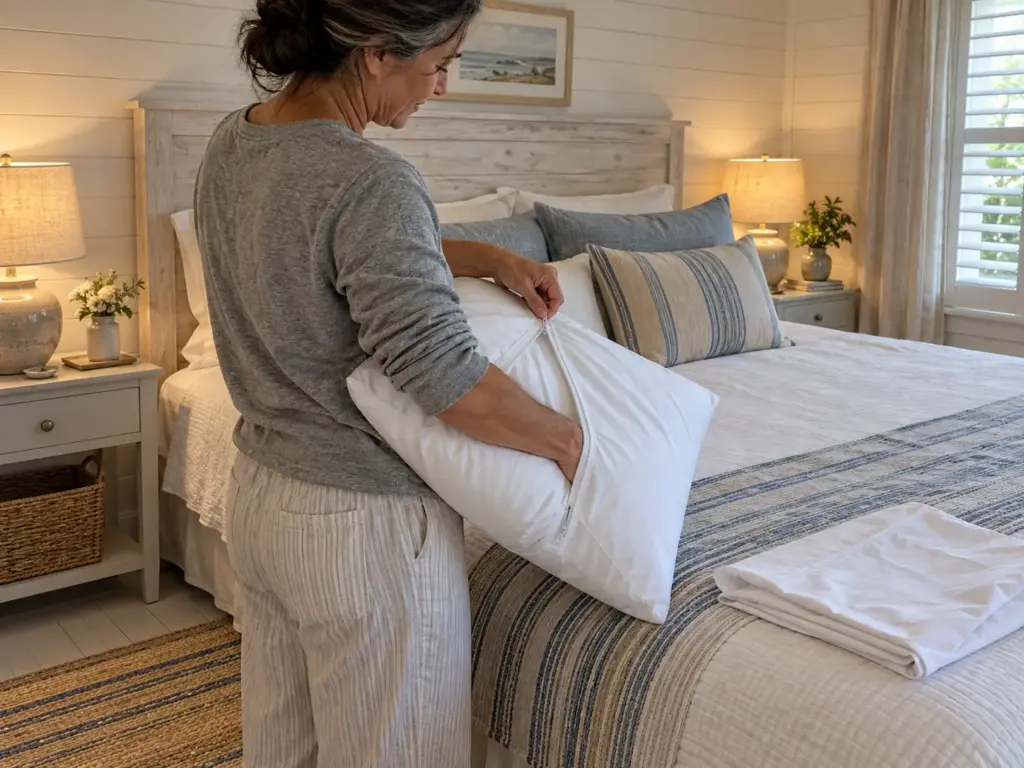
The order is pillow, then protector, then pillowcase, as Vision Linens lays it out. Turn the zipper end of the protector toward the foot of the bed, away from your face, since that end is where oil gets around the barrier. On a new pillow, the protector goes on the same day the plastic comes off. On a used pillow, it goes on after the pillow has been washed and dried all the way through, never over a yellow one.
That timing is most of the answer. Every month a pillow spends uncovered is a month of oil already in the shell, and no protector you add later will draw it back out. If you want the full picture of why pillows turn yellow and which ones come clean, the pillar on yellowing covers the whole sequence.
The ladder: pillowcase weekly, protector monthly, pillow twice a year
Casper, Down & Feather Co. and Vision Linens all print the same cadence, and it works as a ladder, one layer per rung. The pillowcase gets washed weekly with your sheets, the protector monthly in a hot wash, and the pillow itself twice a year, following its care label. Each rung catches what the one above it missed, and the less often a layer can be washed, the deeper it sits.
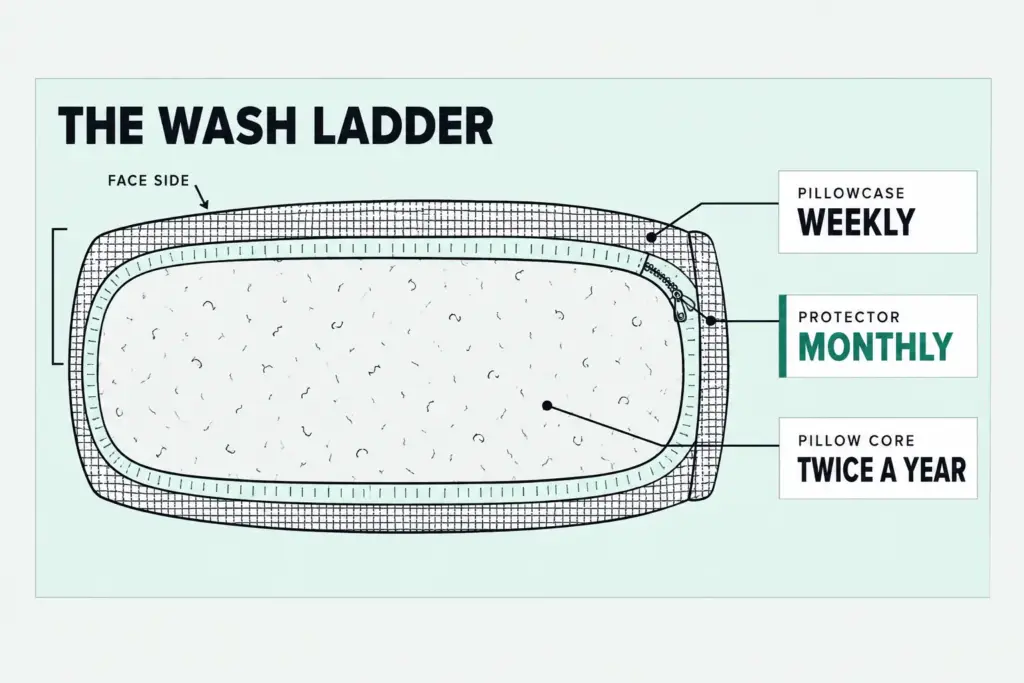
One mattress brand’s care guide tightens the middle rung: wash the protector every two to four weeks, and every one to two weeks if you sweat heavily. The same guide warns against fabric softener on a membrane protector, because it coats the film and blocks the vapor it is supposed to pass, and it calls for low heat in the dryer. A cotton protector has no film to coat, which is one more reason it suits the hot wash.
The routine that comes up again and again in r/LifeProTips is plain: white cotton layers, a hot wash, oxygen bleach. The oil goes down the drain with the wash water instead of into the pillow. The first time you wash a protector after a month on the bed, look at it before it goes in: the faint cream where your head lay is how much the pillow did not have to take.
One side of a shared bed goes first
In a shared bed, one pillow almost always yellows faster, and the question “why does my husband’s pillowcase turn yellow” comes from that. The sleeper who runs warmer, drools, or goes to bed with damp hair or hair product puts more oil into the fabric, and the mechanism is the same as on the pillow underneath. Protect that pillow first, and wash that side’s case more often if it is visibly turning ahead of the other. White sheets show the same pattern, and dingy white sheets often dull on one side of the bed first for the same reason.
A Protector Buys Months, and Its Own Color Tells You How Many
A protector does help, as long as you understand what it does. It moves the yellow off the pillow and onto a layer you can wash hot, and it does that best when it is made of something that takes the heat.
- Put the protector on a clean pillow, with the zipper end away from your face, and wash it monthly in hot water.
- Choose cotton if yellowing is the problem and you sleep warm; save the membrane for spills.
- Count on a protector to push a down or fiberfill pillow toward the end of its life, and on nothing for a foam core’s own aging.
After the protector has been through a few monthly washes, look at where the cream tint settles: a tint that fades with each wash means the protector is doing its job, and a tint that stays and spreads means it is full and ready to replace before the pillow under it starts to turn.
The free change for tonight is a second pillowcase. Pull an old cotton case from the closet, put it on the pillow under the one you sleep on, and leave it there for a month. Then take it off and look at it in daylight. Whatever color it turned is what your pillow would have taken instead.
Frequently Asked Questions
01How do I protect pillows from turning yellow?
Put a zippered protector on a clean pillow, a pillowcase over it, and wash the case weekly and the protector monthly in hot water. The yellow then forms on the layers you can wash, not on the pillow.
02Do you really need pillow protectors?
You do not need one to sleep well, but it is worth having if you want a pillow to stay white and last toward the long end of its life. A second cotton pillowcase underneath does much of the same job for free.
03How do I whiten a yellowed pillow protector?
Soak it in an oxygen booster, wash it in hot water, then dry it in the sun, which is the order the replies in one Facebook thread agreed on. If a cream tint survives two rounds, the protector has done its job and is ready to replace.
04Why does my husband’s pillowcase turn yellow?
The sleeper who runs warmer, drools, or goes to bed with damp hair or hair product puts more skin oil into the fabric, and that oil yellows as it oxidizes. Protect that pillow first and wash that case more often.
05Do waterproof pillow protectors make you hot?
Sealed ones often do, because the film passes vapor slowly and traps air inside the pillow, which also makes them rustle. If you run warm, choose a cotton protector; bedding changes how fast moisture dries, not how much you sweat.





Tried it on your own bed?
No comments yet. Tell us what you changed, and what the sheet did after a few washes.