







What’s in here7 sections
- What Each Fill Does When the Weight Leaves It
- Heat Depends on the Cover and the Fill Height
- What Month Six Looks Like for Each Fill
- What the Label, the Smell and the Rustle Tell You
- Which Sleeper Gets Which Fill, and When It Isn’t the Pillow
- Latex Returns, Buckwheat Holds, and the Dent Tells You Which One Is Wearing
- Frequently Asked Questions
Two listings for a latex vs buckwheat pillow can both promise “supportive” and “cooler”, and neither word is a measurement. What separates the fills is easier to check than either claim: one returns to the height it was given, and the other keeps the shape you pressed into it, including the dent you did not mean to leave. A buckwheat pillow pushed sideways by a rolling head stays pushed. A latex pillow comes back toward full height once the weight is gone.
That one difference settles most of the choice between latex and buckwheat, and the rest is heat, wear, the label and the sleeper. Below: what each fill does when the weight leaves it, what the cover and the fill height do to temperature, what month six looks like, what the smell and the rustle give away, and which sleeper gets which.
The table sets the two fills side by side on the behaviors that decide the verdict. Where the sources disagree, or nobody measured, the cell says so.
| What you compare | Latex | Buckwheat |
|---|---|---|
| Shape after the weight leaves | Springs back. Sleeping Organic rates Talalay “Highly responsive, springy” and Dunlop “Responsive, but slightly slower” | Holds where it was shaped: “no resistance, no rebound” in PineTales’ words |
| Sound | Not described as noisy in the sources read | Rustles when the hulls move; one r/Mattress commenter calls it “a rustling crunchy noise when you move but it’s not bad at all” |
| Heat | Disputed: Comfort Pure says it does not stay as cool as buckwheat, Sleeping Organic credits Talalay’s open cells with better airflow. Nobody measured it | Disputed: Comfort Pure credits the gaps between hulls with “excellent airflow”, one commenter says it sleeps “extremely cool”. Nobody measured it |
| Wear | No clock measured for a pillow; forum reports of 6 and 8 years | The clocks disagree, from 1 to 2 years for the hulls to 5 to 10 for the pillow; a refill is the fix |
| Wash | Spot-clean | Hulls out, cover washed |
| Free fix first | Swap the cover; check the pillow’s height before blaming the fill | Take hulls out; shape the pillow before sleep |
What Each Fill Does When the Weight Leaves It
The table settled the pair in a line. On a pillow, at the end of a night, that line looks like this: one fill carries a dent where the head was, and the other is back at the height it started. The wider map of pillow fill types and what each does by month six covers the other fills, so this section stays with the pair.

Latex: the height it was given
Latex is a foam of open cells, and open cells compress under a head and open again when it leaves. Sleeping Organic rates Talalay latex “Highly responsive, springy” and Dunlop “Responsive, but slightly slower”, which puts the difference in how fast the pillow returns, not in whether it does. For a sleeper who turns over several times a night, speed is most of the story: a pillow that has recovered by the time the head comes back offers the same height on every pass.
The same seller says shredded latex pillows “typically use Dunlop latex, which holds up well to repeated compression and maintains loft over years of use”. That is a statement about the category, so check it against the listing in front of you. Solid latex, a single molded block, keeps everything in one place by definition, but shredded latex raises the question shredded foam does, whether loose pieces stay where they were put, and how shredded pieces behave against a solid block is worked through for foam in its own article.
Buckwheat: the shape you pressed into it
PineTales says buckwheat hulls “retain their natural three-dimensional shape” and that the pillow gives “no resistance, no rebound”. Nothing in the fill pushes back toward a height. The height is whatever the case holds: a case packed to the zipper sits high and firm, a looser one sits low, and PineTales warns that “If the pillow is packed too tightly, the hulls cannot shift properly.”
The strength of the fill and its catch are the same property. It holds the height you chose, and it holds the height you did not choose just as faithfully. People who like it say so in those terms: u/Sine_Wave_ in the r/BuyItForLife thread likes “how it molds to you, then compacts into that shape”, and puts up with a firm pillow, noise included, for the sake of “not having a collapsed pillow”.
The neck roll, and the free fix first
Where the dent ends up matters more than the dent. Roll from your back onto your side and the hulls under your ear move with your head, and that head roll is where buckwheat’s shape retention gets tested; if they pile up at the neck instead, the pillow now has a ridge where support should be. u/Cottaball in an r/Mattress thread puts it in two sentences: “Buckwheat stays in place but its mold can be shifted. Which can be a bad thing if the pillow ends up in a bad position over the neck.”
The fixes cost nothing, and they come before any new pillow. PineTales’ instruction is “Mold the pillow before sleep. Press a shallow space for your head.”
If the pillow feels too tall, take hulls out: u/pambloweenie in the same r/Mattress thread removed about eight cups from theirs and keeps the extra in a ziplock bag in case the height has to go back up. Latex has no equivalent routine, because there is nothing to move. Its free fix sits outside the pillow, in the cover and the height, and the next section takes the cover.
Take hulls out one cup at a time, not by the handful, and sleep on each change for a night or two before the next. Keep what you remove in a bag. Posters describe a few weeks of getting used to a buckwheat pillow, so a height that feels wrong on night one has not been judged yet, and you may want some of those hulls back.
Heat Depends on the Cover and the Fill Height
Comfort Pure says buckwheat pillows “promote excellent airflow” and that latex ones “don’t stay as cool as buckwheat pillows”. Sleeping Organic says Talalay’s “more open cell structure allows better airflow” and that “Both types sleep cooler than memory foam”. Read side by side, the two sellers disagree on which fill runs cooler, and neither reports a measurement. What decides the heat sits closer to the bed than to the name of the fill.
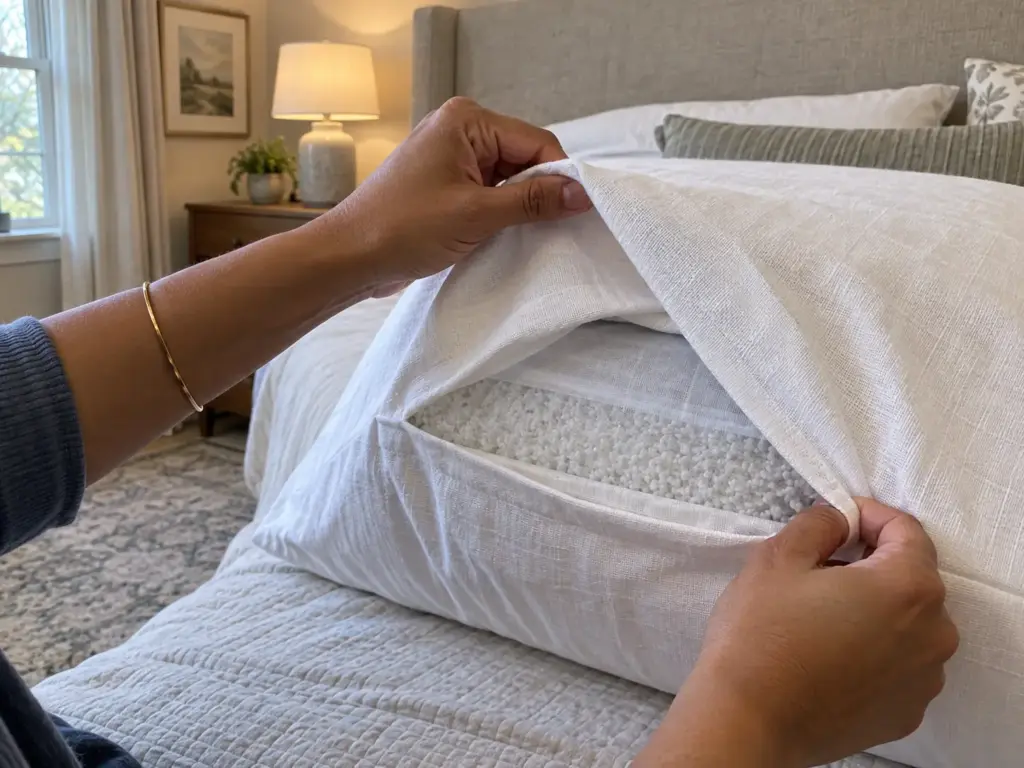
Open cell against gaps between hulls
A buckwheat pillow is a heap of hulls, and the gaps between them are air; whenever the hulls shift, that air moves. Open-cell latex lets some air through the walls of its cells, and a case of loose shreds adds gaps between the pieces, much as hulls have. All of that is reasoning from the build, not a measurement, and it is the same reasoning behind each seller’s claim. It explains why both fills can sleep cooler than a solid, dense foam without telling you which of the two wins.
The cover is the layer both sources skip
Whatever sits between the fill and your head can take the airflow back. A tight cotton cover, or a plastic-backed pillow protector zipped over either fill, closes the gaps and the cell walls alike, and the pillow then sleeps as warm as that outer layer allows. What each cover and protector layer actually does is a subject of its own. The point here is smaller: the cover is the one variable you can change tonight without buying a pillow.
So the obvious pick for a hot sleeper, buckwheat for its airflow, stops being obvious under a closely woven or plastic-backed case, where the gaps have nowhere to send the air. A looser weave on the outside gives either fill the best chance.
Why the sources disagree
The clearest case is a single comment. u/Cottaball wrote “The latex sleeps extremely hot.” and, in the same comment, “The buckwheat sleeps extremely cool.” One person, one thread, no thermometer, and a verdict that happens to sit on Comfort Pure’s side of the argument: a comment is not a test.
A second variable hides inside the first, and that is fill height. A taller pillow puts more material around the ear and cheek, and more material holds more warmth whichever fill it is. A buckwheat pillow with eight cups taken out is a lower pillow, so it may sleep differently for that reason alone, though that too is reasoning from the build. Change the cover and the height before you change the fill, and only then decide that the fill was the problem.
Before you call either fill hot, take any zip-on protector off and put a loose-weave cotton case on the pillow for a week of nights. Change only that. If the pillow still sleeps warm with the lighter cover, the fill height is the next thing to change.
What Month Six Looks Like for Each Fill
Week one flatters both fills, each for its own reason, and the first nights are the least informative ones. What counts is what each fill does once it has been slept on for months, and on durability the sellers give clocks that do not agree with each other.
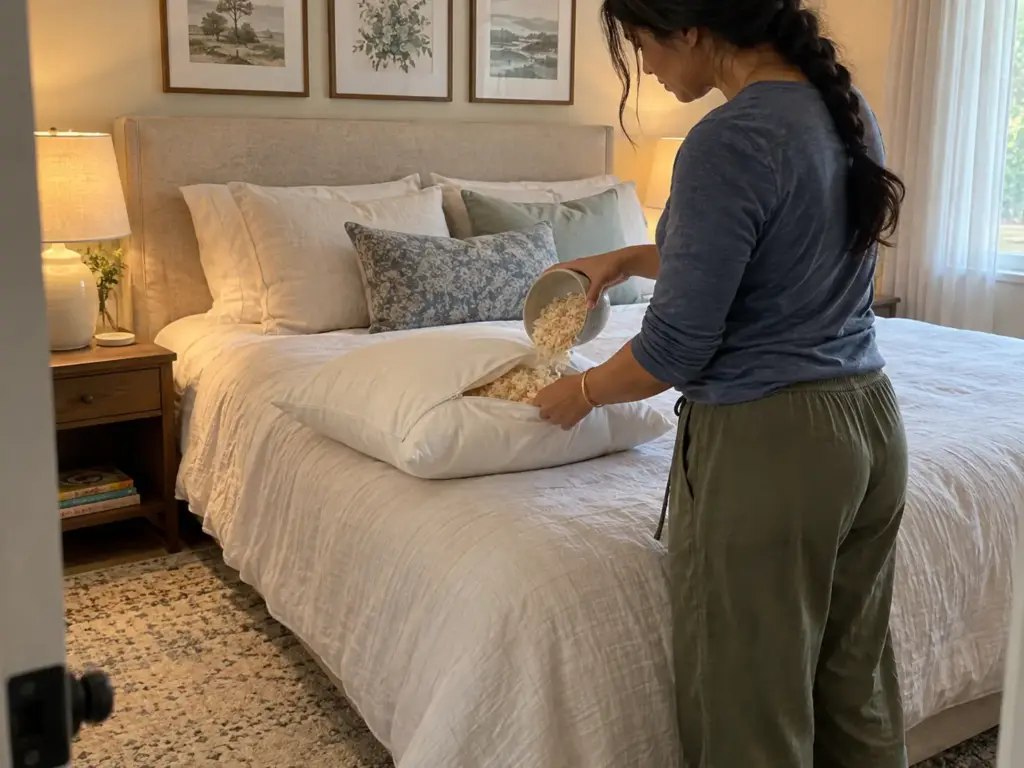
Buckwheat: lost volume you can top up
Buckwheat wears as volume. The hulls break down, the case holds less, and the pillow sits lower. u/ashazureophanim in r/Mattress says the hulls “break down after years of use”, which is why a buckwheat pillow comes in a zippered cover in the first place.
PineTales calls the repair modest: you do not replace the whole pillow, you “just refill it with fresh organic buckwheat hulls when needed”. u/ag_bear in r/BuyItForLife has had one for a couple of years and calls it “easy to top up over time”.
The first weeks need separating from the later months. What reads as wear in week two is often adjustment: u/ag_bear says it is comfortable “after you’ve adjusted over the first week”, and u/pambloweenie says it took a few weeks to get used to. A pillow that was fine in week five and low at month eight has told you something different, and that something is cheap to fix.
Latex: lost spring is the failure
Latex does not shed volume. In a foam the cells do all the work, so what wears is the spring, and the sign is a dent that stops filling back in, which arrives slowly. u/benilla in r/BuyItForLife has had a latex pillow “for 6 years now, still going strong and has not lost shape”, and a 2009 poster on Mothering, rainyday, says the pillows “haven’t deteriorated in the 8 or so years we’ve had them”. Those are forum posts, not measurements.
Sleeping Organic, a latex seller, adds that Talalay softens “slightly faster under sustained compression” than Dunlop.
The honest way to read all of this: latex may outlast a buckwheat fill by years, but when it goes there is no zipper and no cup of fresh fill to add.
The clocks nobody measured
PineTales gives the buckwheat pillow “5 to 10 years with proper care”. Comfort Pure says “several years”. SleepJunkie says to “replace the buckwheat hulls every one to two years”. Three sources, three answers, and none reports a measured rate.
The latex numbers are community years, not tests. How often to replace a pillow, by fill and not by year goes further into why the calendar is the wrong instrument. For these two fills, the better one is the dent: does it still fill back in, or has the pillow lost volume?
Press a fist into the middle of the pillow, lift it and count. A latex pillow that is wearing leaves a dent that lingers longer each month; a buckwheat pillow that is wearing feels like less pillow, and a cup of hulls puts it right. Write the date of the last refill on the care tag in marker.
What the Label, the Smell and the Rustle Tell You
The word natural stops describing the fill fairly quickly. On a latex listing it can sit next to a blend, and on a buckwheat one it can sit next to a cover of unknown fabric. What the label hides, your nose and your ears can check before you decide.
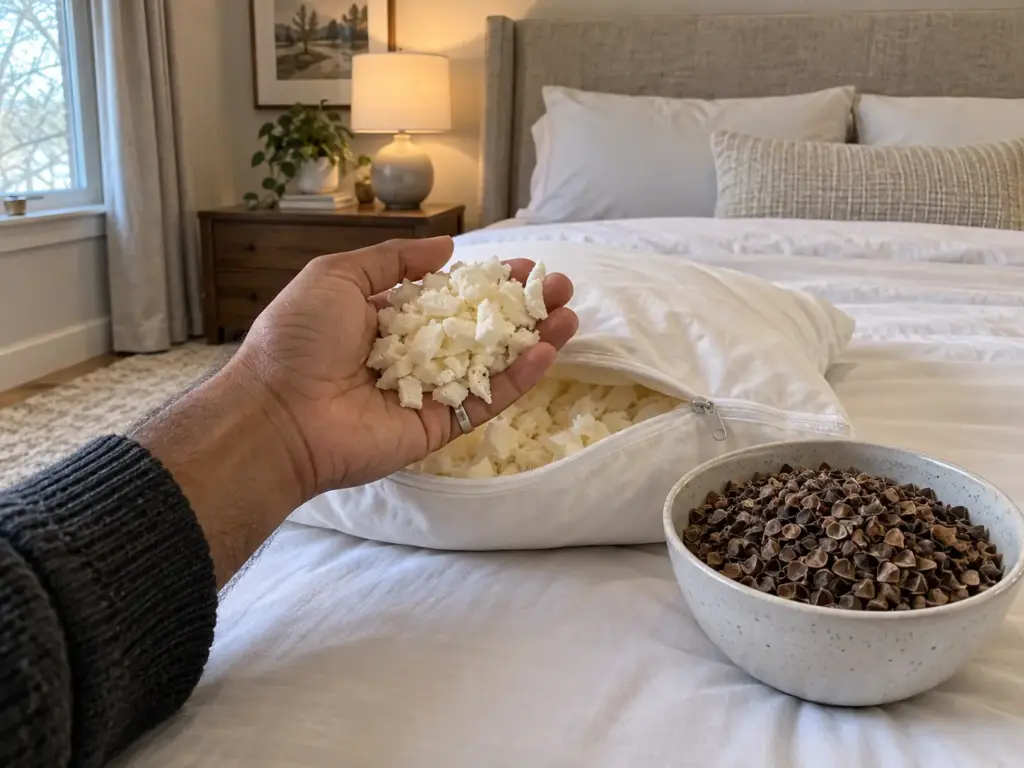
“Natural latex” and the smell test
Dunlop and Talalay are two ways of making latex, and the choice changes how quickly the pillow springs back. A listing that says natural latex and names neither has told you less than it seems to. Look for the process in the description, and when it is absent, take that as information.
Odor is the plain test. u/erratic_life in the r/BuyItForLife thread says “natural latex isn’t supposed to smell”, and reads a strong smell as a sign of “some cheap knockoff memory foam” rather than latex. Another poster in the same thread says a pure latex product “wont smell like anything”. That is a field rule from people, not a lab result, but it costs a nose and a minute.
A certificate is the other half of the label, and it covers less than the logo suggests. OEKO-TEX describes Product Class 2 of OEKO-TEX Standard 100 in one line: “Products with direct skin contact, such as bed linens.” The page does not name pillow fill, so the pillow’s own label is the only proof of what a given certificate covers.
Smell a latex pillow the day it arrives, before it has spent a night on the bed. If you can name the smell as chemical, that is a reason to send it back while sending it back is still easy, and the pillowcase and a week of washing will not be the explanation.
Buckwheat noise and scent
The rustle is the fill working. u/tyinsf in r/Mattress describes “a rustling crunchy noise when you move but it’s not bad at all”, and u/Sine_Wave_ warns that “you will hear it initially”. PineTales’ explanation is mechanical: “Noise is only created when hulls move.” That is why shaping the pillow before sleep matters twice, once for the height and once for the sound, and in a shared bed the second sleeper hears it too.
The scent is milder. u/ashazureophanim says “the scent isn’t super strong or bad and it wears off after a while”.
The wash follows the fill
The two fills have opposite wash rules. PineTales: “Do not wash a buckwheat pillow while the hulls are still inside”. Empty hulls out of the case, wash the cover (a removable one can be hand washed if the care label allows it), and let the hulls dry in the open before they go back; a poster in the BuyItForLife thread says you can “empty the hulls out to wash and dry them”. Latex is spot-cleaned with mild detergent and warm water, per SleepJunkie, and does not go into the machine whole.
What is inside decides the method for anything that has stained the pillow too, and getting yellow stains out of a pillow, by what’s inside follows that rule fill by fill.
Which Sleeper Gets Which Fill, and When It Isn’t the Pillow
After heat, wear and the label, what is left is the person on the pillow: how much they move, and whether the bed holds one head or two.

If your head moves, latex
A sleeper who changes position wants the fill that returns to its height, because the pillow gets a fresh start every time the head leaves it. That is latex. A buckwheat pillow asks to be reshaped each time the sleeper turns, or it gets slept on in whatever shape the last position left. Sleepers who cover three positions in a night are the extreme case, and pillows for sleepers who change position through the night covers how fill migration plays out for them.
One caution applies. Latex returns to the height it was given, and that is only right if the height suits your shoulder. A side sleeper needs enough pillow height to fill the gap between ear and mattress, which depends on shoulder width, and keeping neck alignment is what that height is for. Loft is the number that decides it, and neither fill arrives with yours already fitted.
If you settle and shape the pillow, buckwheat
A sleeper who lies down, finds a position and stays in it wants the opposite behavior, a fill that keeps what it is given. u/ashazureophanim in r/Mattress puts the method in one line: “the key is to put your head where you want it and shape the pillow to your head and it will just hold it right there”. For that person the fill is a custom height, adjusted by hand and by cup. Pillows for back sleepers that hold their height is the same preference seen from the position side.
Firmness is the catch. u/erratic_life in r/BuyItForLife tried buckwheat and found “it was just too hard for me”, preferring a pillow with “give, but keeps it’s shape”. Goldfinches on Mothering put it more bluntly: “hard as a rock”. If the first week with the hulls out and the pillow shaped still feels like that, the fill is not for you, and no amount of reshaping will change a property that comes from the hulls.
Two heads, two heights
When one head moves and the other settles, a single pillow type is a compromise that fits neither. The structure that works is two of something: one latex and one buckwheat, or one fill at two heights. The two sleepers do not need to agree on a pillow, only on a bed. How loft changes with sleep position explains how to set each height, and the result is one pillow per head rather than one pillow per bed.
When it is not the pillow
Everything above assumes the pillow is the question. Neck pain that does not ease, an arm that goes numb, headaches that keep returning: those are for a doctor, and no fill answers them.
Mayo Clinic’s guidance on when neck pain needs a doctor gives the first threshold as pain that “Persists after several weeks of self-care.” It also lists pain that comes with headache, weakness, numbness or tingling as a reason to call a healthcare professional. Past those lines the decision is not about a pillow, and none of the fills in this article is offered as an answer to it.
If none of that describes your nights and the pillow is the question, the latex option is below.
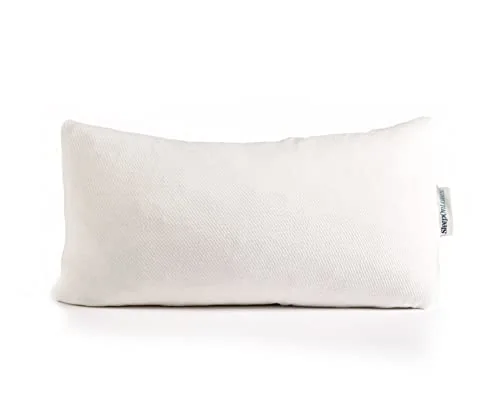
The Natural Latex Shredded Foam Pillow is the fill for a head that moves, in a set of two. The listing describes natural latex shreds with an open-cell structure, which is the build that returns toward its height. A set of two covers both sides of a bed for two sleepers who move, and leaves a spare to try beside a buckwheat pillow. Two things to check before ordering: the listing does not say which latex process it uses, Dunlop or Talalay, and Amazon shows an availability date rather than a current offer.
Latex Returns, Buckwheat Holds, and the Dent Tells You Which One Is Wearing
Three things carry the choice. Latex returns toward the height it was given, and buckwheat keeps the shape pressed into it. Heat depends on the cover and the fill height before it depends on the fill, and nobody measured the difference between the two. Wear shows up as lost volume in a buckwheat pillow, which a cup of hulls repairs, and as lost spring in a latex one, which nothing repairs.
The check for later is the dent. Once the pillow has been slept on for months, look at whether it still fills back in (latex) or has gone low in a way a refill would fix (buckwheat). The calendar tells you less than that does.
Tonight, change one free thing. Take a cup of hulls out of a buckwheat pillow, or swap the cover on either fill for the loosest cotton case you own, and notice in the morning whether the pillow sat the same height and slept the same temperature. That one change sorts out more of the choice than a week of reading listings.
Frequently Asked Questions
01Which type of pillow is better for me, latex or buckwheat?
Latex suits a sleeper who changes position, because it returns to its height; buckwheat suits one who settles and shapes the pillow by hand. Heat is a separate question, decided mostly by the cover and the fill height.
02Is a buckwheat pillow noisy?
It rustles whenever the hulls move, and posters describe the sound as not bad at all once they are used to it. Shaping the pillow before you lie down reduces how much the hulls shift during the night.
03How do you wash a buckwheat pillow and a latex one?
Empty the hulls from a buckwheat pillow and wash only the cover, since the hulls should not be washed inside it. Latex is spot-cleaned with mild detergent and warm water. Check the care label first.
04How long before a buckwheat pillow needs a refill?
Refill when the pillow has lost volume and sits lower than it did, not on a fixed date. Sellers give clocks from one to two years for the hulls up to five to ten for the pillow, and none measured it.
05Does a latex pillow smell, and should it?
Posters in r/BuyItForLife say natural latex should not smell strongly, and read a strong smell as a sign of a foam blend. Smell the pillow when it arrives and read the listing for what the fill is made of.





Tried it on your own bed?
No comments yet. Tell us what you changed, and what the sheet did after a few washes.