







What’s in here7 sections
- One Block or Loose Pieces — How Each Carries the Head
- Loft — the Height You Can Set and the Height That Drifts
- The Heat Claim, Read Against the Reports
- Settling, Care Labels and the Wash
- Which Build for Which Sleeper, and the Free Fix First
- The Morning Check That Decides Which Pillow Stays
- Frequently Asked Questions
The word on the package says adjustable, and it promises a height you can set. It leaves out whether that height stays where you put it, which is the whole question in shredded vs solid memory foam. One Layla reviewer found the pillow right for two months and flat by six, and a Coop reviewer says it “sinks down quite quick.”
Loose foam pieces pack down because nothing holds them in one place, while a solid block returns to its shape because it is one piece. What follows takes the two builds apart: how each carries a head, what the loft does over nights and months, what the heat claim does and does not show, where the care labels disagree, and which sleeper each build suits.
The construction decides the height you can set and the upkeep you accept. It does not settle the heat.
| What you compare | Shredded foam | Solid foam |
|---|---|---|
| Shape | Cut foam pieces in a zipped cover; keeps the dent of the last head | One piece of foam; returns to the same shape every night |
| What you can change | The height, by taking fill out or putting it back | Nothing; the height is the one it ships at |
| Heat | Claims differ, nobody measured it | Claims differ, nobody measured it; both solids here carry gel |
| Support by position | Set per sleeper, so one model can serve side, back or stomach height | One fixed height; the two solids here are 2.6 and 2.75 inches, low-profile |
| Settling and care | Loft drops and needs checking and fluffing; labels split between machine and hand wash | Keeps its shape; the labels here wash the cover and not the foam |
| Durability | Reviewers’ months, no measured rate: flat by month six on one listing | Reviewers’ months, no measured rate; one maker claims it holds shape |
The table is the whole comparison in six rows, and the sections below carry the reasons behind each row; the pillow itself is one fork inside a larger choice among every fill a pillow can have.
One Block or Loose Pieces — How Each Carries the Head
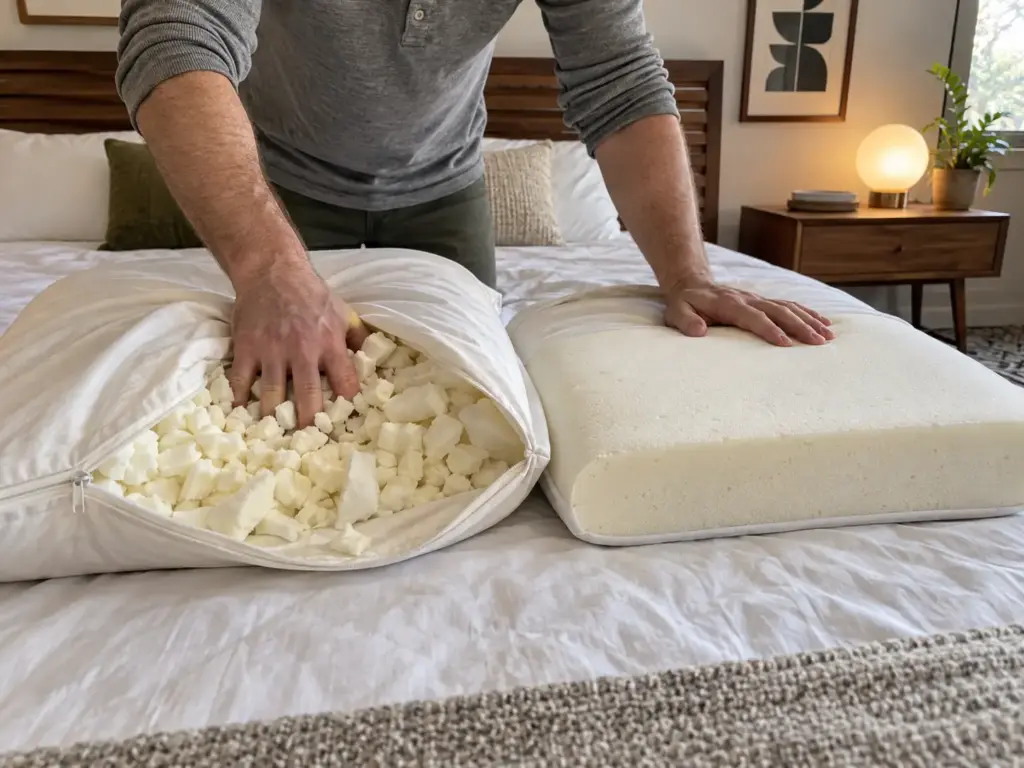
Both pillows are the same kind of polyurethane foam, so the difference is not the material but whether the foam is one piece or many, and the two behave differently the moment a head leaves a dent in them.
One piece: one shape, nothing to set
A solid memory foam pillow is a slab, flat or contoured, in a cover. Push a hand into it and it gives, then comes back to the form it had before, because it is a single piece and has nowhere to move to. The shape is the shape, and no one can change it. The BLISSBURY and Bluewave listings describe no loose fill and no way of adding or removing any, and BLISSBURY’s care tag treats the foam as a separate thing from the pillowcase.
At 2.6 and 2.75 inches, those two sit at the thin end. A solid pillow of standard loft is not part of this comparison, and both carry gel, which matters again in the heat section.
Loose pieces: a pillow that is a bag of foam
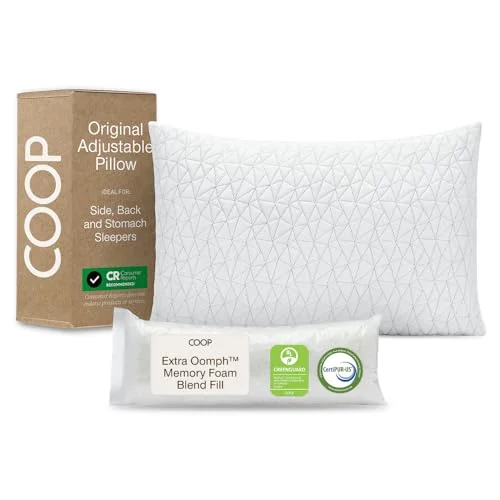
A shredded memory foam pillow is cut foam inside a zipped cover, and the height is whatever the filling happens to be. The Coop listing prints its fill as a cross-cut memory foam and microfiber blend, 76% viscoelastic polyurethane foam and 24% polyester gel fiber. Layla mixes shredded memory foam with natural kapok fibers. Press your fingertips into either and the pieces slide aside and keep the dent.
A shredded pillow holds the shape of the last head until something moves the pieces back, where a block gives the same shape every night.
What the label means by “adjustable”
On a loose-fill pillow, adjustable means the maker ships extra fill, or tells you to take some out. It is a promise about setting the height and says nothing about keeping it. Layla’s listing says the pillow ships overstuffed, so the factory setting is the top of the range, not the middle, and reviews of both shredded pillows here open with the same move: take a little fill out, and then the pillow is right.
More fill or less is also how down and its alternatives get their height, a rule covered in how fill weight sets the height in down and down alternative. What the reviews add for shredded foam is that the setting does not always hold.
Loft — the Height You Can Set and the Height That Drifts
A block cannot let you change its height, and loose pieces cannot keep it, so this section is about what happens between the day you set the pillow and the day you stop noticing it.
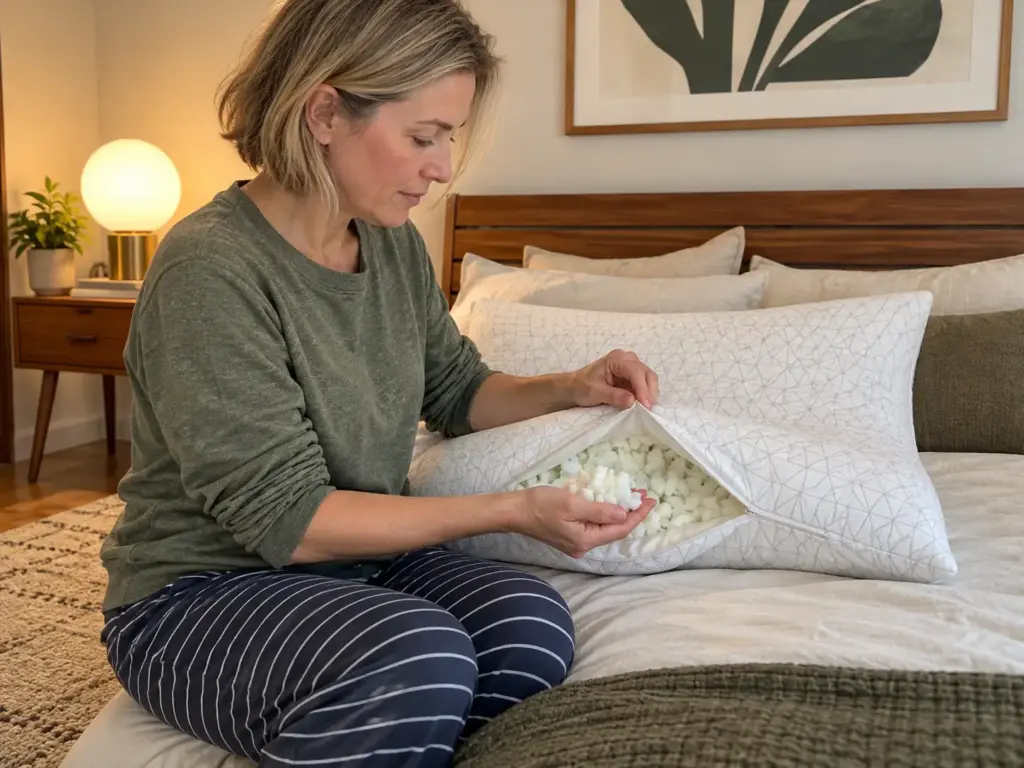
The free fix: take fill out until the height is right
Before any purchase, unzip the cover and take out a little fill until the height fits the sleeper. Check it the next morning, and again after a week. Reviewers describe the same move in their own words: “I removed about 1/3 of filling to make it just perfect for me” on the Layla listing, and “I needed to remove a small amount of filling after sleeping on it as it came” on the Coop one. It costs nothing, which is why it comes before everything else on this page.
Keep what you take out in a zip bag beside the pillow, not in the trash. Removed fill is the only way to raise the height again if the first adjustment turns out too low.
What drifts, and what a fluff brings back
The reviewers’ months are the only clock on record. A Layla reviewer calls the pillow “great for first 2 months” and then writes that it “does not maintain shape after 6 months. No support.” The listing’s review summary tags flatness in 35 reviews.
A Coop reviewer says it “sinks down quite quick.” These are reviewers’ months, not a settling rate, and no measured month-by-month figure sits behind either pillow.
A fluff is the first repair, and it is a hands-on one: one reviewer “had to literally pull on the outside fabric to get them to fluff.” Kneading the pieces apart through the cover is the whole fix, no purchase involved.
The test that tells a holding pillow from a drifting one is the dent. On a pillow that is holding, the dent a head leaves is gone by the time the bed is made. On one that is drifting, it is still there that evening.
The Coop Original is the adjustable shredded pick in this comparison, and its listing prints the fill split and includes an extra fill bag.
Two heads, one bed
An adjustable fill lets two sleepers in one bed each set their own height, which a block cannot do. A tall side sleeper and a shorter back sleeper can use the same model with different amounts of fill in the cover. The catch is that each pillow then drifts in its own direction, and the one set highest has the farthest to fall. This is reasoning from the design, not a reported workaround, and it holds only while somebody checks.
A bed where one sleeper turns through several positions in a night asks more of any pillow, a case taken up in a pillow that has to cope with three positions in a night.
The Heat Claim, Read Against the Reports
Neither build has a thermometer reading behind it, so this section reads the claim against the reports and marks where the gap is.
What the sellers say: air between the pieces
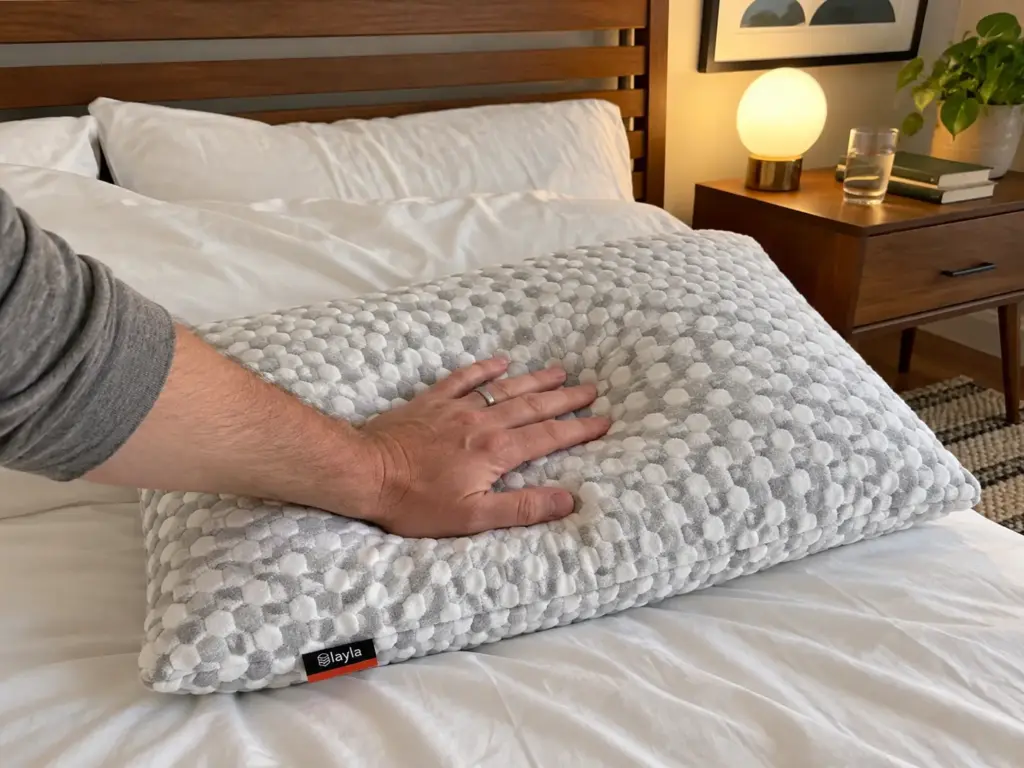
Layla’s listing says air “moves through at a much higher rate than many other fill materials” and that open-cell foam “continues the cooling through ample airflow.” That is a claim about the fill, not a reading of it. The Layla Sleep Adjustable Fill Kapok Pillow pairs shredded memory foam with kapok fibers, and it is the one shredded pick here whose listing makes an airflow claim about the fill itself. The same pillow’s reviews hold the other side: “Very disappointed … cooling products … doesn’t work for me,” and the flatness reports at six months.
The mechanism is plausible, since gaps between pieces leave room for air that a slab does not have. Plausible is not measured. Bluewave’s listing makes its own gel and ventilation claims for the solid side, and they are claims in the same sense.
What sleepers report
The reports run the other way. A Coop reviewer writes, “It does NOT provide any cooling for your head, at all.” An r/Bedding commenter says shredded “runs hot,” another that it “was also hot,” and a third that the fill is “not as cooling as I thought.” Those are reports, not measurements, and none says how warm the room was, what the case was made of or whether the pillow had been turned over.
That last point deserves weight. Any pillow feels cooler for a minute after it is flipped, so a verdict reached at the worst hour of the night says more about the flip than about the fill.
Change one thing per night. Swap only the pillow and leave the case, the sheets and the room as they are; change the case too, and the night is testing the case.
Why the solid picks cannot settle it either
The obvious move is to read the solids as the control. They cannot be one. BLISSBURY is a gel-infused foam with ventilation holes, and the Bluewave listing names gel and ventilation channels too, so any difference between them and a shredded pillow could be the gel, the holes or the construction, and nothing in the listings separates the three. This is not a clean test, and it is not presented as one.
What decides heat on a bed is more than the fill: it is the cover and every layer between the head and the air, the same logic as what decides heat in cooling sheets, where structure is told apart from a finish. Before judging a fill on heat, look at the layer that lets the least air and moisture through, because the least breathable layer sets the ceiling for the whole bed.
Settling, Care Labels and the Wash
A pillow that drifts also has to be cleaned, and the labels on these four do not agree with each other, or sometimes with themselves.
Four labels, four rules
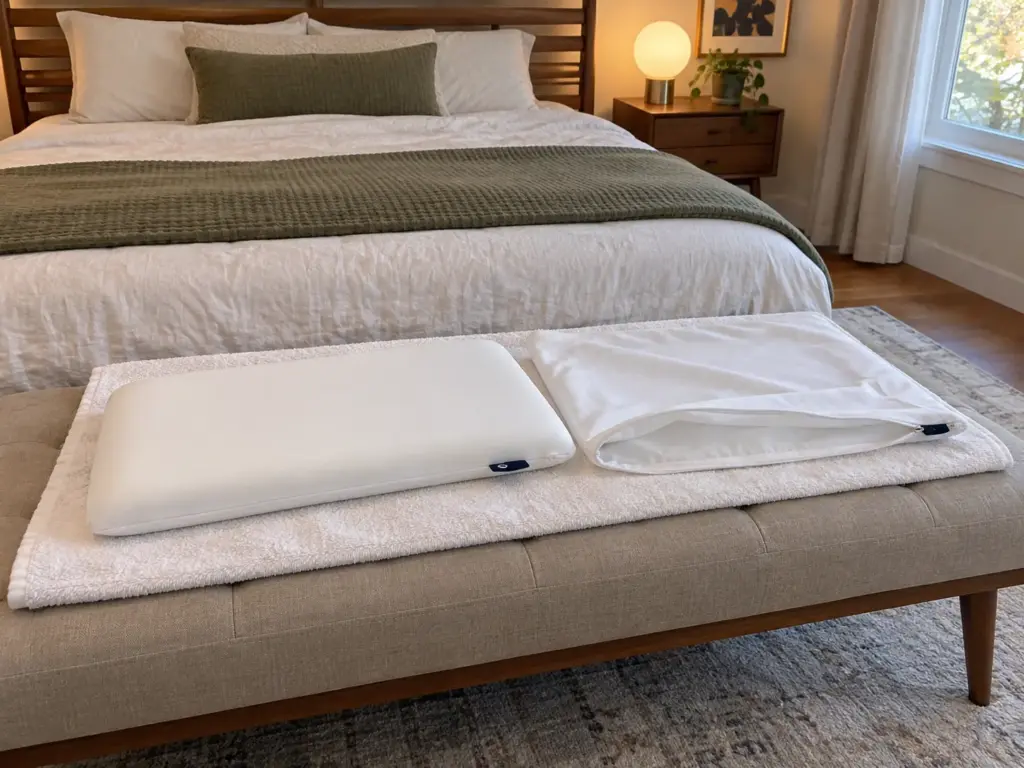
Coop’s own care label for the Original Pillow reads: “Wash in cold water. Gentle cycle. Do not use fabric softner or bleach. Tumble dry low.”
The same block says the inner pillow has to be completely dry and the zipper closed with a safety pin.
Layla’s FAQ allows a gentle machine cycle and a low dryer, then adds that “it’s best to wash by hand.” One listing, two answers.
On the solid side the rule flips. BLISSBURY’s label, which says the foam is not washed, reads: “Machine Wash, Wash pillowcase (not foam) in cold water. Avoid bleach and fabric softners. Air dry for optimal results.”
The Bluewave Ultra Slim Gel Memory Foam Pillow is stricter still: “Inner Core Hand Wash Only – Cover Machine Washable.” Its density, 3.25 lb, is the maker’s own figure. At 2.75 inches it is also the thin kind, and some customers say it is too thin for their needs, so the label is not the only thing to read before it goes on the bed.
The pattern is plain enough: the shredded labels say machine, the solid labels say cover only. But your own tag is the authority here, not the pattern.
The wash that went wrong
One Coop reviewer washed the pillow once and reported: “Heavy and lumpy. Washed the first time and almost broke my washer. Impossible to dry, stinks like mildew.” One reviewer is not a rate, and the Coop tag itself says the machine is fine.
The mechanism is easy to see, though: loose pieces hold water between and inside them, and a pillow that does not dry through sits wet in a dark drum for as long as it takes someone to notice.
An r/Bedding comment says the fill was “renewed in dryer at low temp for 10 to 15” and warns “do not use high temp.” One comment is an anecdote, and it happens to match the low setting on the Coop tag.
Close the zipper and pin it shut before any wash, as the Coop tag asks, and then keep checking the pillow until it is dry in the middle. A pillow that is dry on the outside and damp inside is the one that smells.
What to check before you wash anything
Read your own tag first. If it says the core is not washed, the foam gets a damp cloth and air, not a soak, and getting a stain out depends on what is inside. If the pillow cannot be washed at all, the layer around it does the cleaning, and the care tag decides whether a protector is worth it.
Durability is the other thing the labels cannot settle. Bluewave’s listing claims its denser foam holds its shape instead of going flat within months, while the Layla reviews say the opposite for shredded fill. Both are claims, and no year range appears here because no measured one stands behind either. Replacement timing follows the fill rather than the date, which is the logic of the fold test by fill, not by year.
Which Build for Which Sleeper, and the Free Fix First
The answer depends less on the build than on whether you want to set the height or have it set already, and the free changes come before any new pillow.

Keep a shredded one if you want to set the height
Take fill out, check the next morning, and put some back if it went too far; that costs nothing and answers most of the question. A shredded pillow suits the sleeper who wants to set the height and accepts the upkeep: a fluff when the dent lingers, a look at the pillow each morning, and a tag to read before a wash. Back sleepers and side sleepers can both land on a workable height this way, which a fixed slab only offers by luck.
Keep a solid one if you want it set already
A solid suits the sleeper who wants one shape and no upkeep, and who accepts that the height cannot change. The two solids here are thin, 2.6 and 2.75 inches, and gel-infused, so they answer a low-profile need and not the standard-loft side sleeper. Try the free fix on a pillow you already own before buying a slab: if taking fill out gets the height low enough, the slab is unnecessary.
The BLISSBURY Stomach Sleeper Pillow, Thin Flat Memory Foam is the solid at the thin end, a CertiPUR-US foam with ventilation holes under a cover of 65% polyester and 35% rayon. Reviewers say one “came out flat on one side for a week” and call it “too thin and not supportive enough on its own,” so it works as a low profile and nothing more. Stomach sleepers meet this choice most directly, and adjustable against thin foam for stomach sleepers lays it out, with a shredded pillow emptied low and a bought slab ending up in the same low place.
When it is not the fill
Fill and height are the part of this that bedding can change. If neck or head pain stays the same whatever height the pillow is set to, that is a doctor’s question, not a fill’s, and no pillow of either build answers it. Neither build is a remedy for anything; each is only a way of holding a head at a height. Back at the bed, the choice is the one above: set it, or have it set.
The Morning Check That Decides Which Pillow Stays
Three things carry over from the comparison. The construction decides the height you can set and the upkeep you accept, not the heat. Loose pieces can be set and then drift, while a block keeps one shape that cannot be changed. And the care tag on your own pillow beats every pattern on this page, so read it before anything goes in the machine.
Once the pillow has been through months of nights and washes, lay a hand flat on it at the head position each morning. A drop in height is the signal to act, and the date on a calendar is not.
Tonight, take a small handful of fill out of a shredded pillow and leave a solid one alone. Then look at the pillow the next morning: whether the dent is gone by the time the bed is made, and whether the height is still the one you set.
Frequently Asked Questions
01Is a shredded or solid memory foam pillow better?
Neither is better across the board: a solid pillow keeps one fixed shape, while a shredded one can be set to your height and then drifts from it. Pick by whether you want to set the height or have it set already.
02Are shredded memory foam pillows any good?
They are good for a sleeper who wants to set the height and will check it now and then. Reviews of the two shredded pillows here describe taking fill out for a better fit, and some report the pillow going flat over months.
03Can you wash a shredded memory foam pillow?
Whether a shredded memory foam pillow can be washed depends on its own care label, and the labels on these pillows disagree with each other. Coop’s says gentle cycle and tumble dry low; the Bluewave solid washes only the cover. Read yours first.
04How do you fix a flat shredded memory foam pillow?
Knead and pull the cover to fluff the pieces apart, check the zipper end for fill that moved there, and put back any fill you took out earlier. None of that needs a purchase.
05Which is cooler for a hot sleeper, shredded or solid foam?
Neither shredded nor solid foam has a measured heat reading behind it, so no verdict is fair: the airflow claims and the sleeper reports point in different directions. The cover and every layer between the head and the air count as much as the fill.




Tried it on your own bed?
No comments yet. Tell us what you changed, and what the sheet did after a few washes.