







What’s in here7 sections
- Find Out What’s Inside Before You Mix Anything
- What Lifts Yellow Stains Out of Pillows, and What Makes Them Worse
- Down, Feather and Fiberfill: The Pillows That Can Take a Soak
- Memory Foam, Latex and Buckwheat: What You Can Reach and What You Can’t
- How White It Will Get, and When to Stop Trying
- The Tag Decides, the Window Confirms
- Frequently Asked Questions
You strip the case off, find a pale amber map on the shell right where your head goes, and reach for whatever is under the sink. Knowing how to get yellow stains out of pillows starts one step before the stain: yours might be down, polyester fiberfill, a foam block or a bag of buckwheat hulls, and each one takes that same bottle differently. (One r/CleaningTips poster machine-washed a secondhand memory foam pillow on reflex and only read afterward that “you shouldn’t do that.”) The yellow itself is sweat and skin oil that reacted with air, and on a woven cotton shell an oxidizer can reach it; inside a foam block, nothing can. So this goes in order: what’s inside, which agent to pick (and the two to skip), the method for the pillows that soak, the one for the pillows that don’t, and how white “clean” really gets.
Quick Answer
The fill decides, and so does where the yellow sits: shell or core. Washable down, feather or fiberfill: a baking soda and peroxide paste on the spot, oxygen bleach in a warm wash, check it wet before drying. Foam, latex, buckwheat: never soak; wash the cover, spot-clean the block. Old yellow gets lighter, rarely white.
Find Out What’s Inside Before You Mix Anything
Everybody starts with the stain, and that’s fair. It’s the thing you can see, and the bottle is right there. But the stain doesn’t pick the method. The fill does, and finding out what it is takes about thirty seconds, which is less time than the paste needs to sit.
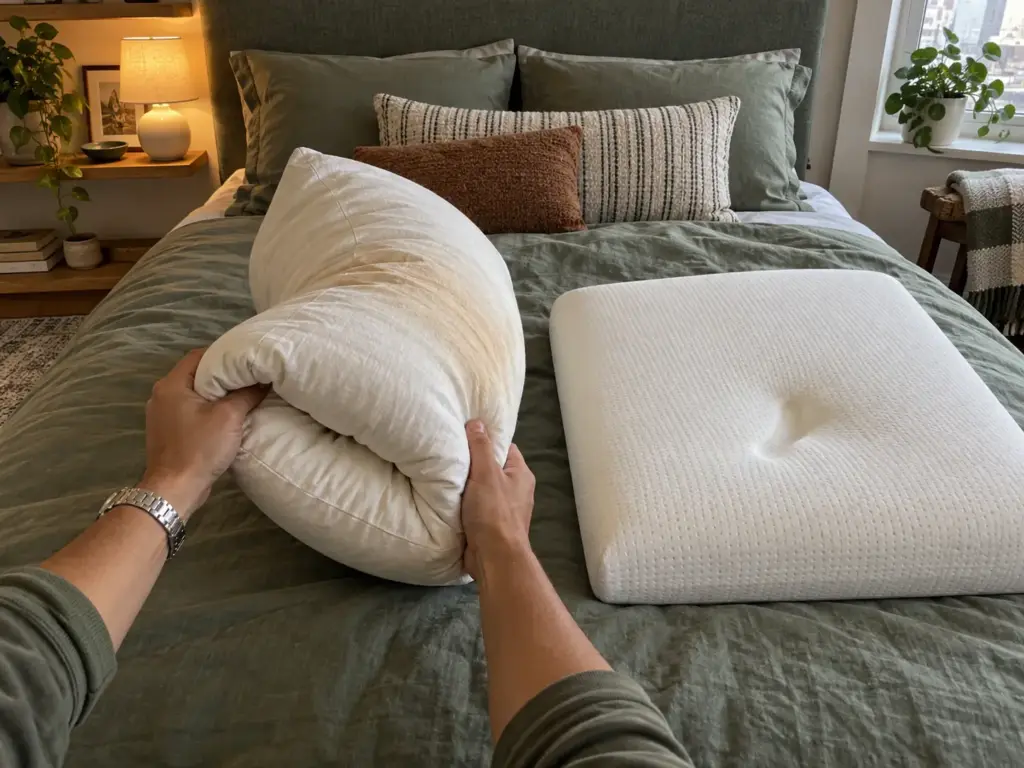
This matters most on the pillow with no history: the one from the guest room, the hand-me-down, the pillow that came with the apartment. Nobody remembers what’s in it, and a guess is how a foam block ends up spinning in a washer.
Read the Fill Line on the Tag
Sewn into a seam of almost every pillow sold in the US is the law label, the white tag that says not to remove it under penalty of law (that warning is aimed at the seller, not at you). Skip the line about machine washing and read the one near it that lists the filling by material, usually with percentages: down, feather, polyester fiber, polyurethane foam, latex, buckwheat hulls. That line picks the method. The washing line only tells you the manufacturer’s best case.
A feather pillow whose tag reads 75% feather, 25% down washes like down. A tag that reads polyurethane foam means foam, and shredded foam, the bag-of-sponge-pieces kind, is still foam for everything that follows.
Two labels need translating. “Down alternative” is polyester microfiber, so it’s fiberfill here, whatever the box promised about feeling like down. And a hybrid, a foam core wrapped in a layer of fiberfill, goes by its core: the fiberfill can take a soak, the foam in the middle can’t, and the foam wins.
No tag at all is typical of the pillow you most need it for: the oldest one, whose tag got cut off years ago because it scratched. Then it’s the fold test. Fold the pillow in half and let go.
- Down and fiberfill fold easily and spring back open.
- Memory foam resists the fold and holds a thumbprint for a few seconds before it fills back in.
- Latex fights the fold and pushes straight back, no delay.
- Buckwheat crunches and shifts under your hand like a bean bag.
To tell down from fiberfill, squeeze a corner hard. Down compresses to almost nothing, and there’s usually a quill poking through the shell somewhere; fiberfill springs back in one piece and often has lumps you can feel through the cotton.
No tag and the fold test leaves you unsure? Treat the pillow as the most fragile fill it could be and spot-clean it like foam until you know better. A down pillow that only got a spot clean has lost an afternoon. A foam block that got a full soak can be finished.
Shell or Core — the Daylight Check
Case off, pillow laid out on the bed near a window, in daylight rather than under a warm bulb that makes every white look cream. Yellow in a patch where the head lies, darkest toward the middle and fading out toward the edges, is sweat and sebum on the shell, the woven cotton ticking the fill lives in. Yellow that tints the whole thing evenly, including the corners and the edges nobody’s face ever touched, is coming from the pillow core.
On a foam or latex pillow with a zip cover, unzip it and look at the block itself. An amber block under a white cover is foam aging, not a stain on anything, and the chemistry behind that gets its own section further down. On the shell, the yellow is oxidation: sweat and oil reacting with air over months, which is the short version of why pillows turn yellow and which ones come clean. This page takes that as given and goes straight to what you do about it.
A shell stain on a washable pillow is a laundry job. A core that yellowed on its own is a question of age, and no bottle answers it.
Four Fills, Four Different Jobs
The rest of this comes down to one split. Down, feather and polyester fiberfill sit inside a woven cotton shell that can go fully wet and dry out again, so the whole pillow soaks. Memory foam, latex and buckwheat either hold water where you can’t get it back out or shouldn’t get wet in the first place, so only the cover does.
Find your row here, then go to its section.
| Fill | What gets wet | What lifts the yellow | The ceiling |
|---|---|---|---|
| Down or feather | The whole pillow, shell and fill | Peroxide paste on the spot, oxygen bleach in a warm wash, sun to finish | Months-old yellow clears; years-old yellow goes lighter |
| Polyester fiberfill | The whole pillow, shell and fill | The same method as down | Comes clean, but clumps and loses loft each round |
| Memory foam or latex | The zip cover only; the block gets a damp cloth | The cover washes; the block only gets a surface spot-clean | An evenly amber block is aging, not a stain |
| Buckwheat hulls | The empty cover only; the hulls stay dry | A cold, gentle wash of the cover; air and sun for the hulls | Musty hulls get replaced, not washed |
The next section, on what goes in the bottle, applies to all four.
What Lifts Yellow Stains Out of Pillows, and What Makes Them Worse
Once you know the yellow is on the shell, the question is the bottle. Open the cupboard under the sink and there are probably four or five candidates: hydrogen peroxide, a tub of oxygen bleach, the chlorine bleach, white vinegar, maybe a glass cleaner. Two of them are the same chemistry at different strengths, one tends to make this particular stain worse, and two of the combinations shouldn’t happen in the same room.
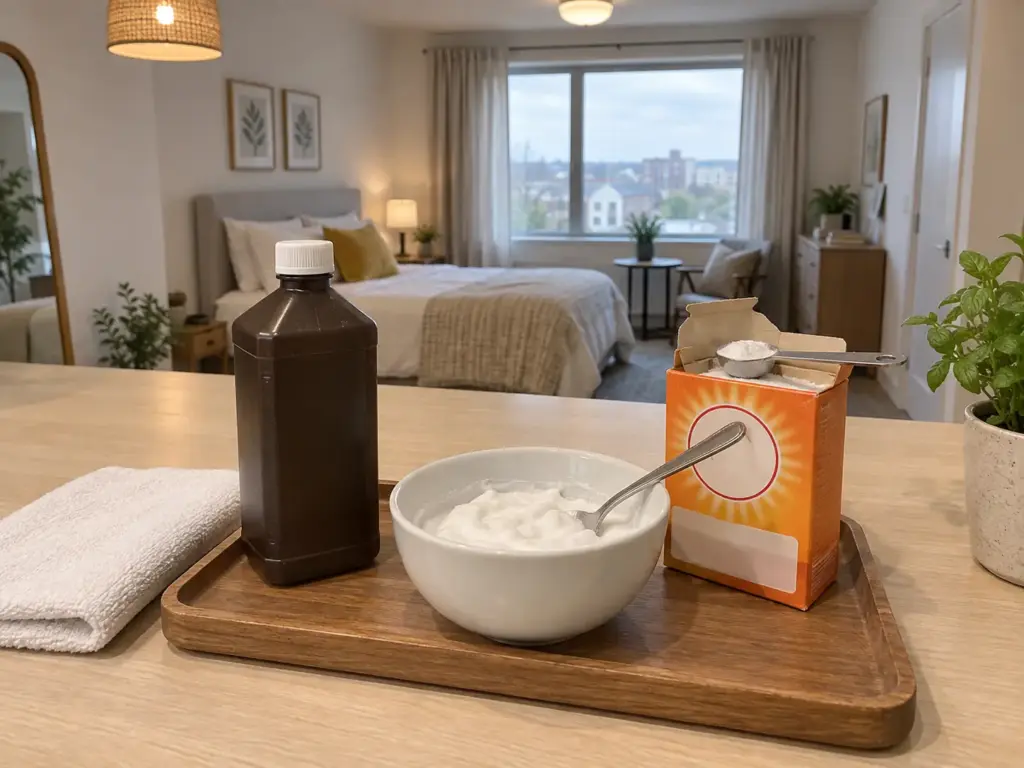
The instinct with a stain that’s had years to set is to throw everything at it. With these bottles it’s one at a time, and usually one is enough.
Oxygen Bleach and Peroxide Are One Tool at Two Strengths
Oxygen bleach is sodium percarbonate, a powder that breaks down in warm water into soda ash and hydrogen peroxide. So the scoop of oxygen bleach in the drum and the peroxide paste you work in by hand are doing the same chemistry. One is diluted across a full drum of water and touches every inch of the pillow; the other is concentrated on the patch where the yellow is.
Start with the free one. Mix three parts baking soda to one part 3% hydrogen peroxide (the brown grocery-store bottle) into a paste thick enough to sit on the fabric without running. Work it into the yellow with a soft brush or your fingertips and leave it at least half an hour before the wash; on an old patch, longer does no harm. If you’d rather not mix anything, spray the 3% peroxide straight onto the stain and give it about 10 minutes before the pillow goes in the machine.
Peroxide lifts color, which is the whole point on a white shell. On a colored or patterned one, do a spot test on a hidden corner first.
Sun adds a third push afterward. UV bleaches as well, so sun-drying a treated white shell keeps working on whatever the peroxide left behind. It costs nothing, and on a cotton shell it’s the easiest finishing step in this whole method.
Oxidizers take the color, not the oil underneath it; if this pillow has come back yellow after an earlier cleaning, the oil under it wants an enzyme detergent first, and the enzyme step and the temperature it needs belong to a pillow that’s already been through the wash once.
Why Chlorine Bleach Is the Wrong Bottle
Chlorine bleach looks like the obvious escalation. Stronger bottle, whiter result. It isn’t a stronger oxygen bleach, though: sodium hypochlorite is a different chemistry, and on a brown or yellow mark it can go the wrong way. The American Cleaning Institute’s stain removal guide files brown and yellow discoloration under one heading, and the warning it prints there (written with rust in mind) is that chlorine bleach “may intensify discoloration.”
It also does nothing for the oil under the color, so even when it seems to work, the yellow has everything it needs to come back. And repeated chlorine soaks weaken cotton fibers, which is a poor trade on a shell that has already carried years of heads.
The usual line is that a little chlorine is fine on white cotton. On a plain white sheet with nothing on it, maybe. On a yellow made of oxidized sweat, oxygen bleach is the tool and chlorine is the gamble.
Here’s what losing the gamble looks like. You soak the pillow overnight, rinse it, and it comes out a harder, brassier yellow than it went in, with the edges of the patch sharper than they were before. There’s no easy way back from that.
Never in the Same Bottle
The worst version of this afternoon is two products on the same stain because each one worked on something else once. The pair that matters most is chlorine bleach and anything with ammonia, which includes a lot of glass and multi-surface cleaners. The National Capital Poison Center is blunt about it in poison control’s own warning on mixing cleaners: “Ammonia should never be mixed with chlorine or bleach products. This can release a highly irritating gas known as chloramine.”
Chlorine bleach and vinegar is the second bad pair, because the acid pulls chlorine gas out of the bleach. And the pair people don’t expect is peroxide and vinegar. Each is fine alone, and both turn up in the same stain-removal advice, but combined in one bottle they form peracetic acid, a corrosive vapor that irritates eyes and lungs. A different chemical, not a stronger stain remover.
So: one agent, rinse it out completely, and only then another, if at all. For this stain you mostly won’t need the second one.
If something already got mixed and the room smells sharp, open the windows, leave, and call Poison Control at 1-800-222-1222. That’s their job, not a pillow article’s.
One agent per round, and rinse between rounds. If the label on a second bottle doesn’t say plainly what’s in it, that bottle doesn’t go on the same pillow that day.
Down, Feather and Fiberfill: The Pillows That Can Take a Soak
These are the good news of this article. A woven cotton shell over a loose fill can go completely wet and dry out again, so the oxidizer reaches every square inch the sweat did. But the down pillow that’s been on the bed longer than the bed frame and the cheap fiberfill spare in the closet don’t come out of it the same way.
Spot the Yellow First, Then Wash the Whole Pillow
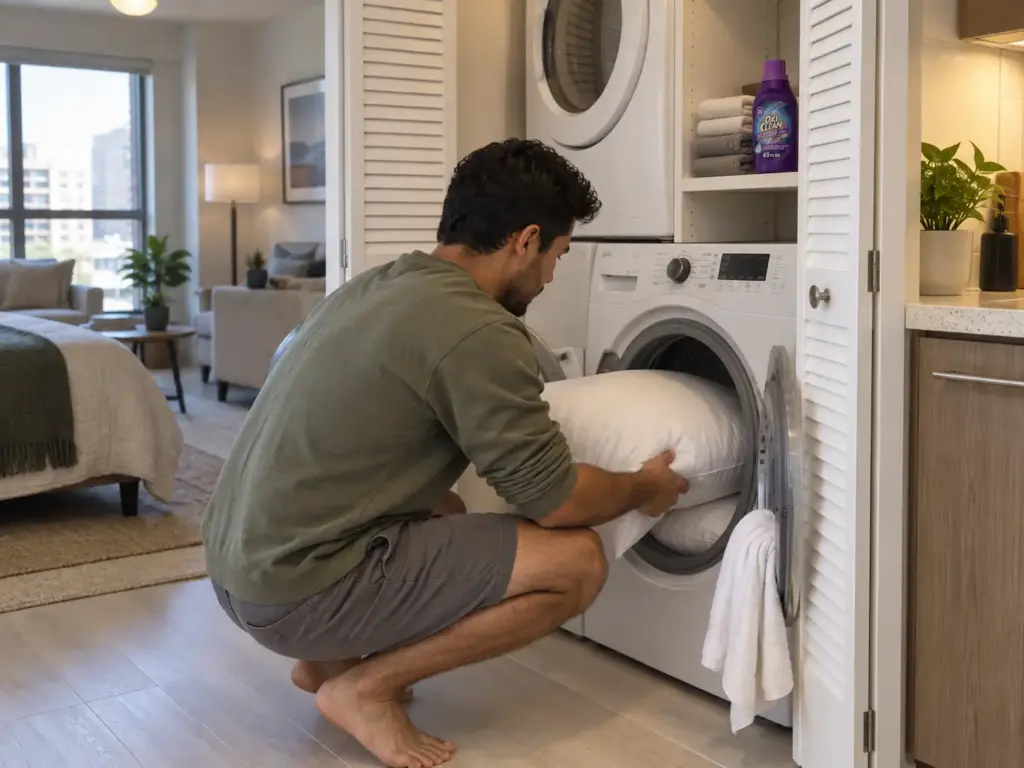
Check that the care label says machine washable first; most down, feather and fiberfill pillows are. Then pretreat before the machine, not in it: the paste or the peroxide spray worked into the yellow patch and left to sit. The American Cleaning Institute gives the same order for any stain (pretreat, let it soak in, then launder), and it’s the wash order that works on sweat on sheets as well.
Then the wash, in this order:
- Load two pillows at a time to balance the drum. Well, two of the same fill: a down pillow and a fiberfill one dry at different speeds, and you’ll end up pulling one out early.
- Use a front-loader, or a top-loader without a center agitator, which is kinder to the seams.
- Set warm water and use a normal dose of detergent, or a little less, because extra detergent stays in the fill.
- Add oxygen bleach with the detergent.
- Run an extra rinse.
If there’s no oxygen bleach in the house, the OxiClean Odor Blasters Odor Laundry Liquid Additive is a liquid oxygen-based additive that goes in the drum with the detergent and treats the whole shell at once, and at 45 fl oz it covers a lot of pillows. It’s a wash additive, not a spot treatment: on yellow that has sat for years, one cycle lightens it but won’t always clear it, which is why the paste goes on first.
Check It Wet, Before the Dryer
This is the step that decides whether the afternoon worked. Dryer heat sets whatever yellow is left, and the ACI’s rule for every stain in its guide is to keep the piece out of the dryer until the stain is gone.
Take the pillow out wet and hold it up to the window. Wet cotton reads darker, and a soaked down pillow looks flatter and grayer than it will once dry, so don’t judge it by itself. Lay a dry white pillowcase next to the patch and compare the two.
Still yellow? Paste it again and run a second wash. If this is already the pillow’s second trip through the machine for the same stain, the full redo for a pillow that’s already been washed picks it up from there.
Lay a dry white pillowcase beside the wet pillow at the window. Wet cotton lies about its color, and a known white right next to the patch is the only reliable way to see whether the yellow actually moved.
Why Fiberfill Comes Out Lumpier Than Down
Down re-lofts. Each cluster is a three-dimensional puff that opens back up as it dries, so a down pillow dried slowly on low heat comes back close to where it started. Polyester fiberfill is a mass of fine synthetic fibers, and wet agitation tangles them into mats that dry in place. The phrase people use after the first wash is “clumped up,” and it’s accurate.
Tennis balls or wool dryer balls get recommended for both, and they do help. On down they’re most of the fix. On matted fiberfill they only fluff the surface, so stop the dryer halfway, pull the pillow out, break the clumps apart with your hands, and finish on low.
Patience beats heat on both. A down pillow that feels dry outside can still be damp at the center, and you’ll find out the next night, when it smells like wet feathers.
Fiberfill survives the method. It just gives up some loft every time, which is why the spare fiberfill pillow is always the first to need replacing while the old down one keeps going.
Memory Foam, Latex and Buckwheat: What You Can Reach and What You Can’t
Everything in the last section depends on water getting in and getting back out. These three fills are the ones where it either can’t get out or shouldn’t get in.
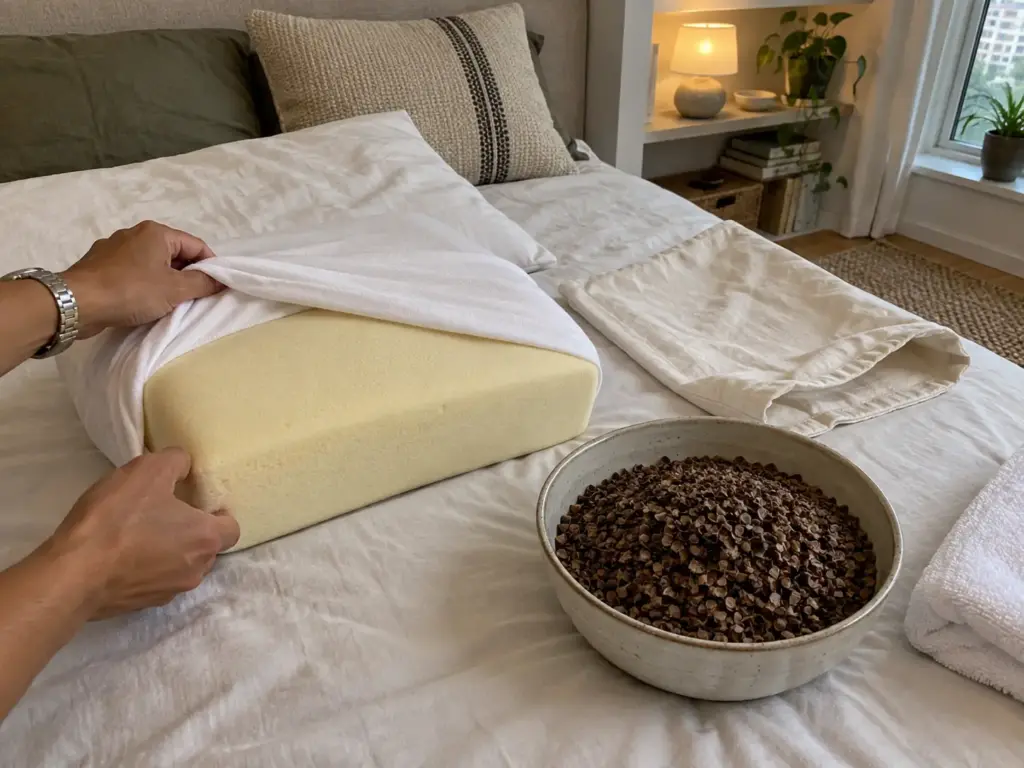
The r/CleaningTips thread about a memory foam pillow that went through the washer by mistake reads like a warning label. One reply gave it “a reasonably good chance it may be ruined,” and another raised the bigger worry: “It might grow mold on the inside.”
Foam and Latex: The Cover Washes, the Block Gets Spot-Cleaned
Memory foam and latex never go in the washer or the dryer, and the reason is mechanical. An open-cell block soaks up water like a sponge, and with nothing wringing it out it can take days to dry all the way through; one commenter in that thread left a rescued foam pillow outside for “3-4 days” before it was usable. A center that stays damp that long is where mold starts. Dryer heat, meanwhile, breaks foam down and can warp the block out of shape.
What you can do:
- Unzip the cover and wash it as a plain piece of fabric, with the method from the down section: paste, wash, check it wet.
- On the block, treat only the surface. Dampen a cloth with a little of the peroxide mix and blot it onto the yellow patch.
- Let the block air-dry completely, somewhere with moving air, before the cover goes back on.
Squeeze a block that feels dry on the outside and pay attention to the inside. If it still feels cool against your hand, it’s still wet, and it isn’t going back in its cover yet.
Sun gets recommended everywhere as the free finisher, and on a white cotton shell it earns that. On a foam block it’s half a help: it dries the surface and speeds up the same yellowing you were trying to get rid of, and long hours of UV break the foam down besides. Shade and a fan do the job better.
The block never goes in the machine, for the same reason a foam pillow can’t be washed after a flu.
Blot, don’t rub, on foam. Rubbing tears the surface cells and leaves a fuzzy, crumbling patch. A damp spot the size of your palm is the most a block should take in one go.
Why a Foam Block Yellows From the Inside
When polyurethane foam is made, water reacts with the isocyanate in the mix and forms an amine that stays in the foam. Over time that amine oxidizes into yellow compounds called quinones, and UV, heat and humidity all speed the reaction up; that’s the foam industry’s own explanation of the chemistry. The color keeps deepening for as long as that reaction runs, which is the life of the pillow.
Latex takes a similar path as it ages, darkening from the inside and, much later, turning crumbly at the surface.
So an evenly amber foam block isn’t dirty, and no cleaner reaches it. You can work the same paste that cleared a cotton shell into the block, wait, rinse, and nothing moves, because there was never a surface stain to lift. The color is in the polymer.
That’s a lifespan question rather than a cleaning one, and how long each pillow fill actually lasts answers it fill by fill. Honestly, color alone isn’t the verdict on foam: a yellow block that still springs back and holds your head where it should is still doing its job.
Buckwheat: Empty the Hulls, Wash Only the Cover
Buckwheat is the easiest of the three to get wrong, because from the outside the whole pillow looks like fabric. Open the zip and pour the hulls into a big bowl or a paper bag first. Buckwheat pillow makers are clear on the one rule that matters: the hulls themselves never get wet.
When you pour them out, look at the bottom of the bowl. A layer of fine dust and broken hull bits means they were due a sift through a colander anyway, stain or no stain.
Then wash the empty cover on a cold, gentle cycle (or hand wash it in the sink) with a small amount of mild detergent and no bleach, which is what the makers’ own care instructions call for. That’s a gentler wash than a down pillow gets, so expect less lift on an old yellow patch. Dry it completely before a single hull goes back in.
The hulls get air instead. Spread them on a tray in the sun for an afternoon and a faint smell usually clears. A strong musty one means moisture reached them at some point, and at that stage they’re replaced, not washed (most makers sell refills separately).
How White It Will Get, and When to Stop Trying
Every method above works on pillow yellowing. None of them brings a five-year-old pillow back to the day it came out of the bag, and it’s better to know that now than an hour into the second soak.

Lighter Is the Win on an Old Stain
Oxidized yellow comes out roughly in proportion to how long it had. A patch that built up over a few months often clears completely in one round. Yellow that’s had years usually gets lighter, sometimes a lot lighter, and then stops, because part of it has become a set-in stain, bonded into the fiber instead of sitting on it. That’s where the whitening ends, whatever the bottle says.
You’ll see this the moment the clean pillow goes back on the bed. On its own it looks white. Slide a brand-new case over half of it and the uncovered half reads faintly cream.
That’s a success, not a failure. The case covers it anyway.
Two Rounds, Then Decide
Give the pillow two full rounds: paste, wash, check it wet. If the second round moved it a shade, a third might move it another. If the second barely moved it, a third won’t, because what’s left is either set into the fiber or coming from the core.
At that point the pillow has stopped being a cleaning question, and another afternoon of soaking won’t answer it.
Keeping the Next Stain From Setting
The free habits come first, and they’re dull ones. Dry your hair before bed instead of sleeping on it wet, give night skincare a while to sink in before your face meets the pillow, and wash the pillowcase every week. All three cut the sweat and oil that reach the shell.
Then the barrier. A zipped cotton protector between the case and the pillow takes the sweat first and goes in the wash with the sheets, while the pillow stays on the bed. The FAUNNA 600TC 100% Cotton Pillow Protector is woven 100% cotton with a zipper, standard 20×26, and comes four to a pack, so two can be on the bed while two are in the wash. It’s prevention, not a cure: it does nothing for the yellow already in the pillow you just cleaned, only for the next one.
Check the size before you order, too. A queen or king pillow won’t close inside a standard protector, and one that gapes at the zipper lets the sweat straight through to the shell.
Wash the protector every time the sheets go in, not when it starts to look yellow. By the time the protector shows yellow, the shell under it is already getting the overflow.
The Tag Decides, the Window Confirms
Three things carry this whole method. Read the fill before you open a bottle, because the fill decides whether the pillow soaks or only its cover does. Use an oxidizer, never chlorine, and never two agents in the same bottle or on the same stain in one round. Soak the soakable pillows and check them wet at the window; spot-clean the foam and latex, and keep buckwheat hulls dry.
Over the years, watch the fiberfill pillow each time it comes out of the dryer. Once it stops springing back after a proper dry, it’s telling you its age, not how clean it is.
Take the case off tonight and look at the tag. That’s the whole first step.
Frequently Asked Questions
01What removes yellow stains from pillows?
An oxidizer removes them: hydrogen peroxide, or oxygen bleach that releases peroxide in warm water, because the yellow is oxidized sweat and oil set into the shell. On a washable pillow, a baking soda and peroxide paste on the spot plus oxygen bleach in the wash does it. Foam and latex cores only get spot-cleaned.
02How can I turn yellow pillows white again?
Pretreat the yellow with a baking soda and peroxide paste, wash the pillow warm with oxygen bleach, and check it wet before it goes anywhere near the dryer. That works on washable down and fiberfill. Months-old yellow can come out white; years-old yellow usually ends up lighter and faintly cream.
03Why do I leave yellow stains on my pillow?
Sweat, skin oil and saliva (drool, plainly) soak through the case into the pillow shell, then slowly oxidize when they meet air, and that reaction is what turns them yellow over months. Wet hair and night creams add to it. The full mechanism is in why pillows turn yellow and which ones come clean.
04Can you put a memory foam pillow in the washing machine?
No, a memory foam pillow should not go in the washing machine, because the block soaks up water and takes days to dry, which risks mold growing inside it. Machine-wash the removable cover instead, spot-clean the foam with a damp cloth, and let it air-dry completely.
05Should I throw out yellow pillows?
Not because of the yellow alone: a washable pillow whose shell comes clean, or at least a lot lighter, is still a perfectly good pillow to keep. An evenly amber foam core, musty buckwheat hulls or fiberfill that no longer springs back after washing means the pillow is finished, not the stain.





Tried it on your own bed?
No comments yet. Tell us what you changed, and what the sheet did after a few washes.