







What’s in here7 sections
- What Memory Foam Does Under a Head That Fill Does Not
- Better Than Down or Polyester? Decide by the Failure You Have
- Solid Block or Loose Shreds — Which One the Problem Calls For
- Heat, a Cold Room and the First Weeks
- Month Six, and the Point Where It Stops Being the Pillow
- Settle the Height With a Towel Before You Pick a Fill
- Frequently Asked Questions
You are about to swap your pillow because someone said memory foam is better, and the question that settles it is the one they skipped: better than what is on your bed now, and failing in which way? Memory foam gives under a head and returns slowly, so it keeps the dent and the height it made, while loose fill is pushed around all night and finishes somewhere else.
So “are memory foam pillows better” has no answer until you know whether your current pillow fails by sinking or by shifting. A r/Bedding thread from someone who gave up on foam shows where it really goes wrong: they were not leaving the material, they were leaving the adding and removing of loose pieces every night. The comparison comes first below, against down and against polyester, then block against shreds, heat, a cold room, the first weeks and month six.
Quick Answer
Memory foam pillows are not better in general. They beat down and polyester at holding the same height every night and lose where a pillow has to be reshaped, and some owners report heat. If your pillow sinks overnight, foam is the likelier fix; if it needs reshaping, fill is.
Foam is one branch of every fill a pillow can have, and the verdict below only makes sense once you have seen what the others do with the same head.
What Memory Foam Does Under a Head That Fill Does Not
Foam does not feel better or worse than fill; it behaves differently the moment a head leaves a dent, and every verdict further down comes from that one difference.
A slow dent that stays a dent
Memory foam is a visco-elastic polyurethane foam that gives under weight and returns to its shape slowly. Press a palm into one for a second and lift it away: the print of your hand stays for a moment, then fills in. A head does the same thing over a night, and for as long as the head is resting there the foam holds the shape it made. That held shape is what people mean when they talk about contour.
Do the same in a down pillow in the same room and the behavior reverses. The hand sinks, the clusters of down move out of the way, and when the hand lifts the pillow is already rising back, with no print to speak of. Neither behavior is the correct one. Foam is a pillow that remembers where the head was, down is one that forgets, and each suits a different failure.
The two also show their hand at different speeds. A foam pillow tells you what it is on the first morning (too tall, too thin, about right), while a fill pillow often needs a few nights before you know where the fill has settled under your head. Height is the one thing foam commits to, so it is worth knowing how to measure the loft instead of guessing it before the pillow is bought rather than after.
One height until it wears out
A one-piece foam pillow keeps its height from night to night. The head that lands on it Monday lands at the same height on Friday, which is the specific thing foam does better than anything loose: a sleeper whose old pillow ends every night too low gets an end to that. The height stays fixed until the foam itself gives out, and that is a month-six question, covered at the end.
Loose fill, whether down, polyester or foam shreds, is a different arrangement. The head moves the pieces, the pieces settle where the weight was, and the pillow finishes the night at a height it did not start at. For some sleepers that is a nuisance. For others it is the whole point, since the pillow adapts when the sleeper turns.
One caution on numbers. The loft printed on a listing is the height of the pillow out of its bag and under no weight. What your head sees depends on how far the pillow compresses, how wide your shoulder is and how firm the mattress under it is, so two sleepers can read the same figure and need different pillows.
What loose fill does that foam cannot
Loose fill can be reshaped. Scrunch it, fold the pillow over, push more of it under the neck and less under the ear, and it stays that way until the head moves it again. A foam block cannot be folded into a new shape or pushed around, and if you turn between your side and your back during the night, a pillow that holds one shape is being asked to be two heights.
That is the trade, and the people who leave foam name it themselves. In the r/Bedding thread from someone who had tried molded and shredded foam and quit both, the complaint was the adjustable fill, because of “constantly adding and removing foam.”
The foam was fine. The chore was the problem. Keep that in mind when the section on shreds comes up, because it is the failure that sentence points to.
Better Than Down or Polyester? Decide by the Failure You Have
“Better” has no meaning until it has a second half, so this section names the two baselines most readers are sleeping on now, down and polyester, and starts with the one comparison that costs nothing.
Measure the gap first, for free
Lie on your back in your own bed with the pillow you have and notice where your chin points. If the pillow tips your head forward so the chin drops toward the chest, it is too thick. If your head and neck fall back, it is too thin.
This is a measurement of the bed, not of anything inside you. On your side the same idea reads as a gap, the distance from your ear to the mattress past the shoulder, which the pillow has to fill.
The towel test is simple: a fold of towel under a pillow that is too thin adds the missing height; taking a layer out of a stack removes it; a different pillow already in the closet is a third try. All three cost nothing and take one night to read. Plenty of “my pillow went flat” complaints are a height problem that foam would only repeat in another material, so settle the height before a purchase, not after.
Fold the towel to the height your chin test asks for and sleep two nights on it before you buy anything. Then check the chin test again in the morning: if the pillow passes at bedtime and fails by morning, the fill is losing height overnight and a towel will not fix that.
Against down
Down vs memory foam comes down to one exchange: down changes shape under a head and has to be fluffed to stand back up; foam keeps its height and cannot change shape. It explains why neither wins by default.
The down side of this article is the Canadian Down & Feather Co. Soft 625 Fill Power White Down Pillow, filled with 625 fill power white down under a 500-thread-count cotton cover. Fill power is the volume one ounce of down takes up, so a higher number means more loft for the same weight of fill. A pillow like this one stands tall when fluffed and flattens a little under a head, which is a feature if you want to push it into a shape and a failure if you wake up lower than you went to bed.
A reader in a Quora thread weighing the two gave the practical drawback: “Down fill is ok, but can be pricey to replace.” That is one reader’s opinion, not a defect of this pillow, but it is the cost of a pillow that has to be replaced when its fill gives out.
So against down, foam wins on keeping a height and down wins on changing shape. If your complaint is a head that ends the night lower than it started, foam answers it. If your complaint is that no single shape stays right, down does, and how much fill weight sets the height is covered in how fill weight sets the height in down and down alternative.
Against polyester
Polyester is the pillow most beds already have, which makes it the fair thing to compare foam to. The Canadian Down & Feather Co. Soft Support Microfiber Down Alternative Pillow is the plain version of it: polyester fiberfill in the form of microfiber, made to imitate the clustering of down, inside a 260-thread-count cotton shell. It moves under a head like any loose fill, and it comes back with a shake.
A maker of foam pillows, answering the same Quora question, says down and synthetic fill “can compress and lose height over the course of the night.” The maker sells foam, so read it as a rival’s claim and not as a test of this pillow. It is also easy to check in your own bed: look at how tall the pillow stands when you lie down and again when you get up. (If it is visibly lower, you have your answer without spending anything.)
Polyester is also where a tight budget tends to land, and what you give up on a budget is worth reading fill by fill before you decide the cheap pillow is the problem. Against polyester, foam is better at holding a height and worse at being reshaped, the same trade as against down.
The same three, side by side
The decision is made by the failure, not by the material. If your pillow sinks overnight, foam is the likelier cure, since it holds the height fill gives up. If you re-set the pillow every night, fill beats shredded foam, and a solid block beats both because there is nothing to re-set. If the complaint is that the pillow runs warm, none of these gets a verdict here, because heat is where the claims run furthest ahead of any measurement, and that has its own section below.
| Under a head | Memory foam | Down | Polyester |
|---|---|---|---|
| What it does | Gives slowly, holds the dent | Moves, takes the head’s shape | Moves, springs back with a shake |
| What you can change | Solid: nothing. Shredded: the amount of fill | Fluff it, fold it, reshape it | Fluff it, reshape it |
| What fails first, as reported | Shreds go flat; a cold room firms the foam | A reader calls it pricey to replace | A foam maker says it compresses overnight |
| Washing | Solid: care labels wash the cover, not the foam. Shredded: care label decides | Care label decides | Care label decides |
| Heat | Reported by some owners, not measured | Not measured | Not measured |
Solid Block or Loose Shreds — Which One the Problem Calls For
Foam is two pillows, not one, and the second half of “better” depends on which: the choice is settled below by the failure, and the construction itself is covered in how shredded and solid foam differ in the way they hold height.
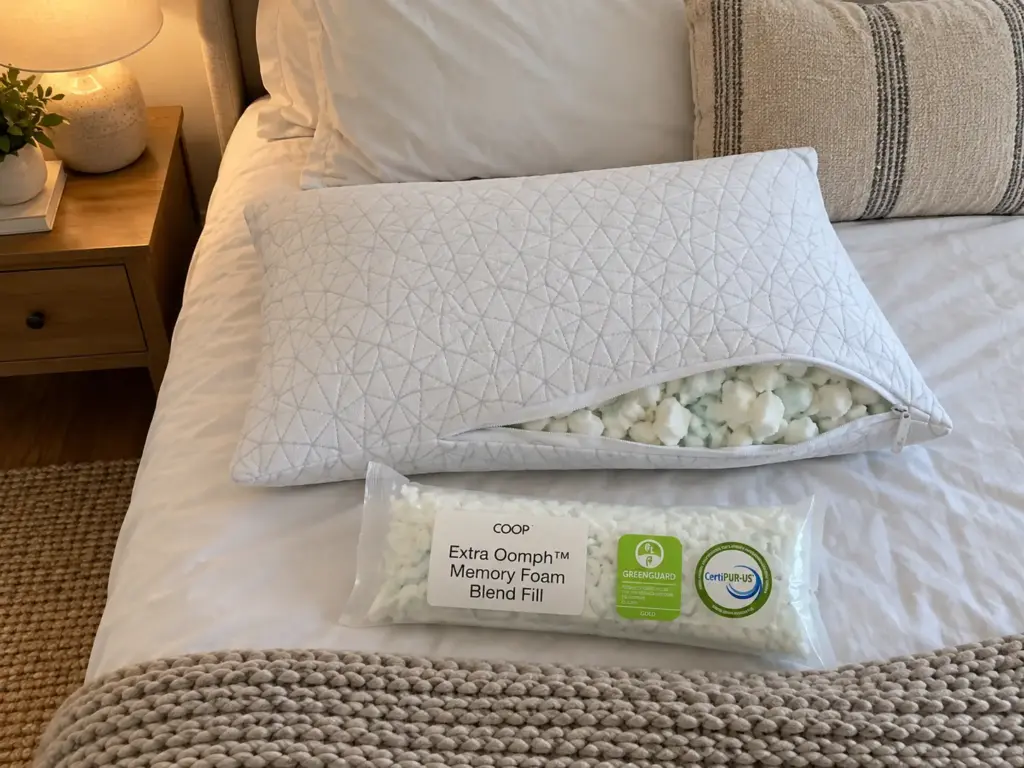
Solid: the height you cannot change
A solid memory foam pillow is one piece with one height and one shape, and there is nothing to adjust. That is its strength and its limit in the same sentence. If the height is right, it will be right every night; if it is wrong, it is wrong for the life of the pillow, and nothing you do to it changes that.
Thin ones suit a sleeper who needs little height, such as a stomach sleeper, or a back sleeper whose chin tips forward on a thicker pillow. The Bluewave Bedding Ultra Slim Gel Memory Foam Pillow is thin by design: gel memory foam in one piece, 2.75 inches high. The number is the point and also the flaw. It is not a stand-in for the taller blocks people picture when they think of a memory foam pillow, and anyone whose ear-to-mattress gap is large will find it far too low.
Run the chin test from the section above first; if you tip forward on your current pillow, this height is worth knowing about, and the pillows for back sleepers article already settles latex against foam for that sleeper, so it is not argued again here.
One more thing about solid foam: its failure comes early. If a block is wrong for you, you know on the first night. That is a kinder failure than a pillow that slowly drifts out of shape over months, but it only helps if the return policy and trial period still cover it.
Shreds: a height you set, then keep setting
Shredded memory foam is cut into small pieces and bagged inside a cover, so the height is whatever amount of filling is in there. Extra fill usually ships in the box, which is the selling point of an adjustable loft: fill removal gives a lower pillow, adding it gives a taller one. The catch is in the verbs. Moving fill in and out of the cover leaves pieces everywhere, and a pillow that is adjustable in theory becomes a pillow you keep adjusting in practice.
The Coop Home Goods Original Adjustable Pillow is the shredded example here because the adjustable argument rests on it. A back sleeper in r/Bedding took some of the foam out and was “very happy with it.” Its drawbacks come from owners too: one described the pillow as “also hottt” and put it in the bin, and in a r/BuyItForLife thread two owners found it too firm whatever amount of filling they used.
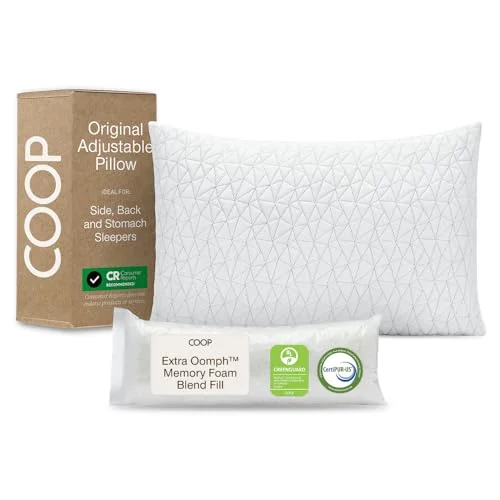
Before you buy a shredded pillow, check that the listing says spare fill is in the box. One owner brought theirs to the right height with the extra foam that shipped with it, and tells other buyers to look for that first.
What owners say once the box is open
The reports cluster around two things, firmness and the amount of fill. In the r/BuyItForLife thread, one owner found the pillow “just too firm for my neck” however much filling they put in or took out, and another said it was too firm no matter the filling volume and gave it up. Side sleepers split the other way on quantity: one said theirs “didn’t end up having anywhere near enough filling,” and another had “too much filler,” with holes appearing when any was removed and a pillow “about a foot tall and very firm” with all of it in. Same pillow, opposite complaints, which says the fill amount is a setting you have to find and not a promise the pillow keeps.
The long-term reports are just as divided, and they should be read as reports. One owner has had Coop pillows since 2018 and describes them as comfortable enough that they have not needed replacing, where they used to replace pillows every year. Another gave up and used the pillow to prop an arm, sleeping with an old pillow under the head. A third commenter called one shredded pillow the best they had ever owned, while another preferred a different brand.
The r/Bedding side of the story is about the chore. Owners talk about adding and removing foam, about “many empty spots” when there is too little fill, and about the pillow going flat. Washing comes up in the r/BuyItForLife thread, and the answer is not the machine: one commenter lists steaming, spot cleaning and a sink or bathtub wash, “maybe not machine wash because of all the fill,” and another owner realized the pillow could not be washed at all, which for a pillow meant to last is a problem.
Two sleepers, two heights
Two people in a shared bed almost never need the same height. One sleeps on a side with a wide shoulder and wants a tall pillow; the other sleeps on the back and finds the same pillow a block under the chin. A compromise height does for neither, so the structure that works is two pillows set to two heights, not one pillow set in the middle.
That is the one place shredded foam earns its keep, because the fill can be set separately for each side of the bed, while a solid block is whatever height it was made. It also means the chore of adjusting is done once per sleeper, not nightly, if the setting holds. Whether it holds by month three is a different question, and the three positions in one night a combination sleeper cycles through are where shifting fill is most put to the test.
Heat, a Cold Room and the First Weeks
Three things readers ask about most, heat, cold and smell, are the ones with the least measurement behind them, so this section says what is claimed, what owners report and what you can check yourself.

Heat: a claim and a complaint, no measurement
Foam has a reputation for heat retention. Sellers of shredded foam say it runs cooler because the gaps between the pieces let air move. Owners, meanwhile, report heat in both builds, and the r/Bedding owner who binned a shredded pillow said it was “also hottt.” No measurement settles the question either way, so this article will not tell you shredded sleeps cooler than solid, or the reverse.
What you can say is narrower and more useful. The pillow is one layer of a bed, and if the bed runs warm, the pillow is rarely the biggest part of it. Look at the mattress, the protector, the sheets and the duvet before blaming the fill, as laid out in the layers around the pillow that decide how warm the bed runs.
The cold room changes the pillow
Many types of memory foam get quite hard when the room is outside the normal household temperature range. One owner described an inexpensive foam pillow that turned into a foam rock when the heating failed in a blizzard, while the other pillows in the house were fine. That is one report, and no temperature threshold goes with it here because none is available, but the direction is clear: a foam pillow tried on a warm afternoon and slept on in an unheated bedroom in January can be two different pillows.
This is the kind of constraint that makes “foam beats fill for a sinking head” fail. In a cold bedroom the foam that holds its height also holds it stiffly, and a fill pillow that stays soft starts to look like the better choice. If your bedroom runs cold, test the pillow there, and read warm bedding for a cold bedroom for the layers that keep the room’s chill off the rest of the bed.
Try a foam pillow in the room it will live in, not the warm one where you bought it. Leave it in your bedroom overnight, then press a palm into it: if it has gone hard, you found out before the return window closed.
The first weeks and what the labels cover
A new foam pillow can give off an odor when it comes out of its wrapping (the word for it is off-gassing), and the labels on the box are easy to misread as a promise about that. They are not. CertiPUR-US certified foam is made with low VOC emissions, under 0.5 parts per million, and without formaldehyde, ozone depleters, regulated phthalates, mercury or lead. That limits what the foam is made of and what it gives off; it does not guarantee the pillow has no smell when you open it, and this article makes no claim about how long a smell lasts.
Take the pillow out of its wrapping and give it a ventilated room, a stripped bed near an open window works, before it goes under your head, and let your own nose make the call.
The second label is about the cover, not the foam. According to OEKO-TEX’s own description of Standard 100, Product Class II covers “Products with direct skin contact, such as bed linens.”
That tests the textile for harmful substances, and a pillow cover touches skin like a pillowcase does. It does not say the foam is tested, and nothing here claims it is. (A cover is the part you can wash, and the foam is the part you cannot, so the two labels are covering different things.)
Month Six, and the Point Where It Stops Being the Pillow
The closing test of “better” is what a foam pillow looks like after the novelty has gone: what happens to its height, what it cannot be cleaned with, how long its maker says it lasts, and the one case where the answer is not in the bedroom at all.

Going flat, and the chore of setting it again
A commenter in the r/Bedding shredded-foam thread put the month-six problem in plain terms: “They go flat and you need to literally pull on the outside fabric to get them to fluff.” The purchase was a year old. The pieces pack down under the head, and the pillow loses height before it loses its look. Nothing about the remedy is hard, but it is a chore, and the chore returns.
The long-lasting reports exist too, and they are reports, not tests. One owner with a shredded pillow “going on 4 years” calls theirs fresh and fluffy, and the Coop owner from 2018 has not needed to replace theirs yet. What you can take from both is that a shredded pillow lasts when it is looked after, and that looking after it is the price.
When a shredded pillow goes flat, grip the outside fabric and pull it away from the fill instead of punching the middle. That is how one owner gets the pieces to loosen and rise again.
What cannot go in the machine
On a solid slab the care labels tend to wash the cover and not the foam, and the label has the last word. Owners of shredded pillows describe steaming, spot cleaning and a sink wash, and one of them doubts the machine is a good idea with that much loose fill. So a foam pillow has a very different relationship with washing than the cotton on the bed around it. The sheet comes off and goes in the machine; the pillow stays where it is.
The practical answer for a pillow that cannot be washed is to keep what touches it washable: a cover that unzips and a pillow protector between the pillow and the case. A protector for a pillow that cannot be washed takes the washing load off the foam.
The maker’s two to three years
On durability, a vice president of product development at a foam manufacturer puts the typical lifespan of a memory foam pillow at two to three years, whether it is shredded or one piece. That is the maker’s number, not an independent test, and owner reports run longer: four years for one commenter, since 2018 for another. Treat two to three years as when to start checking, and not as an expiry date.
The check is physical. Fold the pillow, let go and see if it opens up; press into it and see if it comes back. How often to replace pillows, by fill gives the fold test read against each fill, foam included.
When the pillow is not the problem
Everything above is height, fill, heat and the bed. There is one place where it stops being any of those. According to the NHS neck pain guidance, the line for non-urgent medical advice is when “neck pain or stiffness does not go away after a few weeks.”
If that is you, it is a GP appointment, not another pillow. Below that line, the height, the fill and the room are what we can fix.
Settle the Height With a Towel Before You Pick a Fill
Three things carry over from everything above. First, “better” needs a second half: memory foam is better than down for a head that sinks and worse for one that wants to change shape. Second, a block is for a height you have already measured, and shreds are only worth it if setting the fill is a chore you will keep doing. Third, heat and the cold room are not measured, so test the pillow in the room it will live in.
Once the pillow has been slept on for months, check the height again, because it goes before the look does: lie on your back and see whether your chin still points where it did in the first week.
And the one free change to make tonight: fold a towel to the height your chin test asks for, put it under the pillow you already own, and notice whether the problem was ever the pillow’s material or just its height.
Frequently Asked Questions
01What are the downsides of memory foam pillows?
Owners report five practical downsides: firmness in a cold room, one fixed height in a solid block, nightly adjusting with shreds, heat for some sleepers, and limited washing. These are owner reports, not measurements, and the care label has the last word on washing.
02Why are people no longer buying memory foam?
Owners who walk away from foam name specific reasons, not the material itself: the nightly adding and removing of shreds, firmness that no amount of fill fixed, heat, and washing limits. No sales figure is claimed here, only the reasons given.
03Are memory foam pillows better than down?
Memory foam is better than down at keeping one height and worse at changing shape, so the failure of your current pillow decides it. A head that sinks overnight points to foam; a pillow you want to fluff and reshape points to down.
04Can you wash a memory foam pillow?
The care label decides: on a solid foam pillow the care labels wash the cover and not the foam, and owners of shredded ones describe steaming, spot cleaning or a sink wash rather than the machine. A protector takes the washing load off a pillow that cannot be washed.
05How long does a memory foam pillow last?
A vice president of product development at a foam manufacturer gives two to three years, for shredded and one-piece alike, and some owners report four. That is the maker’s number, not an independent test, so use the fold test to decide when yours has gone.





Tried it on your own bed?
No comments yet. Tell us what you changed, and what the sheet did after a few washes.