

What’s in here7 sections
- Why the Dryer Says Done While the Middle Is Still Wet
- Heat by Fill, and Why the Sources Disagree
- Counted Cycles and the Check That Ends Them
- Dryer Balls, Towels and How Many Pillows Per Load
- The Air Finish, and When the Dryer Is the Wrong Tool
- Press the Middle Before the Case Goes Back On
- Frequently Asked Questions
You lift a pillow out of the dryer, press the case, and it comes out warm and light. By the second night on the bed the middle is cool and heavy, and the case still feels dry.
That is what drying pillows by the dryer’s idea of done produces: the cover and the cycle sensor both read the outside, while the fill keeps its water in the center, where neither one reaches. What follows is why the dryer stops early, what heat each fill can take, how to dry in counted rounds, and what helps along the way. It picks up where the full wash path for pillows leaves off.
Quick Answer
A washed pillow is dry when its middle is dry, not its cover, and these steps get it there.
- Read the care label, then choose low heat or no heat to match the fill.
- Skip the auto-dry setting, because its sensor only reads the surface.
- Add two fresh tennis balls and a couple of dry towels to the drum.
- Run a round, take the pillow out, fluff it and let it cool.
- Press the center with your palm; cool, damp or heavy means another round.
- Finish on a line or flat in fresh air, and never bed a damp pillow.
Why the Dryer Says Done While the Middle Is Still Wet
The spin cycle in the washing machine leaves a washed pillow heavier than any single drying cycle can account for, and the dryer and the pillow measure dry in two different places.
The sensor reads the outside
A dryer with an auto-dry setting guesses at dryness from the surface of what is tumbling past it, and a pillow is the one load where the surface is the least honest part. According to Consumer Reports’ pillow-washing guide, you should skip that setting “because the sensors will detect only surface moisture, leaving you with a pillow that’s still damp on the inside.” The Sleep Foundation’s washing guide says the same thing from the other direction: extra time may be needed to dry the interior fill even when the cover feels dry.
Why the inside holds on is plain reasoning about how a fill behaves, not something either source measured. The cover is a single thin layer facing the hot air, so it gives up its water first. The fill behind it packs into a clump after the spin, and water inside a clump has the whole clump to work its way through before it can leave. The cover is dry, the sensor is satisfied, and the cycle ends with the wet part still sitting in the middle.
A wet pillow weighs more than it looks
Weight is the first signal you have, and it needs no timer. Washed pillows can come out saturated, carrying a surprising amount of water. Most of that water is removed before the dryer ever starts, which is why the spin that sets how long they dry matters more than any dryer setting. This page starts after that spin and does not argue it again.
Lift the pillow before the first round, and again after each one. A pillow that is still wet inside feels like it has more mass than the same fill should, and the difference you feel from one round to the next tells you whether the middle is giving anything up.
Keep a dry pillow of the same fill from the same bed as your reference. Hold one in each hand: a washed pillow that still outweighs its dry twin is not finished, whatever the cover says.
What a dry cover is hiding
A goose-feather pillow can run through the dryer several times on extra dry and high heat and still be soaked in the middle and at the edges. A pillow that is much heavier than it should be is a lot less dry than it feels.
Six runs at the hottest setting did not finish the job, and that is the useful part. Heat was never the missing ingredient. The missing ingredient was something to break the clump so the water inside it had a way out.
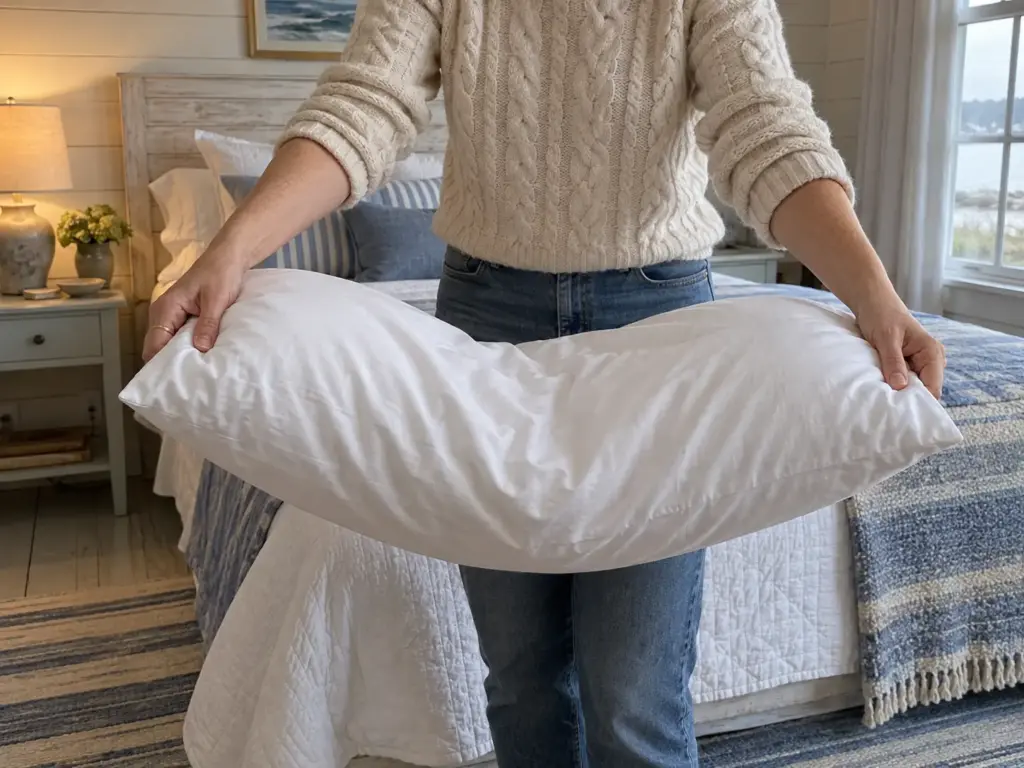
You can test for the same thing without any reference pillow. Hold the pillow level by its two short ends and let the middle hang. A heavy pillow whose center droops while the ends stay firm is still carrying water there, whatever the cover says.
Heat by Fill, and Why the Sources Disagree
Three sources give three different answers on heat, and most of the disagreement is about which fill each one has in mind, so the fill gets named before the setting does.
Down and feather: the lowest heat, or none
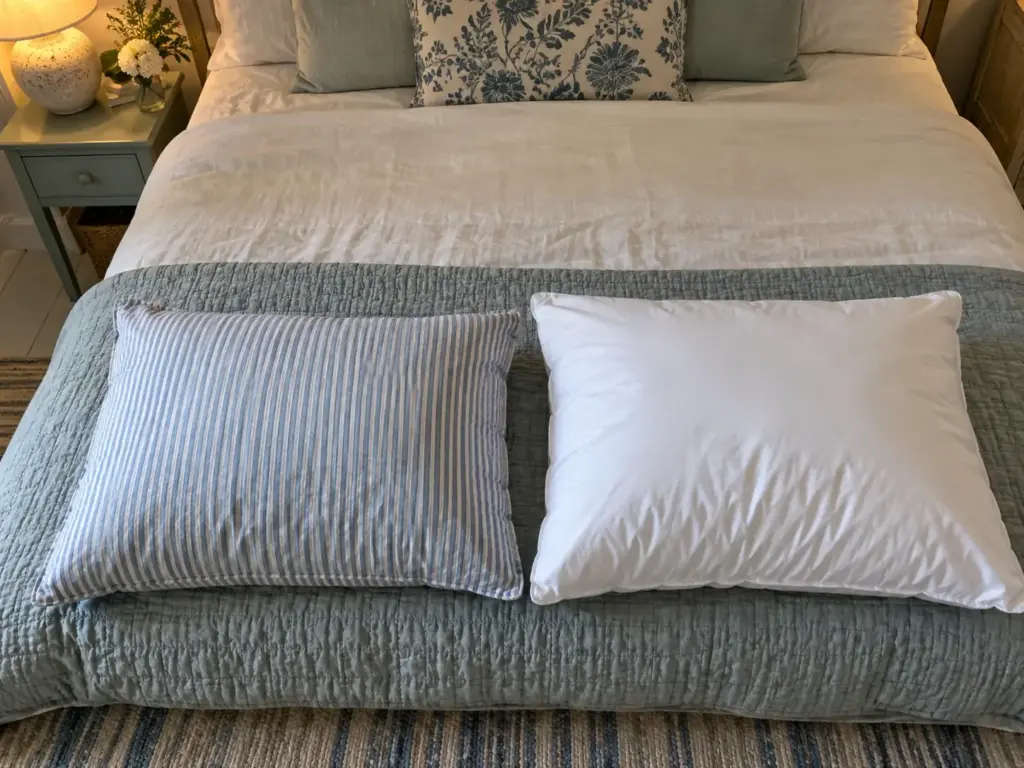
For down and feather, the Sleep Foundation says to use the lowest heat option over multiple cycles. Consumer Reports goes further and puts them on the no-heat air-dry setting, with dryer balls or tennis balls to break up clumps, and warns that it will take a while. Both are describing a fill whose structure is the whole point of the pillow, and what each pillow fill is and does explains why that structure is worth protecting. Maytag, which sells the dryers, gives the mildest answer of the three: a machine-washable pillow can go in on a no-heat or air-dry cycle, because heated cycles can alter and possibly damage the filling.
Polyester and throw pillows: low to medium
Polyester fill is more forgiving, and the guidance reflects it. The Sleep Foundation says throw pillows can tumble dry on low or medium heat with a low tumble setting if the machine offers one. Consumer Reports says many pillows can be dried for a good hour on low to moderate heat.
Notice what each of them leaves out: no one gives a temperature, because the dials differ from machine to machine. Low on your dryer is the setting the label would call low, and the label is the part that decides.
Where the guides contradict each other
No heat, low or medium, and an hour on low to moderate reads like a fight between three sources. It is closer to three descriptions of three fills. Even one source shifts with the fill: Consumer Reports’ washing steps say low heat for down, and its drying steps say the no-heat setting.
Rather than pick a winner, take the rule that holds across all of them. The fill decides, the care label names the setting, and when the label says nothing the lower heat is the one that cannot hurt the pillow.
Hot drying has a cost you can only see afterward. A feather or down pillow dried too hot can come out flat and slightly stiff, and fluffing does not bring that back. That is a loft problem rather than a damp one, and the free fix for it sits in a low-heat dryer as a free loft fix, the same tool used gently. A hotter cycle also does not rescue a pillow that is wet inside, as the six-run feather pillow already showed.
Counted Cycles and the Check That Ends Them
Time is the wrong unit; the number to count is rounds, and the thing that ends the count is a press on the center of the pillow.
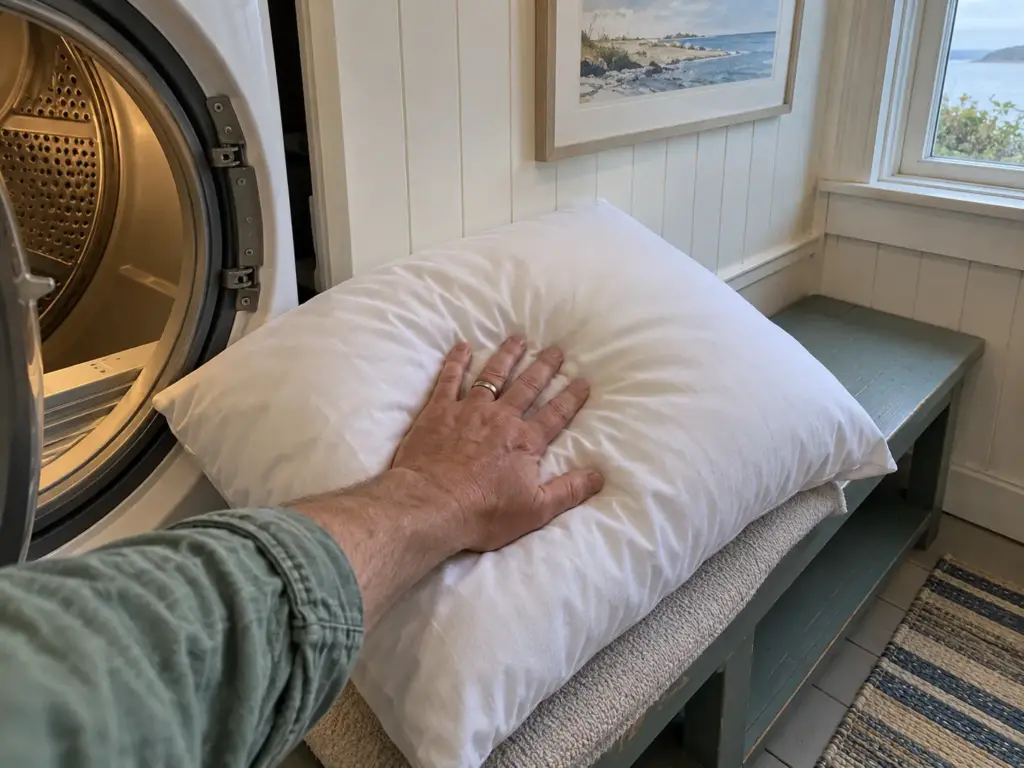
A round, a fluff, a press
A round is one run on the setting the fill allows. When it ends, take the pillow out, fluff it hard to break up whatever clumped, and check it before it goes back in.
Consumer Reports says most pillows can be dried for a good hour on low to moderate heat, and that is as close to a clock as the drying time gets. It also says, “Whichever drying technique you use, you still need to check for moisture inside the pillow.” The Sleep Foundation adds the same break between rounds for down and feather: fluff between cycles to break up the clumps.
The check itself is the one in the press at the center that tells you it is dry. To check the center, use the flat of your palm there first, then on the corners. Cool, damp or heavy at any of those spots means another round, and the round count keeps growing until all three feel the same as a pillow that never got wet.
Press the center a full minute after it leaves the drum, not while it is still hot. A fresh-from-the-dryer pillow is warm all through, and warm reads drier than it is.
What done feels like in the middle
Maytag’s guide says a pillow should be completely dry before it comes out of the dryer, and that is the stop rule: completely dry, not a timer that rang. Done feels like the pillow in your other hand, the one that never got washed. The center springs back when you press it, it carries no chill, and it weighs what it weighed before the wash. If any of those three is off, the round that was supposed to finish it has not happened yet.
The middle that was damp on the first press is also the part that gives itself away later. Put the pillow back on the bed with that spot still holding water and the smell shows up first, a faint sour note on the second night, which is the fill telling you the last round never ran.
Why a hot pillow lies
Warm fiber feels dry because the water inside is held warm too, and your palm cannot tell warm from dry at that point. That is why the press waits a minute outside the drum. It is also why the same pillow can feel finished at the machine and cool and clammy by the time you carry it to the bed. Let it breathe on a counter or a rack, check again, and only then call it done.
Dryer Balls, Towels and How Many Pillows Per Load
The tools that help are cheap and one is free; what they do is keep the fill from clumping, which is the same job a hand does between rounds.
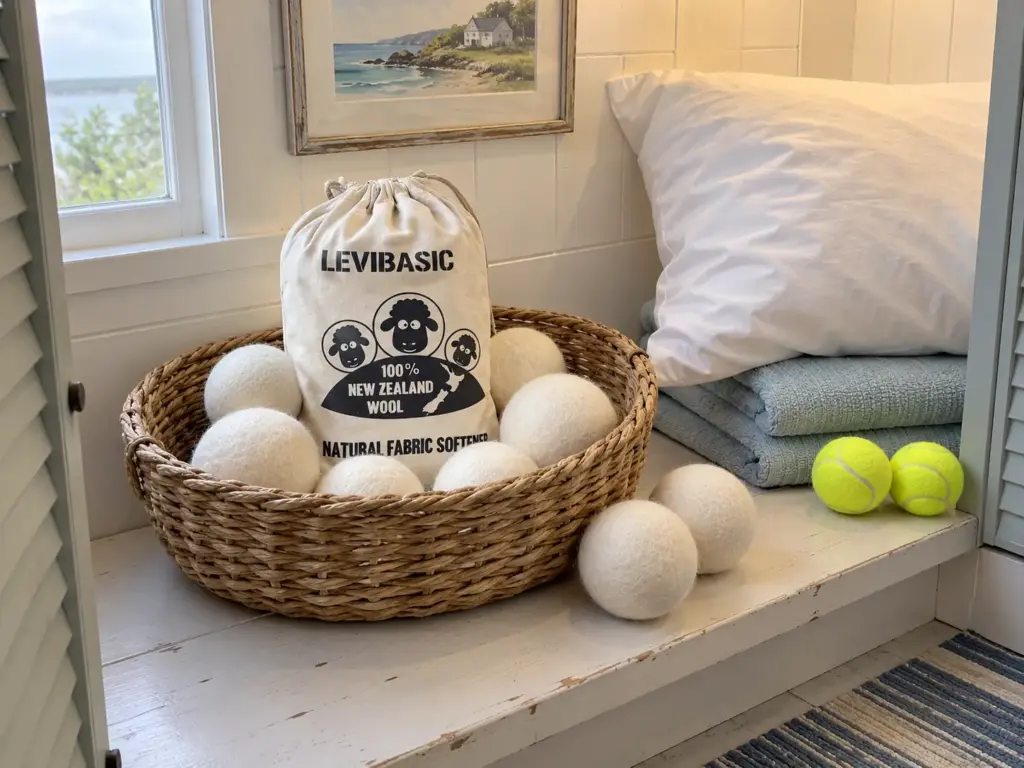
Two balls, a couple of dry towels
According to Consumer Reports, two fresh tennis balls or dryer balls “keep the filling from clumping as they bounce around the drum,” and a couple of dry towels speed things up. The Sleep Foundation names clean dryer balls and dry towels for the same reason. A practical tip is to put some tennis balls in with the pillow so the fluff gets broken up as it tumbles.
The towels do a different job from the balls. A dry towel is a large dry surface for the damp fill to hand its water to, and a towel gives it up quickly because it has so much surface to give it from. The free option is two fresh tennis balls and whatever dry towels are in the basket. Start there before buying anything.
Wool balls, or tennis balls in a sock
New tennis balls can shed a little of their coating or dye onto a white case, which is why a tennis ball in a clean sock is a sensible precaution against dye transfer. A wool dryer ball takes the dye question off the table. The LEVIBASIC Wool Dryer Balls, a pack of six in 100 percent New Zealand wool, do the same clump-breaking job as the tennis balls and can be reused for ordinary laundry too. The limit is the same as for the tennis balls: balls break up clumps, they do not replace the check, and Consumer Reports’ rule that you still check inside the pillow applies with any ball in the drum.
One pillow or two
On how many pillows go in one dryer load, none of the three sources gives a rule. Towels can help the pillows dry in some loads, but it depends on the load. What it comes down to is your dryer’s size and balance. The drum is not asking for a number; it is asking for a load that tumbles evenly.
Listen to the balls. A steady thump means the load is lopsided; add a towel to the light side or take one pillow out, and the sound evens out.
The Air Finish, and When the Dryer Is the Wrong Tool
The dryer is not the last step on a bad week, and for some pillows it is not a step at all.
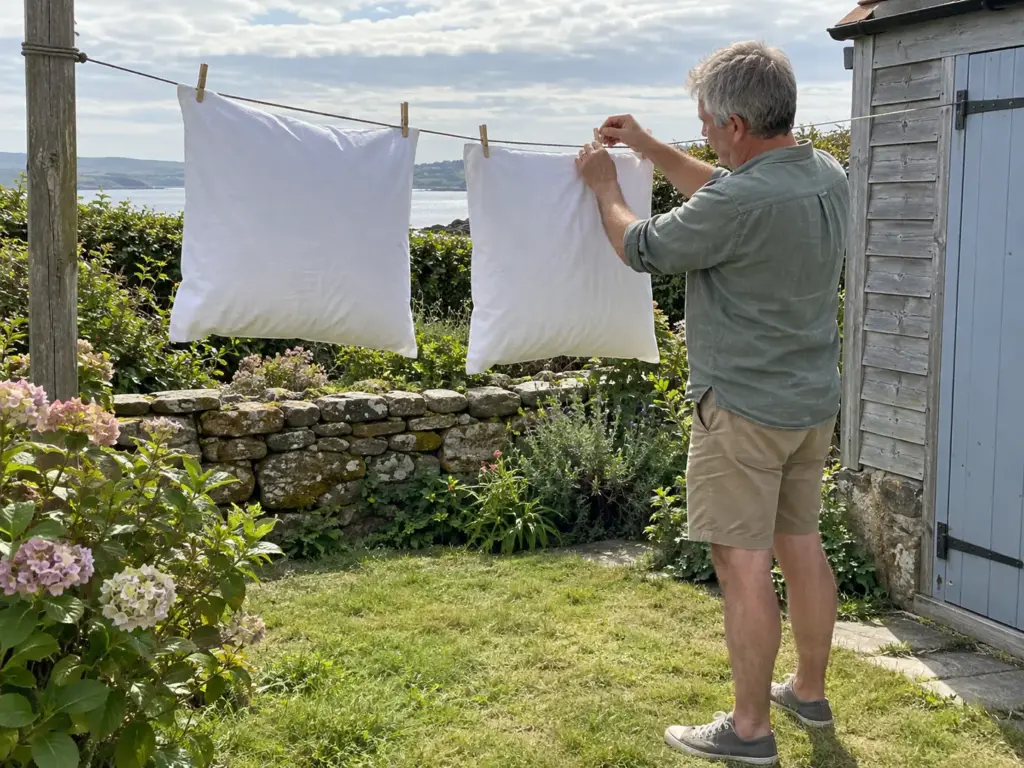
The clothesline and the well-ventilated spot
On a mild day, Consumer Reports says you can hang most pillows on the clothesline until they are dried all the way through, and the Sleep Foundation says some can finish outside in the sun or in a well-ventilated spot. Where there is no line, a pillow laid flat in good air or in sunlight does the same slow job. Air drying a pillow outside works if you shake it now and then so it does not go lumpy, and changing how it hangs so the middle gets air helps. Either way, the idea is the same: turn it so the center is the part facing the moving air.
On a line, clip the pillow by one short end, not along the middle. Clipping the center presses the damp spot flat against itself and keeps the air from reaching it.
Foam goes to its own page
A memory foam pillow is not a dryer pillow. It is cleaned by hand and dried flat, and the page on how to wash a memory foam pillow without soaking the core owns that routine, so it is not repeated here. The same goes for any pillow whose label says no dryer: the label wins over every setting on this page.
What a damp middle does on the bed
Consumer Reports says it plainly: get the pillow completely dry or risk mildew. Maytag says any dampness left behind may cause the pillow to smell, and a musty smell is how a damp fill announces itself on the bed. Both describe what a heavy pillow with a wet middle does to a bed, and neither needs more than that. A pillow dried in open air smells of nothing, and the first night on it is when you notice the difference against one that went back damp.
If the pillow is fully dry and a stain is still there, the drying did not cause it and more rounds will not remove it. Dry heat can lock a stain in before you have checked it, and a stain that stays after the wash has its own page.
Press the Middle Before the Case Goes Back On
Three things carry from this page. The cover is not the pillow, so the middle is the part you check. The fill decides the heat and the label names the setting. And rounds with a press at the center end the job, not a timer.
The check for later comes a few nights in: does the middle still smell of nothing, and does the loft hold the shape it had before the wash. A pillow that passes both was dried right. One that smells faintly of damp, or has gone flat in a way that fluffing will not undo, was either left wet inside or dried too hot, and the next wash is the time to fix whichever it was.
The one free change to make today costs nothing: before the case goes back on, press the center of the pillow with your palm. Then notice whether it feels cool, and whether it still weighs more than the one beside it. If it does, it goes back in.
Frequently Asked Questions
01How can I dry my pillows fast?
Use low heat, two fresh tennis balls and a couple of dry towels, then press the center between rounds and finish in fresh air. Towels and balls shorten the damp stretch, but skipping the check only brings the dry middle back later.
02Is it safe to put pillows in a dryer?
Yes for machine-washable fills on the low or no-heat setting the label names. Down and feather want the lowest heat, and foam does not go in at all. The fill sets the heat; the machine itself is not the problem.
03How long will a pillow take to dry?
It depends on the fill and the water left after the spin, so the clock is the wrong measure. Consumer Reports gives a good hour on low to moderate heat for most pillows, and down and feather take longer. The press at the center ends it.
04How do you dry a pillow without a dryer?
Lay it flat or hang it on a clothesline in a well-ventilated spot, turning it now and then, until the center is dry. Consumer Reports and the Sleep Foundation both approve this on mild days. A memory foam pillow is always dried this way.





Tried it on your own bed?
No comments yet. Tell us what you changed, and what the sheet did after a few washes.