

What’s in here9 sections
- The Cover Goes in the Machine, the Foam Does Not
- Spot-Cleaning the Surface Without Wetting the Middle
- Washing the Whole Block by Hand, and Why Not to Soak It
- Baking Soda Helps the Surface, Not the Core
- Drying Is the Job: The Middle Decides
- If It Already Went Through the Washer
- Counting the Cleanings, and When to Let Go
- Keep the Water Out of the Middle, and Check the Spring Later
- Frequently Asked Questions
You lift the pillow out of the washer and it comes up heavy and cold, a wet block that sags in your hands. That feeling is the whole problem with trying to wash a memory foam pillow: solid foam is one block of open cells that takes water in through its full depth and gives it back slowly, so the cover is the only part a drum was ever meant for.
The foam itself gets cleaned by hand, and the real work is keeping water out of the middle. Here is the whole path, from the cover and the block to the surface, the deep clean, the odor, the drying, the pillow that already took a cycle, and how many cleanings it has in it. The machine rules for the rest of your pillows live in the full wash path for pillows.
Quick Answer
The foam gets cleaned by hand, the cover goes in the machine, and the middle of the pillow decides when you are done.
- Keep the foam block out of the washer and the dryer.
- Machine-wash only the removable cover, zipped shut.
- Blot stains with a damp cloth, cool water and a little mild soap.
- Wipe once more with plain water, and press the foam instead of wringing it.
- Dry it flat with air moving until the center is dry, not just the surface.
The Cover Goes in the Machine, the Foam Does Not
The pillow on your bed is two objects sold as one, and nearly every mistake with a foam pillow starts with washing them as if they were a single thing.
Read the Maker’s Label, and Know What It Can’t Promise
Most covers are built to take a machine, and the first move is to unzip the pillow and take the cover off before you touch the foam. The tag you find first is almost always the cover’s. The foam inside can carry its own instruction, or none, and the two can disagree. The care label on a pillow is also the maker’s word and not a rule (the federal care-label rule covers clothing and certain fabric goods, not pillows), so it tells you what the maker will stand behind, not what the foam can survive.
Shredded memory foam in a zippered cover and a solid memory foam slab read the same tag very differently, which is why it pays to settle whether yours is shredded or solid before anything else. This article is about the solid block.
Check for two tags before you wash anything. If you find only one, treat it as the cover’s, and leave the foam out of every step that involves a drum.
Why a Block Does Not Belong in a Drum
A solid block soaks like a sponge, and the agitation that cleans a sheet tears the cell walls of foam. Foam pillows that go through a machine tend to have two problems: they break apart in the cycle, so hand washing is usually better, and they take a very long time to dry. The dryer adds a second problem. The drum heats the outside of the block while the middle is still wet, so the heat lands on the part that is least dry, and one maker’s care page warns that heat beyond cool air can shrink the foam and make it brittle.
The Cover, in a Mesh Bag
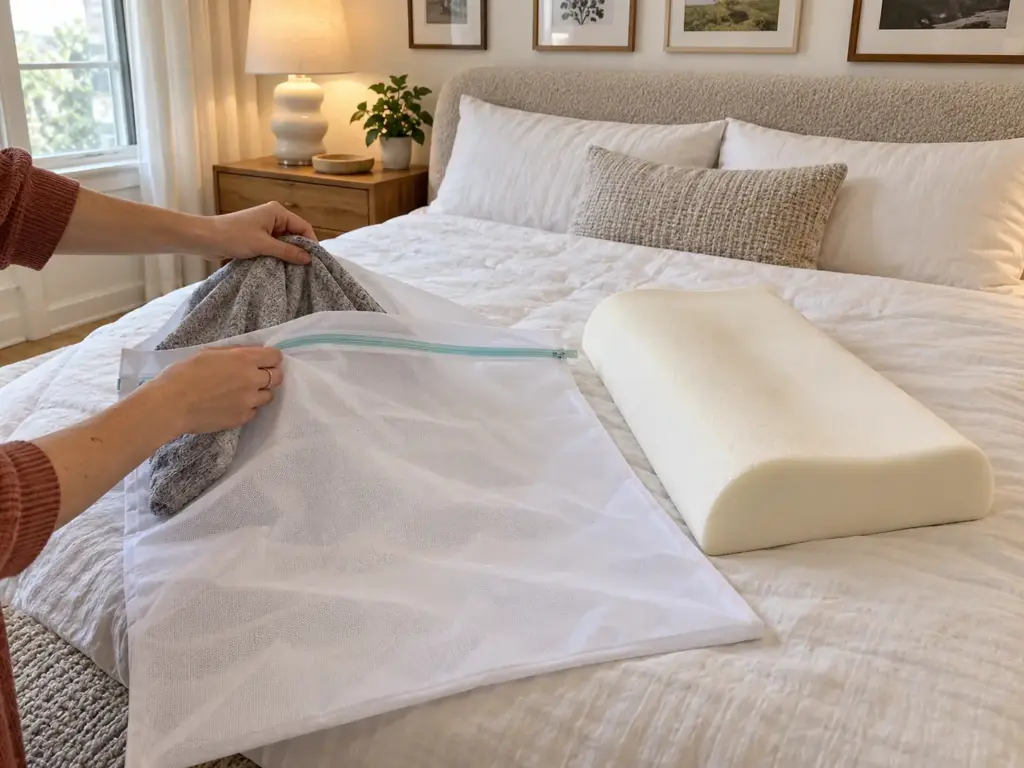
The free step comes first: zip the cover closed and load it on its own, so the zipper tape cannot snag on anything else in the drum. A mesh bag adds a layer between that zipper and the drum wall.
The OTraki Large Mesh Washing Bag is 43 x 35 inches of polyester mesh with a rustproof metal zipper, big enough to take a full pillow cover without folding it. The seller’s own listing warns that the zipper head can catch and open during the cycle unless you slide it into the flap, so tuck it in before the bag goes in the drum. Which cycle to run for the cover, a gentle cycle or otherwise, is a separate question with its own answer.
Spot-Cleaning the Surface Without Wetting the Middle
Most foam pillows that need washing only need spot cleaning on the top inch, and the surface is the one part of a block you can wet without a drying problem, so it comes first.
A Damp Cloth, Not a Wet One
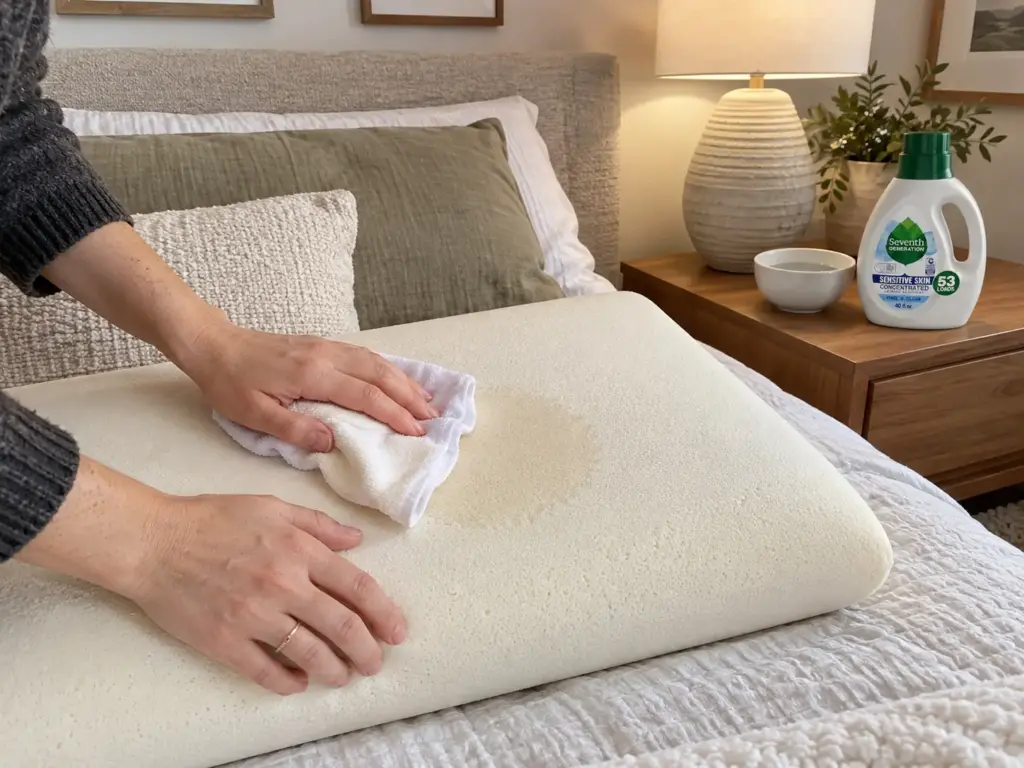
Use cool or lukewarm water, a cloth wrung until it stops dripping, and the smallest amount of mild liquid soap you can manage. A fragrance-free, dye-free detergent is the right choice here, because whatever stays in the cells stays in the pillow. Seventh Generation Free & Clear is a concentrated, enzyme-based liquid with no fragrance and no dye, so a few drops go a long way, which matters when the soap has to come out again. The listing’s own review summary says some buyers find it doesn’t remove stains well, and the 40 oz bottles run small for the money, so a stubborn stain may need a second pass.
Blot from the Edge Toward the Stain
Work from the outside of the mark toward the center, pressing the cloth down and lifting it. Scrubbing pushes the stain deeper and rubs the foam’s surface; blotting lifts it into the cloth. If the mark is yellow rather than dirty, the cause is different and so is the fix, which how to get yellow stains out of pillows covers by what is inside the pillow.
The Plain-Water Pass Is the Rinse
A foam block cannot be rinsed the way a sheet can, so the rinse is a second wipe with a cloth dampened in plain water. Skip it and the soap stays in the cells, where you can’t see it. A surface that looks clean and smells faintly of detergent is a surface that never got its plain-water pass.
That is also where spot-cleaning stops. It reaches the surface and a little under it, not the core.
Washing the Whole Block by Hand, and Why Not to Soak It
This is where care instructions split. Some brand pages say to soak the pillow and squeeze it when the label allows, while the rule for a solid block here is to keep it out of the tub. The disagreement is not about the rinse. It is about what the block does with the water.
What a Block Does with Water
Foam takes water in through its whole depth and lets it out through the same surface it came in by. Nothing in the cell structure moves it quickly. The more water the block takes in, the longer the middle stays wet, and the middle is the part that sours first.
A soak makes the rinse excellent and the drying impossible. So the rinse is not what fails when you submerge a block. The water left in the center is.
Soak-and-squeeze suits a cover, which can be wrung out and hung. A foam core has to give up its water from the inside out, and no tag changes that.
A Shallow Basin and a Damp Cloth, Not a Bath
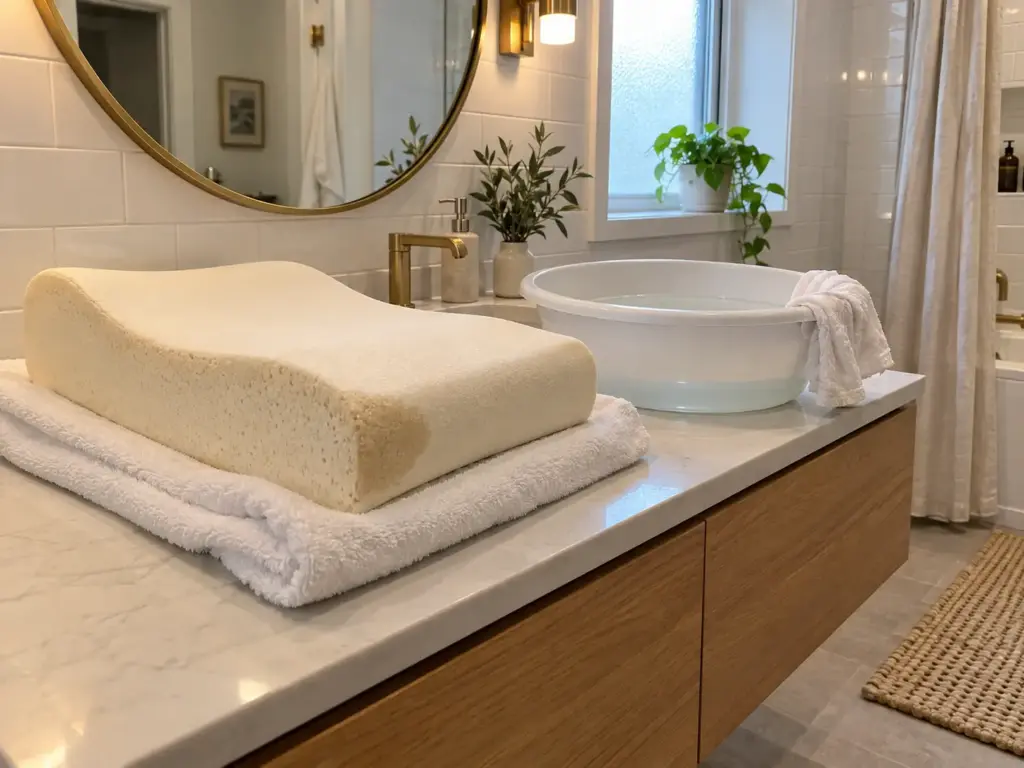
Work the block in sections. Set it on a towel or a flat surface, wash one area at a time with a damp cloth and a few drops of soap, then wipe it with plain water. Keep a shallow basin at hand for rinsing the cloth, never the foam. It takes longer than a dunk, but each section dries while you work on the next.
Shredded foam in a zippered cover is a different build with its own water budget, so what follows is for the solid block.
Lift the pillow before you start and again a minute after each section. If it feels heavier than it did a minute ago, you have used too much water, and that extra weight is extra drying time.
Squeeze, Don’t Wring
Press the foam flat between your palms or against a folded towel and release. Do not wring it. Wringing twists the block and tears cells, which is the breaking apart described above, while a flat press moves the same water without the twist. A pillow that was soaked sags in the middle first, not at the edges, and it stays heavier there for a day.
Baking Soda Helps the Surface, Not the Core
Sprinkle, wait, vacuum is the odor routine that comes with nearly every foam-pillow instruction, and it works as a step for the surface. Where it stops is the part that needs saying.
The Step, as the Instructions Give It
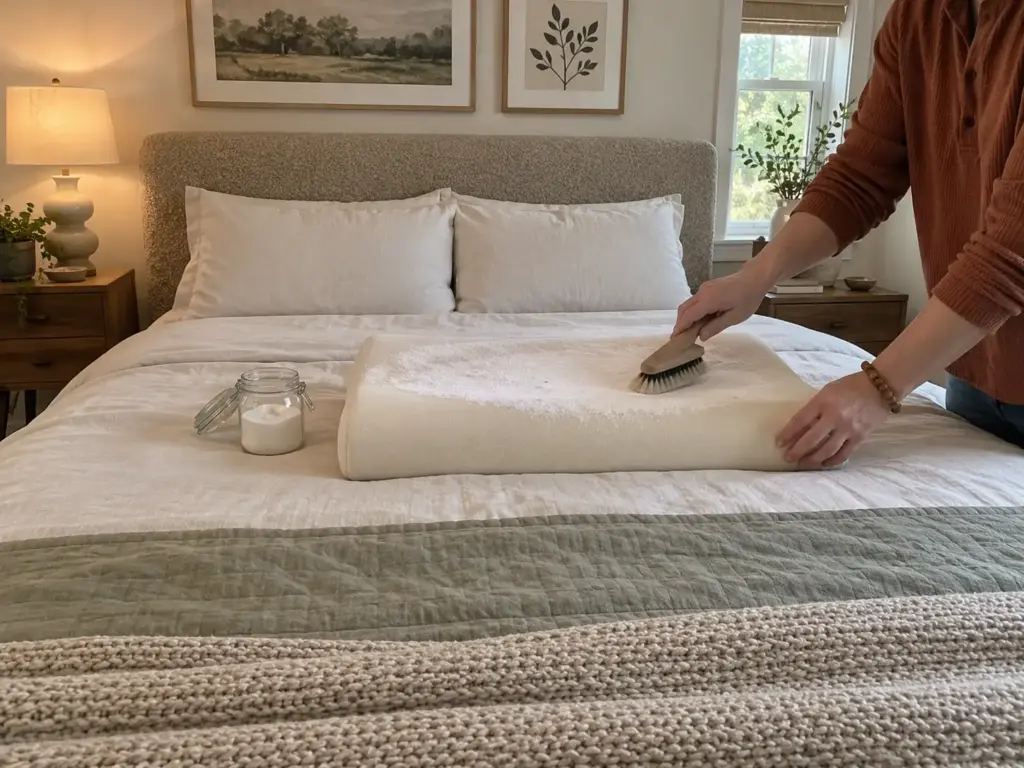
Sprinkle a thin, even layer of baking soda over the dry foam, let it sit, then brush and vacuum it off with a soft upholstery brush. It is meant for surface odor, and the top of the block is all it reaches.
The Hour and the 15 Minutes
The instructions disagree by a factor of four. Several care pages say to leave it at least an hour, and one brand’s FAQ says 15 minutes. None of them says what the powder does once it is inside the block, which is the question that matters for a material built from open cells.
What Stays in the Foam, and What the Vacuum Can’t Take
Baking soda can be very hard to get out of memory foam, and trying to vacuum it out can damage the vacuum. That is one report, not a test.
But the mechanism is plausible: fine powder drops into open cells and does not come back out on its own. Use the brush attachment, move slowly, and run your palm across the surface before the pillow goes back on the bed. If you feel grit, brush again.
A pillow that still smells of baking soda a week later kept some of it in the cells. And if the smell is coming from the middle of the block, powder on top is the wrong tool. A smell that comes from the center is water that never left, which is the next section.
Drying Is the Job: The Middle Decides
Cleaning a foam pillow takes minutes. Getting the water out takes the rest of the day or longer, and no one agrees on how long.

Flat, Flipped, with Air Moving
Let it air dry. Lay the pillow flat on a rack in the shade, away from direct sun and heat, with a fan pointed at it. Flip it every so often so both faces and the edges get air.
A drying rack with a fan pointed at it, turning the pillow every so often, works because it moves air across a block that cannot be tumbled. Pick the room with the most air movement. The dryer is out for the block. This is a free fix, with no product, and it is more than half of the job.
Why the Hours on the Page Disagree
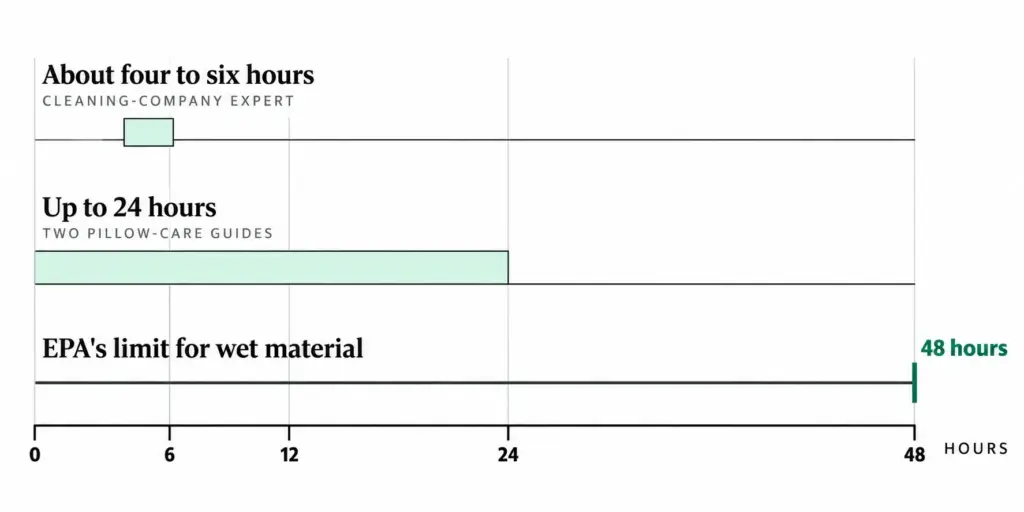
A cleaning-company expert quoted by The Spruce puts it at about four to six hours. Nature’s Sleep says up to 24. Neither number can be wrong for every pillow, because the clock depends on how much water went in, how thick the block is and how much air is moving, which is why the hours on a page can’t decide anything for your pillow.
The limit that does apply to everything wet comes from the EPA. According to the EPA’s mold course, “In general, all wet areas should be completely dried within 48 hours to prevent mold from growing.” That is the window for wet material in general, not a foam figure, but it covers the middle of the pillow, not only the surface.
The surface feels dry long before the core does. A pillow that smells fine at hour four can smell sour by the next evening.
The Press That Says It’s Dry
Press the middle of the pillow with a flat palm. Then smell it after a day, not an hour. A smell that returns means water is still inside. Anything left wet will start to smell, which is how the problem shows up.
Do the smell test the next evening, not the same afternoon. Dry surface foam tells you nothing about the center, and the smell is the only check that reaches it.
If It Already Went Through the Washer
Say the pillow was soaked in the night and then went through a full cycle on a normal wash. Can it be saved? The answer is a sequence of presses, not a rinse.
First, Look at the Shape
Before anything else, check whether the block survived. If the foam crumbles, has broken pieces or has lost its shape, it is a loss. If it still holds together, it goes on to pressing.
Press the Water Out, Don’t Wring It
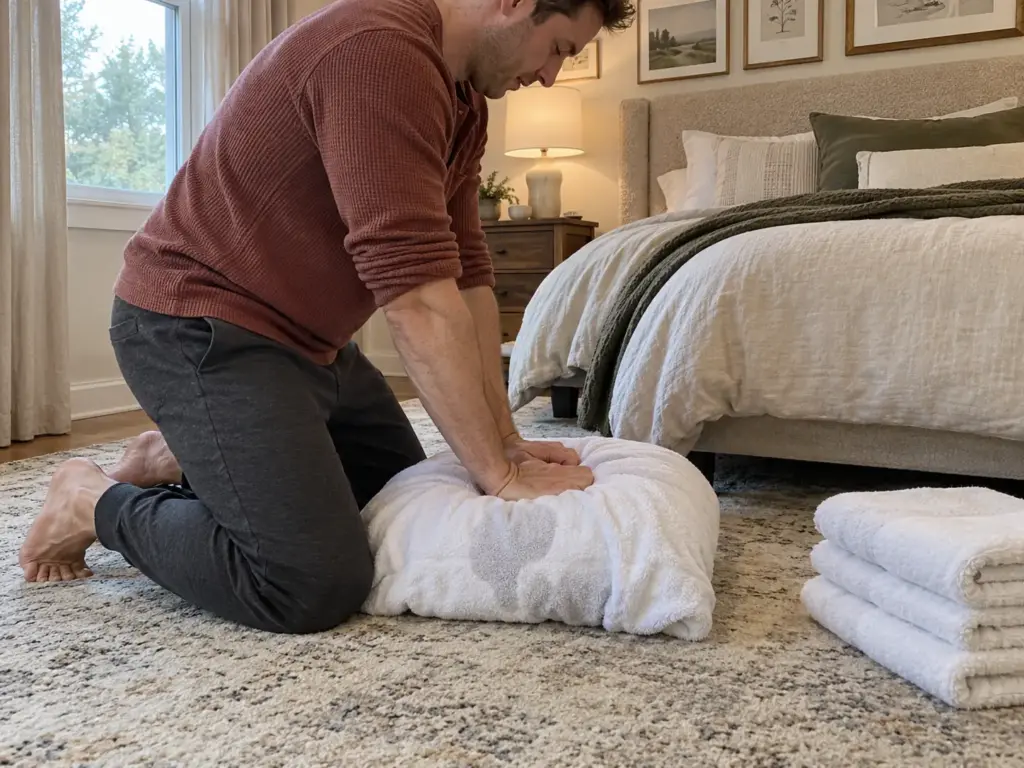
Wrapping the pillow in towels, bagging it and sitting on it, then swapping the towels and repeating, is a flat press that works. It moves water out through the surface it came in by without twisting the cells, which is the quickest and safest way to get the water out without deforming it.
The Towels, the Rolling Pin, the Wet/Dry Vacuum
Roll a rolling pin over the towel-wrapped block for more pressure. A vacuum storage bag also works as a press, but only with a wet/dry vacuum, since a regular vacuum can be destroyed by the water.
The first towel comes out wet, the third comes out damp, and you stop when one stays dry, not when the pillow looks right. Then lay it flat on a rack with a fan and flip it, the same as in the drying section, until the center passes the press-and-smell test. No source gives a recovery rate for a foam pillow that took a full cycle, so none is claimed here.
When It Smells Again After It Dries
A smell that returns after days means water is still inside. That is an inference rather than a source’s claim: a pillow still damp or sour past the EPA’s 48-hour window is better treated as a loss than rescued. If instead the foam comes out of a wash yellow, that is a separate problem, covered in when a pillow comes out yellow after a wash.
Rotate to a dry towel every time one comes out damp. The press is finished when a fresh towel stays dry after a full minute, which is a better stopping point than how the pillow looks.
Counting the Cleanings, and When to Let Go
Wash frequency advice runs from every three months to once a year, and none of them says what the foam looks like after the tenth cleaning.
The Numbers on the Page and What They Leave Out
A cleaning-company expert quoted by The Spruce gives every three months. Pandalondon gives every six to twelve months. Nature’s Sleep gives once or twice a year for the pillow and monthly for the cover. They don’t agree, and none of them follows the foam through years of hand cleaning.
No source here counts what repeated cleanings do to the foam, so this article won’t invent a number. The better count is the one you can keep: how many times the block has needed a hand clean, and whether it springs back more slowly each time.
A Layer That Goes in the Machine So the Block Doesn’t
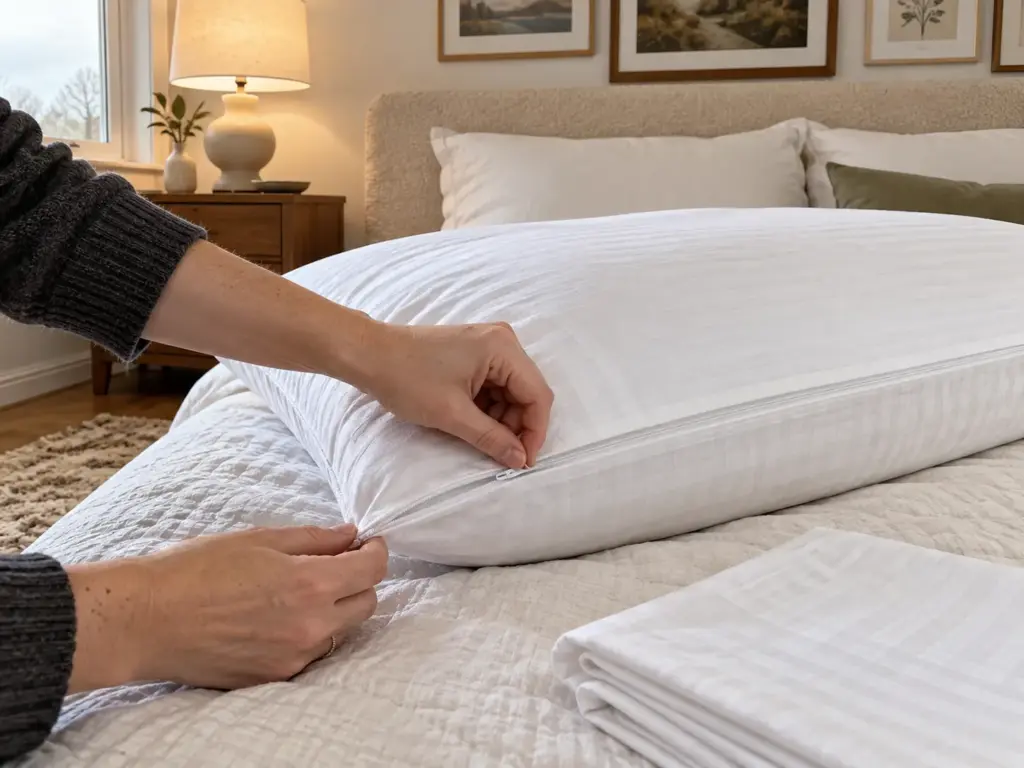
The free fix is a washable layer between you and the foam. A zippered protector goes in the machine and takes the sweat and skin oils, so the block gets cleaned less.
FAUNNA 600TC is 100 percent cotton at 600 thread count (the listing doesn’t state the ply), OEKO-TEX certified, zippered and cut for a standard 20 x 26 inch pillow, and the listing says it washes without pilling or fading. A 4-star reviewer says it gets less soft after washing, and a 1-star reviewer called a zipped-up one an “airtight situation,” which is the trade for a tight layer. Put it under a loose cotton pillowcase instead of stacking a second snug layer on top.
The Guardmax Jersey Knitted Pillow Protector pack of four is the cheaper alternative against the FAUNNA, but its listing doesn’t name the fiber, which is the weaker spec of the two. Some pillows come with a removable cover that already does this job, so it is worth settling whether you need a protector at all before you buy one.
When to Stop Cleaning It
Replace the pillow by its fill, not by the calendar: when the foam crumbles, flattens at the center, holds a smell after it has dried or doesn’t spring back, cleaning has stopped being the question. Replace pillows by fill, not by year lays out the full test. A wash that keeps failing is a replacement question, and when to give up on a pillow draws that line.
Keep the Water Out of the Middle, and Check the Spring Later
Three things are worth keeping. The cover goes in the machine and the foam block does not. Spot-clean the surface and keep the water out of the middle, because the middle is the drying problem. And if the pillow already went through a cycle, press instead of wring and let the smell decide.
After a few cleanings, press the center of the block with your palm. A spring that comes back slower than it used to, a dip at the middle or a smell that survives drying is the foam telling you it has taken enough.
The one free change to make tonight is to put a washable layer between you and the foam. The next cleaning then becomes a cover in the machine and a quick wipe of the block, and you can see how long the foam stays fresh after that.
Frequently Asked Questions
01Can you put a memory foam pillow in the washer?
No, the foam block should stay out of the washer and the dryer, because the drum tears the cells and the block soaks up water it then holds for days. Only the removable cover goes in the machine.
02How do you deep clean a memory foam pillow?
Clean it by hand, in sections, with a damp cloth, a little mild detergent and cool water. Keep the water low, press instead of wringing, then dry it flat until the middle is dry all the way through.
03When should you throw out a memory foam pillow?
Replace it when the foam crumbles, when it has a dip at the center that does not spring back, or when a smell survives drying. Judge it by the fill and the foam, not by the calendar.
04What happens to memory foam when it’s washed?
It soaks up water through its full depth and gives it back slowly, so the middle stays wet long after the surface feels dry. Heat or wringing can also break the cells and change how the foam feels.
05Can you wash a memory foam pillow without a washing machine?
Yes, and by hand is the right way for the foam itself, since the machine is only for the removable cover. Use a damp cloth, mild detergent and cool water, and keep the water out of the middle.





Tried it on your own bed?
No comments yet. Tell us what you changed, and what the sheet did after a few washes.