







What’s in here6 sections
You pull the pillow out of the dryer expecting white, and it’s the same yellow it went in, or worse, with a tan ring along the seam that wasn’t there this morning. A pillow turned yellow after washing looks like a machine that failed, and the reflex in every thread where somebody asks is “buy a new pillow.” It didn’t fail: a detergent cycle is built to lift loose soil out of a weave, the yellow is sweat oil that already reacted with the air and bonded to the fiber, and the care label that said tumble dry never once told you to look first. Below is why the wash left it there, the step the label skips, how to read what came out of the machine (shell or core), and the redo that actually reaches the stain.
Quick Answer
A pillow that comes out yellow, yellower, or newly ringed wasn’t ruined by the wash. Detergent lifts loose soil; the yellow is oxidized sweat oil that needs a pretreat and an oxidizer. The usual misses: no pretreat, detergent alone, drying before checking. Pretreat, wash, check it wet, then dry. If the yellow is in the core, no wash reaches it.
Yellow After Washing Means the Wash Did a Different Job
Start with what didn’t happen. The machine didn’t malfunction, and the pillow didn’t pick up fresh dirt in the drum. The wash did exactly what a wash is built to do, and that is the whole problem.
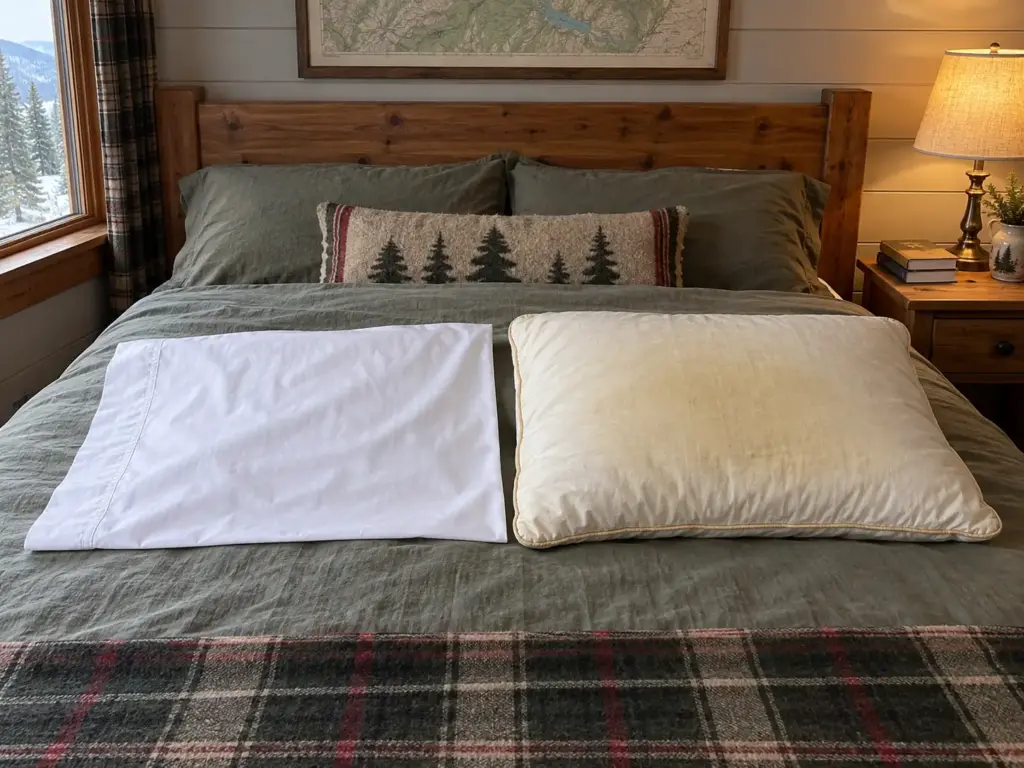
You ran it hot, you used the good detergent, maybe you ran it twice, and it came out yellow anyway, without moving a shade.
What Detergent Is Built to Lift
Detergent works with surfactants and agitation. A surfactant molecule grabs oil and grime at one end and water at the other, the drum tumbles the fabric, and anything sitting loose in the weave (dust, last week’s sweat, the salt that dried on the shell) leaves with the rinse water. It is very good at that. That is what a wash cycle is for.
The yellow isn’t sitting in the weave waiting to be carried off. Sweat, sebum and saliva (drool counts) that dried into the shell months or years ago have oxidized: they reacted with the air, and the color you see is the product of that reaction, fixed to the fiber rather than resting on it. That oxidation is the short version of why pillows turn yellow in the first place, and it’s all this page needs. A reaction product isn’t loose soil, and a cycle designed for loose soil walks right past it.
So “it came out the same” is the wash behaving as designed. The pillowcase is the tell. It came out of the same load looking white because it’s thin, it gets washed every week, and it never had the time to build up years of oxidized oil.
The pillow shell under it had years. One cycle doesn’t undo years.
The Oil Under the Color
There’s a second version of this complaint, and it’s more maddening: the pillow did come out lighter, and a few weeks later the yellow was back. A commenter in r/CleaningTips explained it better than most laundry guides manage: “You can decolor the stain all you want but until you get the oil residue out, it will come back when it oxidizes again.”
That’s two problems stacked. The color is on top. Underneath it is the oil that produced the color, still in the fiber, still meeting air every night the pillow sits on the bed.
Something in your last wash, a whitening detergent or a splash of bleach, handled the color. Nothing handled the oil, so the reaction simply started over.
Two jobs need two agents. An enzyme pretreat or a plain degreaser (dish soap is the one already under the sink) breaks down the oil. An oxidizer, meaning oxygen bleach or hydrogen peroxide, breaks down the color.
The American Cleaning Institute’s stain guide splits a pillow’s kind of soil the same way. For bodily fluids it says to “Pretreat or soak in a product containing enzymes,” then launder with bleach, naming “oxygen bleach” as the option next to chlorine. Two steps, in that order.
A detergent-only cycle is neither of them. Well, it’s a weak version of the first one, which is why a shell sometimes lightens a little and then stalls there for good.
Hot Water Isn’t Always the Stronger Wash
The instinct after a failed wash is to turn everything up: hotter water, more detergent, a second run. It feels like escalation.
In an r/AskUK thread about yellow pillows, somebody described running a bio (enzymatic) detergent at 140°F (60°C) and got corrected a few replies down. Enzymes work in a narrow warm band, around 86 to 104°F (30 to 40°C), and as the correction put it, “If you use it at 60°C you’re most likely to just destroy these enzymes, and it won’t work properly.” Bio detergents are the enzyme ones. Crank the dial and you cook the exact ingredient that was supposed to break down the oil.
The usual advice for a stubborn stain is the hottest water the label allows. With enzymes doing the oil work, that’s backwards. Heat does help the other half of the job, because oxygen bleach and peroxide react faster warm. So hotter helps the oxidizer and hurts the enzyme, which means the order of the steps matters more than the number on the dial: the oil comes out first, at warm, before the machine; the heat comes later, with the oxidizer.
And the “extra hot, extra detergent” second run tends to come out identical to the first, with one difference you can’t see yet. More detergent went in than the rinse could clear, and it’s sitting in the fill. That residue shows up again in the section on rings.
Read the detergent jug before you read the dial. If it says bio or with enzymes, the hottest cycle on the machine is working against it. Do the enzyme work at warm, as a pretreat on the stain, and save the heat for the oxidizer that comes after.
What the Care Label Skips Before the Dryer
So the wash couldn’t reach the yellow. The next question is why it now looks set in, flatter and more stubborn than before, and the answer sits in the one line a care label never prints. You followed the tag to the letter. It said machine wash, tumble dry, and that’s what you did.
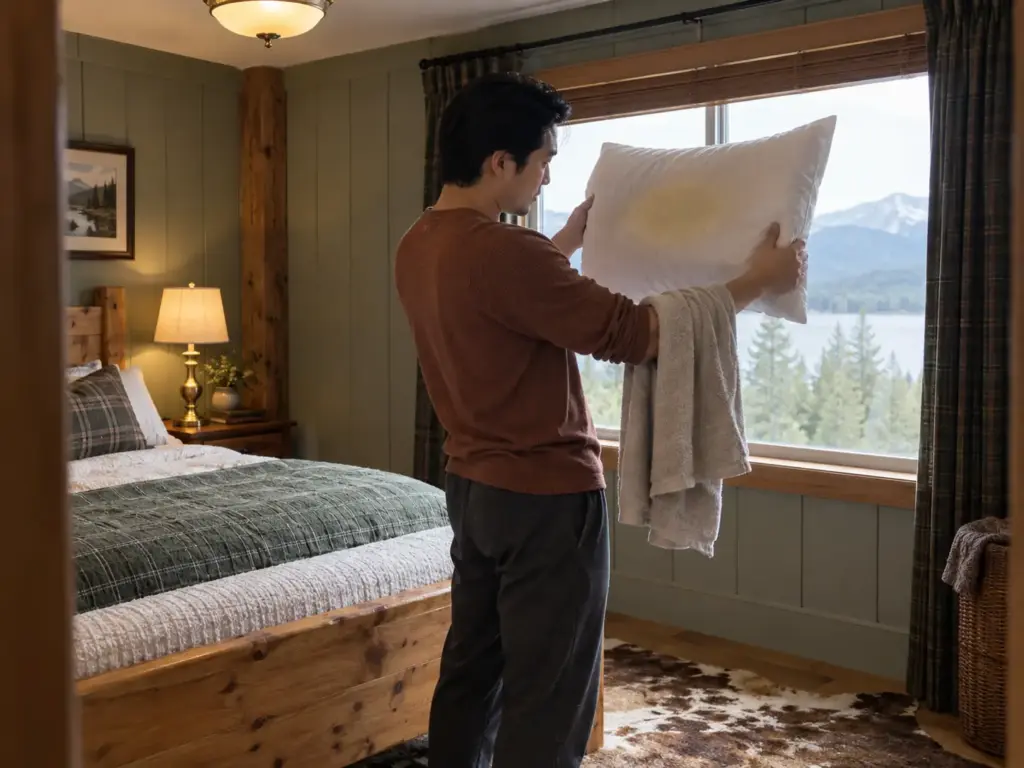
The Minimum a Label Has to Say
Care labels in the US are governed by a federal rule, and the rule sets a floor, not a method. According to the FTC’s Care Labeling Rule, “A minimum washing instruction would include a method of washing and a method of drying, like ‘Machine wash. Tumble dry.'” That is a complete, legal label. Four words.
The wash temperature is optional too. The rule only asks for “a water temperature setting if regular use of hot water will harm the product.” So a tag that just says machine wash isn’t telling you to use cold water.
It’s telling you the maker confirmed hot water won’t wreck the pillow. You’re allowed to use it; nobody told you when you should.
The symbols work the same way. A square with a circle inside means tumble dry, the dots inside the circle set the heat, and there is no symbol at all for “look at it first.”
Read the tag again with that in mind. The care label exists to protect the pillow from your washing machine, and it does that job. Getting a stain out isn’t its job, and nothing on it asks you to stop and look before the pillow goes into the dryer.
Honestly, it’s hard to blame anyone for skipping a step the tag never mentions. On an old pillow, the tag is usually yellowed right along with everything else, sewn into the seam where moisture collects, with half the print already washed off.
The Check Nobody Prints
The trade group for cleaning products does print it. The American Cleaning Institute’s general procedure for any stain ends with two sentences worth taping above the washer: “If the stain remains, repeat the steps above. Do not put it in the dryer until the stain is removed.”
That’s the step. Between the washer and the dryer, you look.
In practice, pull the pillow out wet and carry it to a window. Look at two places: the seams, and the head-shaped oval in the middle of one face, because that’s where the yellow was worst and where it survives longest. Wet fabric reads darker all over, so don’t compare it with your memory of the dry pillow. Compare it with a corner that’s still dry, or with the underside.
The light matters more than people expect. Yellow is easiest to judge on a wet pillow in daylight and hardest under a laundry-room bulb, which is warm and yellowish itself and hides exactly the shade you’re hunting for. Most laundry rooms don’t have a window. Walk it to one.
If that feels fussy, it’s the same lesson as any wash after a rough night: the order you wash things in matters as much as what you wash them with.
Look at it wet, by a window, next to a dry corner of the same pillow. If you can still see the oval, it goes back to the sink, not to the dryer. It takes two minutes, and it decides whether the next attempt starts from here or from further back.
Why Drying First Makes the Redo Harder
ACI doesn’t lay out the chemistry behind that dryer rule, and it doesn’t need to. People call it heat-setting, or say the dryer set the stain; whatever the name, the practical consequence is easy enough to see on a pillow.
A dryer cycle on a shell that still carries the oil and the color finishes the job the wash left half done, in the wrong direction. Whatever the wash loosened but didn’t carry off dries back down into the fabric, right where it was sitting, and then gets an hour or more of heat on top. You’re no longer rewashing a stain that was partway out. You’re rewashing one that has been baked dry into the shell, and the next attempt starts from further back than the first one did.
The reason people rush this is easy to understand. A down or fiber pillow takes hours to dry through, often more than one cycle, and nobody wants a damp pillow on the bed at eleven at night. That’s exactly why the check has to come before the dryer and not after: every minute of that heat goes to a stain you could still have lifted with a sponge and half an hour.
New Rings After Washing, and Whether It’s the Shell or the Core
Sometimes the pillow doesn’t come out the same. It comes out worse, with a tide line along the seam or a tan blotch that wasn’t there before, and the panic arrives on cue: did the wash do this? Not the way it looks. A new mark after washing is information, and it tells you where the yellow lives.
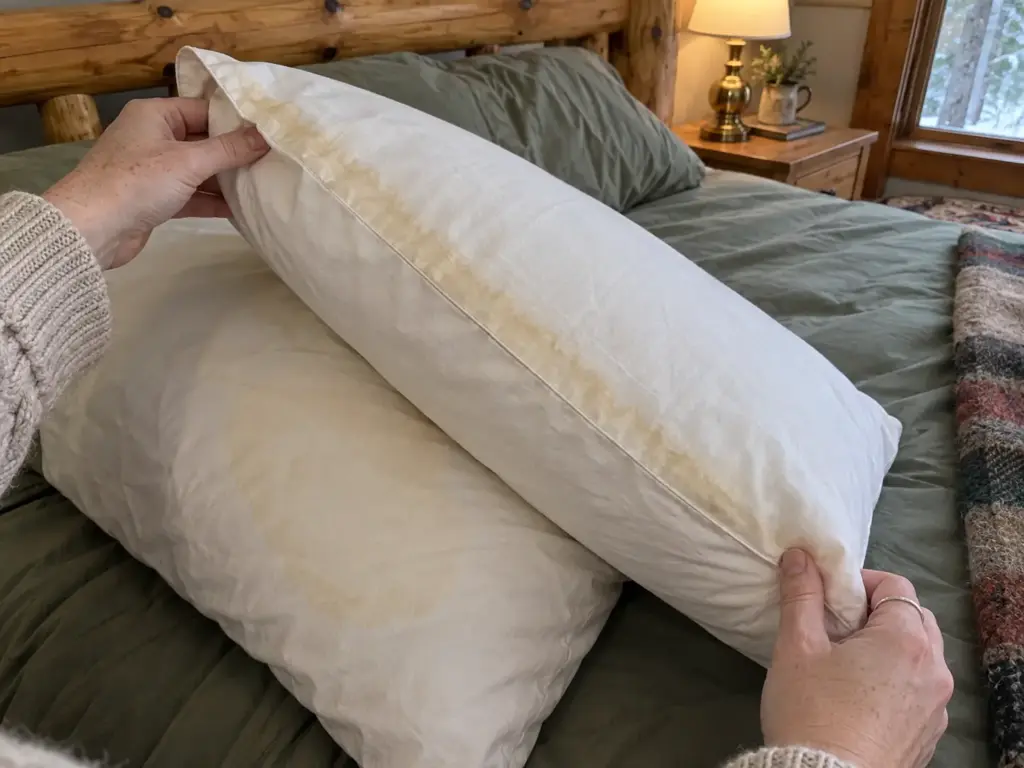
Where a New Ring Comes From
Foam and dense fiber fill soak up a lot of water, and they dry far slower than the thin shell around them. As the pillow dries, water migrates toward the surfaces that are losing it fastest, and it carries whatever it dissolved along the way: loosened oil, detergent residue, the brownish material that had been deep in the pillow fill for years. When that water evaporates, everything it carried stays behind, concentrated in a line. (Same physics as a coffee spill drying on a counter, darkest at the rim.)
So the ring wasn’t made by the wash. It was moved by the wash, then drawn as a line by the drying.
Look where it sits. It follows the seam, or the edge that was pressed against the dryer drum, or the fold where the pillow hung over a drying rack. Those are the borders between the parts that dried early and the parts that stayed wet longest. It’s also why a pillowcase, thin and quick to dry, almost never comes out ringed: there’s nothing deep inside it for the water to bring up.
A ring, then, is evidence that there’s residue in the fill. Whether that residue can come out depends on the next question.
Shell or Core — The Post-Wash Check
Same split as the general case, applied to a pillow that just came out of the machine. If the color is on the shell, the woven cotton ticking on the outside, a proper redo can reach it. If it’s coming through from the pillow core (a yellowed memory foam or polyurethane block, amber latex, a fiber fill gone brown inside), no wash technique reaches it, and another run just gets you another wet pillow.
You can tell without cutting anything. If the pillow has a zipper, open it and look at the fill against the inside of the shell. If it doesn’t, look at a seam where the stitching has spread a little, and look at the underside, the face that never had a head on it.
A color that shows equally on both faces and is deepest in the middle, away from the seams, is coming from inside. A color that sits on one face, heaviest where the head rested, is on the shell.
The fill also decides whether washing is worth it at all. Down washes and comes back. One r/AskUK commenter who washes down pillows every four to six months describes them coming out “all fluffy and renewed,” while the fiber-fill pillows in the same house “come out in a solid matted lump.”
So before a third wash, ask what’s inside. A down pillow with a yellow shell earns the full redo. A foam core with the same color doesn’t.
Here’s how to read what came out of the machine:
| What you see after the wash | What it usually means | What to do next |
|---|---|---|
| The same even yellow as before | The wash lifted soil, not the oxidized color | Pretreat and redo |
| Yellower, or a tan ring at the seam or edges | Residue moved and dried unevenly | Rewash with a pretreat, rinse well, dry fully and evenly |
| Patchy in the middle, on both faces | The core is carrying the color | A wash won’t reach it: replace |
| White, then yellow again weeks later | The color was bleached, the oil stayed | Degrease first, then oxidize |
| Brownish-orange spots, worse after chlorine bleach | Possibly iron in the water, not sweat | Fabric rust remover, never chlorine |
The last row is the odd one out. Brownish-orange spots that got darker after chlorine bleach may not be sweat at all, especially if your water is hard or carries iron. ACI files that under its own brown and yellow discoloration category, calls for “a rust remover recommended for fabrics,” and warns that chlorine bleach “may intensify discoloration.” Different problem, different fix, and not the one this page is about.
Turn it over. The side that never had a head on it is your control. If it’s yellow too, and just as yellow, the color is coming from inside, and no amount of scrubbing the top face will change that.
When Washing Stops Making Sense
There’s a real difference between a pillow that was never washed properly and one that survived a proper redo. A pillow still yellow after washing it properly (pretreated, checked wet, repeated once) is the signal worth acting on: either the shell has given up all it’s going to, or the color was never on the shell. Yellow after one detergent-only cycle is just a pillow nobody pretreated. Don’t replace a pillow on that second kind of evidence.
Fill type also decides how many washes a pillow can take before the fill itself gives out, and how long each fill actually lasts is the other half of that decision.
When the triage says core, the next pillow should be one whose parts you can actually wash. The Canadian Down & Feather Co. Soft Support Microfiber Down Alternative Pillow pairs a 260 thread count cotton shell, which takes a pretreat and an oxidizer like any woven cotton, with a microfiber fill instead of a foam block that yellows from the inside out.
Its flaw is the one this whole section turns on: microfiber doesn’t recover from repeated washes the way real down does, and wash after wash it clumps more than a down core would. Put it in a protector from the first night and wash the pillow itself as rarely as you can get away with.
The Redo: Pretreat, Check It Wet, Then Dry
Once you know the shell is the problem, rewashing it the same way gets you the same pillow back. The fix is the order of the steps, and the first one costs nothing. This is the second attempt, done on purpose:
- Pretreat the oil and the color on the stain, before the machine.
- Wash as warm as the label allows, with an extra rinse.
- Check it wet, at a window, and repeat if the yellow is still there.
- Dry it long, low and all the way through, or outside in the sun.

Pretreat First, With What’s Already in the House
Two things from under the sink cover both jobs. For the oil, a baking soda paste with a squeeze of dish soap, worked into the yellow with a soft brush; dish soap is a degreaser, the cheapest oil step there is.
For the color, 3% hydrogen peroxide, the brown bottle, sponged over the same area. Leave the whole pre-treatment 20 to 30 minutes. Peroxide lightens color, which is the point on a white shell and a problem anywhere else, so keep it off a dyed pillowcase or a colored protector.
The pretreat is its own step, done before the machine, not poured into the drum with the detergent. Enzymes and oxidizers work by different mechanisms and can get in each other’s way when they’re dumped in together. For what it’s worth, it’s also the lowest-risk step of the redo, and the fear that stalls most people is making the pillow worse. One r/AskUK commenter put the whole answer in four words: “Peroxide is the way.”
The Wash Itself
Then the machine, in warm water or hotter, as far as the label allows. ACI’s own advice for very tough stains is to “use the warmest setting safe for the fabric,” and an oxidizer works faster warm. The oil work is already done, so the heat isn’t costing you anything now.
If you’d rather not mix a paste every time, OxiClean Odor Blasters Odor Laundry Liquid Additive is a liquid oxygen additive you can dab straight onto the yellow as the pretreat, then add to the drum as a second pass on the color. Its flaw is that it’s an extra step, not a shortcut around one: poured into the drum with an enzyme detergent as an afterthought, instead of worked into the spot first, it competes with the enzymes and does less than either would alone.
Add an extra rinse. Whatever pretreat, detergent and additive stay in the fill are exactly what the drying water carries outward into the next ring. And leave the chlorine out: it’s the obvious move for a white pillow and the one that can darken yellow-brown marks.
Check It Wet, Then Dry It Properly
Pull it out wet and do the window check: seams, the oval, a dry corner for comparison. Still visible, even faintly? Back for a second pretreat and wash, the repeat ACI’s procedure calls for. Not dry and hope.
Only then dry it, all the way through. Long and low in the dryer, with a stop halfway to squeeze the middle for damp, or outside in direct sun. One r/CleaningTips commenter air-dried washed pillows outside and got them “blindingly white,” and an r/AskUK commenter put the reason plainly: “The UV light gets rid of the yellow.”
Sun-drying gets recommended in nearly every thread. And it works, if the day is long enough to dry the core: a fiber pillow still damp at sunset comes inside wet in the middle, and a damp core left overnight is where the next ring, the next smell and eventually mildew start.
Wash two pillows together, never one. They balance the drum so the spin actually wrings them out, and in the dryer they knock each other’s fill loose instead of letting it set into a clump.
Then Keep It From Needing This Again
A zipped pillow protector under the case takes the sweat, the oil and the wet hair before the pillow does, and it goes in the weekly wash with the pillowcase. One r/AskUK commenter reports pillows kept in protectors still bright white after more than six years. What it’s made of matters, because the protector’s backing matters more than its cover for whether moisture passes through or sits against you.
The FAUNNA 600TC 100% Cotton Pillow Protector is 100% cotton at 600 thread count with a zip, sold as a four-pack so two can be on the pillows while two are in the wash. Its flaw is every protector’s flaw: it does nothing if it never gets washed itself, and wet hair still gets past it. Every week, with the pillowcase.
Hold It to the Window Before It Goes in the Dryer
Three things decide how the next wash goes. A pillow that comes out yellow after washing met a detergent built for loose soil, and oxidized oil isn’t loose soil; it needs a pretreat for the oil and an oxidizer for the color, in that order.
The label only has to say “Machine wash. Tumble dry.”, so the check before the dryer is yours to add. And a new ring is residue moved by uneven drying, while yellow on both faces and deepest in the middle is the core, which no wash reaches.
Over the next few months of monthly washes, watch how fast the color returns. A shell that comes back white after the redo and stays that way is worth keeping; one that yellows back within weeks is telling you where the color lives. Same logic as the rest of the bed: count washes, not years.
Next wash day, pull the pillow out wet and hold it up to a window before it goes anywhere near the dryer. Two minutes. It’s the step nobody printed on the tag.
Frequently Asked Questions
01Why did my pillow turn yellow after washing?
It didn’t turn yellow in the wash: the cycle lifted loose soil and left oxidized sweat oil behind, or moved residue into a ring as the pillow dried unevenly. Pretreat the yellow, rewash, check it wet by a window, and only then dry it.
02How do you clean a yellowed pillow?
Pretreat with a baking soda and dish soap paste plus 3% hydrogen peroxide for 20 to 30 minutes, then wash warm with an oxygen-bleach additive. Rinse twice, check it wet by a window, and dry it completely before it goes back on the bed.
03Should I throw away my pillow if it’s yellow?
Not after one failed wash, because yellow after a detergent-only cycle usually means nobody pretreated it. If the yellow survives a proper redo, or shows on both faces and deepest in the middle, the core is carrying it and no wash will reach it.
04How can I turn yellow pillows white again?
Remove the oil and oxidize the color: a degreasing or enzyme pretreat, an oxygen-bleach wash as warm as the label allows, and a full dry in direct sun. Skip chlorine bleach, which can deepen yellow-brown marks instead of lifting them.
05Can you put a yellowed pillow in the dryer?
Only once the yellow is gone, so check it wet by a window before it goes in. The American Cleaning Institute’s rule is not to put anything in the dryer until the stain is removed, and a redo gets harder once the pillow has been dried.





Tried it on your own bed?
No comments yet. Tell us what you changed, and what the sheet did after a few washes.