

What’s in here10 sections
- Read the Tag Before You Touch the Machine
- Fill by Fill: Who Goes in the Washer and Who Does Not
- Before the Wash: What Sits Between Your Head and the Fill
- Loading the Washer: Two Pillows, One Small Dose, Water That Was Never Tested
- Drying Is Where the Wash Succeeds or Fails
- The Pillows That Never Go in a Machine
- How Often, and What the Protector Changes
- When Washing Stops Helping: Yellow, Flat or Lumpy
- The One Check That Works for Every Fill: Press the Center After the Next Wash
- Frequently Asked Questions
You pull the pillow out of the dryer, the shell is warm, the case slides on dry, and the bed gets made. By the second night the pillowcase smells like a wet basement. A first wash can leave a pillow smelling moldy, and the wash was not the part that failed.
A pillow dries from the outside in, so the shell can feel finished while the core is still wet, and the dryer’s own sensor only reads the surface. This guide shows you how to wash pillows in the order that decides the result: the tag, the fill, the load and the water, the dry, the pillows that never see a machine, how often, and the point where washing stops helping.
Quick Answer
Whether a pillow can be machine washed depends on its care tag and its fill. If it can, this is the order to run it in.
- Read the care tag first; it overrules every tip.
- Identify the fill: down, polyester, foam, latex or buckwheat.
- Keep foam, latex and buckwheat hulls out of the machine.
- Wash two pillows on gentle, with a tablespoon of liquid each.
- Dry on low heat until pressing the center feels dry through.
- Wash again about twice a year, and the case and protector far more often.
Read the Tag Before You Touch the Machine
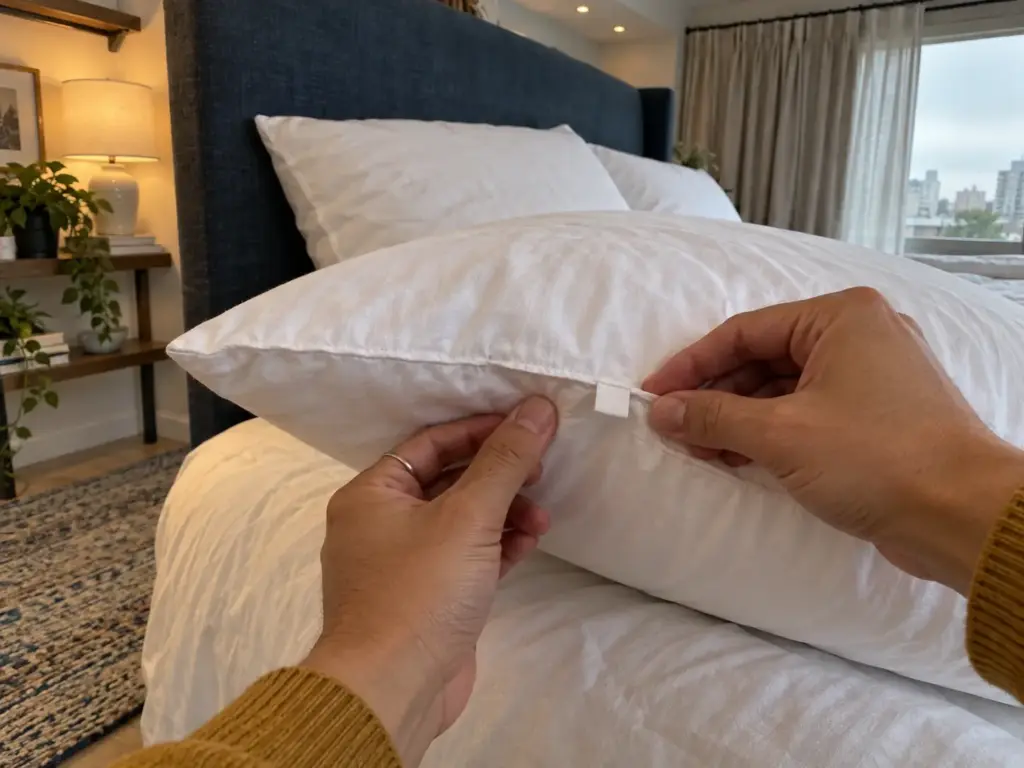
A pillow that has never been washed has already said what it can take, on a sewn-in tag, and that tag is the one instruction the maker has to stand behind. A tip, a video or a neighbor’s habit is only somebody’s practice on somebody else’s pillow. So a wash question is a tag question first and a fill question second.
What the tag can settle and what it cannot
The tag settles whether the machine is allowed at all. Consumer Reports’ laundry guide opens on the same gate: many pillows can be machine-washed, but not all. When the tag and a tip disagree, the care tag (the care label, if yours calls it that) wins, because the people who chose the shell and the fill are the ones who wrote it.
What the tag cannot tell you is how many washes the pillow will take. It says machine wash, gentle, and stays silent about the fifth wash or the thirtieth. Read the words printed beside the symbols, and where words and symbols seem to disagree, follow the more cautious one.
Photograph the tag the day the pillow comes out of its bag. It lives in a seam, and the seam is the first place a wash scrubs down to a gray smudge, which is usually the week you need it.
No tag: read the fill
Squeeze the pillow. One that folds in half and rises back is down or polyester fiberfill. A dense block that keeps the dent of your thumb is foam. One that shifts and rustles under your hand is buckwheat hulls.
A “down alternative” is polyester, whatever the front of the package suggests, and that puts it under the polyester rules in the next section. Each of these ages differently in the wash, and the fill guide covers what each fill does by month six.
Pillows that are cover-only or spot-clean
Throw pillows and long bolster-style pillows are the usual case. Many have a removable pillow cover that is the only part meant for the machine, and the insert gets vacuumed and spot-cleaned. If the tag says spot clean only, believe it: it describes a shell or a fill that cannot take a soak.
Fill by Fill: Who Goes in the Washer and Who Does Not
Once the tag is read, the fill sets everything else: the water, the dry, and whether the machine is allowed to touch the pillow at all. In a bed shared by two people on two different fills, the rules are per pillow and not per bed, so one laundry day is really two plans.
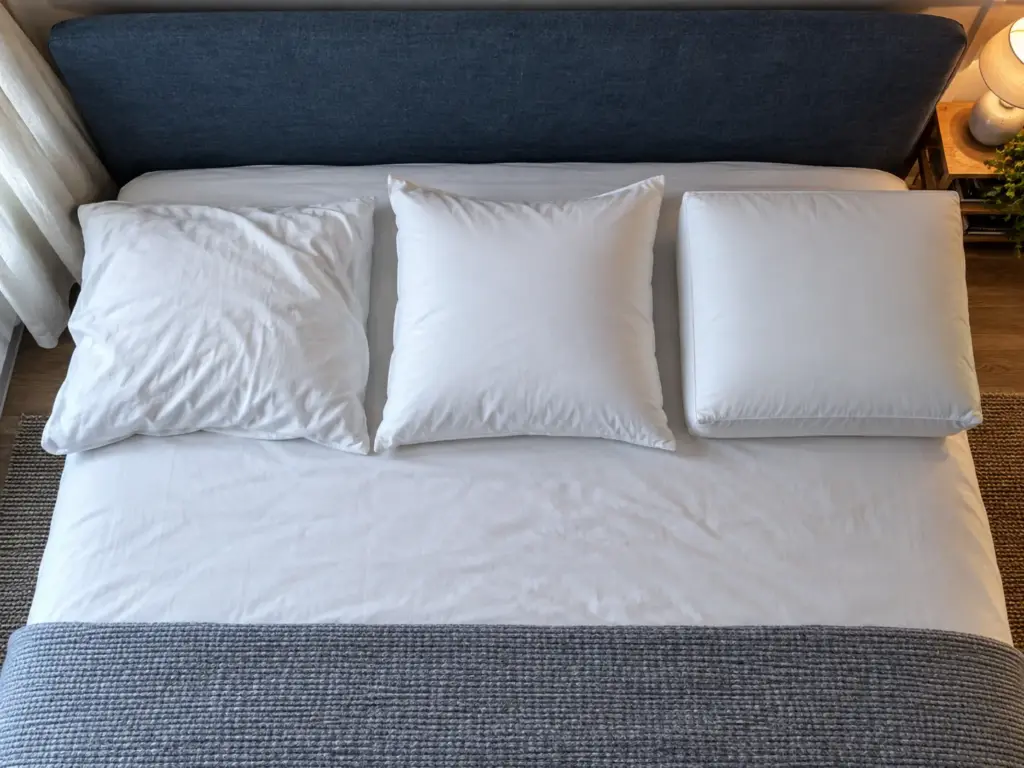
The table below is the short version. The catches that decide each row come after it.
| Fill | Machine? | Water | Dry | The catch |
|---|---|---|---|---|
| Down and feather | Yes, if the tag allows | Cool, mild detergent | Low heat, long, with checks | High heat damages down; wet down dries in lumps |
| Polyester fiberfill (including down alternative) | Yes | Warm, gentle cycle | Low to medium heat, with tennis balls | Dense fill is slow to dry through |
| Solid memory foam | No | Hand wash or spot-clean | Air dry flat | Agitation breaks up slab foam |
| Latex | No | Hand wash or spot-clean | Air dry flat | A soaked block is heavy and slow to dry |
| Buckwheat hulls | Hulls out; shell only | Shell per its own tag | Shell fully dry before refilling | The hulls take on water and stay out of the drum |
Down and feathers: cool water, low heat
Consumer Reports says of down pillows to “use cool water and a mild detergent, then dry on low heat.” The reason is in the fill: down and feather are light clusters and quills that collapse when wet and take a long time to separate again, and high heat damages them. The pillow comes out of a good wash flat and lumpy, which is normal, and the long low-heat dry is what brings the loft back. If you are unsure which of your pillows is real down, down versus down alternative sorts it by fill weight rather than by the name on the package.
Polyester fiberfill: the easy one
Polyester takes warm water on a gentle cycle and about a tablespoon of liquid detergent per pillow. It is the forgiving fill, because the fibers do not collapse the way down does. Its trouble is time: pillows can take far too long to dry, and anyone who has run one through the dryer twice understands. That is a drying problem rather than a washing one, and the drying section below is built around it.
Foam, latex and buckwheat: tag first, hand work after
Consumer Reports warns that washer agitation can break up slab-style foam pillows, which is why foam stays out of the machine. Latex gets the same treatment for the same reason.
If you want the full picture of those fills, see memory foam pillows and latex and buckwheat pillows. Buckwheat is a different problem: the hulls absorb water, so they come out of the shell before anything is washed. Shredded foam sits between these and is a tag question, not a rule. The hand route for all of them is further down.
Before the Wash: What Sits Between Your Head and the Fill
The pillowcase and the protector take the sweat, the oil and the stain first, so how much work the fill needs depends on how often those two layers are washed. The odor people blame on the pillow usually lives in them. Wash the case and the protector more often before you decide the pillow itself is the problem (it is the free fix, and it is also the cheapest).
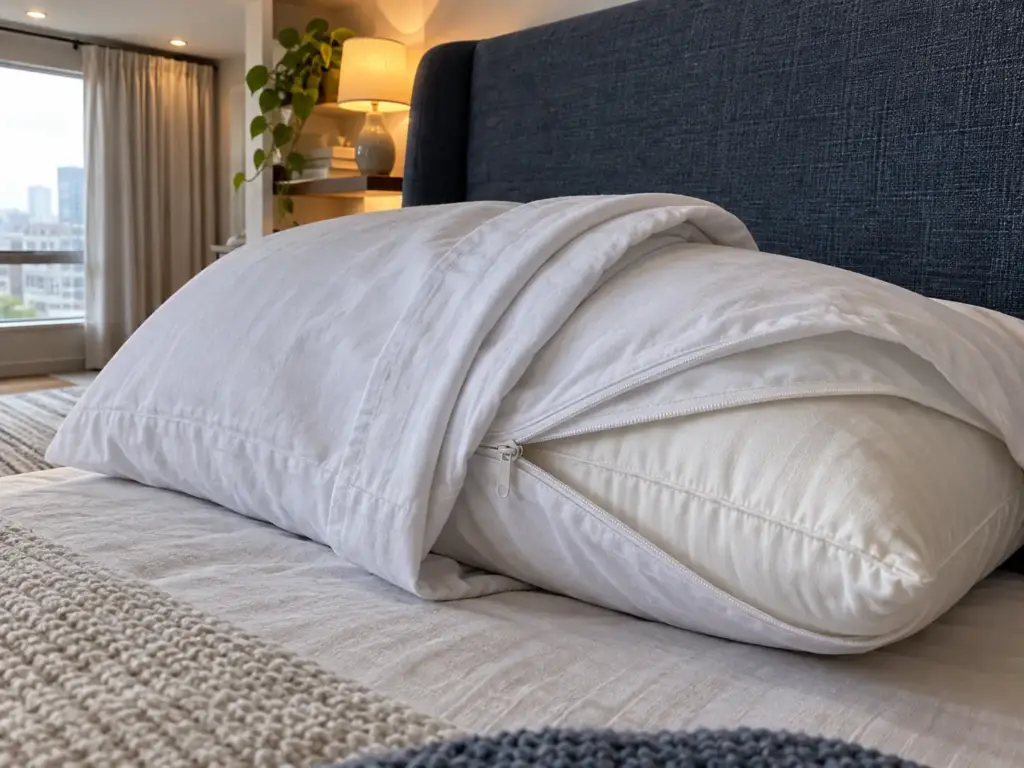
If there is a stain, pretreat it before the pillow gets wet, with one stain agent and never a mix. Consumer Reports says to pretreat the pillowcase and the pillow with a stain cleaner that targets that type of stain before the wash.
A recipe that puts hydrogen peroxide, vinegar and bleach into one drum is a chemistry problem, not a deeper clean, and it does not belong in a load with a pillow. How to get yellow stains out of a pillow, by what’s inside names which single agent suits which fill. Work it into the dent, because that is where the oil sits; the middle of a pillow is the part your head presses into every night.
Loading the Washer: Two Pillows, One Small Dose, Water That Was Never Tested
One pillow in a drum lets the load swing off balance, and a full drum cannot rinse. This section sets the load, the cycle and the dose, and then the water temperature, where the advice splits and no test settles it.
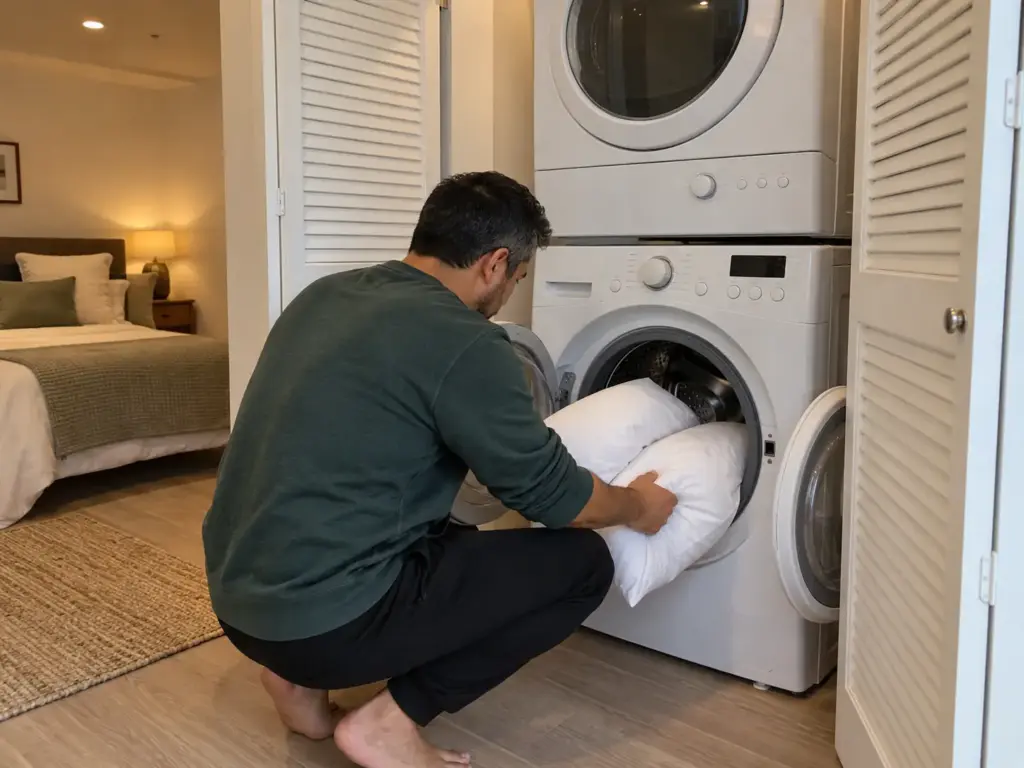
Two at a time, gentle, extra rinse
Wash two pillows at a time if the machine is big enough: the pair balances the drum. A single pillow in a front-loader tends to wad against the door and stop the cycle halfway. Keep it on the gentle or delicate cycle, not the bulky one. Add an extra rinse and a second spin.
A pillow holds soap the way a sponge does, and the residue left in the fill is what makes a washed pillow feel stiff.
A front-loader has one more habit worth knowing: a wet pillow can sit pressed against the glass for the whole cycle and come out with one flat, creased side.
If the machine stops mid-cycle with both pillows wadded on one side, nothing is broken. Open the door, pull them apart so they sit on opposite sides of the drum, and restart. A lopsided load is the whole fault.
How little detergent is enough
About one tablespoon of liquid detergent per pillow is the figure Consumer Reports gives, and it is smaller than most people expect. More soap does not rinse out of dense fill, and the leftovers are the stiffness and the smell. Leave out fabric softener and dryer sheets: both work by leaving a film on the fibers, and a film on the fill is the opposite of what a pillow needs to spring back.
Water temperature: what the sources disagree on
Consumer Reports puts down in cool water and polyester in warm. One guide says cold water so the filling does not clump, another says warm. A published test of three ways to wash a pillow that named a clear winner used one pillow per method. One pillow per method is an anecdote: the better result might belong to the pillow, not the water.
Treat every water rule here as practice: none of them has been measured fill by fill.
And there is a hot figure in circulation. Mayo Clinic’s guidance on dust mites in bedding gives a hot wash of 130°F (54°C) or higher. That is a hygiene temperature for sheets that tolerate it.
A down pillow whose tag says cool water is not a sheet, and for the pillow the tag overrules the figure. Washing a pillow does not treat allergy or asthma, either; if sneezing or wheezing is why you are reading this, that is a question for a doctor, not a drum.
Drying Is Where the Wash Succeeds or Fails
The washing machine does the easy half. A pillow dries from the shell inward, so the outside can feel finished while the core is still wet, and that is the smell that sends people back to the drum. You wash it on Sunday, it feels dry by Monday, and the case smells in the second week.
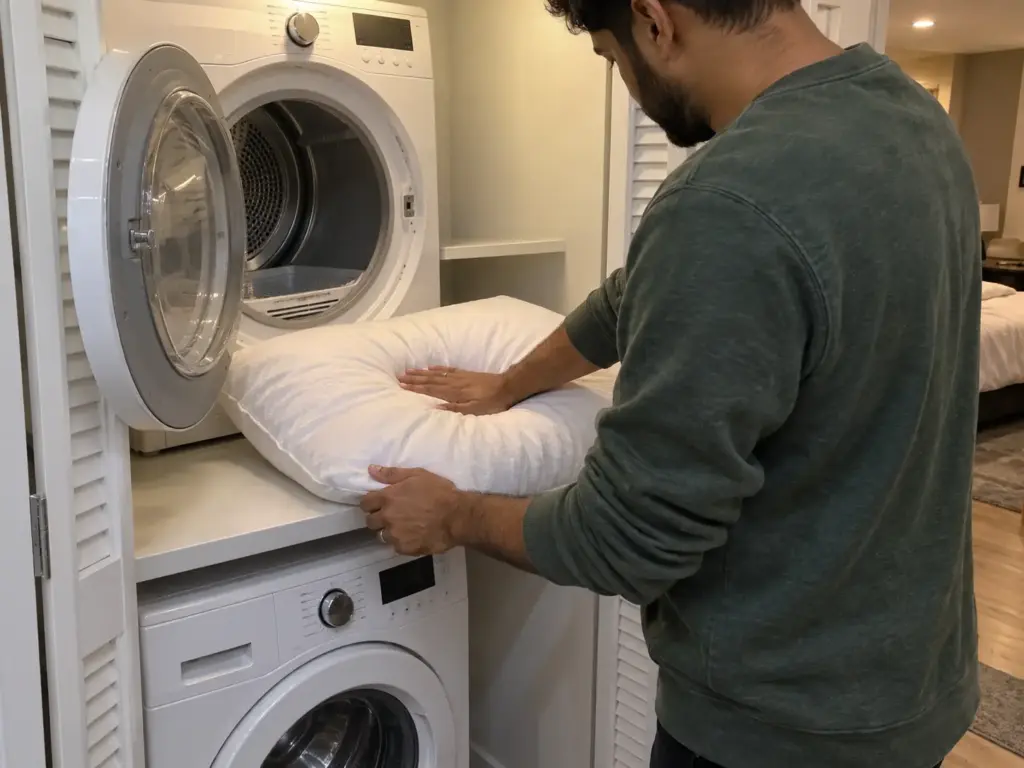
Why the outside dries first
Heat reaches the shell first and the core last, because the moisture in the middle has to travel out through packed fill. A dense polyester pillow or a thick down one holds water in the center long after the surface is warm and dry.
The dryer cannot tell the difference. According to Consumer Reports, “the sensors will detect only surface moisture, leaving you with a pillow that’s still damp on the inside.” So the auto-dry setting stops early, and the answer is to dry by time and check by hand.
A damp core is also what sets up that smell: mildew arrives after the wash, not during it. Slow drying is the same fact seen from the other side, since a dense fill really does take that long.
Press the center before you make the bed
Run the pillow on low heat, take it out, fluff it, and run it again. Repeat until it is dry all the way through, then press the center, not the edge, with the back of your hand. Any cool or damp patch means it goes back in. Do this before the case goes on, never after.
Line drying or a sunny window can finish a pillow that is nearly dry, but neither is a place to start.
Let the pillow cool for a few minutes before the press test. Warm fill reads dry to the hand even when it holds moisture, and a cool, clammy spot in the center only shows once the heat has left.
Tennis balls first, wool balls if you want them
Two clean tennis balls in the dryer keep the filling from clumping as they bounce around the drum, which is Consumer Reports’ advice, and it costs nothing. The same tip works with a clean tennis ball or two, kept in the dryer until the pillow is totally dry. If you would rather keep something permanent in the dryer, LEVIBASIC wool dryer balls do the same job: a six-pack of 3-inch balls made from 100 percent New Zealand wool with no synthetic core, according to the listing. The listing also claims they cut drying time, which is the seller’s own figure and not something this article tested, and the tennis balls break up clumps just as well.
The Pillows That Never Go in a Machine
Some pillows are not washed because washing is the wrong tool: the fill is a solid, a block or a hull, and the machine is what ruins it.
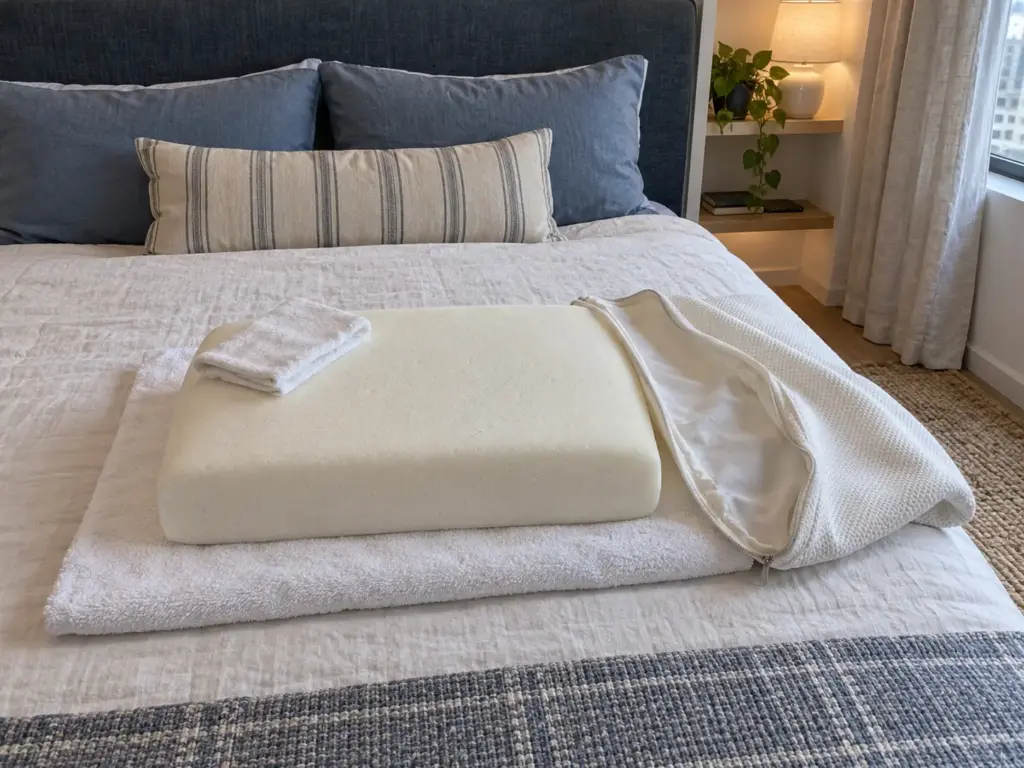
For solid foam and latex, clean the cover and spot-clean the surface of the block with a damp cloth and a little mild soap, then air it out flat. Do not submerge a block that soaks up water and then takes days to dry; the damp that stays inside is a bigger problem than the smell you started with. Buckwheat comes apart more cleanly: empty the hulls into a bowl or bag, wash the shell, dry the shell completely, and only then refill it. Throw pillows and long bolster-style pillows are mostly cover-only, so vacuum the insert, spot-clean it and wash the cover.
Shredded foam, with its zipper and loose pieces, is its own case. The tag decides, and shredded versus solid memory foam explains why labels disagree on it. One last thing to expect: a foam pillow that has been soaked once is rarely the same shape again.
How Often, and What the Protector Changes
The honest answer to how often is a range, not a rule, and the layer you wash most often is not the pillow. This section gives the range, then the layer that makes it easier, then what to do when two people share one bed on two fills.
Twice a year, more if the case needs it
Consumer Reports recommends washing a pillow at least twice a year and four times if you can, and other care advice says every three to six months. Those are ranges, not measurements. The number that depends is your own: a sleeper who sweats lands at the high end, and one with a protector and a case washed weekly can sit at the low end.
There is no published count of what the fifth wash or the twentieth does to a fill’s loft, so every cadence is a habit. The mechanism is not a mystery, though: agitation, heat and soap residue are the three things a wash does to a fill, and the first sign of wear is a pillow that no longer springs back. If the case smells again within weeks of a wash, the layer is the problem, not the fill.
The protector washes so the pillow doesn’t have to
A zippered protector washed monthly does a very good job of keeping the surface of the pillow clean. That is the free fix: wash the case and the protector on a schedule, and the pillow itself goes in the machine less often. Whether you need a protector depends on whether the pillow can be washed at all, and what each layer actually does is worth a read before you add one.
If you want one, the FAUNNA 600TC cotton pillow protector is a four-pack in standard size, 20 by 26 inches, 100 percent cotton, with a silent zipper and a machine-washable label. The 600 is the listing’s figure, and it does not say whether the yarn is single-ply, so treat it as a description rather than a measurement. A customer question on its Amazon page asks whether it is normal that the protector shrank slightly after washing, and no answer appears there. Check that it still closes over the pillow after the first wash.
One bed, two fills, two schedules
When one bed holds a down pillow and a polyester one, the rules are per pillow. The down one goes in cool and gentle, the polyester one in warm, and the two never share a load, since the water and the dry that suit one are wrong for the other. Washing them on two days is the whole solution.
When Washing Stops Helping: Yellow, Flat or Lumpy
Washing cleans the surface and cannot rebuild a fill, so there is a point where a clean pillow is still a worn-out one. This section marks that point and hands you to the articles that decide it.

Yellow after a wash
Yellow that survives a wash has gone into the fill, and a second wash rarely moves it. Why pillows turn yellow and which ones come clean explains which stains are on the surface and which are in the core, and a pillow yellow after washing takes the wash itself apart.
Flat or lumpy after a wash
Fold the pillow in half, the fold test. One that stays folded is spent, and no wash will put the spring back. A pillow that clumps again within weeks of a careful wash has lost the fill’s spring, not its cleanliness. Replacement timing runs by fill and not by calendar, and how often to replace a pillow, by fill holds the numbers.
Wash again or let go
Try the free options first: a protector, and a regular wash of the case. If the pillow is still yellow after two proper washes, when to give up on a yellow pillow is the check to run before you buy another.
The One Check That Works for Every Fill: Press the Center After the Next Wash
Three things carry this whole guide. The tag and the fill decide whether the machine is allowed and what it gets. The load is two pillows, gentle, with a small dose of soap and an extra rinse. And the dry is not finished until the center is, however the outside feels.
After the next wash, press the pillow’s center and see whether it rises back to its old height. A pillow that does not is telling you something a second wash cannot fix, and the clean smell it carries is the shell’s, not the fill’s.
The one free change to make this week is to wash the case and the protector on a fixed schedule before you touch the pillow, and then notice whether the pillow stops smelling. If it does, you just skipped a wash the fill never needed.
Frequently Asked Questions
01Is it safe to wash pillows in a washing machine?
Many pillows are safe to machine wash, but only when the care tag allows it, and the fill decides how gentle the wash must be. Down and polyester usually go in; solid foam and latex stay out, because agitation can break up slab foam.
02What is the best way to wash pillows?
Read the tag, then wash two pillows at a time on a gentle cycle, with about a tablespoon of liquid detergent each and an extra rinse. Dry on low heat until the center is dry through. For water temperature, follow the fill and the tag.
03How do you wash pillows without clumping?
Clumping is wet fill drying in a lump, so add two clean tennis balls or dryer balls to the dryer and keep the heat low. Keep going until the center is dry, fluffing the pillow by hand between rounds.
04Can you put pillows in the dryer?
Yes, pillows that the tag allows can go in the dryer on low heat, with two tennis balls or dryer balls tumbling beside them. Skip auto-dry, because its sensor reads only the surface, and press the center to confirm it is dry.
05How do you clean a yellow pillow?
A wash only removes what sits on the surface of the pillow, so yellow that has soaked into the fill usually stays after washing. Treat early stains with one stain agent, never a mix; how to get yellow stains out of a pillow, by what is inside covers each fill.





Tried it on your own bed?
No comments yet. Tell us what you changed, and what the sheet did after a few washes.