






What’s in here7 sections
Search the question and you get two answers that cannot both be right: brand blogs promising five to fifteen years, and a poster on r/Bedding whose set had gone “a very ugly greyish dirty looking” version of its color by year two. Both are describing something the package called bamboo sheets. The word on that package names a plant, and a plant is not a construction. What decides the number is the process that plant went through, how many threads float over how many in the weave, and whether the thread count on the tag counted single yarns or two thin ones twisted together. Here is the real range, what actually shortens it, the four things to check with your hands, and how to tell a set that is finished from a set that has only stopped being special.
Quick Answer
Most bamboo sheet sets last two to three years of daily use before pilling, graying or thinning shows. Brand claims of ten to fifteen years assume care almost nobody practices. Construction moves the number far more than the word bamboo does: viscose or lyocell, the weave, the blend percentage.
What “two to three years” actually means
The honest answer is a range, and the range is wide for a reason that has nothing to do with luck. Two to three years of daily use is the working figure for a typical bamboo viscose set, which sits inside the same territory as how long a set of sheets lasts in general across every fiber. But the spread around that figure is enormous, and the spread is the interesting part.
Look at what actually gets reported. Amazon reviewers describe cheap and blended sets pilling after three washes, and one reviewer returning a set that had started pilling by the second. At the other end, a reviewer on a different listing reports eighteen months and more than forty washes with no pilling at all.
Same two words on the label, opposite outcomes. That is not bamboo being unpredictable. That is two different products wearing the same name, and only the construction tells them apart.
Meanwhile the brand blogs cluster their claims at five to seven years typical, ten to fifteen “with ideal care,” and one stretches to twenty. A range that wide is always technically true and therefore useless to the person standing over their own bed. Nobody in that band explains why the floor and the ceiling are five times apart.
Part of it is that the unit is wrong. A calendar year is not what does the damage; the wash is. Two people in a bed stripping it every weekend hit wash fifty inside a year. One person changing every other week takes twice as long to get there, on the identical set, and will swear the sheets lasted longer.
They didn’t. They just got washed half as often. State the lifespan in washes and the contradiction starts to resolve itself.
And the r/Bedding complaint sits right where you would expect it to. The thread is called “Bamboozled by bamboo sheets,” and the graying showed up at the two-year mark. That is not a defective unit. That is the median experience for a standard viscose set in a household that washes normally.
The set never announces it, either. There is no morning where it broke. What happens is that you stop reaching for it on laundry day. The other set goes back on because it feels better, and the bamboo one quietly becomes the spare in the closet. That drift is the real first symptom, and it starts months before anything is visibly wrong.
Write the month you first used the set on the care label with a laundry marker. Not the purchase date. The first night. Two years from now you will be trying to remember whether this was the set from before the move, and the tag settles it in three seconds instead of turning into an argument.
Why viscose gives out, and what actually kills it
Every brand blog tells you not to put bamboo sheets in a hot dryer, and not one of them says why. Which is a shame, because the reason is the whole article.
Bamboo viscose is a regenerated cellulose fiber, and regenerated cellulose has a weakness that natural cotton does not share in the same degree: it goes soft when it gets wet. Not soft as in pleasant. Soft as in weak. Its tensile strength runs 1.5 to 2.4 grams per denier dry, and viscose loses more than half its strength when it is wet, dropping to 0.7 to 1.2.
Read that against where the sheet actually spends its hardest hours. The fabric is at its most fragile inside the washing machine, which is the one place in its life it gets tumbled, twisted and dragged against itself under load. Every cycle is a stress test run at the fiber’s worst moment.
Heat damage works on the same weakness. Viscose loses strength rapidly under heat and starts to decompose somewhere between 350 and 400°F, and the damage is cumulative rather than dramatic: a full dryer cycle on medium does more total harm than a short blast on high. That is the mechanism behind the commandment nobody explains. It is not that the dryer is forbidden. It is that the dryer’s duration is what is eating the set.
The absorbency is the same coin, seen from the side people like. Viscose has a moisture regain around 13% against cotton’s 6%, which makes it the thirstiest common cellulosic fiber there is. That is exactly why it feels cool and dry the first time you get into it: it is pulling moisture off your skin faster than cotton would. It is also why the fiber stays wetter, longer, in every wash and every humid night. The same property, doing its damage on the other end.
Then there is the weave, and honestly the weave decides more of this than the fiber does. A sateen weave floats three or four threads over one before the interlace, and that long unanchored float is what makes bamboo feel silky under a hand in a store. It is also the only part of the cloth that touches anything. A twill weave, with its diagonal interlace, has no long float to abrade, so it wears from the whole structure instead of from one exposed face. Two sets, both honestly labeled 100% bamboo, built to opposite ends.
Which is what the standard bamboo set on most beds actually is. The TOSMO Luxury Cooling Sheet Set is 100% bamboo viscose in a sateen construction with OEKO-TEX Standard 100 certification, and it is the textbook version of what “bamboo sheets” means to most people: soft on night one, cool against skin, and the construction that shows the graying signature first. Its flaw is not a defect, it is the trade it was built to make. The sateen float that makes it feel silky on night one is the same thing that abrades and goes matte. If that is the set you own, none of what follows is a warning that you bought badly. It is a description of the clock you bought.
The last variable is one no listing prints. Pills form when short broken fibers rub loose and tangle into balls, so a yarn spun from short staple sheds into pills early and a long-staple yarn holds together for years. The set that pilled at wash three was not unlucky. It was built that way, and no amount of gentle washing repairs a fiber length after the fact.
Here is the part that took me longest to stop misreading: the graying is not dirt and it will not wash out. It is the surface going matte. Thousands of tiny broken fiber ends standing up off the cloth, scattering light in every direction instead of lying flat and reflecting it back. Hold a two-year-old bamboo sheet next to a new one at the same angle to a lamp and the difference is not really color at all, it is sheen. That is also why it stops feeling cool: the smooth face that used to slide against your skin is now fuzz, and fuzz holds air against you.
Pull the set out of the dryer while the seams are still faintly cool and damp, and finish it flat on the bed. The last fifteen minutes of a cycle are the ones doing the real damage, because that is when the fabric is dry, hot and still tumbling with nothing left to evaporate.
The four checks, done by hand
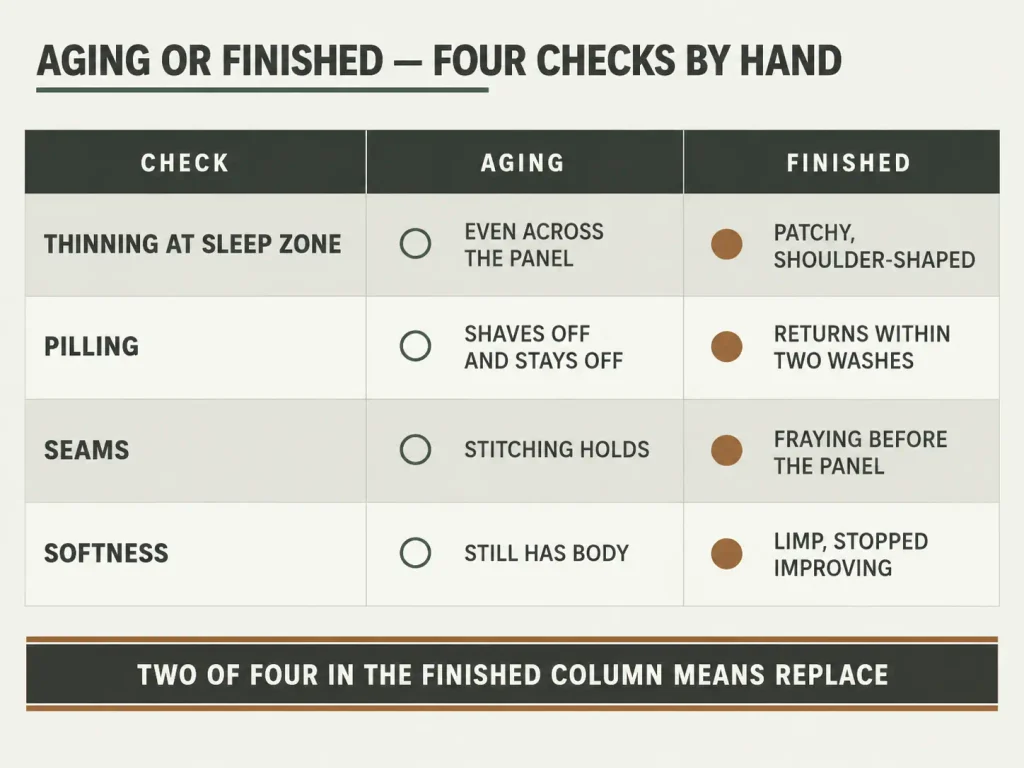
None of this is a calendar question, so put the calendar away and go feel the sheet. There are four things worth checking and the whole thing takes about a minute.
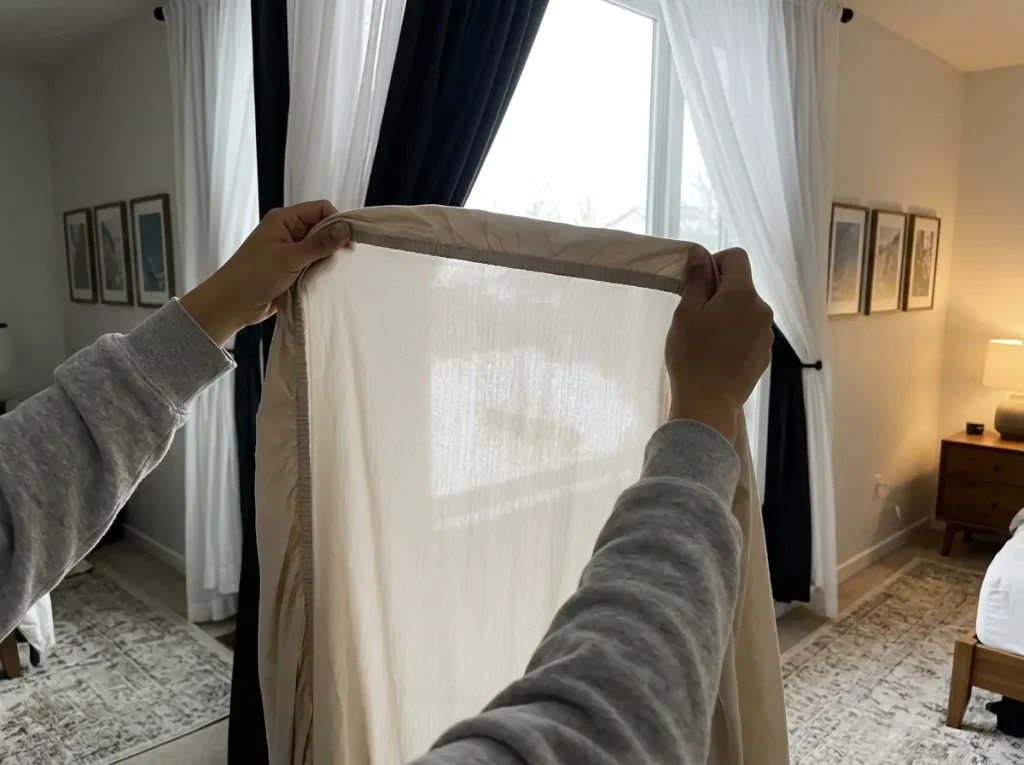
Start with thinning at the sleep-contact zone. Hold the middle third of the fitted sheet up to a window and look through it. The panel under your shoulders and hips thins first, and it thins unevenly, and that unevenness is the tell that you are looking at wear and not at how the cloth was made. A sheet that is thin all the way across was woven thin. A sheet that is thin in a shoulder-shaped patch has been slept on.
Second, pilling that comes back. A first round of pills is not a verdict; shave them off with a fabric shaver and see what happens. Pills that return within two washes mean the fiber is shedding out of the body of the yarn rather than off its surface, and that is structural. You are not removing fuzz at that point, you are unspinning the sheet one pass at a time.
Third, the seams. On a well-built set the stitching outlasts the panels, so when a seam frays or splits first, the fabric on either side of it was already carrying tension it was never built for. Check the fitted sheet’s corner seams and the flat sheet’s hem, which is where it shows up.
Fourth, softness that has stopped improving. Cotton keeps getting softer for years. Bamboo viscose peaks early and then goes limp, which is a loss of body rather than a gain in softness, and it is the one people most often misread as “nicely broken in.” A broken-in percale still has structure in the hand. A finished viscose sateen has none — it drapes over your fingers like a wet napkin.
Check the pillowcases separately, and expect them to lose first. They take face oils, hair product and a nightly friction the flat sheet never sees, on a much smaller piece of cloth. A set where only the pillowcases have gone is not a dead set. It is a set that needs pillowcases, the cheapest repair in the linen closet, and one that almost nobody makes because the box came with four pieces and it feels wrong to keep three.
What to change before you buy anything
Everything that extends a bamboo set’s life is free, and most of it happens in the twenty minutes after the wash rather than during it.
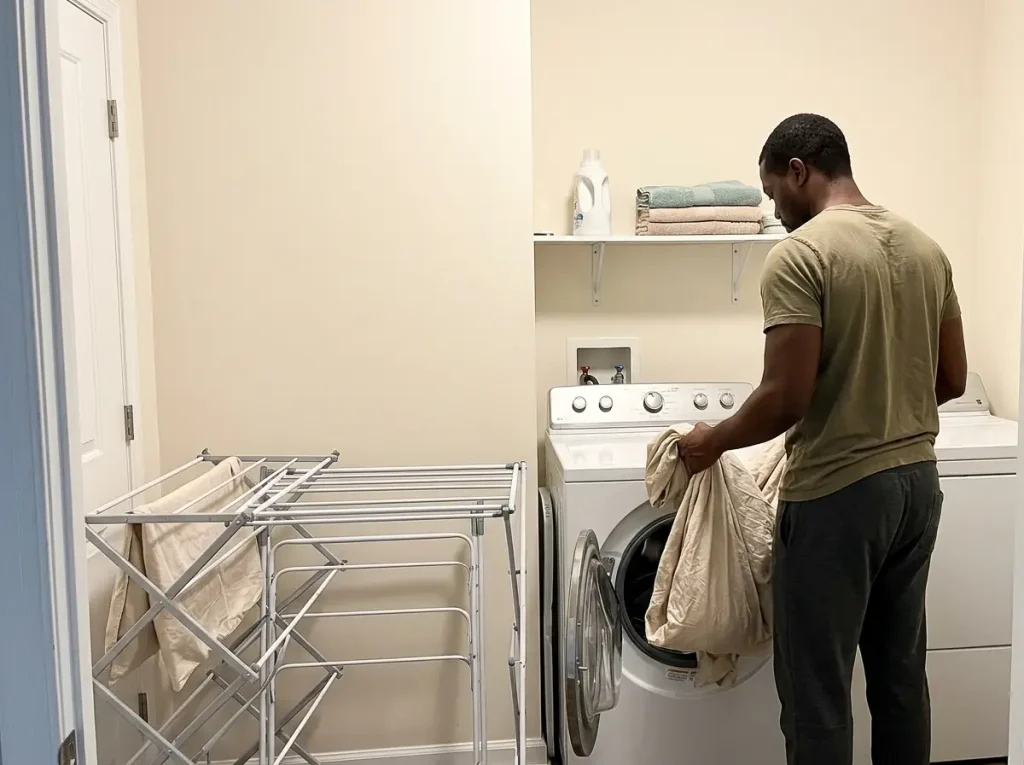
Rotate two sets. That is the whole trick, and it is the one people skip because it looks like buying more sheets when it is actually buying fewer. Halving the wash-and-wear load on each set roughly doubles the runway of both, and in a shared bed stripped every weekend it matters twice over, because that household is burning wash count at double speed. Brand blogs and reviewers repeat this one more than any other tip, and for once they are right.
Skip the fabric softener. It coats the fiber and flattens the surface, which accelerates exactly the matte, limp failure the last section described. You are paying to speed up the thing you are trying to prevent. Same for dryer sheets. This is free, it takes nothing but not buying something, and it is the step most often ignored.
Wash cold on a gentle cycle. This is not a superstition about colors; it is the wet-strength number turned into an instruction. The fiber is at half strength in there, so the job is to take mechanical stress off it while it is soaked. Gentle cycle, cold water, a mild detergent, and a load that is not packed to the door.
Then air dry, or use the lowest heat and pull it out early. The dryer is not banned. The full cycle is. Line-dry or rack-dry to just damp, then finish it on the bed, which also gets most of the wrinkles out for free.
And the honest limit: none of this fixes short staple or a blend percentage the label never printed. If the set pilled at wash three, care was never the variable, and no routine on earth rescues it. Worth saying plainly rather than selling somebody hope in the form of a laundry ritual.
Wash the set alone, or at least with nothing that has a zipper, a hook or a denim seam in the drum. At half its strength, wet viscose does not need much to snag, and one pulled thread becomes the thin spot that becomes the hole four months later. What else is in the load matters more here than which detergent you used, and no care label mentions it.
One aside on the tag while you are in the laundry room: the OEKO-TEX certificate on the package is not a care instruction and not a durability rating. It is worth understanding what the OEKO-TEX tag on the package does and does not cover before it does any deciding for you.
Buying the next set so this takes longer
If the set on the bed has failed the checks, the useful question is not which brand to trust. It is which two words on a listing actually predict how long the next one survives. You are looking at forty listings that all say 100% bamboo, OEKO-TEX certified, 1000 thread count. Three of those words matter and one of them is a trap.
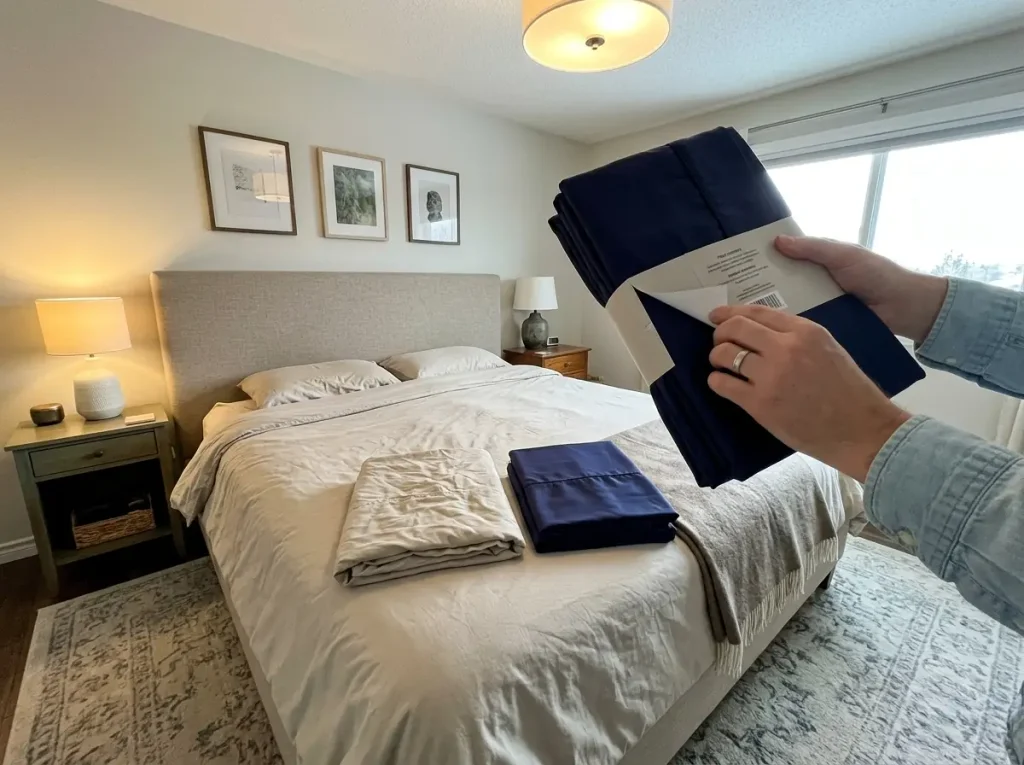
Lyocell versus viscose is the single biggest lever, and it is the one almost nobody looks for. Same plant, different manufacturing: lyocell comes out of a closed-loop solvent process and is reported as more abrasion-resistant, with a smaller wet-strength loss than standard viscose. That is a different fiber arriving at your bed under the same botanical name. If a listing will not tell you which process made it, the answer is viscose, because a maker who used the more expensive process says so.
The ettitude 100% Lyocell from Organic Bamboo Sheet Set is what a listing that knows what it built looks like: CleanBamboo lyocell rather than viscose, the closed-loop solvent process named outright, OEKO-TEX Standard 100 Class 1, and a 17-inch pocket printed where you can find it. Its flaw is that it is still a sateen, so the float can still snag. Lyocell buys back the fiber’s wet strength, not the weave’s. It is the more expensive way to buy bamboo and it buys you washes, not immunity.
Now the trap. The bamboo sweet spot is 250 to 350 thread count, and above roughly 500 the number is almost always multi-ply yarn counted more than once. Two thin threads twisted together and both counted. That gives you thicker yarn and often a less breathable cloth, because the gaps that moved air are now filled with more twist. A 1000-count bamboo sheet is not three times a 300-count one. It is a heavier sheet with a bigger number on the box.
OEKO-TEX belongs in the same category of misread signals. Standard 100 tests the finished fabric for more than 350 harmful substances and gets renewed annually, which means it tells you the sheet will not irritate your skin with leftover processing chemistry. It tells you exactly nothing about whether the cloth is intact at wash fifty. Have it. Do not read it as a durability grade.
Put those together and you get a disclosure test that works better than any brand name. A listing that names the process, names the weave and prints the pocket depth belongs to a maker who knows what they built. Silence on all three is itself a specification, and it is telling you the cheapest available answer to each question.
And the honest exit, because it needs saying: a plain-weave cotton percale has no exposed float to abrade at all, and at a comparable price it will usually outlast a bamboo sateen. The Linen Home 100% Cotton Percale Sheet Set is 200 thread count, single-ply, 15-inch pocket, OEKO-TEX certified, with the spec printed and nothing hidden behind an adjective. Its flaw is right there in that number: 200 is an honest count but a modest one, so expect a good plain hotel sheet rather than a heavy one. If two bamboo sets in a row have died at the two-year mark in your house, the fiber may simply not be the right buy for how you wash — how the two compare over a full season of washes settles that math properly. And if the reason you bought bamboo was heat, that question deserves its own answer before you switch, because giving up the fiber and giving up the cool are not the same trade.
One measurement before you order anything: measure the mattress with the topper on, and buy for the total. A pocket that is fractionally too shallow keeps the elastic under tension every single night, and the elastic then fails long before the fabric does. That is a set retired for a fit problem that was never a fabric problem at all, and it happens constantly.
Conclusion
Two to three years is the working figure for a typical bamboo viscose set, and the thing that moves that number is the construction, not the brand on the package. Count washes rather than months, because the fiber is weakest wet and the washer is where the life goes, and a shared bed stripped weekly burns through it at double speed. And two of the four checks means the set is finished: thinning at the sleep-contact zone, pills that come back, seams fraying before the panels, softness that stopped improving. One means it is aging, which is not the same conversation.
At about wash twenty, hold the middle of the fitted sheet up to the window next to a pillowcase from the same set. If the panel you sleep on has gone visibly thinner and the sheen has flattened while the pillowcase has not, the set is on the two-year track rather than the five-year one. That is the moment a second set in rotation actually buys you something, not year four.
Strip the bed this weekend and run the four checks before you buy anything. If the set passes, put a second set into rotation and wash both cold. If it fails on two, replace it, and this time read the listing for the process, not the thread count.
Frequently Asked Questions
01What is the downside to bamboo sheets?
Bamboo viscose is weakest when wet, so ordinary washing wears it down faster than it wears cotton. The sateen float that makes it feel silky is also the surface that abrades and goes matte, and sets spun from short staple pill within the first month.
02Are bamboo sheets really worth it?
Worth it if you buy lyocell or a mid-count viscose and wash it cold. It is not worth it as a premium purchase you expect to last a decade. What it genuinely gives you is drape and moisture handling. What it will not give you is cotton’s lifespan.
03Which is healthier, cotton or bamboo sheets?
Neither fiber is healthier than the other. What matters is what the finished cloth was treated with, which is exactly what OEKO-TEX Standard 100 tests for. Both fibers come certified, so the real choice between them is comfort and lifespan.
04How often should you wash bamboo sheets?
Every one to two weeks is the ordinary range, and every wash is a withdrawal from the set’s total life rather than a neutral event. Which is the argument for two sets in rotation: it halves the wash count each one carries without changing anything about how often you strip the bed.
05Do bamboo sheets get softer or worse over time?
Unlike cotton, bamboo viscose peaks early and then loses body rather than gaining softness. The tell is fuzz replacing sheen: broken fiber ends scatter light instead of reflecting it. When that limpness arrives with thinning or returning pills, the set is finished.




Tried it on your own bed?
No comments yet. Tell us what you changed, and what the sheet did after a few washes.