






What’s in here7 sections
One comforter goes flat in three years. Another one is still lofting at fifteen, in the same house, on the same bed, washed about as often. Nothing printed on either package explains the gap, and the phrase that hides it is down alternative, two words written to sound like an equivalent when what they describe is a different material running on a different clock. Down is a three-dimensional cluster that springs back through compression cycle after compression cycle; polyester fill is a manufactured fiber that bends, and past a point stays bent.
That single mechanical difference is the whole lifespan story, and the rest of this is what the two clocks actually are, the test you can run tonight without tools, why the shell and the fill die separately, and what pushes a comforter toward the short end of its range.
Quick Answer
A down comforter lasts roughly 10 to 20 years and a down-alternative one roughly 5 to 10. The gap is mechanical, not commercial: down clusters re-loft after being compressed night after night, while synthetic fill fatigues, mats, and stops springing back. Construction and a duvet cover decide where in the range yours lands.
Two Fills, Two Clocks
Two ranges printed side by side are just two numbers somebody chose. The reason they belong to different clocks is worth the paragraph, because once you know it, you can look at a comforter you already own and tell which clock it has been running on.
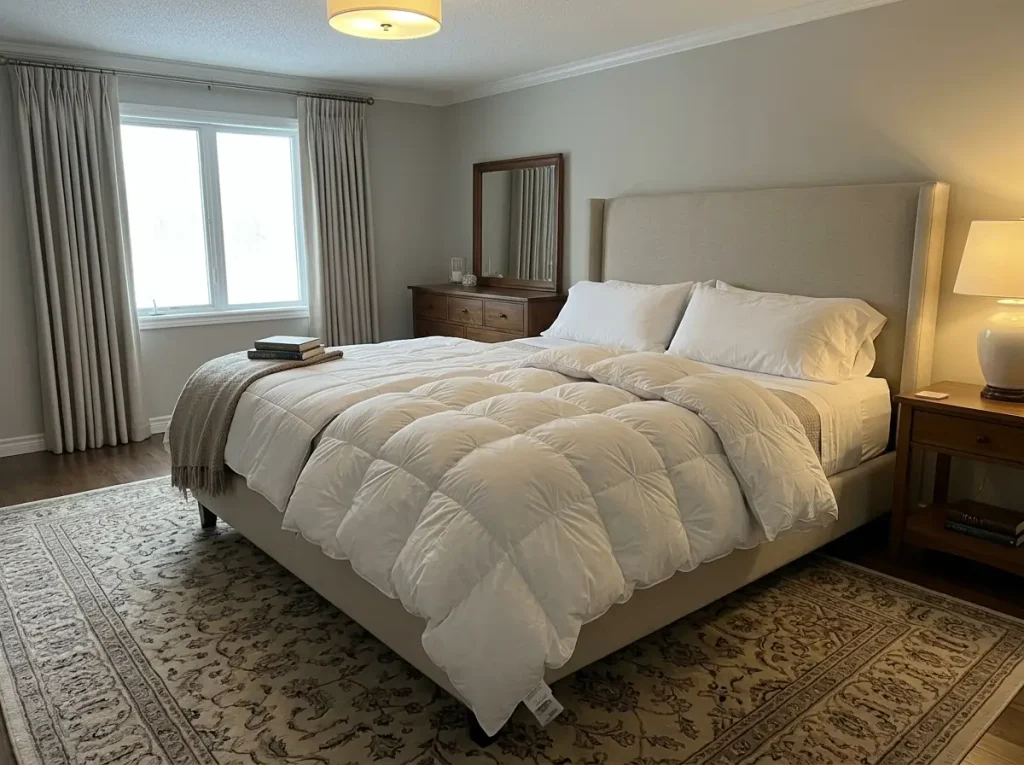
Down is commonly cited at 10 to 15 years, and honest sources stretch that to 20 for one that was covered, stored well and washed twice a decade. Down alternative runs 5 to 10. The difference is not fiber content on a label, it is fatigue. A down cluster is a three-dimensional structure, springy at the fiber level, and it recovers its volume through repeated compression cycles the way a spring does. Synthetic fill is extruded fiber laid in a batt. Every night your weight bends it, and every morning slightly less of that bend comes back out. Eventually the fibers take a permanent set and the batt mats. That is not flatness you can shake out. That is the fill finishing.
Fill power is the number that measures exactly this property, which is why it is the only spec on a comforter package worth reading closely. It is the volume in cubic inches that one ounce of down occupies after it fully re-lofts under a steam-conditioning protocol, so 650 fill power means one ounce fills 650 cubic inches, and how a lab actually measures fill power is a controlled spring-back test, not a marketing figure. A higher number is not a warmth rating. It is a resilience rating, which is the same thing as a lifespan rating.
One caution about ranges from anybody selling comforters: halve the best case. A brand quoting 20 years is quoting a comforter that lived under a cover, got shaken out, and went in a machine twice in ten years. And warmth per ounce is a separate question from lifespan. A lighter, higher-fill-power comforter can be both warmer and longer-lived, which is a different argument settled elsewhere.
The thing worth knowing about how a synthetic comforter fails is that it does not fail evenly. It goes first where the sleeper presses hardest and longest, which is the torso band, so it thins in a stripe down the middle while the foot end still looks new.
On r/Bedding the reports cluster on three words: flat, lumpy, and doesn’t puff back up. None of them is about a hole.
If you want to see what a long-clock comforter declares about itself, the puredown Goose Down Comforter states 800 fill power, a 700-thread-count cotton shell and 3D baffle box construction in the same listing, which is rare enough to be the point: three declared numbers let you check the clock instead of trusting the range.
Its flaw is real and worth knowing before you buy it: the baffle box takes noticeably more closet room than a flat sewn-through comforter, and down wants mild soap once or twice a year, no ordinary detergent and no high dryer heat, or it loses some of the recovery you paid for.
And the honest counterpart, because a reader who is not buying down still deserves a number instead of a shrug: the Cuddledown Dreamstead Down Alternative Comforter declares a fill-power equivalent of roughly 500 under a 235-thread-count cotton percale shell, which almost no down-alternative listing bothers to do. That number is what lets the short clock be compared on the same axis instead of dismissed. Its flaw is the clock itself: the synthetic fill mats over the years and stops recovering after a punch, and that flattening is permanent. No dryer cycle brings it back.
A listing that gives fill weight in ounces but never fill power is telling you it bought volume with quantity instead of quality. Fill weight says how much is in there; fill power says how long it keeps standing up. Two comforters at 30 ounces can sit ten years apart on the clock.
The Light Test
Two ranges are useless to somebody standing over a bed with a specific comforter in their hands. What that person needs is a reading on theirs, tonight, and there is one that takes about a minute and costs nothing.
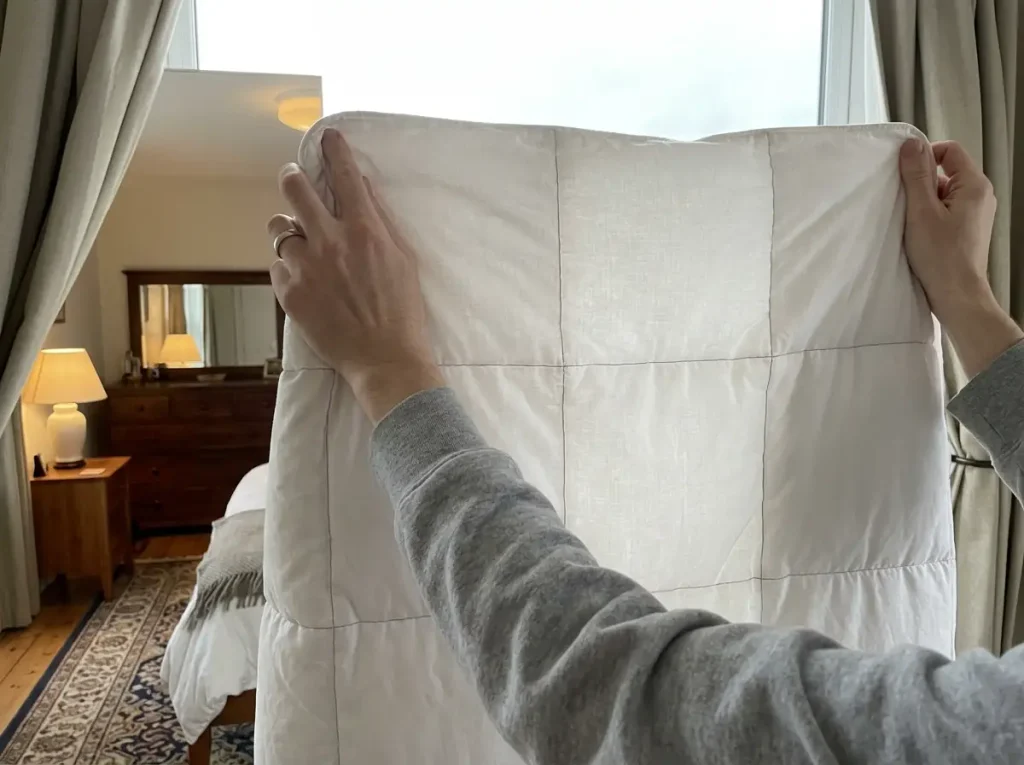
Hold the comforter to the window against a bright sky and look through it compartment by compartment, the way you would hold a suspect banknote to the light. Fill blocks light. Thin fill lets it through.
Then compare the compartments that sit over your shoulders against the compartments along the edges, because the edges do almost no work and are the honest baseline. When a working compartment shows roughly half the density of an untouched one, that zone is finished, whatever the rest of the comforter looks like.
Shake it out first and give it an hour. A comforter that has been compressed inside a duvet cover all week reads as dead when it is only squashed, and plenty of comforters have been thrown out on that misreading.
Run the light test in the morning, not at night. A comforter that has been under a sleeper for eight hours reads thinner than it is, and a comforter that has hung over a chair all day reads thicker. Shake it out, leave it an hour on the bed unfolded, then hold it up.
The light test does not transfer to down alternative, because a synthetic batt is dense and even and blocks light long after it has stopped doing its job. The equivalent check is mechanical: punch a fist into the middle of the flat comforter and count. Down re-lofts in seconds and closes the crater without help. Matted synthetic returns slowly, incompletely, or leaves a dent that is still there when you look back.
The reason the two tests are different is why down recovers its loft and synthetic fiber eventually doesn’t. One recovers structurally, the other spends its recovery a little at a time from the first night.
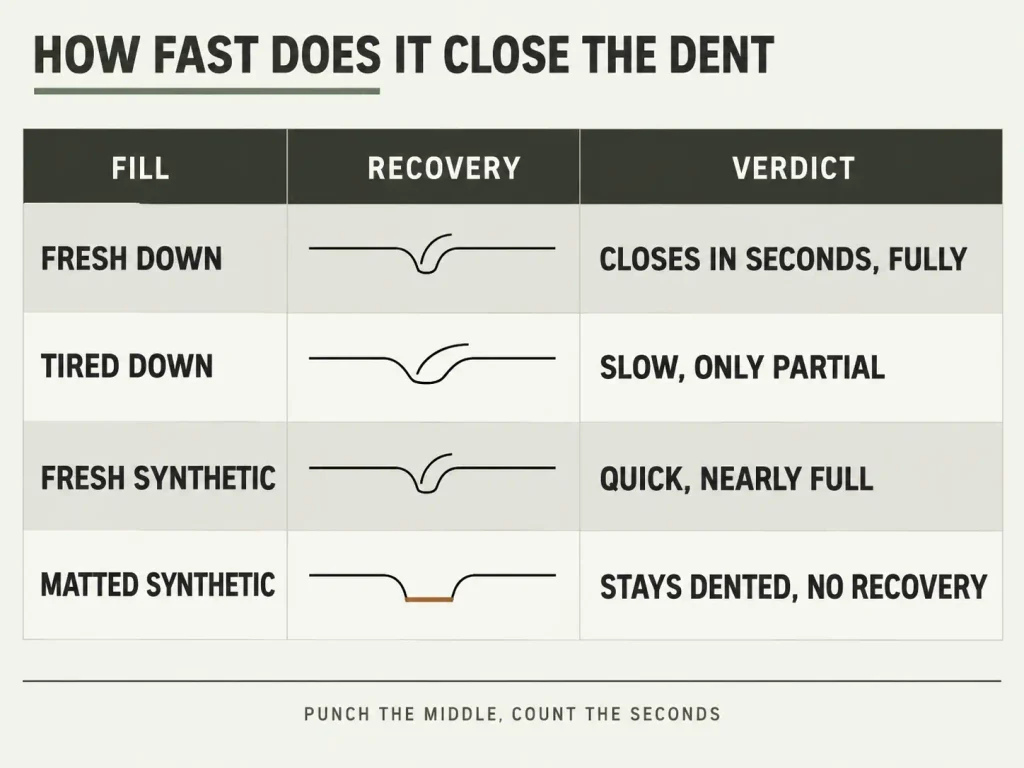
The community arrived at this test without naming it. Doesn’t puff back up is the phrase people reach for, and it is the punch test described by somebody who has done it a dozen times over a decade without thinking of it as a test.
One thing the reading does not do is condemn the whole comforter. A single failed shoulder compartment on a baffle-box comforter is a local failure, and a comforter with one thin box and eleven good ones is a comforter with one thin box. The same reading in three or four compartments across the torso band is a different verdict, and it is the whole thing. That threshold judgement is the same one this site applies to sheets, pillows and everything else on the bed, and it is the same question asked about a whole bed, just with a different clock underneath it.
The Shell and the Fill Die Separately
The light test tells you a compartment is empty. It does not tell you what emptied it, and the two candidates lead to opposite decisions: one is a repair and the other is a replacement. The comforter leaking feathers onto the sheet every morning reads as terminal, and often is not.
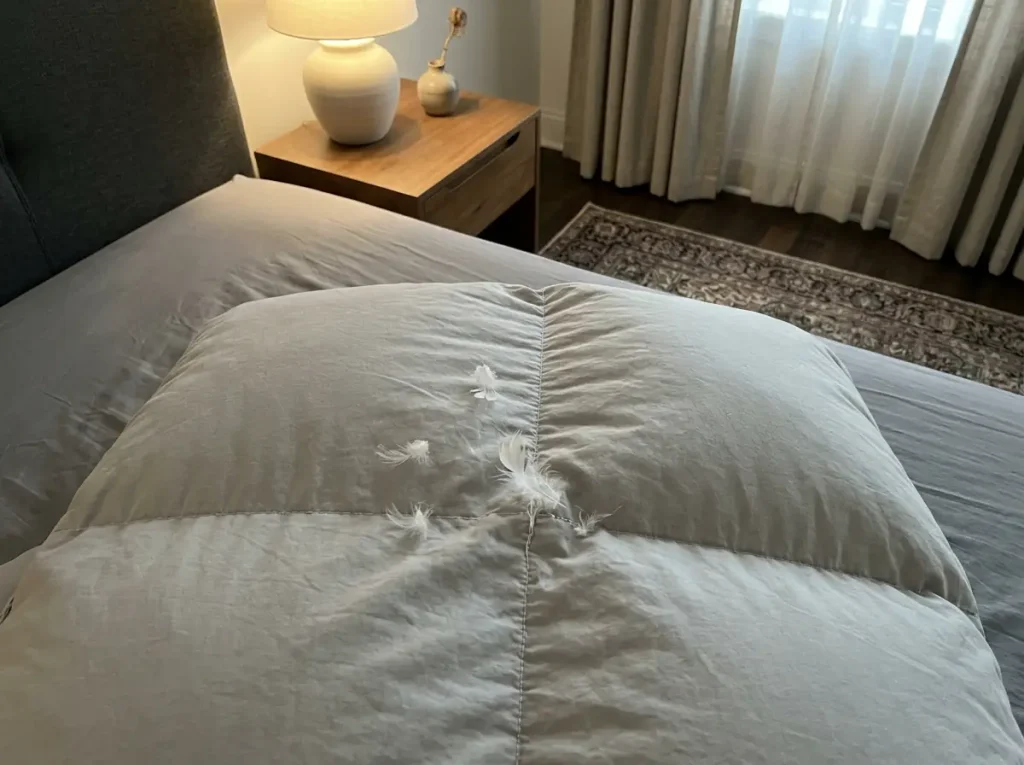
A comforter is two things with two independent failure clocks. The shell is a woven fabric with seams and a thread count, and it wears the way any fabric wears. The fill is a material with a fatigue limit. Either can finish first, and they usually do not finish together.
Shell failure looks like fill leaking at the seams, a thinning or shiny patch where an elbow or a knee has worked at the same spot for years, or a torn internal baffle wall, which shows up as fill migrating out of one compartment and piling into the next. Fill failure looks like the light test and the failed punch, with a shell that is still perfectly sound.
Learning to tell them apart is most of the money in this article, because shell failure is often repairable and fill failure is not. A reseamed edge or a patched panel buys years on a good fill. Nothing brings matted polyester back.
Construction decides how gracefully any of this happens. Baffle box puts vertical fabric walls between the top and bottom shell layers, so the fill has vertical room and can reach its full height. Sewn-through construction stitches the two layers straight together into flat sealed pockets, which is cheaper and lies flatter in a closet.
The consequence is a grid of cold stripes at every stitch line, where the two fabric faces touch with no fill between them at all. That is designed in, not a defect, and it is why a baffle-box comforter can feel thicker than a sewn-through one holding the identical weight of fill.
The shell’s thread count matters here too, and not for the reason it matters on a sheet. On a comforter a high count is down-proofing: a weave tight enough that clusters cannot work their way through the fabric face.
So the direction the feathers escape from is diagnostic. Along the seams means stitching. Straight through the fabric itself means the shell has lost its down-proofing, and no amount of resewing helps.
Before you decide a comforter is leaking, find out where from. Lay it flat, run a hand slowly along each seam, and look at which side of the stitching the feathers sit on. Seam leaks are a sewing job an alterations shop will do in an afternoon. Feathers coming through the flat of the shell fabric are the shell itself giving up.
The failure people misdiagnose most often is neither of those. It is fill that has migrated sideways over years of being dragged up the bed, leaving one end heavy and the other end nearly empty. That is a baffle failure, the internal walls have given way, and it presents exactly like flatness. Shaking it will never fix it, because there is nothing holding the fill where you shake it to.
What Actually Shortens It
Everything up to here is diagnosis. This part is the half you can still change, and most of it costs nothing at all.
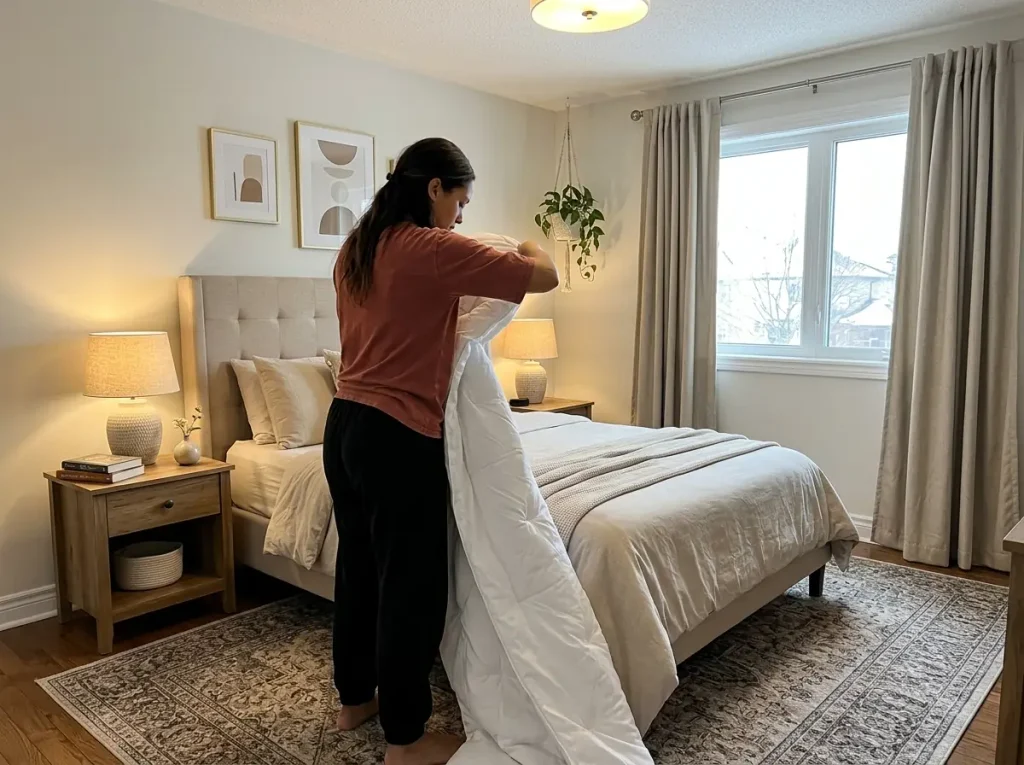
Use a duvet cover. That is the free fix and it is not close. A cover takes the fill out of nightly contact with skin, sweat and the oils a sleeper leaves, and it washes every week or two while the insert underneath goes in the machine once or twice a year. Down is absorbent, chemically so, which means a bare comforter is not just getting dirty faster. It is taking those oils into the fill, yellowing, and holding odor in a way that happens whether or not you wash it. An uncovered comforter and a covered one of the same model age visibly differently by year five, and the wash schedule has almost nothing to do with it.
Washing is the compromise, never the cure. Once or twice a year, gentle cycle, mild soap rather than standard laundry detergent, a full second rinse, then low-heat tumble with dryer balls until the fill is bone dry all the way to the middle. A comforter put away with damp fill is a faster and uglier problem than a comforter washed too rarely.
And the dryer-ball trick people reach for when a comforter comes out lumpy is a redistribution fix: it opens clusters that clumped in the wash. It does nothing for fill that has reached fiber fatigue, which is why the same comforter keeps going back in the dryer, and keeps coming out flat.
Then shake it out. Ten seconds, holding two corners, before the bed gets made. It redistributes fill that has crept toward the foot and lets the clusters open again, and it is the single habit that most delays the flat verdict. That’s it.
A shared bed changes the arithmetic, and almost nobody accounts for it. Two sleepers under one comforter do not wear it the same way, and a restless sleeper wears their half faster still. One sleeper compresses their half every night while the other rolls around; the comforter thins asymmetrically and gets judged dead when only one side of it is.
There is a thread on r/Bedding where a couple rebuilt an entire bed for a hot sleeper, and afterward the partner who had been fine the whole time was suddenly too cold and putting layers back on. One fill cannot serve two different sleepers, and if heat is the argument rather than lifespan, the sheet is what actually touches you and is the cheaper layer to change first.
The concrete answer to the asymmetry is one insert per sleeper, and the cheapest way to try it before committing is a small insert under a washable cover. A Utopia Bedding Twin Duvet Insert is 64 by 88 inches of all-season down-alternative fill, which is enough to run the experiment for a couple of weeks and find out whether two separate covers on one bed is something you can live with. Its flaw is right there in the dimensions: it is a Twin, it will not cover a Queen or a King on its own, and it only makes sense as one half of an insert-plus-cover system for one sleeper, not as a replacement for a full-size comforter.
One more thing that ages a comforter years faster than it should, and it is a sizing mistake rather than a habit. A Queen insert on a King bed is not just short on coverage. It gets dragged and pulled back and forth every night, and the fill takes that compression at the edges where it was never meant to, so the same model on the wrong bed size wears out on a shorter clock than the one that fits.
When to Replace It
Diagnosis and habits both stop one step short of the only decision that matters, which is whether the comforter in your hands right now is worth keeping through another winter. Here is where the line goes.

The replacement threshold is this: replace it when the fill no longer recovers after a shake and a night. Not when it is only flat, and not on a calendar date. Flat is a state a comforter can come back from; not recovering is the fill telling you it has run out of spring.
Two of these together is the call. It fails the light test across the torso band, which is structural wear rather than a bad night. It does not re-loft after a punch.
You are cold under it at a room temperature that used to be fine, or it still smells after a full wash and a complete dry. Any one of those on its own has other explanations; two of them at once do not.
That structural test in place of an age is the same judgement call on a set of sheets, where the deciding clock is wash count rather than compression, but the method is identical: measure the thing, do not count its birthdays.
Age by itself is not a reason. A fifteen-year-old down comforter that still lofts is a good comforter and there is no argument for replacing it. A four-year-old synthetic one that stays dented is finished, and no amount of warranty language changes what the fill is doing.
What replaces what depends on which clock ran out. Failing fill inside a good shell with sound baffles is worth a re-fill or a repair if you have somewhere that does it. Failing fill in a sewn-through synthetic is worth nothing, and the money is better spent on the next one. Which is really the buying lesson of everything above: fill type and construction set the clock before the comforter ever reaches the bed, so those two are what you buy deliberately.
Honestly, though, the reason most comforters actually get replaced is none of the above. A duvet cover comes off for the wash and the insert underneath turns out to be gray. Aesthetics end more comforters than fatigue does, and that is a completely legitimate reason to replace one — as long as you know which of the two you are acting on, because a gray comforter that still lofts is a comforter that needed a cover, not a funeral.
Conclusion
The range depends on the fill and not on the price. Down runs roughly 10 to 20 years because it re-lofts; synthetic runs 5 to 10 because eventually it does not. A brand’s best-case number is a comforter that was covered, shaken and rarely washed, so halve it and start from there.
The whole diagnosis is two minutes long. Hold it to a window and compare the shoulder compartments against the edges, then punch it and count how long the crater takes to close. Down answers in seconds; matted synthetic keeps the dent.
Put a cover on it and shake it out. Both are free, and together they are most of the distance between the two ends of the range.
A comforter never reaches wash twenty, which is exactly why the wash-count logic that governs sheets does not apply to it. The season to check is the one right after its annual wash: if it comes out, gets shaken, and has not returned to its old thickness within a day, that is the fill telling you where it sits on the clock.
Shake it out tonight and leave it an hour. Then hold it to the window. If the shoulders still read like the edges, you have nothing to buy.
Frequently Asked Questions
01When should you throw out a down comforter?
When the fill stops recovering: it fails the light test across the middle and stays dented after a punch and a shake. Age alone is not the trigger. A fifteen-year-old comforter that still lofts is still working.
02What is the life expectancy of a down comforter?
Roughly 10 to 20 years, most commonly cited at 10 to 15. Fill power, construction and whether it spent its life inside a duvet cover decide where in that range it lands.
03How can you tell if a comforter is good quality?
Look for a declared fill power, a shell woven tightly enough to hold clusters in, and baffle box construction rather than sewn-through. A listing that names none of the three is hiding all three.
04How long does a down alternative comforter last?
Roughly 5 to 10 years. Synthetic fill fatigues and mats permanently instead of re-lofting, so it thins along the torso band while the edges still look new.
05Does a duvet cover really make a comforter last longer?
Yes, and it is the cheapest thing that does. The cover absorbs the skin oils and the frequent washing instead of the fill, so the insert goes in the machine once or twice a year rather than monthly.




Tried it on your own bed?
No comments yet. Tell us what you changed, and what the sheet did after a few washes.