

What’s in here8 sections
A cooling mattress can feel like it works in the store and then lose the whole effect at home once a waterproof protector goes over it. The mattress did its job. The layer on top of it did not.
A waterproof backing is one of two things: a solid film with no pathway through it at all, or a membrane full of pores too small for a droplet and big enough for vapor. The face fabric printed in bold on the listing has no vote in which one arrived at your door. This is what that backing does to a bed, how to read a listing that never names it, what to re-measure before you buy anything, and what months of washing quietly take away.
Quick Answer
A waterproof mattress protector can make a bed run hot, but only the vinyl or PVC-backed kind: a solid film blocks vapor as completely as it blocks liquid. A protector backed with a TPU or polyurethane membrane passes vapor and still stops spills. Search the listing for the words TPU or polyurethane. Silence about the backing usually means vinyl.
Yes, a Protector Can Be the Thing Making You Hot
You have probably already changed the sheets. Maybe twice, maybe to something with the word cooling on the package, and you got nothing for it. The protector never came off, because a protector is furniture: it goes on the day the mattress arrives and then it stops existing. Nobody suspects the layer they cannot see.
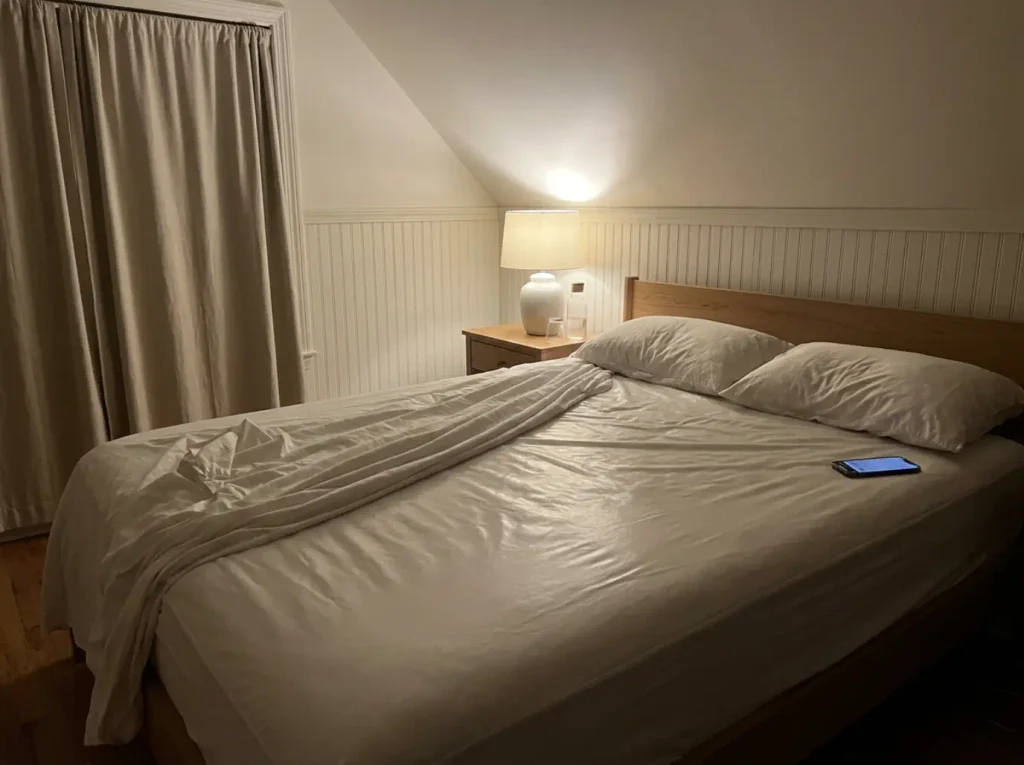
A vinyl or PVC backing is a continuous, non-porous film. It blocks liquid completely, which is the job it was bought for, and it has no pathway for vapor whatsoever, which is the part nobody mentions. Air does not move through it. Moisture does not leave through it.
And here is the sentence this entire article turns on: the backing decides, not the face fabric. A listing can say one hundred percent cotton, it can say bamboo, it can say Tencel in a large friendly font, and if there is a vinyl film laminated to the other side of that fabric, the bed sleeps hot anyway. That is also why one wrong layer undoes the other three. The stack is only as open as its most closed member, and on most beds the protector is the most closed thing on it.
The purest example of a plastic-backed protector is a fully zippered vinyl encasement, the kind sold as a Full Size Vinyl Mattress Protector, Zippered Encasement: one hundred percent vinyl, sealed on all six sides. If what you need is liquid absorbency stopped dead, it is a genuinely excellent product. For a sweat problem it is the worst possible choice, and it is worth knowing the shape of it so you can spot the same construction wearing a nicer description.
The telltale sign of this backing is not heat at all. It is sound. A waterproof protector can feel like sleeping on plastic bags that crinkle all night, and that crinkle is a solid film announcing itself. Same film, both symptoms.
A common complaint is that a waterproof protector does the opposite of cooling, which is a fair description of what a raincoat does under a sheet. It is the same complaint hot sleepers make about a cheap mattress pad laid over a mattress that was doing fine on its own.
And here is the part that keeps people from connecting the two: a vinyl-backed protector does not feel hot when you get in. It feels normal. The crinkle is loudest in the first thirty seconds and then your attention lets go of it, and the heat does not arrive until an hour later when it has nowhere else to go. By then the noise is forgotten and the heat has no obvious author, so you blame the sheets.
Before you buy anything at all: take the protector off for three nights and change nothing else. If the bed cools, you found your variable. If it does not, the answer is further down this page.
What “Breathable Waterproof” Actually Is
The pore that passes vapor and stops a droplet
Waterproof and breathable sound like opposites. They are not, and the reason is a size difference so large it is almost funny: a liquid water droplet and a molecule of water vapor are nowhere near the same scale.
A microporous membrane is built to exploit exactly that. Its pores are large enough for vapor to pass through and too small for liquid to cross. That is the entire trick. There is no technology in it more mysterious than a sieve with very well-chosen holes.
Vinyl has no pores. Not small pores. None. It is a film, the way a plastic bag is a film.
Both a vinyl backing and a membrane will stop a spilled glass of water. Only one of them lets the night’s moisture leave the bed, and that difference is the whole of moisture control on a bed.
TPU and Polyurethane, the Two That Work
The two membranes worth buying are TPU (thermoplastic polyurethane) and plain polyurethane laminate. They are two chemistries doing one job, and the practical difference between them is smaller than the difference between either of them and a sheet of vinyl.
When people talk themselves out of this problem, they land on the same advice: choose a TPU or polyurethane protector and skip the vinyl one. Nobody reaches for a premium brand as the fix. The membrane chemistry is the purchase.
| Backing type | Liquid | Vapor | Sound | How it ages |
|---|---|---|---|---|
| TPU membrane | Blocked | Passes through | Silent | Breathability fades before waterproofing does |
| Polyurethane laminate | Blocked | Passes through | Silent to faint | Same fade, and bleach ends it in one wash |
| Vinyl or PVC film | Blocked | Blocked too | Crinkles | Stays exactly as airtight as day one |
| No backing named | Unknown | Assume blocked | Unknown | Treat as vinyl until the seller says otherwise |
Why there is a number for this, and why no listing shows it
Waterproof is not an adjective in textile terms. It is a measurement. Under the AATCC 127 hydrostatic pressure test that actually measures a fabric’s waterproof rating, a fabric is clamped flat and water pressure is raised underneath it at a controlled rate until droplets break through the top.
The result comes back in millimeters of water column, and high-performance waterproof-breathable laminates rate up to roughly 20,000 mm. So there is a number. There has been a number the whole time. A protector listing that names neither a membrane type nor a hydrostatic figure is not being vague by accident; it is skipping the one spec that would end the argument.
Then there is the face fabric, and cotton terry deserves its own sentence because it does two jobs at once. The terry loop’s raised structure gives it enormous surface area, which is how cotton terry’s loop structure wicks moisture, according to Cotton Incorporated’s fabric research. That is what moisture-wicking actually means on this product: it pulls sweat off skin fast, then holds the water like a sponge until the membrane underneath lets it evaporate away. Fast in, slow out, and the drying time is the part nobody puts on a box.
Which explains something that otherwise makes no sense: a protector can be perfectly dry to the hand at bedtime and still feel faintly damp the following night. The loops were releasing water into the room slowly, and if the bed got remade over the top of them a few hours later, they never finished. The membrane was working the entire time. The sponge on top of it was the bottleneck.
Now the honest limit, and it is the one thing every product page in this category gets wrong. A breathable mattress protector is not a cooling feature. It means the layer has stopped being a heat trap. That is all it means, and it is a smaller promise than the packaging makes. Anybody selling you a protector that keeps you cool is selling the cooling finish on the face fabric, or some temperature-balancing claim built on top of it, which is the next section’s problem.
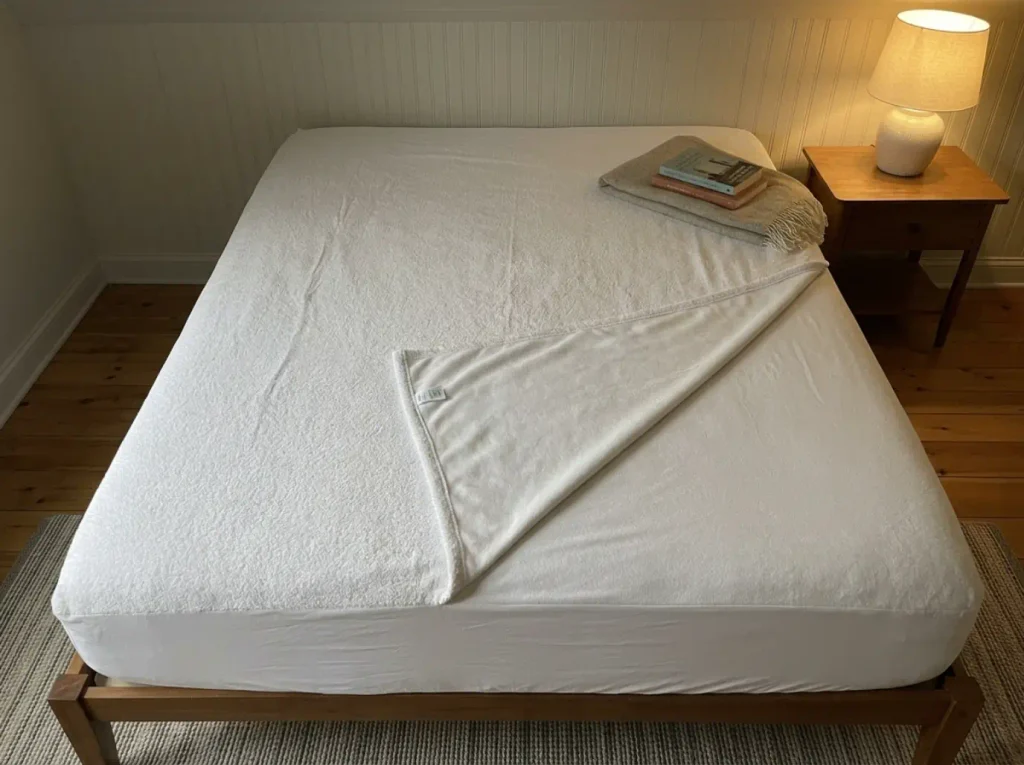
Cotton terry over a TPU membrane is the textbook build of everything above, and this is what it looks like written on a real product.
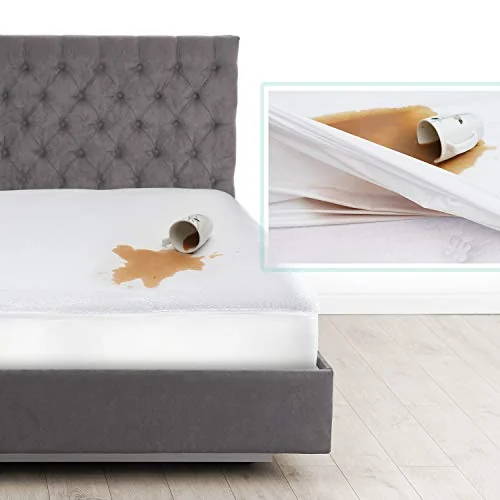
The other chemistry doing the same job is polyurethane, and the SafeRest Waterproof Mattress Protector is the version of that with the longest paper trail — an 80/20 cotton-polyester terry face over a 100 percent polyurethane laminate, with stretch pockets — and several buyers report the terry face sleeping warmer than they expected despite the membrane behind it, which is the honest limit of this section turned into a customer review. Not a heat trap. Not cool either. Two membranes, one job, and the reason to name both is that you should be shopping for a backing type rather than a brand.
Reading a Protector Listing Without Being Lied To
“Cooling” is a finish, “breathable” is a structure
Everybody has bought something whose label was technically true and completely misleading. If you ended up with the vinyl one, the listing was built so you could not tell, and that is a different thing from a mistake.
Here is the distinction nobody draws. Cooling describes a surface treatment applied to the face fabric. It sits on top of the fibers, it has no standard behind it, no certifying organization, no number, and it comes off in the wash, usually inside the first ten cycles. Breathable, when it is earned rather than decorative, describes the membrane, and a membrane is structural.
One is a coat of paint. The other is what the thing is made of. The same goes for the other words that turn up on these listings: hypoallergenic and dust mite barrier describe a weave tight enough to be a barrier, which a membrane already is, so they are usually a restatement of the backing rather than a second feature. It is the same reading habit that separates a claim from a construction on any textile, and the same label-reading habit applied to sheets saves you from thread-count arithmetic in exactly the same way.
The fiber content on the face tells you nothing about the back
One shopper’s protector was sold as 100 percent Tencel, which is a lyocell fiber. Checked against its own care tag after it arrived, it was a 70/30 polyester-Tencel blend, and in that shopper’s own side-by-side it slept hotter than a cheap bamboo viscose one. Two separate label problems stacked on a single product: the face content was wrong, and the face content was never the thing that decided the outcome.
Which is the level-3 lesson buried in that story. The listing and the care tag are written by different people for different reasons, and the tag is the one with a legal obligation behind it. That is why the blend got caught after the box was opened rather than before it was ordered.
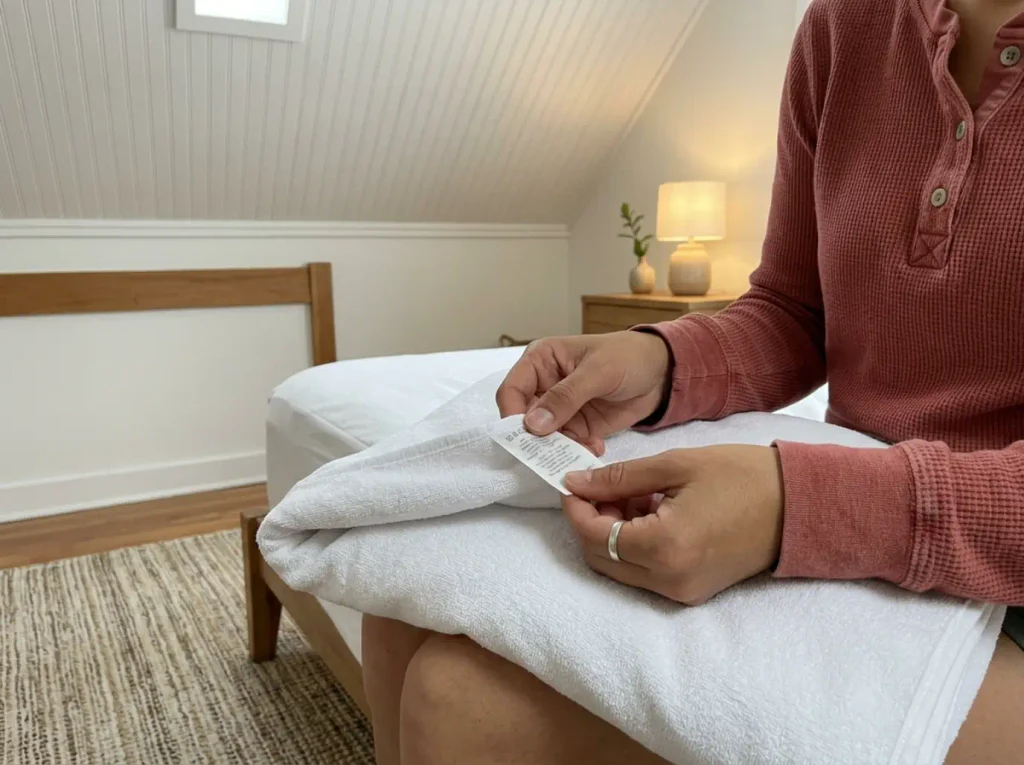
On a protector the tag is also, very often, where the backing finally gets named when the listing skipped it, along with the wash temperature the membrane will actually survive. So if the thing is already in your house and you still do not know what you bought, stop reading the internet and go read the tag sewn into the side seam.
The three words that mean the backing is fine, and the one that means it isn’t
Search the listing text for TPU, polyurethane, or polyurethane laminate. Any of the three and the backing is a membrane. Search for vinyl, PVC, or plastic backing and walk away if you sweat at night.
And treat total silence about the backing as the fourth case. A seller with a membrane says so, because it costs more and it sells. Silence is the same answer as vinyl until somebody proves otherwise, whatever else the label claims are doing.
Use your browser’s find function on the product page and search four terms in order: TPU, polyurethane, vinyl, PVC. Do it on the Q&A and review sections too, not just the description — sellers who avoid naming a vinyl backing in their own copy tend to answer the question honestly when a buyer asks it directly.
A hydrostatic figure in the specs is a very good sign, and not because the number itself matters to anybody trying to sleep. It matters because a seller who publishes one has one to publish. That is the whole signal.
Measure the Stack, Not the Mattress
The topper is part of the mattress now
You measured. You bought the pocket depth that matched. And the corners still rode up by week two, because the topper was not in the tape measure the first time.
Retail pocket depths run roughly 6 to 18 inches. The rule that works: measure the mattress depth with the mattress topper already on it, then add two or three inches of slack for the edge to wrap underneath and stay anchored through the night. That is your number, and it is the same arithmetic as the mattress-plus-topper-plus-two-inches rule one layer further up the bed, because the failure is identical: a pocket sized to a mattress that no longer exists on its own.
Do not over-buy depth to be safe. Too much slack is its own failure mode, and it is the one people walk into trying to avoid the first one. Excess fabric has nowhere to go, so it gathers at the corners instead of lying flat.
What a bunched corner actually does
On a fitted sheet a wrinkle is cosmetic. On the layer managing your sweat it is a damp pocket. That fold is where moisture collects and stays, pressed flat against the mattress, without the airflow the rest of the membrane gets.
It is also the first place the membrane fails mechanically, because it is the part being creased and uncreased every single night. The flat middle of a protector will outlive its own corners by a long way, and a corner that never dries is where mildew starts if anything is going to.
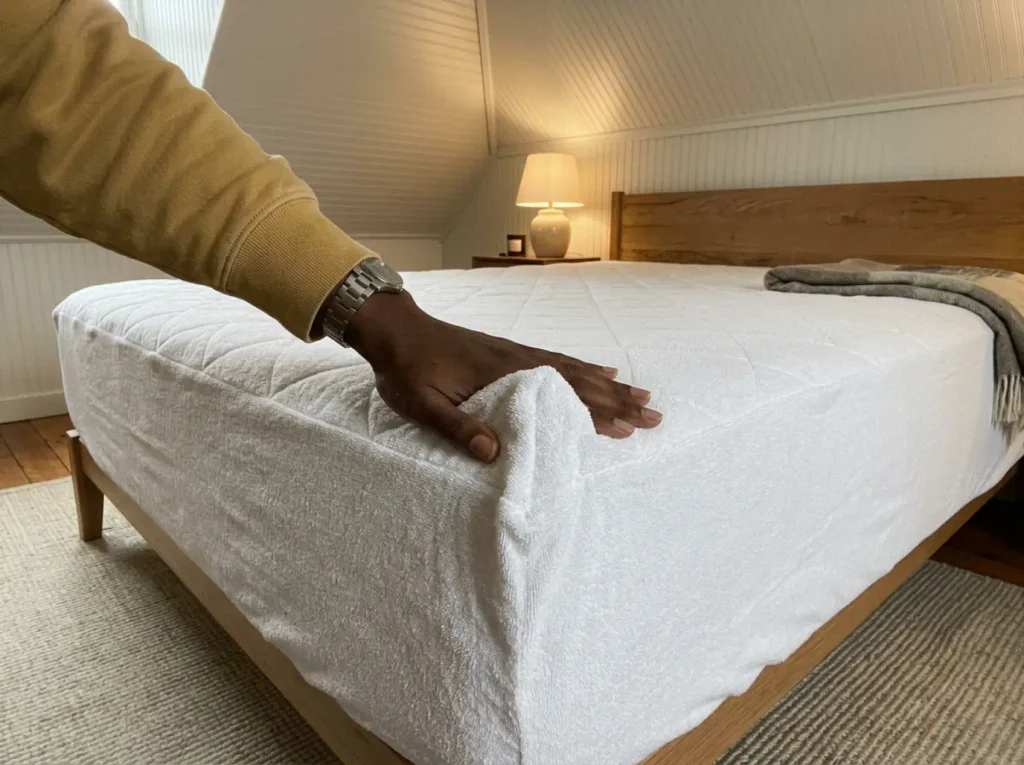
You can find the bunching without stripping the bed. Run a flat hand along the mattress edge about a foot in from each corner. Where there is surplus, the protector moves under your palm as a loose ridge instead of staying stretched. It is always the same two corners: the ones on the side you sit down on to put your shoes on.
Do the flat-hand check in the morning, before the bed is made and while the fold still holds whatever it held overnight. A ridge that feels cool and slightly heavy to the back of your fingers is a damp pocket, not a wrinkle — and it will be in the same place tomorrow unless the pocket depth changes.
Before buying anything, re-measure tonight with the topper on. If your current protector turns out to have three inches of slack too many, moving it to a taller bed or to a topper-less guest room costs nothing and solves it there. Deep-pocket sizing like the Nestl’s is what makes the measurement worth taking in the first place, but the measurement comes first and it is free.
What Months of Washing Take Away
Heat, Bleach and Softener: the Three That Do the Damage
The protector looks exactly the same at month eight as it did on day one. That is the problem with it. This is the one bedding failure with no visible tell at all.
Three things wear a membrane out faster than time does, and all three are care-label mistakes rather than manufacturing defects. High heat is the single biggest cause of premature membrane failure, and the dryer on high, every week, is what ends most protectors. Chlorine bleach chemically breaks down polyurethane, and it can do it in as little as one wash, which matters specifically for a polyurethane-laminate product like the SafeRest whose entire barrier is that chemistry. And fabric softener leaves an oily residue that clogs the pores from the fabric side.
Softener is the cruel one. It is the thing people reach for precisely because they want the protector to feel less like plastic, and it is the thing that stops the membrane breathing. You buy a membrane to fix the plastic feeling, then you pour the plastic feeling back on top of it.
If you want the terry face soft without softener, run half a cup of white vinegar in the rinse instead. It strips detergent residue rather than adding a coating, and it leaves nothing behind on the membrane side. Tumble low or hang it, and never iron a protector — the membrane is thermoplastic, which is a technical way of saying an iron melts it.
Two to three years, not forever
Here is the number nobody gives you. A well-maintained waterproof protector is generally expected to hold its integrity for roughly two to three years of normal washing, and it degrades a little with every cycle rather than failing on a particular Tuesday. Normal washing means every one to two months. Against night sweats it is every week or two, which means a sweat-heavy bed arrives at the end of that service life considerably sooner than the label’s arithmetic assumes.
Set that against the benchmark the industry itself quotes. Manufacturers commonly cite a five-wash test, and on a protector going through the machine every week, five washes is the first month and a half of a three-year working life. It measures how the product starts. It says nothing whatsoever about how it ends.
Count in laundry cycles rather than in months and the durability question answers itself. A guest bed might see a dozen cycles in three years. A night-sweat bed sees closer to a hundred and fifty, so the wash count that matters is yours, not the one on the test report.
And what goes first is not what you would expect. The membrane failing is not a leak, and the leak comes much later if it ever comes at all. What goes first is the breathability: the protector still stops liquid perfectly and has quietly stopped passing vapor.
So the bed starts running warm again months after the purchase that fixed it, with nothing visibly different about anything. That is waterproofing degradation running backwards from what anybody expects, and the person who bought correctly in year one blames their sheets in year three. When the membrane goes, the wash routine is the thing still doing work, which is why the wash routine that keeps the smell from setting matters more on a sweat-heavy bed than on any other.
When It Is Not the Protector

The mattress core underneath it
Five sections arguing that the protector matters, and now the honest part: sometimes it is not the protector. Here is how you find that out without spending anything.
Take the protector off for three nights. Change nothing else: same sheets, same duvet, same room temperature, same bedtime, same pajamas. Three nights, because one night proves nothing about a bed. That is the three-night test, run properly, and it is the only method here that costs nothing and rules something out for good.
Memory foam heat retention is a real property of the core, and no membrane vents what the mattress underneath is storing. A protector can stop being part of the problem. It cannot fix a mattress, and neither can a cooling mattress pad laid over the top of it, which is the purchase most hot sleepers make second. If the three nights come back the same, the protector was never your variable and the next layer down is.
The room, and the two of you in the bed
The room belongs in the test as well. A bedroom with no ventilation is a bedroom where nothing evaporates, membrane or no membrane, and a protector cannot push moisture into air that is already holding all it can. Open a window for ten minutes while the bed is stripped and you have changed more than most purchases would.
Then there is the case nobody covers, and it comes from how the layer sits on the bed rather than from anyone’s reported experience. No source reports this directly, so treat this as reasoning rather than testimony.
A protector runs edge to edge underneath both sleepers. Unlike a duvet, it cannot be split by preference. There is one protector and there are two opinions, so on a shared bed it gets chosen for whichever of you sweats, and the layers that can be split, the duvet and the top sheet, are where the two of you actually get separated. Buying two different protectors for one mattress is not a thing that works, and the only bed where it does is a split king, because that is two mattresses wearing one headboard.
The three-night test also fails for a boring reason more often than for an interesting one: people run it during a week when something else changed. A heat wave, a late heavy dinner, a different bedtime, a glass of wine that was not there the week before. Run it across three ordinary nights in a row, and if this week is not ordinary, wait for one that is.
Write down the room temperature and what time you went to bed on each of the three nights, on your phone, before you sleep. Without those two numbers you will remember the nights as being the same when they were not, and the whole test comes down to whether they were.
When it stops being a bedding question
Clinically, night sweats means sweating heavy enough to soak nightclothes or the bedding, repeatedly. That is a different thing from waking up damp because the room was warm or there were too many blankets on the bed, and the difference is the line this article works on either side of. Bedding and room heat explain the second one. They do not explain the first.
So: when it happens on a regular basis, when it interrupts sleep, or when it arrives alongside other symptoms, that is a conversation for a doctor and not for a bedding article. Mayo Clinic’s own guidance on when night sweats are worth a doctor visit sets the threshold, and it is theirs rather than ours. Nothing on this page reads anybody’s sweat pattern, and this sentence is not doing it either.
Everything else, the backing and the membrane and the pocket depth and the wash, is the whole bed, layer by layer from the bottom up, and that part is genuinely fixable.
What to Do With All of This
The backing decides, not the face fabric. Look for TPU or polyurethane in the listing text, walk away from vinyl and PVC, and read silence about the membrane as a vinyl answer until a seller tells you different.
Measure the mattress with the topper already on it, then add two or three inches. Too much pocket depth is not a safety margin. It is a damp fold at the corner, and it is always the same two corners.
Breathable is not cool. It means the layer has stopped being a heat trap, which is a smaller and considerably more honest promise than the one printed on the box, and expecting the other thing is how people end up disappointed by a product that is working exactly as designed.
The wash-twenty check: after a season of washes the tell is not a leak. It is the bed starting to run warm again with nothing else changed, the breathability going while the waterproofing is still perfectly fine. No softener, no bleach and no high heat is what postpones that, and nothing stops it forever.
Tonight, take the protector off. Leave everything else exactly as it is and sleep three ordinary nights. Then you will know whether you are buying a protector or looking somewhere else entirely.
Frequently Asked Questions
01What is the best mattress protector for night sweats?
One with a named TPU or polyurethane membrane rather than a vinyl backing. The membrane type matters more than the brand or the face fabric, and the usual advice lands in the same place: buy the backing, not the marketing.
02Do waterproof mattress protectors make you sweat?
A vinyl or PVC-backed one can, because a solid film has no pathway for vapor to leave through. A microporous TPU or polyurethane membrane passes vapor while still blocking liquid, so it does not trap heat the same way.
03Why does my mattress protector crinkle?
The crinkle is a solid plastic or vinyl backing announcing itself. It is the same film that blocks airflow, which is why the noise and the heat usually turn up on the same product and disappear on the same one.
04How often should you replace a waterproof mattress protector?
Roughly every two to three years with normal washing, sooner on a bed washed weekly. The membrane degrades gradually rather than failing suddenly, so it stops breathing well before it ever starts leaking.
05Can you put fabric softener on a mattress protector?
No. Softener leaves an oily residue that clogs the membrane’s pores from the fabric side, which removes the breathability you paid for. Skip the bleach and the high dryer heat as well.


Tried it on your own bed?
No comments yet. Tell us what you changed, and what the sheet did after a few washes.