







What’s in here6 sections
You are standing over a stripped bed at nine at night with everything that was on it in a pile on the floor, and somebody else is already handling the actual problem. Your question is narrower and more expensive: how much of this do I have to throw away? The number that decides it is not the one you keep reading. A bed bug stops living when its own temperature reaches 113°F, but your washer has to run at 140°F, because that heat has to travel through a soaked, folded, tangled mass of cotton and reach something hiding inside a hem.
Here is what goes in the wash, what genuinely cannot, when it is safe to buy anything new, and what to look at a year from now.
Quick Answer
Almost everything on the bed survives. Anything that can take a 140°F wash and a full 30 minutes in a high-heat dryer can be kept, which covers sheets, covers, comforters and protectors. The exceptions are items with a foam core and anything labeled dry-clean only. And nothing new comes into the room until pest control says the treatment is finished.
What Goes Straight in the Wash, and How Hot
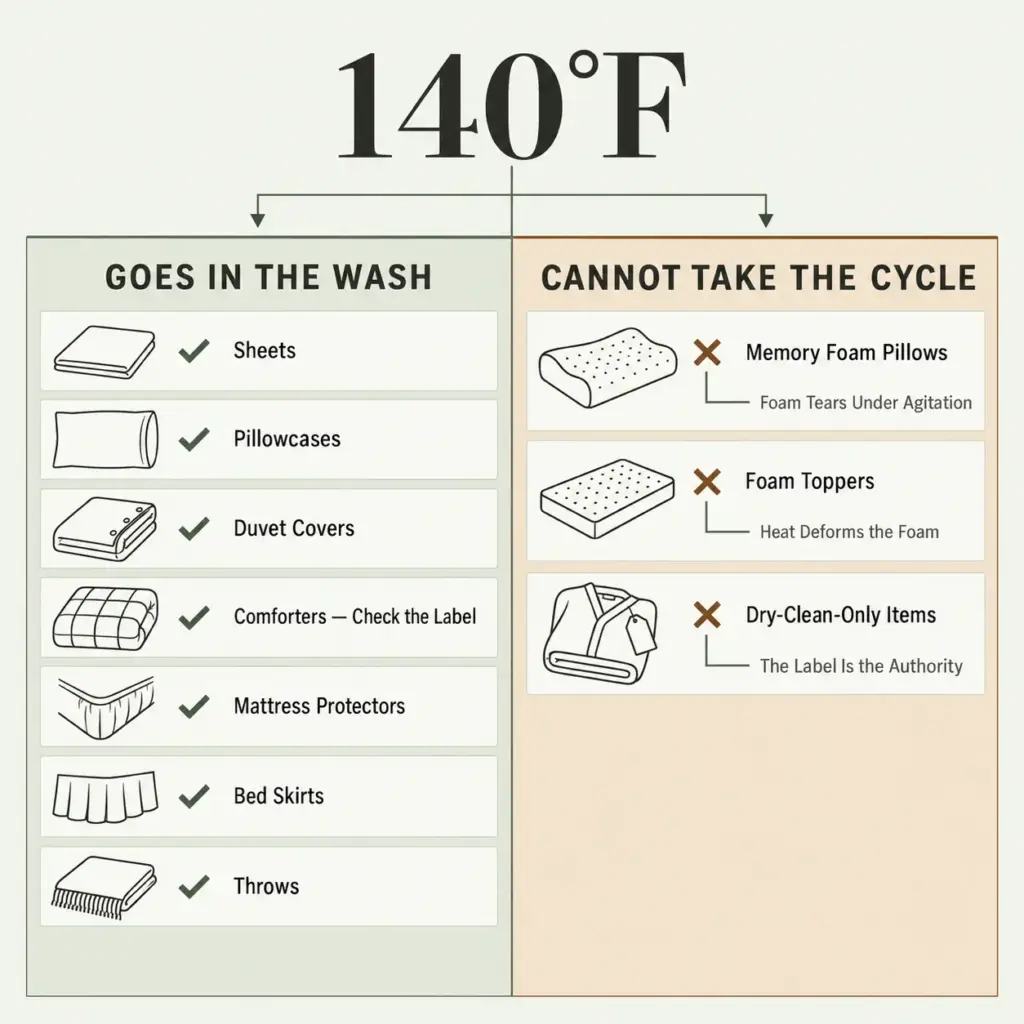
Before anything gets sorted into a keep pile and a throw-away pile, almost all of it belongs in the same place, and the setting on the dial decides whether the trip was worth making. Sheets, pillowcases, duvet covers, the comforter if its label allows it, mattress protectors, the bed skirt, the throw that lives at the foot of the bed. All of it goes in. Sorting comes later, and for most people the sorting turns out to be a very short conversation.
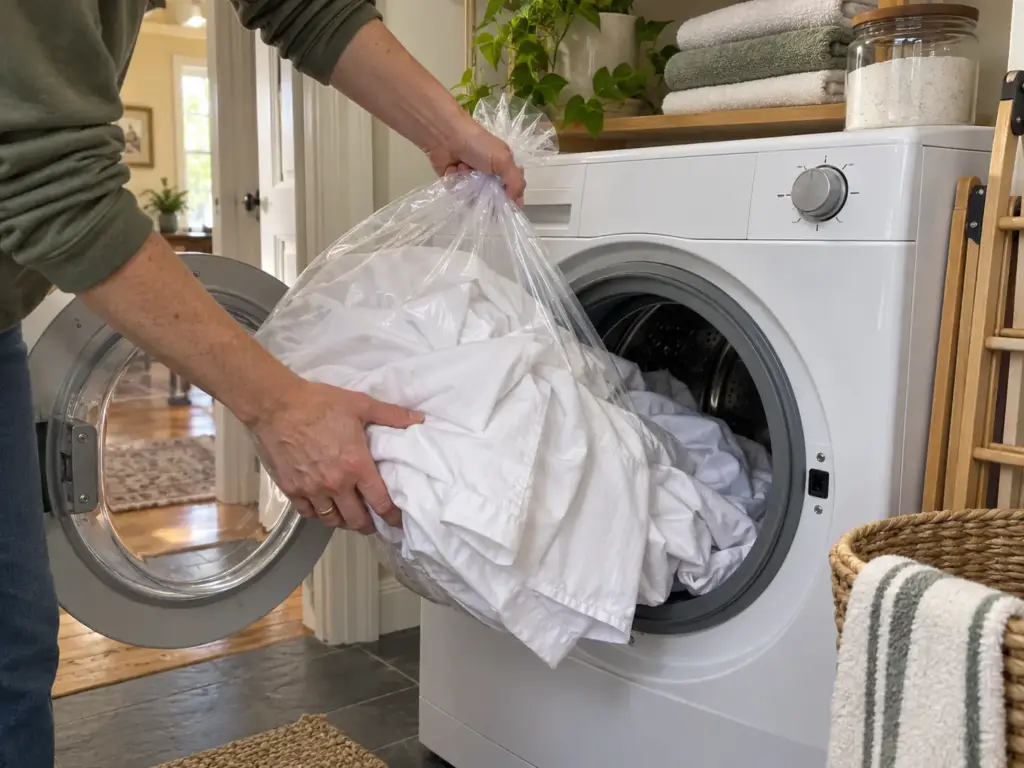
The number is 140°F, which is 60°C, for a full 30-minute cycle. That is what the EPA’s own pre-treatment checklist puts on the wash, and then it does something most guides leave out: it sends the same load to the dryer on high heat for another 30 minutes, and notes that washing alone might not do the job. The dryer is not the optional half.
Water cools as the cycle runs and as the drum drains; hot dry air does not, and it holds that temperature against every fold for half an hour straight. If you ran a warm wash last night because the care label said warm, you are going to have to do it again. A household “warm” setting sits around 105°F, which is under the temperature at which a bed bug stops being a problem, let alone over it.
Bag it on the way. Seal each armful in sealed plastic bags before it leaves the bedroom, carry the bag to the machine, tip the contents straight in, and knot the empty bag shut before it goes in the trash. A pile carried loose down a hallway and left by the washer for two hours has been in three clean rooms by the time it gets washed.
That gap between 113°F and 140°F is the one thing worth understanding, because once you have it you stop guessing at every setting for the rest of this. The lower number is the bug’s ceiling. The higher number is the machine, and it exists because a washer does not heat a bed bug, it heats a load.
Some of that load is a duvet cover twisted into a rope around the agitator with a flat sheet and a pillowcase knotted inside it, and any bed bug eggs in that bundle sit deeper still, cemented into a seam. The water has to be hot enough that by the time the heat has worked through all of that, it still clears the bug’s ceiling with room to spare. Set the dial to the bug’s number and you have built in no margin at all for a soaking wet knot of cotton.
That is also where this parts ways with the ordinary version of the same job. The same hot wash that settles it after a stomach bug works on the principle that hot is hot enough; here the bar is a specific temperature rather than a general one, and there is a category of item that has to be handled outside the machine entirely. And before you buy a single thing to help, know that one of the most-repeated fixes on the forums costs nothing: on an AnandTech thread about a household’s outbreak, one poster’s whole addition to the hot wash and hot dry was a physical barrier smeared on the bed legs. Free, and he called it what worked for him.
One caution on the comforter. A comforter or duvet that clears 140°F in the washer often cannot clear a full high-heat dryer cycle without the fill shifting on you. It comes out heavy and lumpy, with everything migrated into one corner of the baffles and the rest of it flat. The answer is not a cooler dry, which defeats the entire point of the exercise. Stop the machine twice mid-cycle, pull the comforter out, and break the clumps apart with your hands through the shell before sending it back in.
What Can’t Take the Heat, and the Honest Money Call
Two things on that bed will not survive the cycle that saves everything else, and one of them is probably the item you most want to keep.
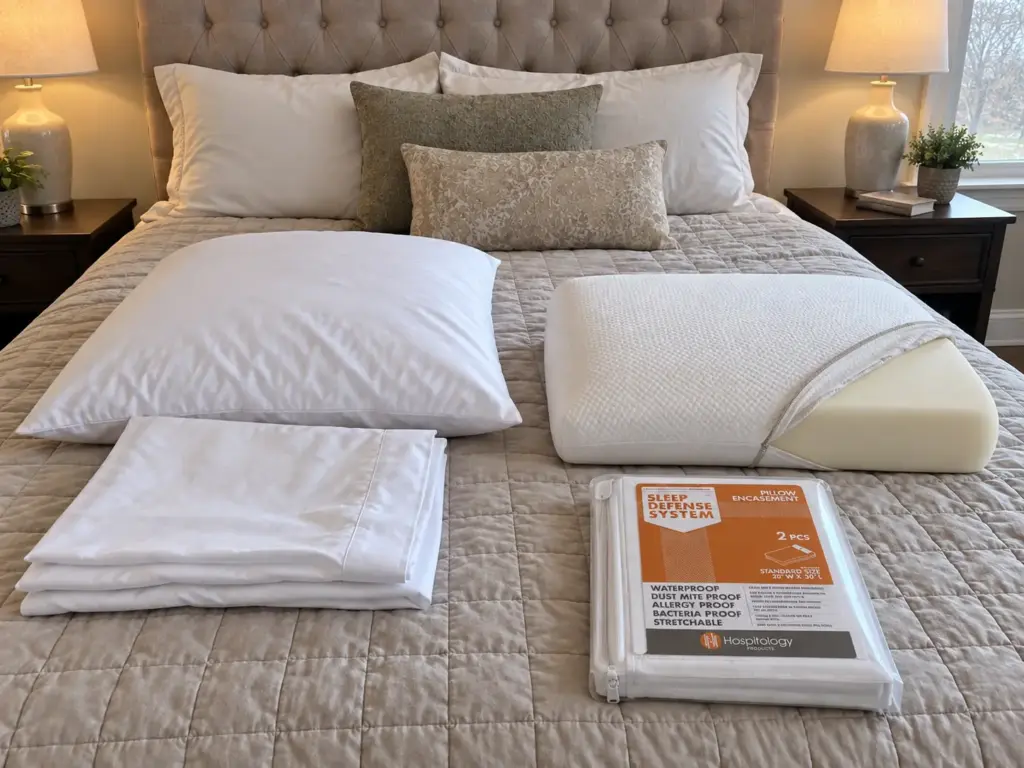
Foam is the first exception, and it has no middle setting. A memory foam pillow or a mattress topper with a foam core cannot be submerged or machine washed. The agitation tears the foam structure apart from the inside, and the heat that makes the wash work is the same heat that deforms the foam permanently. A gentle cycle does not get you halfway there; it just wets the foam and leaves it wet for two days. The cycle that saves the sheets is exactly the cycle foam cannot take, which is why a foam pillow needs its own decision rather than a spot in the laundry queue.
Dry-clean only is the second, and the label is the authority. The EPA’s own wording already carves this out when it limits the heat treatment to items that can withstand a hot dryer. What it never does is say which items those are, and that silence is the whole reason people stand in a doorway holding a wool blanket wondering what to do with it. If the label says dry clean only, it means the fabric will not come back from 140°F and 30 minutes on high, and no amount of wanting it to will change that.
Now the money, which is where most guides go quiet. An infestation is a legitimate forcing function on gear that was already finished. If that pillow flattened out a year ago and you have been folding it in half under your head to get any loft out of it, this is the moment it goes, and saying so out loud is a real answer rather than a dodge. The judgment about whether the pillow was already finished has nothing to do with bugs and everything to do with fill life that ran out a while ago.
The distinction matters, though, and it is the whole ethic of this section: it goes because it was due, never because bed bugs mean throwing things out.
Because that instinct is expensive, and the EPA says so plainly. According to the agency’s bed bug guidance, “Don’t throw out all of your things because most of them can be treated and saved” — it lists the cost, the stress, and the fact that dragging infested belongings to a curb moves the problem into somebody else’s home.
The forums are full of what happens when the panic wins anyway. One poster on that same AnandTech thread got rid of everything he owned when he moved out of an infested building. A woman posting to r/Bedbugs threw out her own mattress and her girlfriend’s on the same day an exterminator had told her to keep sleeping in the bed and wash a few clothes, then came back days later to ask strangers whether she had overreacted. Nobody in either thread regretted washing too much.
So for the foam pillow you have decided to keep, the answer is a barrier rather than a wash. A zippered pillow encasement seals the whole pillow behind a real zipper and a waterproof backing, which handles what the washer cannot reach, and its flaw is exactly what that backing implies: it does not breathe the way a knit protector does, and if you sleep warm you will feel it through the pillowcase.
The cheaper honest version of the same job is a jersey-knit protector in a four-pack, which breathes better and costs a fraction per pillow, and gives up the waterproofing in exchange. A Quora commenter arguing about encasement pricing called the premium tier a nasty cash grab next to basic zippered ones he had bought for a few dollars, and on the sealing question he is not wrong. A cheap zippered encasement that actually closes all the way around does this job.
The mattress is the one thing this section deliberately does not tell you to throw out, and it is the single most expensive object in the room. It stays, and it gets encased. That is the last section.
Don’t Buy Anything New Yet
This is the part every checklist buries around item thirty, and it is the one decision in the whole situation that costs real money to get wrong.

The rule, plainly: no new mattress, no new bedding, no new furniture until the infestation is eliminated. Purdue’s extension entomology guidance states it flatly, and the logic is almost insultingly simple once somebody says it out loud. A brand new mattress delivered into a room that is still mid-treatment is exactly as infestable as the old one was. The sheet set you order tonight is a fresh sheet set in the same room. You spend the money and then you spend it again.
The reason nobody sees this rule is that it lives inside a forty-item pre-treatment checklist as line thirty-one, somewhere between where to move the nightstand and how to label the bags. The person most at risk of breaking it is the person doing everything else right, working down the list at eleven at night with a cart already open in another tab because they cannot face sleeping on the old mattress one more week. That is not a shopping impulse worth shaming. It just has to wait.
Keep sleeping in the bed. Moving to the sofa feels like the cautious move and it is the opposite: you carry the problem into a second room and give it a second place to settle, and the living room has no encasement on it. The treated, encased bed with washed bedding on it is the most controlled surface in the apartment.
So who decides that it is over? Not you, lying in the bed listening. The licensed exterminator decides, on evidence. Cornell’s integrated pest management program is blunt about why: a bite confirms nothing in either direction, because reactions vary enormously and some people never react at all, so an inspection needs an actual bed bug rather than a mark on skin.
That cuts both ways, which is the part worth sitting with. Clear skin does not mean the treatment worked, and a fresh mark does not mean it failed.
Anything on your skin that worries you goes to a doctor, and it is not a bedding question. Whether the treatment is finished goes to the operator with the flashlight, and it is not one either.
And there is a reason to be strict about it rather than optimistic. Another r/Bedbugs poster described doing every single thing correctly, bagging everything, washing at 140°F, running the full dryer cycle, even discarding the mattresses, and still finding live bugs a month after a professional treatment. Doing it right does not guarantee it is over on your schedule. It only means that when it is over, you still own your things.
In the meantime the bed stays made. Washed bedding goes straight back on, the mattress goes under a cover, and you carry on as normally as this allows. When you want the general version of this judgment rather than the crisis version, the four checks that decide when any set is finished are the ones that apply on an ordinary Tuesday with nothing wrong.
The Encasement Year, and What to Check When It Comes Off
The mattress that stayed is not simply back to normal. It is under warranty of a sort, and the warranty has a zipper and a twelve-month clock.
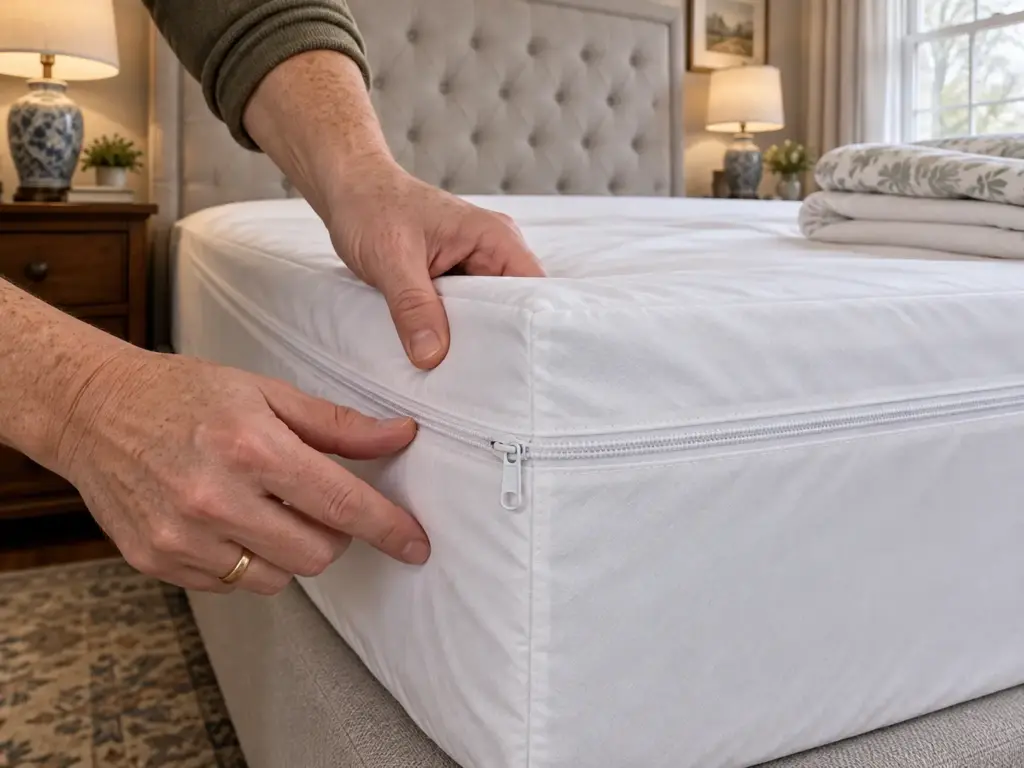
What the cover is doing over that year is starvation, and the EPA’s top-ten list for bed bug control frames it exactly that way rather than as an instant fix. Anything sealed inside cannot get out to feed, and over a long enough stretch that settles itself. The same goes for the box spring underneath, which gets its own cover for the same reason.
This is worth saying because the cover looks like it did nothing on day one and people take it off in week three, disappointed. It was never a same-week product. The year is the product.
Which means the zipper and the seams are the entire thing you are buying. A cover that closes completely around all six sides and stays sturdy for twelve months is doing the whole job; one that splits at a seam in month three quietly restarts the clock on the mattress underneath it, and nobody notices for weeks, which is how a quiet re-infestation starts in a room everybody had stopped worrying about.
This is why “bed bug proof” has to mean a full six-sided seal with a real zipper, not a fitted-style protector with elastic corners that leaves the underside open. The bed frame is a separate job and a separate article; the mattress is the one you are deciding about tonight. An elastic protector is a laundry item. An encasement is a container.
On that criterion, a zippered waterproof mattress encasement with a stated six-sided seal and a 12-inch pocket is the honest version, because it declares the bed bug rating outright instead of hiding behind the word protector. Its flaw is the one the EPA writes into its own instructions: it has to be checked for tears, periodically and not once. The seam near the head of the bed takes the most stress, and the run of fabric where the zipper pull has been worked back and forth is the second place to look. A zipper that stops closing all the way is not a small annoyance, it restarts the whole year.
A new encasement crackles. The laminated backing is audible under the fitted sheet for the first few weeks, loudest when somebody rolls over at night, and it quiets down as the material relaxes and warms to the bed. That noise is the lamination doing its job, not a defect, and people return perfectly good covers over it in the first fortnight.
When the year is up and the cover comes off, look for tears and nothing else. Not for fabric that has somehow expired: no source describes an encasement degrading on a timeline, and inventing one would just give you a reason to buy something. It is intact or it is torn, and the mattress inside is the same mattress it was when it went in.
The sheets are a different story, and it is the quiet cost of all this. Those surviving sets have just been through a run of 140°F washes and full high-heat dryer cycles that nobody bought them for. Hot water swells and stresses cotton fiber, a hard dry finishes the job, and the two of them together age a set faster than any amount of ordinary warm-and-tumble. It does not show up as damage the week it happens.
It shows up months later as thinning through the middle of the fitted sheet and pilling that arrives earlier than it should, which is the argument for a set’s life being counted in washes rather than years in the first place. This episode just spent a lot of them at once.
What to Do Tonight, and What to Look at in a Year
Nearly all of it survives, and that is the headline.
Run 140°F in the washer and a full 30 minutes on high in the dryer, and treat the dryer as the half that finishes the job rather than a courtesy afterward. Foam cores and dry-clean-only labels are the only two real exceptions, and if something does end up in the trash it goes because it was already finished, not because bed bugs mean throwing things out. And nothing new comes into the house until the professional with the flashlight says the treatment is done. That call is theirs, not yours, and definitely not the bed’s.
A season from now, go back and look at the hems and the high-contact middle of the fitted sheet before the thinning surprises you. Those sets just aged faster than the calendar says they did, and they will tell you so if you check.
Tonight: strip the bed, bag what comes off on the way to the machine, knot the bag, and run it hot. Then leave the shopping alone.
Frequently Asked Questions
01Should I throw everything away after bed bugs?
No. Most of it survives a 140°F wash and a full 30 minutes in a high-heat dryer, and the EPA argues specifically against mass disposal. The only real exceptions are items with a foam core and anything labeled dry-clean only.
02Should I throw out my pillows after bed bugs?
A washable pillow goes through the same cycle as the sheets and comes back fine. A foam pillow cannot be washed at all, so it gets a zippered encasement instead — or it gets replaced, if the fill was already flat before any of this started.
03Do I have to throw out my clothes if I have bed bugs?
No, and the rule is the same as for bedding. Bag them sealed on the way to the machine, wash at 140°F, then dry on high for a full 30 minutes. Dry-clean-only pieces are the exception and need handling outside the machine.
04Will changing the sheets get rid of bed bugs?
No. Clean sheets on an untreated mattress and frame change nothing at all. The wash handles the fabric and only the fabric; the room itself is a separate job and belongs to whoever is treating it.
05How long should a mattress encasement stay on?
A year, which is the span the EPA specifies, because anything sealed inside starves over that stretch. Check it for tears while it is on, especially at the head-of-bed seam, and know that a split zipper restarts the clock.




Tried it on your own bed?
No comments yet. Tell us what you changed, and what the sheet did after a few washes.