







What’s in here6 sections
You are upright again for the first time in four days, standing over a bed you would rather not touch, with a laundry basket in one hand and the vague sense that some of this should go straight in the trash. The sheets do not agree. A cotton sheet has no idea it was slept in through a fever; all it knows is that it spent a hard week under a sleeper who barely moved off one spot, and that it is about to get washed hotter than it has been washed in months. That is a use question and a wear question, not a contamination one, and this page settles which pieces of that bed are simply dirty and which are actually finished. How to wash them is a separate page.
Quick Answer
Being sick is a wash trigger, not a replace trigger. It only becomes a replace trigger in three cases: a stain that survives a proper wash, an item the wash exposes as already worn out, or something that cannot be washed at all, like a foam pillow core. Everything else goes back on the bed.
Almost Everything You Slept In Is Just Laundry
The honest answer comes first and it is the dull one. Strip the bed, wash the lot, put it back on. The sheets, the pillowcases, the duvet cover, the mattress protector, the throw that ended up on the floor at some point: machine-washable goes in the machine and comes back out as bedding. Nearly nothing that was on that bed is finished, and the only reason this page runs past this paragraph is the short list of items where that is not true.
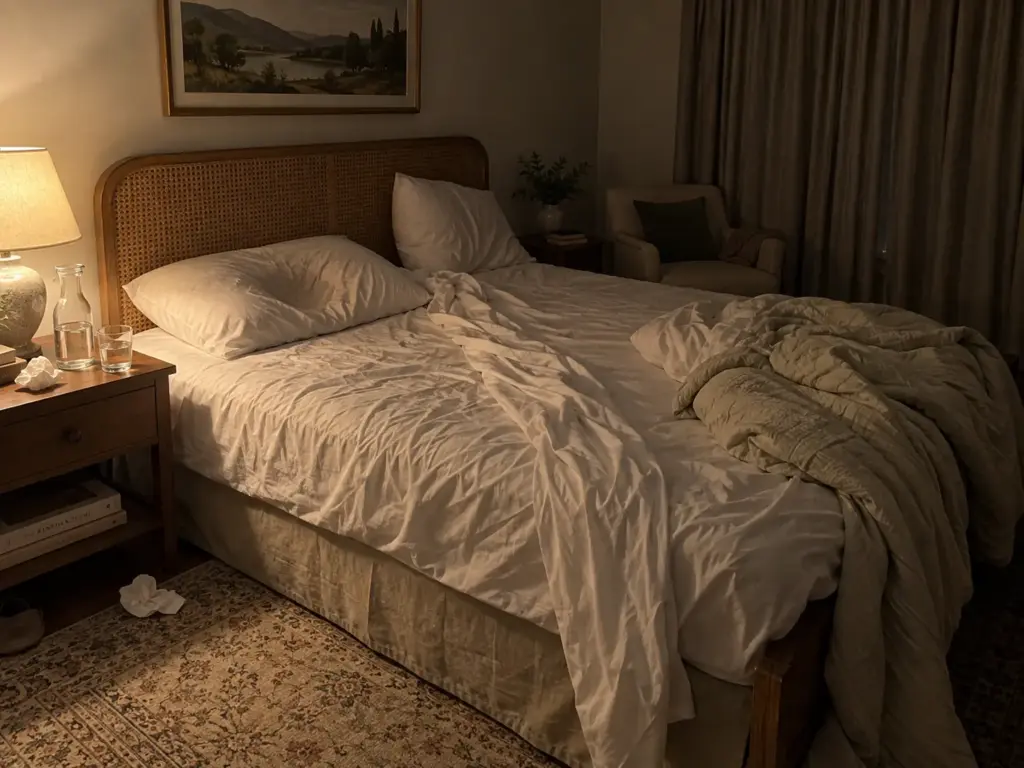
What most people actually arrive here carrying is not a laundry question at all. It is the worry that the bed is now going to make them sick a second time.
Whether that can happen is a medical question, and it belongs to your doctor, who knows what you actually had. This page stays on the bedding side of it. Wash the bed because it has four days of sweat in it and because you will sleep better on clean sheets. That reason is enough.
What an illness genuinely changes is not the cleanliness of the fabric, it is the use. Several days of lying in one position, sweating into one patch of one sheet, then one or two hot washes back to back to feel normal again. That is a hard week for a woven cotton, in the same ordinary way that any hard week is hard for it.
Friction and heat are what wear a sheet out, and an illness delivers a concentrated dose of both in a short stretch. It is not a new kind of damage. It is the usual kind, compressed.
So the question you are actually standing there asking is not is this contaminated. It is did the extra use, or that hot wash, finish something that was already close to finished. Those are two completely different questions with two completely different answers, and everything below is about the second one. This is also not the calendar question: how often sheets actually need replacing is measured in wash cycles, and a sick week is one unusual entry in that count, not a reset of it.
If only one of you was ill, only one side of the bed needs this scrutiny. Their pillow, their half of the fitted sheet, their pillow protector. A shared duvet cover gets washed anyway because it always does. The other half of the set is exactly as old as it was last week and does not need inspecting on somebody else’s account.
One exception belongs at the end of this section rather than inside it. Anything that cannot go in the machine at all is a different problem, and it is the one case where the decision in front of you is real. That is the pillow with a solid foam core, and the duvet insert with a care label you have never read. Those get their own section further down, because “just wash it” is not on the table for them.
The Four Checks, Run Once, After the Wash
There is already a test on this site for whether a sheet is done, and an illness does not need a fifth check invented for it. It needs the same four run now, on a wash you would otherwise not have thought twice about. The four checks are the light test, the elastic snap-back, the 48-hour smell, and stain survival, scored two-of-four: two failures is a replacement, one failure is a set you keep an eye on. That threshold is not new here and it does not move because somebody had the flu.
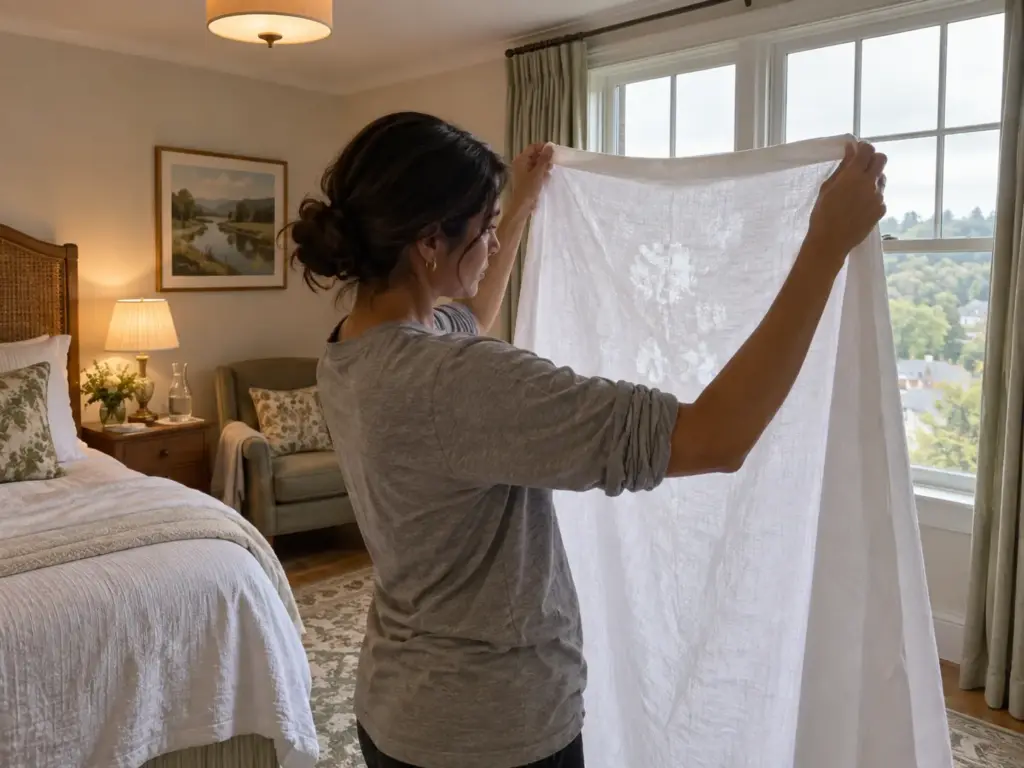
The part that matters for this article is when you run them. An illness is a non-calendar trigger: a reason to run the checks now rather than on a schedule. Not in the laundry basket, and not while the set is still damp and the whole thing smells of detergent. Wash it, dry it, put it back on the bed, and look at it the next morning in daylight.
There is nothing mystical in that; “run a controlled wash and then evaluate the result” is a real procedure with real parameters behind it, which is why the textile people maintain the standardized laundering conditions textile testers use so a wash result is reproducible. According to AATCC, “Reliable testing requires standard testing equipment and materials.” You do not have their machine. You do have the same principle: wash first, judge after, and judge the same way every time.
Stain survival is the check an illness actually triggers, and it is the simplest of the four. A mark that is still visible after a proper wash is a mark that is staying. At that point it has stopped being about the illness entirely and become an ordinary stain decision, the same one you would make about spilled coffee or a leaked pen.
Does it sit where a pillowcase covers it, or does it sit in the middle third of a flat sheet where you will look at it every night for the next two years? That is the whole question, and you are allowed to answer it on aesthetics.
Before you write a set off for one stain, there is a cheap thing worth trying, and it costs a fraction of a new set. An enzyme laundry booster is an unscented enzymatic powder made for exactly this job: the mark that a normal wash did not lift. One more cycle with a booster in it is a much smaller decision than buying sheets.
Its flaw is real, though. It is a powder, so it needs to dissolve properly before it touches fabric directly or it can leave pale marks on dark colors, and if the stain has already been through a dryer cycle the booster is arriving late.
If you would rather not measure a powder, OxiClean Odor Blasters is the liquid version of the same idea, though being oxygen-based rather than enzymatic it does less on the deeply set marks and works better as routine reinforcement than as a rescue.
The light test is the one everybody skips, and a hard week is exactly what exposes it. Hold the flat sheet up to a window and look through it. You are not hunting for holes; a hole announces itself and needs no article. You are looking for the middle third to glow evenly brighter than the hems, because thinning reads as brightness long before it reads as a tear. Four days of one sleeper barely shifting position is a lot of concentrated friction in one band of cloth, and if that band was already thin, this is the week you find out.
Elastic snap-back is where a hot wash tells the truth. Pull a fitted corner out and let it go: elastic with life in it pulls straight back, elastic that is finished stays stretched and slack in your hand. Tired elastic does not survive hot cycles gracefully, and the corner that used to snap onto the mattress and now needs a tug did not break during the illness. It broke earlier, quietly, and the hot wash simply finished the argument. This is the same failure the fitted-sheet article walks through in detail, because elastic, not age, is what finishes a fitted sheet on almost every set that ever gets thrown out.
Then the 48-hour smell test, which is the one that needs patience and the one most people get wrong. A set that comes out of the dryer smelling of nothing and turns sour two nights later has something living in the fiber that the wash did not reach, and that is a genuine end-of-life signal rather than an illness signal. It has nothing to do with being sick. It is what a fabric does when years of oils have built up in the yarn past the point a detergent can pull them back out.
The smell test only works on a bed that has actually been slept in for two nights. A freshly made bed in an empty room passes it every single time, which is precisely why so many people are convinced their set is fine. Sleep on it twice, then put your face in the pillowcase in the morning before you open a window.
And one thing this section is deliberately not going to do: name a temperature, a cycle or a detergent as instruction. How hot to wash a sick bed is a real question with a real answer, and it belongs to a different page than this one. What matters here is only that the wash happened properly and that you looked afterward.
The Things You Cannot Simply Wash
Everything above quietly assumed the item goes in a machine. The two things most likely to have taken the worst of an illness are the two most likely not to.
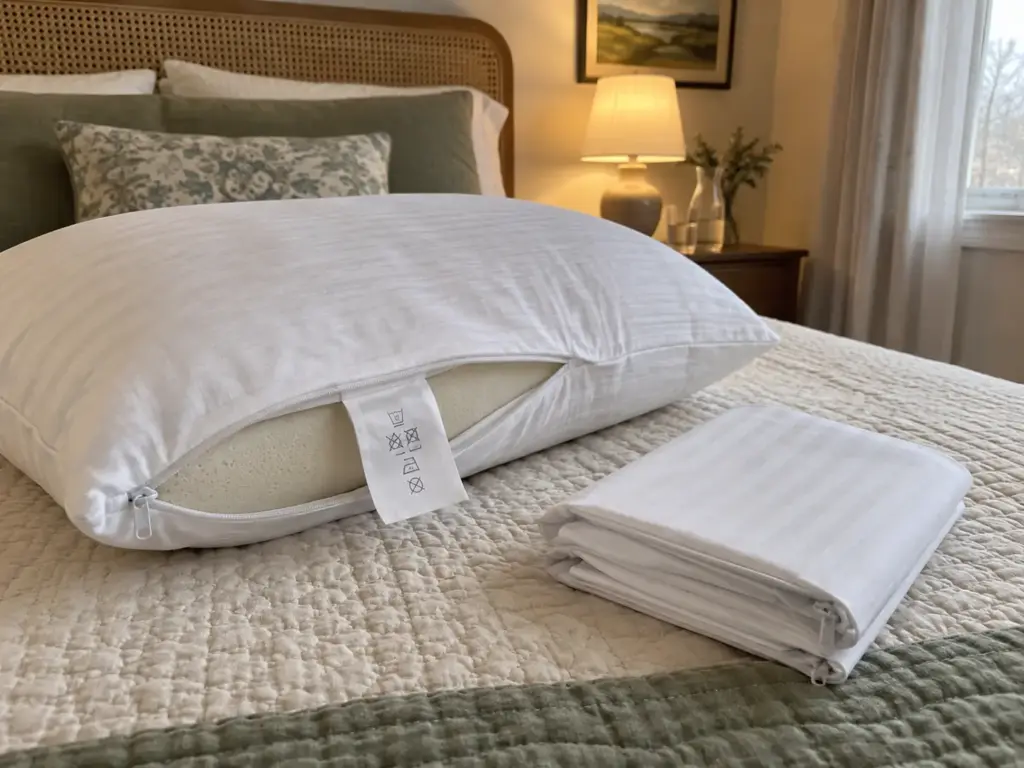
Start with the pillow, because it is the item you had your face against for four days and the one every checklist article skips. Check what it is before you check anything else. A polyester fill or a washable down pillow goes in the machine like a towel and this section does not apply to you.
A solid memory foam core is a different object. Foam pillow care labels typically restrict cleaning to spot-cleaning or a light surface hand-wash, because the core is not built for agitation or a full soak: the foam can crack under the mechanical stress, and water that gets trapped deep in it has nowhere to go and does not dry.
None of that is about the illness. It is a construction limit, printed by the people who made the thing.
So a foam pillow has a hard ceiling on what any wash can fix, and that ceiling is why this is the one item on the bed where an illness can genuinely end the decision. Not because it is contaminated. Because you cannot run the test.
Every other item on that bed gets washed and then judged; the foam core gets a damp cloth on the surface and a shrug. If it took the real brunt of a bad night and the case was not between it and you, no amount of looking at it afterward is going to tell you what you want to know, and that is why people replace it. Which is also the honest reason to know pillows go by fill, not by year before you are standing there at seven in the morning trying to decide.
The same logic applies, more weakly, to an unwashable insert — a duvet insert or a comforter you cannot put through a machine. Read the care label before you commit to a hot wash rather than after, because a hot wash an insert was never built for can be its own kind of ending: down clumps, some synthetic fills mat into flat ropes inside the baffles and never recover their loft. You would have traded a cleaning problem for a dead duvet. If the cover was on, and duvet covers exist for exactly this reason, the insert almost certainly never needed the wash in the first place.
A foam pillow that got damp inside and dried badly tells you about it later, not now. Weeks after the illness, when nobody is thinking about the illness any more, there is a faint musty note that shows up every time your head warms the pillow through and vanishes when it cools. That is trapped moisture from a soak the foam was never built to take, and it does not wash out because the wash is what caused it.
The fix that is not a purchase comes first, as always. Wash the pillowcase you already own with the rest of the load and put it straight back on, because a case between the sleeper and the core is what stops the next illness from ever reaching the foam. If the case is the only barrier the pillow has, a dedicated zippered layer under it is the thing worth adding from now on rather than a new pillow: a cotton pillow protector at 600 thread count, OEKO-TEX certified, zips shut around the core so that the washable part of the pillow is the only part that ever gets anything on it. Two flaws to state plainly: it comes in a four-pack whether you need four or not, and the zipper, quiet as it is, is still a ridge you can feel if you sleep face-down with your cheek on the pillow. This one is a from-now-on measure, not a remedy for the week you have just had.
When the Illness Just Showed You the Protector Was Done
One item on that bed exists specifically to absorb a week like this, and an illness is usually the first time in years anybody finds out whether theirs still works. Nobody inspects a mattress protector. It lives under the fitted sheet, it is the least-looked-at thing in the room, and its entire job is liquids, which means it is almost always the piece that quietly stopped working months ago without telling anyone.
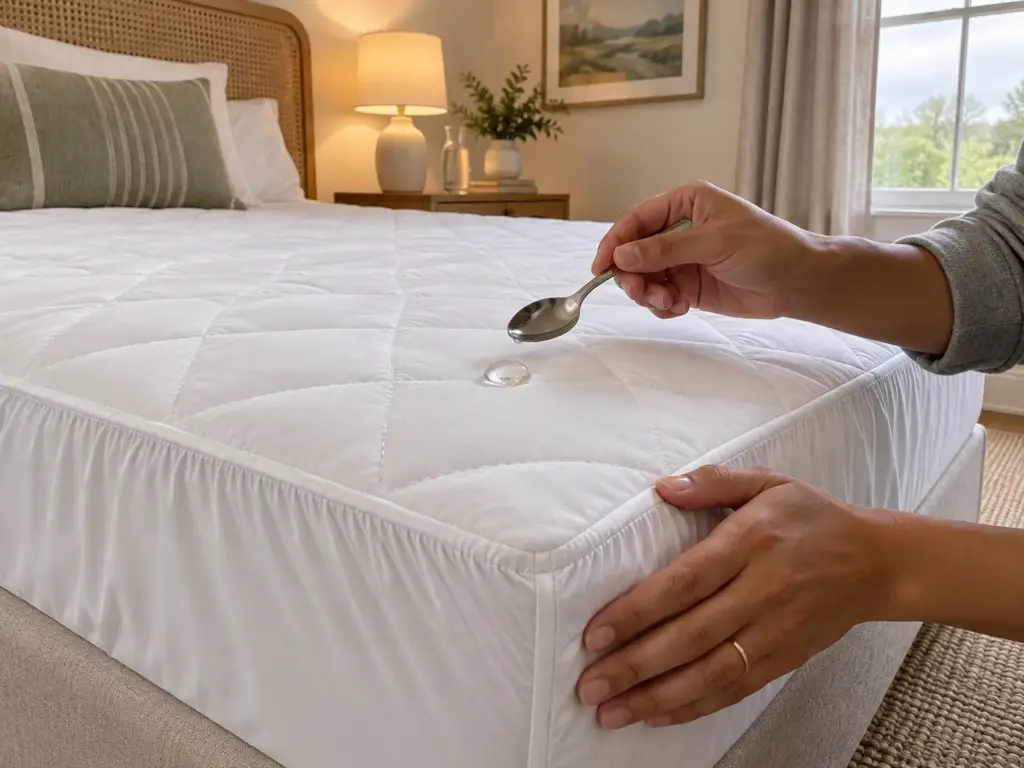
Its failure signs are specific, structural and checkable, and none of them are about age. This is the structural wear and cosmetic wear line that decides every replacement on this site, drawn on the one item nobody looks at. Corners that have lost their snap-back, the same test you just ran on the fitted sheet. Seepage where liquid used to bead and roll off the face. And an odor that is still there after a proper wash, which is the 48-hour test again, one layer down. A protector can look perfectly presentable on the fabric face and fail all three, because the fabric face is not the part that does the work.
The part that does the work is the membrane, and the elastic, and those two are what wear out first regardless of how good the top looks. A waterproof protector’s rated working life runs roughly one to two years of regular use. That is not a long time, and almost nobody knows it, which is how you end up with a five-year-old protector on the bed that has been decorative since year two. The membrane is also the layer people quietly blame for the backing that traps night sweats, and it is worth knowing which kind you have for reasons that have nothing to do with being ill.
Here is the stress-test framing, stated plainly, because this section is carrying the whole thesis of the article in one item. If an illness wash is the first genuinely hot cycle a protector has ever had, that single wash can be what reveals the membrane or the elastic was already at the end of its life. The illness did not break it. It exposed it. Same wash, two possible verdicts, and which one you get depends entirely on the state the thing was in beforehand. That is the sentence to carry away from this page.
So check the one you own before you buy anything, because most people never have. Pull the corner and let it go. Put a tablespoon of water on the face and watch it: on a protector that still works it sits there in a bead you can tip off into the sink, and on one that is finished it goes dark and flat inside a minute, and the fabric underneath feels cool against the back of your hand. That is a thirty-second test and it settles the question better than any amount of thinking about it will.
If it genuinely fails those checks, replacing it is worth doing properly rather than grabbing whatever is nearest. The SafeRest waterproof protector uses an 80/20 cotton-polyester face over a 100 percent polyurethane laminate rather than vinyl, and that distinction is the spec that decides it: polyurethane is thinner, quieter and considerably less like sleeping on a tarp. It is not perfect. The laminate still has a faint plastic sound the first few nights until the washes soften it, and if the elastic on your old one had already gone slack before the illness, nothing about a hot wash was ever going to bring that back. That was gone before you got sick.
Wash It, Then Look at It Properly
Three things to take out of this. Strip the bed, wash it, and then look at it in daylight, because the verdict comes after the wash and never in the laundry basket. Two of the four checks failing is a replacement and one is a set you simply keep an eye on. And the items that actually decide this are almost never the sheets you are worried about; they are the protector and the pillow, the two nobody ever inspects.
After a season of washes, run the elastic snap-back on the fitted sheet and the water-bead test on the protector on the same afternoon. They age on completely different clocks, and the protector usually loses first.
Strip the bed tonight and wash it. Put it back on, look at it once in the morning with the curtains open, and then decide. Most of the time the decision is that you have clean sheets. If it is not, what to do with the set once you have decided is the next thing to read.
Frequently Asked Questions
01Should I change my bed sheets after being sick?
Yes, but that is a laundry decision rather than a replacement one. Strip the bed once you are up and back to normal, wash the set, and judge it after it is clean and back on the bed.
02Do I need to throw away bedding after being sick?
Almost never. Washable bedding is dirty, not finished. The three exceptions are an item that fails the stain survival test, one already failing the two-of-four rule, and a foam core that cannot be washed at all.
03Can I get sick again from my own sheets?
Whether you can catch the same illness again from your own bedding is a question for your doctor, who knows what you had, not for a bedding page. The bedding answer is simpler: a normal wash is the reset, and the bed goes back on.
04What about a pillow I was sick on?
Check what the pillow is made of first. A washable fill goes in the machine like anything else. A memory foam core usually cannot be washed or soaked at all, and that limit, not the illness, is what makes replacing it a real decision.
05Does a mattress protector need replacing after an illness?
Only if it fails its own checks: corners that no longer snap back, liquid that soaks in instead of beading, or a smell that survives a wash. An illness often exposes a protector that was already at the end of its one-to-two-year life.





Tried it on your own bed?
No comments yet. Tell us what you changed, and what the sheet did after a few washes.