







What’s in here8 sections
- The Four Checks You Can Run Tonight
- What Each Check Is Actually Measuring
- Three Reasons to Replace That Have Nothing to Do With Age
- When It’s Fixable and You Should Not Replace Anything
- Two People, One Bed, Uneven Wear
- The Verdict, and What to Buy Only If You Scored Two
- Four Minutes Tonight Beats Any Number of Years
- Frequently Asked Questions
You pull the sheet up at eleven and something about it is wrong. Nothing tore, nothing stained, nothing you could point at — it just does not feel the way it felt the first month, and it has not for a while.
The reason a sheet can look fine and feel finished is that a woven fabric wears from the inside out: in a plain weave every yarn is locked over-under-over, and when those yarns start snapping under friction the surface is the last place it shows. So the eye keeps voting “fine” while the hand keeps voting “done.” Here are four checks you can run tonight without buying anything, a scoring rule that turns them into a verdict, the three reasons to replace that have nothing to do with age, and what to do when the answer comes back “not yet.”
Quick Answer
There is no universal date. Budget blends are usually finished in one to two years, good cotton and linen run three to five or more, so test the set instead of counting birthdays.
- Hold it to a window: even thinning across the middle is a fail
- Tug the fitted corner: elastic that stays stretched is a fail
- Smell it 24 to 48 hours after a wash: odor back early is a fail
- Check the stains: one that survived a hot wash is set for good
- Two or more failures means the set is finished. One means a repair
The Four Checks You Can Run Tonight
Every list in the search results asks you to recognize signs. This one asks you to run tests, because a sign you can only recognize is a sign you can talk yourself out of at eleven at night, standing over a bed you now have to remake. Tests give an answer that does not move. These four take about four minutes, need nothing you do not own, and between them they cover the two ways a set dies: the fabric goes, or the hygiene goes.
Before any of it, one thing this article is deliberately not going to lead with: a number of years. If you want the ranges by fiber and fill, the numbers each fabric actually runs to are worth having in your head as background. But a calendar tells you what an average set does under an average wash load, and yours is neither. The bed in front of you can answer better than the receipt can.
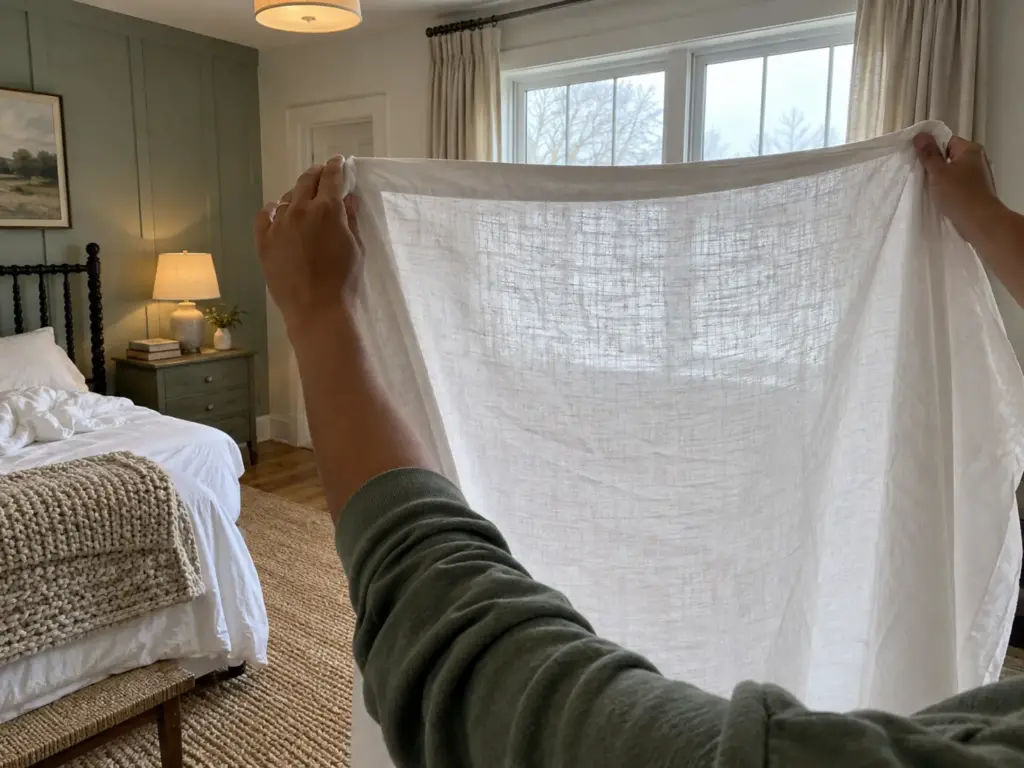
Check one, the window/light test. Strip the flat sheet off, take it to a window or hold it under a bare bulb, and look through it. You are not looking for holes. Holes are an easy verdict nobody needs an article for. You are looking for even thinning across the middle third, the band where a sleeper lies. One thin patch where a heel has been parking for two years is ordinary local wear and not a verdict on the whole sheet. A middle third that glows evenly brighter than the hems is the fabric telling you there is measurably less yarn left in it than there was.
The light check only works with the sheet off the bed and held up. Looked at while it lies on the mattress, the pale surface underneath fills in every thin place, and a sheet one season from splitting reads as perfectly fine. That is the single reason most people are surprised by a tear.
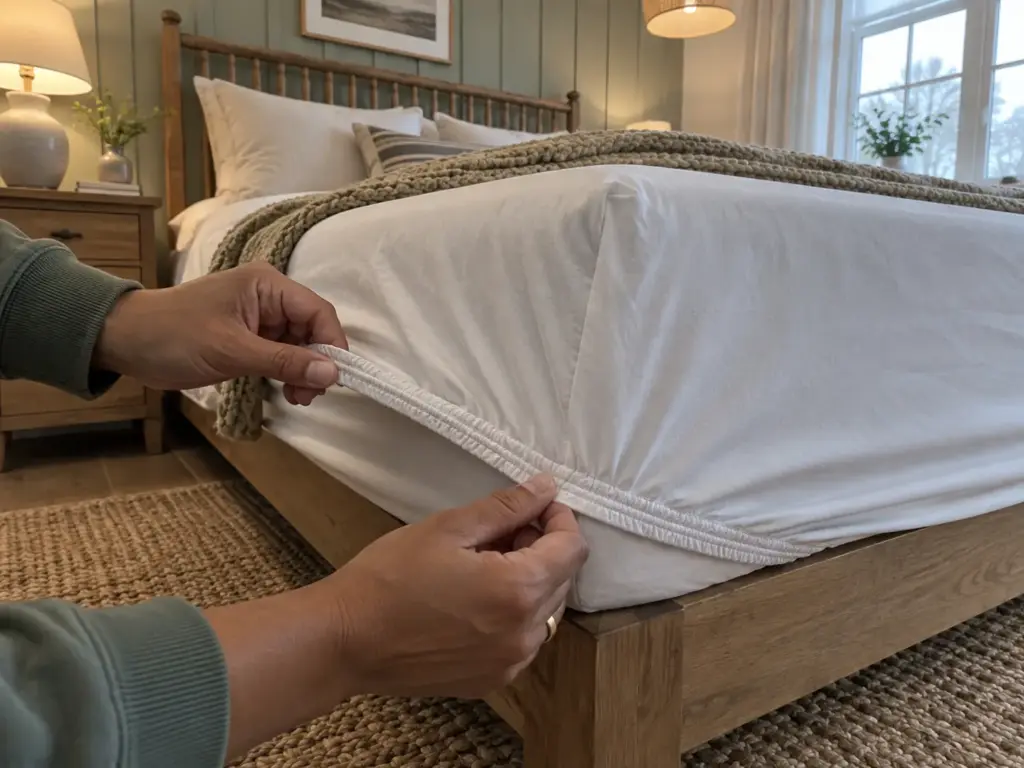
Check two, the snap-back test. Find a corner of the fitted sheet, pull the elastic casing out a few inches, and let go. It should pull back to roughly the shape it was resting in. Casing that stays where you left it, or that has gone hard and wavy like a dried rubber band, has failed, and it has failed permanently. Elastane starts losing recovery under sustained heat above 40 °C, and at 60 °C, which is an ordinary “warm” household wash, the hard segments inside the polymer soften and stop pulling back. Nothing restores that. Not a cold rinse, not a rest, not a gentler cycle from here on.
Check three, the smell test at 24 to 48 hours. A properly washed sheet should smell of nothing two nights in. Not of detergent, which fades by the second night and is supposed to. Of nothing. If an odor is back inside 48 hours on a sheet that genuinely went through a full wash, the fiber is holding something the wash can no longer reach. This is the check that decides a lot of sets and the one almost nobody formalizes. People describe it sideways: the phrase that keeps coming up in replacement threads is that the sheets are worn “from washing” or that “the washing doesn’t seem to clean them”, which is this check, said in the voice of somebody who has noticed the problem without naming it.
Check four, stain survival. Look at the stains that are already there. A mark that has been through a hot wash and is still in the same place at the same strength is set. It is not dirt any more; it is dye. Whether that matters is honestly a question about your bedroom, not about the fabric, and a set stain does nothing to how the sheet performs. Score it as a failure only if you would be embarrassed to have the bed seen.
Then the rule that makes the four tests worth running: one failure is a fabric with a flaw. Two or more is a set that is finished. One failure almost always has a repair, and the next-but-one section is about exactly that. Two means the thing is going in more than one direction at once, and repairing one of them just leaves you re-checking the other in a month.
That threshold is the whole reason this article exists. The way real people put it, they replace when sheets get “ratty,” and ratty is checks one and three happening together.
One warning about what does not count. A good half of what sends people shopping is cosmetic wear rather than structural wear, and the two look equally final at eleven at night. Fading, discoloration where a bottle of something spilled, a scratchy texture that arrived after a hot dry cycle, even fraying seams: none of those is on the list above, because none of them means there is less fabric than there was.
Seams are the clearest case, since a seam is thread failing and a seam can be sewn. Yellowing sits in its own strange middle, because yellowing that washes out is cosmetic and yellowing bonded into the fiber by skin oils and sunlight will not. The four checks measure structure and hygiene, which are the only two things a new set actually buys you.
Material changes the pace of all four, not the tests themselves. Microfiber and polyester pill early and hold odor after washing hardest, because the fiber is hydrophobic rather than hygroscopic: it does not take moisture into itself, so skin oil sits on the surface instead of washing out of it. Bamboo viscose is weakest wet, so it thins on the wash cycle rather than on the bed.
Long-staple and Egyptian cotton are the slowest to fail check one, and flannel goes fuzzy and then thin in a way that looks like wear long before it is. Run the same four tests either way. Just do not be surprised when a cheap polyester set fails check three at eighteen months and a linen one is still passing all four at eight years.
Two of the four depend on things a label controls before you ever wash the set. Staple length decides how many loose fiber ends are sticking out of each yarn from day one, and the weave decides how much of that yarn is exposed to rub, which is why Cotton Incorporated’s own fiber-and-weave education spends its time on those two and almost none on thread count. A long-staple cotton in a plain weave starts the race with less to lose.
What Each Check Is Actually Measuring
The four tests are fast because each one stands in for something slow and invisible. Knowing what that something is stops you re-running the test on a different corner, at a different hour, hoping for a kinder answer. You are not going to get one. Here is what is underneath each.
Thinning is broken yarn, not stretched fabric. Nothing about a worn sheet has been pulled thinner. Individual fibers snap under the friction of a sleeper moving on them, work loose from the twist of the yarn, and leave in the wash. The fabric goes translucent because there is physically less material between you and the light, and what a thin spot is at the yarn level is a count of missing fiber, not a measurement of tension.
Pilling and thinning are the same process photographed at two moments. Loose fiber ends tangle into balls on the surface first, then the balls shed and take the fiber with them for good. Pills are not lint arriving from elsewhere; they are your sheet leaving. If you want why it pills in the first place, the short answer is fiber length first and weave second, and that is as far as this article needs to go.
The weave sets the pace. Percale is a 1/1 plain weave: one over, one under, every yarn anchored on both sides, very little of any single yarn exposed at any point. Sateen floats four yarns over one, and those long exposed floats are what your shoulder rubs all night. Same cotton, same thread count, same wash, different aging speed, and the difference is not small. The float is also where the sheen comes from, which is the honest trade: sateen looks better and spends itself faster.
The elastic runs on its own clock and dies of heat rather than age. That is why a set can fail the snap-back check while the flat sheet is still immaculate. They were never on the same schedule. The flat sheet is aging by friction, the casing by temperature, and one hot summer of sanitizing cycles can put five years on a corner while doing almost nothing to the sheet beside it. If the corner is your only failure, reading a fitted sheet by its elastic rather than its age will get you further than any calendar.
The smell is bacteria bonded into the fiber, not sitting on it. That is the whole reason it comes back on a sheet you just washed: the cycle removed what was on the surface and left what is inside the yarn, and the next warm night rehydrates it. Whether a fabric survives repeated home laundering is measurable enough that AATCC keeps a named method for it, test 124, which grades how smooth a fabric still looks after repeated washing. The point is not the number. The point is that this is a property of the cloth, testable in a lab, and not a matter of whether you are using the right detergent.
The corner that goes first is almost always the same one: the foot corner on the side you strip the bed from. It gets dragged over the mattress edge every single wash day while the other three get lifted. Check that corner first. It is the set’s fastest clock, and it will fail months before its neighbors.
Three Reasons to Replace That Have Nothing to Do With Age
A set can pass all four checks on Saturday morning and need to come off the bed that same night. Three things reset the clock regardless of how the fabric reads, and the reason they deserve their own category is that most of the advice on this query silently assumes the only variable is time.
Illness changes the cadence, not usually the set. During a fever, through vomiting, with heavy sweating or any kind of skin drainage, sheets come off every few days rather than once a week, get washed hot, and go through the machine separately from the rest of the household’s laundry. That is a wash instruction, not a shopping instruction. The set you were sleeping on before the flu is almost always the set you go back to after it. What changed for a week was the frequency.
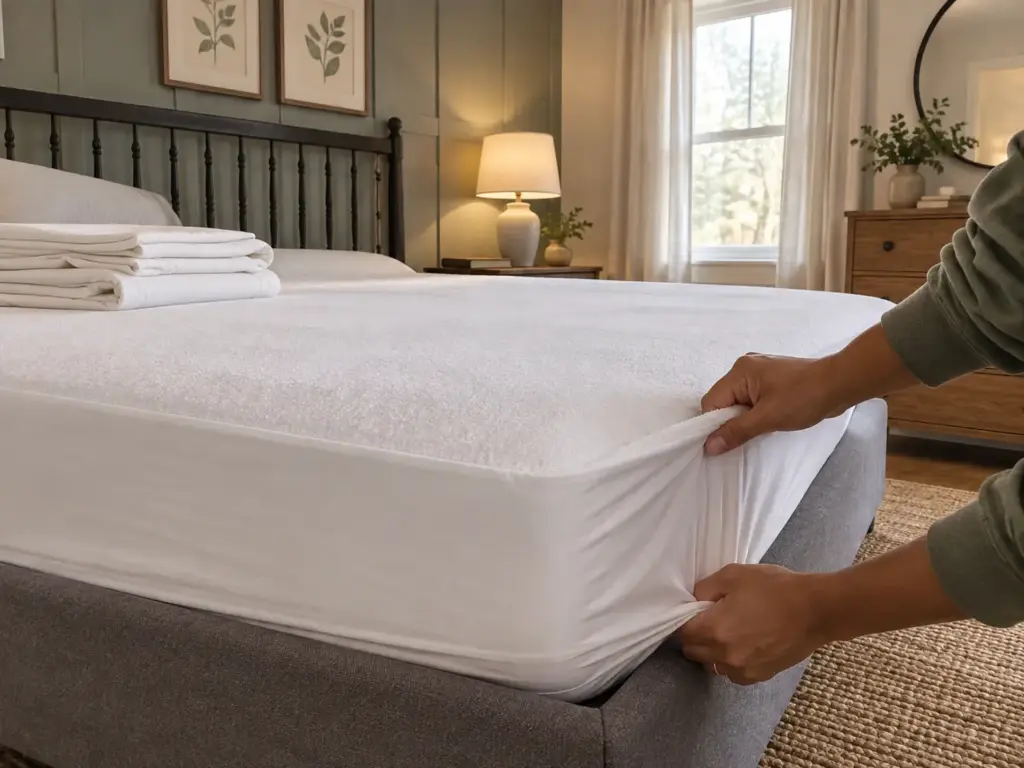
The fixable-first move for a household coming out of a rough week is to protect the layer that cannot be replaced cheaply. The Nestl Premium Cotton Terry Mattress Protector has a cotton terry face over a TPU waterproof backing, so it stops what gets through the sheet without being the vinyl raincoat that traps heat against you, though the TPU backing does crackle a little for the first few nights until a couple of washes soften it. It is the thing standing between a bad night and a mattress you cannot put in a machine.
Bed bugs are a wash-and-bag trigger, and the sequence matters more than the heat. The EPA’s own bed bug prep instructions are specific about the order: hot water for at least 30 minutes, and then high heat in the dryer for 30 minutes, because it is the dryer that finishes eggs and washing alone does not. Clean items then stay sealed in plastic until the infestation is actually resolved, which is the step people skip, because putting treated sheets straight back on an untreated bed undoes the whole afternoon. Notice what this is not: it is not automatically a reason to buy new sheets. Sheets that can take a hot wash and a hot dryer cycle come through it.
Odor that will not leave is the one on this list that genuinely means replace. If check three fails on a set that has had a proper hot wash, more hot washing is not going to reverse it, and hot washing is the thing that finishes the elastic. You end up trading a corner for a smell that comes back anyway. At that point the set has told you its answer twice.
And the boundary this article does not cross: if a skin reaction, a rash, or night sweats persist, that is a conversation with a doctor, not a fabric decision. Bedding can make a hot night worse and a good set can make it better, and what bedding can and cannot do about a hot night is a real, useful, entirely non-medical question. But it is not the thing to diagnose with, and no sheet on this page is a treatment for anything.
Underneath all of it, the other layers are running clocks of their own. The Asthma and Allergy Foundation of America’s dust-mite guidance says plainly: “Wash sheets, pillow cases and blankets weekly in hot, soapy water (130°F) to kill dust mites.” The same guidance puts pillows at roughly two years and mattresses at ten, and those intervals do not care at all how your sheets scored tonight.
The 60 °C cycle that feels like the responsible answer to a sick week is the same cycle that finishes the fitted sheet’s elastic. Run it while somebody is ill, absolutely. Then go back down to a warm wash the moment the house is well. Households that stay on sanitize find the corners letting go a month later and blame the age of the set.
When It’s Fixable and You Should Not Replace Anything
Two of the four checks fail in ways that have a repair, and the repair costs a fraction of a set. So the honest order is fix first, verdict second, which is the opposite of the order most pages on this question use, where the signs list runs straight into a shopping list. Replace versus repair is a real fork, and only two of the four checks put you on the repair side of it.
A popped corner is often a fit problem rather than a failure. Before blaming any elastic, measure the mattress with the topper on it, then add two inches. That is your minimum pocket depth. A 14-inch pocket on a 16-inch stack pops off every morning no matter how new the sheet is, and no amount of “extra-strong elastic” on the package invents the missing inches. If the corners let go on a set you bought six months ago, the elastic is almost certainly innocent.
If the casing genuinely is tired but the fabric still passes the light check, clips buy the set its remaining life for almost nothing. The GORILLA GRIP Fitted Bed Sheet Holders are elastic straps with metal clips that stretch to 25 inches and cover everything from a twin to a California king, and they fail honestly: they hold the corner down, they do not bring the elastic back, and the metal clip can mark or snag a fine fabric if you attach it with the sheet already on the bed instead of before you stretch it. Clip first, then fit.
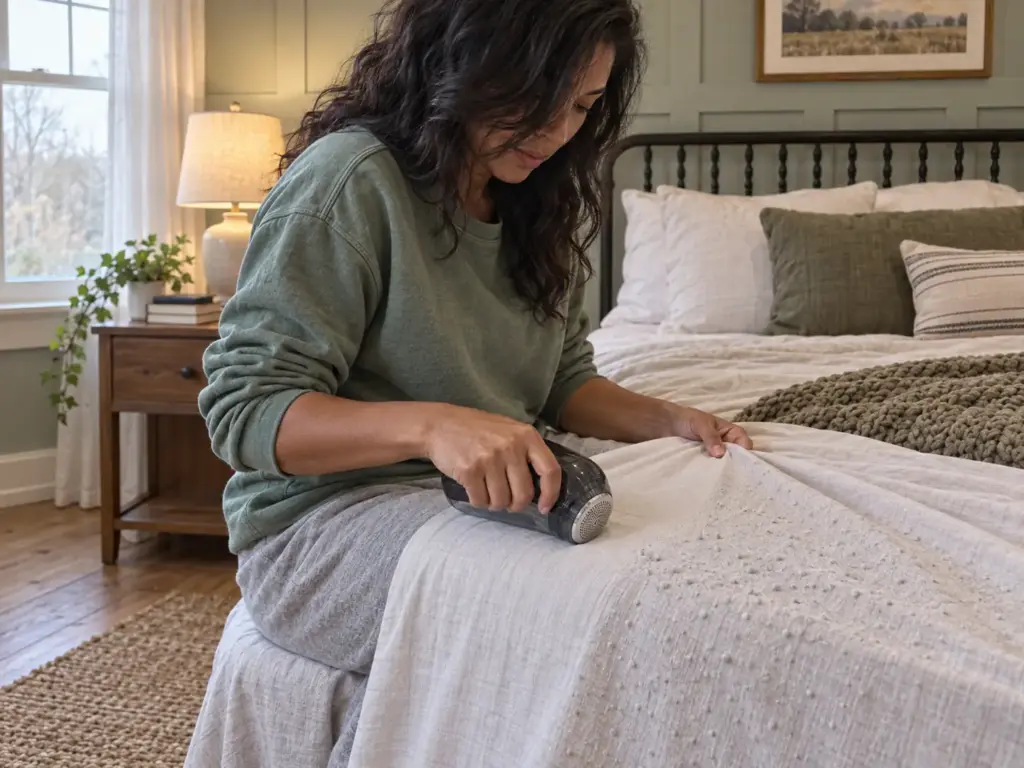
Shaving pills buys about a month, and it is worth knowing what you are trading. It works, the bed looks better within ten minutes, and what you are removing is the sheet’s own fiber, and every pass takes a little more of what is left. A Pionix Extra Power Fabric Shaver runs a 35W motor at 12,000 RPM, which is enough to take a pilled sheet back to flat in one session rather than four, and its flaw is written into the job: it is a patch, and the pills come back within weeks if the cause (short staple, long floats) is still in the cloth. That is the honest frame, and what shaving actually buys you does not change it.
| The check that failed | Fixable or finished | What the repair is |
|---|---|---|
| Corner will not stay on | Fixable | Measure mattress plus topper plus two inches; clip the corners if the pocket is right and the casing is tired |
| Pilling on the sleeping side | Fixable | Shave it. Buys roughly a month, and it is removing fabric each time |
| Even thinning at the light check | Finished | None. The yarn is gone, and nothing puts fiber back into a woven cloth |
| Odor back within 48 hours | Finished | None. Hotter washing does not reverse it and it finishes the elastic on the way |
Stop using fabric softener on anything with elastic in it. It leaves a waxy coating on the fiber, and that coating degrades spandex directly, so the bottle that makes your flat sheet feel nicer is quietly working against the corner you are about to blame. Chlorine is worse and faster: it breaks down the polyurethane outright. If you want the corners to last, the flat sheet has to go without the softener too, because they go through the machine together.
And the thing that outperforms all of the above: rotate two sets instead of wearing one. Reported cadences range from twice a week to once every four months, and the households that get the most years out of a set are not the ones washing most gently. They are the ones with a second set in the cupboard, halving the wash count on each. That’s it. No technique, no special cycle.
Two People, One Bed, Uneven Wear
A shared bed does not wear evenly, which means the four checks can pass on one side and fail on the other. Almost nobody checks both. One of you sleeps hot and sweats into the same square of fabric every night; the other barely moves between eleven and seven. After two years those are not the same cloth any more, and testing the sheet “as a sheet” averages away the only part that is failing.
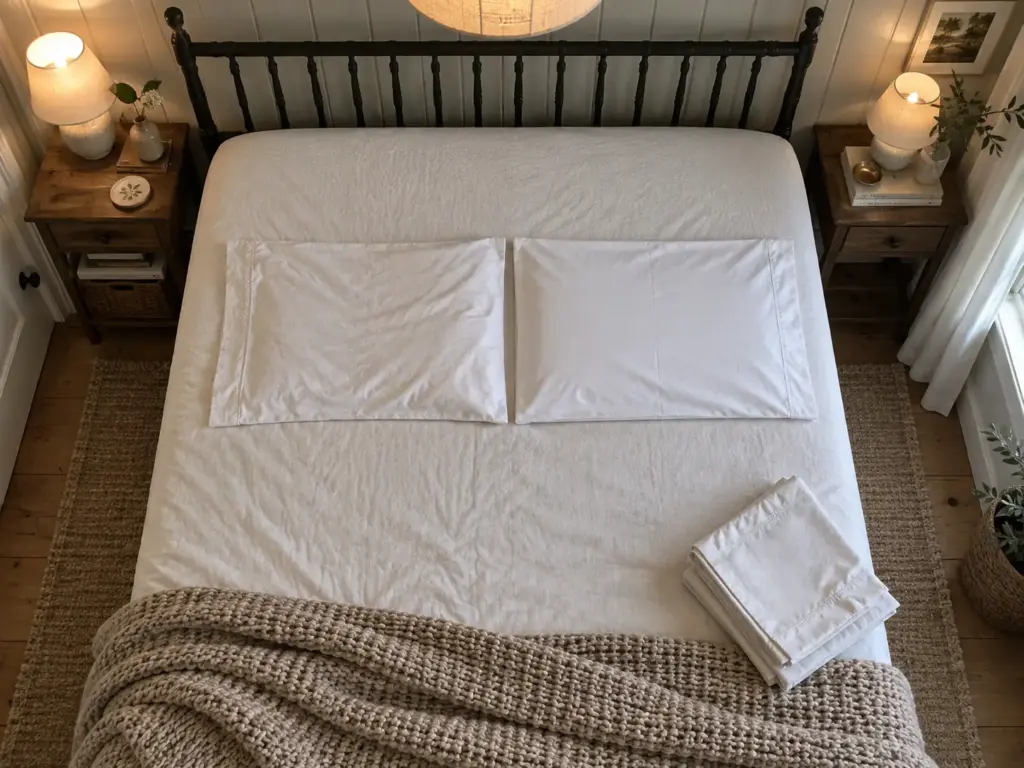
So run the light check on each side separately, holding up the half that belongs to one sleeper at a time. The thin place is where one specific person has been lying, and it will be off-center. Heat and moisture accelerate everything on that side: more sweat means more washing, and washing is the clock that actually runs. The warmer sleeper’s half of the bed is doing more laps than the other half of the same sheet.
A sheet failing on one side is still a failed sheet, and you cannot rotate your way out of it forever, though turning the flat sheet end for end genuinely does buy time, and costs nothing to try tonight. What you cannot do is move the fitted sheet, which is the piece most likely to be carrying the asymmetric load anyway.
The larger point is that the set does not share one clock. The fitted sheet, the flat sheet, the pillowcases and the duvet cover fail at different speeds under the same roof. There are four separate clocks in one bedding set, and the pillowcases almost always run out first because they take face oils every night and get washed hottest. And the pillow underneath has its own deadline regardless of what its case is doing.
Which makes replacing the piece that failed, rather than the whole set, the honest move, and it is the reason to keep one plain white set in rotation that matches everything you own. A mismatched pillowcase is a design problem. Buying three good pieces to replace one bad one is a money problem.
Run the light check on a pillowcase first. It is the same fabric from the same set living a harder version of the same life: hotter washes, face oils nightly, more friction per square inch. A pillowcase that fails the light check is showing you roughly where the flat sheet will be in a year, which makes it the cheapest early warning in the bed.
The Verdict, and What to Buy Only If You Scored Two
If two checks failed, the set is finished and the only question left is what replaces it, so the next one lasts longer than this one did. Read the scoring back plainly before you do anything: two or more failures, replace. One failure with a repair in the table above, fix it and re-run the checks in a month.

Replace versus repair, decided on the cloth rather than on a guess at the sheet lifespan. And zero failures means put it back on the bed and stop thinking about it.
What to look for on the next label is a short list, and it is mostly about what the label is willing to say. Stated fiber. Stated weave. Single-ply. Stated pocket depth. GSM if they print it, because grams per square meter is harder to fake than thread count, which is routinely inflated by twisting two thin yarns together and counting both, which gives you a denser, heavier, warmer sheet and a bigger number on the box. The same instinct applies to pilling: reading a label for pilling resistance is mostly about finding staple length and weave among the adjectives.
Long-staple cotton in a plain weave is the durability default. Fewer loose fiber ends per inch of yarn to work free, and no long exposed floats to abrade. It will not have the sheen or the weight of a sateen, and that is the trade you are making on purpose: you are buying the version that ages slowly rather than the version that photographs well.
As a worked example of that label rule, the Feather & Stitch 100% Cotton Percale Sheet Set states all four things this section just asked for: 100 percent cotton, percale (a genuine 1/1 plain weave), 300 thread count in single-ply yarn, and a 16-inch pocket. Its flaw is the direct consequence of that single-ply construction: it will never have the heavy hand of a multi-ply sateen, because it is a percale, and a percale is crisp and light rather than dense and draping. If that crispness is what you are after, the spec is doing exactly what it says.
Then buy the pocket depth for your actual stack, not for your mattress. Mattress plus topper plus two inches, measured, not guessed. This is the single most common reason a brand-new set gets blamed for bad elastic within a week of arriving.
And the old set is not finished being useful just because it is finished being a sheet. Disposal has a better answer than the bin for most of it: what to do with the set that just failed splits into the pieces you can donate, the ones a textile program will recycle, and the small remainder that genuinely has nowhere left to go. Worn cotton in particular has places that will take it in the state it is in.
Four Minutes Tonight Beats Any Number of Years
Run the four checks with the sheet off the bed and held up to the light. Two failures is the verdict, one is a repair, and the receipt is not evidence either way. Illness, bed bugs and an odor that survives a proper wash reset the clock regardless of how old the set is, and two of those three are wash problems wearing the costume of a buying problem. If you share the bed, check both sides separately and replace the piece that failed instead of the set around it.
When the next set has been through a season of washing, run the same light check on it. What you are looking for then is not damage: it is whether the middle third has started going translucent at a different rate from the hems. That gap is the whole difference between a set wearing in and a set wearing out, and it shows up long before anything tears.
Strip the bed tonight, hold the flat sheet to the window, and tug one corner. Four minutes, nothing to buy. Then decide.
Frequently Asked Questions
01How often are you supposed to replace bed sheets?
There is no single interval — budget blends run one to two years, good cotton and linen three to five or more. Wash count decides it, not the calendar. Run the four checks and replace on two failures.
02Is it okay to change your bed sheets every two weeks?
It is common, and it is a wash-frequency question rather than a replacement one. Weekly is the usual guidance, and the AAFA puts the hot-water figure at 130 °F. Rotating two sets makes a longer interval easier on the fabric.
03Why are people no longer using top sheets?
Mostly duvet-cover habits imported from Europe, where the cover gets washed like a sheet. It changes what wears out: with no flat sheet, the duvet cover takes the abrasion and becomes the piece that fails first.
04Do sheets need replacing if they still look fine?
Sometimes, yes. Odor that returns within 48 hours of a proper wash, and elastic that no longer snaps back, are both failures that leave the fabric looking untouched. Looking fine is one check out of four.
05Does washing sheets more often wear them out faster?
Yes, washing is the main clock — but temperature does more damage than frequency. Hot cycles finish the fitted sheet’s elastic permanently, so a weekly warm wash is gentler on a set than an occasional hot one.




Tried it on your own bed?
No comments yet. Tell us what you changed, and what the sheet did after a few washes.